light FORD F250 1998 Owner's Manual
[x] Cancel search | Manufacturer: FORD, Model Year: 1998, Model line: F250, Model: FORD F250 1998Pages: 219, PDF Size: 1.65 MB
Page 79 of 219
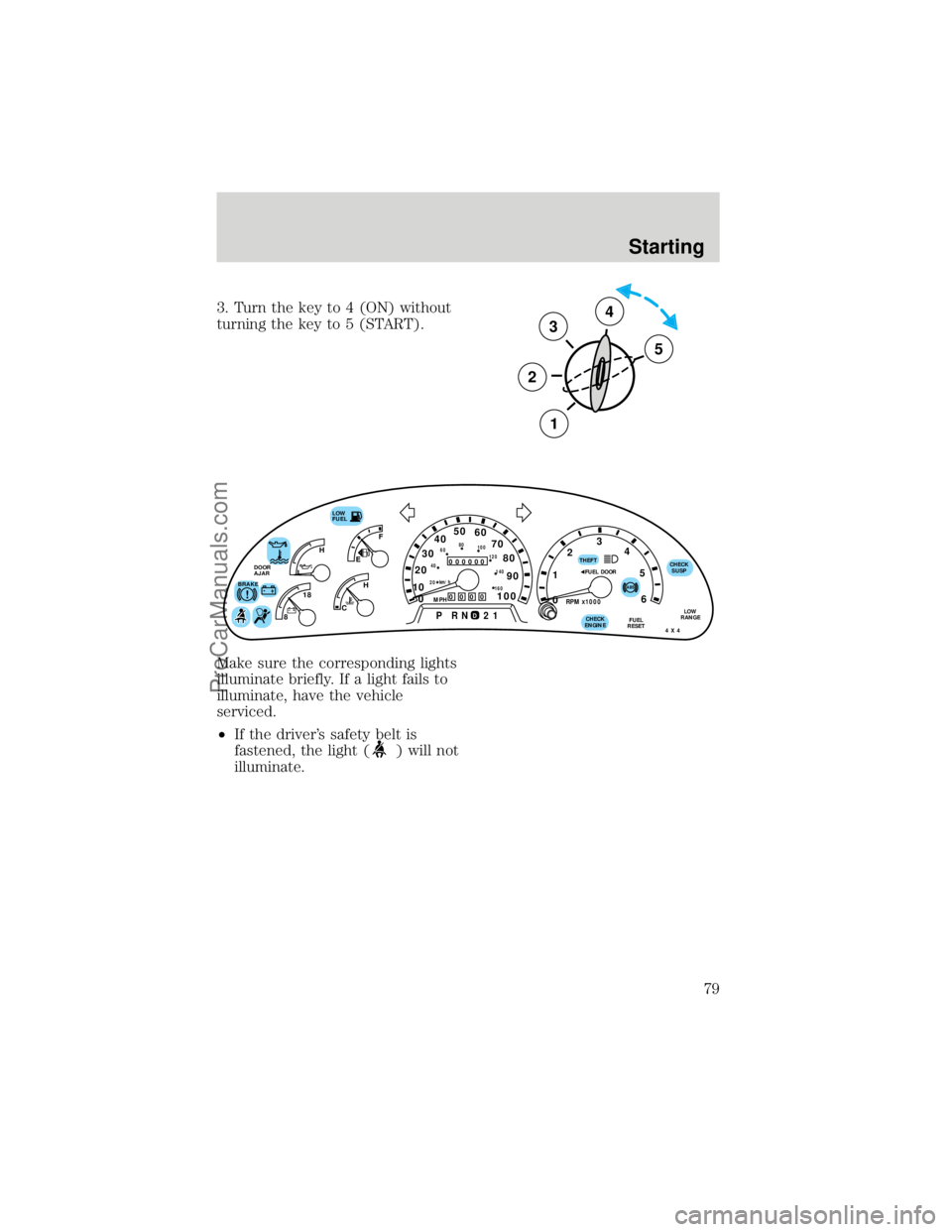
3. Turn the key to 4 (ON) without
turning the key to 5 (START).
Make sure the corresponding lights
illuminate briefly. If a light fails to
illuminate, have the vehicle
serviced.
²If the driver's safety belt is
fastened, the light (
) will not
illuminate.
3
2
1
5
4
LOW
FUEL
DOOR
AJAR
BRAKE
FUEL
RESET CHECK
ENGINELOW
RANGE
4 X 4
!ABS+ -
THEFTLEF
H0
0000
RPM1000X
00000
MPH
20km/h 406080
100
120
140
160
0
0 123
5
6 4
PRN 21
1020304050
60
70
80
90
100
8C 18
H
D
CHECK
SUSPFUEL DOOR
Starting
79
ProCarManuals.com
Page 84 of 219

shudder while braking, felt mainly
in the steering wheel, the vehicle
most likely needs service.
The ABS operates by detecting the
onset of wheel lock up during
brake applications and
compensating for this tendency.
The front wheels are prevented
from locking even when the brakes
are firmly applied. The
accompanying illustration depicts
the advantage of an ABS equipped
vehicle (on bottom) to a non-ABS
equipped vehicle (on top) during
hard braking.
ABS warning lamp
The
ABSwarning lamp in the
instrument cluster illuminates for
about five seconds when starting
the vehicle. If an ABS fault is
detected, the light will remain on
and your vehicle should be
serviced as soon as possible.
Normal braking is still effective
unless the BRAKE warning lamp is
also illuminated.
Using ABS
²In an emergency or when
maximum efficiency from the
ABS is required, apply
continuous full force on the
brake. The ABS will be activated
immediately, thus allowing you
to retain full steering control of
your vehicle and, providing
!
BRAKE
Driving
84
ProCarManuals.com
Page 89 of 219
is possible that a fuse has blown
and the vehicle's brakelamps may
not be operating properly. Refer to
Fuses and relaysin theRoadside
emergencieschapter.
Do not drive your vehicle
until you verify that the
brakelamps are working.
If your vehicle gets stuck in mud
or snow it may be rocked out by
shifting from forward and reverse
gears in a steady pattern. Press
lightly on the accelerator in each
gear.
Do not rock the vehicle for
more than a few minutes. The
transmission and tires may be
damaged or the engine may
overheat.
Always set the parking
brake fully and make sure
the gearshift is latched in P
(Park). Turn off the ignition
whenever you leave your vehicle.
Driving with a 4±speed
automatic transmission
Understanding gearshift
positions
Pull the gearshift lever towards
you and downward to move the
automatic gearshift.
Driving
89
ProCarManuals.com
Page 91 of 219
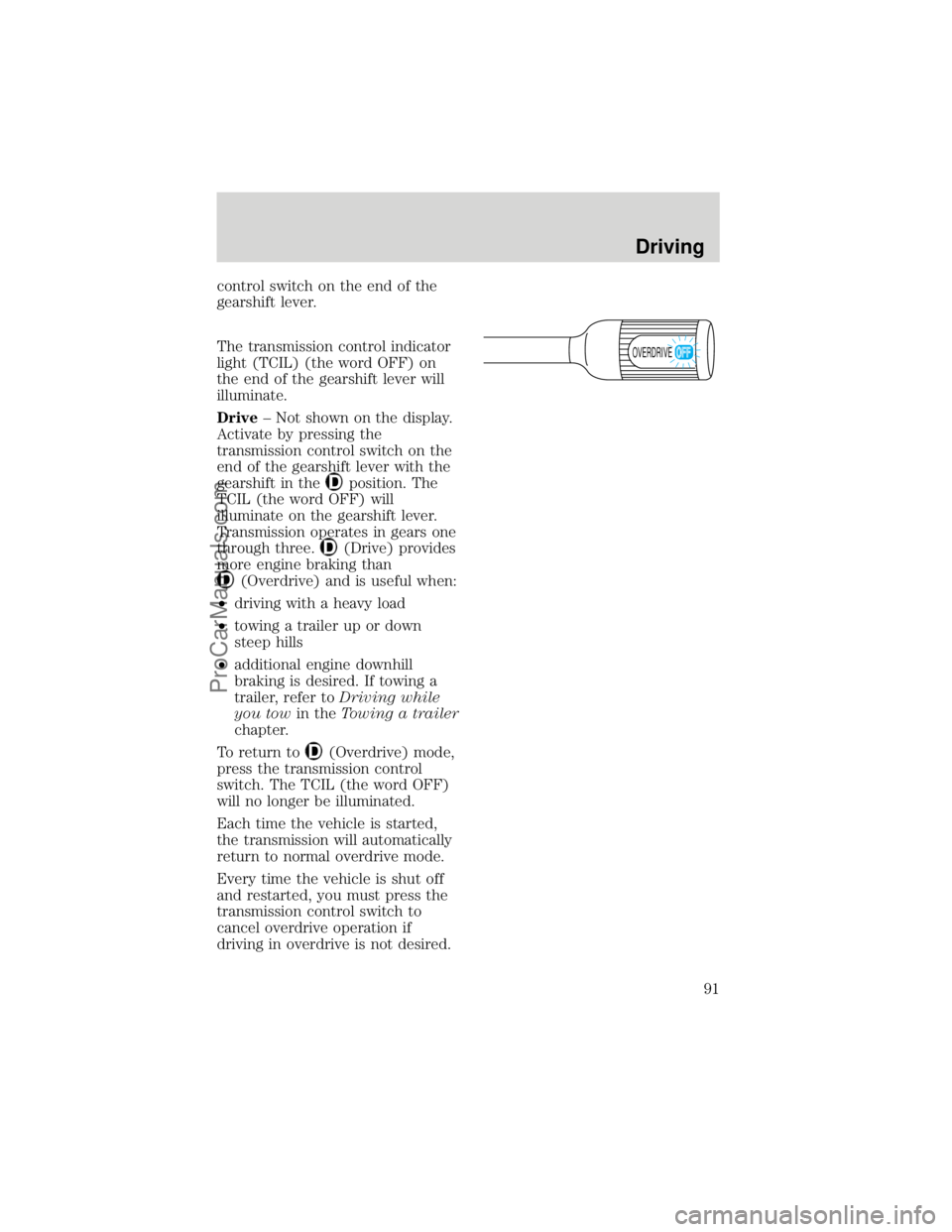
control switch on the end of the
gearshift lever.
The transmission control indicator
light (TCIL) (the word OFF) on
the end of the gearshift lever will
illuminate.
Drive± Not shown on the display.
Activate by pressing the
transmission control switch on the
end of the gearshift lever with the
gearshift in the
position. The
TCIL (the word OFF) will
illuminate on the gearshift lever.
Transmission operates in gears one
through three.
(Drive) provides
more engine braking than
(Overdrive) and is useful when:
²driving with a heavy load
²towing a trailer up or down
steep hills
²additional engine downhill
braking is desired. If towing a
trailer, refer toDriving while
you towin theTowing a trailer
chapter.
To return to
(Overdrive) mode,
press the transmission control
switch. The TCIL (the word OFF)
will no longer be illuminated.
Each time the vehicle is started,
the transmission will automatically
return to normal overdrive mode.
Every time the vehicle is shut off
and restarted, you must press the
transmission control switch to
cancel overdrive operation if
driving in overdrive is not desired.
OVERDRIVE
Driving
91
ProCarManuals.com
Page 99 of 219
Utility and four-wheel
drive vehicles arenot
designed for cornering at speeds
as high as passenger cars any
more than low-slung sports cars
are designed to perform
satisfactorily under off-road
conditions. Avoid sharp turns or
abrupt maneuvers in these
vehicles.
4WD operation is not
recommended on dry pavement.
Doing so could result in difficult
disengagement of the transfer
case, increased tire wear and
decreased fuel economy.
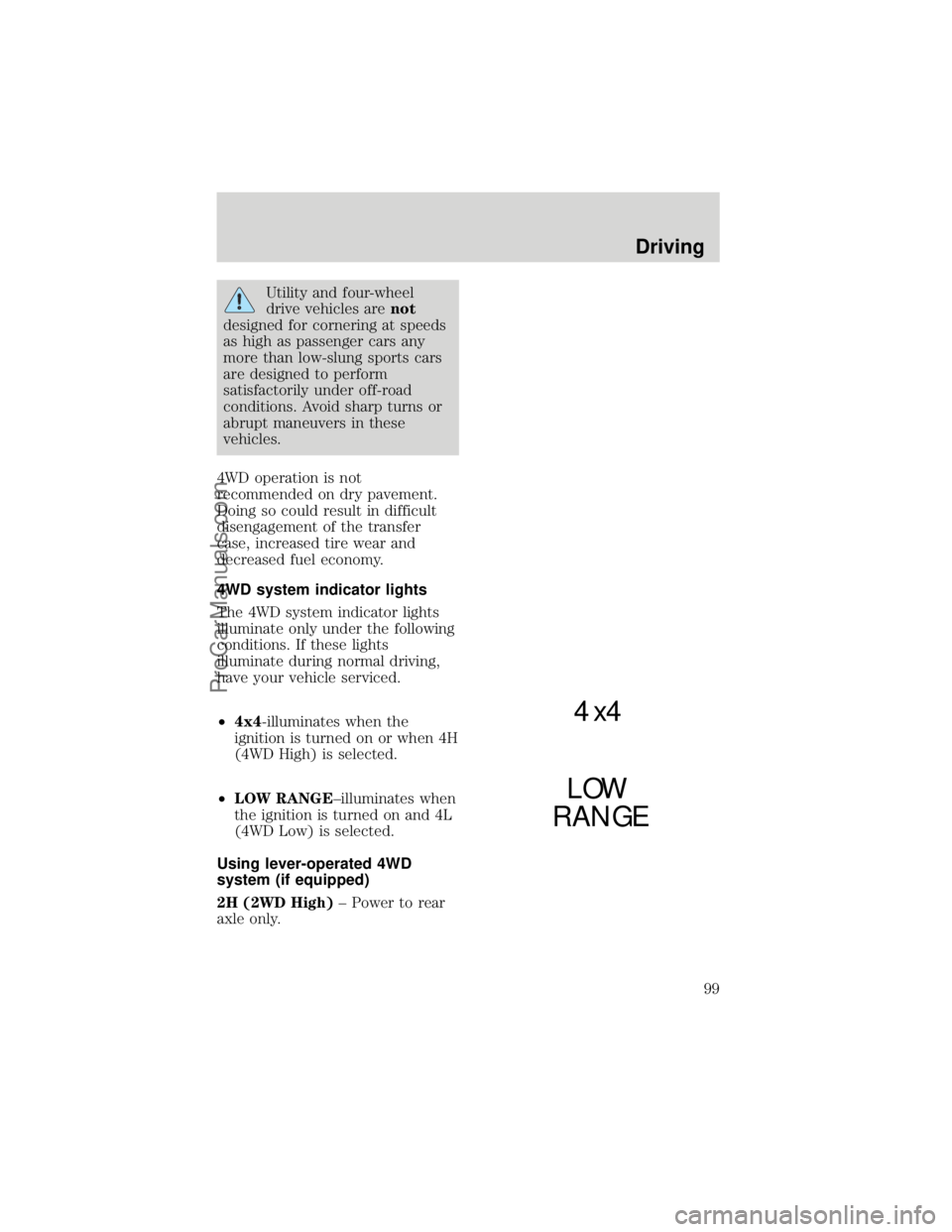
4WD system indicator lights
The 4WD system indicator lights
illuminate only under the following
conditions. If these lights
illuminate during normal driving,
have your vehicle serviced.
²4x4-illuminates when the
ignition is turned on or when 4H
(4WD High) is selected.
²LOW RANGE±illuminates when
the ignition is turned on and 4L
(4WD Low) is selected.
Using lever-operated 4WD
system (if equipped)
2H (2WD High)± Power to rear
axle only.
4x4
LOW
RANGE
Driving
99
ProCarManuals.com
Page 105 of 219
If your vehicle gets stuck
If the vehicle is stuck, shift the
transmission in a steady motion
between forward and reverse
gears. Allow the transmission to
engage, then press lightly on the
accelerator.
DO NOT rock the vehicle
for more than a few
minutes. The transmission and
tires may be damaged or the
engine can overheat.
Do not spin the wheels at
over 35 mph (55 km/h).
The tires may fail and injure a
passenger or bystander.
Sand
When driving over sand, try to
keep all four wheels on the most
solid area of the trail. Do not
reduce the tire pressures but shift
to a lower gear and drive steadily
through the terrain. Apply the
accelerator slowly and avoid
spinning the wheels.
Mud and water
If you must drive through high
water, drive slowly. Traction or
brake capability may be limited.
When driving through water,
determine the depth; avoid water
higher than the bottom of the hubs
(if possible) and proceed slowly. If
the ignition system gets wet, the
vehicle may stall.
Driving
105
ProCarManuals.com
Page 106 of 219
Once through water, always try the
brakes. Wet brakes do not stop the
vehicle as effectively as dry brakes.
Drying can be improved by moving
your vehicle slowly while applying
light pressure on the brake pedal.
After driving through mud, clean
off residue stuck to rotating
driveshafts and tires. Excess mud
stuck on tires and rotating
driveshafts causes an imbalance
that could damage drive
components.
If the transmission and transfer
case are submerged in water, their
fluids should be checked and
changed, if necessary.
Water intrusion into the
transmission may damage
the transmission.
If the rear axle is submerged in
water, the rear axle lubricant
should be checked and changed, if
necessary. The rear axle is filled
with a synthetic lubricant and does
not normally require a lubricant
change for the life of the vehicle.
Rear axle lubricant quantities
should not need to be checked
unless a leak is suspected.
Driving on hill or slope terrain
When driving on a hill, avoid
driving crosswise or turning on
steep slopes. You could lose
traction and slip sideways. Drive
straight up, straight down or avoid
the hill completely. Know the
conditions on the other side of a
Driving
106
ProCarManuals.com
Page 111 of 219

on the following charts. This is the
maximum trailer weight your
vehicle can tow and must fall
below the maximum shown under
maximum trailer weight on the
chart.
DRIVING THROUGH WATER
Do not drive quickly through
standing water, especially if the
depth is unknown. Traction or
brake capability may be limited
and if the ignition system gets wet,
your engine may stall. Water may
also enter your engine's air intake
and severely damage your engine.
If driving through deep or standing
water is unavoidable, proceed very
slowly. Never drive through water
that is higher than the bottom of
the hubs (truck)/wheel rims (car).
Once through the water, always try
the brakes. Wet brakes do not stop
the vehicle as effectively as dry
brakes. Drying can be improved by
moving your vehicle slowly while
applying light pressure on the
brake pedal.
Driving
111
ProCarManuals.com
Page 126 of 219

must not exceed the front
accessory reserve capacity.
²The total weight of the
snowplow and aftermarket
equipment must not exceed the
Total Accessory Reserve
Capacity.
²The weight of the installed
snowplow and aftermarket
equipment must not load the
vehicle beyond the GAWR
(front/rear) and GVWR listed on
the Safety Compliance
Certification Label.
²The total weight of the
snowplow and aftermarket
equipment must be considered
part of the payload and must
not exceed the Gross Combined
Weight Rating (GCWR) for
towing.
²Federal and most local
regulations require additional
exterior lamps for
snowplow-equipped vehicles.
Consult your dealer for
additional information.
²After installing a snowplow to
the vehicle, ensure the vehicle's
front toe alignment and front
ride height are within
specification (reset if required).
These specifications are located
in the vehicle's Workshop
Manual. Adherence to the toe,
tire pressures and ride height
specification is important for
proper tire wear, ride, handling
and headlight aim. Also,
Driving
126
ProCarManuals.com
Page 127 of 219

maintain the engine oil and
transmission fluid change
intervals.
Do not exceed the GVWR
or the GAWR specified on
the Safety Compliance
Certification Label.
Removing snowplow
Read the following instructions
before removing a snowplow:
²After removing a snowplow from
the vehicle, ensure the vehicle's
front toe alignment and front
ride height are within
specification (reset if required).
These specifications are located
in the vehicle's Workshop
Manual. Adherence to the toe
and ride height specification is
important for proper tire wear,
ride, handling and headlight aim.
Snowplowing with your air bag
equipped vehicle
Your vehicle is equipped with
driver and passenger air bags. The
air bags are designed to deploy in
a collision with a solid barrier at a
range of 13 to 23 km/h (8 to 14
mph) or a parked car at a range of
25 to 45 km/h (16 to 28 mph).
Careless or high speed driving
while plowing snow which results
in vehicle decelerations equivalent
Driving
127
ProCarManuals.com