lock FORD F250 1998 Owner's Manual
[x] Cancel search | Manufacturer: FORD, Model Year: 1998, Model line: F250, Model: FORD F250 1998Pages: 219, PDF Size: 1.65 MB
Page 73 of 219
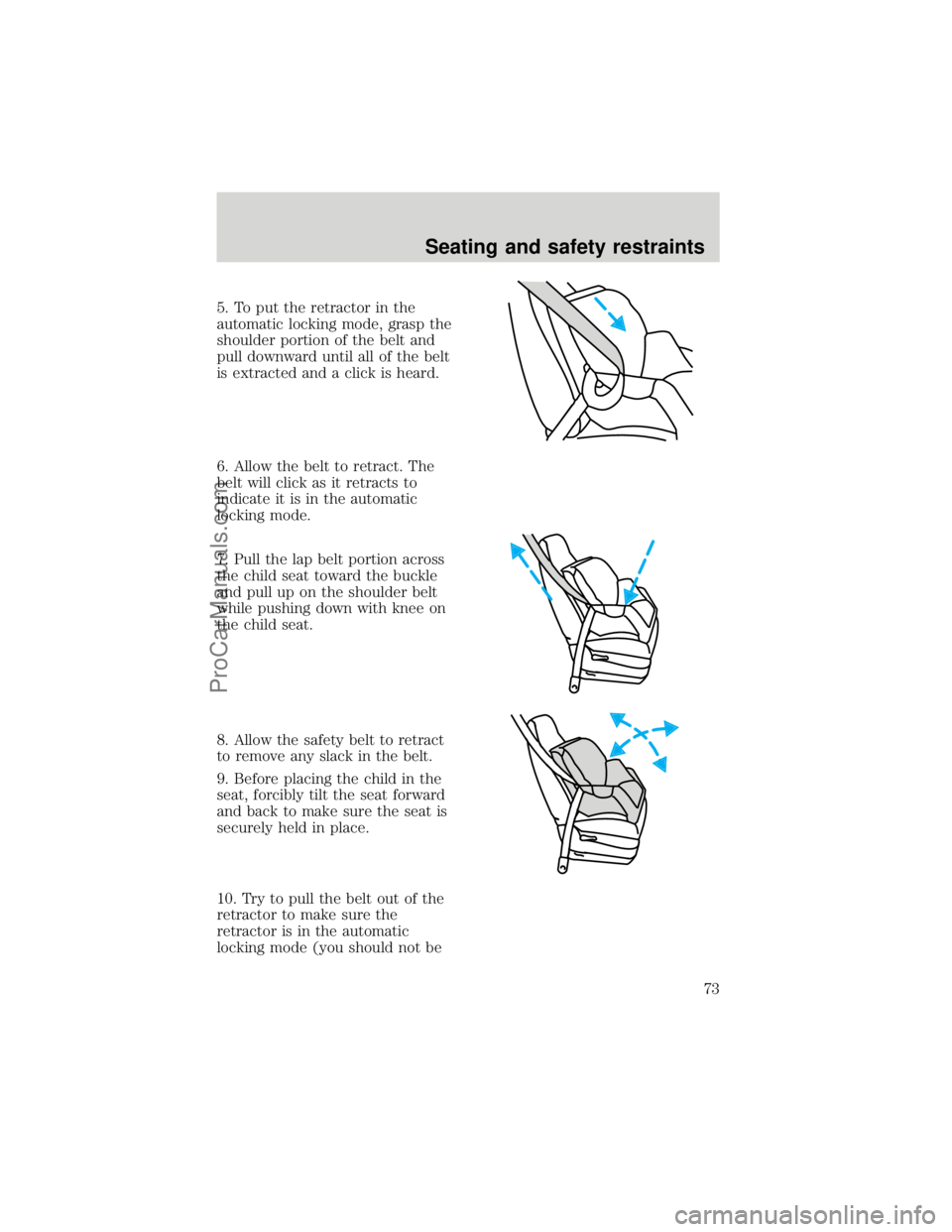
5. To put the retractor in the
automatic locking mode, grasp the
shoulder portion of the belt and
pull downward until all of the belt
is extracted and a click is heard.
6. Allow the belt to retract. The
belt will click as it retracts to
indicate it is in the automatic
locking mode.
7. Pull the lap belt portion across
the child seat toward the buckle
and pull up on the shoulder belt
while pushing down with knee on
the child seat.
8. Allow the safety belt to retract
to remove any slack in the belt.
9. Before placing the child in the
seat, forcibly tilt the seat forward
and back to make sure the seat is
securely held in place.
10. Try to pull the belt out of the
retractor to make sure the
retractor is in the automatic
locking mode (you should not be
Seating and safety restraints
73
ProCarManuals.com
Page 74 of 219

able to pull more belt out). If the
retractor is not locked, unbuckle
the belt and repeat steps two
through nine.
Check to make sure the child seat
is properly secured before each
use.
Attaching safety seats with
tether straps
Some manufacturers make safety
seats that include a tether strap
that goes over the back of the
vehicle seat and attaches to an
anchoring point. Other
manufacturers offer the tether
strap as an accessory. Contact the
manufacturer of your child safety
seat for information about ordering
a tether strap.
Tether anchorage hardware
A tethered seat can be installed in
the front seat. Put the tether strap
over the seatback and attach it to
a anchor bracket.
An anchor bracket can be installed
on the rear edge of the front seat
cushion.
The provision (attaching hole) is
provided in the rear edge of the
front passenger seat cushion
frame. The anchor bracket must be
installed using the instructions
provided with the kit.
Tether anchorage hardware kits
(part number 613D74) including
instructions, may be obtained at no
charge from any Ford or
Lincoln-Mercury dealer.
Seating and safety restraints
74
ProCarManuals.com
Page 80 of 219
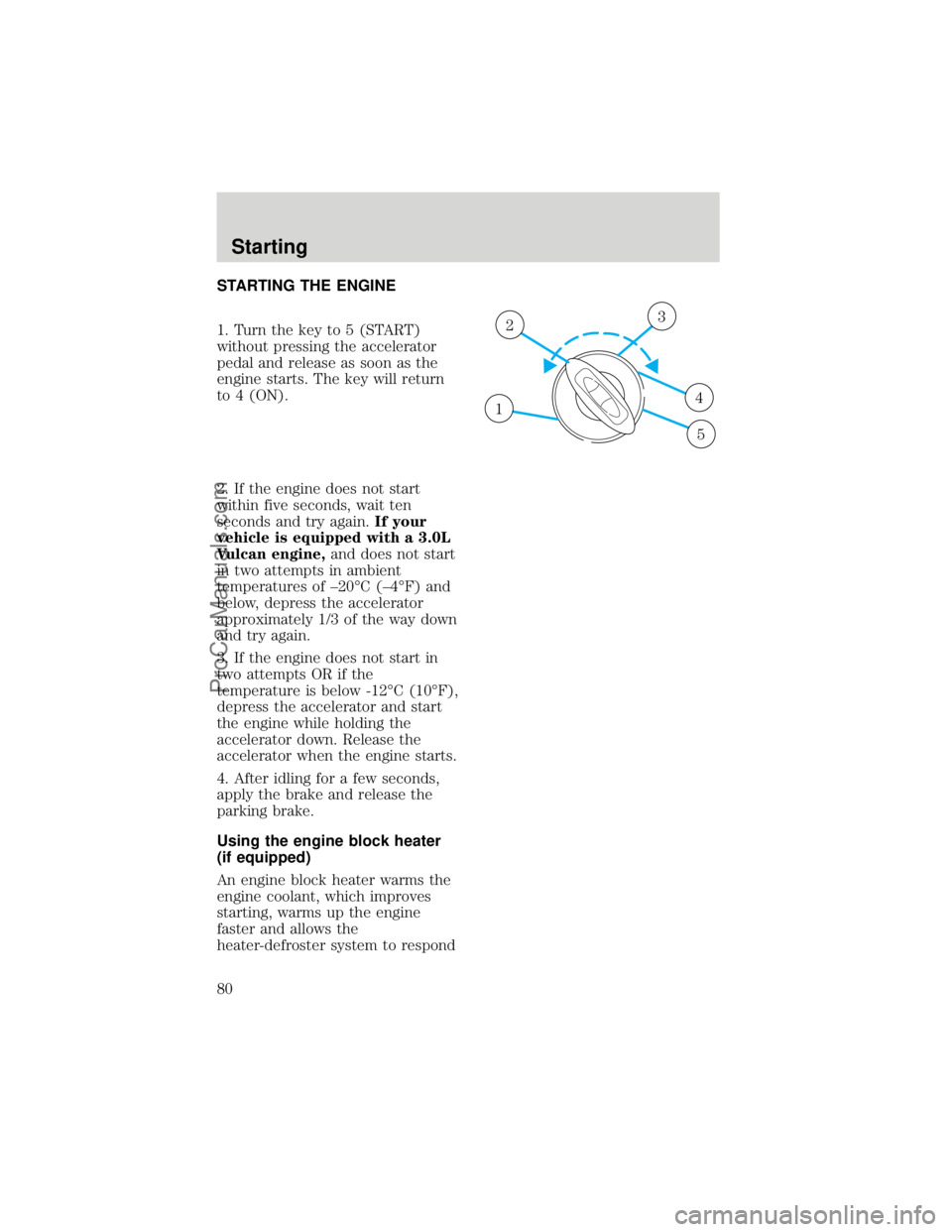
STARTING THE ENGINE
1. Turn the key to 5 (START)
without pressing the accelerator
pedal and release as soon as the
engine starts. The key will return
to 4 (ON).
2. If the engine does not start
within five seconds, wait ten
seconds and try again.If your
vehicle is equipped with a 3.0L
Vulcan engine,and does not start
in two attempts in ambient
temperatures of ±20ÉC (±4ÉF) and
below, depress the accelerator
approximately 1/3 of the way down
and try again.
3. If the engine does not start in
two attempts OR if the
temperature is below -12ÉC (10ÉF),
depress the accelerator and start
the engine while holding the
accelerator down. Release the
accelerator when the engine starts.
4. After idling for a few seconds,
apply the brake and release the
parking brake.
Using the engine block heater
(if equipped)
An engine block heater warms the
engine coolant, which improves
starting, warms up the engine
faster and allows the
heater-defroster system to respond
1
23
4
5
Starting
80
ProCarManuals.com
Page 83 of 219

BRAKES
Your brakes are self-adjusting.
Refer to the ªService Guideº for
scheduled maintenance.
Occasional brake noise is normal
and often does not indicate a
performance concern with the
vehicle's brake system. In normal
operation, automotive brake
systems may emit occasional or
intermittent squeal or groan noises
when the brakes are applied. Such
noises are usually heard during the
first few brake applications in the
morning; however, they may be
heard at any time while braking
and can be aggravated by
environmental conditions such as
cold, heat, moisture, road dust, salt
or mud. If a ªmetal-to-metal,º
ªcontinuous grindingº or
ªcontinuous squealº sound is
present while braking, the brake
linings may be worn-out and
should be inspected by a qualified
service technician.
Anti-lock brake system (ABS)
On vehicles equipped with an
anti-lock braking system (ABS), a
noise from the hydraulic pump
motor and pulsation in the pedal
may be observed during ABS
braking events. Pedal pulsation
coupled with noise while braking
under panic conditions or on loose
gravel, bumps, wet or snowy roads
is normal and indicates proper
functioning of the vehicle's
anti-lock brake system. If the
vehicle has continuous vibration or
Driving
83
ProCarManuals.com
Page 84 of 219
shudder while braking, felt mainly
in the steering wheel, the vehicle
most likely needs service.
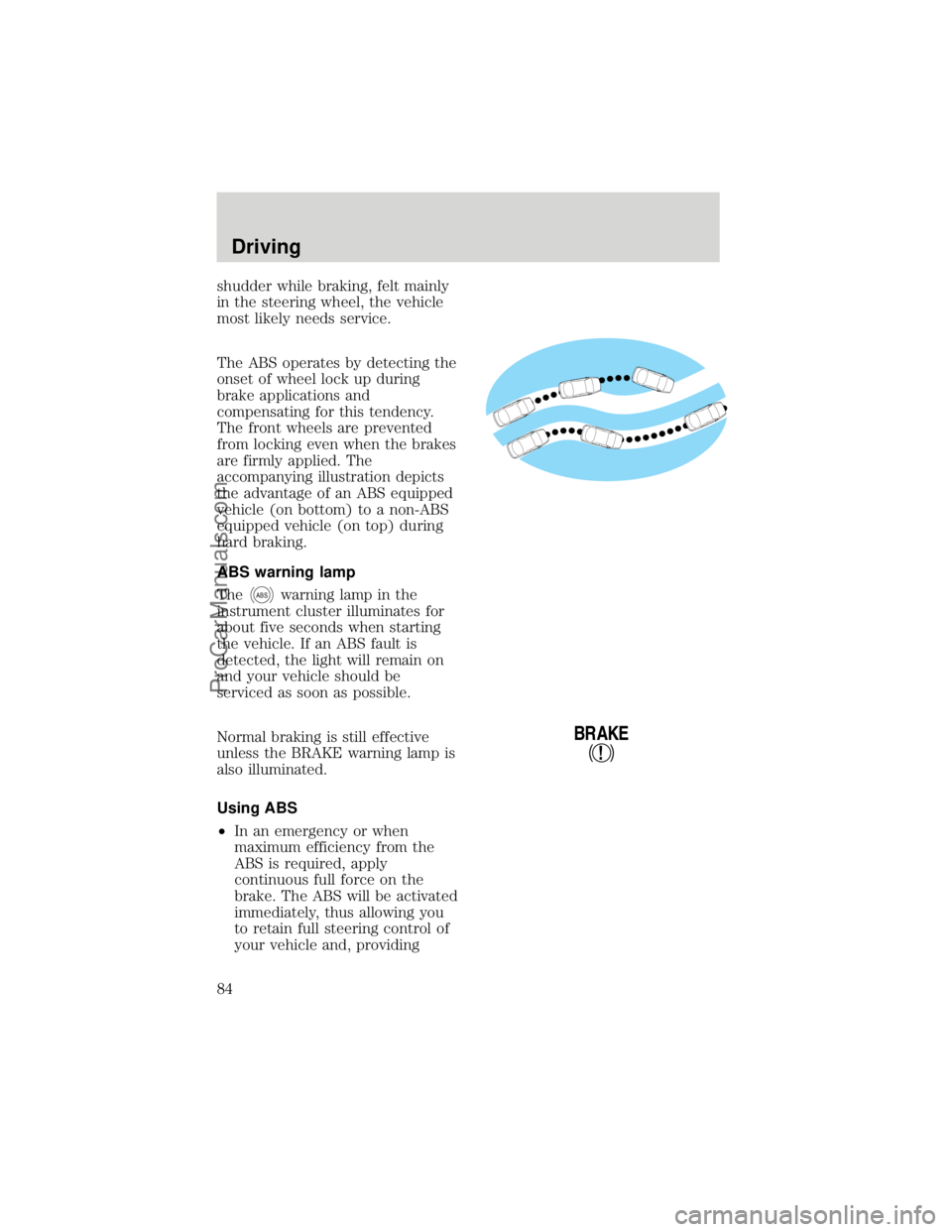
The ABS operates by detecting the
onset of wheel lock up during
brake applications and
compensating for this tendency.
The front wheels are prevented
from locking even when the brakes
are firmly applied. The
accompanying illustration depicts
the advantage of an ABS equipped
vehicle (on bottom) to a non-ABS
equipped vehicle (on top) during
hard braking.
ABS warning lamp
The
ABSwarning lamp in the
instrument cluster illuminates for
about five seconds when starting
the vehicle. If an ABS fault is
detected, the light will remain on
and your vehicle should be
serviced as soon as possible.
Normal braking is still effective
unless the BRAKE warning lamp is
also illuminated.
Using ABS
²In an emergency or when
maximum efficiency from the
ABS is required, apply
continuous full force on the
brake. The ABS will be activated
immediately, thus allowing you
to retain full steering control of
your vehicle and, providing
!
BRAKE
Driving
84
ProCarManuals.com
Page 88 of 219
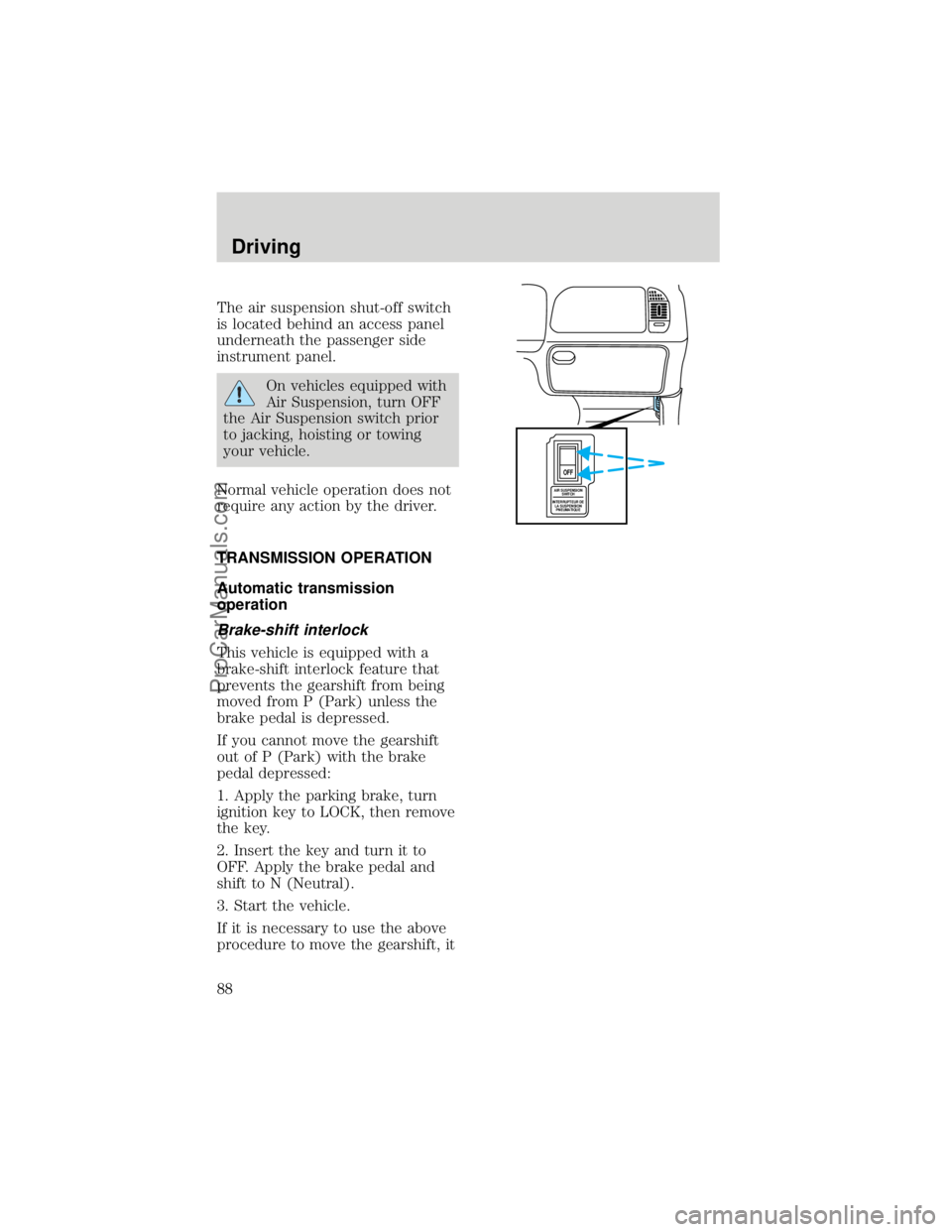
The air suspension shut-off switch
is located behind an access panel
underneath the passenger side
instrument panel.
On vehicles equipped with
Air Suspension, turn OFF
the Air Suspension switch prior
to jacking, hoisting or towing
your vehicle.
Normal vehicle operation does not
require any action by the driver.
TRANSMISSION OPERATION
Automatic transmission
operation
Brake-shift interlock
This vehicle is equipped with a
brake-shift interlock feature that
prevents the gearshift from being
moved from P (Park) unless the
brake pedal is depressed.
If you cannot move the gearshift
out of P (Park) with the brake
pedal depressed:
1. Apply the parking brake, turn
ignition key to LOCK, then remove
the key.
2. Insert the key and turn it to
OFF. Apply the brake pedal and
shift to N (Neutral).
3. Start the vehicle.
If it is necessary to use the above
procedure to move the gearshift, it
AIR SUSPENSION
SWITCH
INTERRUPTEUR DE
LA SUSPENSION
PNEUMATIQUE
OFF
Driving
88
ProCarManuals.com
Page 92 of 219
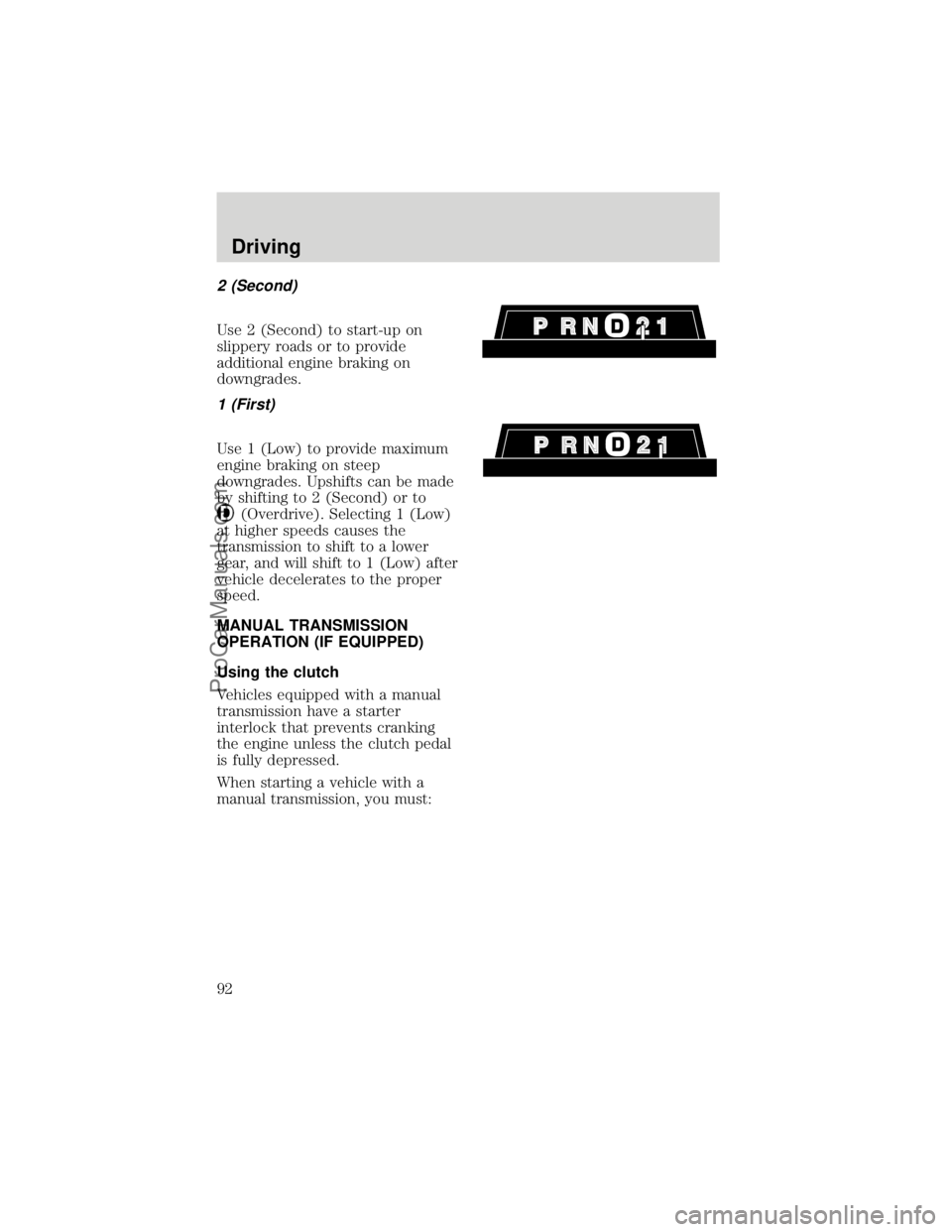
2 (Second)
Use 2 (Second) to start-up on
slippery roads or to provide
additional engine braking on
downgrades.
1 (First)
Use 1 (Low) to provide maximum
engine braking on steep
downgrades. Upshifts can be made
by shifting to 2 (Second) or to
(Overdrive). Selecting 1 (Low)
at higher speeds causes the
transmission to shift to a lower
gear, and will shift to 1 (Low) after
vehicle decelerates to the proper
speed.
MANUAL TRANSMISSION
OPERATION (IF EQUIPPED)
Using the clutch
Vehicles equipped with a manual
transmission have a starter
interlock that prevents cranking
the engine unless the clutch pedal
is fully depressed.
When starting a vehicle with a
manual transmission, you must:
Driving
92
ProCarManuals.com
Page 97 of 219
4. Turn ignition to Off.
Do not park your vehicle
in Neutral, it may move
unexpectedly and injure
someone. Use 1 (First) gear and
set the parking brake fully.
Reverse
Make sure that your vehicle is at a
complete stop before you shift into
R (Reverse). Failure to do so may
damage the transmission.
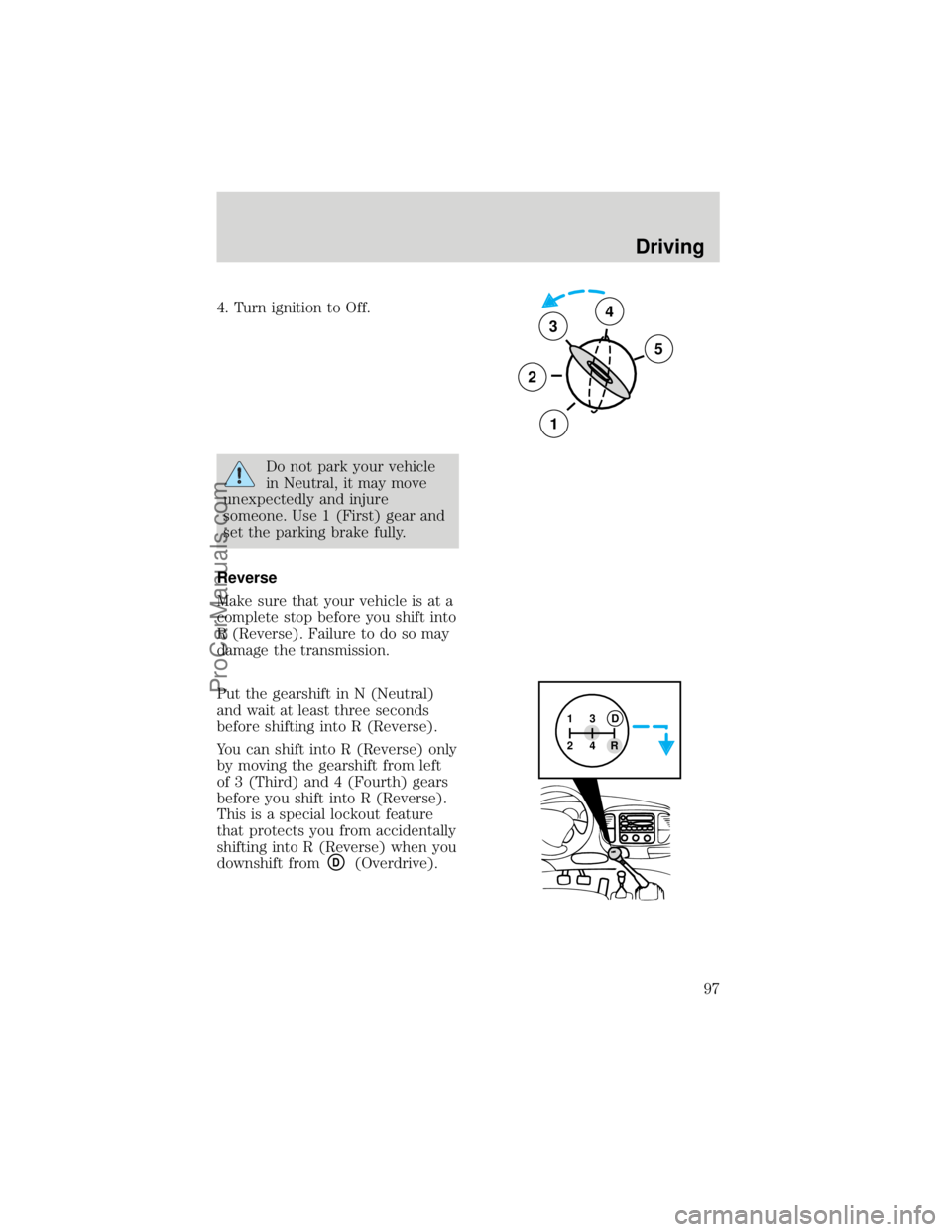
Put the gearshift in N (Neutral)
and wait at least three seconds
before shifting into R (Reverse).
You can shift into R (Reverse) only
by moving the gearshift from left
of 3 (Third) and 4 (Fourth) gears
before you shift into R (Reverse).
This is a special lockout feature
that protects you from accidentally
shifting into R (Reverse) when you
downshift from
D(Overdrive).
3
2
1
5
4
13
24RD
Driving
97
ProCarManuals.com
Page 108 of 219

Avoid sudden applications of
power and quick changes of
direction on snow and ice. Apply
the accelerator slowly and steadily
when starting from a full stop.
When braking, apply the brakes as
you normally would. In order to
allow the anti-lock brake system
(ABS) to operate properly, keep
steady pressure on the brake
pedal.
Allow more stopping distance and
drive slower than usual. Consider
using one of the lower gears.
VEHICLE LOADING
Before loading a vehicle, familiarize
yourself with the following terms:
²Base Curb Weight: Weight of
the vehicle including any
standard equipment, fluids,
lubricants, etc. It does not
include passengers or
aftermarket equipment.
²Payload: Combined maximum
allowable weight of cargo,
passengers and optional
equipment. The payload equals
the gross vehicle weight rating
minus base curb weight.
²GVW (Gross Vehicle Weight):
Base curb weight plus payload
weight. The GVW is not a limit
or a specification.
²GVWR (Gross Vehicle Weight
Rating): Maximum total weight
of the base vehicle, passengers,
optional equipment and cargo.
The GVWR is specific to each
Driving
108
ProCarManuals.com
Page 124 of 219

3. Lockout the center disconnect
by capping off one of the front
axle vacuum motor lines. See your
Ford dealer for assistance.
4. Vehicle speed should not exceed
88 km/h (55 mph) and there are
no mileage restrictions.
4WD ± Electronic shift transfer
case
1. Place transmission in N
(Neutral).
2. Shift the transfer case to 2H
(2WD high).
3. Lockout the center disconnect
by capping off one of the front
axle vacuum motor lines. See your
dealer for assistance.
4. Maximum speed is 56 km/h
(35 mph).
5. Maximum distance is 80 km
(50 miles).
If a distance of 80 km (50 miles)
or a speed of 56 km/h (35 mph)
must be exceeded, you must
disconnect the rear driveshaft.
With the rear driveshaft
disconnected, the maximum speed
is 88 km/h (55 mph) and there are
no mileage restrictions.
See your dealer for help with
disconnecting the driveshaft.
SNOWPLOWING
Ford recommends the following
specifications for low speed,
personal use snow removal:
Driving
124
ProCarManuals.com