wheel FORD F250 1998 Owner's Guide
[x] Cancel search | Manufacturer: FORD, Model Year: 1998, Model line: F250, Model: FORD F250 1998Pages: 219, PDF Size: 1.65 MB
Page 154 of 219
Working with the engine on
²Automatic transmission:
1. Set the parking brake fully and
ensure the gearshift is securely
latched in P (Park).
2. Block the wheels to prevent the
vehicle from moving unexpectedly.
Do not start your engine
with the air cleaner
removed and do not remove it
while the engine is running.
²Manual transmission:
1. Set the parking brake, depress
the clutch and place the gearshift
in 1 (First).
2. Block the wheels to prevent the
vehicle from moving unexpectedly.
OPENING THE HOOD
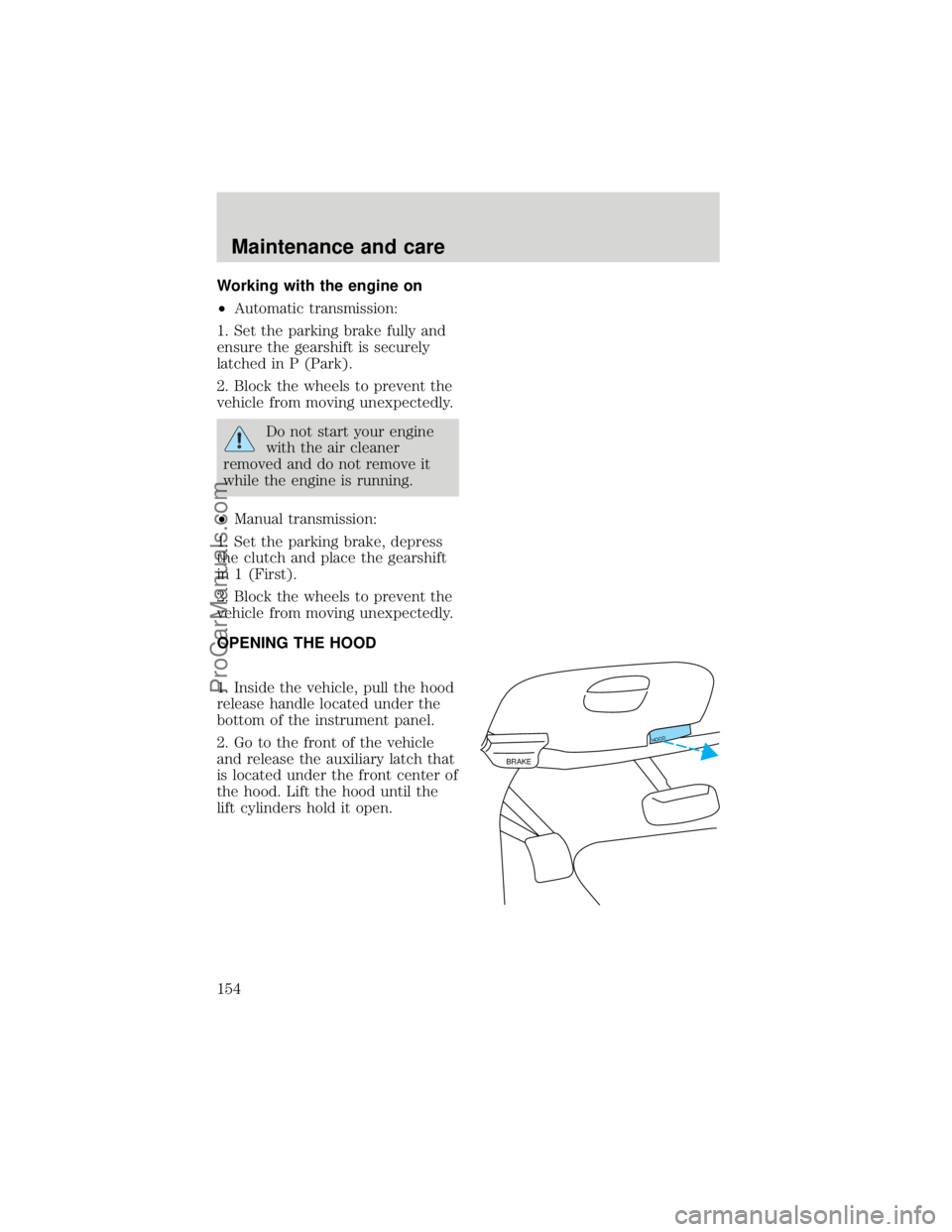
1. Inside the vehicle, pull the hood
release handle located under the
bottom of the instrument panel.
2. Go to the front of the vehicle
and release the auxiliary latch that
is located under the front center of
the hood. Lift the hood until the
lift cylinders hold it open.
BRAKE
HOOD
Maintenance and care
154
ProCarManuals.com
Page 169 of 219
As the engine temperature cools,
the engine may be re-started. Take
your vehicle to a service facility as
soon as possible to minimize
engine damage.
When fail-safe mode is
activated
²Pull off the road as soon as
possible.
²Immediately turn the engine off
to prevent severe engine
damage.
²Wait for the engine to cool.
²Check the coolant level.
CHECKING AND ADDING
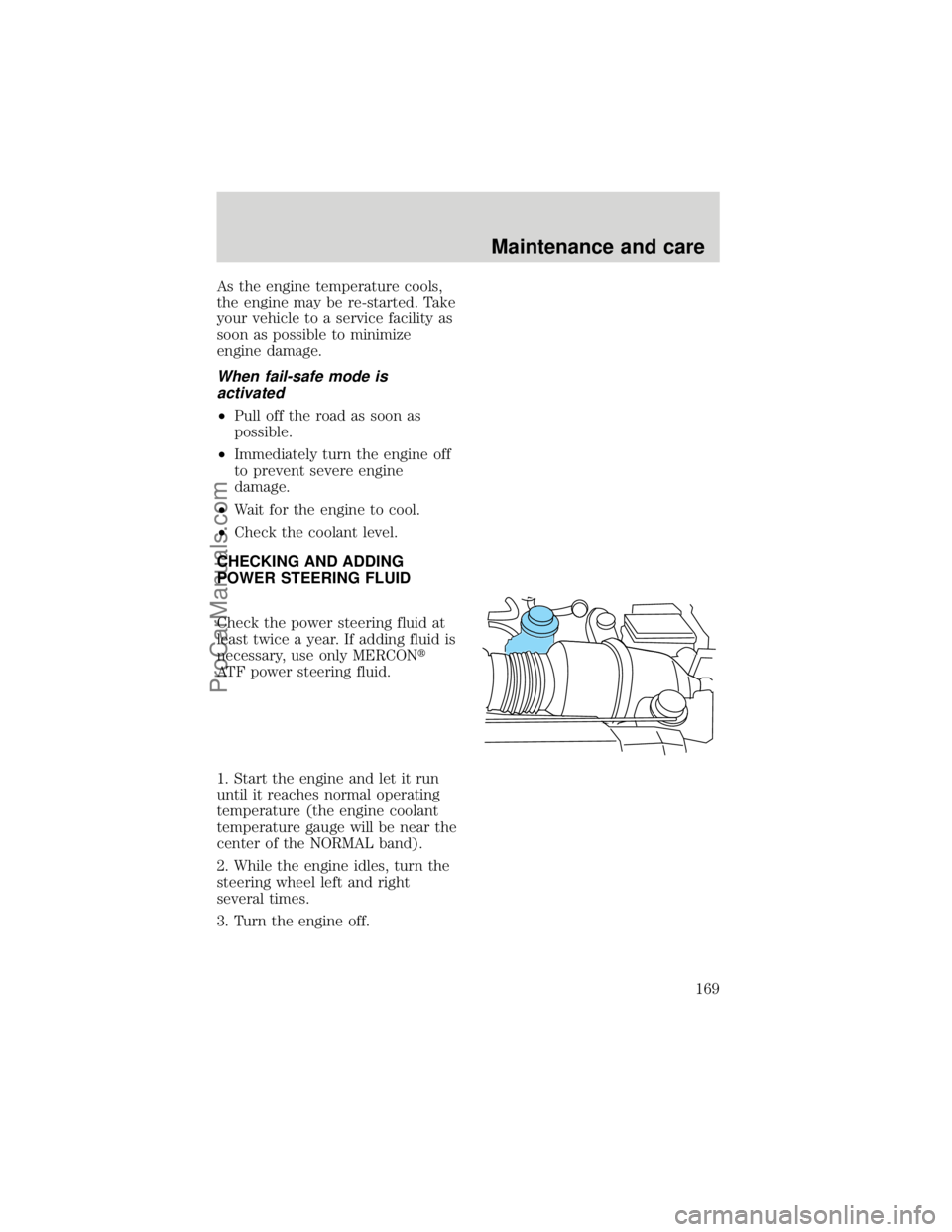
POWER STEERING FLUID
Check the power steering fluid at
least twice a year. If adding fluid is
necessary, use only MERCONt
ATF power steering fluid.
1. Start the engine and let it run
until it reaches normal operating
temperature (the engine coolant
temperature gauge will be near the
center of the NORMAL band).
2. While the engine idles, turn the
steering wheel left and right
several times.
3. Turn the engine off.
Maintenance and care
169
ProCarManuals.com
Page 180 of 219
tires depends upon the actual
conditions of their use, however,
and may depart significantly from
the norm due to variations in
driving habits, service practices,
and differences in road
characteristics and climate.
Traction A B C
The traction grades, from highest
to lowest are A, B, and C, and they
represent the tire's ability to stop
on wet pavement as measured
under test surfaces of asphalt and
concrete. A tire marked C may
have poor traction performance.
The traction grade
assigned to this tire is
based on braking (straight
ahead) traction tests and does
not include cornering (turning)
traction.
Temperature A B C
The temperature grades are A (the
highest), B, and C, representing
the tire's resistance to the
generation of heat and its ability to
dissipate heat when tested under
controlled conditions on a
specified indoor laboratory test
wheel. Sustained high temperature
can cause the material of the tire
to degenerate and reduce tire life,
and excessive temperature can
lead to sudden tire failure. The
grade C corresponds to a level of
performance which all passenger
car tires must meet under the
Maintenance and care
180
ProCarManuals.com
Page 181 of 219
Federal Motor Vehicle Safety
Standard No. 109. Grades B and A
represent higher levels of
performance on the laboratory test
wheel than the minimum required
by law.
The temperature grade for
this tire is established for a
tire that is properly inflated and
not overloaded. Excessive speed,
underinflation, or excessive
loading, either separately or in
combination, can cause heat
buildup and possible tire failure.
SERVICING YOUR TIRES
Checking the tire pressure
²Use an accurate tire pressure
gauge.
²Check the tire pressure when
tires are cold, after the vehicle
has been parked for at least one
hour or has been driven less
than 5 km (3 miles).
²Adjust tire pressure to
recommended specifications
found on the Safety Compliance
Certification Label.
Improperly inflated tires
can affect vehicle handling
and can fail suddenly, possibly
resulting in loss of vehicle
control.
Maintenance and care
181
ProCarManuals.com
Page 183 of 219
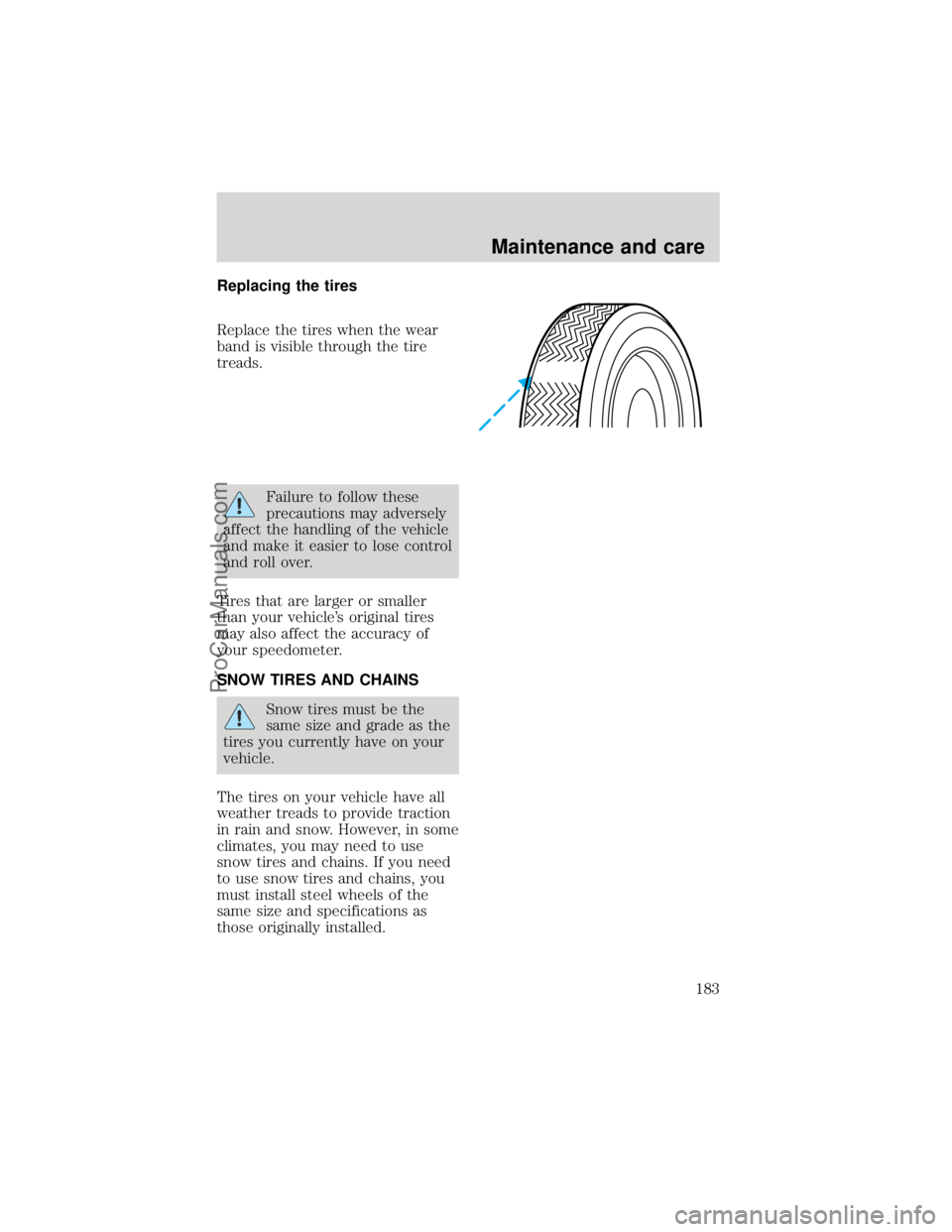
Replacing the tires
Replace the tires when the wear
band is visible through the tire
treads.
Failure to follow these
precautions may adversely
affect the handling of the vehicle
and make it easier to lose control
and roll over.
Tires that are larger or smaller
than your vehicle's original tires
may also affect the accuracy of
your speedometer.
SNOW TIRES AND CHAINS
Snow tires must be the
same size and grade as the
tires you currently have on your
vehicle.
The tires on your vehicle have all
weather treads to provide traction
in rain and snow. However, in some
climates, you may need to use
snow tires and chains. If you need
to use snow tires and chains, you
must install steel wheels of the
same size and specifications as
those originally installed.
Maintenance and care
183
ProCarManuals.com
Page 184 of 219
Follow these guidelines when using
snow tires and chains:
²Use only SAE Class S chains.
²Install chains securely, verifying
that the chains do not touch any
wiring, brake lines or fuel lines.
²Drive cautiously. If you hear the
chains rub or bang against your
vehicle, stop and re-tighten the
chains. If this does not work,
remove the chains to prevent
damage to your vehicle.
²If possible, avoid fully loading
your vehicle.
²Do not use tire chains on
aluminum wheels. Chains may
chip the wheels.
²Remove the tire chains when
they are no longer needed. Do
not use tire chains on dry roads.
²The suspension insulation and
bumpers will help prevent
vehicle damage. Do not remove
these components from your
vehicle when using snow tires
and chains.
WHAT YOU SHOULD KNOW
ABOUT AUTOMOTIVE FUELS
Important safety precautions
Do not overfill the fuel
tank. The pressure in an
overfilled tank may cause
leakage and lead to fuel spray
and fire.
Maintenance and care
184
ProCarManuals.com
Page 199 of 219

antennas, before entering a car
wash.
After washing, apply the brakes
several times to dry them.
Waxing your vehicle
Wax when water stops beading on
the surface. This could be every
three or four months, depending
on operating conditions.
Use only carnauba or
synthetic-based waxes. Remove
any bugs and tar before waxing
vehicle. Use cleaning fluid or
alcohol with a clean cloth to
remove. Use tar remover to
remove any tar spots.
Repairing paint chips
Minor scratches or paint damage
from road debris may be repaired
with touch-up , paint repair foil or
aerosol paint spray from the Ford
accessory line. Observe the
application instructions on the
products.
Remove particles such as bird
droppings, tree sap, insect
remains, tar spots, road salt and
industrial fallout immediately.
Cleaning the wheels
Wash with the same detergent as
the body of your vehicle. Do not
use acid-based wheel cleaners,
steel wool, fuel or strong
detergents. Never use abrasives
that will damage the finish of
special wheel surfaces. Use a tar
remover to remove grease and tar.
Maintenance and care
199
ProCarManuals.com
Page 206 of 219

FluidFord Part
NameApplication Capacity
Rear axle
2,4
Motorcraft
SAE
75W140
Synthetic
Rear Axle
LubricantF-250 3.3-3.8L (7.5-8.0
pints)5
Brake fluidFord High
Performance
DOT 3
Brake FluidAll Fill to line in
reservoir
Engine
coolantFord
Premium
Cooling
System
Fluid4.2L w/o A/C 14.9L (15.7 quarts)
4.2L with A/C 16.4L (17.3 quarts)
4.6L and 5.4L w/o
A/C16.9L (17.9 quarts)
4.6L and 5.4L with
A/C18.4L (19.4 quarts)
Engine oil
(includes
filter
change)Motorcraft
5W30 Super
Premium
Motor OilAll 5.7L (6.0 quarts)
Fuel tank N/A4x4 Reg. Cab 92.7L (24.5 gallons)
4x2 Regular Cab
and all SuperCab94.6L (25.0 gallons)
Long Wheelbase 113.6L (30.0 gallons)
Power
steering
fluidMotorcraft
MERCONt
AT FAll Fill to line in
reservoir
Transfer
case fluid
3
Motorcraft
MERCONt
AT F4 x 4 vehicles 1.9L (2.0 quarts)
Capacities and specifications
206
ProCarManuals.com
Page 211 of 219

DimensionBody Style
Regular
Cab 4x2Regular Cab
4x4Super Cab
4x2Super Cab
4x4
(3) Overall
height1 846 mm
(72.7 in)
(SWB) 1838
mm (72.4
in) (LWB)1 917 mm
(75.5 in)
(SWB)1 907
mm (75.1 in)
(LWB)1 846 mm
(72.7 in)
(SWB)1 838
mm (72.4 in)
(LWB)1 917 mm
(75.5 in)
(SWB)1
907mm (75.1
in) (LWB)
(4)Wheel
base3 022 mm
(119.9 in)
(SWB)3 505
mm (138.5
in) (LWB)3 048 mm
(120.2 in)
(SWB) 3 505
mm (138.8
in) (LWB)3 505 mm
(138.5 in)
(SWB) 3 987
mm (157.1
in) (LWB)3 505 mm
(138.8 in)
(SWB) 3 987
mm (157.4
in) (LWB)
(5)Track
front/rear1 661 mm
(65.4 in)/1
661 mm
(65.4 in)1 661 mm
(65.4 in)/1
661 mm (65.4
in)1 661 mm
(65.4 in)/1
661 mm (65.4
in)1 661 mm
(65.4 in)/1
661 mm
(65.4 in)
Flareside
DimensionBody Style
Regular
Cab 4x2Regular
Cab 4x4Super Cab
4x2Super Cab
4x4
(1)Overall
length5 229 mm
(205.9 in)5 267 mm
(207.4 in)5 702 mm
(224.5 in)5 740 mm
(226.0 in)
(2) Overall
width2 009 mm
(79.1 in)2 026 mm
(79.8 in)2 009 mm
(79.1 in)2 026 mm
(79.8 in)
(3) Overall
height1 846 mm
(72.7 in)1 917 mm
(75.5 in)1 846 mm
(72.7 in)1 917 mm
(75.5 in)
(4)Wheel
base3 045 mm
(119.9 in)3 053 mm
(120.2 in)3 517 mm
(138.5 in)3 525 mm
(138.8 in)
(5) Track
front/rear1 661 mm
(65.4 in)1 661 mm
(65.4 in)1 661 mm
(65.4 in)1 661 mm
(65.4 in)
Capacities and specifications
211
ProCarManuals.com
Page 216 of 219

Air bag supplemental restraint
system ..........................................60
and child safety seats ..............61
description ................................60
disposal ......................................64
indicator light ...........................63
passenger air bag ...........62,65,66
Air conditioning
manual heating and air
conditioning system .......22,23,26
Air suspension
description ................................87
warning light .............................11
Ambulance packages ....................3
Anti-lock brake system (ABS)
description ................................84
Anti-theft system ........................40
Battery .......................................175
voltage gauge ............................16
Brake fluid
checking and adding ..............162
Brakes ..........................................83
anti-lock .....................................83
anti-lock brake system (ABS)
warning light .............................84
fluid, checking and adding ....162
Brake-shift interlock ...................88
Break-in period .............................2
Bulbs, replacing ........................192
headlamps ...............................193
specifications ..........................197
Changing a tire .........................141
Child safety seats ........................70
Chime
headlamps on ............................12
Cleaning your vehicle ...............198
engine compartment ..............200
fabric ........................................201
instrument panel ....................201
plastic parts ............................201
safety belts ..............................202
tail lamps .................................201washing ....................................198
waxing .....................................199
wheels ......................................199
Clutch
fluid ..........................................163
Controls .......................................19
Daytime running light system ...17
Driving under special
conditions ..................................105
high water ...............................105
slippery roads ..................106,107
Emission control system ..........189
Engine ........................................210
check engine temperature
warning, message
center ...............................155,156
service points ..........................155
Engine block heater ...................80
Engine coolant
checking and adding .......164,165
disposal ....................................166
refill capacities ........................167
Engine oil ...........................156,160
changing oil and oil filter .......161
checking and
adding ........................156,158,160
Exhaust fumes ............................81
Fail safe cooling ........................168
Foglamps ............................196,197
Four-Wheel Drive vehicles .........98
control trac ........................19,102
indicator light ...........................99
lever operated electric shift ....99
Fuel
calculating fuel economy .......188
improving fuel economy ........130
octane rating ...........................187
quality ......................................187
safety information relating to
automotive fuels .....................184
Fuel gauge ...................................13
Fuel pump shut-off switch .......131
Index
216
ProCarManuals.com