automatic transmission FORD F250 2013 Owner's Manual
[x] Cancel search | Manufacturer: FORD, Model Year: 2013, Model line: F250, Model: FORD F250 2013Pages: 577, PDF Size: 7.74 MB
Page 265 of 577
•If your transmission is equipped with the Tow/Haul feature, use this
when towing. This provides engine braking and helps eliminate
excessive transmission shifting for optimum fuel economy and
transmission cooling.
•If your vehicle is equipped with AdvanceTrac™ with RSC, this system
may turn on during typical cornering maneuvers with a heavily loaded
trailer. This is normal. Turning the corner at a slower speed while
towing may reduce this tendency.
•If you are towing a trailer frequently in hot weather, hilly conditions,
at the gross combined weight rating (or any combination of these
factors), consider refilling your rear axle with synthetic gear lubricant
(if the axle is not already filled with it). See theCapacities and
Specificationschapter for the lubricant specification.
•Allow more distance for stopping with a trailer attached. Anticipate
stops and brake gradually.
•Avoid parking on a grade. However, if you must park on a grade:
1. Turn the steering wheel to point your vehicle tires away from
traffic flow.
2. Set your vehicle parking brake.
3. Place the automatic transmission in positionP.
4. Place wheel chocks in front and back of the trailer wheels.
(Chocks not included with vehicle.)
Your vehicle may be equipped with a temporary or conventional spare
tire. A “temporary” spare tire is different in size (diameter or width),
tread-type (All-Season or All-Terrain) or is from a different manufacturer
than the road tires on your vehicle. Consult information on the tire label
or Safety Compliance label for limitations when using.
Launching or Retrieving a Boat or Personal Watercraft (PWC)
Note:Disconnect the wiring to the trailerbeforebacking the trailer into
the water.
Note:Reconnect the wiring to the trailerafterremoving the trailer from
the water.
When backing down a ramp during boat launching or retrieval:
•Do not allow the static water level to rise above the bottom edge of
the rear bumper.
•Do not allow waves to break higher than 6 inches (15 centimeters)
above the bottom edge of the rear bumper.
264Towing
2013 F-250/350/450/550(f23)
Owners Guide gf, 3rd Printing, December 2012
USA(fus)
Page 268 of 577
We recommend the use of a wheel lift and dollies or flatbed equipment
to tow your vehicle. Do not tow with a slingbelt. Ford Motor Company
has not approved a slingbelt towing procedure. Vehicle damage may
occur if towed incorrectly, or by any other means.
Ford Motor Company produces a towing manual for all authorized tow
truck operators. Have your tow truck operator refer to this manual for
proper hook-up and towing procedures for your vehicle.
It is acceptable to have your two-wheel drive vehicle towed with the
front wheels on the ground (without dollies) and the rear wheels off the
ground.
We recommend towing a four-wheel drive vehicle with all wheels off the
ground, such as using a wheel lift and dollies or flatbed equipment.
However, it is acceptable to use a wheel lift to raise the rear of your
vehicle so long as, depending on vehicle configuration, you perform the
following before towing:
•If your vehicle is equipped with a manual-shift transfer case, make
sure the front wheel hub locks are in theFREEposition before
towing.
•If your vehicle is equipped with an electronic shift-on-the-fly transfer
case, make sure you turn the four-wheel drive control to the2L
position before towing.
Note:Towing an electronic shift-on-the-fly four-wheel drive vehicle with
the front wheels on the ground without disengaging the front hubs may
cause damage to the automatic transmission.
Note:Towing a two-wheel drive vehicle or an electronic shift-on-the-fly
four-wheel drive vehicle with the rear wheels on the ground for more
than 50 miles (80 km) or faster than 35 mph (56 km/h) may cause
damage to the automatic transmission.
Note:Using wheel lift equipment to tow a dual rear wheel vehicle
requires removing an outer rear wheel before towing.
Towing267
2013 F-250/350/450/550(f23)
Owners Guide gf, 3rd Printing, December 2012
USA(fus)
Page 269 of 577
TOWING THE VEHICLE ON FOUR WHEELS
Emergency Towing
If your vehicle becomes inoperable (without access to wheel dollies,
car-hauling trailer, or flatbed transport vehicle), it can be flat-towed
(all wheels on the ground, regardless of the powertrain and transmission
configuration) under the following conditions:
•Your vehicle is facing forward for towing in a forward direction.
•
Place the transmission in positionN.SeeAutomatic transmissionin
theTransmissionchapter if you cannot move the transmission intoN.
•Maximum speed is 35 mph (56 km/h).
•Maximum distance is 50 miles (80 kilometers).
Recreational Towing
Note:Put your climate control system in recirculated air mode to
prevent exhaust fumes from entering your vehicle. See theClimate
Controlchapter.
Follow these guidelines if you have a need for recreational towing,
such as towing your vehicle behind a motorhome. We designed these
guidelines to prevent damage to your transmission.
Four-wheel Drive Vehicles Equipped with a Manual-shift Transfer
Case
1. Put the transmission in positionN.
2. Put the transfer case in positionN.
3. Put the hub locks in theFREEposition. Always make sure that both
hub locks are set to the same position.
Two-wheel Drive Vehicles and Four-wheel Drive Vehicles Equipped
with an Electronic-shift Transfer Case
Do not tow your vehicle with any wheels on the ground, as vehicle or
transmission damage may occur. It is recommended to tow your vehicle
with all four (4) wheels off the ground, such as when using a car-hauling
trailer. Otherwise, you cannot tow your vehicle.
268Towing
2013 F-250/350/450/550(f23)
Owners Guide gf, 3rd Printing, December 2012
USA(fus)
Page 280 of 577
JUMP-STARTING THE VEHICLE
WARNING:The gases around the battery can explode if exposed
to flames, sparks, or lit cigarettes. An explosion could result in
injury or vehicle damage.
WARNING:Batteries contain sulfuric acid which can burn skin,
eyes and clothing, if contacted.
Do not attempt to push-start your automatic transmission vehicle.
Automatic transmissions do not have push-start capability. Attempting
to push-start a vehicle with an automatic transmission may cause
transmission damage.
When the battery is disconnected or a new battery is installed, the
automatic transmission must relearn its shift strategy. As a result, the
transmission may exhibit a combination of firm and soft shifts. This
operation is considered normal and will not affect function or durability
of the transmission. Over time, the adaptive learning process will fully
update transmission operation.
Preparing Your Vehicle
Note:Use only a 12–volt supply to start your vehicle.
Note:Do not disconnect the battery of the disabled vehicle as this could
damage the vehicle’s electrical system.
1. Park the booster vehicle close to the hood of the disabled vehicle
making sure the two vehicles do not touch. Set the parking brake on
both vehicles and stay clear of the engine cooling fan and other moving
parts.
2. Check all battery terminals. Remove the positive terminal cover
(if equipped) and any excessive corrosion before you attach the battery
cables. Ensure that vent caps are tight and level.
3. Turn the heater fan on in both vehicles to protect from any electrical
surges. Turn all other accessories off.
Roadside Emergencies279
2013 F-250/350/450/550(f23)
Owners Guide gf, 3rd Printing, December 2012
USA(fus)
Page 305 of 577
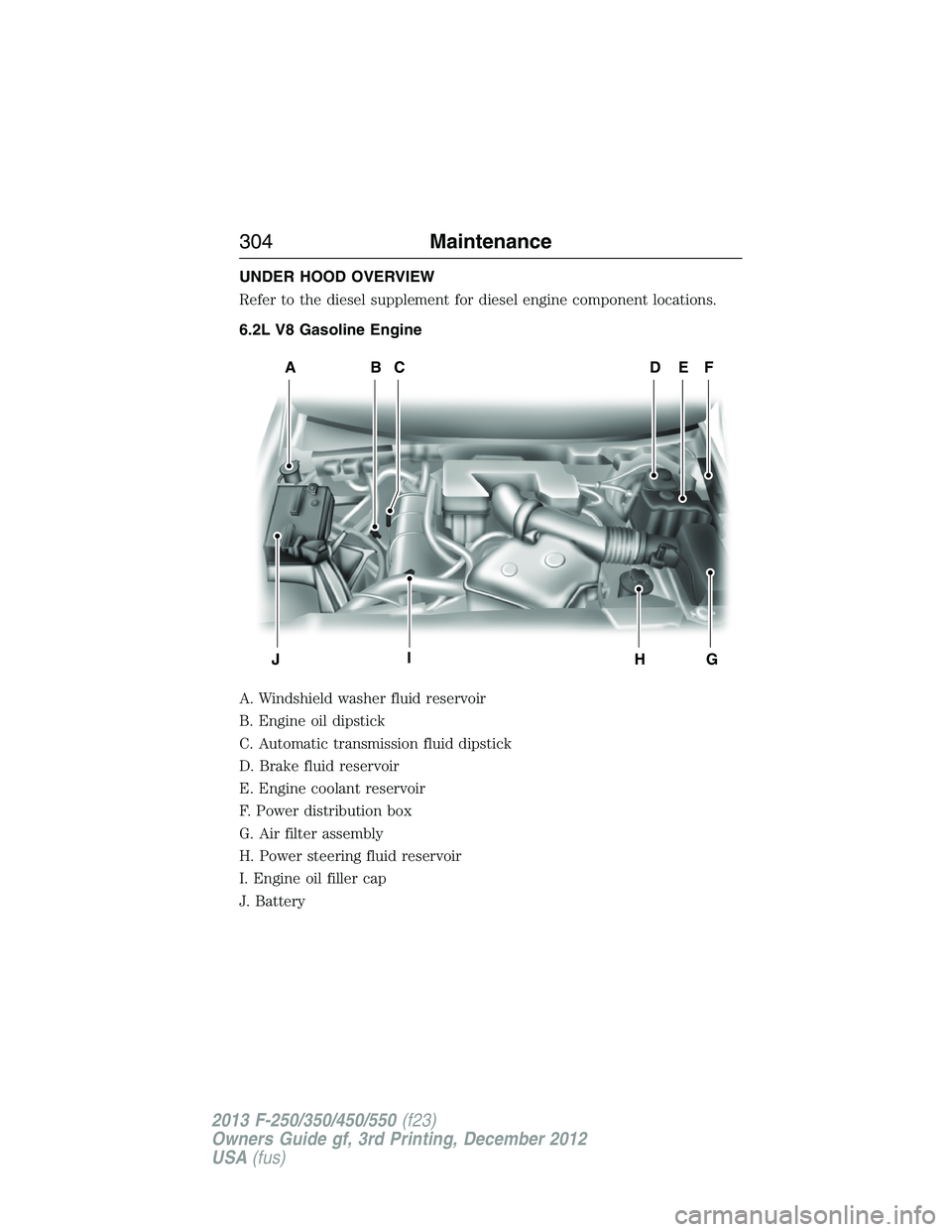
UNDER HOOD OVERVIEW
Refer to the diesel supplement for diesel engine component locations.
6.2L V8 Gasoline Engine
A. Windshield washer fluid reservoir
B. Engine oil dipstick
C. Automatic transmission fluid dipstick
D. Brake fluid reservoir
E. Engine coolant reservoir
F. Power distribution box
G. Air filter assembly
H. Power steering fluid reservoir
I. Engine oil filler cap
J. Battery
ADFEBC
GHIJ
304Maintenance
2013 F-250/350/450/550(f23)
Owners Guide gf, 3rd Printing, December 2012
USA(fus)
Page 306 of 577
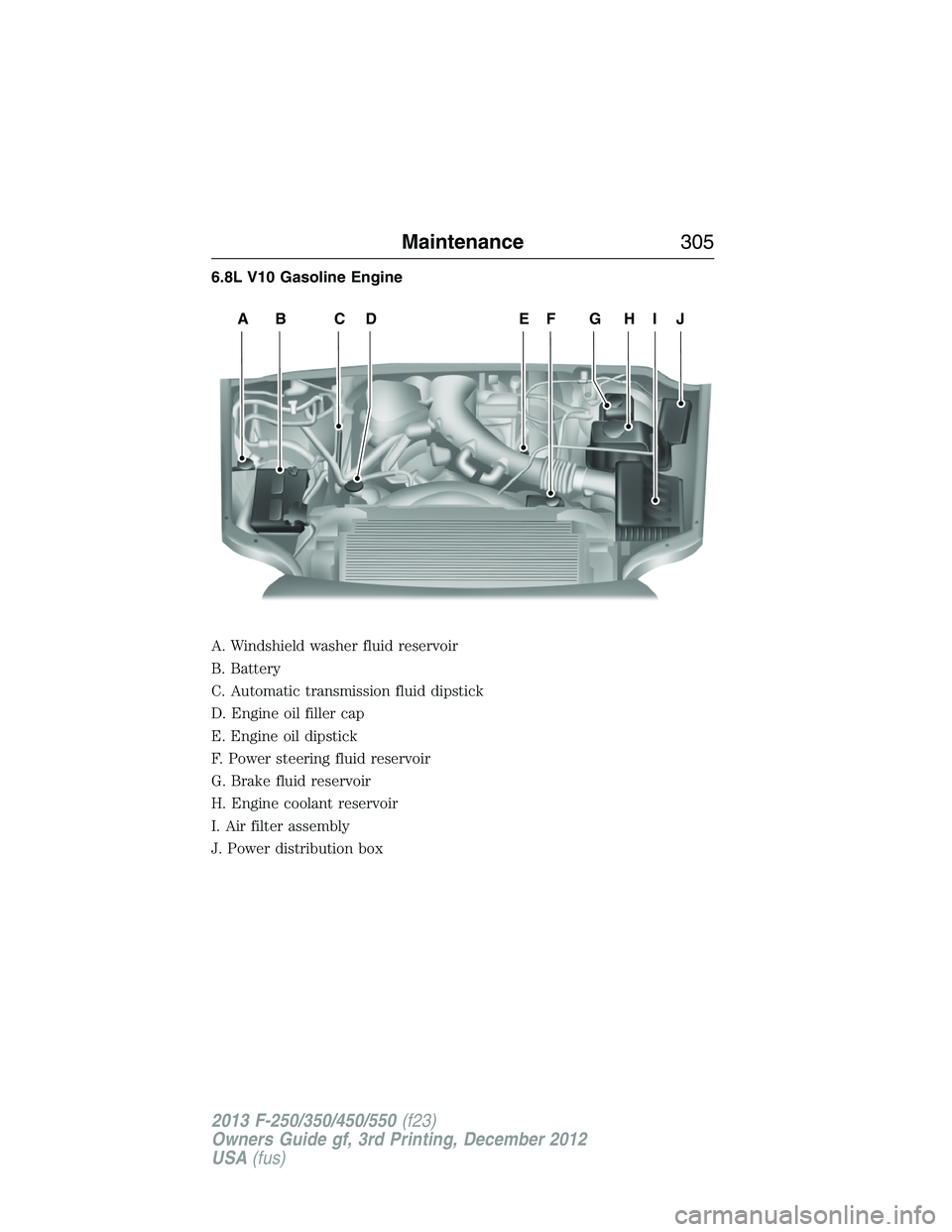
6.8L V10 Gasoline Engine
A. Windshield washer fluid reservoir
B. Battery
C. Automatic transmission fluid dipstick
D. Engine oil filler cap
E. Engine oil dipstick
F. Power steering fluid reservoir
G. Brake fluid reservoir
H. Engine coolant reservoir
I. Air filter assembly
J. Power distribution box
ABCEHIJFDG
Maintenance305
2013 F-250/350/450/550(f23)
Owners Guide gf, 3rd Printing, December 2012
USA(fus)
Page 314 of 577
TRANSMISSION FLUID CHECK
Checking Automatic Transmission Fluid (If Equipped)
Refer to yourScheduled Maintenance Informationfor scheduled
intervals for fluid checks and changes. Your transmission does not
consume fluid. However, the fluid level should be checked if the
transmission is not working properly, i.e., if the transmission slips
or shifts slowly or if you notice some sign of fluid leakage.
Automatic transmission fluid expands when warmed. To obtain an
accurate fluid check, drive the vehicle until it is at normal operating
temperature (approximately 20 miles [30 km]). Verify that the
transmission fluid temperature gauge, located on the instrument
cluster, is within normal range.
1. Drive the vehicle 20 miles (30 km) or until it reaches normal operating
temperature.
2. Park the vehicle on a level surface and engage the parking brake.
3. With the engine running, parking brake engaged and your foot on the
brake pedal, move the gearshift lever through all of the gear ranges.
Allow sufficient time for each gear to engage.
4. Latch the gearshift lever in P (Park) and leave the engine running.
5. Remove the dipstick, wiping it clean with a clean, dry lint free rag.
If necessary, refer toUnder Hood Overviewin this chapter for the
location of the dipstick.
6. Install the dipstick making sure it is fully seated in the filler tube.
7. Remove the dipstick and inspect the fluid level. The fluid should be
in the designated area for normal operating temperature or ambient
temperature.
Your vehicle is equipped with one of the following dipsticks.
Maintenance313
2013 F-250/350/450/550(f23)
Owners Guide gf, 3rd Printing, December 2012
USA(fus)
Page 316 of 577
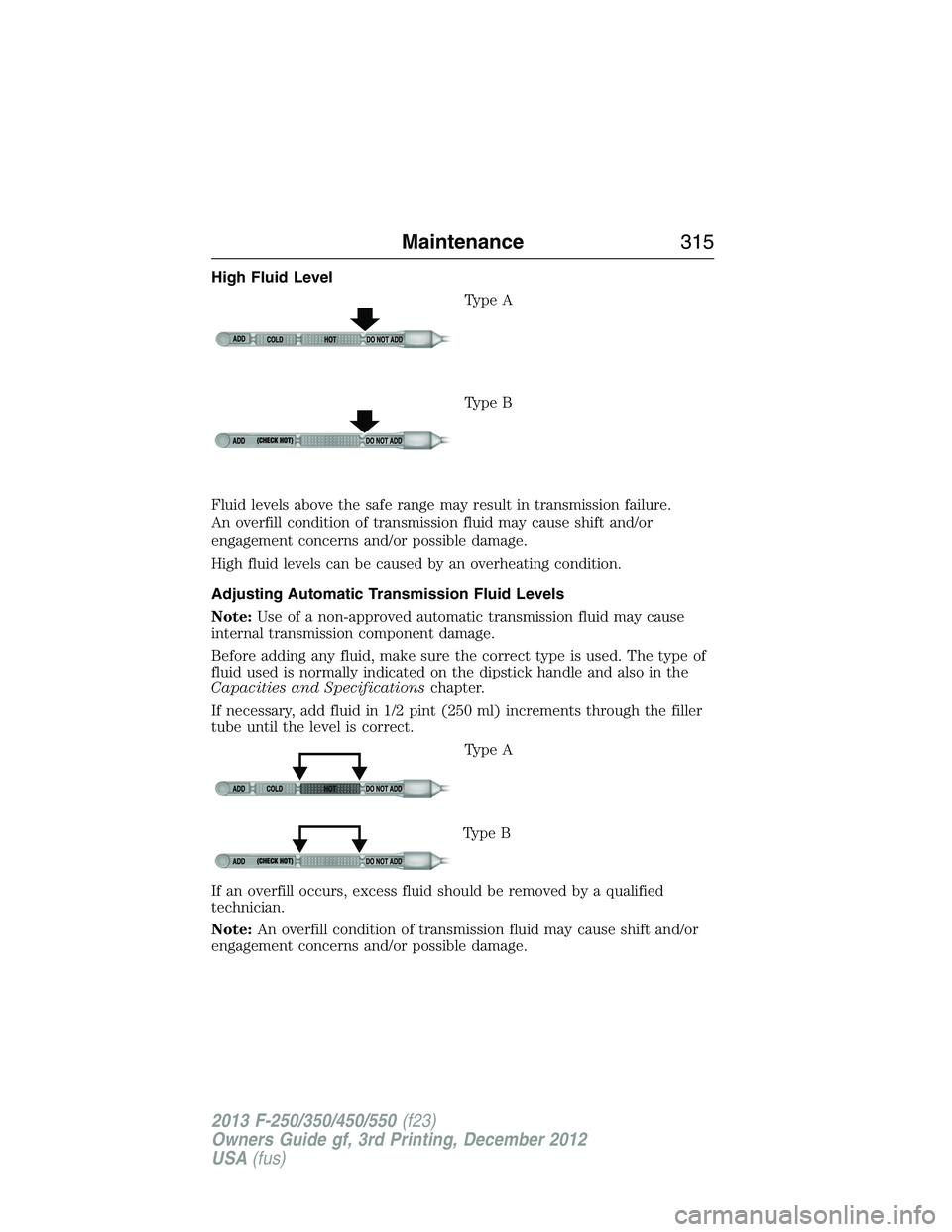
High Fluid Level
Type A
Type B
Fluid levels above the safe range may result in transmission failure.
An overfill condition of transmission fluid may cause shift and/or
engagement concerns and/or possible damage.
High fluid levels can be caused by an overheating condition.
Adjusting Automatic Transmission Fluid Levels
Note:Use of a non-approved automatic transmission fluid may cause
internal transmission component damage.
Before adding any fluid, make sure the correct type is used. The type of
fluid used is normally indicated on the dipstick handle and also in the
Capacities and Specificationschapter.
If necessary, add fluid in 1/2 pint (250 ml) increments through the filler
tube until the level is correct.
Type A
Type B
If an overfill occurs, excess fluid should be removed by a qualified
technician.
Note:An overfill condition of transmission fluid may cause shift and/or
engagement concerns and/or possible damage.
Maintenance315
2013 F-250/350/450/550(f23)
Owners Guide gf, 3rd Printing, December 2012
USA(fus)
Page 394 of 577
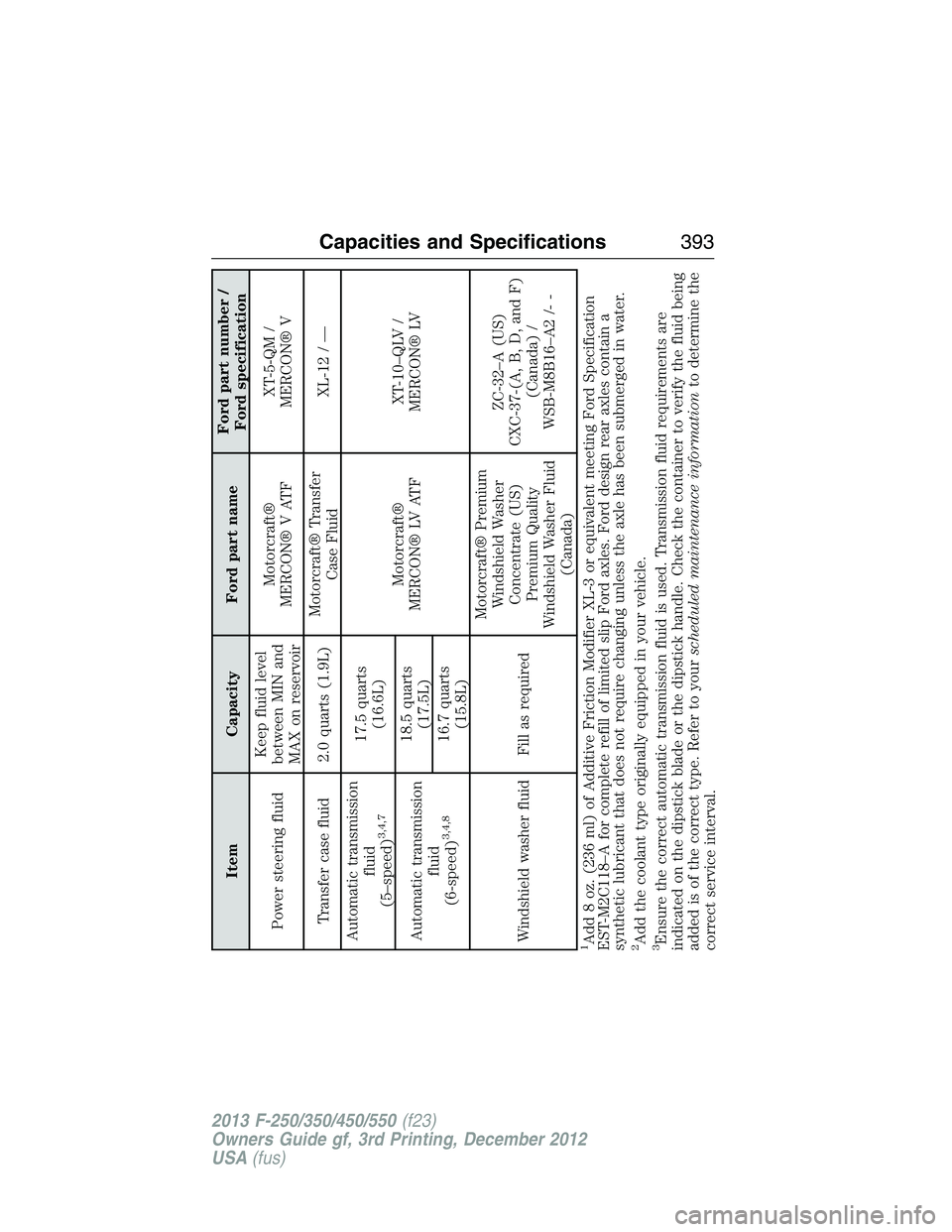
Item Capacity Ford part nameFord part number /
Ford specification
Power steering fluidKeep fluid level
between MIN and
MAX on reservoirMotorcraft®
MERCON® V ATFXT-5-QM /
MERCON® V
Transfer case fluid 2.0 quarts (1.9L)Motorcraft® Transfer
Case FluidXL-12 / —
Automatic transmission
fluid
(5–speed)
3,4,7
17.5 quarts
(16.6L)
Motorcraft®
MERCON® LV ATFXT-10–QLV /
MERCON® LV
Automatic transmission
fluid
(6-speed)
3,4,8
18.5 quarts
(17.5L)
16.7 quarts
(15.8L)
Windshield washer fluid Fill as requiredMotorcraft® Premium
Windshield Washer
Concentrate (US)
Premium Quality
Windshield Washer Fluid
(Canada)ZC-32–A (US)
CXC-37-(A, B, D, and F)
(Canada) /
WSB-M8B16–A2 /- -
1Add 8 oz. (236 ml) of Additive Friction Modifier XL-3 or equivalent meeting Ford Specification
EST-M2C118–A for complete refill of limited slip Ford axles. Ford design rear axles contain a
synthetic lubricant that does not require changing unless the axle has been submerged in water.2Add the coolant type originally equipped in your vehicle.3Ensure the correct automatic transmission fluid is used. Transmission fluid requirements are
indicated on the dipstick blade or the dipstick handle. Check the container to verify the fluid being
added is of the correct type. Refer to yourscheduled maintenance informationto determine the
correct service interval.
Capacities and Specifications393
2013 F-250/350/450/550(f23)
Owners Guide gf, 3rd Printing, December 2012
USA(fus)
Page 395 of 577
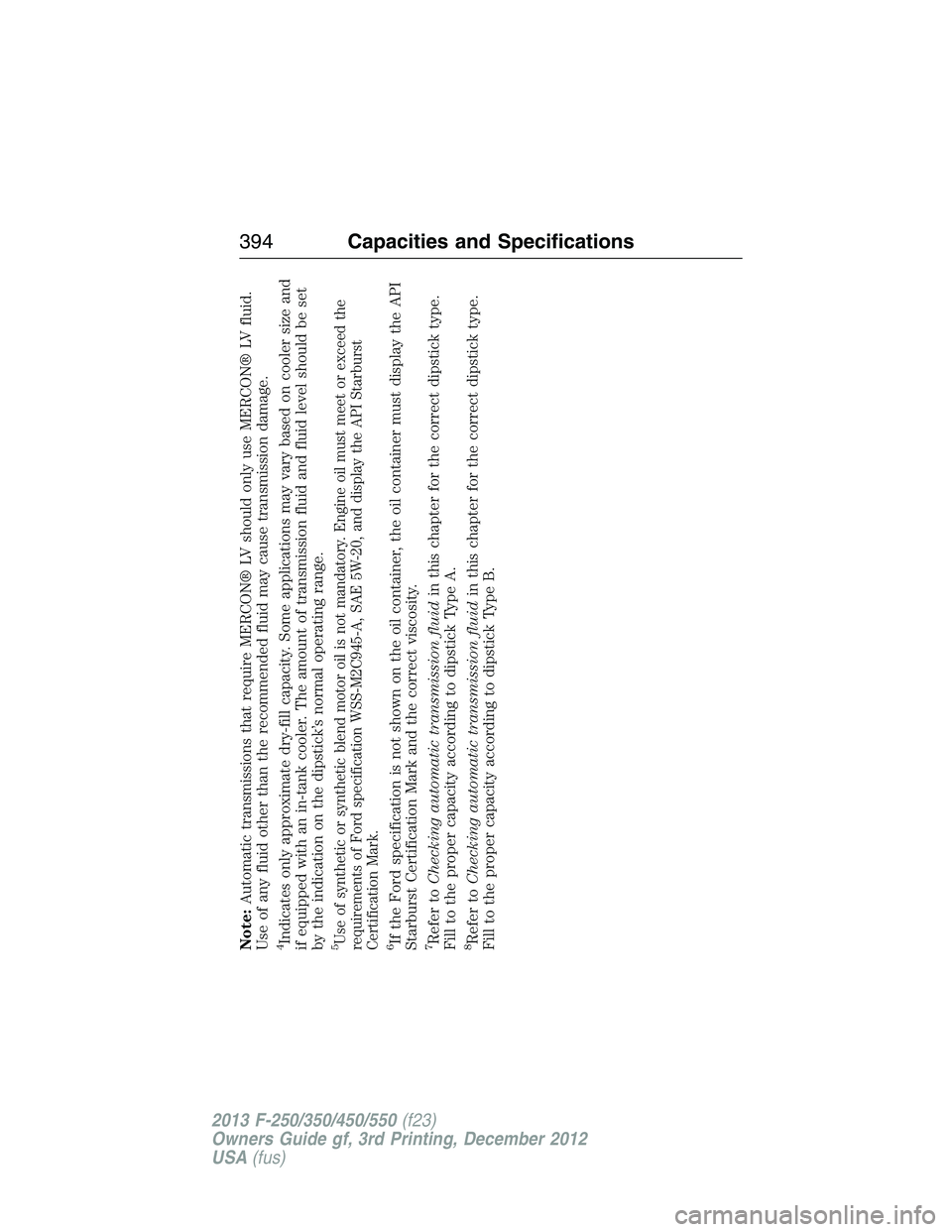
Note:Automatic transmissions that require MERCON® LV should only use MERCON® LV fluid.
Use of any fluid other than the recommended fluid may cause transmission damage.4Indicates only approximate dry-fill capacity. Some applications may vary based on cooler size and
if equipped with an in-tank cooler. The amount of transmission fluid and fluid level should be set
by the indication on the dipstick’s normal operating range.5Use of synthetic or synthetic blend motor oil is not mandatory. Engine oil must meet or exceed the
requirements of Ford specification WSS-M2C945-A, SAE 5W-20, and display the API Starburst
Certification Mark.6If the Ford specification is not shown on the oil container, the oil container must display the API
Starburst Certification Mark and the correct viscosity.7Refer toChecking automatic transmission fluidin this chapter for the correct dipstick type.
Fill to the proper capacity according to dipstick Type A.8Refer toChecking automatic transmission fluidin this chapter for the correct dipstick type.
Fill to the proper capacity according to dipstick Type B.
394Capacities and Specifications
2013 F-250/350/450/550(f23)
Owners Guide gf, 3rd Printing, December 2012
USA(fus)