lock FORD F450 SUPER DUTY 2017 Repair Manual
[x] Cancel search | Manufacturer: FORD, Model Year: 2017, Model line: F450 SUPER DUTY, Model: FORD F450 SUPER DUTY 2017Pages: 642, PDF Size: 12.35 MB
Page 166 of 642
2. Lift the cushion to gain access to thestorage compartment.
The cupholder is located inside the storagecompartment. You can also flip thecupholder so that it faces forward. SeeCenter Console (page 170).
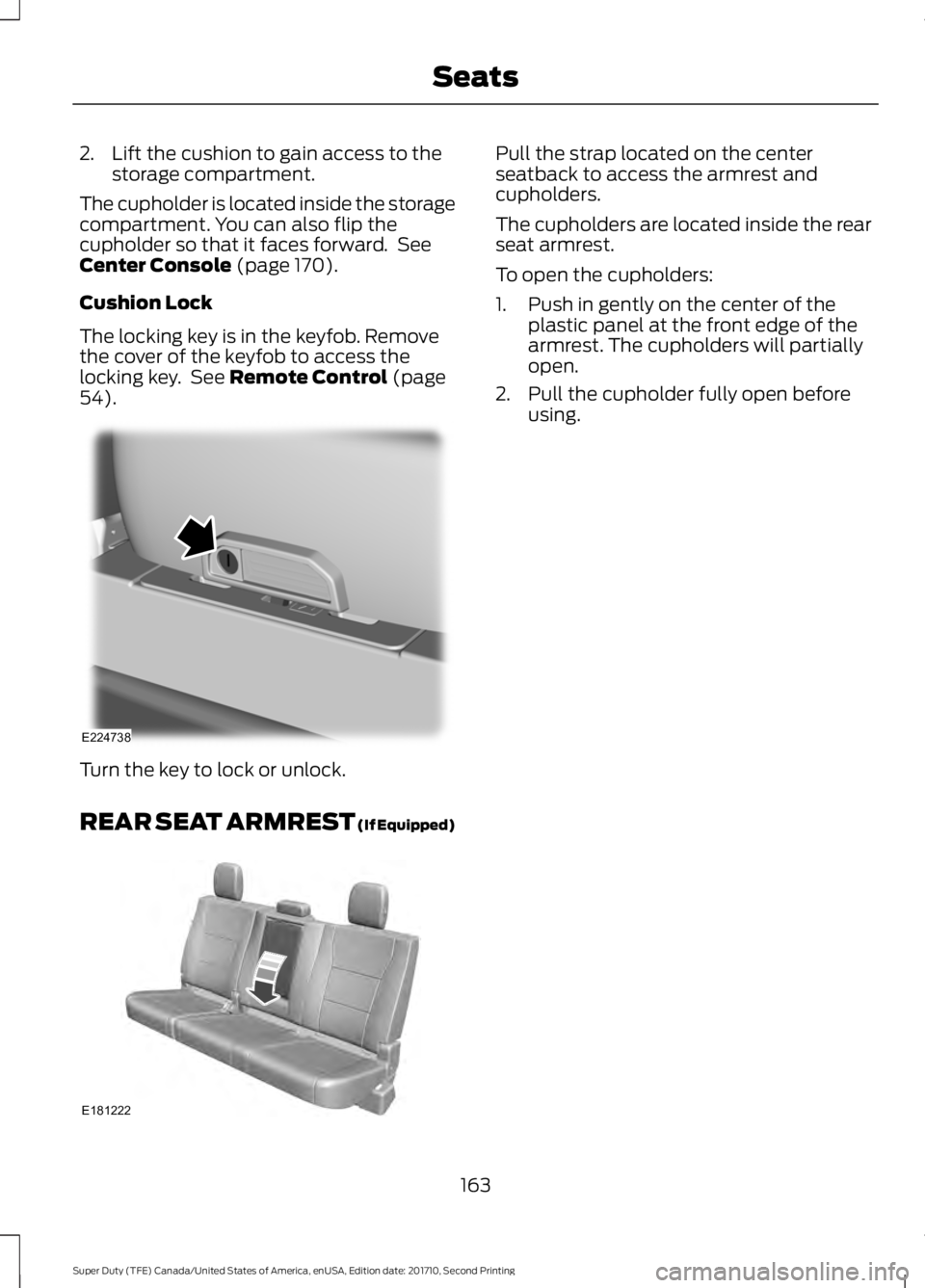
Cushion Lock
The locking key is in the keyfob. Removethe cover of the keyfob to access thelocking key. See Remote Control (page54).
Turn the key to lock or unlock.
REAR SEAT ARMREST (If Equipped)
Pull the strap located on the centerseatback to access the armrest andcupholders.
The cupholders are located inside the rearseat armrest.
To open the cupholders:
1. Push in gently on the center of theplastic panel at the front edge of thearmrest. The cupholders will partiallyopen.
2. Pull the cupholder fully open beforeusing.
163
Super Duty (TFE) Canada/United States of America, enUSA, Edition date: 201710, Second Printing
SeatsE224738 E181222
Page 167 of 642
HomeLink Wireless ControlSystem
WARNINGS
Make sure that the garage door andsecurity device are free fromobstruction when you areprogramming. Do not program the systemwith the vehicle in the garage.
Do not use the system with anygarage door opener that does nothave the safety stop and reversefeature as required by U.S. Federal SafetyStandards (this includes any garage dooropener manufactured before April 1, 1982).A garage door opener which cannot detectan object, signaling the door to stop andreverse, does not meet current federalsafety standards. Using a garage dooropener without these features increasesthe risk of serious injury or death.
Note:Make sure you keep the originalremote control transmitter for use in othervehicles as well as for future systemprogramming.
Note:We recommend that upon the saleor lease termination of your vehicle, youerase the programmed function buttons forsecurity reasons. See Erasing the FunctionButton Codes later in this section.
Note:You can program a maximum ofthree devices. To change or replace any ofthe three devices after it has been initiallyprogrammed, you must first erase thecurrent settings. See Erasing the FunctionButton Codes.
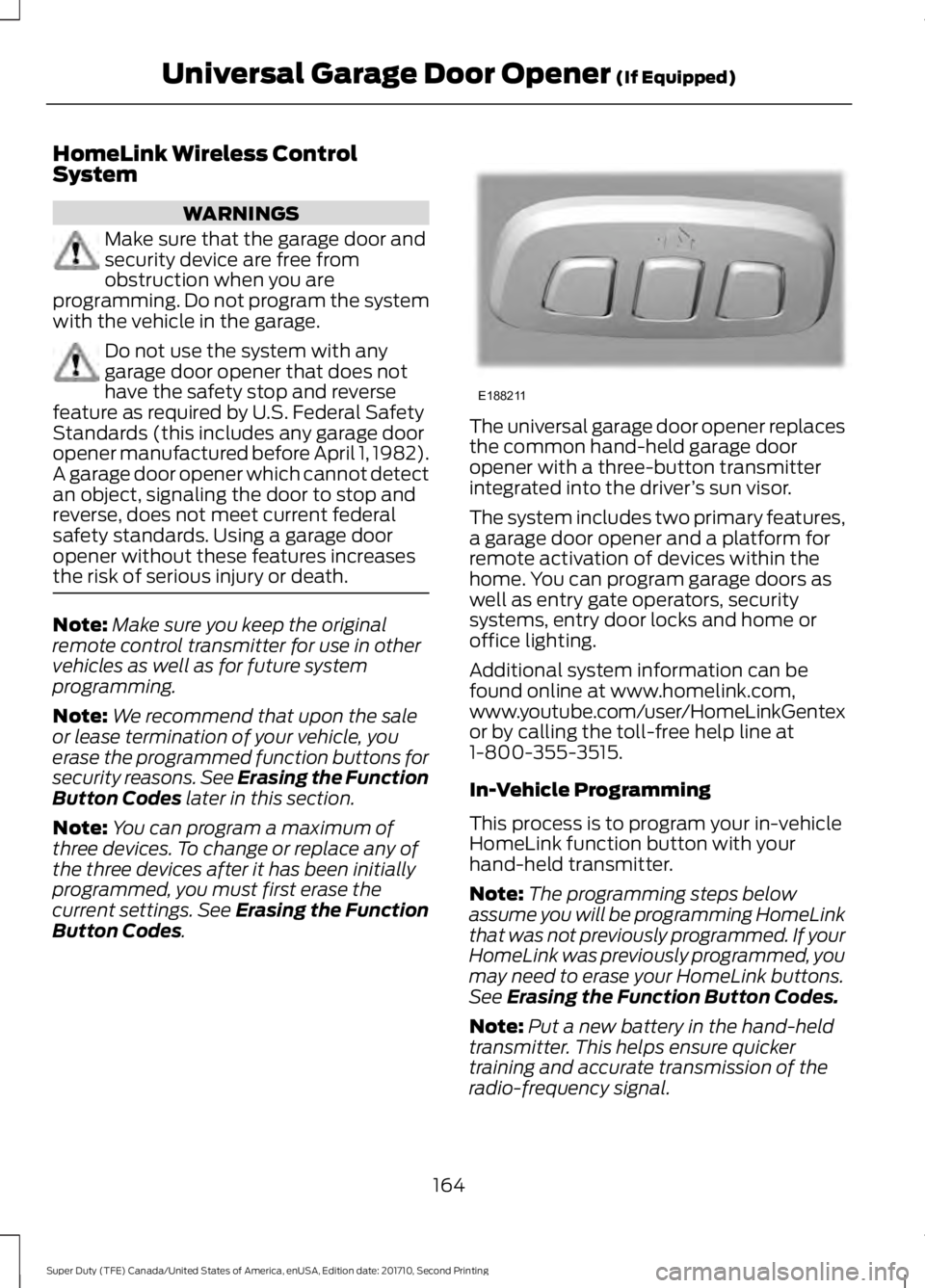
The universal garage door opener replacesthe common hand-held garage dooropener with a three-button transmitterintegrated into the driver’s sun visor.
The system includes two primary features,a garage door opener and a platform forremote activation of devices within thehome. You can program garage doors aswell as entry gate operators, securitysystems, entry door locks and home oroffice lighting.
Additional system information can befound online at www.homelink.com,www.youtube.com/user/HomeLinkGentexor by calling the toll-free help line at1-800-355-3515.
In-Vehicle Programming
This process is to program your in-vehicleHomeLink function button with yourhand-held transmitter.
Note:The programming steps belowassume you will be programming HomeLinkthat was not previously programmed. If yourHomeLink was previously programmed, youmay need to erase your HomeLink buttons.See Erasing the Function Button Codes.
Note:Put a new battery in the hand-heldtransmitter. This helps ensure quickertraining and accurate transmission of theradio-frequency signal.
164
Super Duty (TFE) Canada/United States of America, enUSA, Edition date: 201710, Second Printing
Universal Garage Door Opener (If Equipped)E188211
Page 174 of 642
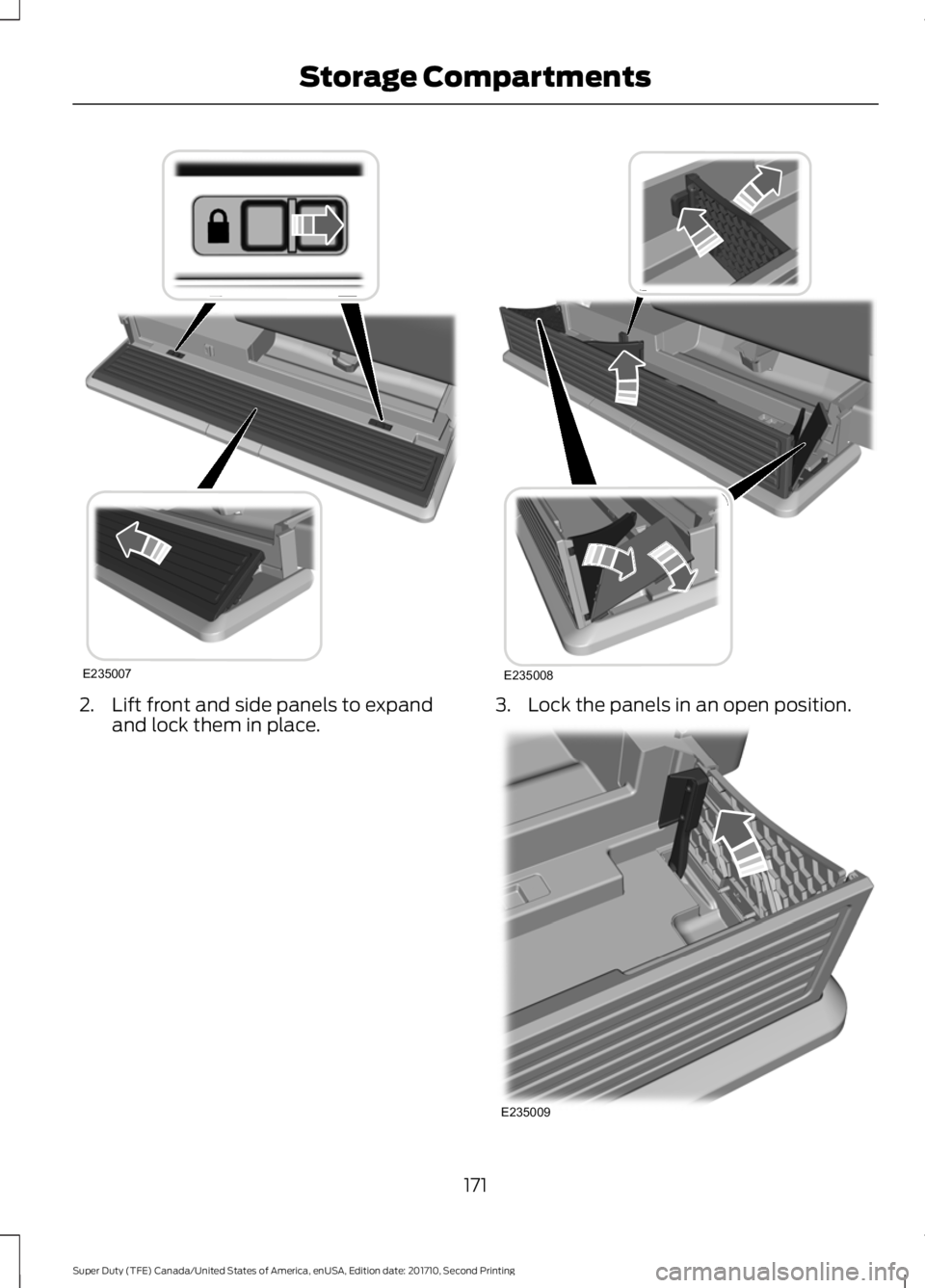
2. Lift front and side panels to expandand lock them in place.3. Lock the panels in an open position.
171
Super Duty (TFE) Canada/United States of America, enUSA, Edition date: 201710, Second Printing
Storage CompartmentsE235007 E235008 E235009
Page 175 of 642

4. To collapse, lift lever and fold in theside and front panels.
Note:Make sure the storage divider is notlocked into place when collapsing.
172
Super Duty (TFE) Canada/United States of America, enUSA, Edition date: 201710, Second Printing
Storage Compartments
Page 178 of 642
Failure to Start
If you cannot start the engine after threeattempts, wait 10 seconds and follow thisprocedure:
1. Fully depress the brake pedal.
2. Fully press the accelerator pedal andhold it there.
3. Start the engine.
Stopping the Engine When YourVehicle is Stationary
1. When your vehicle has stopped, shiftinto park (P) and switch the ignitionoff.
2. Apply the parking brake.
Stopping the Engine When YourVehicle is Moving
WARNING
Switching off the engine when thevehicle is still moving will result in aloss of brake and steering assistance.The steering will not lock, but higher effortwill be required. When the ignition isswitched off, some electrical circuits,including air bags, warning lamps andindicators may also be off. If the ignitionwas turned off accidentally, you can shiftinto neutral (N) and re-start the engine.
1. Put the transmission into neutral (N)and use the brakes to bring your vehicleto a safe stop.
2. When your vehicle has stopped, shiftinto park (P) and switch the ignitionoff.
3. Apply the parking brake.
Cold Weather Starting (FlexibleFuel Vehicles Only)
The starting characteristics of all gradesof E85 ethanol make it unsuitable for usewhen ambient temperatures fall below-0°F (-18°C). Consult your fuel distributorfor the availability of winter grade ethanol.As the outside temperature approachesfreezing, ethanol fuel distributors shouldsupply winter grade ethanol, the same aswith unleaded gasoline.
If summer grade ethanol is used in coldweather conditions, -0°F (-18°C), you mayexperience increased cranking times, roughidle or hesitation until the engine haswarmed up.
You may experience a decrease inperformance when the engine is cold whenoperating on E85 ethanol.
Do not use starting fluid such as ether inthe air intake system. Such fluid couldcause immediate explosive damage to theengine and possible personal injury.
If you should experience cold weatherstarting problems on E85 ethanol, andneither an alternative brand of E85 ethanolnor an engine block heater is available, theaddition of unleaded gasoline to your tankimproves cold starting performance. Yourvehicle is designed to operate on E85ethanol alone, unleaded gasoline alone, orany mixture of the two.
If the Engine Fails to Start Using thePreceding Instructions (Flexible FuelVehicles Only)
1. Press the accelerator pedal downone-third to one-half of its travel, andthen crank the engine.
2. When the engine starts, release thekey, then gradually release theaccelerator pedal as the engine speedincreases. If the engine still does notstart, repeat Step 1.
175
Super Duty (TFE) Canada/United States of America, enUSA, Edition date: 201710, Second Printing
Starting and Stopping the Engine
Page 180 of 642
sensor to determine how long the glowplugs stay energized. The required time forthe glow plugs to be energized decreasesas the coolant temperature, barometricpressure and environmental temperatureincrease.
Cold Weather Starting
WARNINGS
Do not use starting fluid, for exampleether, in the air intake system. Suchfluid could cause immediateexplosive damage to the engine andpossible personal injury.
Do not add gasoline, gasohol, alcoholor kerosene to diesel fuel. Thiscreates a serious fire hazard andcauses engine performance problems.
We recommend that the engine blockheater be used for starting when thetemperature is -9°F (-23°C) or colder. SeeEngine Block Heater (page 181).
When operating in cold weather, you mayuse Motorcraft® cetane improvers ornon-alcohol-based cetane improvers froma reputable manufacturer as needed.
Do not crank the engine for more than 10seconds as starter damage may occur. Ifthe engine does not start, switch theignition off and wait 30 seconds beforetrying again.
Switch the ignition on. Do notstart the engine until theglow-plug indicator turns off.
When the glow plug pre-heat indicatorturns off, turn the key to start. After youstart the engine, the glow plugs mayremain on for a period. If you do not startthe engine before the glow plug activationtime ends, you will need to reset the glowplugs by switching the ignition off. Afterthe engine starts, allow it to idle for about15 seconds. This protects the engine. Donot increase engine speed until the oilpressure gauge indicates normal pressure.
Cold Weather Operation
Note:Idling in cold weather does not heatthe engine to its normal operatingtemperature. Long periods of idling,especially in cold weather, can cause abuildup of deposits which can cause enginedamage.
Change to a lighter grade engine oil tomake starting easier under theseconditions. Refer to engine oilspecifications. See Capacities andSpecifications (page 427).
Diesel fuel is adjusted seasonally for coldtemperatures. Diesel fuel which has notbeen properly formulated for the ambientconditions may gel which can clog the fuelfilters. One indication that the fuel filter(s)may be clogged is if the engine starts, stallsafter a short time, and then does notrestart. If you have been using biodiesel,you may need to use a fuel with lowerbiodiesel content, try another brand, ordiscontinue using biodiesel. Do not usealcohol based additives to correct fuelgelling. This may result in damage to thefuel injectors and system. Use the properanti-gel and performance improvementproduct. See Capacities andSpecifications (page 427).
177
Super Duty (TFE) Canada/United States of America, enUSA, Edition date: 201710, Second Printing
Starting and Stopping the Engine
Page 181 of 642
Your vehicle has a fuel and water separatorthat recirculates fuel from the engine tohelp prevent fuel filter clogging. To avoidengine fuel starvation during cold weatheroperation of 32°F (0°C) or below, werecommend that the fuel level in your tankshould not drop below ¼ full. This helpsprevent air from entering the fuel systemand stalling the engine.
Your vehicle has a selective catalyticreduction system that uses Diesel ExhaustFluid (DEF) to operate properly. You needto replenish your vehicle’s DEF at certainintervals. When filling your vehicle’s DEFtank in cold weather, take special care toprevent damage to the tank. SeeSelective Catalytic Reduction System(page 188).
In cold weather below 32°F (0°C), theengine may slowly increase to a higher idlespeed if you leave it idling in park (P). Asthe engine warms-up, the engine soundlevel decreases due to the activation ofPCM-controlled sound reduction features.
If you operate your vehicle in a heavysnowstorm or blowing snow conditions,snow and ice can clog the engine airinduction. If this occurs, the engine mayexperience a significant reduction in poweroutput. At the earliest opportunity, clearall the snow and ice away from inside theair filter assembly. Remove the air cleanercover and the air filter and remove anysnow or ice. Remove any debris, snow orice, on the foam filter by brushing thesurface with a soft brush. Once you havecleared all of the debris, reinstall the airfilter and cover.
Do not use water, solvents, or a hard brushfor cleaning the foam filter.
WARNING
To reduce the risk of vehicle damageand personal burn injuries, do notstart your engine with the air cleanerremoved and do not remove it while theengine is running.
In order to operate the engine intemperatures of 32°F (0°C) or lower, readthe following instructions:
•Make sure that the batteries are ofsufficient size and are fully charged.Check other electrical components tomake sure they are in optimumcondition.
•Use the proper coolant solution at theconcentration recommendedprotecting the engine against damagefrom freezing.
•Try to keep the fuel tank full as muchas possible at the end of operation toprevent condensation in the fuelsystem.
•Make sure you use proper cold weatherengine oil and that it is at its properlevel. Also, if necessary, make sure tofollow the engine oil and filter changeschedule found under the Specialoperating conditions section listed inthe scheduled maintenanceinformation.
•At temperatures of -9°F (-23°C) orbelow, it is recommended that you usean engine block heater to improve coldengine starting.
•If operating in arctic temperatures of-20°F (-29°C) or lower, consult yourtruck dealer for information aboutspecial cold weather equipment andprecautions.
178
Super Duty (TFE) Canada/United States of America, enUSA, Edition date: 201710, Second Printing
Starting and Stopping the Engine
Page 182 of 642
We recommend the following coldweather idling guidelines:
•You can use Motorcraft® cetaneimprovers or non-alcohol-basedcetane improvers from a reputablemanufacturer as needed.
•Maintain the engine cooling systemproperly.
•Avoid shutting the engine down afteran extensive idling period. Drive yourvehicle for several miles with theengine at normal operatingtemperatures under a moderate load.
•Consider using an engine block heater.
•For extended idle times use anapproved idle speed increase device.
Winter Operating Tips for ArcticOperation -20°F (-29°C) and Below
The following information is a guidelineonly and is not to be the only source ofpossible solutions in resolving extremecold temperature issues.
Starting Aids
WARNING
Do not use starting fluid, for exampleether, in the air intake system. Suchfluid could cause immediateexplosive damage to the engine andpossible personal injury.
The use of the factory engine block heaterassists in engine starting in extreme coldambient temperatures See Engine BlockHeater (page 181).
Idle Control
Your vehicle may have a factory option fora stationary elevated idle control throughthe upfitter switches in the overheadconsole. This allows the operator toelevate the idle RPM for extended idleperiods, as well as aftermarket equipmentsuch as PTO operation. You must configurethis feature even if ordered from thefactory. See your authorized dealer forrequired upfitting.
Operation in Snow and Rain
Vehicle operation in heavy snowfall orextreme rain conditions may feedexcessive amounts of snow or water intothe air intake system. This could plug theair filter with snow and may cause theengine to lose power and possibly shutdown.
We recommend the following actions afteroperating your vehicle up to 200 mi(320 km) in snowfall or extreme rain:
•Snow: At the earliest opportunity, openthe hood and clear all the snow and icefrom the air filter housing inlet (do notremove the foam filter) and reset theair filter restriction gauge.
Note:Removal of the foam filter degradesyour vehicle performance during snow andhot weather conditions.
•Extreme rain: The air filter dries afterabout 15–30 minutes at highwayspeeds. At the earliest opportunity,open the hood and reset the air filterrestriction gauge.
Refer to Air filter and restriction gauge inthe Maintenance chapter for moreinformation. See Changing the EngineAir Filter (page 357).
179
Super Duty (TFE) Canada/United States of America, enUSA, Edition date: 201710, Second Printing
Starting and Stopping the Engine
Page 184 of 642
To help prolong engine life, werecommended you allow the engine to idlefor three to five minutes, especially afterany of the following:
•Continuous engine speed.
•High ambient temperature.
•High GVW or GCW operation, forexample heavy loads or trailers.
This allows the turbo charged engine tocool down.
ENGINE IDLE SHUTDOWN (If
Equipped)
Your vehicle may be equipped with anengine idle shutdown system. This systemautomatically shuts down your enginewhen it has been idling in P (Park) or N(Neutral) for five minutes (parking brakeset) or 15 minutes (parking brake not set).When the engine idle shutdown processhas started:
•A chime sounds and the informationdisplay will show ENGINE TURNS OFFIN 30 (seconds) and start countingdown
•You can restart the five or 15-minutetimer by changing the position of theaccelerator pedal, brake pedal or thepark brake within the final 30 seconds
•When the timer reaches zero, theengine shuts down and this messagewill appear in your information displayENGINE TURNED OFF
•One minute after the engine has shutdown, the electrical system simulateskey off, even though the ignition is stillin the on position, initiating normalaccessory delay period
•You must move the ignition to the offposition to reset the system beforerestarting your vehicle.
The engine idle shutdown idle timer doesnot start if:
•The engine is operating in powertake-off mode.
•The engine coolant temperature isbelow 60°F (16°C).
•The exhaust emission control device isregenerating.
ENGINE BLOCK HEATER (If
Equipped)
WARNINGS
Failure to follow engine block heaterinstructions could result in propertydamage or serious personal injury.
Do not use your heater withungrounded electrical systems ortwo-pronged adapters. There is a riskof electrical shock.
Note:The heater is most effective whenoutdoor temperatures are below 0°F(-18°C).
The heater acts as a starting aid bywarming the engine coolant. This allowsthe climate control system to respondquickly. The equipment includes a heaterelement (installed in the engine block) anda wire harness. You can connect thesystem to a grounded 120-volt ACelectrical source.
181
Super Duty (TFE) Canada/United States of America, enUSA, Edition date: 201710, Second Printing
Starting and Stopping the Engine
Page 185 of 642
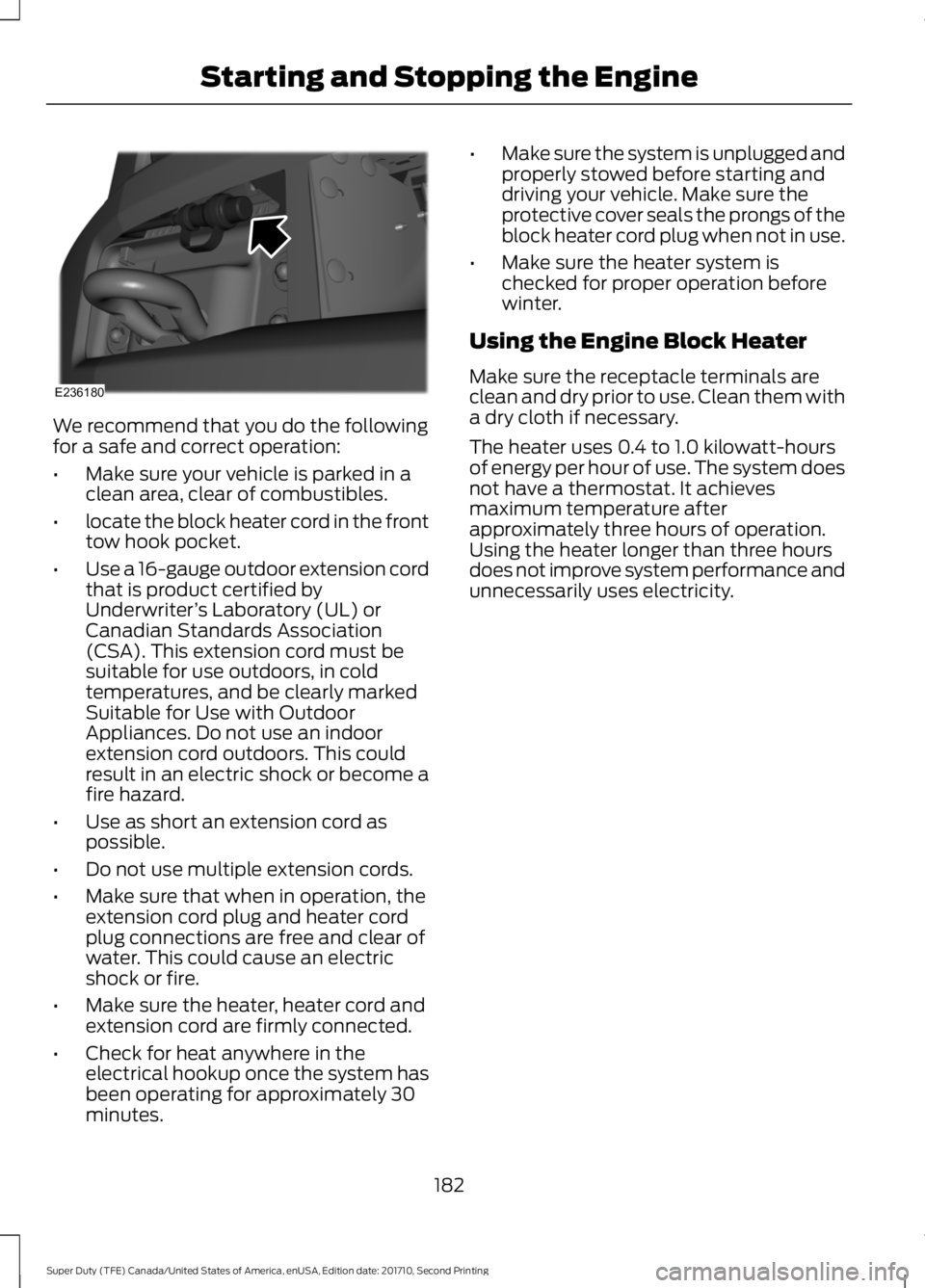
We recommend that you do the followingfor a safe and correct operation:
•Make sure your vehicle is parked in aclean area, clear of combustibles.
•locate the block heater cord in the fronttow hook pocket.
•Use a 16-gauge outdoor extension cordthat is product certified byUnderwriter’s Laboratory (UL) orCanadian Standards Association(CSA). This extension cord must besuitable for use outdoors, in coldtemperatures, and be clearly markedSuitable for Use with OutdoorAppliances. Do not use an indoorextension cord outdoors. This couldresult in an electric shock or become afire hazard.
•Use as short an extension cord aspossible.
•Do not use multiple extension cords.
•Make sure that when in operation, theextension cord plug and heater cordplug connections are free and clear ofwater. This could cause an electricshock or fire.
•Make sure the heater, heater cord andextension cord are firmly connected.
•Check for heat anywhere in theelectrical hookup once the system hasbeen operating for approximately 30minutes.
•Make sure the system is unplugged andproperly stowed before starting anddriving your vehicle. Make sure theprotective cover seals the prongs of theblock heater cord plug when not in use.
•Make sure the heater system ischecked for proper operation beforewinter.
Using the Engine Block Heater
Make sure the receptacle terminals areclean and dry prior to use. Clean them witha dry cloth if necessary.
The heater uses 0.4 to 1.0 kilowatt-hoursof energy per hour of use. The system doesnot have a thermostat. It achievesmaximum temperature afterapproximately three hours of operation.Using the heater longer than three hoursdoes not improve system performance andunnecessarily uses electricity.
182
Super Duty (TFE) Canada/United States of America, enUSA, Edition date: 201710, Second Printing
Starting and Stopping the EngineE236180