lock FORD F650 2000 10.G Owner's Guide
[x] Cancel search | Manufacturer: FORD, Model Year: 2000, Model line: F650, Model: FORD F650 2000 10.GPages: 208, PDF Size: 1.08 MB
Page 127 of 208
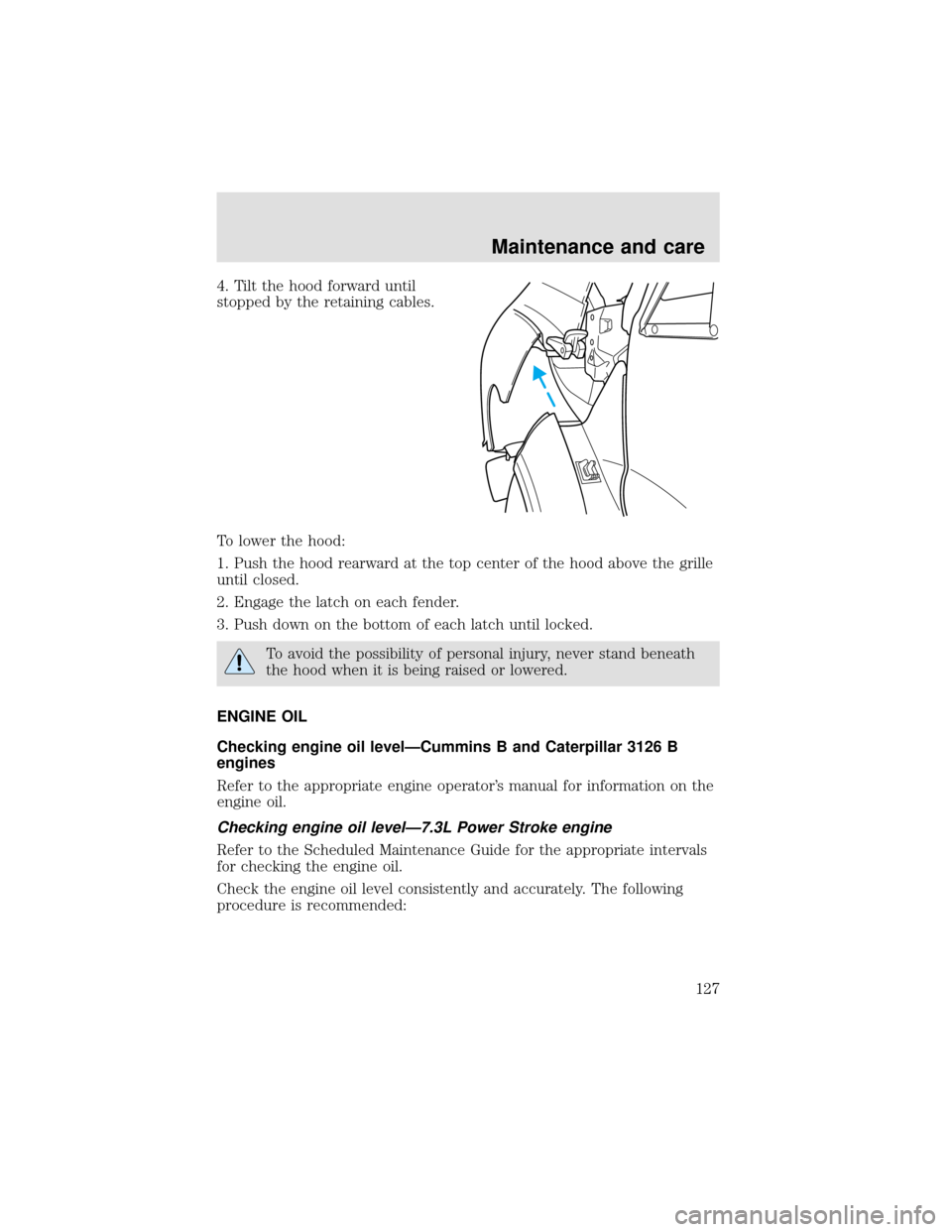
4. Tilt the hood forward until
stopped by the retaining cables.
To lower the hood:
1. Push the hood rearward at the top center of the hood above the grille
until closed.
2. Engage the latch on each fender.
3. Push down on the bottom of each latch until locked.
To avoid the possibility of personal injury, never stand beneath
the hood when it is being raised or lowered.
ENGINE OIL
Checking engine oil level—Cummins B and Caterpillar 3126 B
engines
Refer to the appropriate engine operator’s manual for information on the
engine oil.
Checking engine oil level—7.3L Power Stroke engine
Refer to the Scheduled Maintenance Guide for the appropriate intervals
for checking the engine oil.
Check the engine oil level consistently and accurately. The following
procedure is recommended:
Maintenance and care
127
Page 134 of 208
ENGINE COOLANT
Checking coolant level
Refer to the Scheduled Maintenance
Guide for the appropriate intervals
for checking the engine coolant
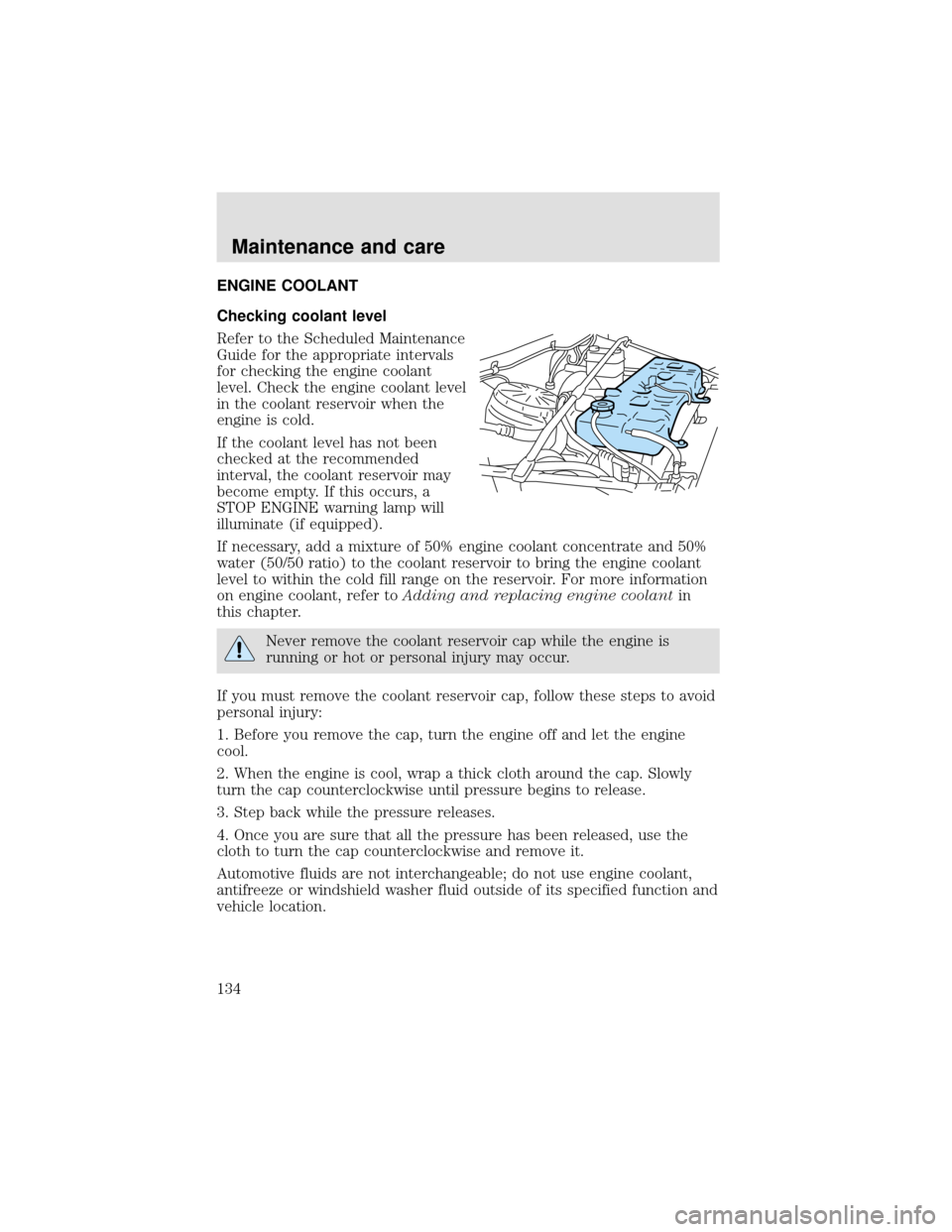
level. Check the engine coolant level
in the coolant reservoir when the
engine is cold.
If the coolant level has not been
checked at the recommended
interval, the coolant reservoir may
become empty. If this occurs, a
STOP ENGINE warning lamp will
illuminate (if equipped).
If necessary, add a mixture of 50% engine coolant concentrate and 50%
water (50/50 ratio) to the coolant reservoir to bring the engine coolant
level to within the cold fill range on the reservoir. For more information
on engine coolant, refer toAdding and replacing engine coolantin
this chapter.
Never remove the coolant reservoir cap while the engine is
running or hot or personal injury may occur.
If you must remove the coolant reservoir cap, follow these steps to avoid
personal injury:
1. Before you remove the cap, turn the engine off and let the engine
cool.
2. When the engine is cool, wrap a thick cloth around the cap. Slowly
turn the cap counterclockwise until pressure begins to release.
3. Step back while the pressure releases.
4. Once you are sure that all the pressure has been released, use the
cloth to turn the cap counterclockwise and remove it.
Automotive fluids are not interchangeable; do not use engine coolant,
antifreeze or windshield washer fluid outside of its specified function and
vehicle location.
Maintenance and care
134
Page 144 of 208
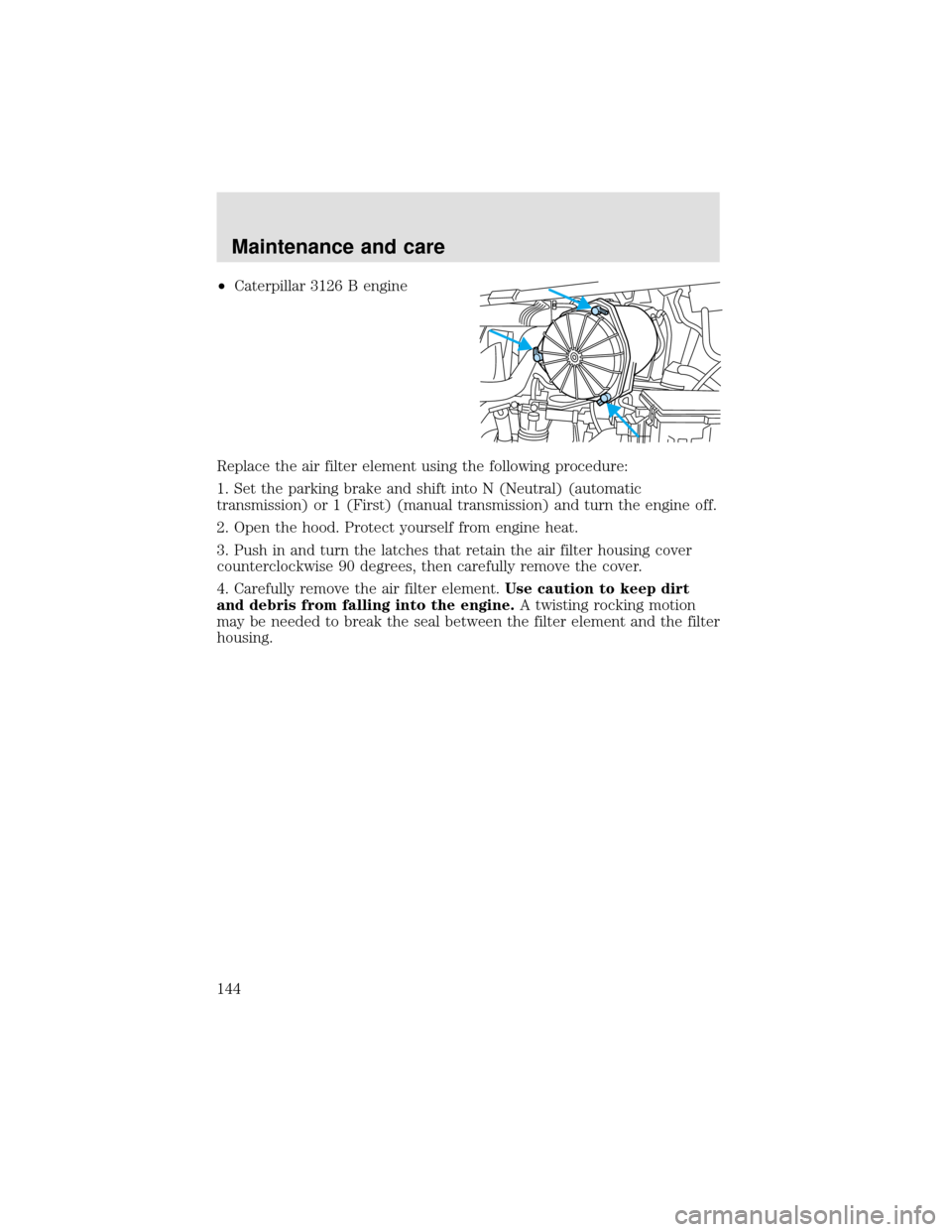
•Caterpillar 3126 B engine
Replace the air filter element using the following procedure:
1. Set the parking brake and shift into N (Neutral) (automatic
transmission) or 1 (First) (manual transmission) and turn the engine off.
2. Open the hood. Protect yourself from engine heat.
3. Push in and turn the latches that retain the air filter housing cover
counterclockwise 90 degrees, then carefully remove the cover.
4. Carefully remove the air filter element.Use caution to keep dirt
and debris from falling into the engine.A twisting rocking motion
may be needed to break the seal between the filter element and the filter
housing.
Maintenance and care
144
Page 145 of 208
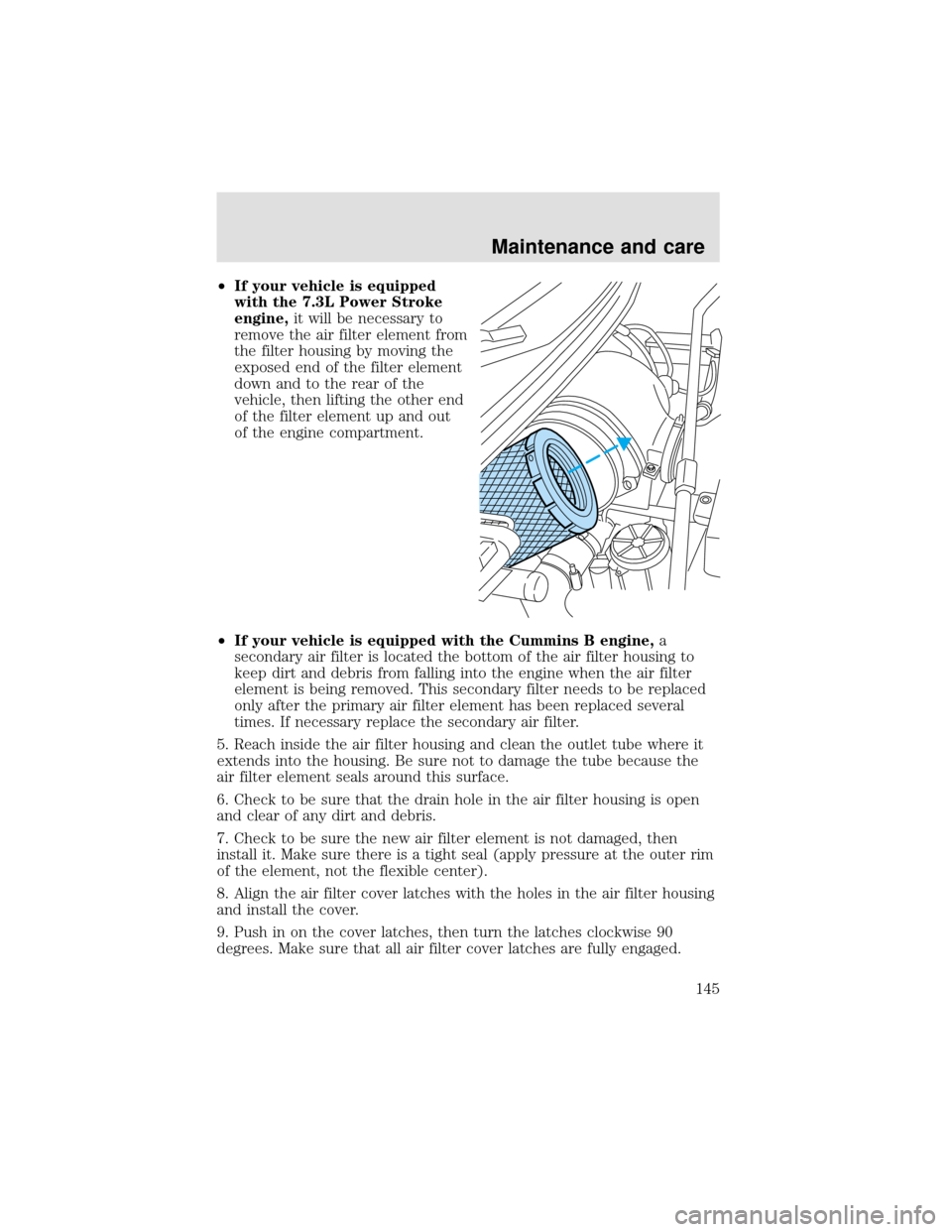
•If your vehicle is equipped
with the 7.3L Power Stroke
engine,it will be necessary to
remove the air filter element from
the filter housing by moving the
exposed end of the filter element
down and to the rear of the
vehicle, then lifting the other end
of the filter element up and out
of the engine compartment.
•If your vehicle is equipped with the Cummins B engine,a
secondary air filter is located the bottom of the air filter housing to
keep dirt and debris from falling into the engine when the air filter
element is being removed. This secondary filter needs to be replaced
only after the primary air filter element has been replaced several
times. If necessary replace the secondary air filter.
5. Reach inside the air filter housing and clean the outlet tube where it
extends into the housing. Be sure not to damage the tube because the
air filter element seals around this surface.
6. Check to be sure that the drain hole in the air filter housing is open
and clear of any dirt and debris.
7. Check to be sure the new air filter element is not damaged, then
install it. Make sure there is a tight seal (apply pressure at the outer rim
of the element, not the flexible center).
8. Align the air filter cover latches with the holes in the air filter housing
and install the cover.
9. Push in on the cover latches, then turn the latches clockwise 90
degrees. Make sure that all air filter cover latches are fully engaged.
Maintenance and care
145
Page 146 of 208
10. Reset the air filter restriction indicator.
11. Inspect the air induction system for loose fitting, damaged or missing
components and repair as necessary.
WINDSHIELD WIPER BLADES
Check the wiper blades at least twice a year or when they seem less
effective. Substances such as tree sap and some hot wax treatments used
by commercial car washes reduce the effectiveness of wiper blades.
Checking the wiper blades
If the wiper blades do not wipe properly, clean both the windshield and
wiper blades using undiluted windshield wiper solution or a mild
detergent. Rinse thoroughly with clean water. To avoid damaging the
blades, do not use fuel, kerosene, paint thinner or other solvents.
Changing the wiper blades
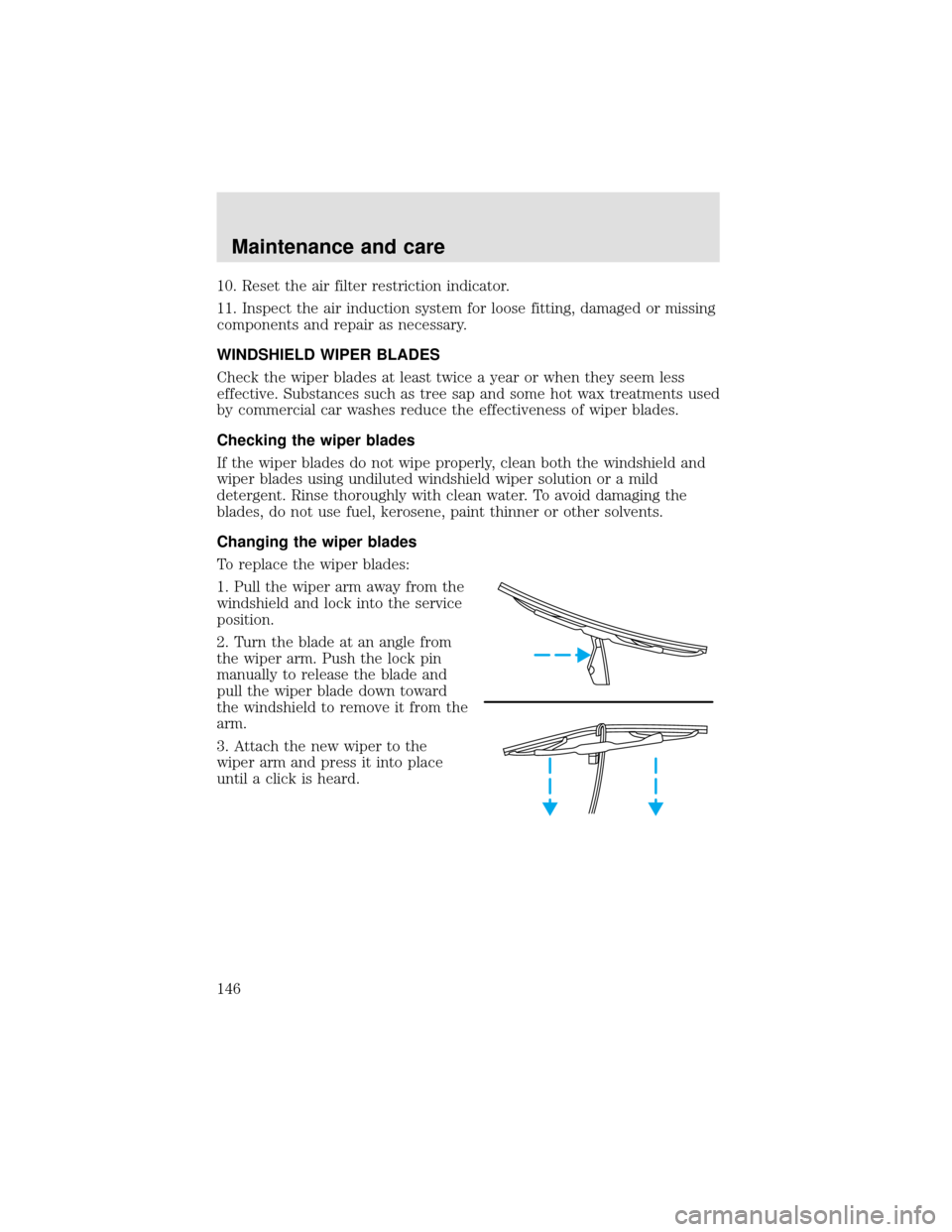
To replace the wiper blades:
1. Pull the wiper arm away from the
windshield and lock into the service
position.
2. Turn the blade at an angle from
the wiper arm. Push the lock pin
manually to release the blade and
pull the wiper blade down toward
the windshield to remove it from the
arm.
3. Attach the new wiper to the
wiper arm and press it into place
until a click is heard.
Maintenance and care
146
Page 154 of 208
Fuel filter/water separator
The fuel filter/water separator removes any contaminated particles
and/or water from the fuel before the fuel enters the engine.
The fuel filter/water separator should be drained as recommended in the
Scheduled Maintenance Guide.
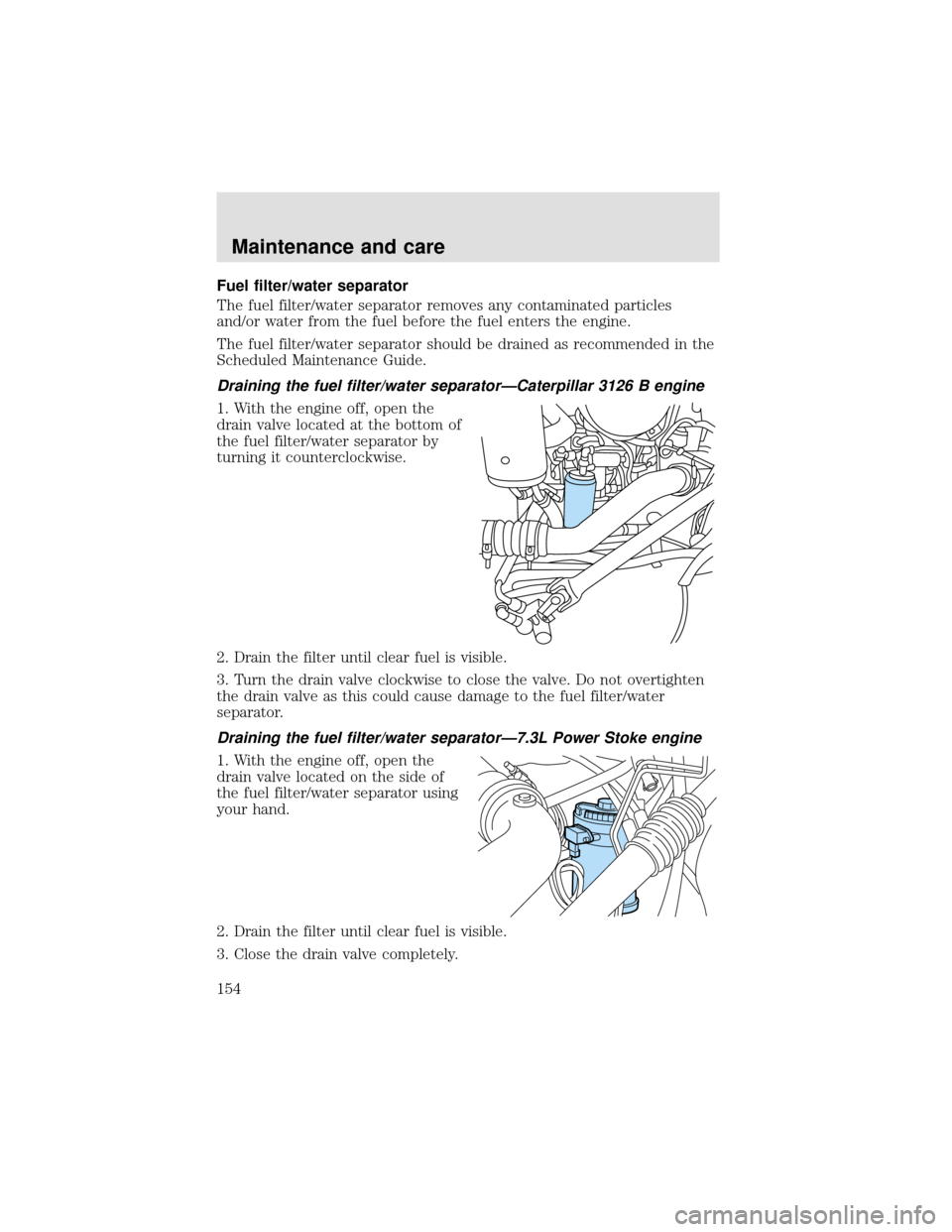
Draining the fuel filter/water separator—Caterpillar 3126 B engine
1. With the engine off, open the
drain valve located at the bottom of
the fuel filter/water separator by
turning it counterclockwise.
2. Drain the filter until clear fuel is visible.
3. Turn the drain valve clockwise to close the valve. Do not overtighten
the drain valve as this could cause damage to the fuel filter/water
separator.
Draining the fuel filter/water separator—7.3L Power Stoke engine
1. With the engine off, open the
drain valve located on the side of
the fuel filter/water separator using
your hand.
2. Drain the filter until clear fuel is visible.
3. Close the drain valve completely.
Maintenance and care
154
Page 156 of 208

Fuel filter replacement—7.3L Power Stroke engine
The fuel filter/water separator is
located on the right side of the
engine. Replace the fuel filter/water
separator as recommended in the
Scheduled Maintenance Guide, or
sooner if it becomes plugged.
Vehicles operated on fuel with more
than average impurities may require
replacement of the fuel filter more
frequently. The filter has a water
drain valve built into the bottom of
the filter housing.
Removal
1. Remove the fuel filter cap by
turning counterclockwise. The fuel
filter element will come out with the
cap.
2. Remove and discard the bevel gasket. Carefully clean the mating
surfaces.
3. Press in on the fuel filter element locking tabs to separate the element
from the cap.
Maintenance and care
156
Page 169 of 208

4Approximate quantities only, does not include external lines and cooler
hoses.
5Approximate quantities only, does not include external lines and cooler
hoses.
REAR AXLE REFILL CAPACITIES
Make and model Approximate capacity
Rockwell RS-17-144116.6L (35 pints)
Rockwell RS-17-1451, 216.6L (35 pints)
Rockwell RS-21-1451, 216.6L (35 pints)
Rockwell RS-23-1601, 218.9L (40 pints)
1Quantities listed are approximate. Fill axle until the lubricant level is at
bottom of filler hole, with vehicle on level ground.
2If hubs have been removed, add an additional 0.75 liter (1.6 pints) of
axle lubricant. Add lubricant through the axle vent.
FUEL TANK CAPACITIES
Type Approximate capacity
Single tank 189.0L (50 gallons)
Dual tank 378.6L (100 gallons)
LUBRICANT SPECIFICATIONS
Item Ford Part NameFord Part
NumberFord
Specification
Brake and clutch
fluid (if
equipped)High Performance
DOT 3 Motor
Vehicle Brake
FluidC6AZ-19542-AB ESA-M6C25-A
and DOT 3
Body hinges,
hood hinges and
latches.Multi-Purpose
GreaseD0AZ-19584-AA
or F5AZ-
19G209-AAESB-M1C93-B
or
ESR-M1C159-A
Lock cylinders Penetrating
LubricantE8AZ-19A501-B N/A
Capacities and specifications
169
Page 170 of 208

Item Ford Part NameFord Part
NumberFord
Specification
Front axle
spindle pins,
steering linkage,
front and rear
spring shackle
pins, steering
column U-joints,
steering shaft
slip yoke and
universal joint,
steering shaft
pillow block
bearing, clutch
linkage fittings.Premium Long
Life GreaseXG-1-C or
XG-1-KESA-M1C75-B
Bushings, front
wheel bearings
(grease packed
type)and seals,
fuel shut-off
solenoid linkage,
air brake control
valve, linkage,
treadle hinge and
roller,
transmission and
transmission
cables, clutch
release bearing
hub,
transmission
shift lever pivot.Premium Long
Life GreaseXG-1-C or
XG-1-KESA-M1C75-B
Door
weatherstripsSilicone Lubricant F7AZ-19G208-
BA and
F5AZ-19553-AAESR-M13P4-A
Driveshaft
U-joints and slip
splines, power
steering gear
output shaft.High Temperature
4 x 4 Front Axle
and Wheel
Bearing GreaseE8TZ-19590-A ESA-M1C198-A
Capacities and specifications
170
Page 187 of 208
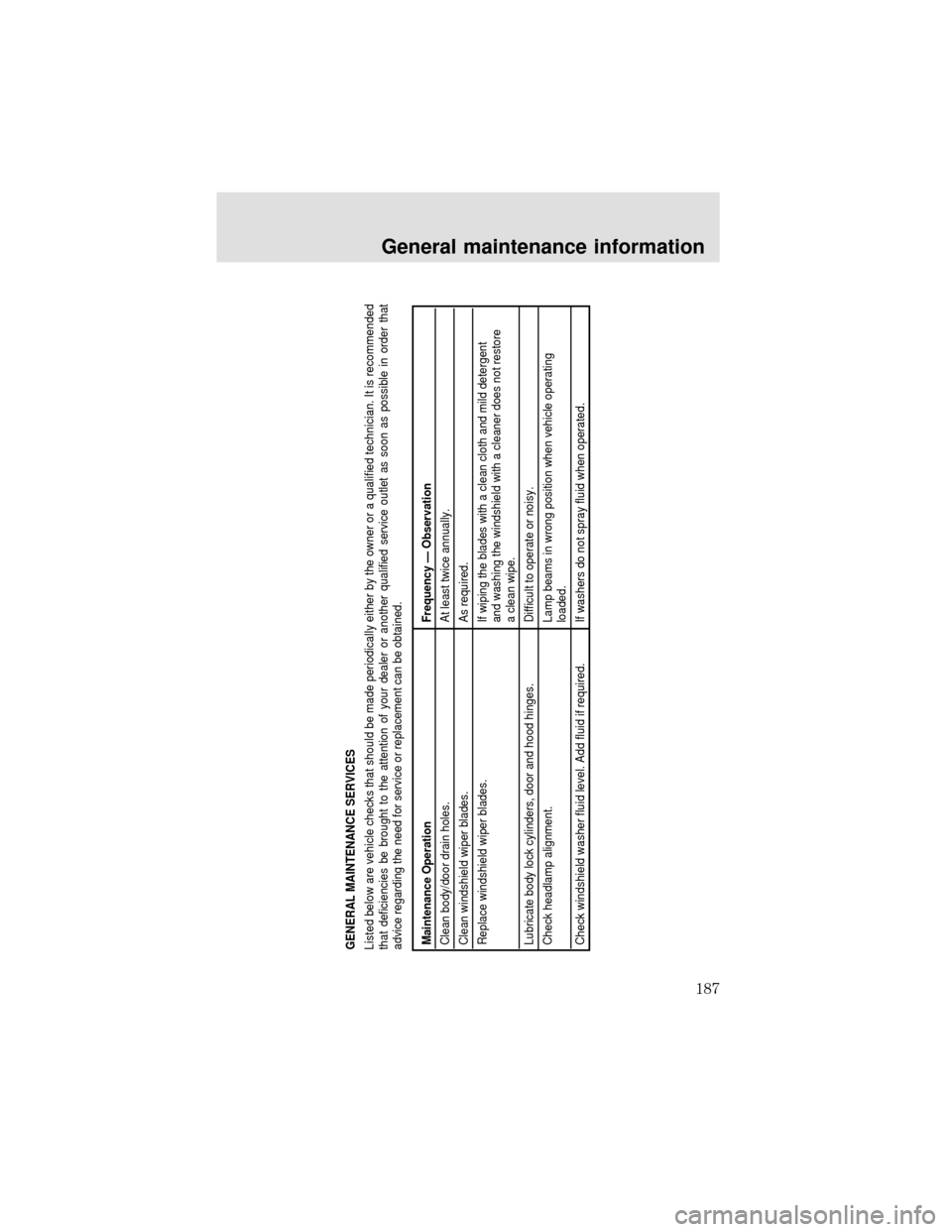
Maintenance Operation Frequency — ObservationClean body/door drain holes.
Clean windshield wiper blades.
Replace windshield wiper blades.
Lubricate body lock cylinders, door and hood hinges.
Check headlamp alignment.
Check windshield washer fluid level. Add fluid if required.At least twice annually.
As required.
If wiping the blades with a clean cloth and mild detergent
and washing the windshield with a cleaner does not restore
a clean wipe.
Difficult to operate or noisy.
Lamp beams in wrong position when vehicle operating
loaded.
If washers do not spray fluid when operated. GENERAL MAINTENANCE SERVICES
Listed below are vehicle checks that should be made periodically either by the owner or a qualified technician. It is recommended
that deficiencies be brought to the attention of your dealer or another qualified service outlet as soon as possible in order that
advice regarding the need for service or replacement can be obtained.
General maintenance information
187