light FORD F650 2004 11.G Owner's Manual
[x] Cancel search | Manufacturer: FORD, Model Year: 2004, Model line: F650, Model: FORD F650 2004 11.GPages: 264, PDF Size: 1.47 MB
Page 48 of 264
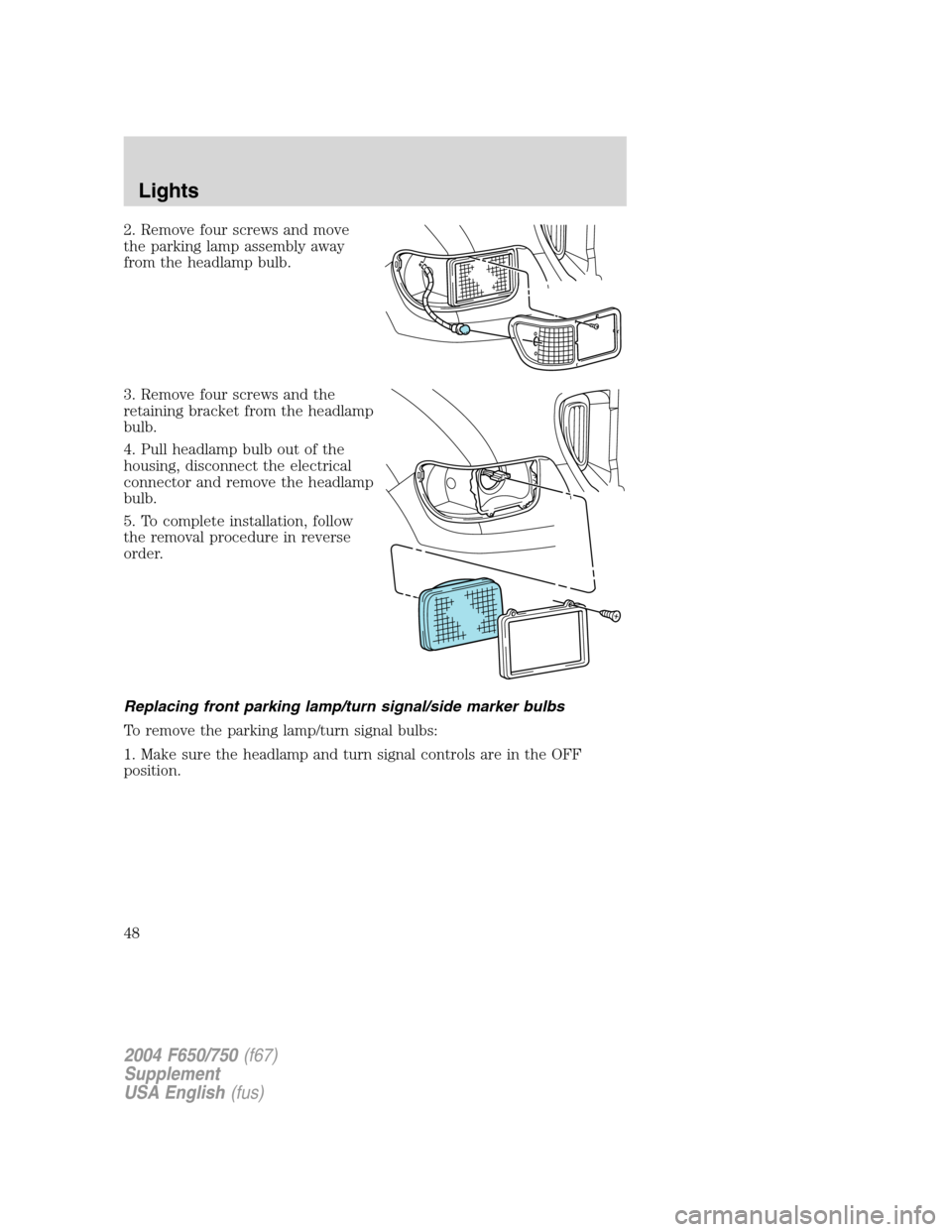
2. Remove four screws and move
the parking lamp assembly away
from the headlamp bulb.
3. Remove four screws and the
retaining bracket from the headlamp
bulb.
4. Pull headlamp bulb out of the
housing, disconnect the electrical
connector and remove the headlamp
bulb.
5. To complete installation, follow
the removal procedure in reverse
order.
Replacing front parking lamp/turn signal/side marker bulbs
To remove the parking lamp/turn signal bulbs:
1. Make sure the headlamp and turn signal controls are in the OFF
position.
2004 F650/750(f67)
Supplement
USA English(fus)
Lights
48
Page 49 of 264
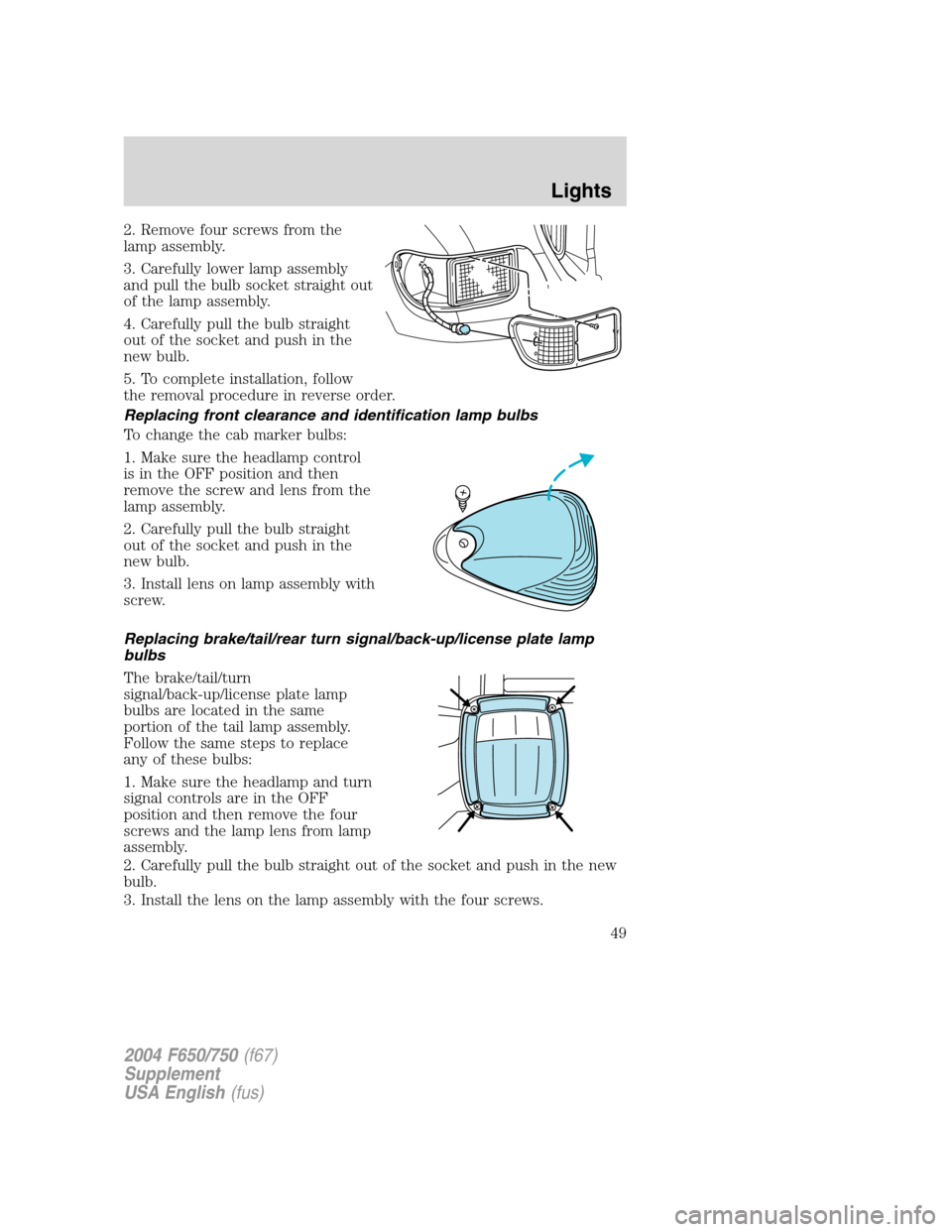
2. Remove four screws from the
lamp assembly.
3. Carefully lower lamp assembly
and pull the bulb socket straight out
of the lamp assembly.
4. Carefully pull the bulb straight
out of the socket and push in the
new bulb.
5. To complete installation, follow
the removal procedure in reverse order.
Replacing front clearance and identification lamp bulbs
To change the cab marker bulbs:
1. Make sure the headlamp control
is in the OFF position and then
remove the screw and lens from the
lamp assembly.
2. Carefully pull the bulb straight
out of the socket and push in the
new bulb.
3. Install lens on lamp assembly with
screw.
Replacing brake/tail/rear turn signal/back-up/license plate lamp
bulbs
The brake/tail/turn
signal/back-up/license plate lamp
bulbs are located in the same
portion of the tail lamp assembly.
Follow the same steps to replace
any of these bulbs:
1. Make sure the headlamp and turn
signal controls are in the OFF
position and then remove the four
screws and the lamp lens from lamp
assembly.
2. Carefully pull the bulb straight out of the socket and push in the new
bulb.
3. Install the lens on the lamp assembly with the four screws.
2004 F650/750(f67)
Supplement
USA English(fus)
Lights
49
Page 52 of 264
Never adjust the steering wheel when the vehicle is moving.
AUXILIARY POWER POINT
Power points are designed for
accessory plugs only. Do not
hang any type of accessory or
accessory bracket from the plug.
Improper use of the power point
can cause damage not covered
by your warranty.
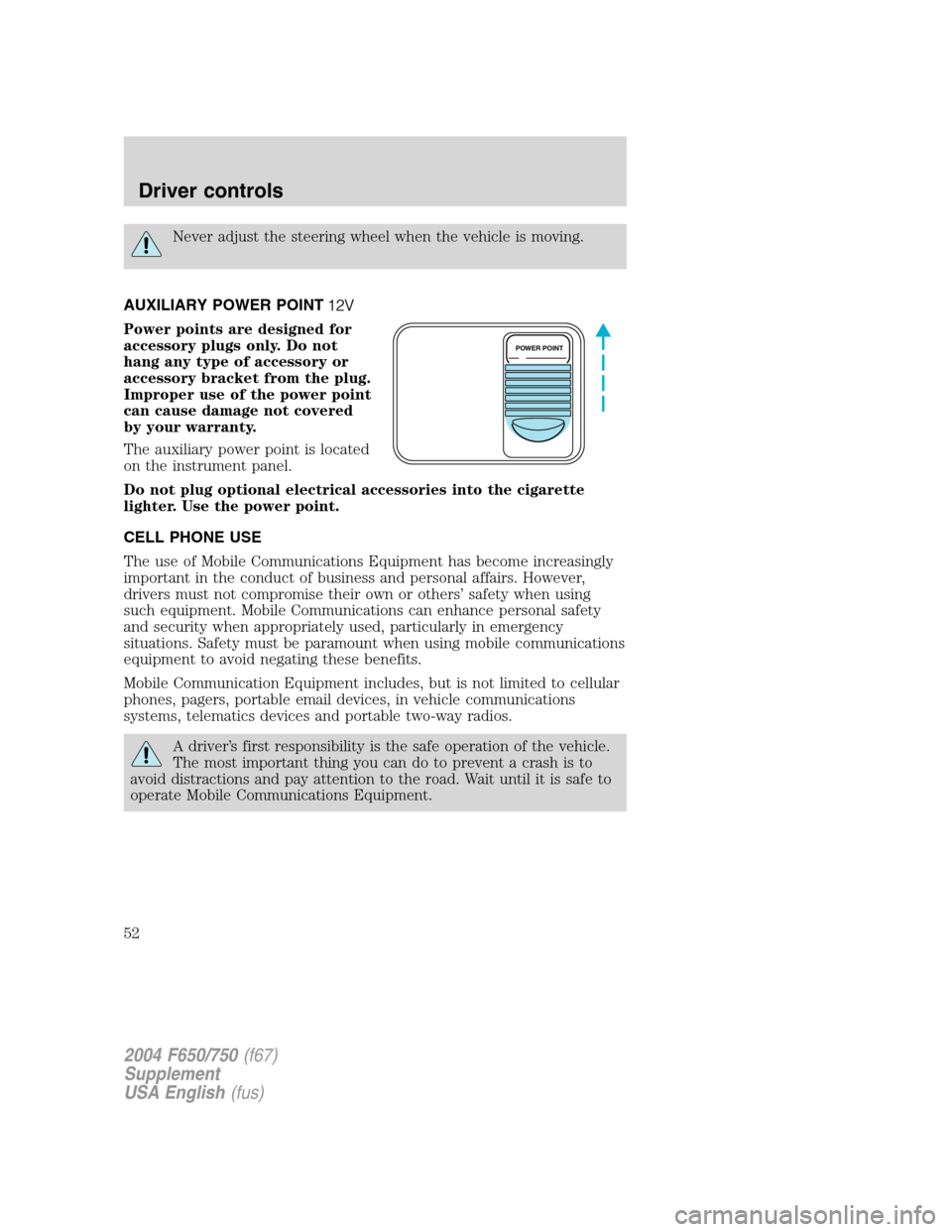
The auxiliary power point is located
on the instrument panel.
Do not plug optional electrical accessories into the cigarette
lighter. Use the power point.
CELL PHONE USE
The use of Mobile Communications Equipment has become increasingly
important in the conduct of business and personal affairs. However,
drivers must not compromise their own or others’safety when using
such equipment. Mobile Communications can enhance personal safety
and security when appropriately used, particularly in emergency
situations. Safety must be paramount when using mobile communications
equipment to avoid negating these benefits.
Mobile Communication Equipment includes, but is not limited to cellular
phones, pagers, portable email devices, in vehicle communications
systems, telematics devices and portable two-way radios.
A driver’s first responsibility is the safe operation of the vehicle.
The most important thing you can do to prevent a crash is to
avoid distractions and pay attention to the road. Wait until it is safe to
operate Mobile Communications Equipment.
POWER POINT
2004 F650/750(f67)
Supplement
USA English(fus)
Driver controls
52
Page 72 of 264
To lower the shoulder belt height, push the button and slide the height
adjuster down. To raise the height of the shoulder belt, slide the height
adjuster up. Pull down on the height adjuster to make sure it is locked in
place.
Position the safety belt height adjusters so that the belt rests
across the middle of your shoulder. Failure to adjust the safety
belt properly could reduce the effectiveness of the seat belt and
increase the risk of injury in a collision.
Lap belts
The front center and rear center lap belts do not adjust automatically.
The lap belt should fit snugly and as low as possible around the
hips, not across the waist.
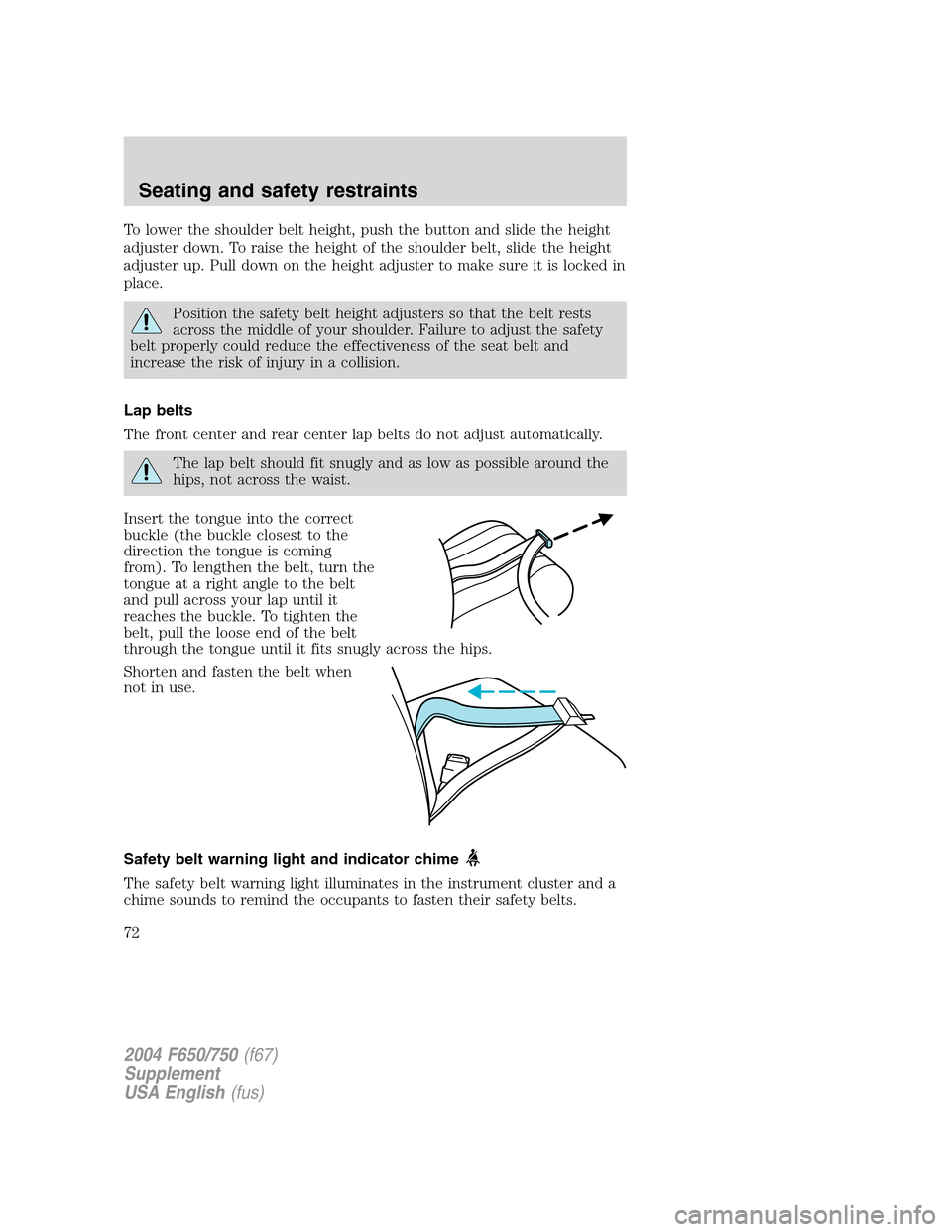
Insert the tongue into the correct
buckle (the buckle closest to the
direction the tongue is coming
from). To lengthen the belt, turn the
tongue at a right angle to the belt
and pull across your lap until it
reaches the buckle. To tighten the
belt, pull the loose end of the belt
through the tongue until it fits snugly across the hips.
Shorten and fasten the belt when
not in use.
Safety belt warning light and indicator chime
The safety belt warning light illuminates in the instrument cluster and a
chime sounds to remind the occupants to fasten their safety belts.
2004 F650/750(f67)
Supplement
USA English(fus)
Seating and safety restraints
72
Page 73 of 264
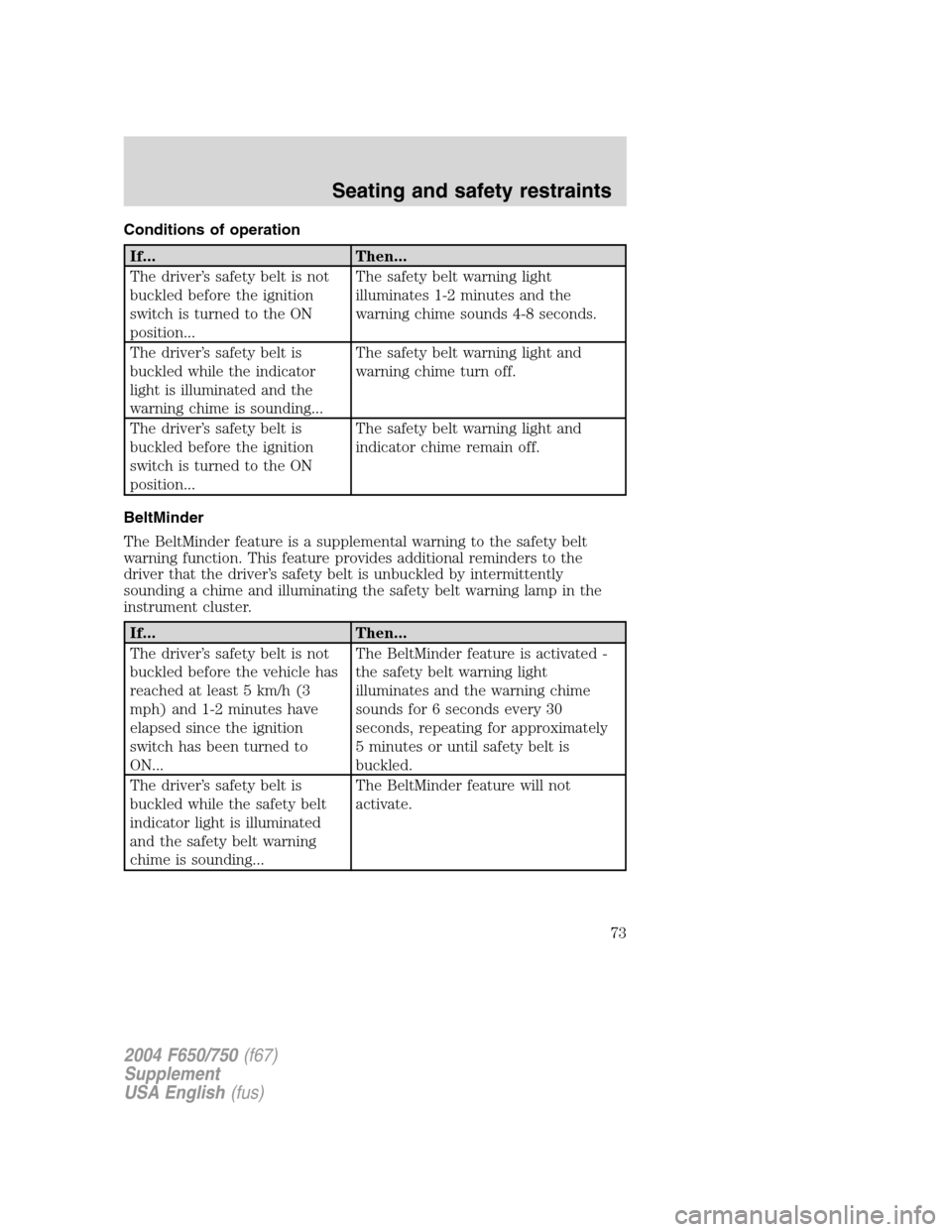
Conditions of operation
If... Then...
The driver’s safety belt is not
buckled before the ignition
switch is turned to the ON
position...The safety belt warning light
illuminates 1-2 minutes and the
warning chime sounds 4-8 seconds.
The driver’s safety belt is
buckled while the indicator
light is illuminated and the
warning chime is sounding...The safety belt warning light and
warning chime turn off.
The driver’s safety belt is
buckled before the ignition
switch is turned to the ON
position...The safety belt warning light and
indicator chime remain off.
BeltMinder
The BeltMinder feature is a supplemental warning to the safety belt
warning function. This feature provides additional reminders to the
driver that the driver’s safety belt is unbuckled by intermittently
sounding a chime and illuminating the safety belt warning lamp in the
instrument cluster.
If... Then...
The driver’s safety belt is not
buckled before the vehicle has
reached at least 5 km/h (3
mph) and 1-2 minutes have
elapsed since the ignition
switch has been turned to
ON...The BeltMinder feature is activated -
the safety belt warning light
illuminates and the warning chime
sounds for 6 seconds every 30
seconds, repeating for approximately
5 minutes or until safety belt is
buckled.
The driver’s safety belt is
buckled while the safety belt
indicator light is illuminated
and the safety belt warning
chime is sounding...The BeltMinder feature will not
activate.
2004 F650/750(f67)
Supplement
USA English(fus)
Seating and safety restraints
73
Page 74 of 264
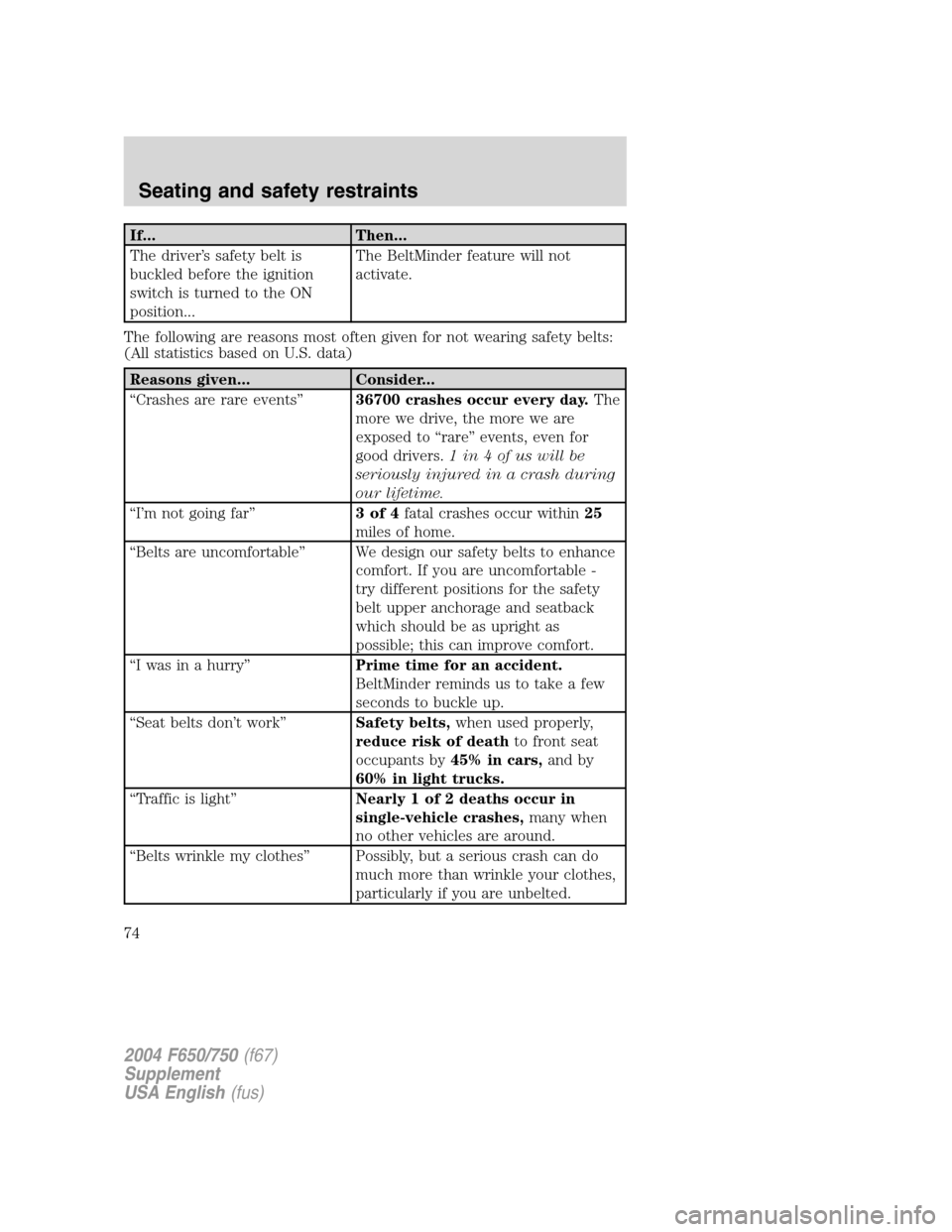
If... Then...
The driver’s safety belt is
buckled before the ignition
switch is turned to the ON
position...The BeltMinder feature will not
activate.
The following are reasons most often given for not wearing safety belts:
(All statistics based on U.S. data)
Reasons given... Consider...
“Crashes are rare events”36700 crashes occur every day.The
more we drive, the more we are
exposed to“rare”events, even for
good drivers.1 in 4 of us will be
seriously injured in a crash during
our lifetime.
“I’m not going far”3of4fatal crashes occur within25
miles of home.
“Belts are uncomfortable”We design our safety belts to enhance
comfort. If you are uncomfortable -
try different positions for the safety
belt upper anchorage and seatback
which should be as upright as
possible; this can improve comfort.
“I was in a hurry”Prime time for an accident.
BeltMinder reminds us to take a few
seconds to buckle up.
“Seat belts don’t work”Safety belts,when used properly,
reduce risk of deathto front seat
occupants by45% in cars,and by
60% in light trucks.
“Traffic is light”Nearly 1 of 2 deaths occur in
single-vehicle crashes,many when
no other vehicles are around.
“Belts wrinkle my clothes”Possibly, but a serious crash can do
much more than wrinkle your clothes,
particularly if you are unbelted.
2004 F650/750(f67)
Supplement
USA English(fus)
Seating and safety restraints
74
Page 76 of 264
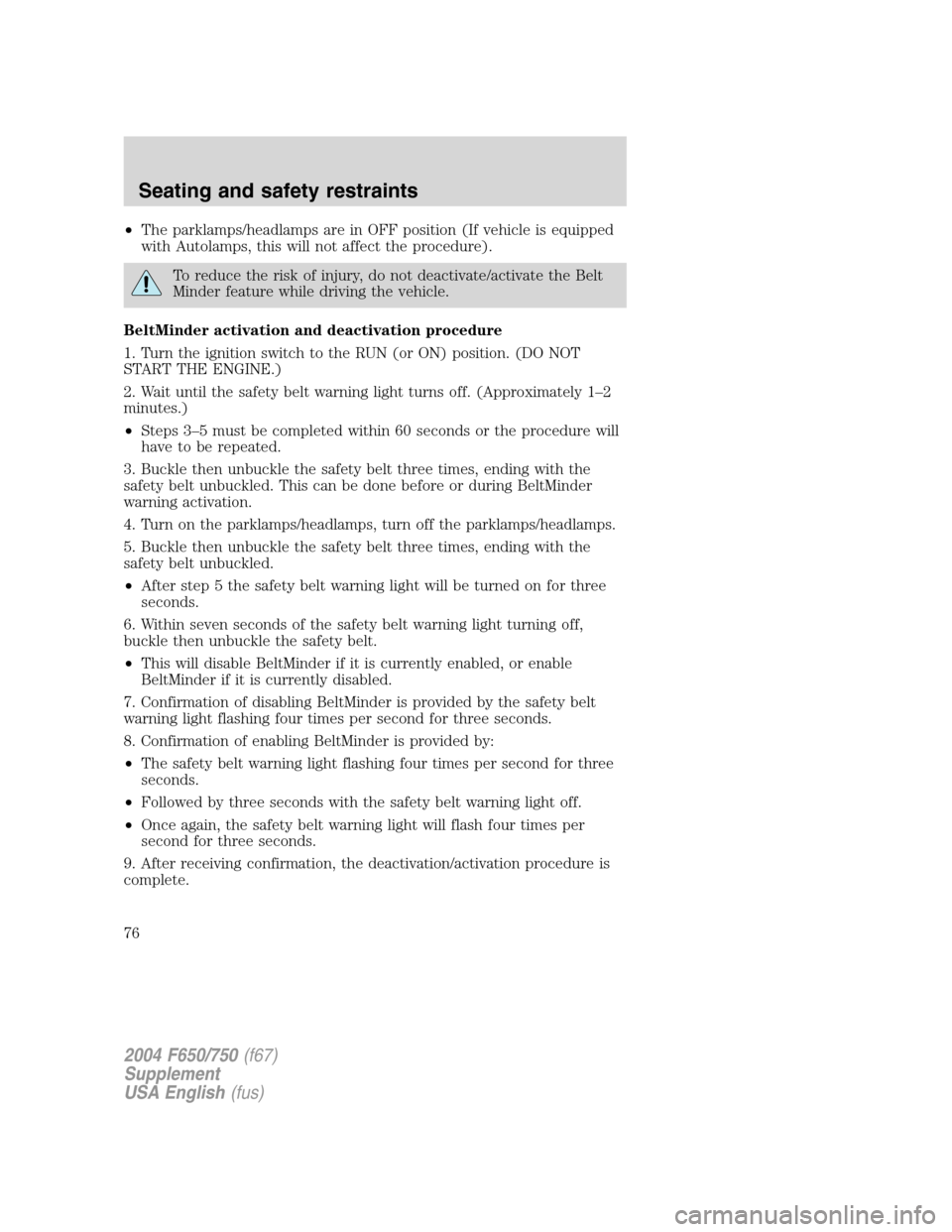
•The parklamps/headlamps are in OFF position (If vehicle is equipped
with Autolamps, this will not affect the procedure).
To reduce the risk of injury, do not deactivate/activate the Belt
Minder feature while driving the vehicle.
BeltMinder activation and deactivation procedure
1. Turn the ignition switch to the RUN (or ON) position. (DO NOT
START THE ENGINE.)
2. Wait until the safety belt warning light turns off. (Approximately 1–2
minutes.)
•Steps 3–5 must be completed within 60 seconds or the procedure will
have to be repeated.
3. Buckle then unbuckle the safety belt three times, ending with the
safety belt unbuckled. This can be done before or during BeltMinder
warning activation.
4. Turn on the parklamps/headlamps, turn off the parklamps/headlamps.
5. Buckle then unbuckle the safety belt three times, ending with the
safety belt unbuckled.
•After step 5 the safety belt warning light will be turned on for three
seconds.
6. Within seven seconds of the safety belt warning light turning off,
buckle then unbuckle the safety belt.
•This will disable BeltMinder if it is currently enabled, or enable
BeltMinder if it is currently disabled.
7. Confirmation of disabling BeltMinder is provided by the safety belt
warning light flashing four times per second for three seconds.
8. Confirmation of enabling BeltMinder is provided by:
•The safety belt warning light flashing four times per second for three
seconds.
•Followed by three seconds with the safety belt warning light off.
•Once again, the safety belt warning light will flash four times per
second for three seconds.
9. After receiving confirmation, the deactivation/activation procedure is
complete.
2004 F650/750(f67)
Supplement
USA English(fus)
Seating and safety restraints
76
Page 86 of 264
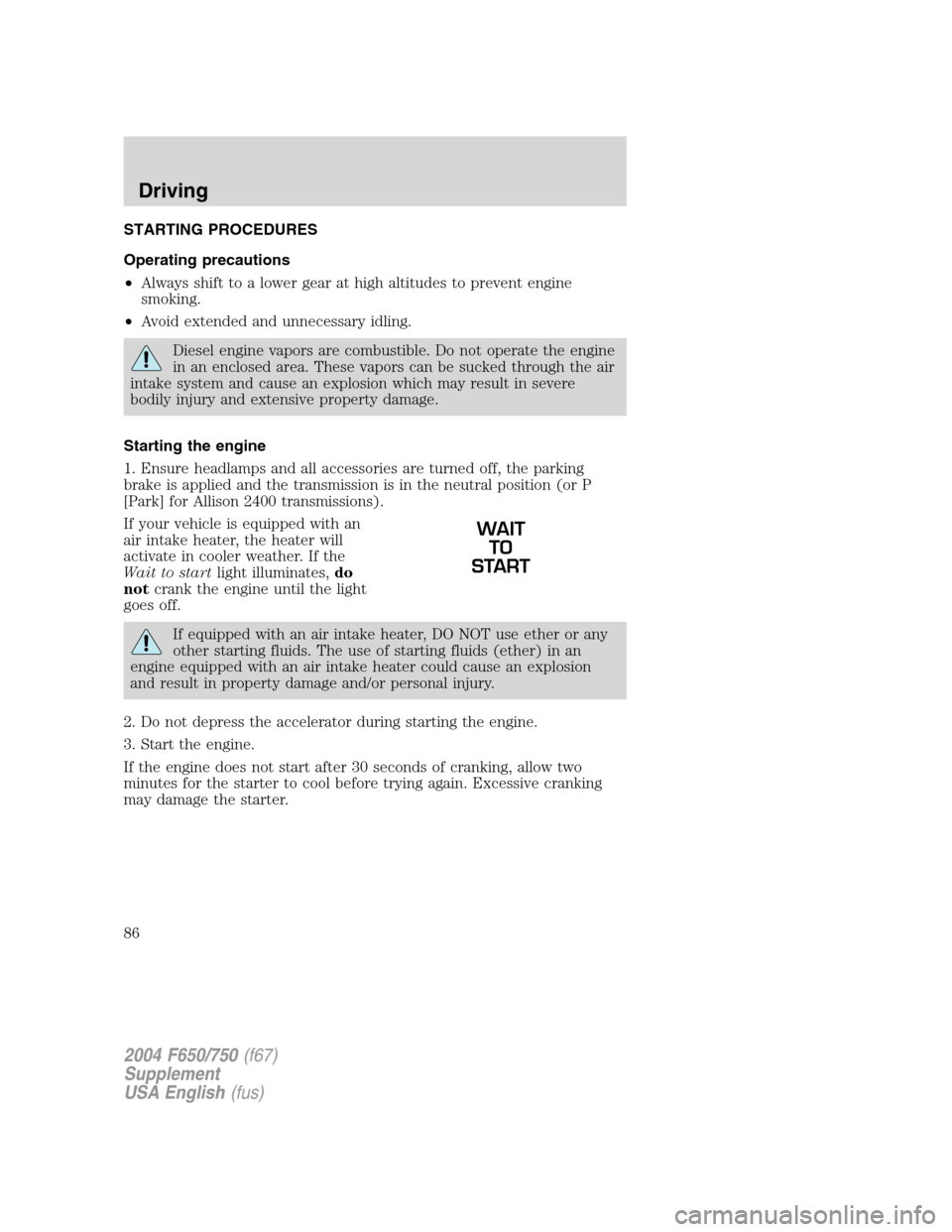
STARTING PROCEDURES
Operating precautions
•Always shift to a lower gear at high altitudes to prevent engine
smoking.
•Avoid extended and unnecessary idling.
Diesel engine vapors are combustible. Do not operate the engine
in an enclosed area. These vapors can be sucked through the air
intake system and cause an explosion which may result in severe
bodily injury and extensive property damage.
Starting the engine
1. Ensure headlamps and all accessories are turned off, the parking
brake is applied and the transmission is in the neutral position (or P
[Park] for Allison 2400 transmissions).
If your vehicle is equipped with an
air intake heater, the heater will
activate in cooler weather. If the
Wait to startlight illuminates,do
notcrank the engine until the light
goes off.
If equipped with an air intake heater, DO NOT use ether or any
other starting fluids. The use of starting fluids (ether) in an
engine equipped with an air intake heater could cause an explosion
and result in property damage and/or personal injury.
2. Do not depress the accelerator during starting the engine.
3. Start the engine.
If the engine does not start after 30 seconds of cranking, allow two
minutes for the starter to cool before trying again. Excessive cranking
may damage the starter.
WAIT
TO
START
2004 F650/750(f67)
Supplement
USA English(fus)
Driving
Driving
86
Page 87 of 264
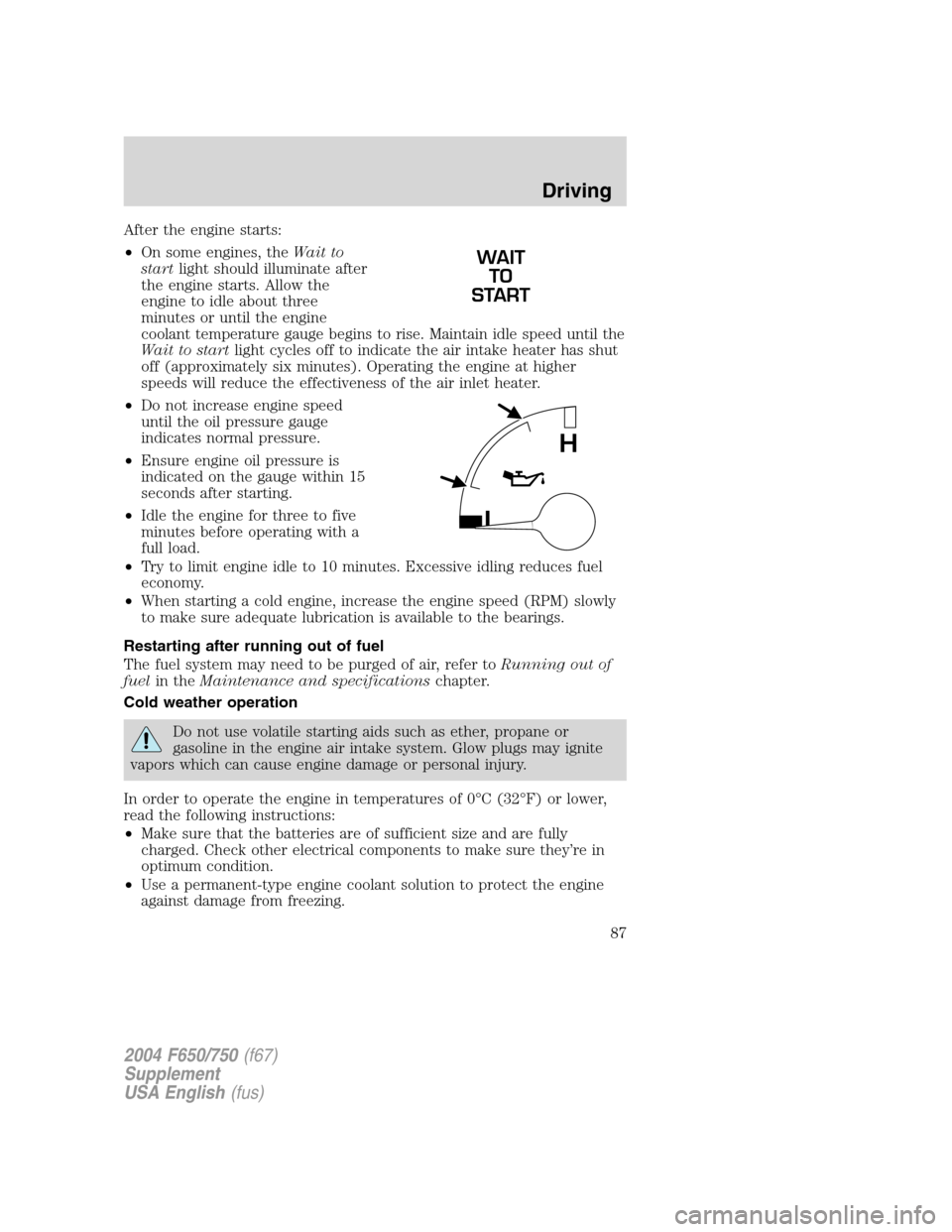
After the engine starts:
•On some engines, theWait to
startlight should illuminate after
the engine starts. Allow the
engine to idle about three
minutes or until the engine
coolant temperature gauge begins to rise. Maintain idle speed until the
Wait to startlight cycles off to indicate the air intake heater has shut
off (approximately six minutes). Operating the engine at higher
speeds will reduce the effectiveness of the air inlet heater.
•Do not increase engine speed
until the oil pressure gauge
indicates normal pressure.
•Ensure engine oil pressure is
indicated on the gauge within 15
seconds after starting.
•Idle the engine for three to five
minutes before operating with a
full load.
•Try to limit engine idle to 10 minutes. Excessive idling reduces fuel
economy.
•When starting a cold engine, increase the engine speed (RPM) slowly
to make sure adequate lubrication is available to the bearings.
Restarting after running out of fuel
The fuel system may need to be purged of air, refer toRunning out of
fuelin theMaintenance and specificationschapter.
Cold weather operation
Do not use volatile starting aids such as ether, propane or
gasoline in the engine air intake system. Glow plugs may ignite
vapors which can cause engine damage or personal injury.
In order to operate the engine in temperatures of 0°C (32°F) or lower,
read the following instructions:
•Make sure that the batteries are of sufficient size and are fully
charged. Check other electrical components to make sure they’re in
optimum condition.
•Use a permanent-type engine coolant solution to protect the engine
against damage from freezing.
WAIT
TO
START
L
H
2004 F650/750(f67)
Supplement
USA English(fus)
Driving
87
Page 89 of 264
Hot weather operation
•Keep the engine cooling system filled with a clean, permanent coolant
solution to protect against damage from overheating.
•Fill the fuel tank at the end of daily operation to prevent condensation
in the fuel system.
•Keep external surfaces of the engine, radiator, charge air cooler, A/C
condenser and accessories clean to avoid dirt build-up.
Above normal coolant temperatures could be experienced while driving
in a transmission gear ratio which lugs the engine. To correct this
problem, engine speed should be increased by downshifting in to the
next lower gear to increase engine RPM.
Starting a turbocharged engine with the vehicle on a steep grade
When starting a naturally aspirated Diesel engine when the loaded
vehicle is on a grade, the engine RPM will start to fall slightly when the
clutch is engaged, but quickly recovers as the vehicle begins moving.
Turbocharged Diesel engines act differently; once the clutch is engaged,
the engine RPM will fall significantly. When the engine RPM first falls, do
not disengage the clutch and try to increase engine RPM as this may
damage driveline components. After the initial drop in engine RPM, the
engine will recover by itself and accelerate in a normal manner.
GENERAL OPERATING INSTRUCTIONS
•Start the vehicle in motion by using the highest gear speed in the
transmission that will let the engine easily start the load without
slipping the clutch.
•Accelerate smoothly and evenly; rapid acceleration increases fuel
consumption without increasing engine performance.
•When approaching a hill, depress the accelerator smoothly to start the
incline at full power, then shift down as needed to maintain vehicle
speed.
•When going down a hill, or long steep grades, prevent over-speeding
of the engine. The engine governor has no control over engine speed
when it is being pushed by a loaded vehicle.
2004 F650/750(f67)
Supplement
USA English(fus)
Driving
89