light FORD F650 2004 11.G Repair Manual
[x] Cancel search | Manufacturer: FORD, Model Year: 2004, Model line: F650, Model: FORD F650 2004 11.GPages: 264, PDF Size: 1.47 MB
Page 170 of 264
ENGINE COOLING SYSTEM
Inspect cooling system daily
Note:The de-aeration tank requires air space for expansion volume. The
proper fill level is identified on the reservoir; do not overfill the reservoir.
To reduce the risk of personal injury or death, use only the
following procedure to remove the pressure-type cap from the
radiator or expansion tank.
1. Always allow the engine to cool first.
2. Wrap a thick, heavy cloth around the cap.
3. Loosen the cap slowly, then pause a moment. This will reduce the risk
of possible scalding by hot water or steam.
4. Continue to unscrew the cap and remove only after pressure in the
radiator is fully released.
Note:If the coolant should get extremely low and the engine very hot,
let the engine cool for approximately 15 minutes before adding coolant.
After the engine has cooled, start the engine and add coolant slowly.
Adding coolant to a hot engine may crack the cylinder head or
crankcase. Never use only water to fill the cooling system.
Adding engine coolant - 6.0L Power Stroke
When adding coolant, make sure it is a 50/50 mixture of engine coolant
and distilled water. Add the mixture to the coolant reservoir,when the
engine is cool, until the appropriate fill level is obtained.
For vehicles with overflow coolant systems with a non-pressurized cap
on the coolant recovery system, add coolant to the coolant recovery
reservoir when the engine is cool. Add the proper mixture of coolant and
water to the“cold full”level. For all other vehicles, which have a coolant
degas system with a pressurized cap, or if it is necessary to remove the
coolant pressure relief cap on the radiator of a vehicle with an overflow
system, follow these steps to add engine coolant.
To reduce the risk of personal injury, make sure the engine is
cool before unscrewing the coolant pressure relief cap. The
cooling system is under pressure; steam and hot liquid can come out
forcefully when the cap is loosened slightly.
2004 F650/750(f67)
Supplement
USA English(fus)
Maintenance and specifications
170
Page 177 of 264
For longer, trouble-free operation, keep the top of the batteries clean
and dry. Also, make certain the battery cables are always tightly fastened
to the battery terminals.
If you see any corrosion on the battery or terminals, remove the cables
from the terminals and clean with a wire brush. You can neutralize the
acid with a solution of baking soda and water.
Batteries normally produce explosive gases which can cause
personal injury. Therefore, do not allow flames, sparks or lighted
substances to come near the battery. When working near the battery,
always shield your face and protect your eyes. Always provide proper
ventilation.
When lifting a plastic-cased battery, excessive pressure on the
end walls could cause acid to flow through the vent caps,
resulting in personal injury and/or damage to the vehicle or battery.
Lift the battery with a battery carrier or with your hands on opposite
corners.
Keep batteries out of reach of children. Batteries contain sulfuric
acid. Avoid contact with skin, eyes or clothing. Shield your eyes
when working near the battery to protect against possible splashing of
acid solution. In case of acid contact with skin or eyes, flush
immediately with water for a minimum of 15 minutes and get prompt
medical attention. If acid is swallowed, call a physician immediately.
Battery posts, terminals and related accessories contain lead and
lead compounds.Wash hands after handling.
Always dispose of automotive
batteries in a responsible manner.
Follow your local authorized
standards for disposal. Call your
local authorized recycling center to
find out more about recycling
automotive batteries.
LEAD
RETURN
RECYCLE
2004 F650/750(f67)
Supplement
USA English(fus)
Maintenance and specifications
177
Page 187 of 264
Fuel filter/water separator
Do not drain water separator while engine is running. Fuel may
ignite if separator is drained while engine is running or vehicle is
moving.
The fuel filter/water separator removes any contaminated particles
and/or water from the fuel before the fuel enters the engine.
The fuel filter/water separator should be drained as recommended in the
general maintenance information section.
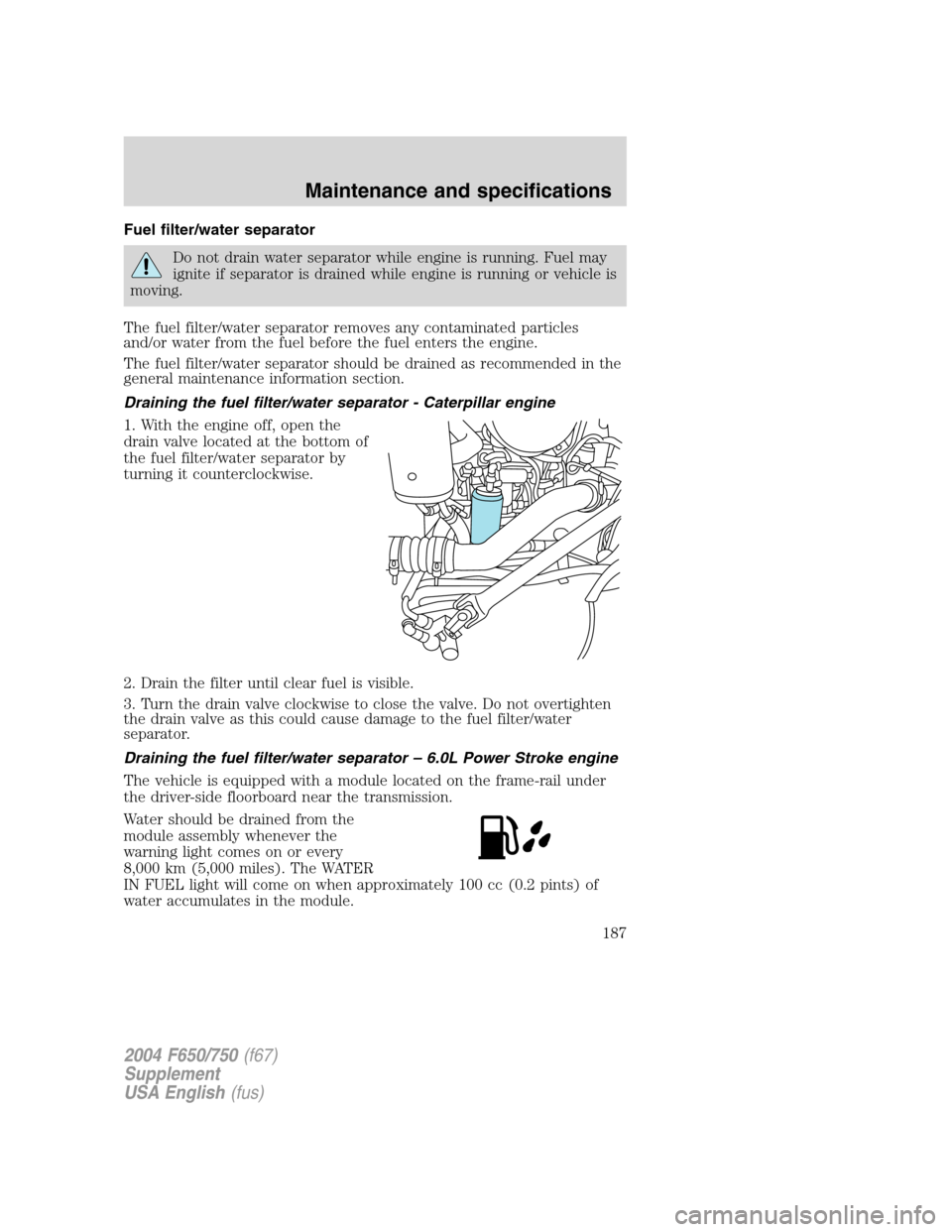
Draining the fuel filter/water separator - Caterpillar engine
1. With the engine off, open the
drain valve located at the bottom of
the fuel filter/water separator by
turning it counterclockwise.
2. Drain the filter until clear fuel is visible.
3. Turn the drain valve clockwise to close the valve. Do not overtighten
the drain valve as this could cause damage to the fuel filter/water
separator.
Draining the fuel filter/water separator–6.0L Power Stroke engine
The vehicle is equipped with a module located on the frame-rail under
the driver-side floorboard near the transmission.
Water should be drained from the
module assembly whenever the
warning light comes on or every
8,000 km (5,000 miles). The WATER
IN FUEL light will come on when approximately 100 cc (0.2 pints) of
water accumulates in the module.
2004 F650/750(f67)
Supplement
USA English(fus)
Maintenance and specifications
187
Page 188 of 264
Replace the fuel filter with Motorcraft Part No. F81Z-9N184–AA
(FD-4596).
1. Stop the vehicle andshut offthe engine.
The vehicle must be stopped with the engine off when draining
the HFCM. Fuel may ignite if separator is drained while the
engine is running or vehicle is moving.
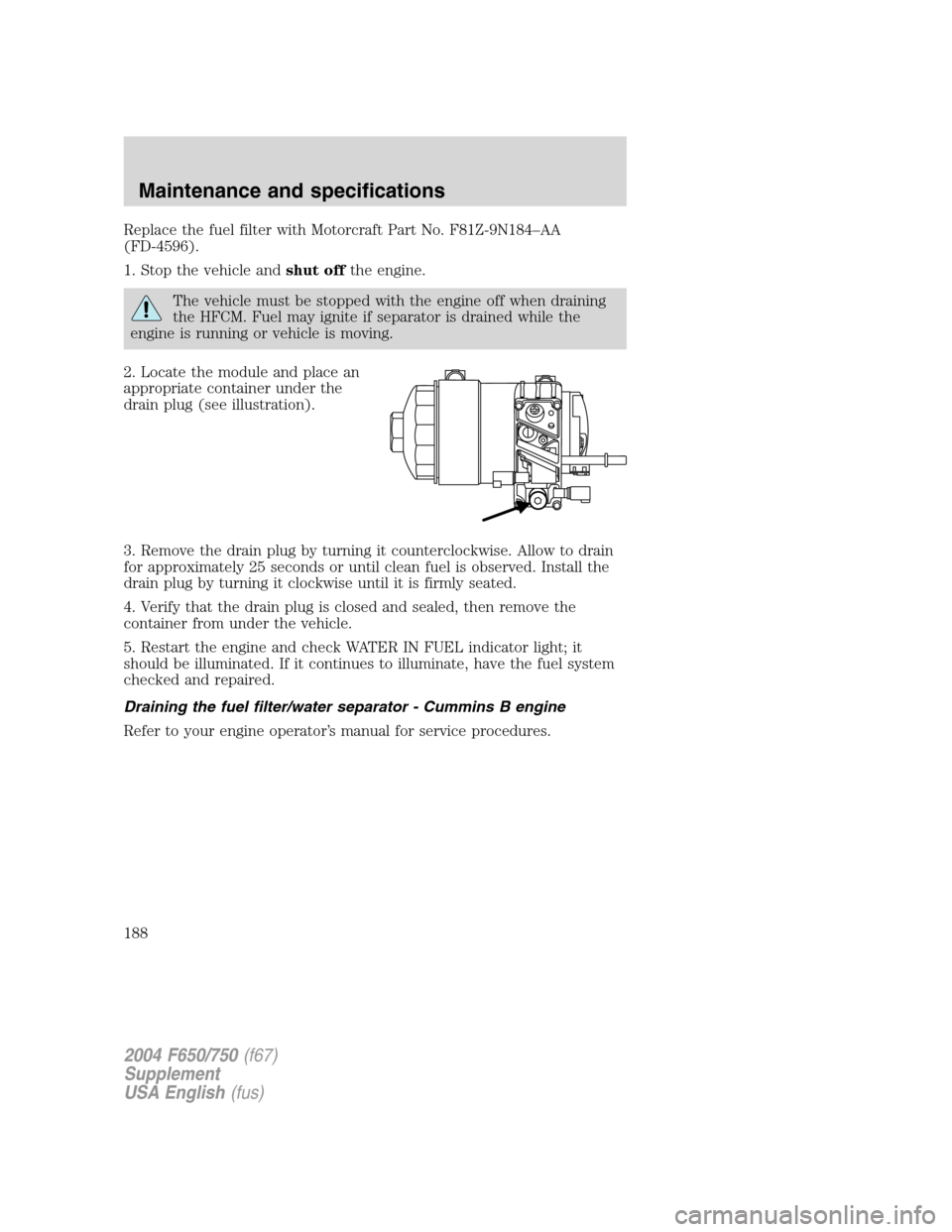
2. Locate the module and place an
appropriate container under the
drain plug (see illustration).
3. Remove the drain plug by turning it counterclockwise. Allow to drain
for approximately 25 seconds or until clean fuel is observed. Install the
drain plug by turning it clockwise until it is firmly seated.
4. Verify that the drain plug is closed and sealed, then remove the
container from under the vehicle.
5. Restart the engine and check WATER IN FUEL indicator light; it
should be illuminated. If it continues to illuminate, have the fuel system
checked and repaired.
Draining the fuel filter/water separator - Cummins B engine
Refer to your engine operator’s manual for service procedures.
2004 F650/750(f67)
Supplement
USA English(fus)
Maintenance and specifications
188
Page 192 of 264
The amount of Empty Reserve varies and should not be relied
upon to increase driving range. When refueling your vehicle after
the fuel gauge indicates empty, you might not be able to refuel
the full amount of the advertised capacity of the fuel tank due to
the empty reserve still present in the tank.
Filling the tank
For consistent results:
•Use the same fill rate setting (low—medium—high) each time
during filling.
•Allow three automatic click-offs when filling.
•Always use fuel of a known quality, preferably a national brand.
•Have the vehicle loading and distribution the same every time.
•When refueling a vehicle equipped with dual fuel tanks, if the two
tanks are not filled equally, the fuel gauge reading may fluctuate
slightly until the fuel level between the two tanks balance out and
become equal.
Your results will be most accurate if your filling method is consistent.
Note:For vehicles equipped with dual fuel tanks, engine performance
may degrade if fuel is not added to both tanks when refueling.
Calculating fuel economy
1. Fill the fuel tank(s) completely and record the initial odometer
reading (in kilometers or miles).
2. Each time you fill the tank(s), record the amount of fuel added (in
liters or gallons).
3. After at least three to five tank fill-ups, fill the fuel tank(s) and record
the current odometer reading.
4. Subtract your initial odometer reading from the current odometer
reading.
5. Follow one of the simple calculations in order to determine fuel economy:
•Multiply liters used by 100, then divide by total kilometers traveled.
•Divide total miles traveled by total gallons used.
Keep a record for at least one month and record the type of driving (city
or highway). This will provide an accurate estimate of the vehicle’s fuel
economy under current driving conditions. Additionally, keeping records
during summer and winter will show how temperature impacts fuel
economy. In general, lower temperatures give lower fuel economy.
2004 F650/750(f67)
Supplement
USA English(fus)
Maintenance and specifications
192
Page 195 of 264
Inspect air intake piping
•Check for accumulation of salt deposits (where applicable). If present,
disassemble and clean the complete air intake piping system. If the
intake piping is pitted, use RTV silicone to seal joints against leakage.
•Check for loose hoses and clamps.
•Check for ruptured or collapsed hoses.
•Check air cleaner housing for cracks.
ELECTRICAL SYSTEM INSPECTIONS
Periodically inspect electrical connectors on the outside of the cab, on
the engine and frame for corrosion and tightness. Exposed terminals
such as the fuel sender, cranking motor, alternator and feed-through
studs should be cleaned and re-coated with a lubricant sealing grease
such as Motorcraft XG-3, or equivalent. This should include the ground
cable connector for batteries, engine and cab as well as the jump starting
stud.
Accessory feed connections
Vehicle electrical systems are complex and often include electronic
components such as engine and transmission controls, instrument panels,
ABS, etc. While most systems operate on battery voltage (12 volts),
some systems can be as high as 90 volts or as low as five volts. Refer to
the Electrical Circuit Diagram Manuals, available from your vehicle’s
manufacturer, to assure that any additional body lights and accessories
are connected to circuits that are both appropriate and not overloaded.
No modification should be made to any vehicle control system without
first contacting your dealer.
SUSPENSION INSPECTION
Note:Do not adjust air suspension height to any setting other than the
specified setting. Altering the height setting will change the driveline
angle and may result in unwarrantable component damage, such as
transmission component damage.
Verify drive axle air suspension height and height control valve
performance at engine lube oil change intervals.
Periodically:
•Check condition of spring leaves for evidence of fatigue, bending or
breakage.
•Check condition of suspension mounting brackets and bushings.
2004 F650/750(f67)
Supplement
USA English(fus)
Maintenance and specifications
195
Page 199 of 264
6. Clean and install the drain plug securely.
7. Add enough lubricant through the filler plug opening so that the
lubricant level is up to the bottom of the opening.
8. Clean and install the filler plug securely.
WHEELS
General
Wheel bearings should be inspected, lubricated and adjusted at regular
intervals. This is especially important if operating in deep sand, mud, or
water. Refer toLubricant specificationsin this chapter.
Oil lubricated front wheel bearings
During normal vehicle duty cycle, the lube and air inside the hub/wheel
cavity expands and if not vented, causes pressure build-up that could
cause accelerated seal wear.
There are two venting methods:
•a slit or small hole in the rubber check vent or
•the window
You can use either of these methods to prevent pressure build-up.
Normal maintenance
Over a period of time, if not routinely cleaned, a slight film of oil can
collect dirt around the rubber fill plug and face, which could appear to
be a leak. Routine cleaning ensures that the lube level can be easily
observed through the clear window as intended. In situations where the
window is clean on the outside but discolored on the inside, the lube
level may be checked by inserting a finger through the rubber check
vent hole.
The specified lube level for a clear window type hubcaps is from the
minimum line to + 5/16 inch above the minimum line.
If the lube level should suddenly drop dramatically below the minimum
level, see the Service Manual for diagnostic procedure.
2004 F650/750(f67)
Supplement
USA English(fus)
Maintenance and specifications
199
Page 203 of 264
Prior to re-installing rear aluminum hub-piloted wheels, clean each wheel
locator pad on the hub from all dirt, rust and foreign material. Apply a
light coat of chassis grease, never-seize or disc brake corrosion control
grease, only to the wheel locator pad.
When installing the tire and rim assembly on disc-brake equipped axles,
make sure the tire valve stem clears the brake caliper. The use of a tire
manufacturer’s stem forming tool is the only acceptable method of
obtaining clearance when necessary.
Note:Always observe the following instructions:
•Always loosen rim clamps before complete removal of nut from stud
(cast spoke wheels). With loosened nuts on stud, strike clamps with a
heavy hammer and be sure each clamp is loose.
•Always deflate tires completely before removing locks or side rings.
•Always inflate tires in a safety cage.
•Never mix rim side rings or lock rings of different types,
manufacturers or sizes.
•Never use cracked, bent or badly rusted parts.
•Never re-inflate flat tires on-vehicle; use the spare tire.
•Never add air until each side ring or lock ring is fully seated.
•Never hammer side ring or lock ring on a partially- or fully-inflated
tire.
Failure to follow these instructions could result in property
damage, personal injury or death
Proper torque
It is important to tighten and maintain wheel and rim mounting nuts to
the proper torque. Loose nuts or over-tightened nuts can lead to
premature wear and possible failure of the wheel and/or mounting
hardware.
2004 F650/750(f67)
Supplement
USA English(fus)
Maintenance and specifications
203
Page 204 of 264
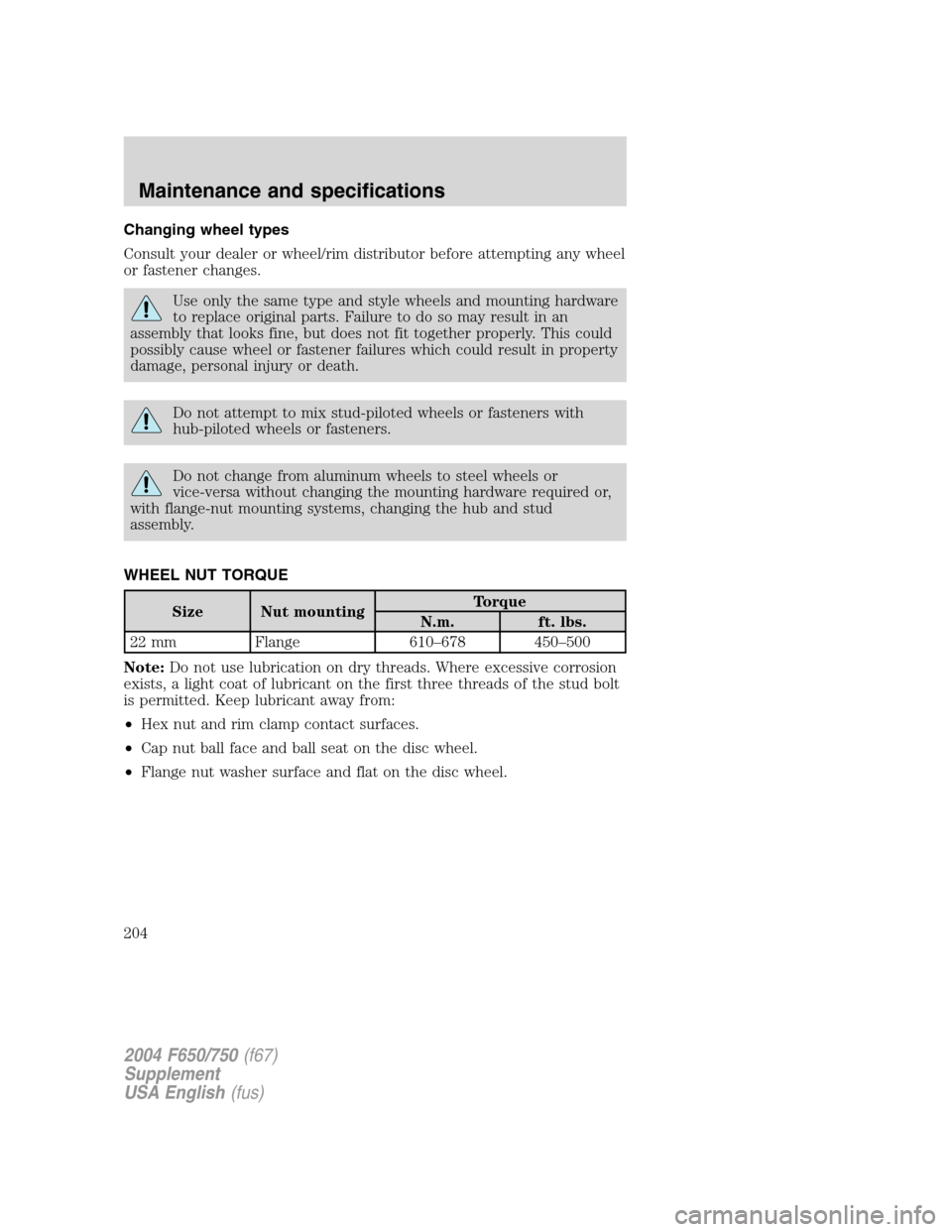
Changing wheel types
Consult your dealer or wheel/rim distributor before attempting any wheel
or fastener changes.
Use only the same type and style wheels and mounting hardware
to replace original parts. Failure to do so may result in an
assembly that looks fine, but does not fit together properly. This could
possibly cause wheel or fastener failures which could result in property
damage, personal injury or death.
Do not attempt to mix stud-piloted wheels or fasteners with
hub-piloted wheels or fasteners.
Do not change from aluminum wheels to steel wheels or
vice-versa without changing the mounting hardware required or,
with flange-nut mounting systems, changing the hub and stud
assembly.
WHEEL NUT TORQUE
Size Nut mountingTorque
N.m. ft. lbs.
22 mm Flange 610–678 450–500
Note:Do not use lubrication on dry threads. Where excessive corrosion
exists, a light coat of lubricant on the first three threads of the stud bolt
is permitted. Keep lubricant away from:
•Hex nut and rim clamp contact surfaces.
•Cap nut ball face and ball seat on the disc wheel.
•Flange nut washer surface and flat on the disc wheel.
2004 F650/750(f67)
Supplement
USA English(fus)
Maintenance and specifications
204
Page 216 of 264
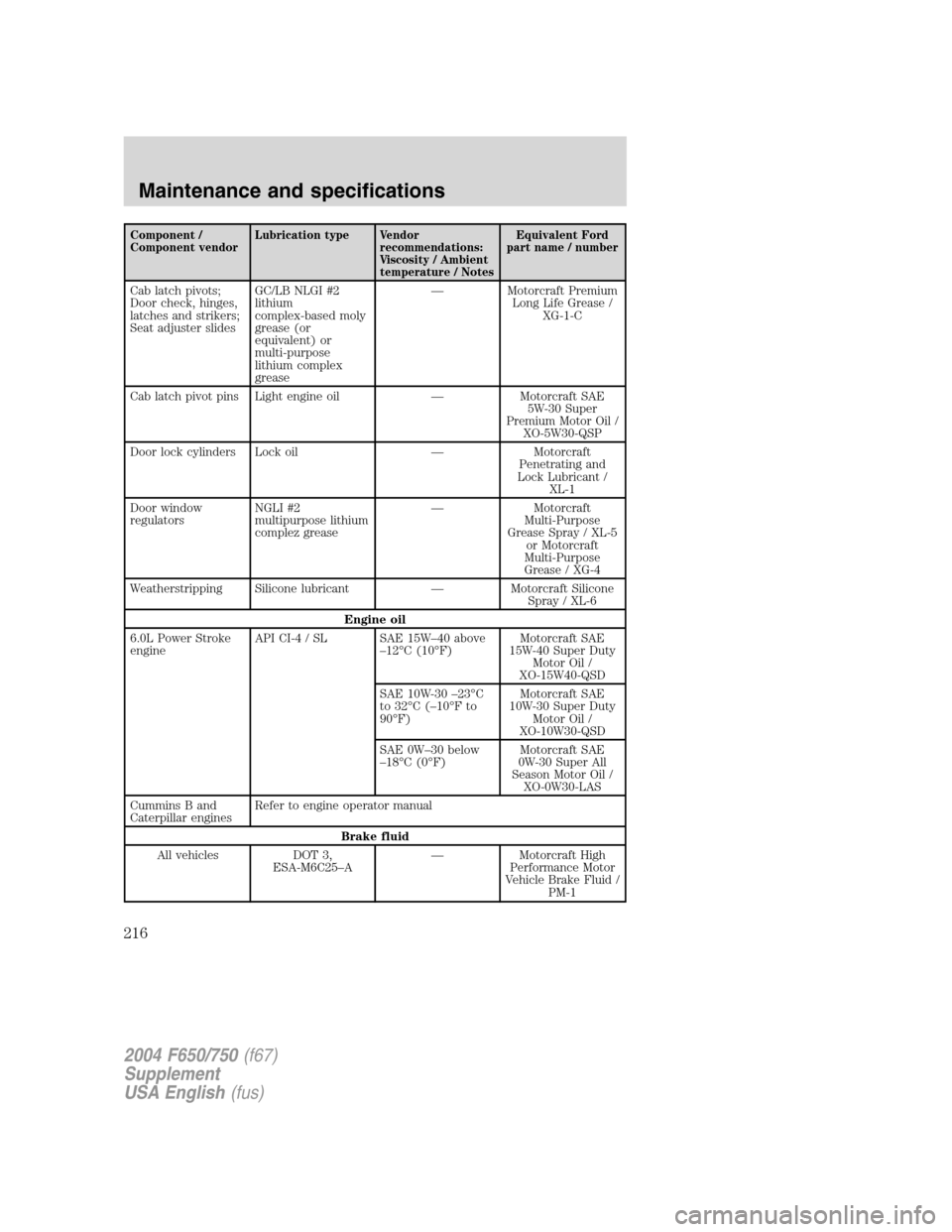
Component /
Component vendorLubrication type Vendor
recommendations:
Viscosity / Ambient
temperature / NotesEquivalent Ford
part name / number
Cab latch pivots;
Door check, hinges,
latches and strikers;
Seat adjuster slidesGC/LB NLGI #2
lithium
complex-based moly
grease (or
equivalent) or
multi-purpose
lithium complex
grease—Motorcraft Premium
Long Life Grease /
XG-1-C
Cab latch pivot pins Light engine oil—Motorcraft SAE
5W-30 Super
Premium Motor Oil /
XO-5W30-QSP
Door lock cylinders Lock oil—Motorcraft
Penetrating and
Lock Lubricant /
XL-1
Door window
regulatorsNGLI #2
multipurpose lithium
complez grease—Motorcraft
Multi-Purpose
Grease Spray / XL-5
or Motorcraft
Multi-Purpose
Grease / XG-4
Weatherstripping Silicone lubricant—Motorcraft Silicone
Spray / XL-6
Engine oil
6.0L Power Stroke
engineAPI CI-4 / SL SAE 15W–40 above
–12°C (10°F)Motorcraft SAE
15W-40 Super Duty
Motor Oil /
XO-15W40-QSD
SAE 10W-30–23°C
to 32°C(–10°Fto
90°F)Motorcraft SAE
10W-30 Super Duty
Motor Oil /
XO-10W30-QSD
SAE 0W–30 below
–18°C(0°F)Motorcraft SAE
0W-30 Super All
Season Motor Oil /
XO-0W30-LAS
Cummins B and
Caterpillar enginesRefer to engine operator manual
Brake fluid
All vehicles DOT 3,
ESA-M6C25–A—Motorcraft High
Performance Motor
Vehicle Brake Fluid /
PM-1
2004 F650/750(f67)
Supplement
USA English(fus)
Maintenance and specifications
216