brake FORD F650 2004 11.G Manual Online
[x] Cancel search | Manufacturer: FORD, Model Year: 2004, Model line: F650, Model: FORD F650 2004 11.GPages: 264, PDF Size: 1.47 MB
Page 198 of 264
PROPELLER SHAFT
At the regular lubrication interval, check the universal joints for any
evidence of wear or looseness. Should propeller shaft vibrations occur,
stop the vehicle immediately to avoid possible hazardous consequences
or damage to other components.
REAR AXLE LUBRICANT
Refer to your general maintenance information section for rear axle
lubricant level checks and lubricant change intervals.
Your rear axle may be filled with an optional synthetic lubricant which
allows the use of extended service intervals. A tag on the filler plug will
identify the use of the synthetic lubricant.
Use only a lubricant that meets manufacturer specifications (refer to
Lubricant specificationsin this chapter).
Use of a non-approved rear axle lubricant may cause internal axle
component damage.
Check your rear axle lubricant level using the following procedure:
1. Park the vehicle on level ground.
2. Set the parking brake and shift into N (Neutral) (automatic
transmission) or 1 (First) (manual transmission) and turn the engine off.
3. Clean any dirt from around the rear axle filler plug.
4. Remove the filler plug and inspect the lubricant level.
5. The lubricant level should be up to the bottom of the filler plug
opening.
6. If necessary, add enough lubricant through the filler plug opening so
that the lubricant level is at the bottom of the opening.
7. Clean and install the filler plug securely.
Drain and refill your rear axle lubricant using the following procedure:
1. Drain the rear axle while the lubricant is warm.
2. Park the vehicle on level ground.
3. Set the parking brake and shift into N (Neutral) (automatic
transmission) or 1 (First) (manual transmission) and turn the engine off.
4. Clean any dirt from around the rear axle filler and drain plugs.
5. Remove the filler and drain plugs and drain the lubricant into a
suitable container. Dispose all used automotive fluids in a responsible
manner following your local authorized standards.
2004 F650/750(f67)
Supplement
USA English(fus)
Maintenance and specifications
198
Page 201 of 264
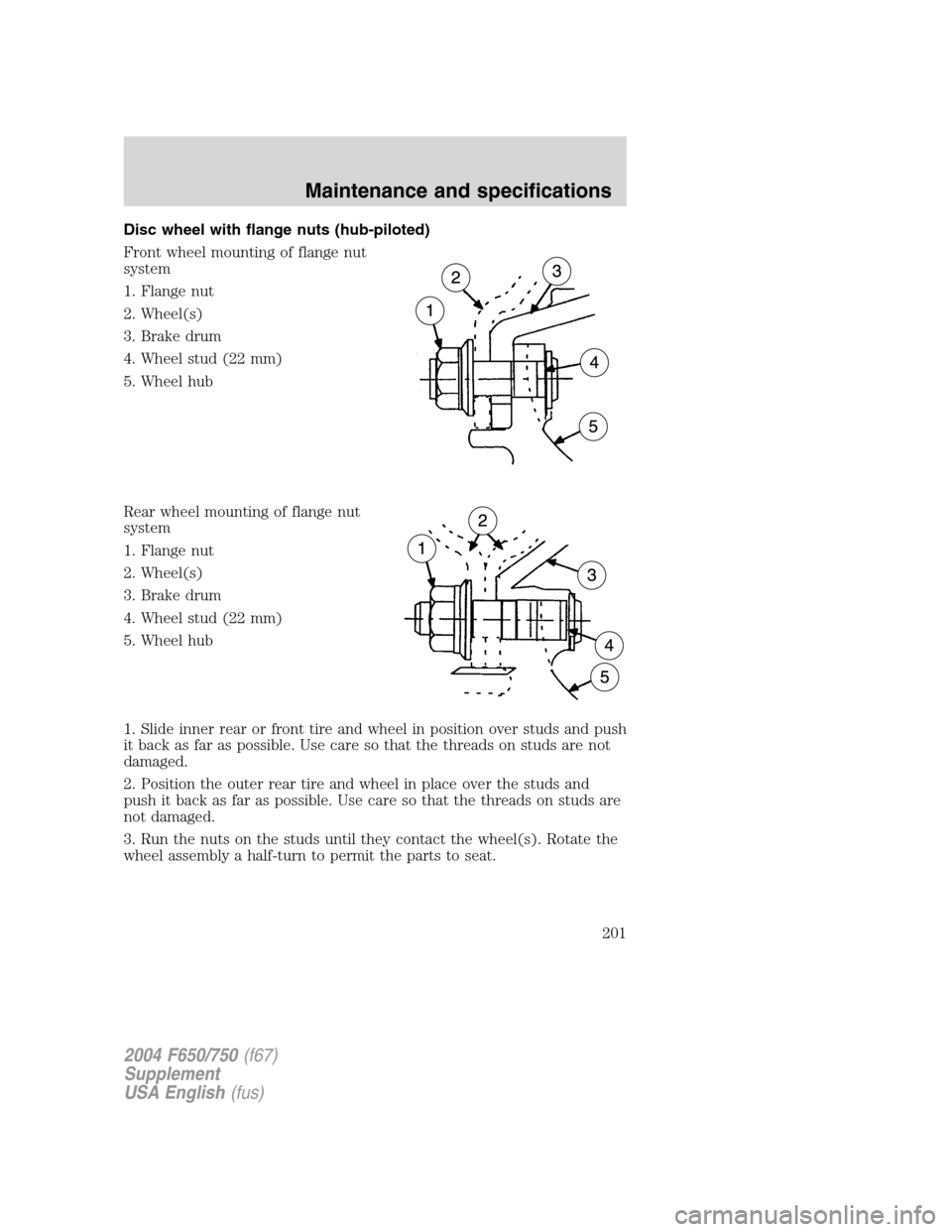
Disc wheel with flange nuts (hub-piloted)
Front wheel mounting of flange nut
system
1. Flange nut
2. Wheel(s)
3. Brake drum
4. Wheel stud (22 mm)
5. Wheel hub
Rear wheel mounting of flange nut
system
1. Flange nut
2. Wheel(s)
3. Brake drum
4. Wheel stud (22 mm)
5. Wheel hub
1. Slide inner rear or front tire and wheel in position over studs and push
it back as far as possible. Use care so that the threads on studs are not
damaged.
2. Position the outer rear tire and wheel in place over the studs and
push it back as far as possible. Use care so that the threads on studs are
not damaged.
3. Run the nuts on the studs until they contact the wheel(s). Rotate the
wheel assembly a half-turn to permit the parts to seat.
2004 F650/750(f67)
Supplement
USA English(fus)
Maintenance and specifications
201
Page 202 of 264
4. Draw up the nuts alternately following the crisscross sequence
illustrated underInstallation, tightening and alignment. Do not fully
tighten the nuts. This will allow uniform seating of the nuts and assure
even face-to-face contact of the wheel and hub.
5. Continue tightening the nuts to the torque specifications in the torque
chart using the same crisscross sequence shown.
6. After operating the vehicle approximately 80 km (50 miles), check the
nuts for tightness. Some natural seating of parts may be encountered
and the torque on the nuts will drop. Retighten all nuts to specifications.
Once a week, inspect and retighten the wheel stud nuts.
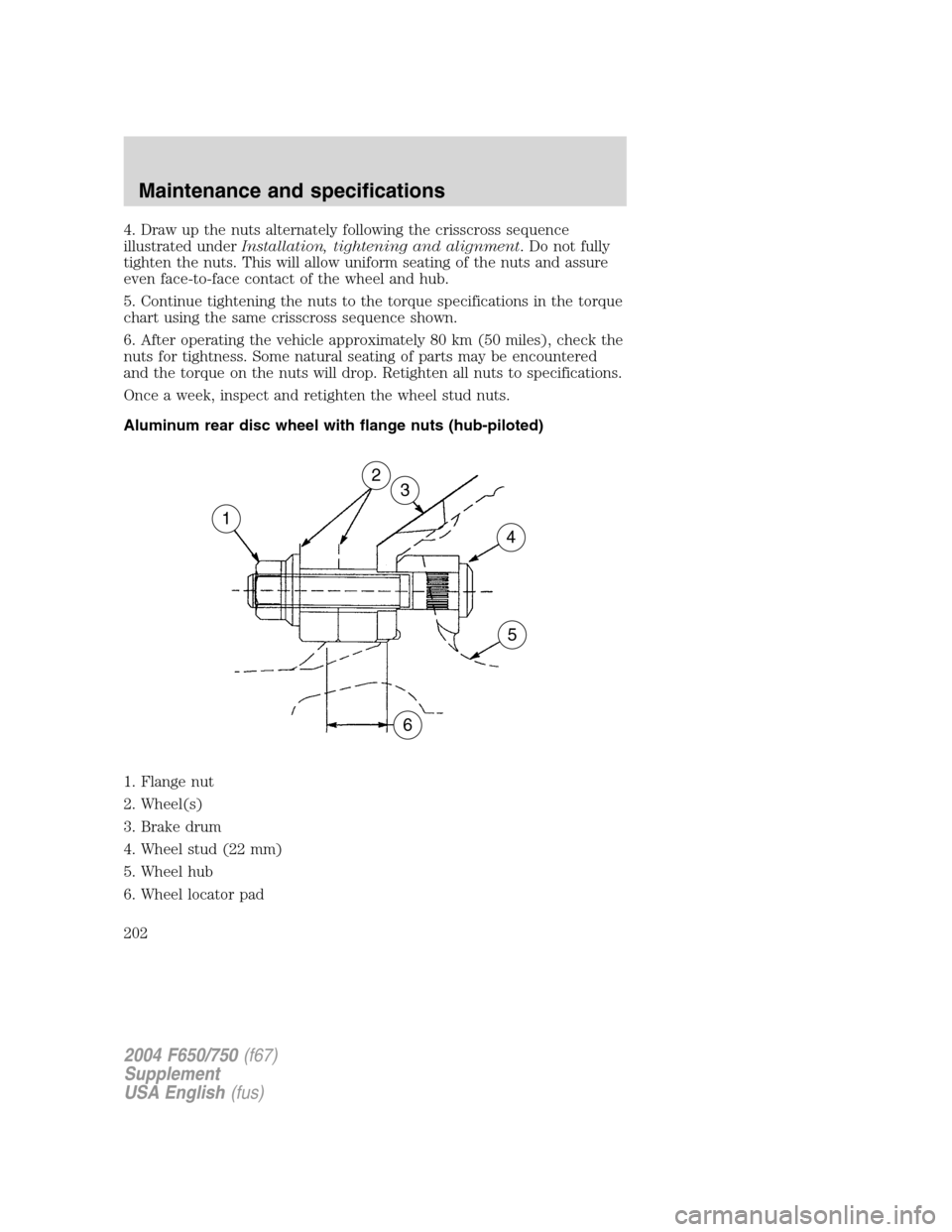
Aluminum rear disc wheel with flange nuts (hub-piloted)
1. Flange nut
2. Wheel(s)
3. Brake drum
4. Wheel stud (22 mm)
5. Wheel hub
6. Wheel locator pad
1
6
5
4
32
2004 F650/750(f67)
Supplement
USA English(fus)
Maintenance and specifications
202
Page 203 of 264
Prior to re-installing rear aluminum hub-piloted wheels, clean each wheel
locator pad on the hub from all dirt, rust and foreign material. Apply a
light coat of chassis grease, never-seize or disc brake corrosion control
grease, only to the wheel locator pad.
When installing the tire and rim assembly on disc-brake equipped axles,
make sure the tire valve stem clears the brake caliper. The use of a tire
manufacturer’s stem forming tool is the only acceptable method of
obtaining clearance when necessary.
Note:Always observe the following instructions:
•Always loosen rim clamps before complete removal of nut from stud
(cast spoke wheels). With loosened nuts on stud, strike clamps with a
heavy hammer and be sure each clamp is loose.
•Always deflate tires completely before removing locks or side rings.
•Always inflate tires in a safety cage.
•Never mix rim side rings or lock rings of different types,
manufacturers or sizes.
•Never use cracked, bent or badly rusted parts.
•Never re-inflate flat tires on-vehicle; use the spare tire.
•Never add air until each side ring or lock ring is fully seated.
•Never hammer side ring or lock ring on a partially- or fully-inflated
tire.
Failure to follow these instructions could result in property
damage, personal injury or death
Proper torque
It is important to tighten and maintain wheel and rim mounting nuts to
the proper torque. Loose nuts or over-tightened nuts can lead to
premature wear and possible failure of the wheel and/or mounting
hardware.
2004 F650/750(f67)
Supplement
USA English(fus)
Maintenance and specifications
203
Page 216 of 264
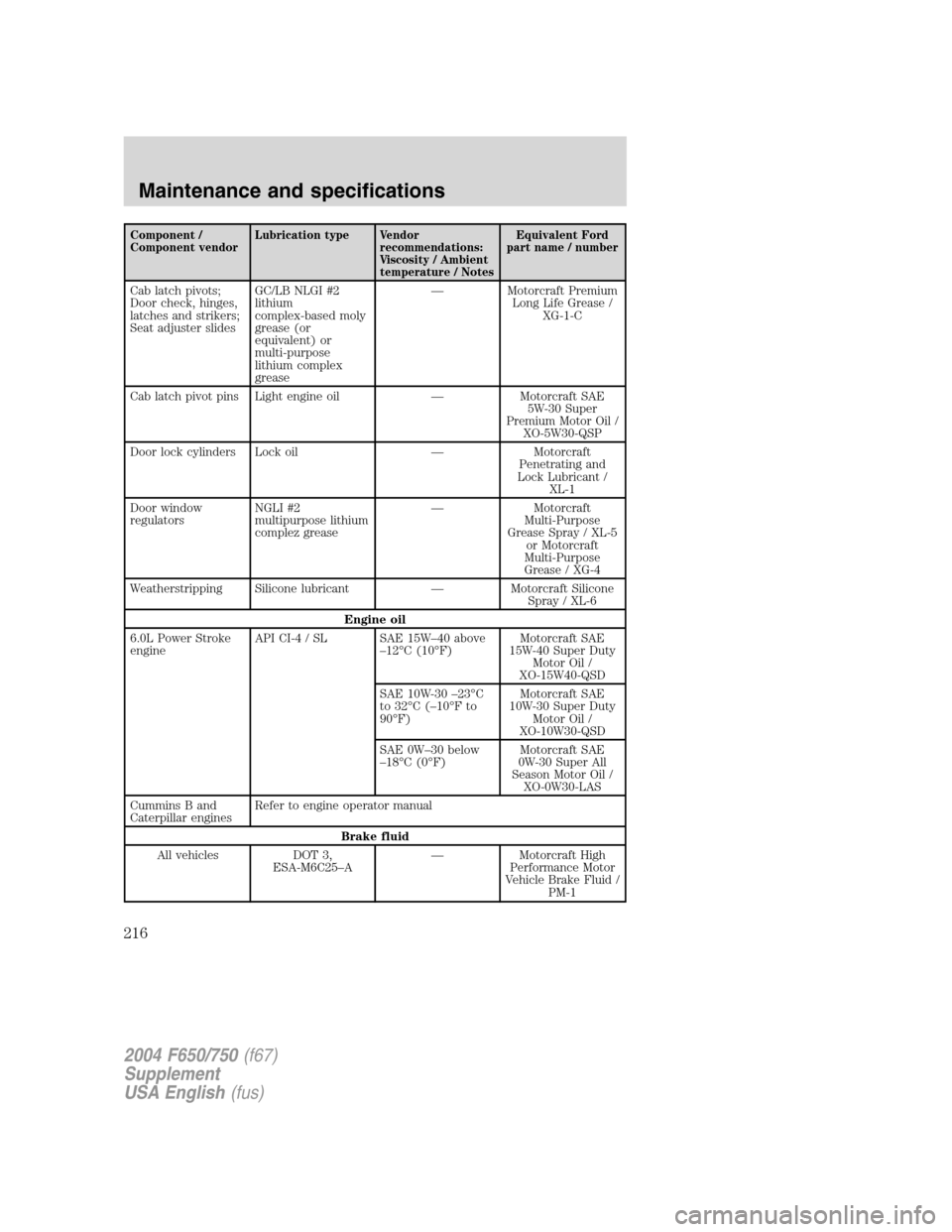
Component /
Component vendorLubrication type Vendor
recommendations:
Viscosity / Ambient
temperature / NotesEquivalent Ford
part name / number
Cab latch pivots;
Door check, hinges,
latches and strikers;
Seat adjuster slidesGC/LB NLGI #2
lithium
complex-based moly
grease (or
equivalent) or
multi-purpose
lithium complex
grease—Motorcraft Premium
Long Life Grease /
XG-1-C
Cab latch pivot pins Light engine oil—Motorcraft SAE
5W-30 Super
Premium Motor Oil /
XO-5W30-QSP
Door lock cylinders Lock oil—Motorcraft
Penetrating and
Lock Lubricant /
XL-1
Door window
regulatorsNGLI #2
multipurpose lithium
complez grease—Motorcraft
Multi-Purpose
Grease Spray / XL-5
or Motorcraft
Multi-Purpose
Grease / XG-4
Weatherstripping Silicone lubricant—Motorcraft Silicone
Spray / XL-6
Engine oil
6.0L Power Stroke
engineAPI CI-4 / SL SAE 15W–40 above
–12°C (10°F)Motorcraft SAE
15W-40 Super Duty
Motor Oil /
XO-15W40-QSD
SAE 10W-30–23°C
to 32°C(–10°Fto
90°F)Motorcraft SAE
10W-30 Super Duty
Motor Oil /
XO-10W30-QSD
SAE 0W–30 below
–18°C(0°F)Motorcraft SAE
0W-30 Super All
Season Motor Oil /
XO-0W30-LAS
Cummins B and
Caterpillar enginesRefer to engine operator manual
Brake fluid
All vehicles DOT 3,
ESA-M6C25–A—Motorcraft High
Performance Motor
Vehicle Brake Fluid /
PM-1
2004 F650/750(f67)
Supplement
USA English(fus)
Maintenance and specifications
216
Page 227 of 264
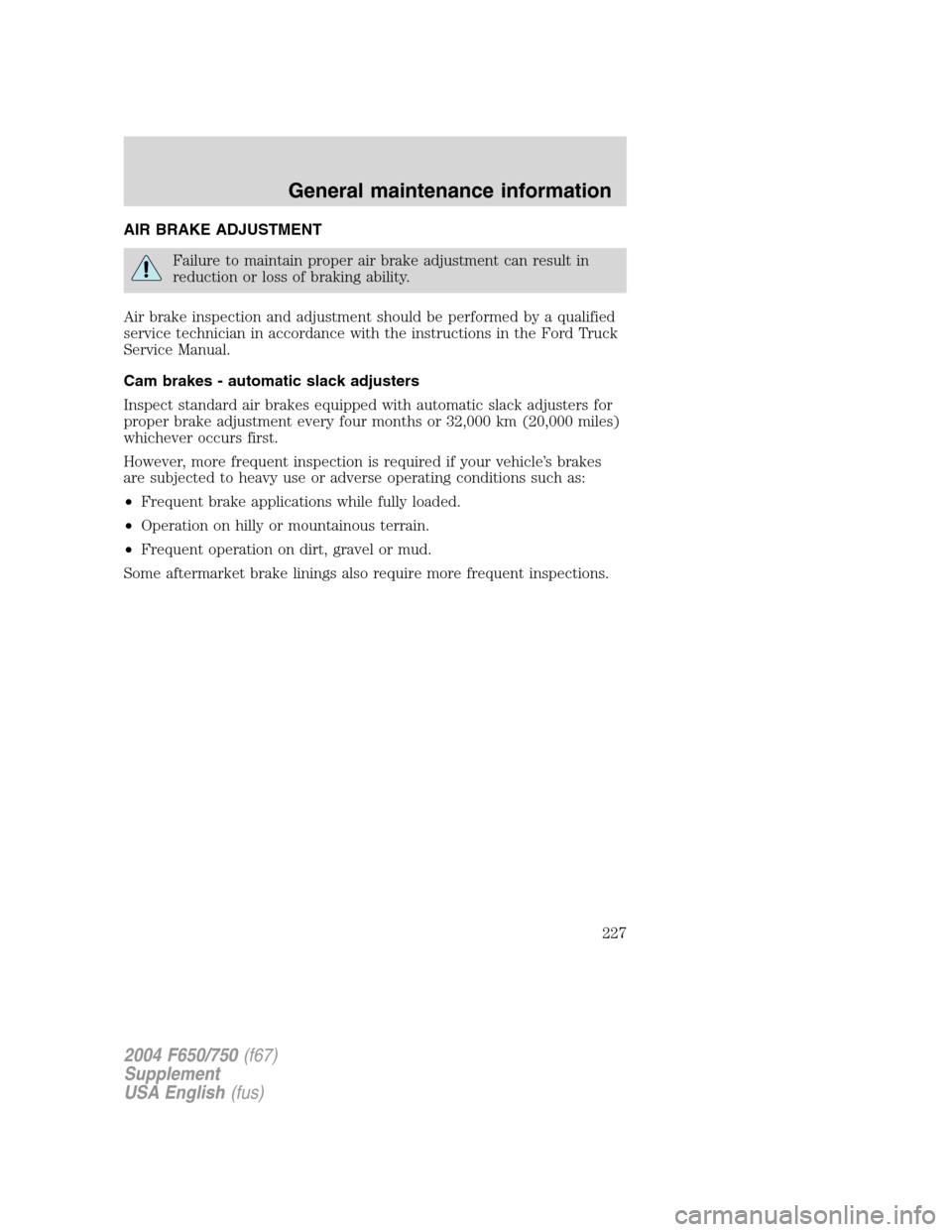
AIR BRAKE ADJUSTMENT
Failure to maintain proper air brake adjustment can result in
reduction or loss of braking ability.
Air brake inspection and adjustment should be performed by a qualified
service technician in accordance with the instructions in the Ford Truck
Service Manual.
Cam brakes - automatic slack adjusters
Inspect standard air brakes equipped with automatic slack adjusters for
proper brake adjustment every four months or 32,000 km (20,000 miles)
whichever occurs first.
However, more frequent inspection is required if your vehicle’s brakes
are subjected to heavy use or adverse operating conditions such as:
•Frequent brake applications while fully loaded.
•Operation on hilly or mountainous terrain.
•Frequent operation on dirt, gravel or mud.
Some aftermarket brake linings also require more frequent inspections.
2004 F650/750(f67)
Supplement
USA English(fus)
General maintenance information
227
Page 229 of 264
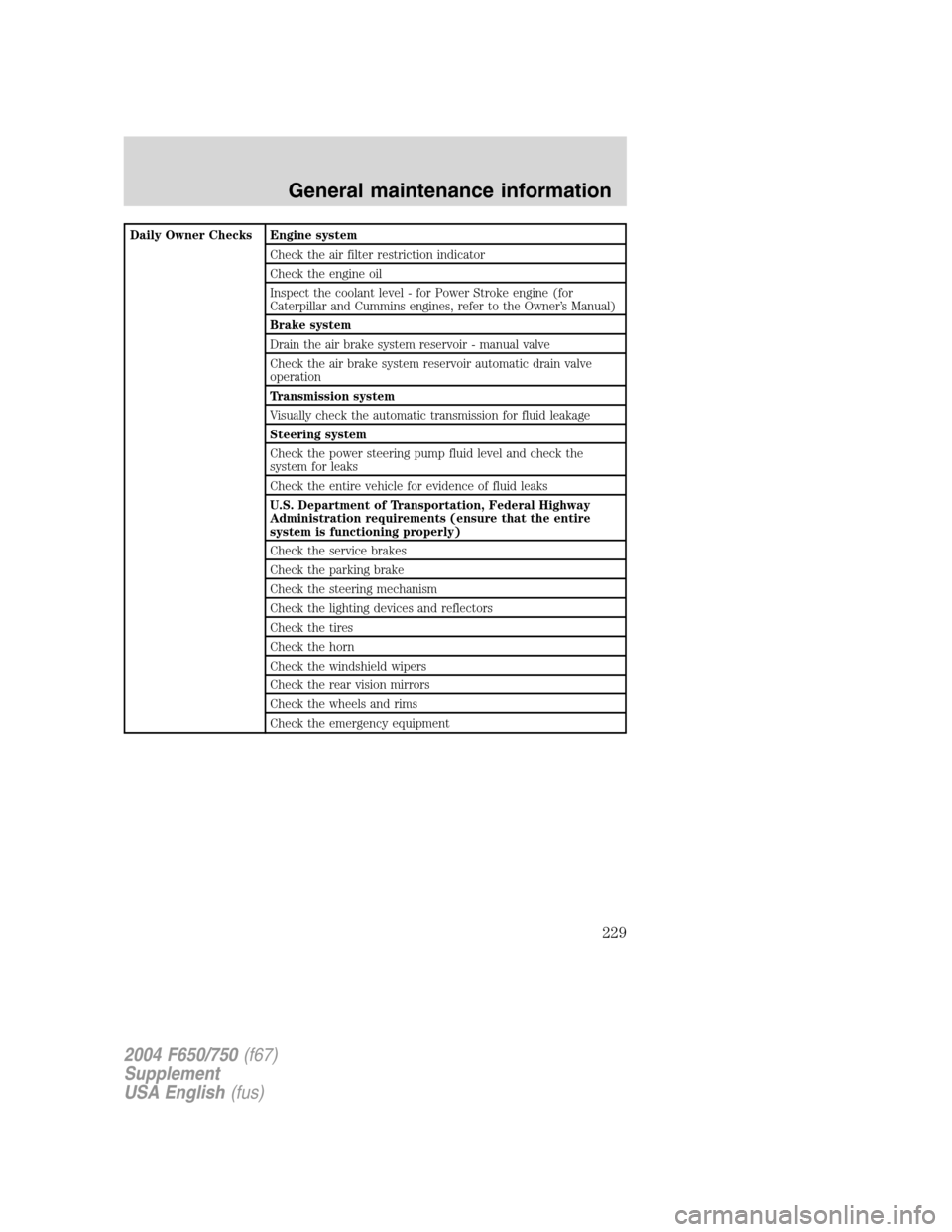
Daily Owner Checks Engine system
Check the air filter restriction indicator
Check the engine oil
Inspect the coolant level - for Power Stroke engine (for
Caterpillar and Cummins engines, refer to the Owner’s Manual)
Brake system
Drain the air brake system reservoir - manual valve
Check the air brake system reservoir automatic drain valve
operation
Transmission system
Visually check the automatic transmission for fluid leakage
Steering system
Check the power steering pump fluid level and check the
system for leaks
Check the entire vehicle for evidence of fluid leaks
U.S. Department of Transportation, Federal Highway
Administration requirements (ensure that the entire
system is functioning properly)
Check the service brakes
Check the parking brake
Check the steering mechanism
Check the lighting devices and reflectors
Check the tires
Check the horn
Check the windshield wipers
Check the rear vision mirrors
Check the wheels and rims
Check the emergency equipment
2004 F650/750(f67)
Supplement
USA English(fus)
General maintenance information
229
Page 230 of 264
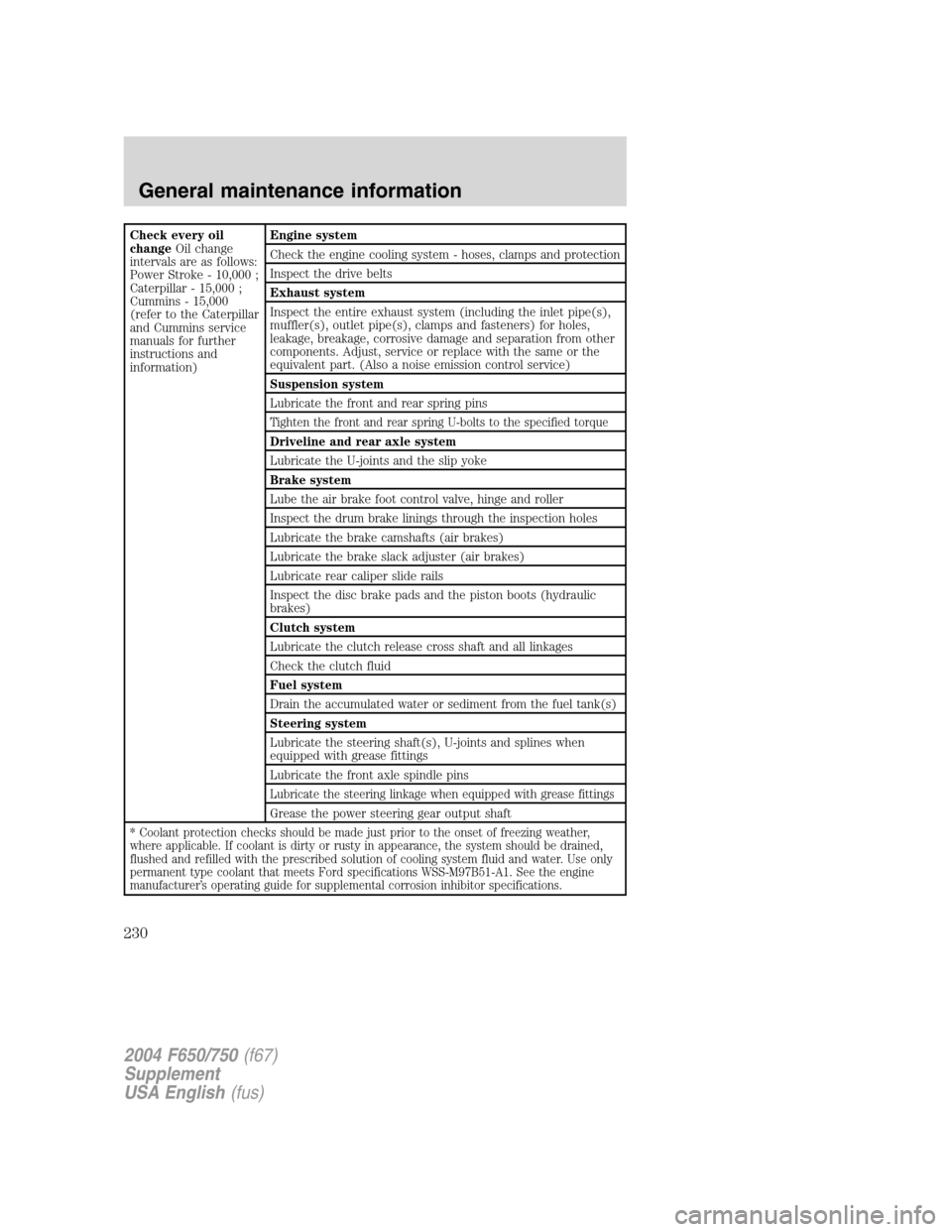
Check every oil
changeOil change
intervals are as follows:
Power Stroke - 10,000 ;
Caterpillar - 15,000 ;
Cummins - 15,000
(refer to the Caterpillar
and Cummins service
manuals for further
instructions and
information)Engine system
Check the engine cooling system - hoses, clamps and protection
Inspect the drive belts
Exhaust system
Inspect the entire exhaust system (including the inlet pipe(s),
muffler(s), outlet pipe(s), clamps and fasteners) for holes,
leakage, breakage, corrosive damage and separation from other
components. Adjust, service or replace with the same or the
equivalent part. (Also a noise emission control service)
Suspension system
Lubricate the front and rear spring pins
Tighten the front and rear spring U-bolts to the specified torque
Driveline and rear axle system
Lubricate the U-joints and the slip yoke
Brake system
Lube the air brake foot control valve, hinge and roller
Inspect the drum brake linings through the inspection holes
Lubricate the brake camshafts (air brakes)
Lubricate the brake slack adjuster (air brakes)
Lubricate rear caliper slide rails
Inspect the disc brake pads and the piston boots (hydraulic
brakes)
Clutch system
Lubricate the clutch release cross shaft and all linkages
Check the clutch fluid
Fuel system
Drain the accumulated water or sediment from the fuel tank(s)
Steering system
Lubricate the steering shaft(s), U-joints and splines when
equipped with grease fittings
Lubricate the front axle spindle pins
Lubricate the steering linkage when equipped with grease fittings
Grease the power steering gear output shaft
* Coolant protection checks should be made just prior to the onset of freezing weather,
where applicable. If coolant is dirty or rusty in appearance, the system should be drained,
flushed and refilled with the prescribed solution of cooling system fluid and water. Use only
permanent type coolant that meets Ford specifications WSS-M97B51-A1. See the engine
manufacturer’s operating guide for supplemental corrosion inhibitor specifications.
2004 F650/750(f67)
Supplement
USA English(fus)
General maintenance information
230
Page 232 of 264
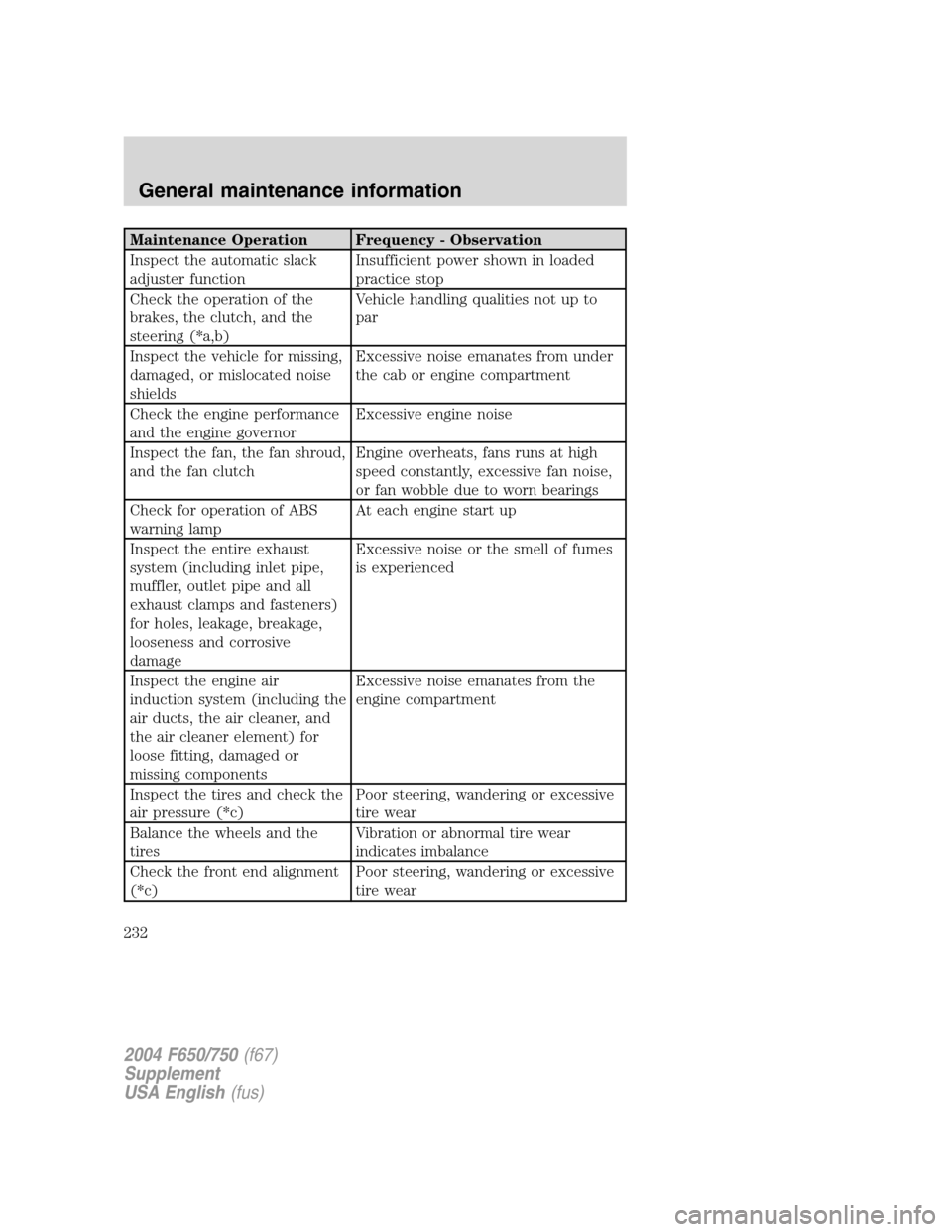
Maintenance Operation Frequency - Observation
Inspect the automatic slack
adjuster functionInsufficient power shown in loaded
practice stop
Check the operation of the
brakes, the clutch, and the
steering (*a,b)Vehicle handling qualities not up to
par
Inspect the vehicle for missing,
damaged, or mislocated noise
shieldsExcessive noise emanates from under
the cab or engine compartment
Check the engine performance
and the engine governorExcessive engine noise
Inspect the fan, the fan shroud,
and the fan clutchEngine overheats, fans runs at high
speed constantly, excessive fan noise,
or fan wobble due to worn bearings
Check for operation of ABS
warning lampAt each engine start up
Inspect the entire exhaust
system (including inlet pipe,
muffler, outlet pipe and all
exhaust clamps and fasteners)
for holes, leakage, breakage,
looseness and corrosive
damageExcessive noise or the smell of fumes
is experienced
Inspect the engine air
induction system (including the
air ducts, the air cleaner, and
the air cleaner element) for
loose fitting, damaged or
missing componentsExcessive noise emanates from the
engine compartment
Inspect the tires and check the
air pressure (*c)Poor steering, wandering or excessive
tire wear
Balance the wheels and the
tiresVibration or abnormal tire wear
indicates imbalance
Check the front end alignment
(*c)Poor steering, wandering or excessive
tire wear
2004 F650/750(f67)
Supplement
USA English(fus)
General maintenance information
232
Page 233 of 264
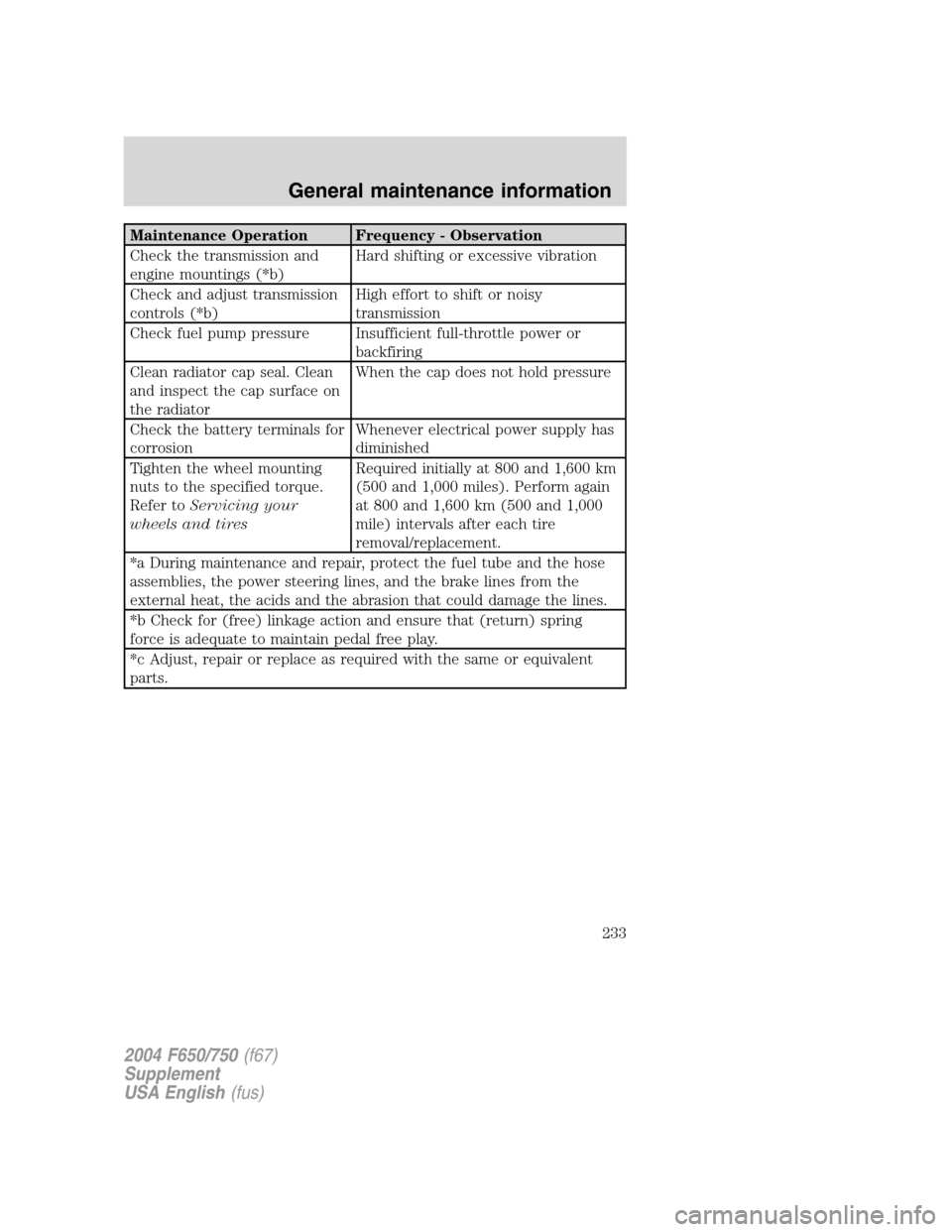
Maintenance Operation Frequency - Observation
Check the transmission and
engine mountings (*b)Hard shifting or excessive vibration
Check and adjust transmission
controls (*b)High effort to shift or noisy
transmission
Check fuel pump pressure Insufficient full-throttle power or
backfiring
Clean radiator cap seal. Clean
and inspect the cap surface on
the radiatorWhen the cap does not hold pressure
Check the battery terminals for
corrosionWhenever electrical power supply has
diminished
Tighten the wheel mounting
nuts to the specified torque.
Refer toServicing your
wheels and tiresRequired initially at 800 and 1,600 km
(500 and 1,000 miles). Perform again
at 800 and 1,600 km (500 and 1,000
mile) intervals after each tire
removal/replacement.
*a During maintenance and repair, protect the fuel tube and the hose
assemblies, the power steering lines, and the brake lines from the
external heat, the acids and the abrasion that could damage the lines.
*b Check for (free) linkage action and ensure that (return) spring
force is adequate to maintain pedal free play.
*c Adjust, repair or replace as required with the same or equivalent
parts.
2004 F650/750(f67)
Supplement
USA English(fus)
General maintenance information
233