ignition FORD F650 2015 13.G User Guide
[x] Cancel search | Manufacturer: FORD, Model Year: 2015, Model line: F650, Model: FORD F650 2015 13.GPages: 384, PDF Size: 4.95 MB
Page 71 of 384
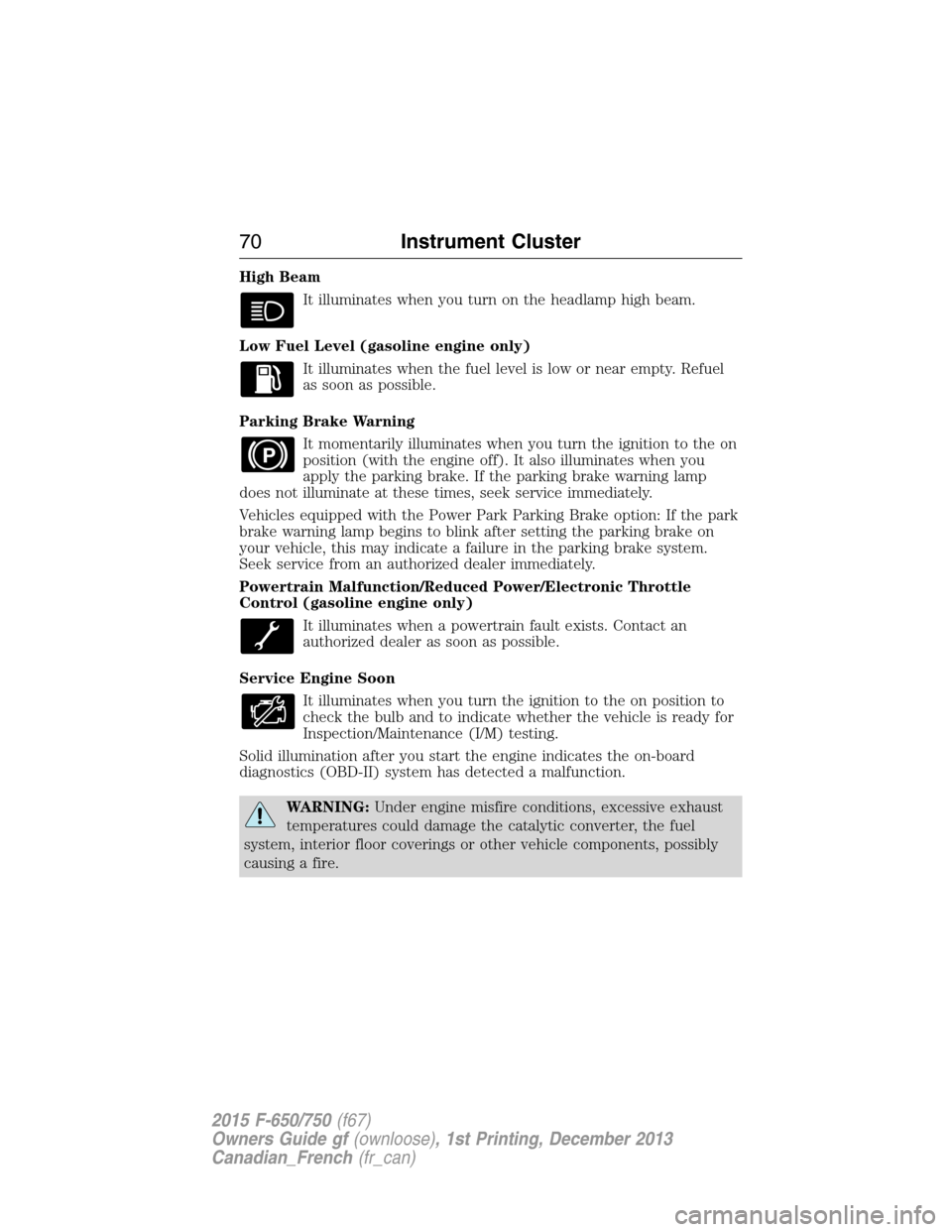
High Beam
It illuminates when you turn on the headlamp high beam.
Low Fuel Level (gasoline engine only)
It illuminates when the fuel level is low or near empty. Refuel
as soon as possible.
Parking Brake Warning
It momentarily illuminates when you turn the ignition to the on
position (with the engine off). It also illuminates when you
apply the parking brake. If the parking brake warning lamp
does not illuminate at these times, seek service immediately.
Vehicles equipped with the Power Park Parking Brake option: If the park
brake warning lamp begins to blink after setting the parking brake on
your vehicle, this may indicate a failure in the parking brake system.
Seek service from an authorized dealer immediately.
Powertrain Malfunction/Reduced Power/Electronic Throttle
Control (gasoline engine only)
It illuminates when a powertrain fault exists. Contact an
authorized dealer as soon as possible.
Service Engine Soon
It illuminates when you turn the ignition to the on position to
check the bulb and to indicate whether the vehicle is ready for
Inspection/Maintenance (I/M) testing.
Solid illumination after you start the engine indicates the on-board
diagnostics (OBD-II) system has detected a malfunction.
WARNING:Under engine misfire conditions, excessive exhaust
temperatures could damage the catalytic converter, the fuel
system, interior floor coverings or other vehicle components, possibly
causing a fire.
P
70Instrument Cluster
2015 F-650/750(f67)
Owners Guide gf(ownloose), 1st Printing, December 2013
Canadian_French(fr_can)
Page 72 of 384
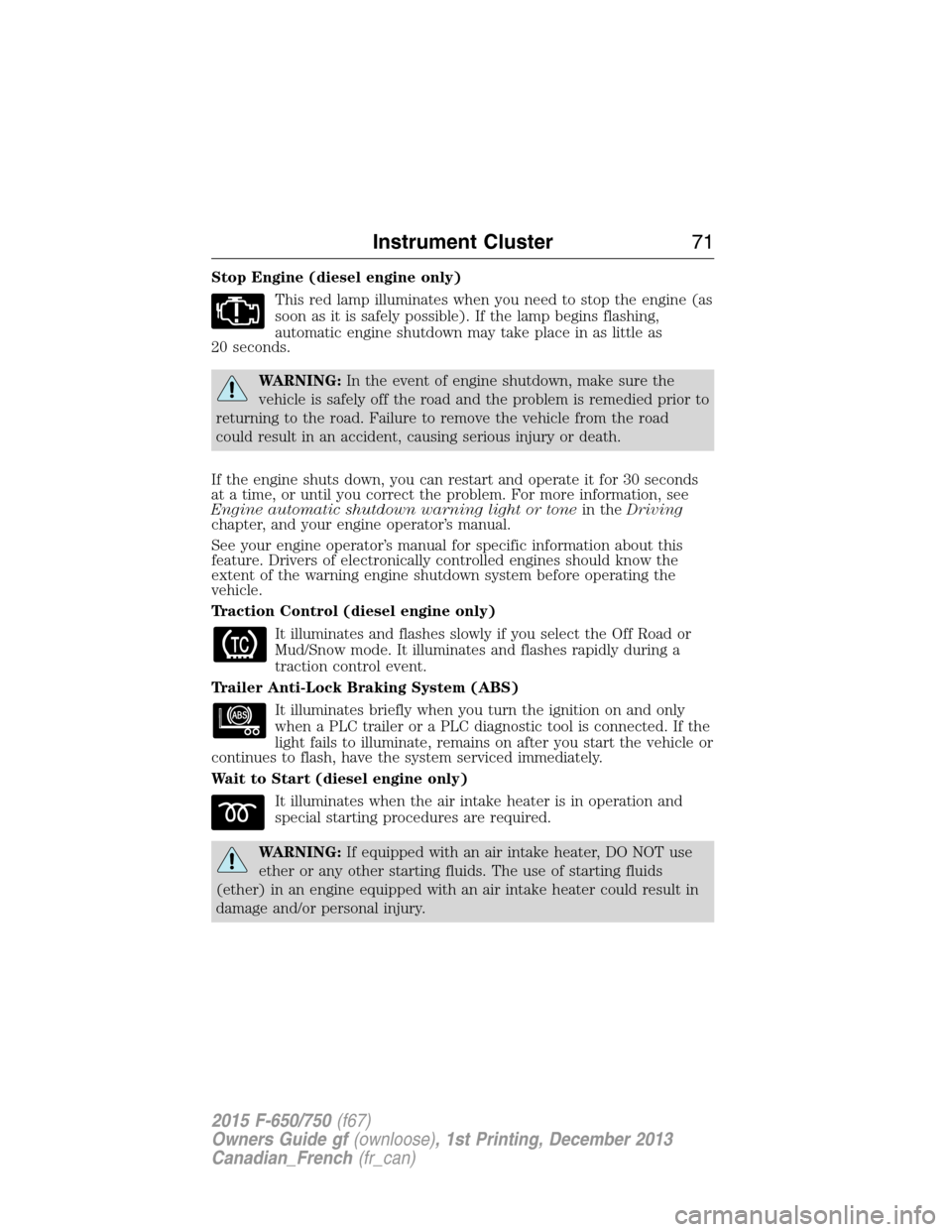
Stop Engine (diesel engine only)
This red lamp illuminates when you need to stop the engine (as
soon as it is safely possible). If the lamp begins flashing,
automatic engine shutdown may take place in as little as
20 seconds.
WARNING:In the event of engine shutdown, make sure the
vehicle is safely off the road and the problem is remedied prior to
returning to the road. Failure to remove the vehicle from the road
could result in an accident, causing serious injury or death.
If the engine shuts down, you can restart and operate it for 30 seconds
at a time, or until you correct the problem. For more information, see
Engine automatic shutdown warning light or tonein theDriving
chapter, and your engine operator’s manual.
See your engine operator’s manual for specific information about this
feature. Drivers of electronically controlled engines should know the
extent of the warning engine shutdown system before operating the
vehicle.
Traction Control (diesel engine only)
It illuminates and flashes slowly if you select the Off Road or
Mud/Snow mode. It illuminates and flashes rapidly during a
traction control event.
Trailer Anti-Lock Braking System (ABS)
It illuminates briefly when you turn the ignition on and only
when a PLC trailer or a PLC diagnostic tool is connected. If the
light fails to illuminate, remains on after you start the vehicle or
continues to flash, have the system serviced immediately.
Wait to Start (diesel engine only)
It illuminates when the air intake heater is in operation and
special starting procedures are required.
WARNING:If equipped with an air intake heater, DO NOT use
ether or any other starting fluids. The use of starting fluids
(ether) in an engine equipped with an air intake heater could result in
damage and/or personal injury.
Instrument Cluster71
2015 F-650/750(f67)
Owners Guide gf(ownloose), 1st Printing, December 2013
Canadian_French(fr_can)
Page 73 of 384
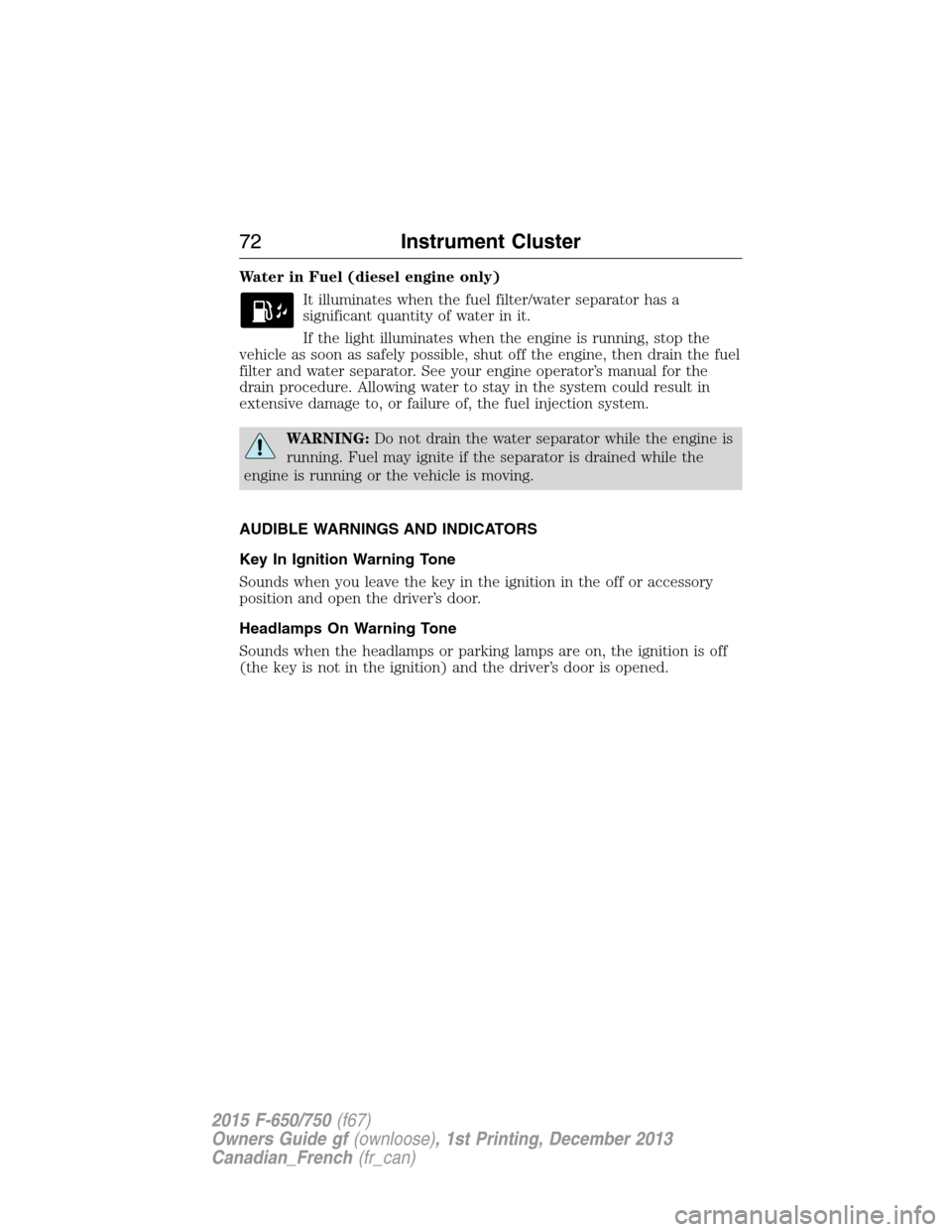
Water in Fuel (diesel engine only)
It illuminates when the fuel filter/water separator has a
significant quantity of water in it.
If the light illuminates when the engine is running, stop the
vehicle as soon as safely possible, shut off the engine, then drain the fuel
filter and water separator. See your engine operator’s manual for the
drain procedure. Allowing water to stay in the system could result in
extensive damage to, or failure of, the fuel injection system.
WARNING:Do not drain the water separator while the engine is
running. Fuel may ignite if the separator is drained while the
engine is running or the vehicle is moving.
AUDIBLE WARNINGS AND INDICATORS
Key In Ignition Warning Tone
Sounds when you leave the key in the ignition in the off or accessory
position and open the driver’s door.
Headlamps On Warning Tone
Sounds when the headlamps or parking lamps are on, the ignition is off
(the key is not in the ignition) and the driver’s door is opened.
72Instrument Cluster
2015 F-650/750(f67)
Owners Guide gf(ownloose), 1st Printing, December 2013
Canadian_French(fr_can)
Page 75 of 384
•TRIP A/B: Registers the distance of individual journeys. Press and
release the INFO button until the A or B trip appears in the display
(this represents the trip mode). Press the RESET button to reset.
SeeSystem check and vehicle feature customizationlater in this
section to switch the display from metric to English.
•MILES (KILOMETERS) TO E: This displays an estimate of
approximately how far you can drive with the fuel remaining in your
tank under normal driving conditions. Remember to turn the ignition
off when refueling to allow this feature to detect the added fuel
correctly. The distance to empty calculation uses a running average
fuel economy based on your recent driving history of 500 miles
(800 kilometers). This value is not the same as the average fuel
economy display. The running average fuel economy resets to a
factory default value if the battery is disconnected.
•AVG MPG (L/100 km): Average fuel economy displays your average
fuel economy in miles/gallon or liters/100 km.
•TIMER: Displays the trip elapsed drive time. Press and release
RESET to pause the timer. Press and hold RESET to reset the timer.
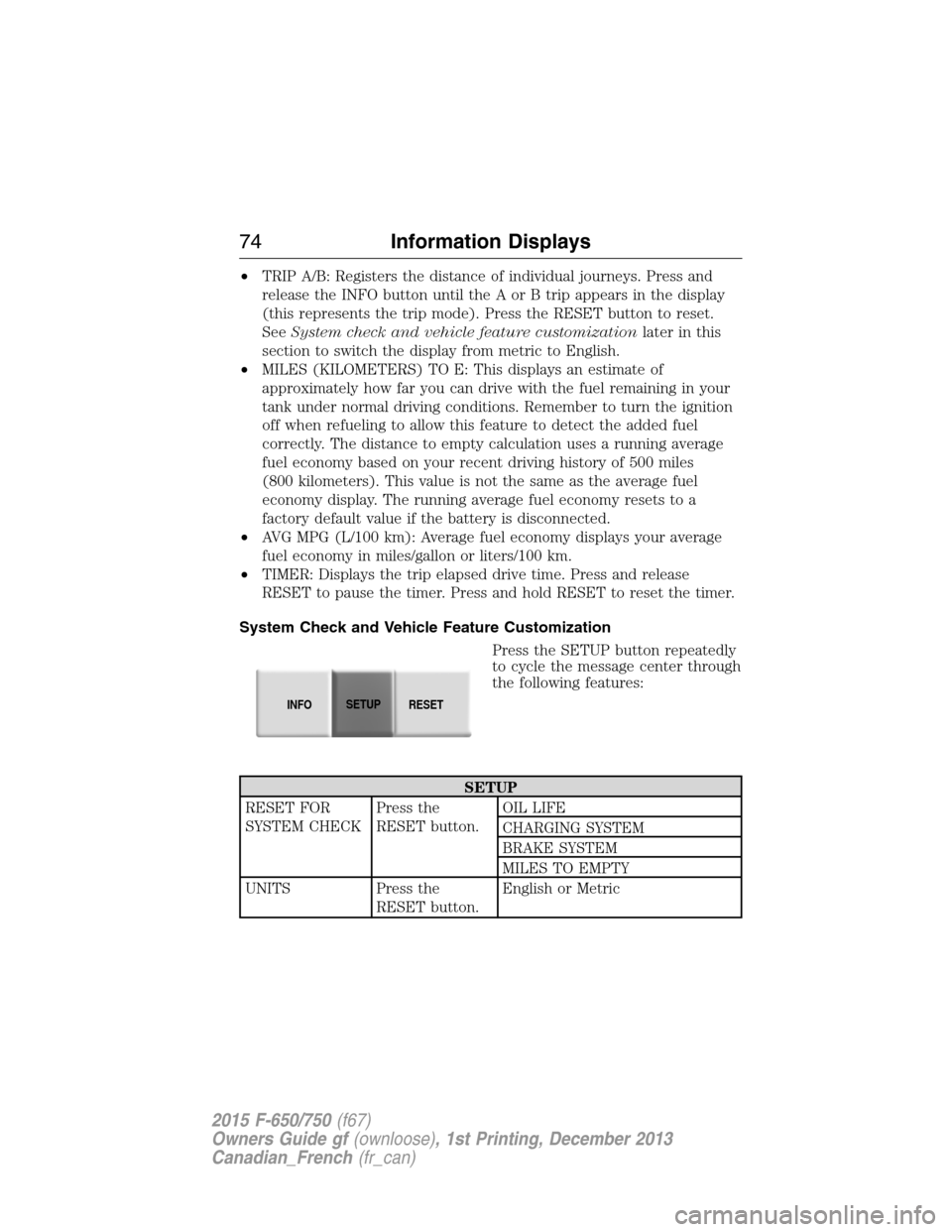
System Check and Vehicle Feature Customization
Press the SETUP button repeatedly
to cycle the message center through
the following features:
SETUP
RESET FOR
SYSTEM CHECKPress the
RESET button.OIL LIFE
CHARGING SYSTEM
BRAKE SYSTEM
MILES TO EMPTY
UNITS Press the
RESET button.English or Metric
INFOSETUP
RESET
74Information Displays
2015 F-650/750(f67)
Owners Guide gf(ownloose), 1st Printing, December 2013
Canadian_French(fr_can)
Page 94 of 384
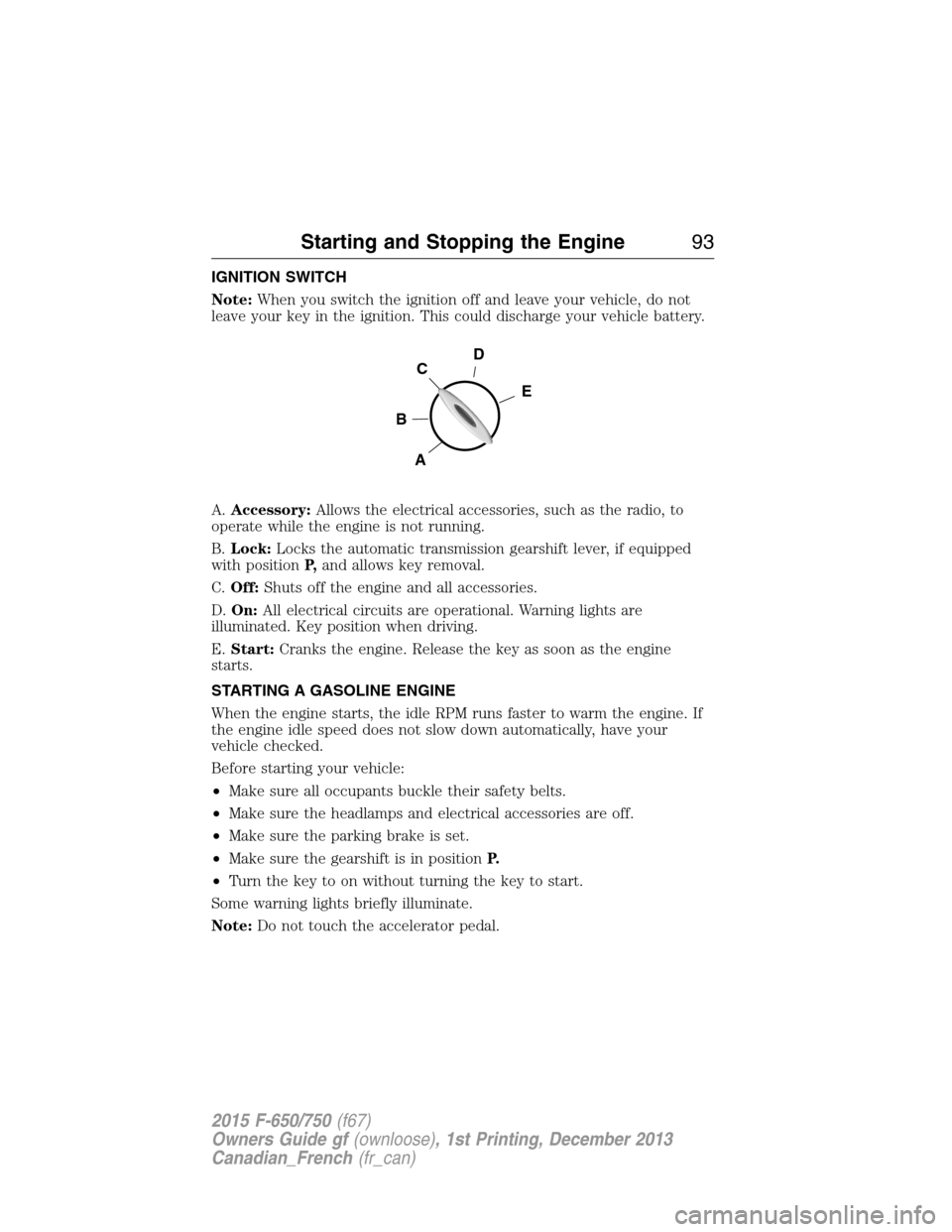
IGNITION SWITCH
Note:When you switch the ignition off and leave your vehicle, do not
leave your key in the ignition. This could discharge your vehicle battery.
A.Accessory:Allows the electrical accessories, such as the radio, to
operate while the engine is not running.
B.Lock:Locks the automatic transmission gearshift lever, if equipped
with positionP,and allows key removal.
C.Off:Shuts off the engine and all accessories.
D.On:All electrical circuits are operational. Warning lights are
illuminated. Key position when driving.
E.Start:Cranks the engine. Release the key as soon as the engine
starts.
STARTING A GASOLINE ENGINE
When the engine starts, the idle RPM runs faster to warm the engine. If
the engine idle speed does not slow down automatically, have your
vehicle checked.
Before starting your vehicle:
•Make sure all occupants buckle their safety belts.
•Make sure the headlamps and electrical accessories are off.
•Make sure the parking brake is set.
•Make sure the gearshift is in positionP.
•Turn the key to on without turning the key to start.
Some warning lights briefly illuminate.
Note:Do not touch the accelerator pedal.
D
E
C
B
A
Starting and Stopping the Engine93
2015 F-650/750(f67)
Owners Guide gf(ownloose), 1st Printing, December 2013
Canadian_French(fr_can)
Page 96 of 384
STARTING A DIESEL ENGINE
WARNING:Operation of a diesel engine near flammable vapors
in the air may cause the engine speed to increase uncontrollably
and over speed. If this situation occurs, mechanical damage, fire,
explosion, personal injury or death could result.Turning off the
ignition key does not slow or stop the engine due to uncontrollable
fueling of the engine through flammable vapors being drawn into
the engine air inlet.Operation of components such as starter,
alternator, electric motors, etc. and static electricity could also ignite
flammable vapors.
Do not operate the truck in the possible presence of flammable vapors
unless both a complete hazard analysis is performed and necessary
additional safety processes and/or equipment such as vapor testing, air
intake shutoff devices, ventilation, etc. are utilized. The operator is
responsible for using those processes and/or equipment to ensure that
the diesel engine and all other components on the truck can be
operated safely under the specific conditions and hazards that may be
encountered.
WARNING:If equipped with an air intake heater, DO NOT use
ether or any other starting fluids. The use of starting fluids
(ether) in an engine equipped with an air intake heater could cause an
explosion and result in property damage and/or personal injury.
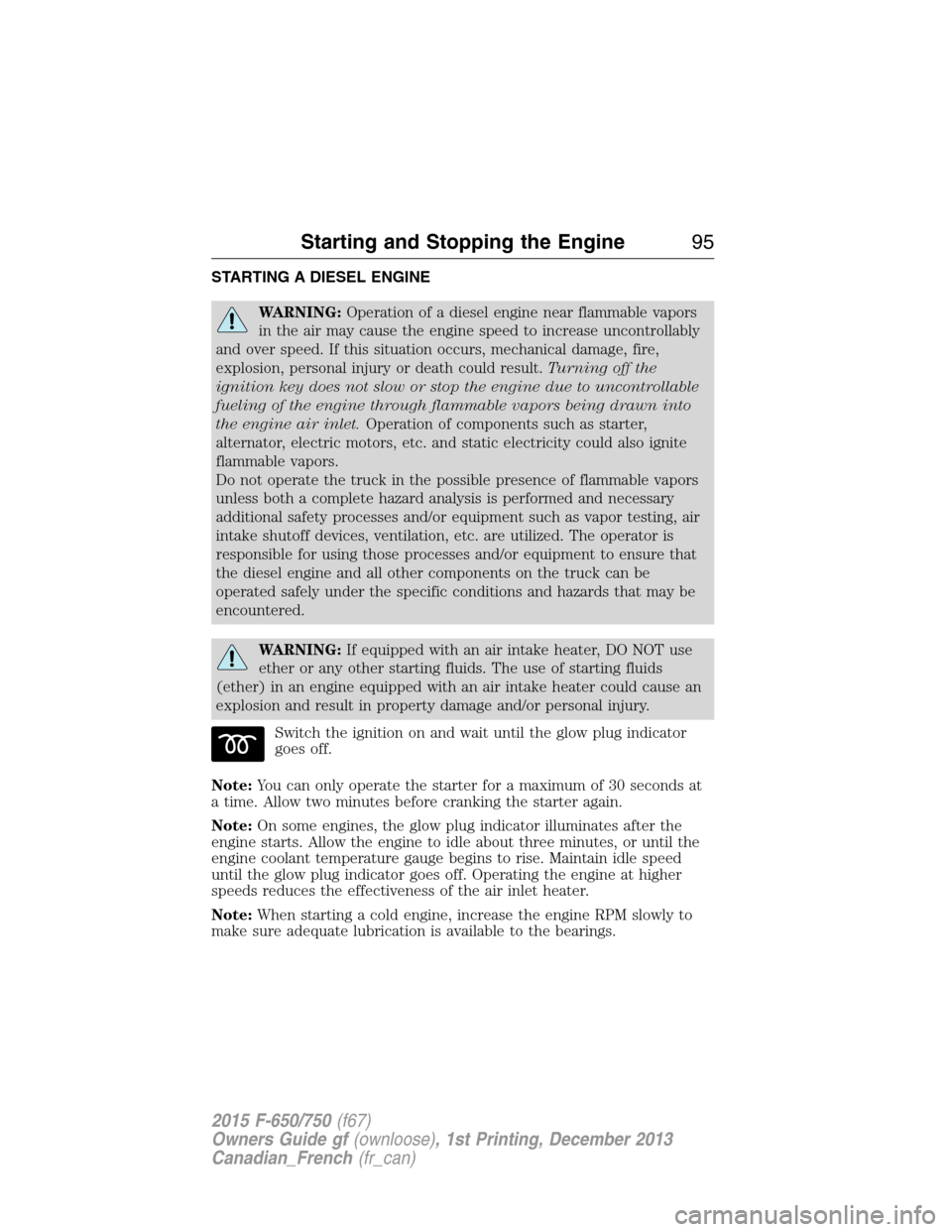
Switch the ignition on and wait until the glow plug indicator
goes off.
Note:You can only operate the starter for a maximum of 30 seconds at
a time. Allow two minutes before cranking the starter again.
Note:On some engines, the glow plug indicator illuminates after the
engine starts. Allow the engine to idle about three minutes, or until the
engine coolant temperature gauge begins to rise. Maintain idle speed
until the glow plug indicator goes off. Operating the engine at higher
speeds reduces the effectiveness of the air inlet heater.
Note:When starting a cold engine, increase the engine RPM slowly to
make sure adequate lubrication is available to the bearings.
Starting and Stopping the Engine95
2015 F-650/750(f67)
Owners Guide gf(ownloose), 1st Printing, December 2013
Canadian_French(fr_can)
Page 107 of 384
Biodiesel fuel is a product converted from renewable fuel sources,
including vegetable oil, animal fat and cooking oil. You should not use
raw, refined, and recycled vegetable/plant oils, greases, and animal fats.
Biodiesel fuel blends must meet requirements of ASTM D7467 standard
specification. See your engine operator’s manual for more information
and restrictions about the use of biodiesel fuel.
Octane Recommendations - Gasoline Engines
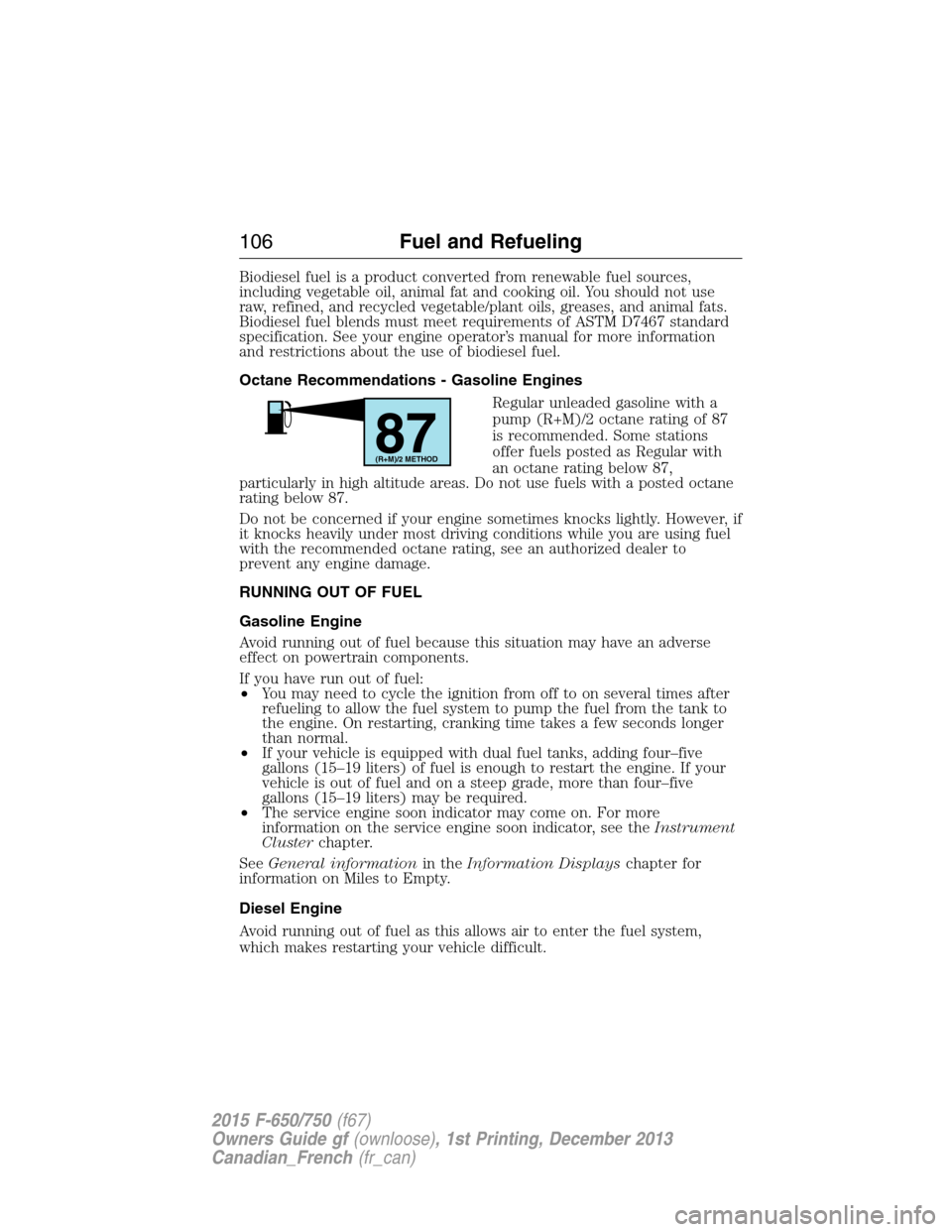
Regular unleaded gasoline with a
pump (R+M)/2 octane rating of 87
is recommended. Some stations
offer fuels posted as Regular with
an octane rating below 87,
particularly in high altitude areas. Do not use fuels with a posted octane
rating below 87.
Do not be concerned if your engine sometimes knocks lightly. However, if
it knocks heavily under most driving conditions while you are using fuel
with the recommended octane rating, see an authorized dealer to
prevent any engine damage.
RUNNING OUT OF FUEL
Gasoline Engine
Avoid running out of fuel because this situation may have an adverse
effect on powertrain components.
If you have run out of fuel:
•You may need to cycle the ignition from off to on several times after
refueling to allow the fuel system to pump the fuel from the tank to
the engine. On restarting, cranking time takes a few seconds longer
than normal.
•If your vehicle is equipped with dual fuel tanks, adding four–five
gallons (15–19 liters) of fuel is enough to restart the engine. If your
vehicle is out of fuel and on a steep grade, more than four–five
gallons (15–19 liters) may be required.
•The service engine soon indicator may come on. For more
information on the service engine soon indicator, see theInstrument
Clusterchapter.
SeeGeneral informationin theInformation Displayschapter for
information on Miles to Empty.
Diesel Engine
Avoid running out of fuel as this allows air to enter the fuel system,
which makes restarting your vehicle difficult.
87(R+M)/2 METHOD
106Fuel and Refueling
2015 F-650/750(f67)
Owners Guide gf(ownloose), 1st Printing, December 2013
Canadian_French(fr_can)
Page 108 of 384
If you have run out of fuel:
•If your vehicle is equipped with dual fuel tanks, adding four–five
gallons (15–19 liters) of fuel is enough to restart the engine. If your
vehicle is out of fuel and on a steep grade, more than four–five
gallons (15–19 liters) may be required.
•The fuel system must be primed before attempting to restart the
engine. See your engine operator’s manual for instructions on priming
the engine.
•Use caution not to overheat and damage the starter by cranking the
engine for an excessive period. You may need to crank the engine for
a longer time than normal. If the engine fails to start in 30 seconds,
turn the ignition to the off position and wait for two minutes before
cranking the engine again.
•Any remaining trapped air self-purges from the fuel system once the
engine starts running.
•The engine may run rough and produce white smoke while air is in
the fuel system. This is normal and should stop after a short period.
SeeGeneral informationin theInformation Displayschapter for
information on Miles to Empty.
REFUELING
WARNING:Fuel vapor burns violently and a fuel fire can cause
severe injuries. To help avoid injuries to you and others:
•Read and follow all the instructions on the pump island.
•Turn off your engine when you are refueling.
•Do not smoke if you are near fuel or refueling your vehicle.
•Keep sparks, flames and smoking materials away from fuel.
•Stay outside your vehicle and do not leave the fuel pump unattended
when refueling your vehicle - this is against the law in some places.
•Keep children away from the fuel pump; never let children pump
fuel.
•Do not use personal electronic devices while refueling.
Use the following guidelines to avoid electrostatic charge build-up when
filling an ungrounded fuel container:
•Place approved fuel container on the ground.
•DO NOT fill a fuel container while it is in the vehicle (including the
cargo area).
Fuel and Refueling107
2015 F-650/750(f67)
Owners Guide gf(ownloose), 1st Printing, December 2013
Canadian_French(fr_can)
Page 110 of 384
FUEL CONSUMPTION
Filling the Tank
The advertised capacity is the indicated capacity and the empty reserve
combined. Indicated capacity is the difference in the amount of fuel in a
full tank and a tank when the fuel gauge indicates empty. Empty reserve
is the amount of fuel in the tank after the fuel gauge indicates empty.
Note:The amount of usable fuel in the empty reserve varies. Do not rely
on it to increase your driving range. When refueling your vehicle after
the fuel gauge indicates empty, you might not be able to refuel the full
amount of the advertised capacity of the fuel tank due to the empty
reserve still present in the tank.
For consistent results when filling the fuel tank:
•Turn the ignition off before fueling. An inaccurate reading results if
you leave the engine running.
•Use the same fill rate (low–medium–high) each time you fill the tank.
•Allow no more than two automatic click–offs when filling.
•Have the vehicle loading and distribution the same every time.
•If your vehicle is equipped with dual fuel tanks, fill the tanks evenly
or the fuel gauge reading may fluctuate slightly until the fuel level
between the two tanks balances out and becomes equal.
Note:If your vehicle is equipped with dual fuel tanks add fuel to both
fuel tanks when refueling or engine performance may degrade.
Results are most accurate when the filling method is consistent.
Calculating Fuel Economy
Do not measure fuel economy during the first 1000 miles
(1600 kilometers) of driving; this is your engine’s break-in period. Start
measuring after driving 2000–3000 miles (3200–4800 kilometers). Also,
fuel expense, frequency of fill-ups or fuel gauge readings are not
accurate ways to measure fuel economy.
1. Fill the fuel tank completely and record the initial odometer reading.
2. Each time you fill the tank, record the amount of fuel added.
3. After at least three to five tank fill-ups, fill the fuel tank and record
the current odometer reading.
4. Subtract your initial odometer reading from the current odometer
reading.
5. Calculate fuel economy as follows:
•Standard: Divide miles traveled by gallons used.
•Metric: Multiply liters used by 100, then divide by kilometers
traveled.
Fuel and Refueling109
2015 F-650/750(f67)
Owners Guide gf(ownloose), 1st Printing, December 2013
Canadian_French(fr_can)
Page 128 of 384
Brake-shift Interlock
Vehicles equipped with a gasoline engine have a brake-shift interlock
feature that prevents you from moving the gearshift lever from position
Pwhen the ignition is in the on position and the brake pedal is not
pressed.
If you cannot move the gearshift lever out of positionPwith the ignition
in the on position and the brake pedal pressed, it is possible that a fuse
has blown or your vehicle’s brake lamps are not operating properly. See
theFuseschapter.
WARNING:Do not drive your vehicle until you verify that the
brake lamps are working.
WARNING:When doing this procedure, you will be taking the
vehicle out of park which means the vehicle can roll freely. To
avoid unwanted vehicle movement, always fully set the parking brake
prior to doing this procedure. Use wheel chocks if appropriate.
WARNING:If the parking brake is fully released, but the brake
warning lamp remains illuminated, the brakes may not be
working properly. See your authorized dealer.
Transmission127
2015 F-650/750(f67)
Owners Guide gf(ownloose), 1st Printing, December 2013
Canadian_French(fr_can)