ignition FORD F650 2015 13.G Owner's Manual
[x] Cancel search | Manufacturer: FORD, Model Year: 2015, Model line: F650, Model: FORD F650 2015 13.GPages: 384, PDF Size: 4.95 MB
Page 129 of 384
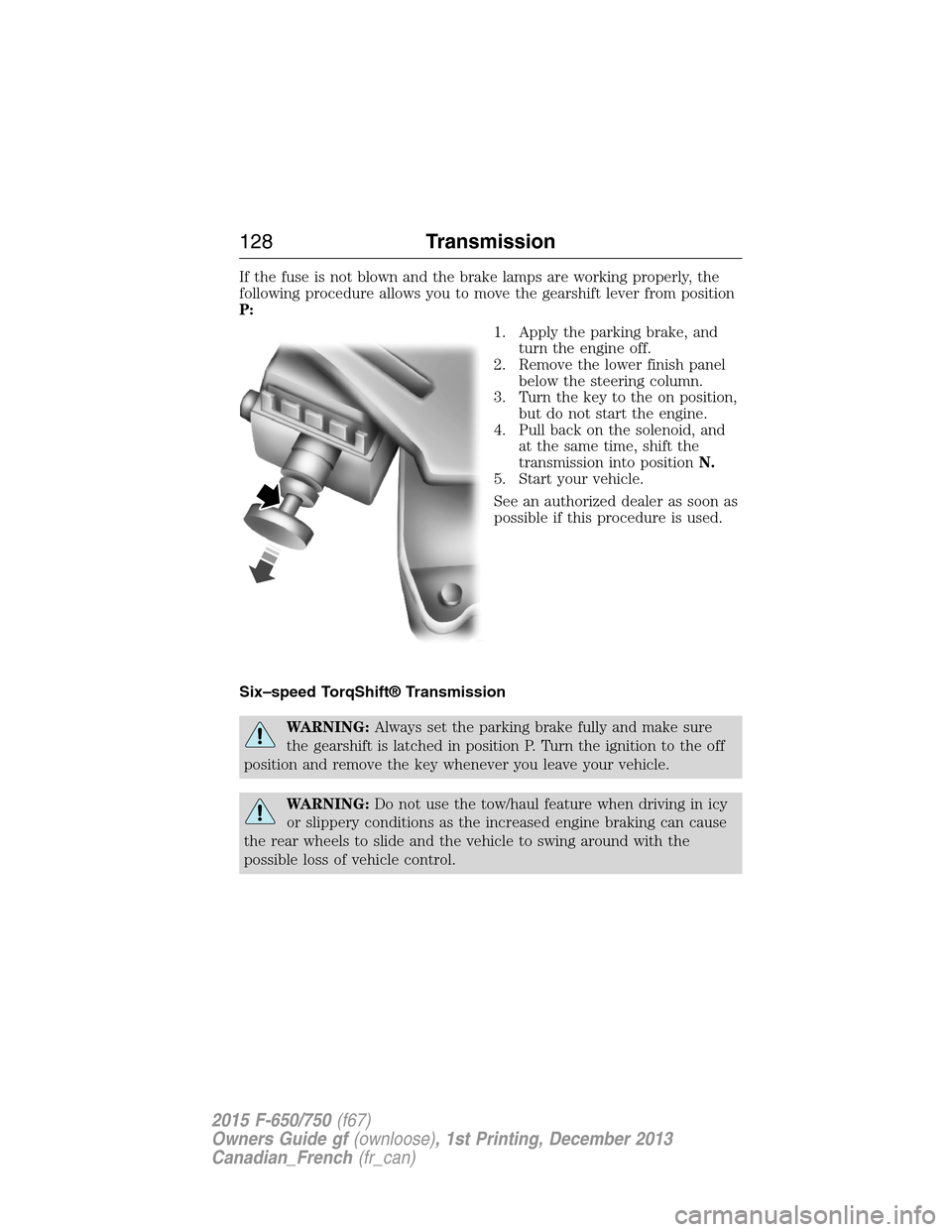
If the fuse is not blown and the brake lamps are working properly, the
following procedure allows you to move the gearshift lever from position
P:
1. Apply the parking brake, and
turn the engine off.
2. Remove the lower finish panel
below the steering column.
3. Turn the key to the on position,
but do not start the engine.
4. Pull back on the solenoid, and
at the same time, shift the
transmission into positionN.
5. Start your vehicle.
See an authorized dealer as soon as
possible if this procedure is used.
Six–speed TorqShift® Transmission
WARNING:Always set the parking brake fully and make sure
the gearshift is latched in position P. Turn the ignition to the off
position and remove the key whenever you leave your vehicle.
WARNING:Do not use the tow/haul feature when driving in icy
or slippery conditions as the increased engine braking can cause
the rear wheels to slide and the vehicle to swing around with the
possible loss of vehicle control.
128Transmission
2015 F-650/750(f67)
Owners Guide gf(ownloose), 1st Printing, December 2013
Canadian_French(fr_can)
Page 140 of 384
Anti-lock Brake System (ABS)
This system helps you maintain steering control during emergency stops
by keeping the brakes from locking.
The ABS lamp momentarily illuminates when you switch on the
ignition. If the light does not illuminate during start-up, if it
remains on or flashes, the ABS may not be working and
requires servicing.
If the ABS is disabled, normal braking is still effective. If the
brake warning lamp illuminates, have your brake system
serviced immediately.
If you connect a PLC trailer with the ignition on, the trailer
ABS light also illuminates. If the light fails to illuminate, if it
remains on after you start the vehicle or continues to flash,
have the system serviced immediately.
FULL POWER BRAKE SYSTEM
WARNING:If the red BRAKE warning lamp in the instrument
cluster remains illuminated after engine start up, this indicates a
system failure in the Full Power Brake System. Stop the vehicle safely
as soon as possible and seek service immediately.
This system incorporates standard braking, an anti-lock braking system
(ABS) and optional Power Park Brake into one fully integrated hydraulic
brake system. With the Full Power Brake System, braking energy is
stored, similar to an air brake system, resulting in faster response times
and shorter stopping distances. This is accomplished using motor and
pump assemblies that pressurize the system by pumping brake fluid into
accumulators. This is similar to the air compressor of an air brake system
pressurizing the air tanks. The system includes a master cylinder that
provides the normal pedal feel and transfers the pedal force, via brake
fluid, to the main components of the system.
Note:The motor and pumps run momentarily with the ignition switch in
the on or run position, or in the off position with the brake pedal
pressed.
Note:During normal driving, you may hear the pump and motors
replenishing the accumulators. This is a normal function of the system.
AIR BRAKES
After starting the engine, give the air compressor time to build up the air
pressure to 60 psi (414 kPa) before moving your vehicle.
Brakes139
2015 F-650/750(f67)
Owners Guide gf(ownloose), 1st Printing, December 2013
Canadian_French(fr_can)
Page 141 of 384
WARNING:Do not drive or continue to drive if the low air
pressure buzzer is sounding or the brake warning light is lit.
These warnings indicate that air pressure is not to normal operating
level. Continued use of the vehicle could result in loss of braking ability.
WARNING:Avoid repeated light application of the brake pedal.
This depletes air pressure faster and could result in loss of
braking capability.
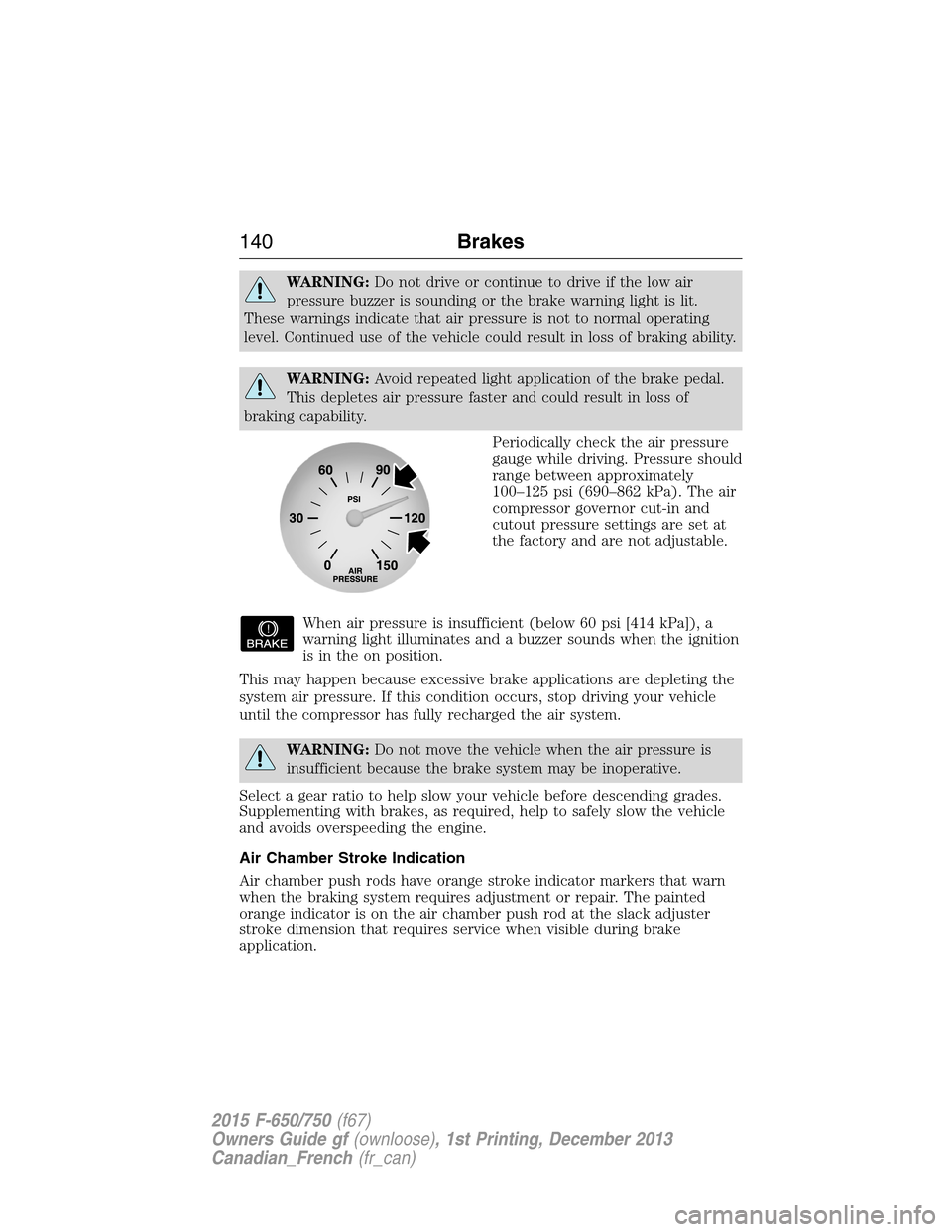
Periodically check the air pressure
gauge while driving. Pressure should
range between approximately
100–125 psi (690–862 kPa). The air
compressor governor cut-in and
cutout pressure settings are set at
the factory and are not adjustable.
When air pressure is insufficient (below 60 psi [414 kPa]), a
warning light illuminates and a buzzer sounds when the ignition
is in the on position.
This may happen because excessive brake applications are depleting the
system air pressure. If this condition occurs, stop driving your vehicle
until the compressor has fully recharged the air system.
WARNING:Do not move the vehicle when the air pressure is
insufficient because the brake system may be inoperative.
Select a gear ratio to help slow your vehicle before descending grades.
Supplementing with brakes, as required, help to safely slow the vehicle
and avoids overspeeding the engine.
Air Chamber Stroke Indication
Air chamber push rods have orange stroke indicator markers that warn
when the braking system requires adjustment or repair. The painted
orange indicator is on the air chamber push rod at the slack adjuster
stroke dimension that requires service when visible during brake
application.
140Brakes
2015 F-650/750(f67)
Owners Guide gf(ownloose), 1st Printing, December 2013
Canadian_French(fr_can)
Page 149 of 384
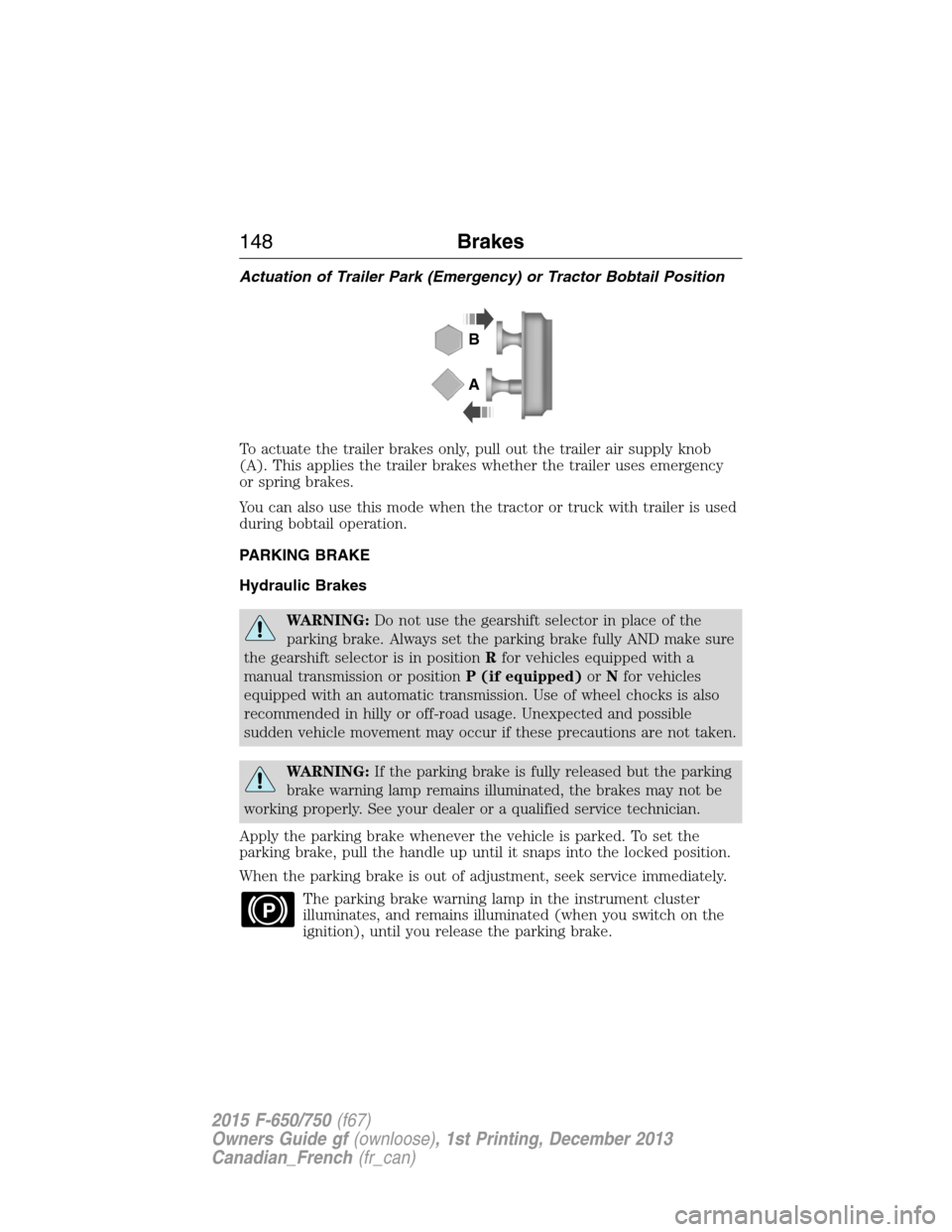
Actuation of Trailer Park (Emergency) or Tractor Bobtail Position
To actuate the trailer brakes only, pull out the trailer air supply knob
(A). This applies the trailer brakes whether the trailer uses emergency
or spring brakes.
You can also use this mode when the tractor or truck with trailer is used
during bobtail operation.
PARKING BRAKE
Hydraulic Brakes
WARNING:Do not use the gearshift selector in place of the
parking brake. Always set the parking brake fully AND make sure
the gearshift selector is in positionRfor vehicles equipped with a
manual transmission or positionP (if equipped)orNfor vehicles
equipped with an automatic transmission. Use of wheel chocks is also
recommended in hilly or off-road usage. Unexpected and possible
sudden vehicle movement may occur if these precautions are not taken.
WARNING:If the parking brake is fully released but the parking
brake warning lamp remains illuminated, the brakes may not be
working properly. See your dealer or a qualified service technician.
Apply the parking brake whenever the vehicle is parked. To set the
parking brake, pull the handle up until it snaps into the locked position.
When the parking brake is out of adjustment, seek service immediately.
The parking brake warning lamp in the instrument cluster
illuminates, and remains illuminated (when you switch on the
ignition), until you release the parking brake.
B
A
P
148Brakes
2015 F-650/750(f67)
Owners Guide gf(ownloose), 1st Printing, December 2013
Canadian_French(fr_can)
Page 151 of 384
Note:Read and understand the following steps and perform them
whenever you prepare to drive the vehicle.
Note:The parking brake does not disengage unless sufficient system air
pressure is available.
If your vehicle is equipped with a dash-mounted push button (Allison
3000 Series) or steering column-mounted (Allison 2200 and 2500) gear
selector:
1. Press and hold the service brake pedal while the engine is running.
2. Select the appropriate drive gear.
3. Push and hold the yellow, dash-mounted parking brake knob until the
parking brake light turns off, then release.
If your vehicle is equipped with a manual transmission:
1. Press and hold the service brake pedal while the engine is running.
2. Press and hold the clutch pedal.
3. Select the appropriate drive gear.
4. Push and hold the yellow, dash-mounted parking brake knob until the
parking brake light turns off, then release.
Parking Brake Light Illumination Due to Low Air Pressure
If the air pressure becomes too low at any time during vehicle operation,
the parking brake may apply and the parking brake light turns on.
If the parking brake applies due to low air pressure, immediate service is
required to the parking brake system.
Parking Brake Warning System
If the parking brake light blinks and a tone sounds when pulling the
yellow control knob out, this indicates the parking brake is not
functioning properly. Seek service for the parking brake immediately.
With the ignition key not in the run position:
•A tone sounds if the parking brake remains released (or in an
unknown state). The tone stops in approximately eight minutes or
until the parking brake is applied. Seek service for the parking brake
immediately.
Diesel engines:Parking brake light operation (the light only works
when the ignition key is in the run position):
•On:Parking brake applied.
•Off:Parking brake released and no faults or malfunctions.
•Blink and tone:Parking brake released (or in an unknown state)
and faults or malfunctions exist.
150Brakes
2015 F-650/750(f67)
Owners Guide gf(ownloose), 1st Printing, December 2013
Canadian_French(fr_can)
Page 153 of 384
Air Brakes
WARNING:Do not use the gearshift selector in place of the
parking brake; unexpected and possible sudden vehicle
movement may occur if these precautions are not taken. Always set the
parking brake fully AND make sure the gearshift selector is in position
Rfor vehicles equipped with manual transmission or positionN(except
Allison 2200 transmission) orP(Allison 2200 transmission) for vehicles
with automatic transmission.
If the service brakes should fail to operate while your vehicle is moving,
you can make an emergency stop with the parking brake. Since the
parking brake only applies stopping power to the rear wheels, your
vehicle’s stopping distance greatly increases and the handling of your
vehicle is adversely affected. Make repairs immediately to an inoperative
air brake system circuit.
WARNING:This control is used for parking only. Do not leave
the vehicle unattended after setting the parking brake without
placing the transmission inpositionRfor vehicles equipped with manual
transmission or positionN(except Allison 2200 transmission) orP
(Allison 2200 transmission) for vehicles with automatic transmission.
Use of wheel chocks is also recommended in hilly or off-road usage.
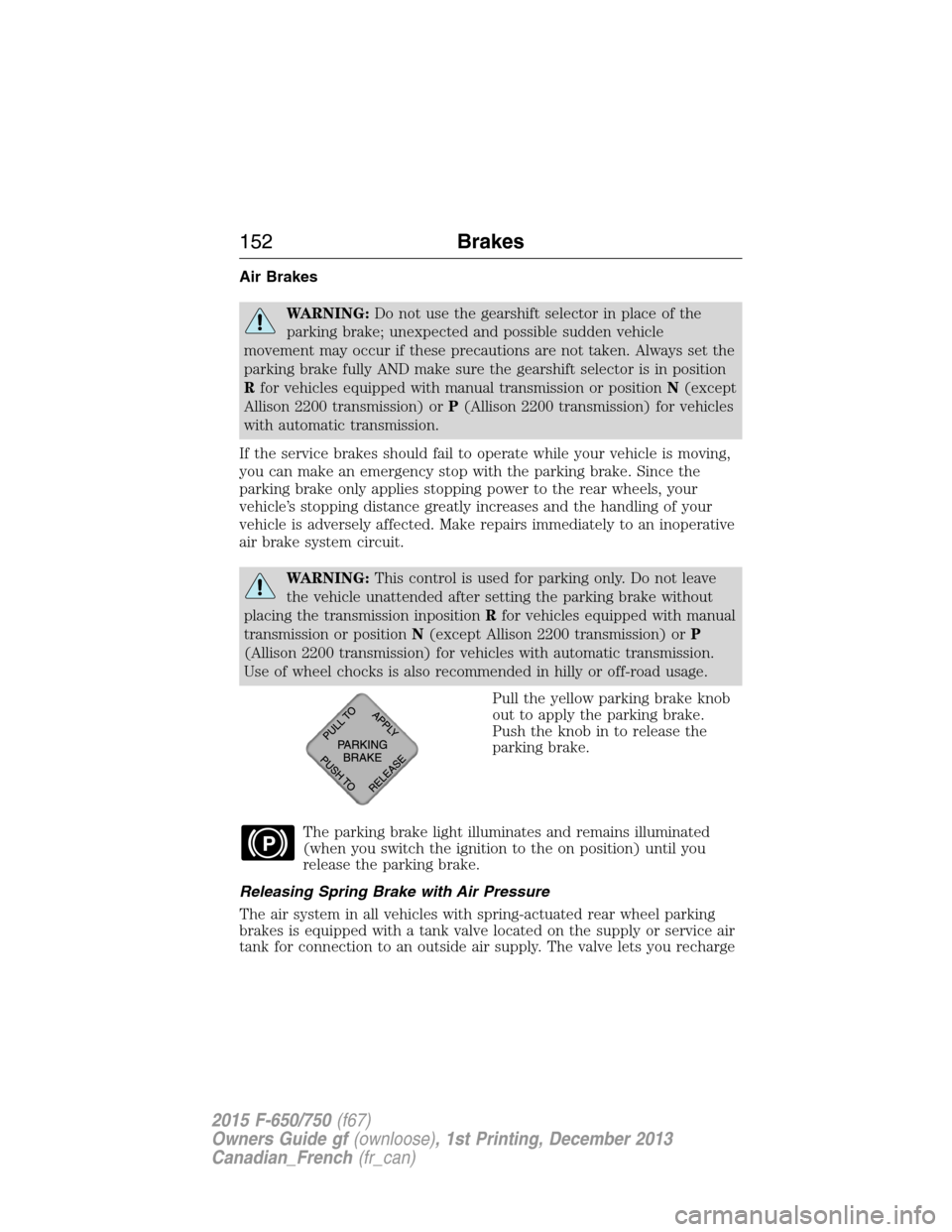
Pull the yellow parking brake knob
out to apply the parking brake.
Push the knob in to release the
parking brake.
The parking brake light illuminates and remains illuminated
(when you switch the ignition to the on position) until you
release the parking brake.
Releasing Spring Brake with Air Pressure
The air system in all vehicles with spring-actuated rear wheel parking
brakes is equipped with a tank valve located on the supply or service air
tank for connection to an outside air supply. The valve lets you recharge
P
152Brakes
2015 F-650/750(f67)
Owners Guide gf(ownloose), 1st Printing, December 2013
Canadian_French(fr_can)
Page 156 of 384
PRINCIPLES OF OPERATION
The traction control system helps avoid drive wheel spin and loss of
traction.
If your vehicle begins to slide, the system applies the rear brakes to
individual wheels and, when needed, reduces engine power at the same
time. If the wheels spin when accelerating on slippery or loose surfaces,
the system reduces engine power in order to increase traction.
Note:The system does not apply the brakes when vehicle speed is
above 25 mph (40 km/h).
USING TRACTION CONTROL
WARNING:Aggressive driving in any road conditions can cause
you to lose control of your vehicle increasing the risk of severe
personal injury or property damage. The occurrence of a traction
control event is an indication that at least some of the tires have
exceeded their ability to grip the road; this may lead to an increased
risk of loss of vehicle control, vehicle rollover, personal injury and
death. If you experience a severe road event, SLOW DOWN.
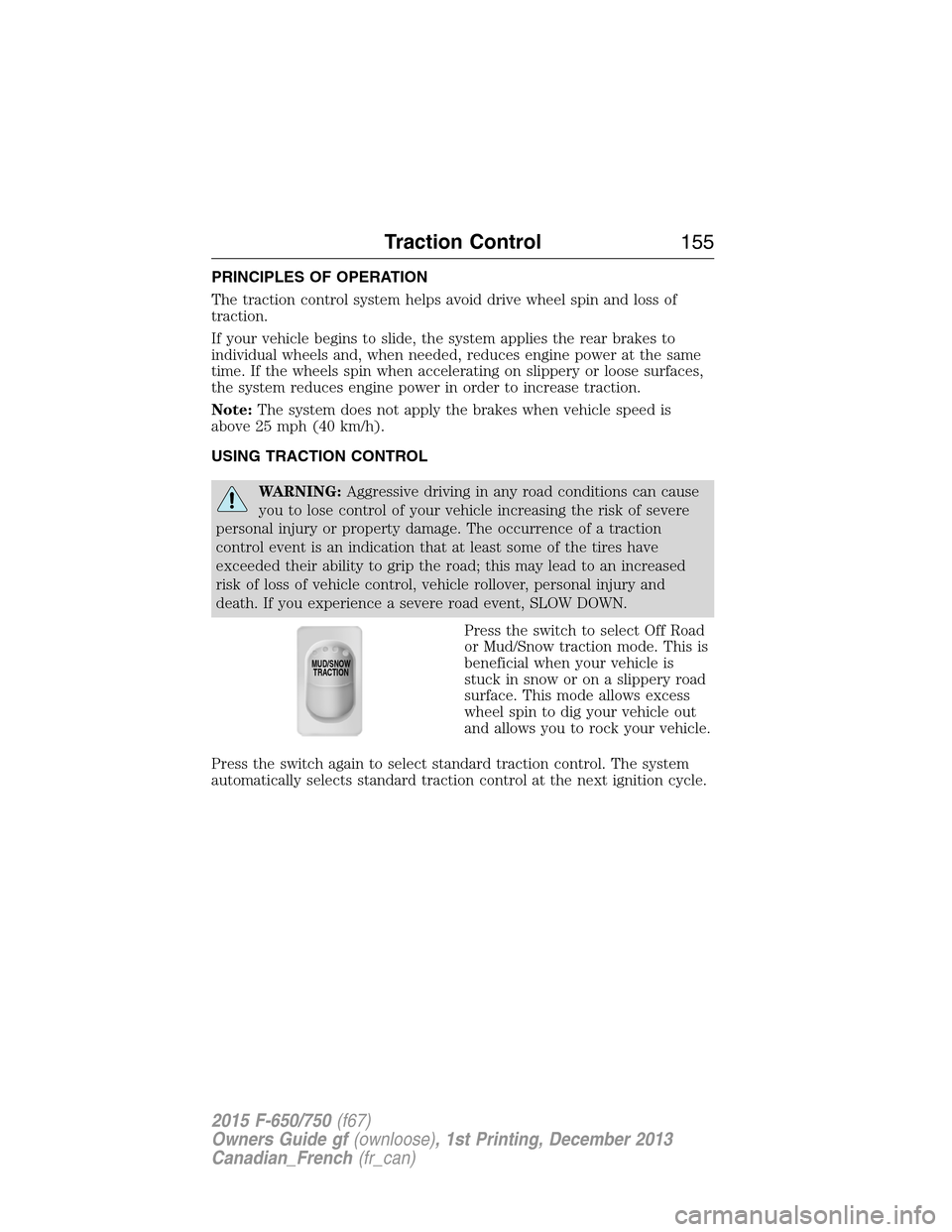
Press the switch to select Off Road
or Mud/Snow traction mode. This is
beneficial when your vehicle is
stuck in snow or on a slippery road
surface. This mode allows excess
wheel spin to dig your vehicle out
and allows you to rock your vehicle.
Press the switch again to select standard traction control. The system
automatically selects standard traction control at the next ignition cycle.
MUD/SNOW
TRACTION
Traction Control155
2015 F-650/750(f67)
Owners Guide gf(ownloose), 1st Printing, December 2013
Canadian_French(fr_can)
Page 159 of 384
Changing the Set Speed
There are a few ways to change the set speed:
•Press and holdSET ACCELto increase orCOASTto decrease the
set speed. Release the button when you reach the desired speed.
•Press and releaseSET ACCELto increase orCOASTto decrease.
The set speed changes in approximately 1 mph (2 km/h) increments.
•Press the accelerator pedal or brake pedal until you reach the desired
speed. Press and releaseSET ACCEL.
Canceling a Set Speed
Tap the brake pedal. This does not erase the set speed.
Resuming a Set Speed
Press and releaseRES.
Switching Off Cruise Control
Note:Turning off the cruise control erases the set speed.
PressOFFor turn off the ignition.
158Cruise Control
2015 F-650/750(f67)
Owners Guide gf(ownloose), 1st Printing, December 2013
Canadian_French(fr_can)
Page 163 of 384
If the steering wanders or pulls, check for:
•Underinflated tire(s) on any wheel(s)
•Uneven vehicle loading
•High crown in center of road
•High crosswinds
•Wheels out of alignment
•Loose or worn suspension components.
AIR SUSPENSION (IF EQUIPPED)
Note:Do not operate your vehicle without air in the suspension springs.
Operating your vehicle without air in the suspension springs damages the
suspension, degrades ride performance and may cause property damage.
The air suspension system automatically adjusts to different loads to
maintain a constant frame height, allows for ease of vehicle loading,
provides improved vehicle ride, and increased driver comfort.
Air Suspension Dump Switch
Note:The suspension dumps air when the ignition is in the accessory or
on position, but fills only when the ignition is in the on position.
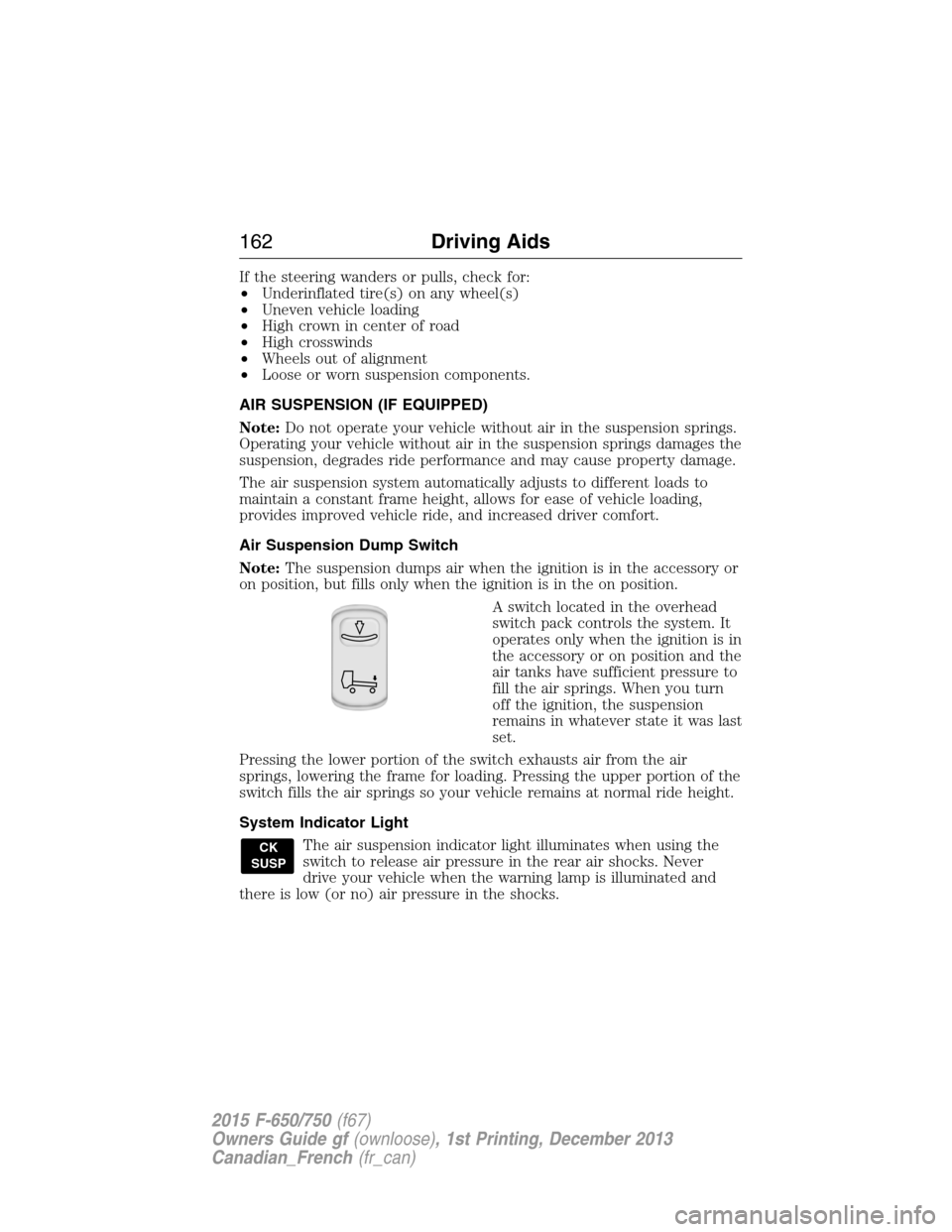
A switch located in the overhead
switch pack controls the system. It
operates only when the ignition is in
the accessory or on position and the
air tanks have sufficient pressure to
fill the air springs. When you turn
off the ignition, the suspension
remains in whatever state it was last
set.
Pressing the lower portion of the switch exhausts air from the air
springs, lowering the frame for loading. Pressing the upper portion of the
switch fills the air springs so your vehicle remains at normal ride height.
System Indicator Light
The air suspension indicator light illuminates when using the
switch to release air pressure in the rear air shocks. Never
drive your vehicle when the warning lamp is illuminated and
there is low (or no) air pressure in the shocks.
CK
SUSP
162Driving Aids
2015 F-650/750(f67)
Owners Guide gf(ownloose), 1st Printing, December 2013
Canadian_French(fr_can)
Page 165 of 384
UPFITTER CONTROLS (IF EQUIPPED)
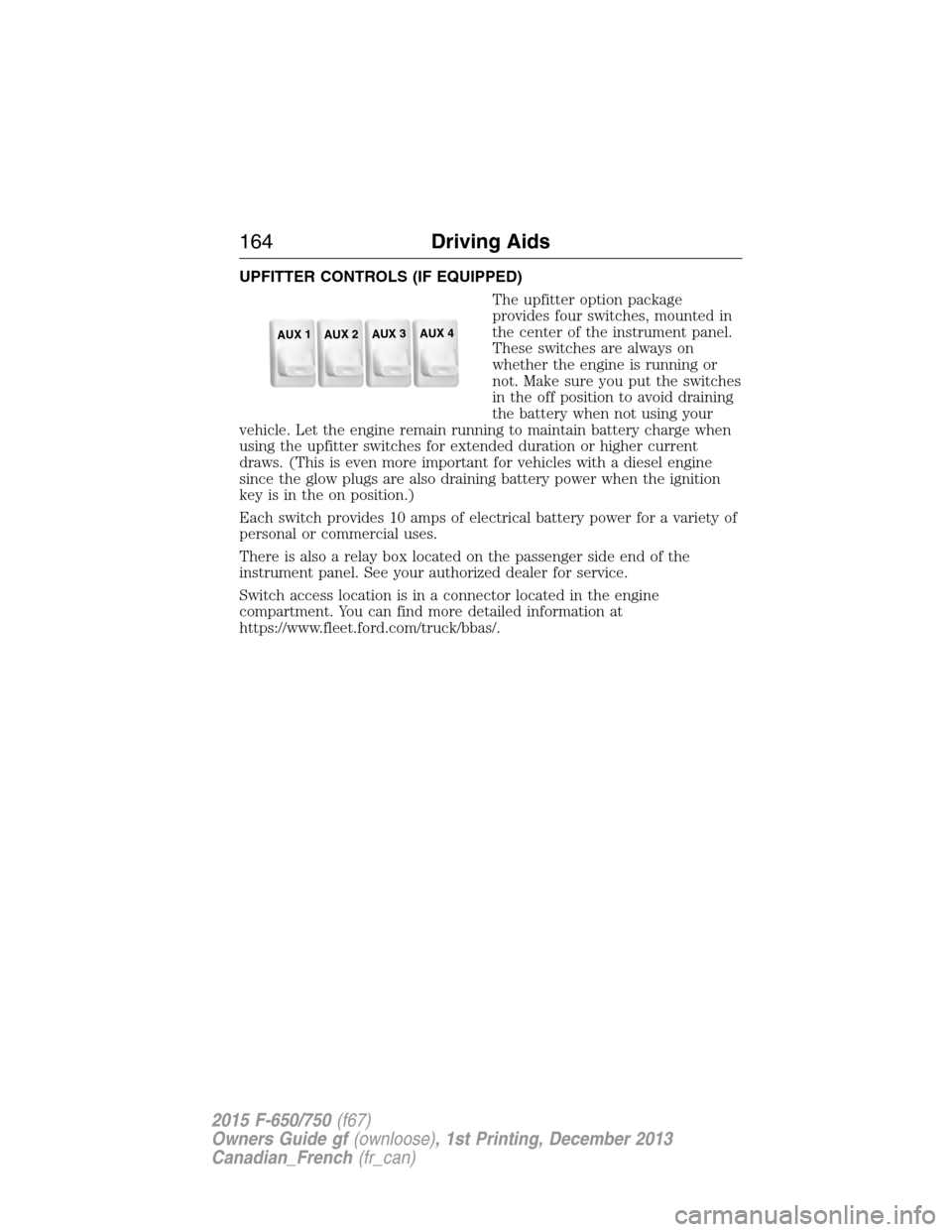
The upfitter option package
provides four switches, mounted in
the center of the instrument panel.
These switches are always on
whether the engine is running or
not. Make sure you put the switches
in the off position to avoid draining
the battery when not using your
vehicle. Let the engine remain running to maintain battery charge when
using the upfitter switches for extended duration or higher current
draws. (This is even more important for vehicles with a diesel engine
since the glow plugs are also draining battery power when the ignition
key is in the on position.)
Each switch provides 10 amps of electrical battery power for a variety of
personal or commercial uses.
There is also a relay box located on the passenger side end of the
instrument panel. See your authorized dealer for service.
Switch access location is in a connector located in the engine
compartment. You can find more detailed information at
https://www.fleet.ford.com/truck/bbas/.
AUX 1
AUX 2
AUX 3
AUX 4
164Driving Aids
2015 F-650/750(f67)
Owners Guide gf(ownloose), 1st Printing, December 2013
Canadian_French(fr_can)