brake fluid FORD F650 2015 13.G Owner's Manual
[x] Cancel search | Manufacturer: FORD, Model Year: 2015, Model line: F650, Model: FORD F650 2015 13.GPages: 384, PDF Size: 4.95 MB
Page 222 of 384
WARNING:If you use a brake fluid that is not DOT 3, you will
cause permanent damage to your brakes.
WARNING:Do not let the reservoir for the master cylinder run
dry. This may cause the brakes to fail.
Check and refill the Full Power brake fluid reservoir using the following
procedure. See theScheduled Maintenancechapter for the service
interval.
1. Clean the reservoir caps before removal to prevent dirt or water from
entering the reservoir.
2. Visually inspect the fluid level. It should be at the bottom of the fill
ports.
3. Add brake fluid, if necessary, from a clean, unopened container until
the level reaches the bottom of the fill ports. Do not fill above this
line.
Only use a DOT 3 brake fluid certified to meet manufacturer
specifications. See theCapacities and Specificationschapter.
CLUTCH FLUID AND LINKAGE
Clutch Fluid
WARNING:Carefully read cautionary information on product
label. For MEDICAL EMERGENCY INFORMATION, contact a
physician or Poison Control Center immediately; on Ford-Motorcraft®
products call: 1-800-959-3673 (FORD). Failure to follow these
instructions may result in personal injury.
Use only a DOT 3 brake fluid designed to meet manufacturer
specifications. See theCapacities and Specificationschapter.
During normal operation, the fluid level in the clutch reservoir should
remain constant. If the fluid level drops, fill to the step in the reservoir.
Maintenance221
2015 F-650/750(f67)
Owners Guide gf(ownloose), 1st Printing, December 2013
Canadian_French(fr_can)
Page 223 of 384
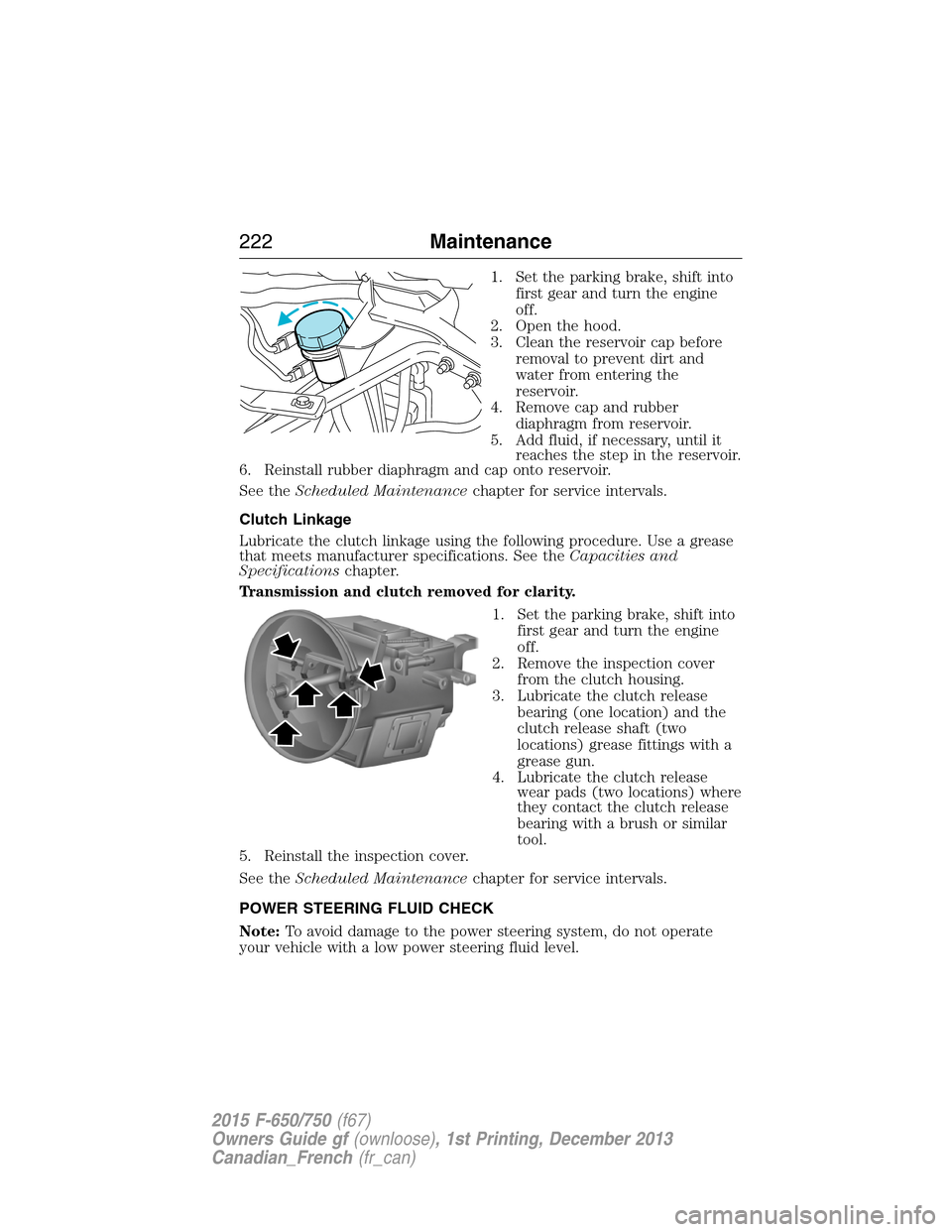
1. Set the parking brake, shift into
first gear and turn the engine
off.
2. Open the hood.
3. Clean the reservoir cap before
removal to prevent dirt and
water from entering the
reservoir.
4. Remove cap and rubber
diaphragm from reservoir.
5. Add fluid, if necessary, until it
reaches the step in the reservoir.
6. Reinstall rubber diaphragm and cap onto reservoir.
See theScheduled Maintenancechapter for service intervals.
Clutch Linkage
Lubricate the clutch linkage using the following procedure. Use a grease
that meets manufacturer specifications. See theCapacities and
Specificationschapter.
Transmission and clutch removed for clarity.
1. Set the parking brake, shift into
first gear and turn the engine
off.
2. Remove the inspection cover
from the clutch housing.
3. Lubricate the clutch release
bearing (one location) and the
clutch release shaft (two
locations) grease fittings with a
grease gun.
4. Lubricate the clutch release
wear pads (two locations) where
they contact the clutch release
bearing with a brush or similar
tool.
5. Reinstall the inspection cover.
See theScheduled Maintenancechapter for service intervals.
POWER STEERING FLUID CHECK
Note:To avoid damage to the power steering system, do not operate
your vehicle with a low power steering fluid level.
222Maintenance
2015 F-650/750(f67)
Owners Guide gf(ownloose), 1st Printing, December 2013
Canadian_French(fr_can)
Page 224 of 384
Note:If adding fluid is necessary, use only the appropriate fluid. See the
Capacities and Specificationschapter. A low fluid level may indicate a
leak in the power steering system. Inspect the power steering system
and repair the leak or see an authorized dealer or a qualified technician
for service. See theScheduled Maintenancechapter for the
recommended service intervals.
Check the fluid level when it is at ambient temperature, 20°F–80°F
(-7°C–25°C):
1. Set the parking brake, and then start the engine.
2. Shift into positionNorP(if equipped) (automatic transmission) or
first gear (manual transmission) and turn the engine off.
3. Open the hood.
4. Clean the top of the power steering fluid reservoir.
5. Remove the dipstick from the reservoir and wipe the dipstick clean.
6. Reinstall the dipstick. Remove it again and check the fluid level.
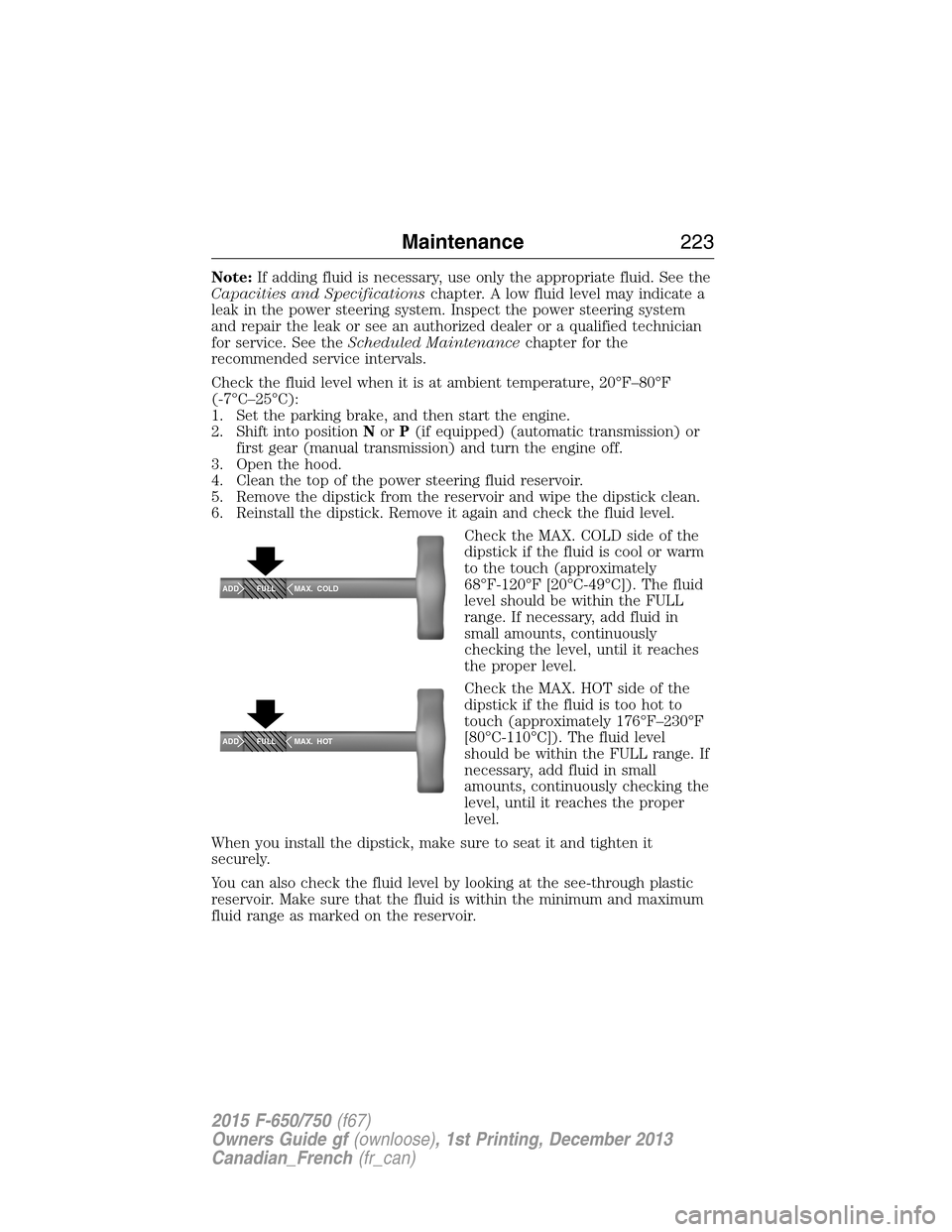
Check the MAX. COLD side of the
dipstick if the fluid is cool or warm
to the touch (approximately
68°F-120°F [20°C-49°C]). The fluid
level should be within the FULL
range. If necessary, add fluid in
small amounts, continuously
checking the level, until it reaches
the proper level.
Check the MAX. HOT side of the
dipstick if the fluid is too hot to
touch (approximately 176°F–230°F
[80°C-110°C]). The fluid level
should be within the FULL range. If
necessary, add fluid in small
amounts, continuously checking the
level, until it reaches the proper
level.
When you install the dipstick, make sure to seat it and tighten it
securely.
You can also check the fluid level by looking at the see-through plastic
reservoir. Make sure that the fluid is within the minimum and maximum
fluid range as marked on the reservoir.
ADD MAX. COLD
FULL
ADD MAX. HOT
FULL
Maintenance223
2015 F-650/750(f67)
Owners Guide gf(ownloose), 1st Printing, December 2013
Canadian_French(fr_can)
Page 228 of 384
4. Allow the engine to idle for at least one minute.
5. Turn on the air conditioning and allow the engine to idle for at least
one minute.
6. Release the parking brake. With your foot on the brake pedal and
with the air conditioning on, put the transmission in positionP
(automatic transmission) or neutral (manual transmission) and allow
the engine to idle for at least one minute.Note:Not allowing the
engine to relearn the idle trim may adversely affect the idle quality of
your vehicle until the engine eventually relearns the idle trim.
7. Drive your vehicle to complete the relearning process.
If you disconnect the battery or install a new battery, you have to reset
the clock and radio settings after reconnecting the battery.
Always dispose of automotive
batteries in a responsible manner.
Follow your local authorized
standards for disposal. Call your
local authorized recycling center to
find out more about recycling
automotive batteries.
CHECKING THE WIPER BLADES
Run the tip of your fingers over the edge of the blade
to check for roughness.
Clean the wiper blades with washer fluid or water
applied with a soft sponge or cloth.
L
E
A
D
RETURN
RECYCLE
Maintenance227
2015 F-650/750(f67)
Owners Guide gf(ownloose), 1st Printing, December 2013
Canadian_French(fr_can)
Page 242 of 384
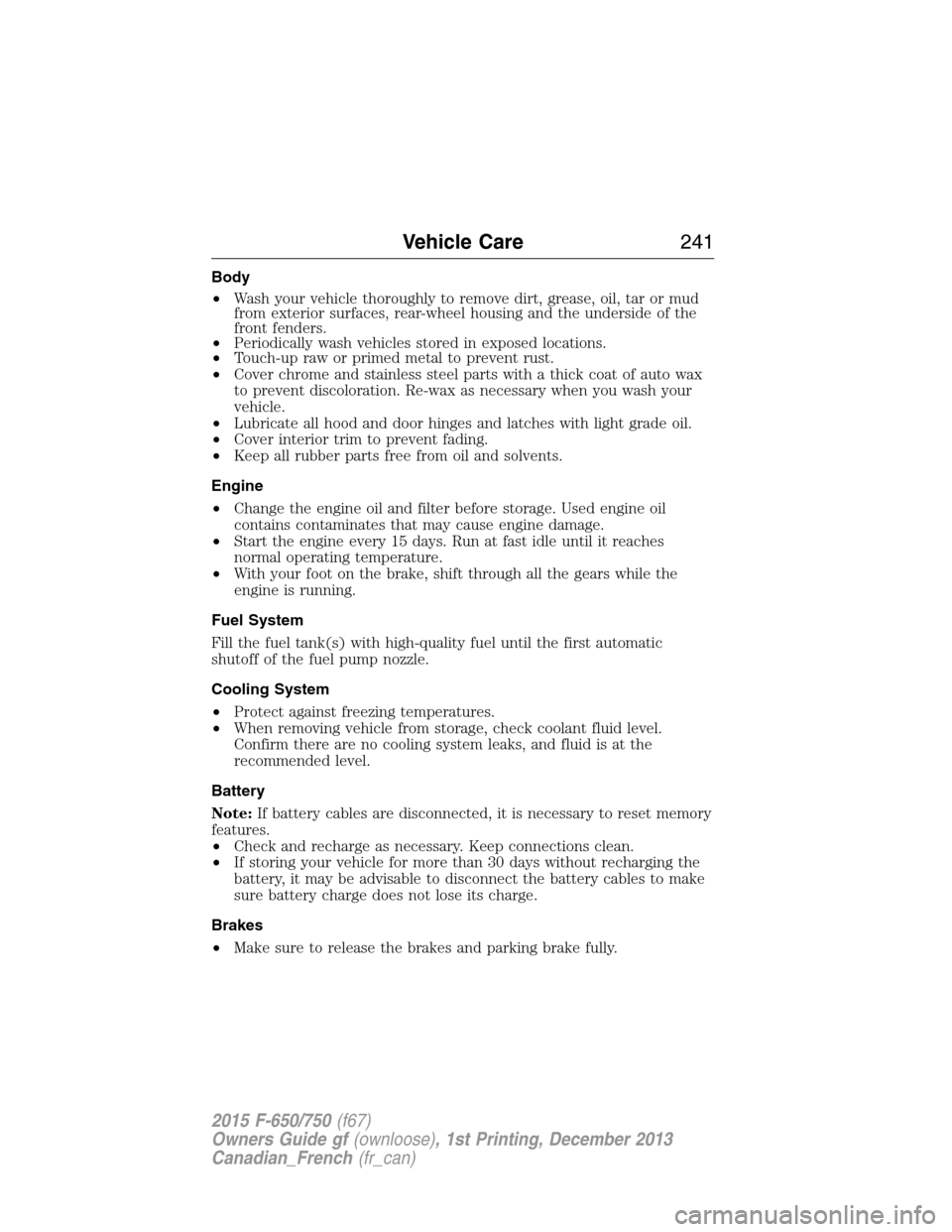
Body
•Wash your vehicle thoroughly to remove dirt, grease, oil, tar or mud
from exterior surfaces, rear-wheel housing and the underside of the
front fenders.
•Periodically wash vehicles stored in exposed locations.
•Touch-up raw or primed metal to prevent rust.
•Cover chrome and stainless steel parts with a thick coat of auto wax
to prevent discoloration. Re-wax as necessary when you wash your
vehicle.
•Lubricate all hood and door hinges and latches with light grade oil.
•Cover interior trim to prevent fading.
•Keep all rubber parts free from oil and solvents.
Engine
•Change the engine oil and filter before storage. Used engine oil
contains contaminates that may cause engine damage.
•Start the engine every 15 days. Run at fast idle until it reaches
normal operating temperature.
•With your foot on the brake, shift through all the gears while the
engine is running.
Fuel System
Fill the fuel tank(s) with high-quality fuel until the first automatic
shutoff of the fuel pump nozzle.
Cooling System
•Protect against freezing temperatures.
•When removing vehicle from storage, check coolant fluid level.
Confirm there are no cooling system leaks, and fluid is at the
recommended level.
Battery
Note:If battery cables are disconnected, it is necessary to reset memory
features.
•Check and recharge as necessary. Keep connections clean.
•If storing your vehicle for more than 30 days without recharging the
battery, it may be advisable to disconnect the battery cables to make
sure battery charge does not lose its charge.
Brakes
•Make sure to release the brakes and parking brake fully.
Vehicle Care241
2015 F-650/750(f67)
Owners Guide gf(ownloose), 1st Printing, December 2013
Canadian_French(fr_can)
Page 243 of 384
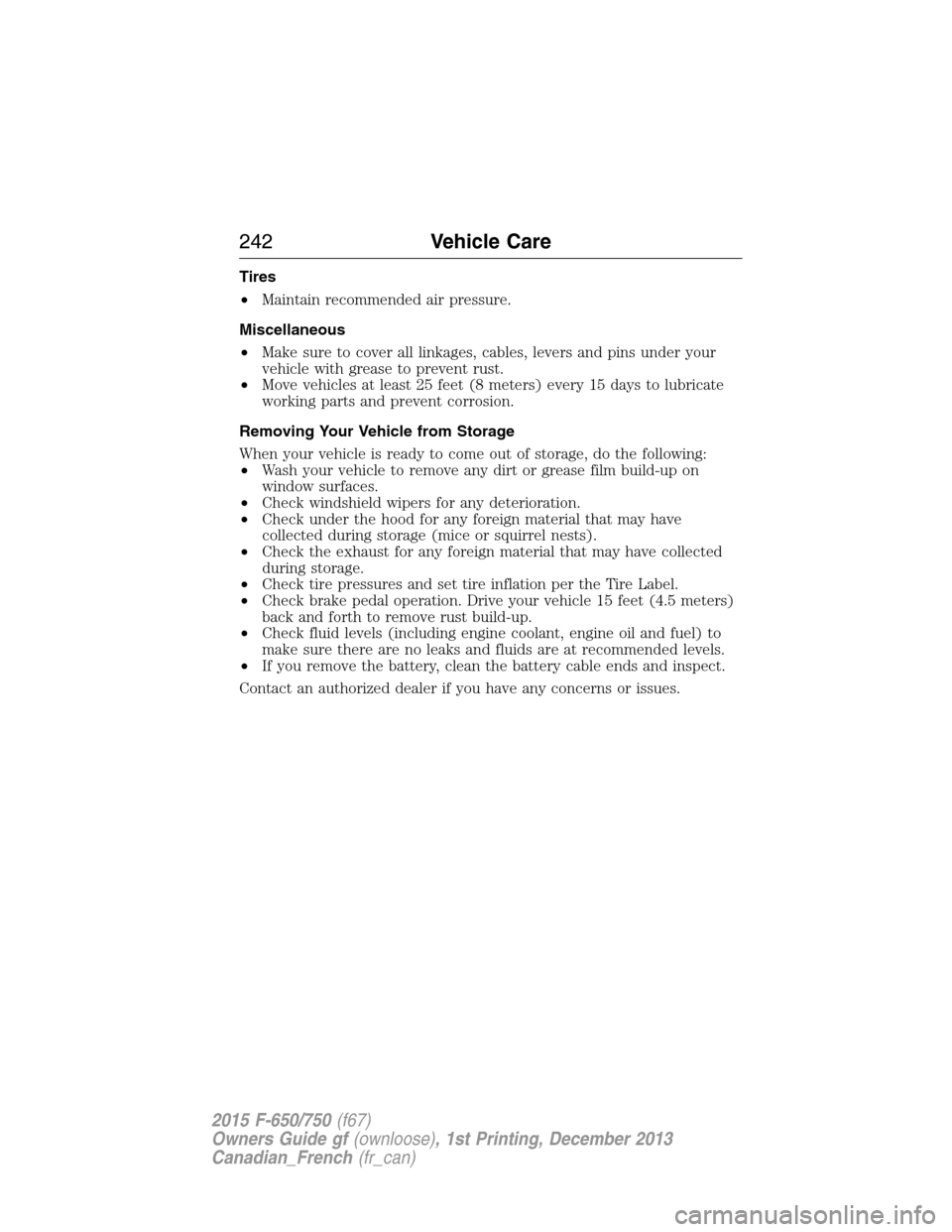
Tires
•Maintain recommended air pressure.
Miscellaneous
•Make sure to cover all linkages, cables, levers and pins under your
vehicle with grease to prevent rust.
•Move vehicles at least 25 feet (8 meters) every 15 days to lubricate
working parts and prevent corrosion.
Removing Your Vehicle from Storage
When your vehicle is ready to come out of storage, do the following:
•Wash your vehicle to remove any dirt or grease film build-up on
window surfaces.
•Check windshield wipers for any deterioration.
•Check under the hood for any foreign material that may have
collected during storage (mice or squirrel nests).
•Check the exhaust for any foreign material that may have collected
during storage.
•Check tire pressures and set tire inflation per the Tire Label.
•Check brake pedal operation. Drive your vehicle 15 feet (4.5 meters)
back and forth to remove rust build-up.
•Check fluid levels (including engine coolant, engine oil and fuel) to
make sure there are no leaks and fluids are at recommended levels.
•If you remove the battery, clean the battery cable ends and inspect.
Contact an authorized dealer if you have any concerns or issues.
242Vehicle Care
2015 F-650/750(f67)
Owners Guide gf(ownloose), 1st Printing, December 2013
Canadian_French(fr_can)
Page 259 of 384
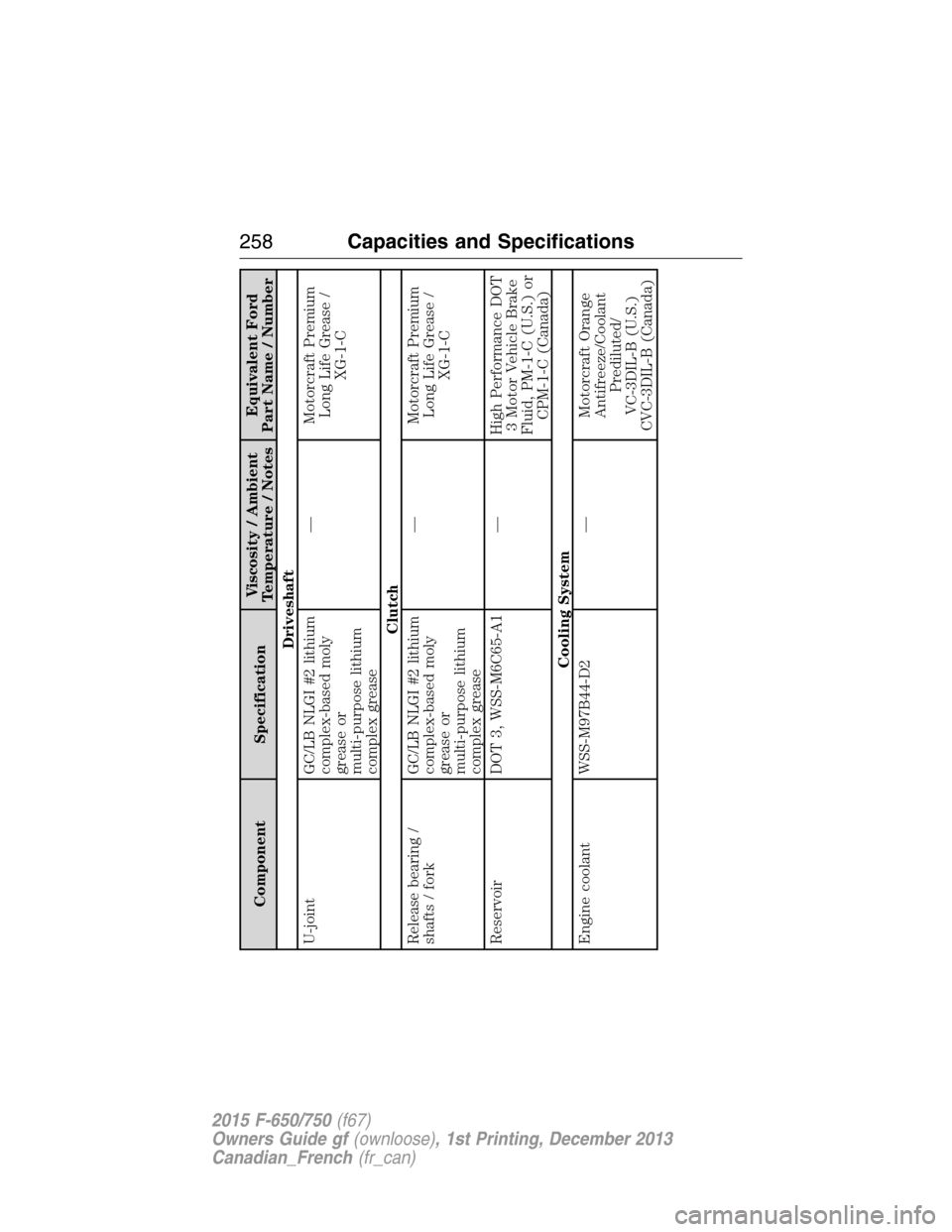
Component SpecificationViscosity / Ambient
Temperature / NotesEquivalent Ford
Part Name / Number
Driveshaft
U-joint GC/LB NLGI #2 lithium
complex-based moly
grease or
multi-purpose lithium
complex grease— Motorcraft Premium
Long Life Grease /
XG-1-C
Clutch
Release bearing /
shafts / forkGC/LB NLGI #2 lithium
complex-based moly
grease or
multi-purpose lithium
complex grease— Motorcraft Premium
Long Life Grease /
XG-1-C
Reservoir DOT 3, WSS-M6C65-A1 — High Performance DOT
3 Motor Vehicle Brake
Fluid, PM-1-C (U.S.) or
CPM-1-C (Canada)
Cooling System
Engine coolant WSS-M97B44-D2 — Motorcraft Orange
Antifreeze/Coolant
Prediluted/
VC-3DIL-B (U.S.)
CVC-3DIL-B (Canada)
258Capacities and Specifications
2015 F-650/750(f67)
Owners Guide gf(ownloose), 1st Printing, December 2013
Canadian_French(fr_can)
Page 268 of 384
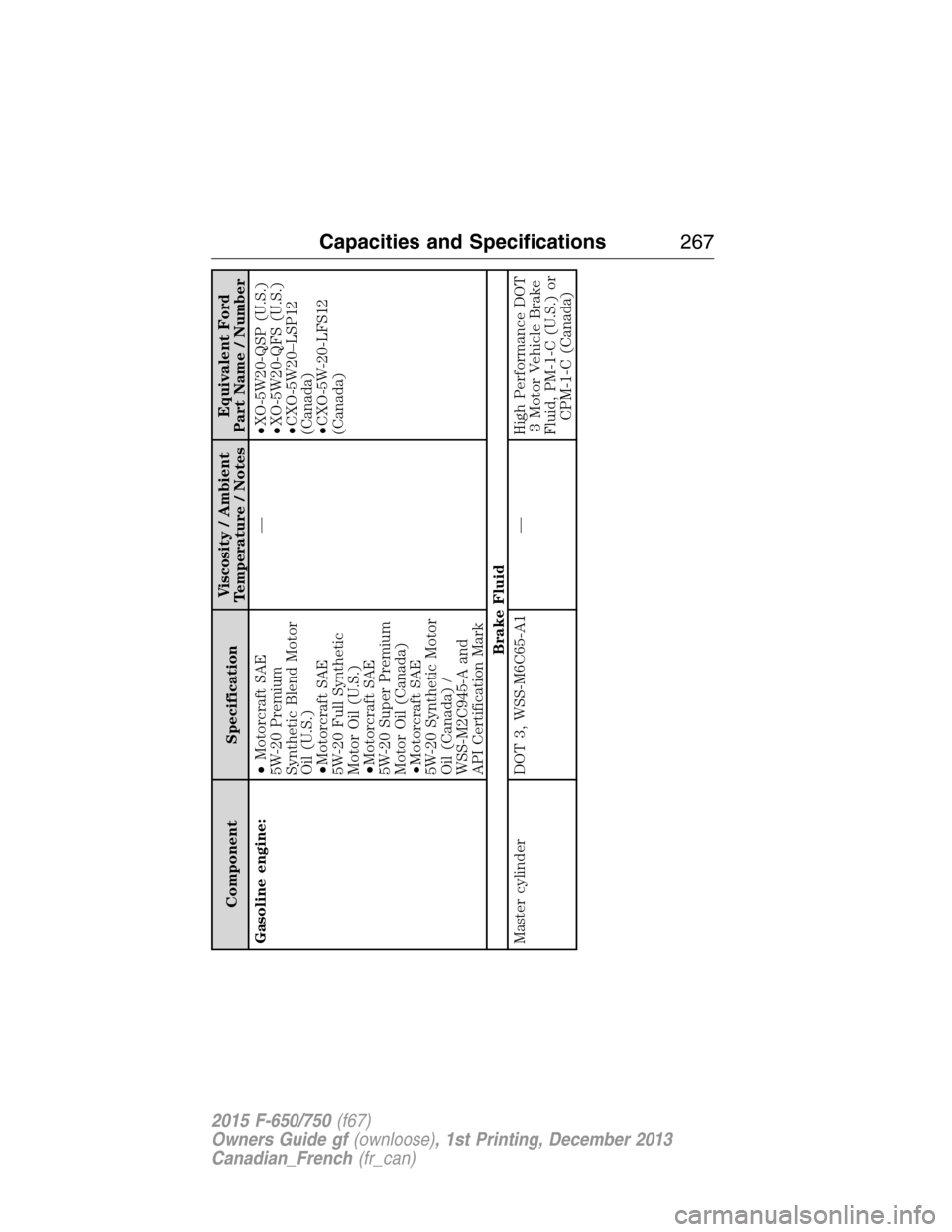
Component SpecificationViscosity / Ambient
Temperature / NotesEquivalent Ford
Part Name / Number
Gasoline engine:•Motorcraft SAE
5W-20 Premium
Synthetic Blend Motor
Oil (U.S.)
•Motorcraft SAE
5W-20 Full Synthetic
Motor Oil (U.S.)
•Motorcraft SAE
5W-20 Super Premium
Motor Oil (Canada)
•Motorcraft SAE
5W-20 Synthetic Motor
Oil (Canada) /
WSS-M2C945-A and
API Certification Mark—•XO-5W20-QSP (U.S.)
•XO-5W20-QFS (U.S.)
•CXO-5W20–LSP12
(Canada)
•CXO-5W-20-LFS12
(Canada)
Brake Fluid
Master cylinder DOT 3, WSS-M6C65-A1 — High Performance DOT
3 Motor Vehicle Brake
Fluid, PM-1-C (U.S.) or
CPM-1-C (Canada)
Capacities and Specifications267
2015 F-650/750(f67)
Owners Guide gf(ownloose), 1st Printing, December 2013
Canadian_French(fr_can)
Page 342 of 384
Additives and Chemicals
This owner’s manual and the Ford Workshop Manual list the
recommended additives and chemicals for your vehicle. We do not
recommend using chemicals or additives not approved by us as part of
your vehicle’s normal maintenance. Please consult your warranty
information.
Oils, Fluids and Flushing
In many cases, fluid discoloration is a normal operating characteristic
and, by itself, does not necessarily indicate a concern or that the fluid
needs to be changed. However, a qualified expert, such as the
factory-trained technicians at your dealership, should inspect discolored
fluids that also show signs of overheating or foreign material
contamination immediately.
Make sure to change your vehicle’s oils and fluids at the specified
intervals or in conjunction with a repair. Flushing is a viable way to
change fluid for many vehicle sub-systems during scheduled
maintenance. It is critical that systems are flushed only with new fluid
that is the same as that required to fill and operate the system or using a
Ford-approved flushing chemical.
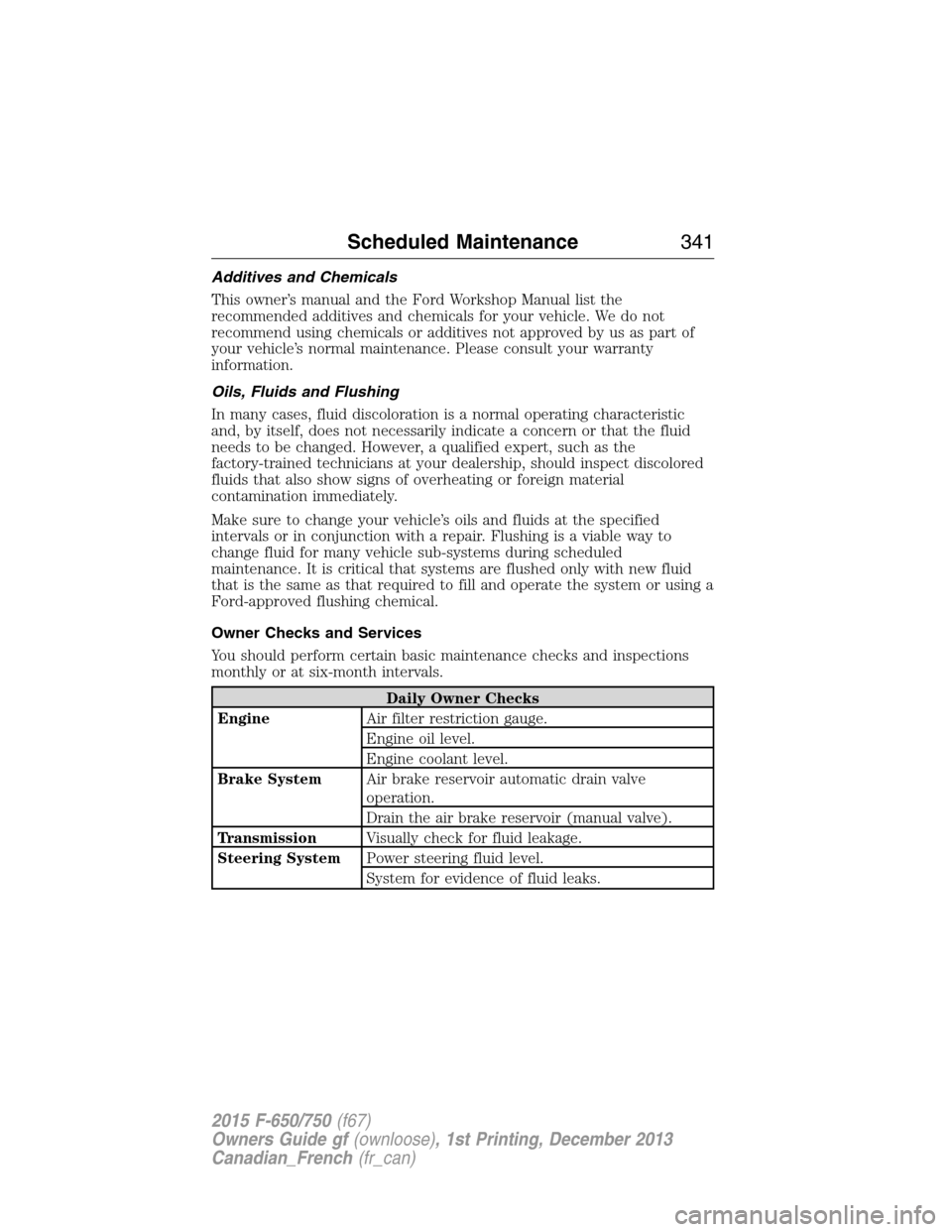
Owner Checks and Services
You should perform certain basic maintenance checks and inspections
monthly or at six-month intervals.
Daily Owner Checks
EngineAir filter restriction gauge.
Engine oil level.
Engine coolant level.
Brake SystemAir brake reservoir automatic drain valve
operation.
Drain the air brake reservoir (manual valve).
TransmissionVisually check for fluid leakage.
Steering SystemPower steering fluid level.
System for evidence of fluid leaks.
Scheduled Maintenance341
2015 F-650/750(f67)
Owners Guide gf(ownloose), 1st Printing, December 2013
Canadian_French(fr_can)
Page 346 of 384
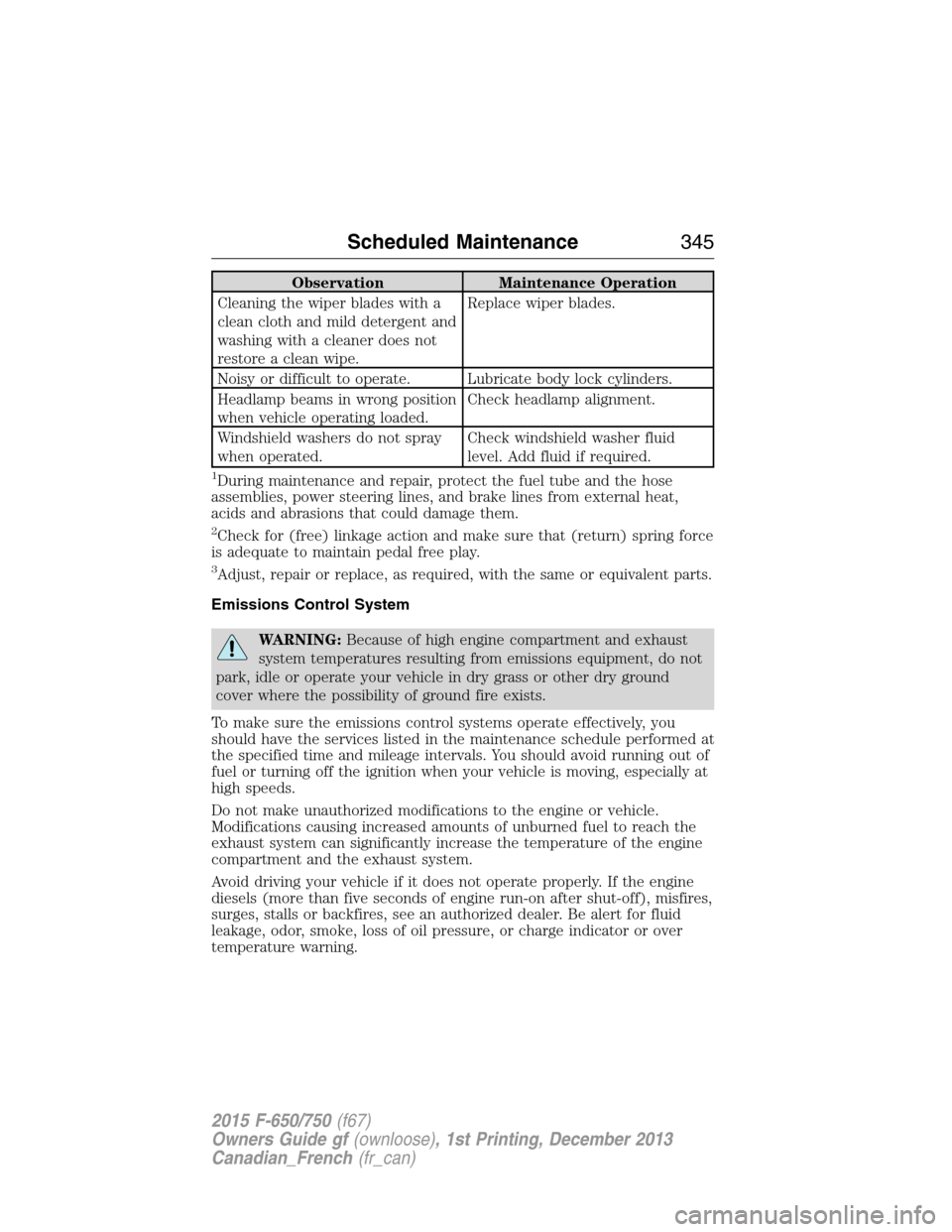
Observation Maintenance Operation
Cleaning the wiper blades with a
clean cloth and mild detergent and
washing with a cleaner does not
restore a clean wipe.Replace wiper blades.
Noisy or difficult to operate. Lubricate body lock cylinders.
Headlamp beams in wrong position
when vehicle operating loaded.Check headlamp alignment.
Windshield washers do not spray
when operated.Check windshield washer fluid
level. Add fluid if required.
1During maintenance and repair, protect the fuel tube and the hose
assemblies, power steering lines, and brake lines from external heat,
acids and abrasions that could damage them.
2Check for (free) linkage action and make sure that (return) spring force
is adequate to maintain pedal free play.
3Adjust, repair or replace, as required, with the same or equivalent parts.
Emissions Control System
WARNING:Because of high engine compartment and exhaust
system temperatures resulting from emissions equipment, do not
park, idle or operate your vehicle in dry grass or other dry ground
cover where the possibility of ground fire exists.
To make sure the emissions control systems operate effectively, you
should have the services listed in the maintenance schedule performed at
the specified time and mileage intervals. You should avoid running out of
fuel or turning off the ignition when your vehicle is moving, especially at
high speeds.
Do not make unauthorized modifications to the engine or vehicle.
Modifications causing increased amounts of unburned fuel to reach the
exhaust system can significantly increase the temperature of the engine
compartment and the exhaust system.
Avoid driving your vehicle if it does not operate properly. If the engine
diesels (more than five seconds of engine run-on after shut-off), misfires,
surges, stalls or backfires, see an authorized dealer. Be alert for fluid
leakage, odor, smoke, loss of oil pressure, or charge indicator or over
temperature warning.
Scheduled Maintenance345
2015 F-650/750(f67)
Owners Guide gf(ownloose), 1st Printing, December 2013
Canadian_French(fr_can)