wheel FORD F650 2016 13.G Manual PDF
[x] Cancel search | Manufacturer: FORD, Model Year: 2016, Model line: F650, Model: FORD F650 2016 13.GPages: 379, PDF Size: 4.8 MB
Page 252 of 379

TECHNICAL SPECIFICATIONS
Wheel Lug Nut Torque Specifications
WARNING
When a wheel is installed, always remove any corrosion, dirt or foreign materials
present on the mounting surfaces of the wheel or the surface of the wheel hub,
brake drum or brake disc that contacts the wheel. Make sure that any fasteners
that attach the rotor to the hub are secured so they do not interfere with the mounting
surfaces of the wheel. Installing wheels without correct metal-to-metal contact at the
wheel mounting surfaces can cause the wheel nuts to loosen and the wheel to come off
while the vehicle is in motion, resulting in loss of control. lb.ft (Nm)
Bolt size
450–500 lb.ft (610–678 Nm)
M22 x 1.5
* Torque specifications are for nut and bolt threads free of dirt and rust. Use only Ford
recommended replacement fasteners.
On vehicles equipped with single rear wheels, retighten the lug nuts to the specified torque
at 100 miles (160 kilometers) after any wheel disturbance (such as tire rotation, changing
a flat tire, wheel removal).
On vehicles equipped with dual rear wheels, retighten the lug nuts to the specified torque
at 100 miles (160 kilometers) and again at 500 miles (800 kilometers) of new vehicle
operation and after any wheel disturbance (such as tire rotation, changing a flat tire,
wheel removal).
It is important to follow the proper wheel mounting and lug nut torque procedures. On all two-piece flat wheel nuts,
apply one drop of motor oil
between the flat washer and the
nut. Do not apply motor oil to the
wheel nut threads or the wheel
stud threads.
249
F650750 (TBC), enUSA, First Printing Wheels and TiresE161443
Page 253 of 379

Wheel pilot bore
A
Inspect the wheel pilot hole and
mounting surface prior to installation.
Remove any visible corrosion or loose
particles. The Tire Label is located on the
B-Pillar or edge of the driver
’s
door.
250
F650750 (TBC), enUSA, First Printing Wheels and TiresE145950 E184089
Page 261 of 379

Specification
Name
VC-3DIL-B WSS-M97B44-D2
Engine coolant (Canada):
Motorcraft Orange Antifreeze/Coolant Prediluted
CVC-3DIL-B
WSS-M6C65-A3
Brake fluid:
Motorcraft® DOT 5.1 Motor Vehicle Brake Fluid
PM-21
WSS-M2C938-A
Automatic transmission fluid (U.S. and Mexico):
MERCON LV
Motorcraft MERCON LV Automatic Transmission Fluid
XT-10-QLVC
WSS-M2C938-A
Automatic transmission fluid (Canada):
MERCON LV
Motorcraft MERCON LV Automatic Transmission Fluid
CXT-10-QLVC
WSL-M2C192-A
Front axle (wheel bearing oil)
Motorcraft® SAE 75W-140 Synthetic Rear Axle Lubricant
XY-75W140-QL
WSP-M2C197-A*
Recommended Rear axle fluid (U.S.): (S-140)
Motorcraft® SAE 80W-90 Premium Rear Axle Lubricant
XY-80W90-QL
WSP-M2C197-A*
Recommended Rear axle fluid (Canada): (S-140)
Motorcraft® SAE 80W-90 Premium Rear Axle Lubricant
CXY-80W90-1L
WSL-M2C192-A*
Optional Rear axle fluid (U.S.): (S-140)
Motorcraft® SAE 75W-140 Synthetic Rear Axle Lubricant
XY-75W140-QL
WSL-M2C192-A*
Optional Rear axle fluid (Canada): (S-140)
Motorcraft® SAE 75W-140 Synthetic Rear Axle Lubricant
CXY-75W140-1L
WSP-M2C197-A
Recommended Rear axle fluid (U.S.): (S-170)
Motorcraft® SAE 80W-90 Premium Rear Axle Lubricant
XY-80W90-QL
WSP-M2C197-A
Recommended Rear axle fluid (Canada): (S-170)
Motorcraft® SAE 80W-90 Premium Rear Axle Lubricant
CXY-80W90-1L
WSL-M2C192-A
Optional Rear axle fluid (U.S.): (S-170)
Motorcraft® SAE 75W-140 Synthetic Rear Axle Lubricant
XY-75W140-QL
258
F650750 (TBC), enUSA, First Printing Capacities and Specifications
Page 268 of 379

Specification
Name
WSS-M2C938-A
Automatic transmission fluid (Canada):
MERCON LV
Motorcraft MERCON LV Automatic Transmission Fluid
CXT-10-QLVC
WSL-M2C192-A
Front axle (wheel bearing oil)
Motorcraft® SAE 75W-140 Synthetic Rear Axle Lubricant
XY-75W140-QL
WSP-M2C197-A
Recommended Rear axle fluid (U.S.): (S-140)
Motorcraft® SAE 80W-90 Premium Rear Axle Lubricant
XY-80W90-QL
WSP-M2C197-A
Recommended Rear axle fluid (Canada): (S-140)
Motorcraft® SAE 80W-90 Premium Rear Axle Lubricant
CXY-80W90-1L
WSL-M2C192-A
Optional Rear axle fluid (U.S.): (S-140)
Motorcraft® SAE 75W-140 Synthetic Rear Axle Lubricant
XY-75W140-QL
WSL-M2C192-A
Optional Rear axle fluid (Canada): (S-140)
Motorcraft® SAE 75W-140 Synthetic Rear Axle Lubricant
CXY-75W140-1L
WSP-M2C197-A
Recommended Rear axle fluid (U.S.): (S-170)
Motorcraft® SAE 80W-90 Premium Rear Axle Lubricant
XY-80W90-QL
WSP-M2C197-A
Recommended Rear axle fluid (U.S.): (S-170)
Motorcraft® SAE 80W-90 Premium Rear Axle Lubricant
CXY-80W90-1L
WSL-M2C192-A
Optional Rear axle fluid (U.S.): (S-170)
Motorcraft® SAE 75W-140 Synthetic Rear Axle Lubricant
XY-75W140-QL
WSL-M2C192-A
Optional Rear axle fluid (Canada): (S-170)
Motorcraft® SAE 75W-140 Synthetic Rear Axle Lubricant
CXY-75W140-1L
WSP-M2C197-A
Recommended Rear axle fluid (U.S.): (S-190)
Motorcraft® SAE 80W-90 Premium Rear Axle Lubricant
XY-80W90-QL
WSP-M2C197-A
Recommended Rear axle fluid (Canada): (S-190)
Motorcraft® SAE 80W-90 Premium Rear Axle Lubricant
CXY-80W90-1L
WSL-M2C192-A
Optional Rear axle fluid (U.S.): (S-190)
265
F650750 (TBC), enUSA, First Printing Capacities and Specifications
Page 284 of 379
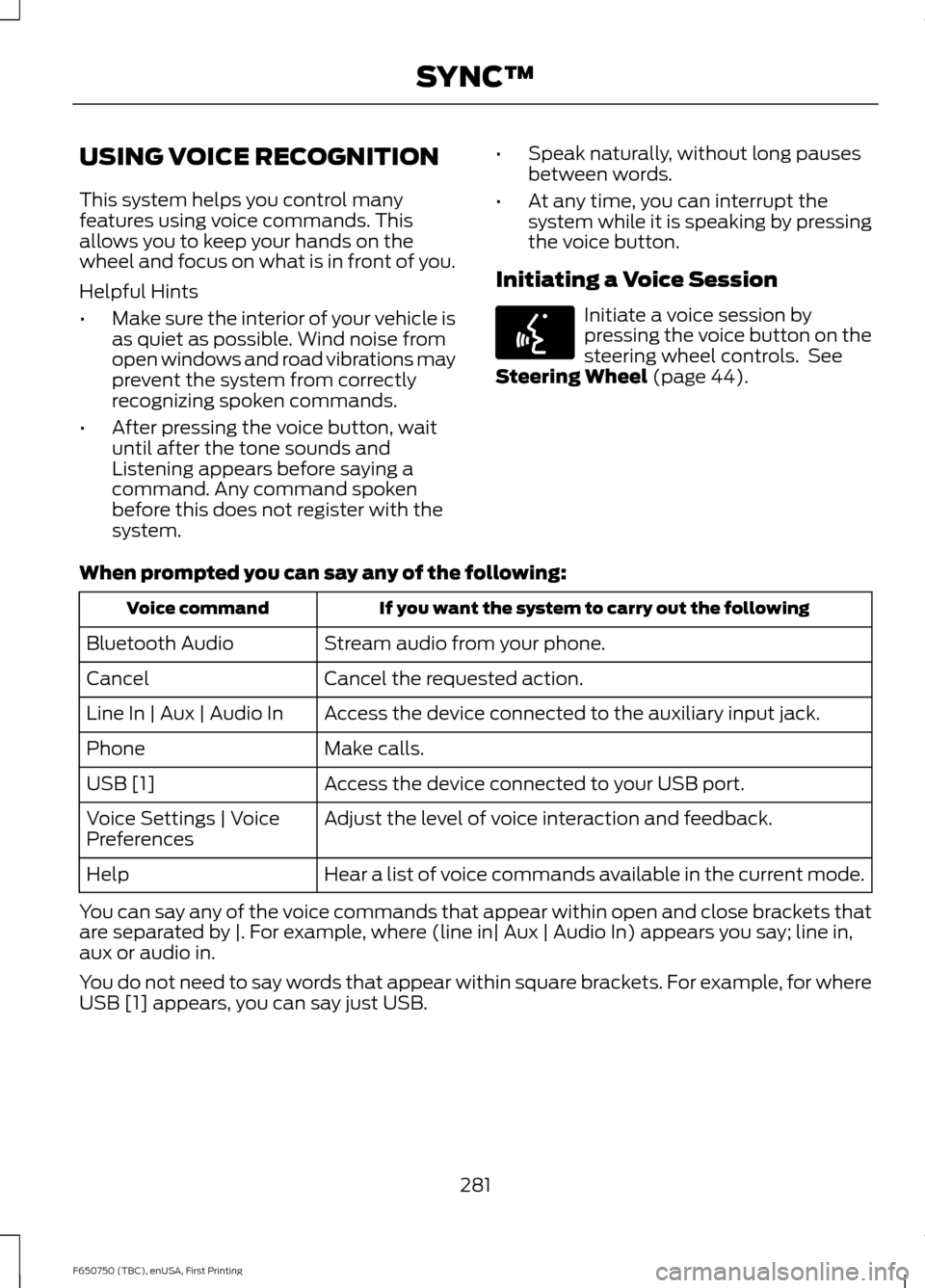
USING VOICE RECOGNITION
This system helps you control many
features using voice commands. This
allows you to keep your hands on the
wheel and focus on what is in front of you.
Helpful Hints
•
Make sure the interior of your vehicle is
as quiet as possible. Wind noise from
open windows and road vibrations may
prevent the system from correctly
recognizing spoken commands.
• After pressing the voice button, wait
until after the tone sounds and
Listening appears before saying a
command. Any command spoken
before this does not register with the
system. •
Speak naturally, without long pauses
between words.
• At any time, you can interrupt the
system while it is speaking by pressing
the voice button.
Initiating a Voice Session Initiate a voice session by
pressing the voice button on the
steering wheel controls. See
Steering Wheel (page 44).
When prompted you can say any of the following: If you want the system to carry out the following
Voice command
Stream audio from your phone.
Bluetooth Audio
Cancel the requested action.
Cancel
Access the device connected to the auxiliary input jack.
Line In | Aux | Audio In
Make calls.
Phone
Access the device connected to your USB port.
USB [1]
Adjust the level of voice interaction and feedback.
Voice Settings | Voice
Preferences
Hear a list of voice commands available in the current mode.
Help
You can say any of the voice commands that appear within open and close brackets that
are separated by |. For example, where (line in| Aux | Audio In) appears you say; line in,
aux or audio in.
You do not need to say words that appear within square brackets. For example, for where
USB [1] appears, you can say just USB.
281
F650750 (TBC), enUSA, First Printing SYNC™E142599
Page 285 of 379

System Interaction and Feedback
The system provides feedback through
audible tones, prompts, questions and
spoken confirmations depending on the
situation and the chosen level of
interaction (voice settings). You can
customize the voice recognition system to
provide more or less instruction and
feedback.
The default setting is to a higher level of
interaction in order to help you learn to use
the system. You can change these settings
at any time.
Adjusting the Interaction Level Initiate a voice session by
pressing the voice button on the
steering wheel controls. See
Steering Wheel (page 44).
When prompted say the following: If you want the system to carry out the following
Voice command
Voice Settings | Voice Preferences
Followed by either of the following: Provide more detailed interaction and guidance.
Interaction Mode
Standard
Provide less audible interaction and more tone prompts.
Interaction Mode
Advanced
The system defaults to the standard interaction mode.
Confirmation prompts are short questions
the system asks when it is not sure of your
request or when there are multiple possible
responses to your request. For example,
the system may ask "Phone, is that
correct?". If turned off, the system simply
makes a best guess as to what you
requested and may ask you to confirm
settings. If you want the system to carry out the following
Voice command
Make a best guess from the command; you may still occa-
sionally be asked to confirm settings.
Confirmation Prompts
Off
Clarify your voice command with a short question.
Confirmation Prompts
On
282
F650750 (TBC), enUSA, First Printing SYNC™E142599
Page 323 of 379

Tightening lug nuts
Tighten the lug nuts to the specified torque *
at 500 miles
(800 km) after any wheel disturbance (such as tire rota-
tion, changing a flat tire or wheel removal).
Single rear wheels
Tighten the wheel lug nuts to the specified torque *
at 100
miles (160 km), and again at 500 miles (800 km) of new vehicle operation and after any wheel disturbance (such as tire rotation, changing a flat tire or wheel removal).
Dual rear wheels
* See Technical Specifications (page 249).
Multi-point Inspection
In order to keep your vehicle running right,
it is important to have the systems on your
vehicle checked regularly. This can help
identify potential issues and prevent major
problems. We recommend having the
following multi-point inspection performed
at every scheduled maintenance interval
to help make sure your vehicle keeps
running great. Multi-point inspection
Horn operation
Accessory drive belt(s)
Radiator, cooler, heater and A/C hoses
Battery performance
Suspension component for leaks ordamage
Engine air filter
Steering and linkage
Exhaust system
Tires (including spare) for wear and properpressure**
Exterior lamps and hazard warning system
operation
Windshield for cracks, chips or pits
Fluid levels *
; fill if necessary
320
F650750 (TBC), enUSA, First Printing Scheduled Maintenance
Page 325 of 379

When to expect the message prompting you to change your oil
Vehicle use and example
Interval
Moderate to heavy load or towing
Mountainous or off-road conditions
Extended idling
Extended hot or cold operation Extreme
3000-4999 miles (4000-7999 km) Maximum load or towing
Extreme hot or cold operation
Use of high sulfur diesel fuel
Note: Use the appropriate special operating
condition for maintenance information
when using high sulfur diesel fuels,
operating your vehicle off-road or in dusty
conditions (such as unpaved roads).
Normal Maintenance Intervals
Gasoline Engines Every 7500 miles (12000 km) or six months (whichever comes first)
Change the engine oil and filter.
Rotate the tires *
, inspect tire wear and measure tread depth.
Inspect the wheels and related components for abnormal noise, wear, looseness or
drag.
Perform a multi-point inspection (recommended).
* Vehicles with dual rear wheels should rotate the front wheels when specified; rear wheels
only if unusual wear is noted.
322
F650750 (TBC), enUSA, First Printing Scheduled Maintenance
Page 326 of 379

Every 15000 miles (24000 km) or 12 months (whichever comes first)
Inspect the automatic transmission fluid level. Consult an authorized dealer for
requirements.
Inspect the brake pads, shoes, rotors, drums, brake linings, hoses and parking brake.
Inspect the engine cooling system strength and hoses.
Inspect the exhaust system and heat shields.
Inspect the steering linkage, ball joints, suspension, tie-rod ends, driveshaft and U-joints.
Lubricate components equipped with grease fittings. Other maintenance items
Replace the engine air filter.
Every 30000 miles (48000
km)
Replace the front wheel bearing grease and grease seal
if equipped with non-sealed bearings.
Every 60000 miles (96000
km)
Replace the spark plugs.
Every 97500 miles (156000
km)
Change the engine coolant.*
Every 105000 miles
(168000 km) Change the rear axle fluid (Dana axles).
Inspect the accessory drive belt(s).
**
Change crankcase ventilation filter.
Change the automatic transmission fluid and filter. Consult
an authorized dealer for requirements.
Every 150000 miles
(240000 km) Change the rear axle fluid (non-Dana axles).
Replace the accessory drive belt(s) if not replaced within
the last 100000 miles (160000 km).
Replace the front wheel bearings and seals if equipped
with non-sealed bearings.
* Initial replacement at six years or 105000 miles (168000 kilometers), then every three
years or 45000 miles (72000 kilometers).
** If not replaced, inspect the belt(s) every 15000 miles (24000 kilometers).
323
F650750 (TBC), enUSA, First Printing Scheduled Maintenance
Page 327 of 379
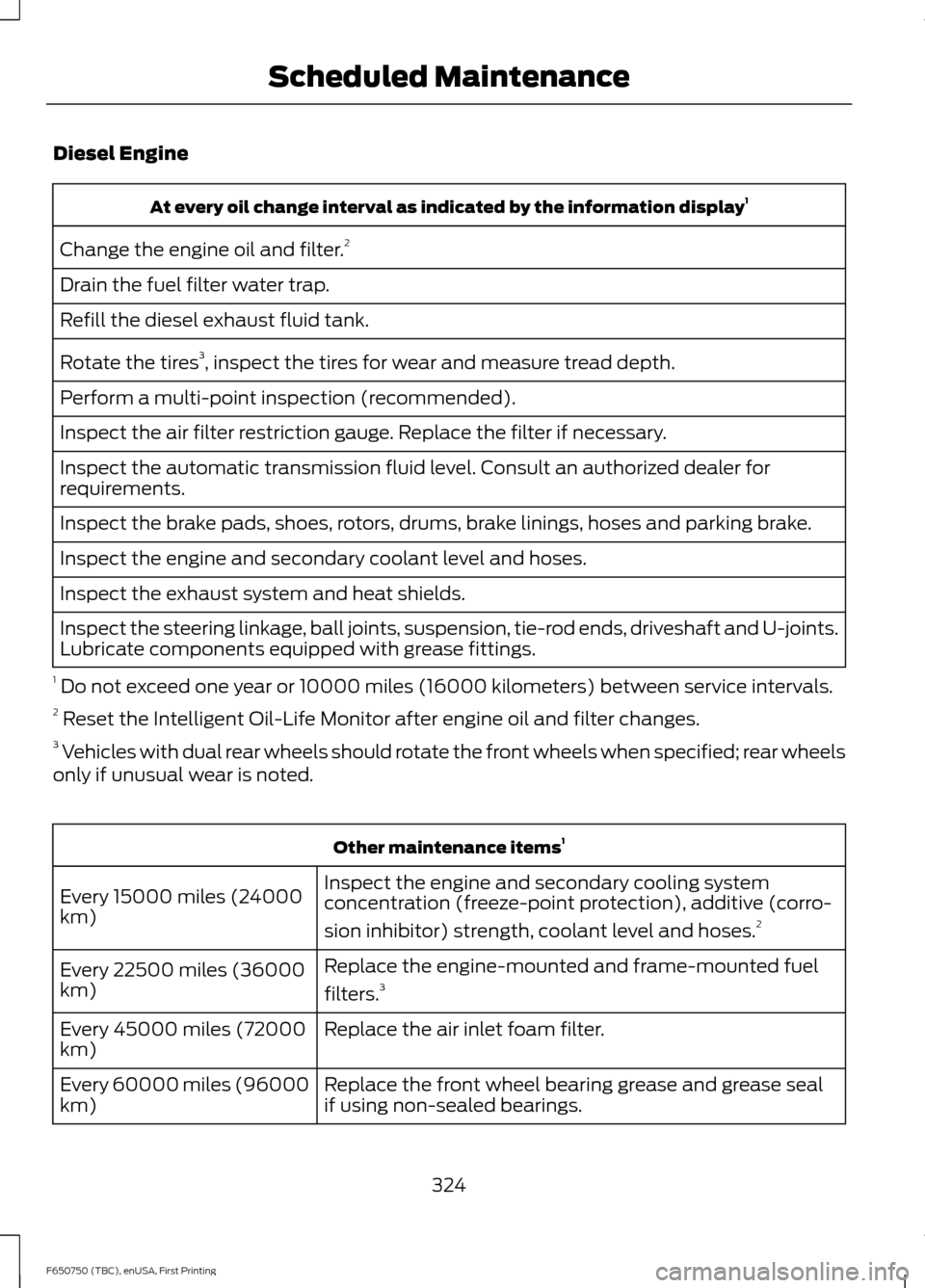
Diesel Engine
At every oil change interval as indicated by the information display
1
Change the engine oil and filter. 2
Drain the fuel filter water trap.
Refill the diesel exhaust fluid tank.
Rotate the tires 3
, inspect the tires for wear and measure tread depth.
Perform a multi-point inspection (recommended).
Inspect the air filter restriction gauge. Replace the filter if necessary.
Inspect the automatic transmission fluid level. Consult an authorized dealer for
requirements.
Inspect the brake pads, shoes, rotors, drums, brake linings, hoses and parking brake.
Inspect the engine and secondary coolant level and hoses.
Inspect the exhaust system and heat shields.
Inspect the steering linkage, ball joints, suspension, tie-rod ends, driveshaft and U-joints.
Lubricate components equipped with grease fittings.
1 Do not exceed one year or 10000 miles (16000 kilometers) between service intervals.
2 Reset the Intelligent Oil-Life Monitor after engine oil and filter changes.
3 Vehicles with dual rear wheels should rotate the front wheels when specified; rear wheels
only if unusual wear is noted. Other maintenance items
1
Inspect the engine and secondary cooling system
concentration (freeze-point protection), additive (corro-
sion inhibitor) strength, coolant level and hoses. 2
Every 15000 miles (24000
km)
Replace the engine-mounted and frame-mounted fuel
filters.3
Every 22500 miles (36000
km)
Replace the air inlet foam filter.
Every 45000 miles (72000
km)
Replace the front wheel bearing grease and grease seal
if using non-sealed bearings.
Every 60000 miles (96000
km)
324
F650750 (TBC), enUSA, First Printing Scheduled Maintenance