power FORD F650/750 2023 Owners Manual
[x] Cancel search | Manufacturer: FORD, Model Year: 2023, Model line: F650/750, Model: FORD F650/750 2023Pages: 378, PDF Size: 5.65 MB
Page 6 of 378
Windows and Mirrors
Power Windows ............................................59
Exterior Mirrors ..............................................60
Interior Mirror ..................................................62
Sun Visors ........................................................62
Instrument Cluster
Gauges ..............................................................63
Warning Lamps and Indicators ...............66
Audible Warnings and Indicators ............69
Information Displays
General Information .....................................70
Information Messages .................................74
Climate Control
Manual Climate Control .............................85
Hints on Controlling the Interior Climate
..........................................................................8 6
Heated Exterior Mirrors ...............................87
Seats
Sitting in the Correct Position ..................88
Head Restraints .............................................88
Manual Seats .................................................90
Power Seats .....................................................91
Rear Seats ........................................................93
Front Seat Armrest .......................................94
Rear Seat Armrest ........................................94
Auxiliary Power Points
Auxiliary Power Points ................................95
USB Ports
Locating the USB Ports ...............................97
Playing Media Using the USB Port .........97
Charging a Device .........................................98
Storage Compartments
Overhead Console ........................................99
Starting and Stopping the
Engine
General Information ..................................100
Ignition Switch .............................................100
Starting a Gasoline Engine .......................101
Starting the Engine .....................................102
Switching Off the Engine ..........................102
Engine Idle Shutdown ...............................102
Engine Block Heater ...................................103
Fuel and Refueling
Safety Precautions .....................................105
Fuel Quality - Diesel ...................................106
Fuel Quality - Gasoline .............................109
Running Out of Fuel - Diesel ....................110
Running Out of Fuel - Gasoline ...............110
Refueling - Diesel .........................................110
Refueling - Gasoline ....................................112
Fuel Consumption ........................................113
Fuel Tank Selector Switch .........................114
Engine Emission Control
Emission Law .................................................115
Catalytic Converter ......................................116
Selective Catalytic Reductant System -
Diesel ............................................................118
Diesel Particulate Filter ..............................122
Transmission
Automatic Transmission ...........................128
Power Take-Off ............................................133
Rear Axle
General Information ...................................134
2-Speed Rear Axle ......................................134
2
Table of Contents
Page 8 of 378
Jump Starting the Vehicle ........................190
Transporting the Vehicle ...........................192
Towing Points ...............................................193
Customer Assistance
Getting the Services You Need ..............194
In California (U.S. Only) ............................195
The Better Business Bureau (BBB) Auto
Line Program (U.S. Only) .....................196
Getting Assistance Outside the U.S. and
Canada ........................................................197
Ordering Additional Owner's Literature
........................................................................1 9 8
Reporting Safety Defects (U.S. Only)
........................................................................1 9 8
Reporting Safety Defects (Canada Only)
........................................................................1 9 9
Fuses
Fuse Specification Chart .........................200
Changing a Fuse .........................................208
Vehicle Inspection Guide
Vehicle Inspection Information ..............210
Maintenance
General Information ...................................219
Opening and Closing the Hood .............220
Under Hood Overview - 6.7L Diesel ......222
Under Hood Overview - 7.3L ...................223
Engine Oil Dipstick - 6.7L Diesel ............224
Engine Oil Dipstick - 7.3L ..........................224
Engine Oil Check - 6.7L Diesel ...............224
Engine Oil Check - 7.3L .............................225
Changing the Engine Oil and Oil Filter
........................................................................226
Oil Change Indicator Reset ......................227
Changing the Engine Air Filter - 6.7L
Diesel ...........................................................228
Changing the Engine Air Filter - 7.3L .....230Draining the Fuel Filter Water Trap - 6.7L
Diesel ...........................................................232
Engine Coolant Check - 6.7L Diesel ......233
Engine Coolant Check - 7.3L ...................238
Automatic Transmission Fluid Check
........................................................................242
Brake Fluid Check .......................................244
Power Steering Fluid Check ....................245
Changing the 12V Battery ........................246
Adjusting the Headlamps ........................247
Washer Fluid Check ...................................249
Fuel Filter - 7.3L ...........................................249
Checking the Wiper Blades ....................249
Changing the Wiper Blades ....................249
Removing a Headlamp ............................250
Changing a Bulb .........................................250
Changing the Engine-Mounted and
Diesel Fuel Conditioner Module Fuel
Filters - 6.7L Diesel ..................................251
Electrical System Inspection ..................254
Air Induction System Inspection ...........254
Exhaust System Inspection ....................255
Brake System Inspection .........................255
Axle Inspection ............................................258
Steering System Inspection ...................259
Suspension System Inspection .............259
Frame and Tow Hook Inspection .........260
Rear Axle Fluid Check ...............................260
Spring U-Bolt Check .................................260
Vehicle Care
General Information ..................................262
Cleaning Products ......................................262
Cleaning the Exterior .................................263
Waxing ............................................................264
Cleaning the Engine ..................................264
Cleaning the Windows and Wiper Blades
........................................................................265
Cleaning the Interior ..................................265
Cleaning the Instrument Panel and
Instrument Cluster Lens ......................266
4
Table of Contents
Page 9 of 378
Repairing Minor Paint Damage .............266
Cleaning the Wheels .................................266
Vehicle Storage ............................................267
Wheels and Tires
Tire Care .........................................................269
Using Snow Chains ....................................284
Changing a Road Wheel ..........................284
Technical Specifications .........................286
Capacities and Specifications
Engine Specifications - 6.7L Diesel ......288
Engine Specifications - 7.3L ...................289
Motorcraft Parts - 6.7L Diesel ................290
Motorcraft Parts - 7.3L ...............................291
Bulb Specification Chart ..........................292
Engine Oil Capacity and Specification -
6.7L Diesel .................................................292
Engine Oil Capacity and Specification -
7.3L ...............................................................295
Cooling System Capacity and
Specification - 6.7L Diesel ...................297
Cooling System Capacity and
Specification - 7.3L ................................298
Fuel Tank Capacity - Diesel ....................298
Fuel Tank Capacity - Gasoline ..............299
Air Conditioning System Capacity and
Specification - 6.7L Diesel ..................300
Air Conditioning System Capacity and
Specification - 7.3L .................................301
Washer Fluid Specification ......................301
Diesel Exhaust Fluid Capacity and
Specification ............................................302
Automatic Transmission Fluid Capacity
and Specification ...................................302
Brake Fluid Specification .........................303
Rear Axle Fluid Capacity and
Specification - Diesel ...........................304
Rear Axle Fluid Capacity and
Specification - Gasoline ......................305Hydraulic Power Steering Fluid Capacity
and Specification ...................................306
Vehicle Identification
Vehicle Identification Number ...............307
Connected Vehicle
Connected Vehicle Requirements .......308
Connected Vehicle Limitations .............308
Connecting the Vehicle to a Mobile
Network - Vehicles With: Modem .....308
Connected Vehicle – Troubleshooting
.......................................................................3 0 8
Audio System
General Information ..................................309
Audio Unit .....................................................309
Connecting a Bluetooth® Device ..........312
Streaming Bluetooth Audio .....................312
Playing Media From a USB Device ........312
Audio Input Jack ...........................................313
USB Port .........................................................314
Using Voice Recognition ...........................314
Accessories
Auxiliary Switches .......................................315
Ford Protect
Ford Protect ...................................................317
Scheduled Maintenance
General Maintenance Information .......319
Normal Scheduled Maintenance ..........323
Special Operating Conditions Scheduled
Maintenance ............................................329
Customer Information
Rollover Warning ........................................338
Radio Frequency Certification Labels
........................................................................338
5
Table of Contents
Page 11 of 378
ABOUT THIS MANUAL
Thank you for choosing Ford. We
recommend that you take some time to
get to know your vehicle by reading this
manual. The more that you know about
your vehicle, the greater the safety and
pleasure you will get from driving it.
WARNING: Driving while distracted
can result in loss of vehicle control, crash
and injury. We strongly recommend that
you use extreme caution when using any
device that may take your focus off the
road. Your primary responsibility is the
safe operation of your vehicle. We
recommend against the use of any
hand-held device while driving and
encourage the use of voice-operated
systems when possible. Make sure you
are aware of all applicable local laws
that may affect the use of electronic
devices while driving.
Note: Always use and operate your vehicle
in line with all applicable laws and
regulations.
Note: Pass on this manual when selling
your vehicle. It is an integral part of your
vehicle.
Note:Your vehicle’s powertrain control
systems can detect and store information
about vehicle modifications that increase
horsepower and torque output such as
whether or not performance-enhancing
powertrain components commonly referred
to as performance chips have been used.
This information will stay in the system’s
memory and cannot be erased even if the
modification is removed. Ford Motor
Company, Ford of Canada, Ford of Mexico
and service or repair facilities can retrieve
this information when servicing your vehicle.
Ford Motor Company may use this
information to determine if your warranty
covers any needed repairs.Note:Some aftermarket products may
cause severe engine/transmission and/or
exhaust system damage; refer to your
warranty information for more information.
Your new diesel engine will feel, drive and
function somewhat differently than a
gasoline engine. Therefore it is very
important that you read and thoroughly
familiarize yourself and others operating
the vehicle with this guide. There is a
special procedure for turning off the diesel
engine. See Starting a Diesel Engine
(page 102). It is important to read and
understand this material in order to
maintain the best service life for your
engine.
Ford may discontinue models or change
specifications without any notice and
without incurring obligations.
Note:Either Ford Motor Company or an
authorized Ford dealer may have originally
sold this incomplete vehicle to a vehicle
modifier who upfitted it. As a result, some
of the options and features on this vehicle
may differ from what we describe in this
manual.
This manual may qualify the location of a
component as left-hand side or right-hand
side. The side is determined when facing
forward in the seat.
7
Introduction
Page 12 of 378
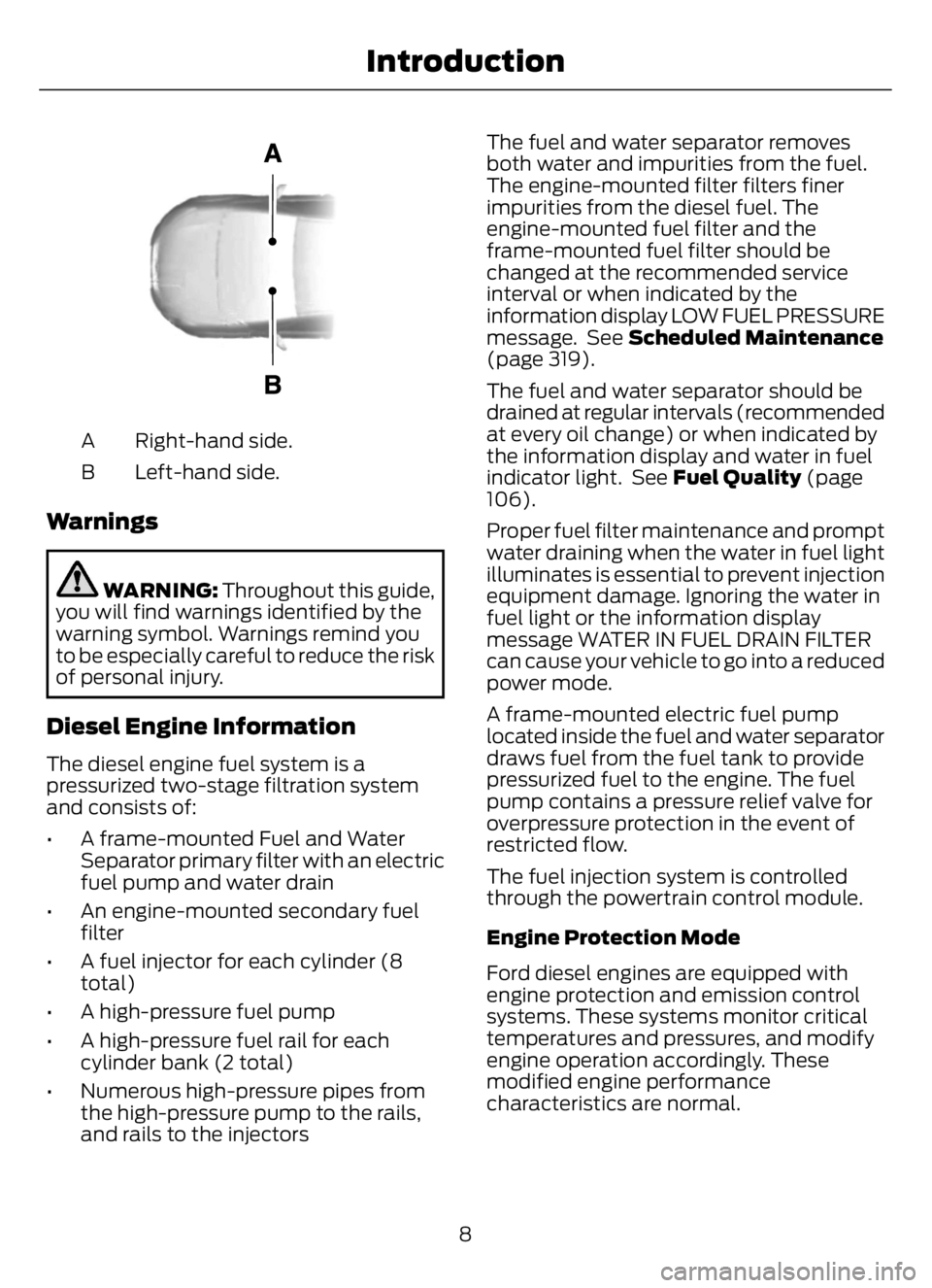
E154903
Right-hand side. A
Left-hand side. B
Warnings
WARNING: Throughout this guide,
you will find warnings identified by the
warning symbol. Warnings remind you
to be especially careful to reduce the risk
of personal injury.
Diesel Engine Information
The diesel engine fuel system is a
pressurized two-stage filtration system
and consists of:
• A frame-mounted Fuel and Water
Separator primary filter with an electric
fuel pump and water drain
• An engine-mounted secondary fuel
filter
• A fuel injector for each cylinder (8
total)
• A high-pressure fuel pump
• A high-pressure fuel rail for each
cylinder bank (2 total)
• Numerous high-pressure pipes from
the high-pressure pump to the rails,
and rails to the injectorsThe fuel and water separator removes
both water and impurities from the fuel.
The engine-mounted filter filters finer
impurities from the diesel fuel. The
engine-mounted fuel filter and the
frame-mounted fuel filter should be
changed at the recommended service
interval or when indicated by the
information display LOW FUEL PRESSURE
message. See Scheduled Maintenance
(page 319).
The fuel and water separator should be
drained at regular intervals (recommended
at every oil change) or when indicated by
the information display and water in fuel
indicator light. See Fuel Quality (page
106).
Proper fuel filter maintenance and prompt
water draining when the water in fuel light
illuminates is essential to prevent injection
equipment damage. Ignoring the water in
fuel light or the information display
message WATER IN FUEL DRAIN FILTER
can cause your vehicle to go into a reduced
power mode.
A frame-mounted electric fuel pump
located inside the fuel and water separator
draws fuel from the fuel tank to provide
pressurized fuel to the engine. The fuel
pump contains a pressure relief valve for
overpressure protection in the event of
restricted flow.
The fuel injection system is controlled
through the powertrain control module.
Engine Protection Mode
Ford diesel engines are equipped with
engine protection and emission control
systems. These systems monitor critical
temperatures and pressures, and modify
engine operation accordingly. These
modified engine performance
characteristics are normal.
8
Introduction
Page 13 of 378
If these modified engine performance
characteristics persist for an extended
period and either the service engine soon
or powertrain malfunction, reduced power,
electronic throttle control light is
illuminated, have the system checked by
an authorized dealer.
Service engine soon
Powertrain malfunction, reduced
power, electronic throttle control
Diesel Lubrication System
It is important to change the engine oil at
the recommended service intervals or
when indicated by the information display
to maintain oil viscosity. Extending the oil
and filter change interval beyond the
recommended interval can negatively
affect engine performance, fuel economy
and engine life. See Engine Oil Check
(page 224).
Engine and secondary cooling system
The cooling system contains a primary
cooling loop to cool the engine and a
secondary cooling loop to cool the
transmission, charge air, and fuel. The
coolant serves three primary purposes: to
provide heat transfer, freeze point
protection, and corrosion protection using
additives.
Vehicles with diesel engines typically are
used to carry heavy loads and accumulate
mileage rapidly. These two factors may
cause the additives in the coolant to wear
out in a shorter time. You can find more
information about coolant additives and
coolant change intervals in the coolant
chapter. See General Maintenance
Information (page 319). Operating the
engine with insufficient coolant or coolant
additive can cause severe engine damage.Selective catalytic reduction system
Your vehicle is equipped with a selective
catalytic reduction system designed to
reduce emission levels of nitrogen oxides
from the exhaust of your diesel engine. This
system relies on the use of Diesel Exhaust
Fluid (DEF) that you must replenish at
certain intervals. Failure to maintain proper
DEF levels or if the DEF becomes
contaminated will result in vehicle speed
limitations or result in your vehicle entering
an idle-only mode. See Selective
Catalytic Reductant System (page 118).
Minor Troubleshooting Guide
If the engine won’t crank
WARNING: Battery posts,
terminals and related accessories
contain lead and lead compounds. Wash
hands after handling.
Turn on the headlights. If the lights are dim,
do not go on at all or when the ignition is
turned to the start position, the lights
become dim or go out, the battery
connections may be loose or corroded, or
the battery may be discharged. If there is
a clicking or stuttering sound coming from
the engine compartment when you turn
the key to the start position, this may also
indicate a loose or corroded battery
connection.
Check the battery connections at the
battery posts, cable connection to the
engine grounding point and at the starter
connection.
If you suspect a discharged battery, have
it checked and corrected.
9
Introduction
Page 16 of 378
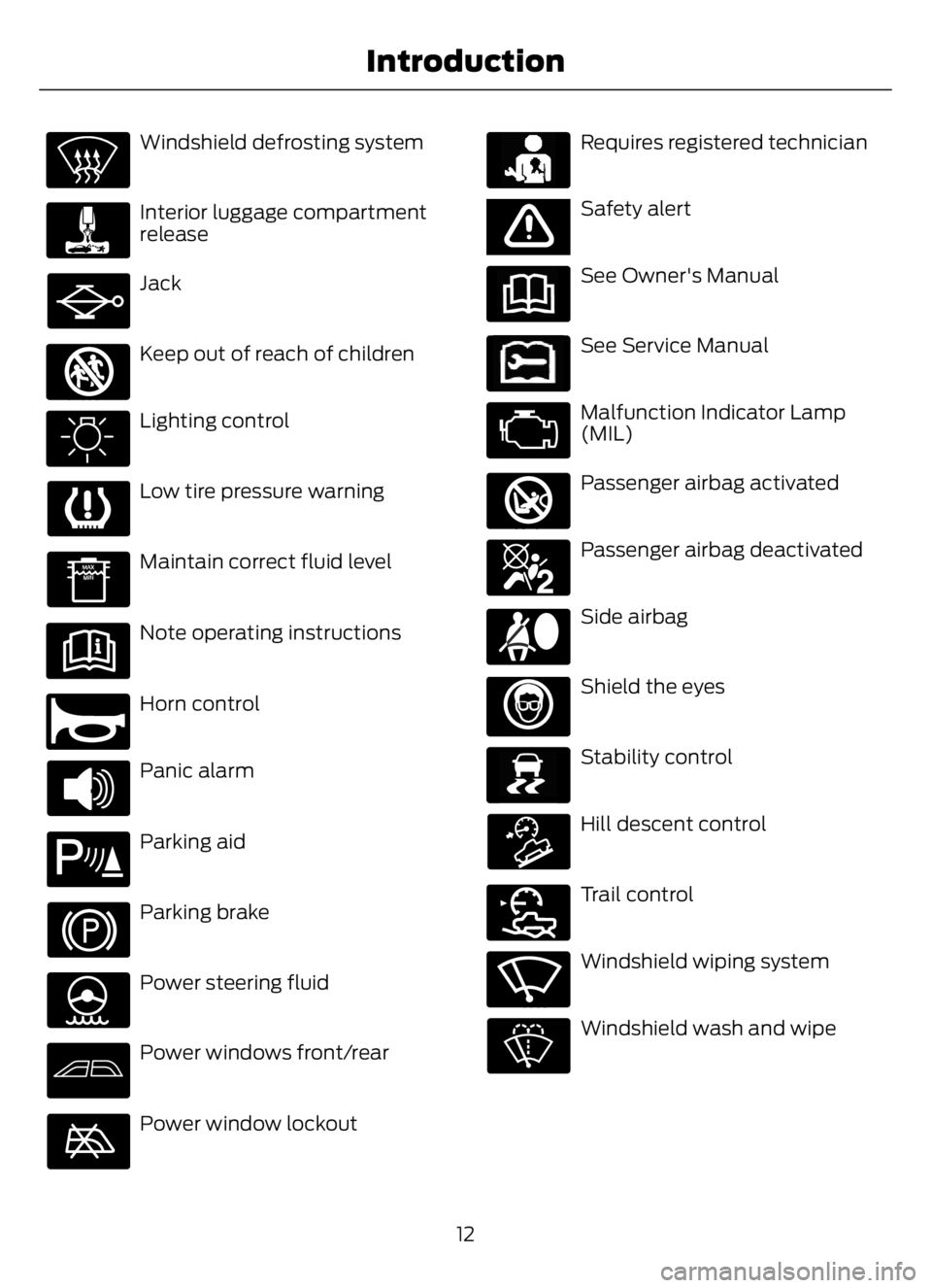
Windshield defrosting system
Interior luggage compartment
release
Jack
E161353
Keep out of reach of children
Lighting control
Low tire pressure warning
Maintain correct fluid level
Note operating instructions
E270945
Horn control
Panic alarm
E139213
Parking aid
Parking brake
Power steering fluid
Power windows front/rear
Power window lockout
E231159
Requires registered technician
E65963E65963Safety alert
See Owner's Manual
E231158
See Service Manual
Malfunction Indicator Lamp
(MIL)
E270849
Passenger airbag activated
E270850
Passenger airbag deactivated
Side airbag
Shield the eyes
E138639
Stability control
E163957
Hill descent control
E272858
Trail control
E270969
Windshield wiping system
Windshield wash and wipe
12
Introduction
Page 52 of 378
LOCKING AND UNLOCKING
You can use the power door lock control
or the remote control to lock and unlock
your vehicle.
Power Door Locks (If Equipped)
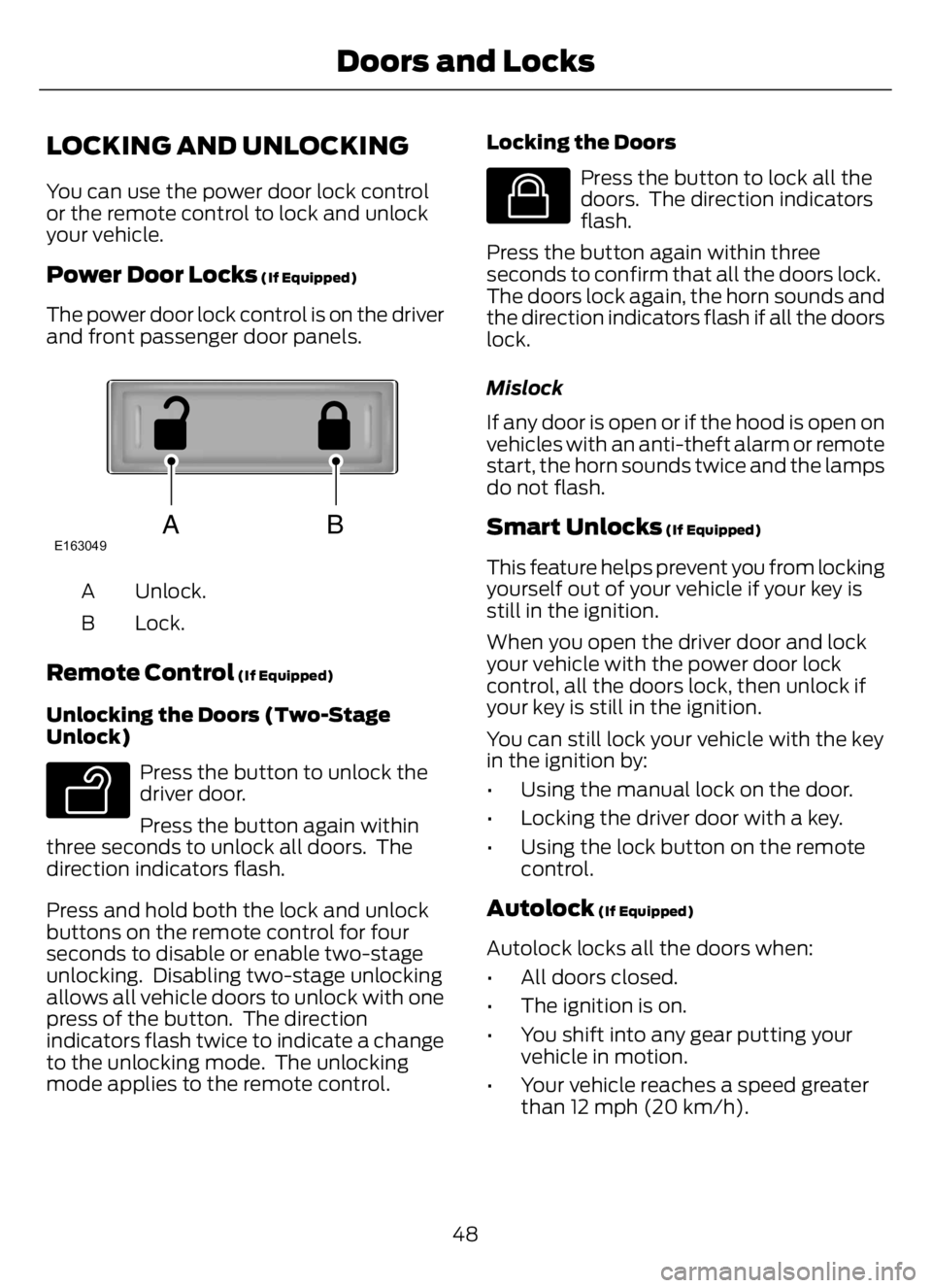
The power door lock control is on the driver
and front passenger door panels.
ABE163049
Unlock. A
Lock. B
Remote Control (If Equipped)
Unlocking the Doors (Two-Stage
Unlock)
E138629
Press the button to unlock the
driver door.
Press the button again within
three seconds to unlock all doors. The
direction indicators flash.
Press and hold both the lock and unlock
buttons on the remote control for four
seconds to disable or enable two-stage
unlocking. Disabling two-stage unlocking
allows all vehicle doors to unlock with one
press of the button. The direction
indicators flash twice to indicate a change
to the unlocking mode. The unlocking
mode applies to the remote control.Locking the Doors
E138623
Press the button to lock all the
doors. The direction indicators
flash.
Press the button again within three
seconds to confirm that all the doors lock.
The doors lock again, the horn sounds and
the direction indicators flash if all the doors
lock.
Mislock
If any door is open or if the hood is open on
vehicles with an anti-theft alarm or remote
start, the horn sounds twice and the lamps
do not flash.
Smart Unlocks (If Equipped)
This feature helps prevent you from locking
yourself out of your vehicle if your key is
still in the ignition.
When you open the driver door and lock
your vehicle with the power door lock
control, all the doors lock, then unlock if
your key is still in the ignition.
You can still lock your vehicle with the key
in the ignition by:
• Using the manual lock on the door.
• Locking the driver door with a key.
• Using the lock button on the remote
control.
Autolock (If Equipped)
Autolock locks all the doors when:
• All doors closed.
• The ignition is on.
• You shift into any gear putting your
vehicle in motion.
• Your vehicle reaches a speed greater
than 12 mph (20 km/h).
48
Doors and Locks
Page 63 of 378
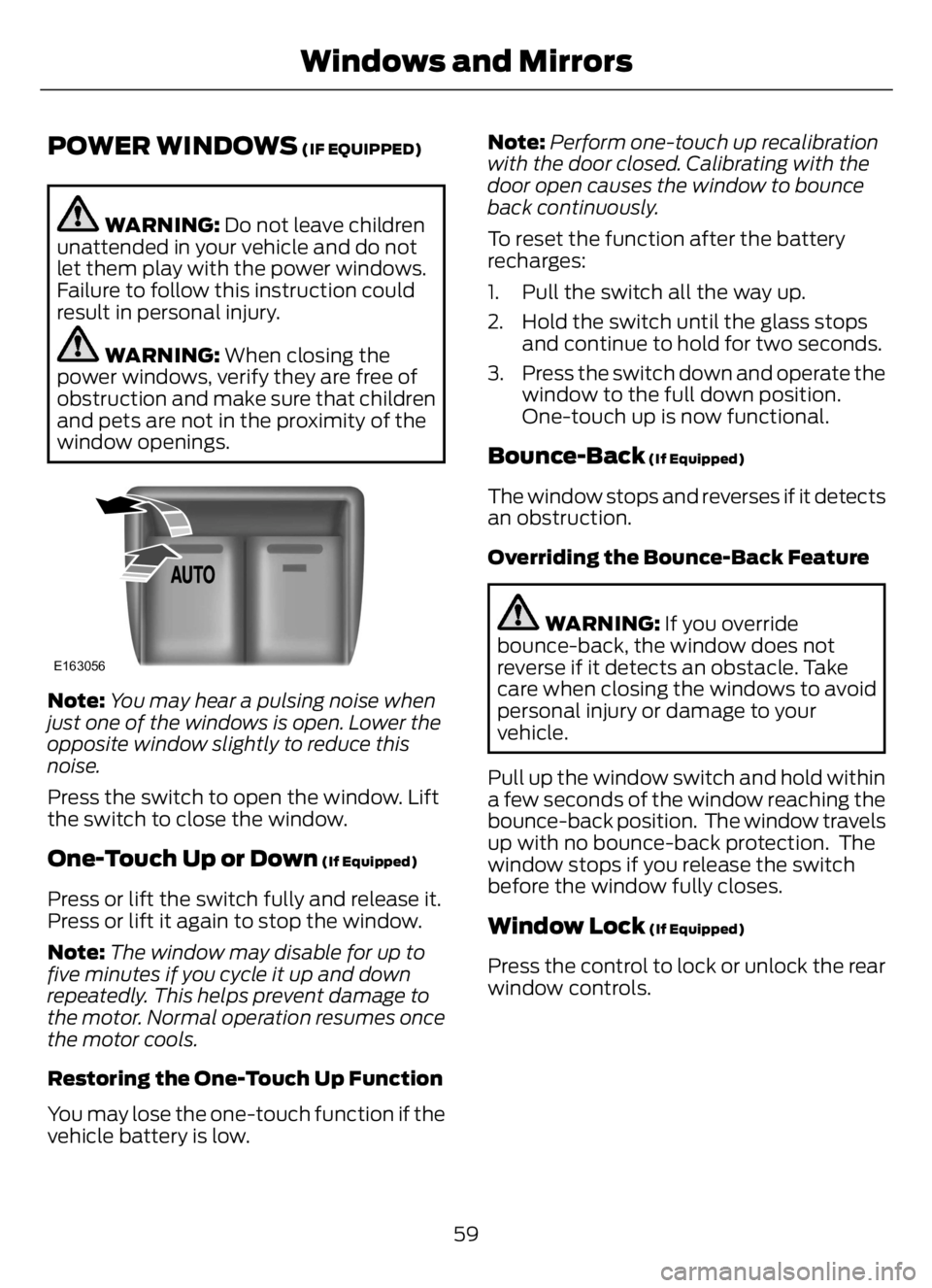
POWER WINDOWS (IF EQUIPPED)
WARNING: Do not leave children
unattended in your vehicle and do not
let them play with the power windows.
Failure to follow this instruction could
result in personal injury.
WARNING: When closing the
power windows, verify they are free of
obstruction and make sure that children
and pets are not in the proximity of the
window openings.
E163056
Note:You may hear a pulsing noise when
just one of the windows is open. Lower the
opposite window slightly to reduce this
noise.
Press the switch to open the window. Lift
the switch to close the window.
One-Touch Up or Down (If Equipped)
Press or lift the switch fully and release it.
Press or lift it again to stop the window.
Note:The window may disable for up to
five minutes if you cycle it up and down
repeatedly. This helps prevent damage to
the motor. Normal operation resumes once
the motor cools.
Restoring the One-Touch Up Function
You may lose the one-touch function if the
vehicle battery is low.Note:Perform one-touch up recalibration
with the door closed. Calibrating with the
door open causes the window to bounce
back continuously.
To reset the function after the battery
recharges:
1. Pull the switch all the way up.
2. Hold the switch until the glass stops
and continue to hold for two seconds.
3. Press the switch down and operate the
window to the full down position.
One-touch up is now functional.
Bounce-Back (If Equipped)
The window stops and reverses if it detects
an obstruction.
Overriding the Bounce-Back Feature
WARNING: If you override
bounce-back, the window does not
reverse if it detects an obstacle. Take
care when closing the windows to avoid
personal injury or damage to your
vehicle.
Pull up the window switch and hold within
a few seconds of the window reaching the
bounce-back position. The window travels
up with no bounce-back protection. The
window stops if you release the switch
before the window fully closes.
Window Lock (If Equipped)
Press the control to lock or unlock the rear
window controls.
59
Windows and Mirrors
Page 64 of 378
EXTERIOR MIRRORS
Auxiliary Convex Mirrors
E208233
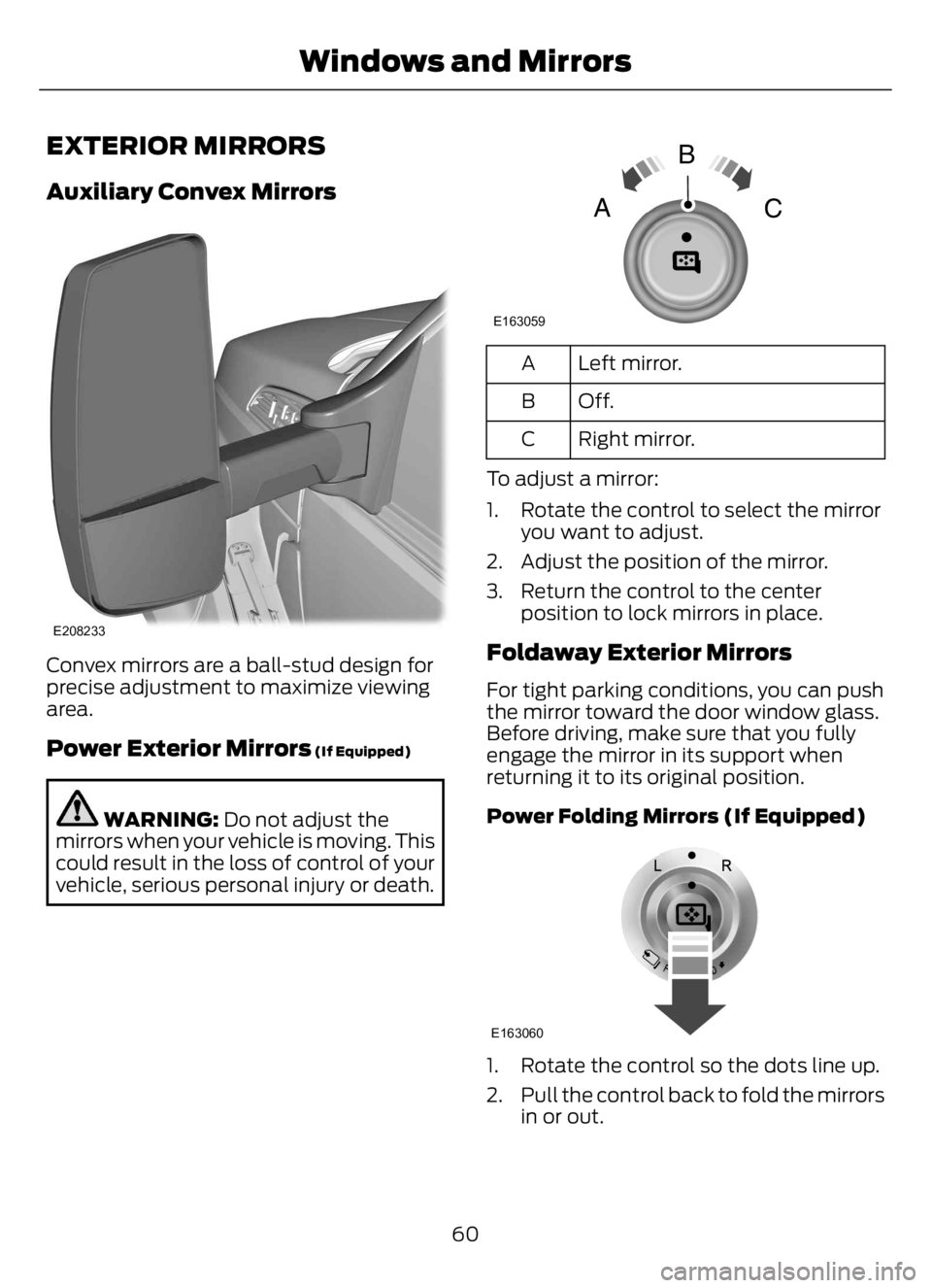
Convex mirrors are a ball-stud design for
precise adjustment to maximize viewing
area.
Power Exterior Mirrors (If Equipped)
WARNING: Do not adjust the
mirrors when your vehicle is moving. This
could result in the loss of control of your
vehicle, serious personal injury or death.
E163059
B
AC
Left mirror. A
Off. B
Right mirror. C
To adjust a mirror:
1. Rotate the control to select the mirror
you want to adjust.
2. Adjust the position of the mirror.
3. Return the control to the center
position to lock mirrors in place.
Foldaway Exterior Mirrors
For tight parking conditions, you can push
the mirror toward the door window glass.
Before driving, make sure that you fully
engage the mirror in its support when
returning it to its original position.
Power Folding Mirrors (If Equipped)
E163060
1. Rotate the control so the dots line up.
2. Pull the control back to fold the mirrors
in or out.
60
Windows and Mirrors