child lock FORD F650/750 2024 Owners Manual
[x] Cancel search | Manufacturer: FORD, Model Year: 2024, Model line: F650/750, Model: FORD F650/750 2024Pages: 386, PDF Size: 8.7 MB
Page 5 of 386
Introduction
About This Manual..........................................7
Data Recording.................................................11
Perchlorate.......................................................15
Ford Credit........................................................15
Replacement Parts Recommendation............................................................................15
Special Notices...............................................16
Mobile Communications Equipment............................................................................17
Export Unique Options................................18
Federal Highway AdministrationRegulation....................................................18
Entering, Exiting or Climbing on ThisVehicle............................................................18
Symbols Glossary
Symbols Used on Your Vehicle.................19
Environment
Protecting the Environment......................22
Noise Pollution Control...............................22
At a Glance
Instrument Panel...........................................24
Child Safety
General Information.....................................25
Installing Child Restraints...........................27
Booster Seats.................................................33
Child Restraint Positioning........................35
Child Safety Locks........................................36
Seatbelts
Principle of Operation.................................38
Fastening the Seatbelts.............................39
Seatbelt Height Adjustment.....................42
Seatbelt Warning Lamp and IndicatorChime............................................................43
Seatbelt Reminder.......................................43
Child Restraint and SeatbeltMaintenance...............................................45
Seatbelt Extensions.....................................45
Keys and Remote Controls
General Information on RadioFrequencies................................................46
Remote Control..............................................47
Replacing a Lost Key or Remote Control..........................................................................48
Doors and Locks
Locking and Unlocking...............................49
Security
Passive Anti-Theft System.........................51
Steering Wheel
Adjusting the Steering Wheel...................52
Cruise Control - Vehicles With: AdaptiveCruise Control.............................................52
Cruise Control - Vehicles With: CruiseControl...........................................................52
Information Display Control......................53
Horn....................................................................53
Wipers and Washers
Windshield Wipers........................................54
Windshield Washers....................................54
Lighting
General Information.....................................55
Lighting Control.............................................55
Autolamps.......................................................56
Instrument Lighting Dimmer....................56
Headlamp Exit Delay...................................56
Daytime Running Lamps - Vehicles With:Daytime Running Lamps (DRL)..........57
Daytime Running Lamps - Vehicles With:Configurable Daytime Running Lamps...........................................................................57
1
2024 F-650/750 (TBC) , enUSA, Edition date: 202210, First-PrintingTable of Contents
Page 23 of 386
SYMBOLS USED ON YOUR
VEHICLE
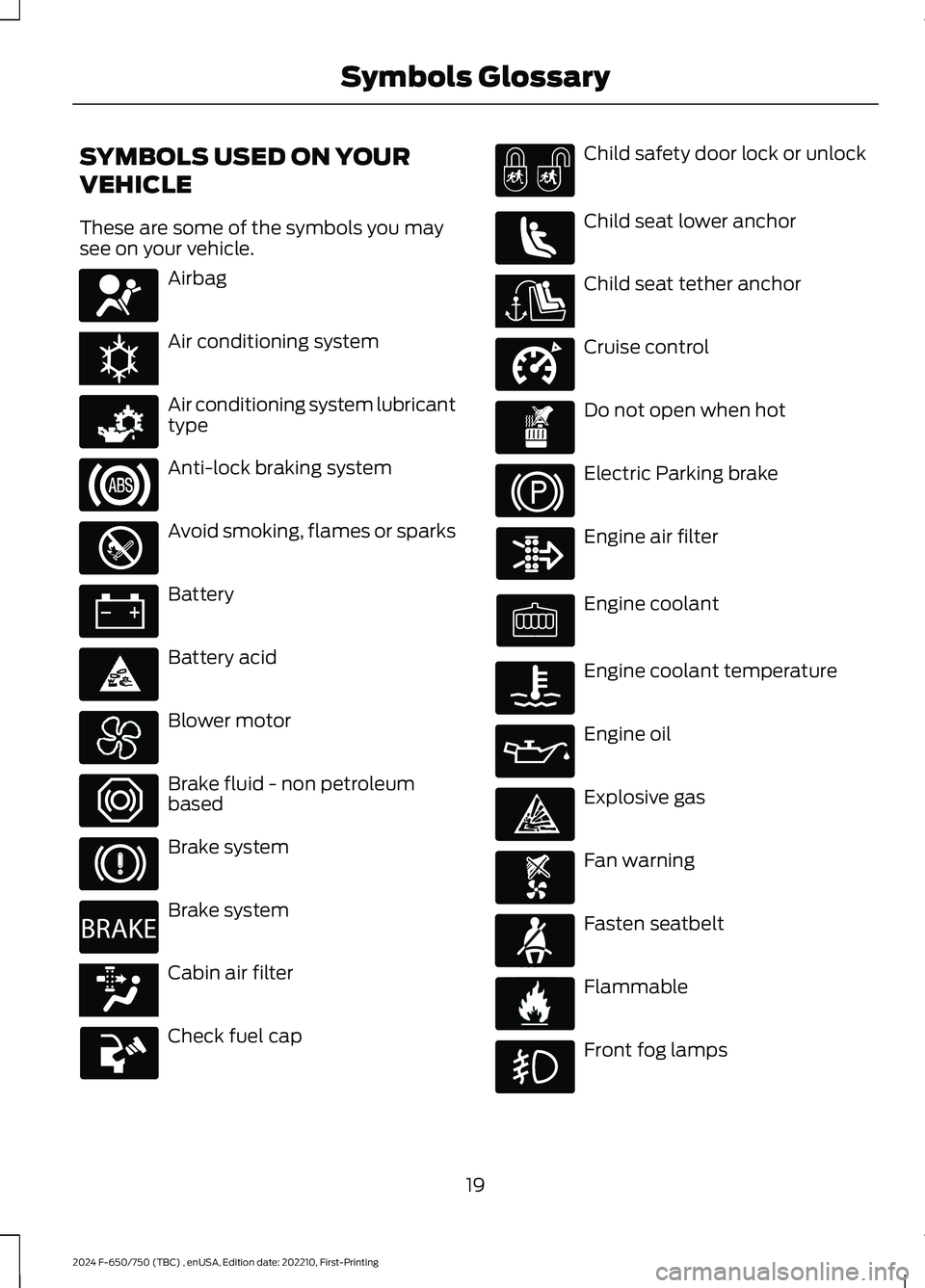
These are some of the symbols you maysee on your vehicle.
Airbag
Air conditioning system
Air conditioning system lubricanttype
Anti-lock braking system
Avoid smoking, flames or sparks
Battery
Battery acid
Blower motor
Brake fluid - non petroleumbased
Brake system
Brake system
Cabin air filter
Check fuel cap
Child safety door lock or unlock
Child seat lower anchor
Child seat tether anchor
Cruise control
Do not open when hot
Electric Parking brake
Engine air filter
Engine coolant
Engine coolant temperature
Engine oil
Explosive gas
Fan warning
Fasten seatbelt
Flammable
Front fog lamps
19
2024 F-650/750 (TBC) , enUSA, Edition date: 202210, First-PrintingSymbols GlossaryE67017 E162384 E231157 E67020 E139220 E67021 E139227 E139209 E67024 E270480 E139223 E139211 E141128 E332905 E139219 E139212 E103308 E67022 E139221 E139228 E71880 E231160
Page 24 of 386
Fuel pump reset
Fuse compartment
Hazard flashers
Headlamp high beams
Headlamps on
Heated rear window
Hill descent control
Horn control
Interior luggage compartmentrelease
Jack
Keep out of reach of children
Lighting control
Low fuel level
Low tire pressure warning
Maintain correct fluid level
Malfunction Indicator Lamp(MIL)
Note operating instructions
Panic alarm
Parking aid
Parking lamps
Passenger airbag activated
Passenger airbag deactivated
Power steering fluid
Power windows front/rear
Power window lockout
Requires registered technician
Safety alert
See Owner's Manual
See Service Manual
Side airbag
20
2024 F-650/750 (TBC) , enUSA, Edition date: 202210, First-PrintingSymbols Glossary E139214 E75790 E67019 E270968 E163171 E270945 E139231 E161353 E139232 E139229 E67028 E72343 E139213 E71341 E270849 E270850 E139216 E139225 E231159 E65963 E72021 E231158
Page 31 of 386
INSTALLING CHILD
RESTRAINTS
Child Restraints
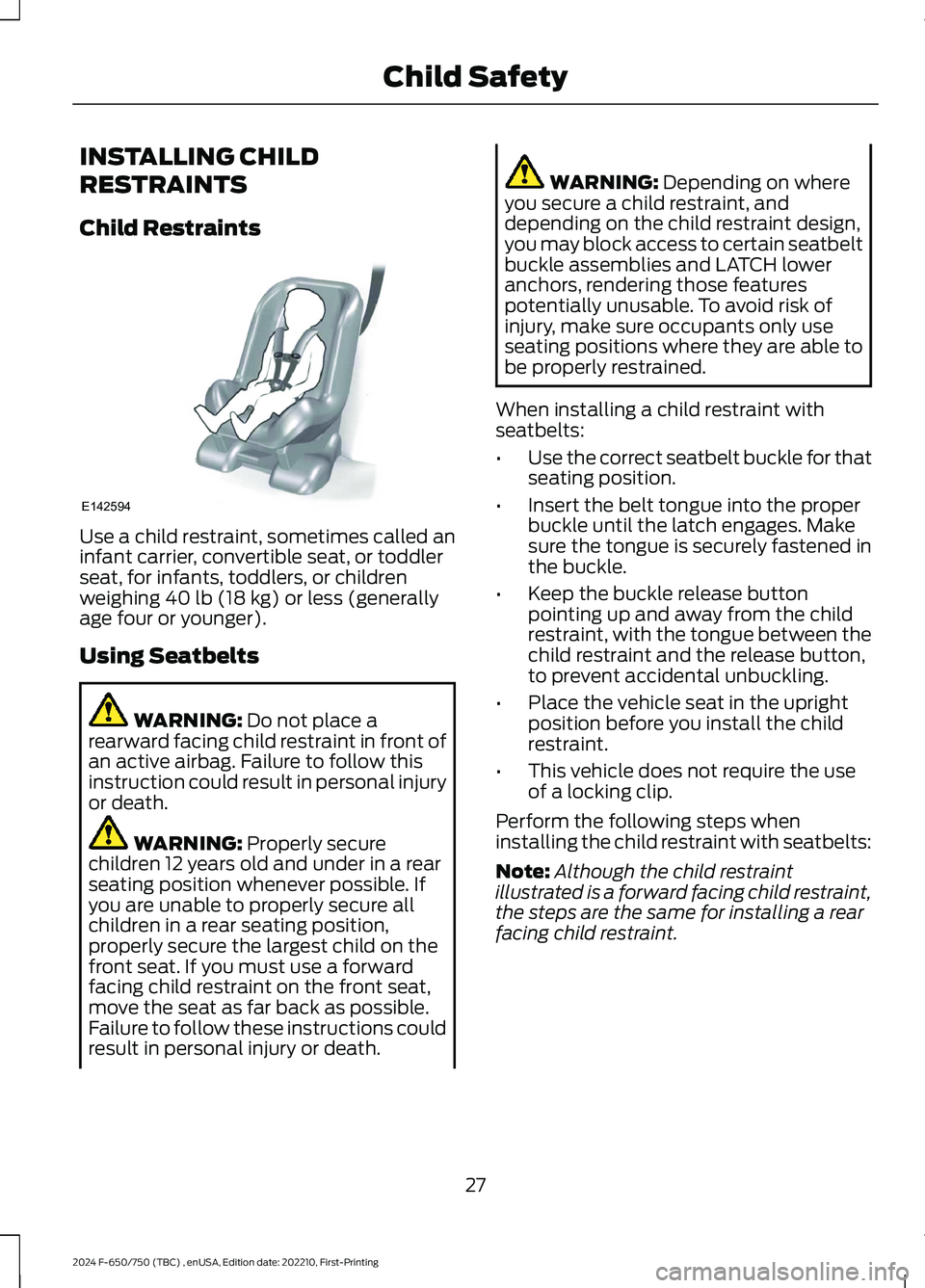
Use a child restraint, sometimes called aninfant carrier, convertible seat, or toddlerseat, for infants, toddlers, or childrenweighing 40 lb (18 kg) or less (generallyage four or younger).
Using Seatbelts
WARNING: Do not place arearward facing child restraint in front ofan active airbag. Failure to follow thisinstruction could result in personal injuryor death.
WARNING: Properly securechildren 12 years old and under in a rearseating position whenever possible. Ifyou are unable to properly secure allchildren in a rear seating position,properly secure the largest child on thefront seat. If you must use a forwardfacing child restraint on the front seat,move the seat as far back as possible.Failure to follow these instructions couldresult in personal injury or death.
WARNING: Depending on whereyou secure a child restraint, anddepending on the child restraint design,you may block access to certain seatbeltbuckle assemblies and LATCH loweranchors, rendering those featurespotentially unusable. To avoid risk ofinjury, make sure occupants only useseating positions where they are able tobe properly restrained.
When installing a child restraint withseatbelts:
•Use the correct seatbelt buckle for thatseating position.
•Insert the belt tongue into the properbuckle until the latch engages. Makesure the tongue is securely fastened inthe buckle.
•Keep the buckle release buttonpointing up and away from the childrestraint, with the tongue between thechild restraint and the release button,to prevent accidental unbuckling.
•Place the vehicle seat in the uprightposition before you install the childrestraint.
•This vehicle does not require the useof a locking clip.
Perform the following steps wheninstalling the child restraint with seatbelts:
Note:Although the child restraintillustrated is a forward facing child restraint,the steps are the same for installing a rearfacing child restraint.
27
2024 F-650/750 (TBC) , enUSA, Edition date: 202210, First-PrintingChild SafetyE142594
Page 32 of 386
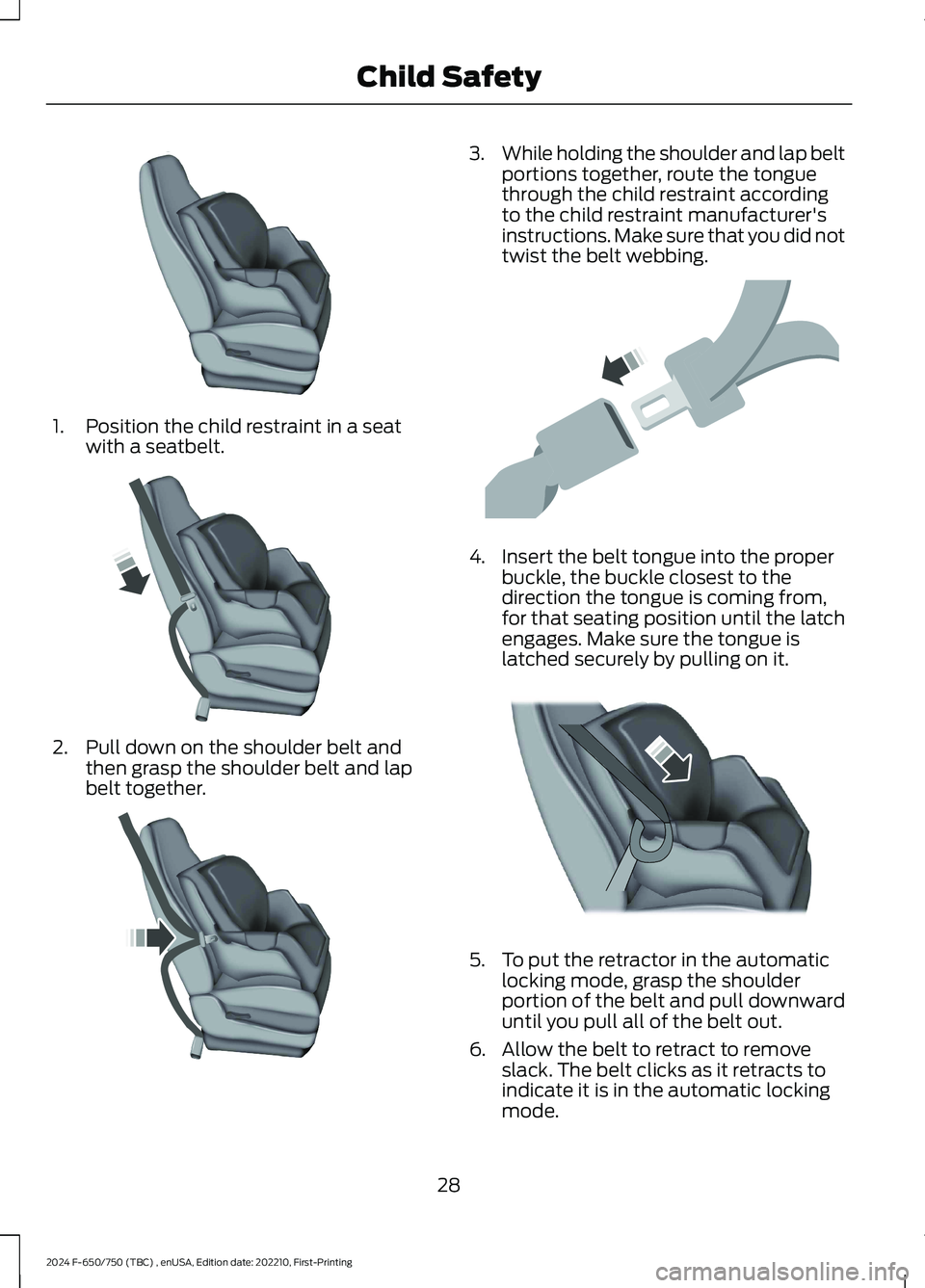
1.Position the child restraint in a seatwith a seatbelt.
2.Pull down on the shoulder belt andthen grasp the shoulder belt and lapbelt together.
3.While holding the shoulder and lap beltportions together, route the tonguethrough the child restraint accordingto the child restraint manufacturer'sinstructions. Make sure that you did nottwist the belt webbing.
4.Insert the belt tongue into the properbuckle, the buckle closest to thedirection the tongue is coming from,for that seating position until the latchengages. Make sure the tongue islatched securely by pulling on it.
5.To put the retractor in the automaticlocking mode, grasp the shoulderportion of the belt and pull downwarduntil you pull all of the belt out.
6.Allow the belt to retract to removeslack. The belt clicks as it retracts toindicate it is in the automatic lockingmode.
28
2024 F-650/750 (TBC) , enUSA, Edition date: 202210, First-PrintingChild SafetyE142528 E142529 E142530 E142531 E142875
Page 33 of 386
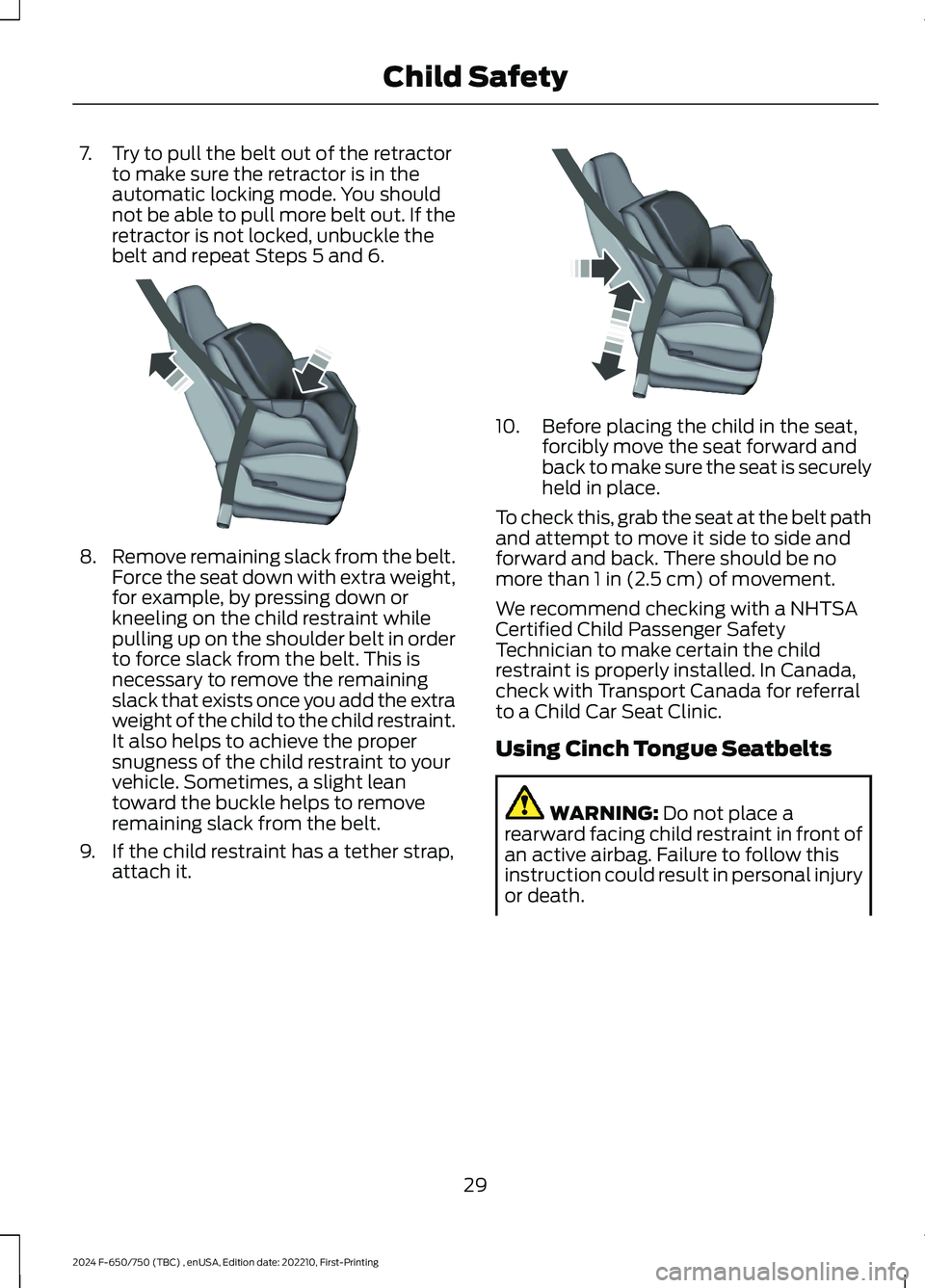
7.Try to pull the belt out of the retractorto make sure the retractor is in theautomatic locking mode. You shouldnot be able to pull more belt out. If theretractor is not locked, unbuckle thebelt and repeat Steps 5 and 6.
8.Remove remaining slack from the belt.Force the seat down with extra weight,for example, by pressing down orkneeling on the child restraint whilepulling up on the shoulder belt in orderto force slack from the belt. This isnecessary to remove the remainingslack that exists once you add the extraweight of the child to the child restraint.It also helps to achieve the propersnugness of the child restraint to yourvehicle. Sometimes, a slight leantoward the buckle helps to removeremaining slack from the belt.
9.If the child restraint has a tether strap,attach it.
10.Before placing the child in the seat,forcibly move the seat forward andback to make sure the seat is securelyheld in place.
To check this, grab the seat at the belt pathand attempt to move it side to side andforward and back. There should be nomore than 1 in (2.5 cm) of movement.
We recommend checking with a NHTSACertified Child Passenger SafetyTechnician to make certain the childrestraint is properly installed. In Canada,check with Transport Canada for referralto a Child Car Seat Clinic.
Using Cinch Tongue Seatbelts
WARNING: Do not place arearward facing child restraint in front ofan active airbag. Failure to follow thisinstruction could result in personal injuryor death.
29
2024 F-650/750 (TBC) , enUSA, Edition date: 202210, First-PrintingChild SafetyE142533 E142534
Page 36 of 386
Contact the manufacturer of your childrestraint for information about ordering atether strap, or to obtain a longer tetherstrap if the tether strap on your childrestraint does not reach the appropriatetop tether anchor in the vehicle.
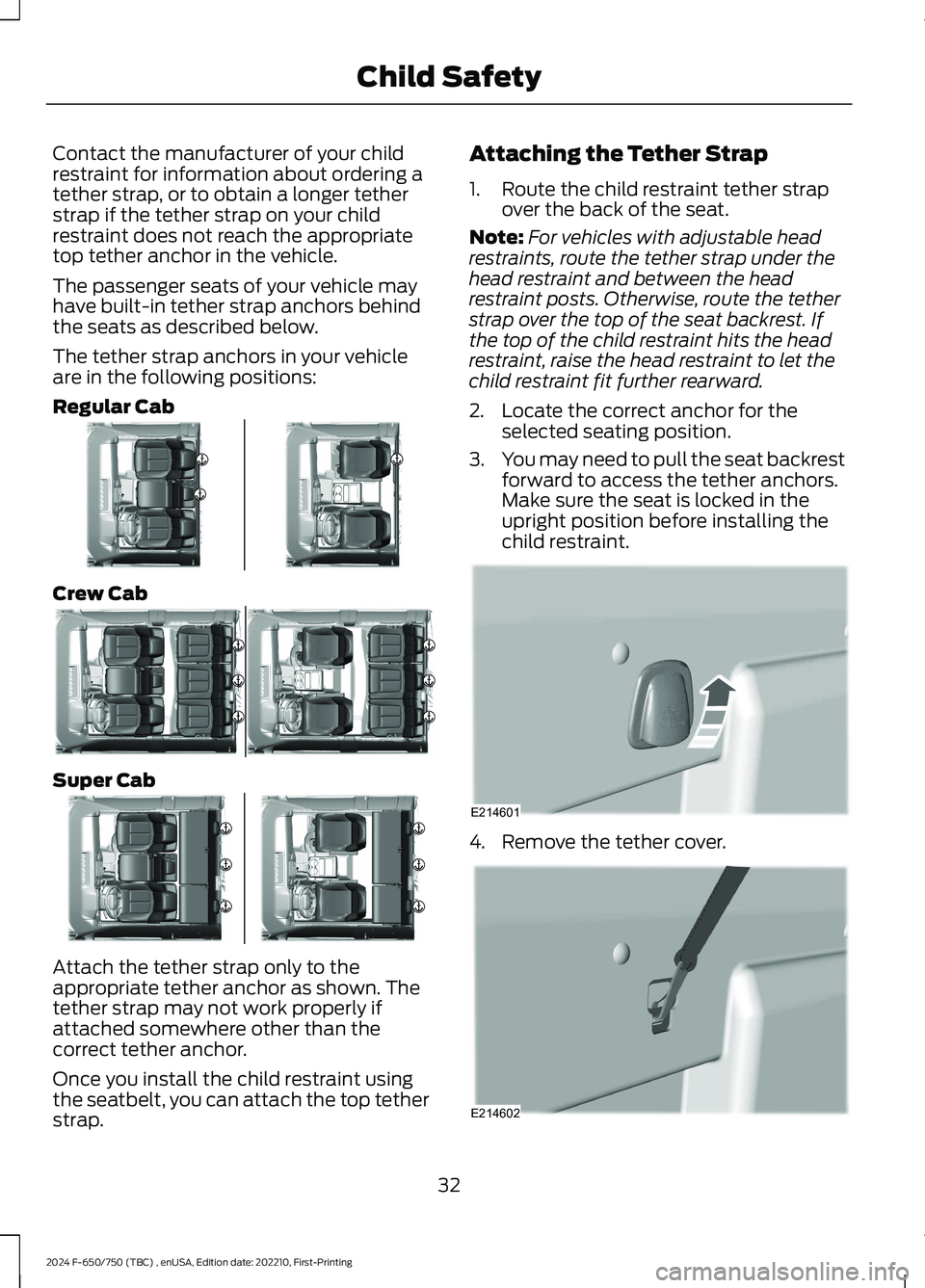
The passenger seats of your vehicle mayhave built-in tether strap anchors behindthe seats as described below.
The tether strap anchors in your vehicleare in the following positions:
Regular Cab
Crew Cab
Super Cab
Attach the tether strap only to theappropriate tether anchor as shown. Thetether strap may not work properly ifattached somewhere other than thecorrect tether anchor.
Once you install the child restraint usingthe seatbelt, you can attach the top tetherstrap.
Attaching the Tether Strap
1.Route the child restraint tether strapover the back of the seat.
Note:For vehicles with adjustable headrestraints, route the tether strap under thehead restraint and between the headrestraint posts. Otherwise, route the tetherstrap over the top of the seat backrest. Ifthe top of the child restraint hits the headrestraint, raise the head restraint to let thechild restraint fit further rearward.
2.Locate the correct anchor for theselected seating position.
3.You may need to pull the seat backrestforward to access the tether anchors.Make sure the seat is locked in theupright position before installing thechild restraint.
4.Remove the tether cover.
32
2024 F-650/750 (TBC) , enUSA, Edition date: 202210, First-PrintingChild SafetyE345911 E345904 E345910 E214601 E214602
Page 40 of 386
WARNING: Always restrain anunoccupied child seat or booster seat.These objects may become projectilesin a crash or sudden stop, which mayincrease the risk of serious injury.
WARNING: Never place, or allowa child to place, the shoulder belt undera child's arm or behind the back becauseit reduces the protection for the upperpart of the body and may increase therisk of injury or death in a crash.
WARNING: To avoid risk of injury,do not leave children or pets unattendedin your vehicle.
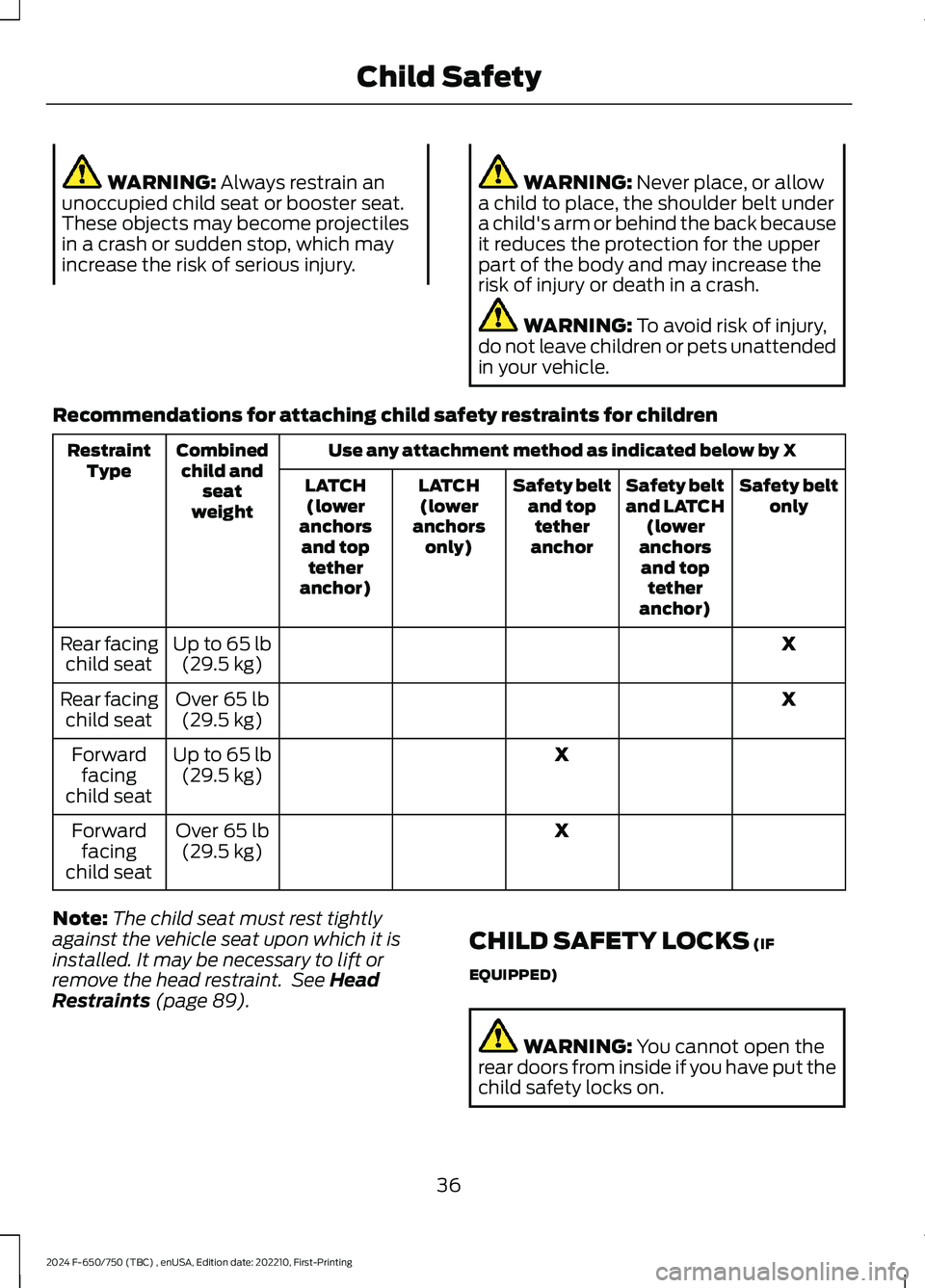
Recommendations for attaching child safety restraints for children
Use any attachment method as indicated below by XCombinedchild andseatweight
RestraintTypeSafety beltonlySafety beltand LATCH(loweranchorsand toptetheranchor)
Safety beltand toptetheranchor
LATCH(loweranchorsonly)
LATCH(loweranchorsand toptetheranchor)
XUp to 65 lb(29.5 kg)Rear facingchild seat
XOver 65 lb(29.5 kg)Rear facingchild seat
XUp to 65 lb(29.5 kg)Forwardfacingchild seat
XOver 65 lb(29.5 kg)Forwardfacingchild seat
Note:The child seat must rest tightlyagainst the vehicle seat upon which it isinstalled. It may be necessary to lift orremove the head restraint. See HeadRestraints (page 89).
CHILD SAFETY LOCKS (IF
EQUIPPED)
WARNING: You cannot open therear doors from inside if you have put thechild safety locks on.
36
2024 F-650/750 (TBC) , enUSA, Edition date: 202210, First-PrintingChild Safety
Page 41 of 386
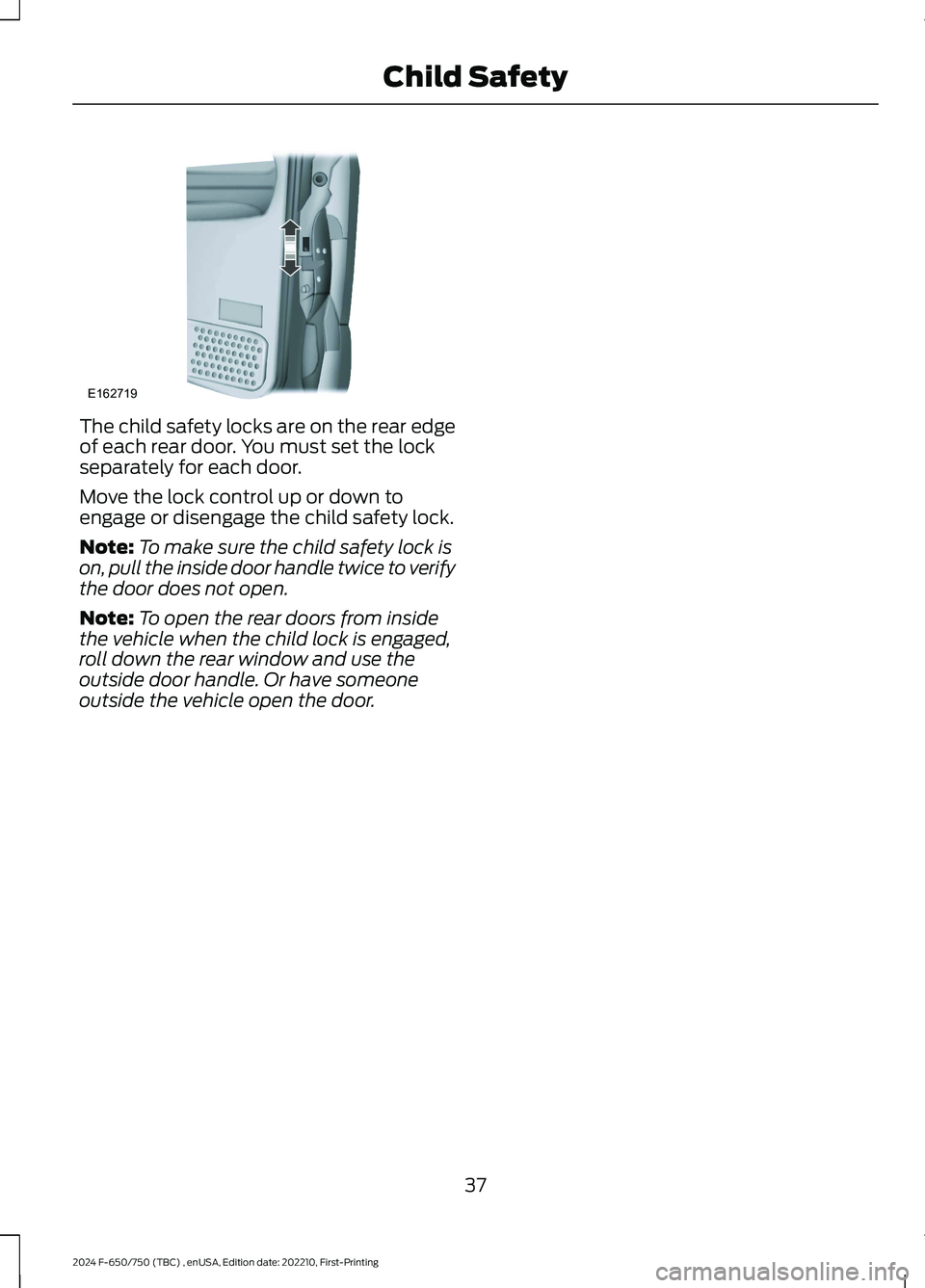
The child safety locks are on the rear edgeof each rear door. You must set the lockseparately for each door.
Move the lock control up or down toengage or disengage the child safety lock.
Note:To make sure the child safety lock ison, pull the inside door handle twice to verifythe door does not open.
Note:To open the rear doors from insidethe vehicle when the child lock is engaged,roll down the rear window and use theoutside door handle. Or have someoneoutside the vehicle open the door.
37
2024 F-650/750 (TBC) , enUSA, Edition date: 202210, First-PrintingChild SafetyE162719
Page 42 of 386
PRINCIPLE OF OPERATION
WARNING: Always drive and ridewith the seat backrest upright and thelap belt snug and low across the hips.
WARNING: To reduce the risk ofinjury, make sure children sit where theycan be properly restrained.
WARNING: Never let a passengerhold a child on his or her lap while yourvehicle is moving. The passenger cannotprotect the child from injury in a crashwhich may result in serious injury ordeath.
WARNING: All occupants of thevehicle, including the driver, shouldalways properly wear their safety belts,even when an airbag supplementalrestraint system is provided. Failure toproperly wear your safety belt couldseriously increase the risk of injury ordeath.
WARNING: It is extremelydangerous to ride in a cargo area, insideor outside of a vehicle. In a crash, peopleriding in these areas are more likely to beseriously injured or killed. Do not allowpeople to ride in any area of your vehiclethat is not equipped with seats andsafety belts. Be sure everyone in yourvehicle is in a seat and using a safety beltproperly.
WARNING: In a rollover crash, anunbelted person is significantly morelikely to die than a person wearing asafety belt.
WARNING: Each seating positionin your vehicle has a specific safety beltassembly which is made up of onebuckle and one tongue that are designedto be used as a pair. 1) Use the shoulderbelt on the outside shoulder only. Neverwear the shoulder belt under the arm. 2)Never swing the safety belt around yourneck over the inside shoulder. 3) Neveruse a single belt for more than oneperson.
WARNING: When possible, allchildren 12 years old and under shouldbe properly restrained in a rear seatingposition. Failure to follow this couldseriously increase the risk of injury ordeath.
WARNING: Safety belts and seatscan become hot in a vehicle that hasbeen closed up in sunny weather; theycould burn a small child. Check seatcovers and buckles before you place achild anywhere near them.
WARNING: Front and rear seatoccupants, including pregnant women,should wear safety belts for optimumprotection in an accident.
All seating positions in this vehicle havelap and shoulder safety belts. Alloccupants of the vehicle should alwaysproperly wear their safety belts, even whenan airbag supplemental restraint systemis provided.
The safety belt system consists of:
•Lap and shoulder safety belts.
•Shoulder safety belt with automaticlocking mode, (except driver safetybelt).
38
2024 F-650/750 (TBC) , enUSA, Edition date: 202210, First-PrintingSeatbelts