schedule FORD F750 2015 13.G User Guide
[x] Cancel search | Manufacturer: FORD, Model Year: 2015, Model line: F750, Model: FORD F750 2015 13.GPages: 384, PDF Size: 4.95 MB
Page 203 of 384
Inspection and adjustment:Establish a regular schedule for periodic
cleaning, lubrication and adjustment inspection based on vehicle use.
Exact maintenance intervals are difficult to predetermine due to vehicle
applications and operating conditions. If you are uncertain of the proper
schedule for your vehicle, contact an authorized dealer.
Regular inspections should include:
•Periodic checking (every service interval) of push rod travel or brake
adjustment. This is essential for effective braking. Brake chamber
push rods on original equipment chambers now incorporate an orange
paint marker near the base of the push rod as a stroke indicator to
aid in adjustment checks. If the push rod is clean and the brakes are
out of adjustment, you can see the orange marker protruding from
the chamber when the brakes are applied.
•Checking the brake lining (every service interval). When brake lining
or blocks wear within 1/16th inch (1.6 millimeters) of rivets, replace
the brake linings. A qualified technician should perform this
inspection and keep to instructions provided by the service manual.
Do not back off or disconnect the front brakes so that they are less
effective, letting the rear brakes do all the stopping of your vehicle. Do
not overlook the brakes on the trailer either. Brake condition on the
trailer is just as important as the tractor. Proper brake balance on trucks
and tractor-trailers is essential for effective braking.
Once a year, inspect the entire brake system:
•Rubber components for deterioration. A qualified technician should
inspect these components and replace them as necessary.
Replacement intervals vary according to the severity and length of
vehicle service.
•Condition of brake drums, brake chambers and slack adjusters.
•System for air leaks.
•Hose or pipes for rust, damage and deterioration.
•Operation of service and parking brakes.
Periodically inspect parts such as air brake chamber diaphragm, air
compressor and air cleaner. Replace any parts if you can consider them
unserviceable.
Air dryer:Climactic conditions affect performance of desiccant or
after-cooler type air dryers. You must establish a maintenance schedule
for each specific operation.
The use of an air dryer on a vehicle does not eliminate the need to drain
the air reservoirs periodically.
202Maintenance
2015 F-650/750(f67)
Owners Guide gf(ownloose), 1st Printing, December 2013
Canadian_French(fr_can)
Page 204 of 384
Desiccant air dryer:Inspect for moisture in the air system by opening
reservoirs, draincocks or valves and checking for presence of water. The
presence of small amounts of water due to condensation is normal and is
not an indication that the dryer is not functioning properly.
Replace or rebuild the desiccant cartridge when you determine that the
desiccant is contaminated and does not have adequate water absorption
capacity. The desiccant change interval may vary. A general
recommendation is to replace the desiccant every 12 months (yearly). If
experience has shown that extended or shortened life has resulted for a
particular installation, then the yearly interval can be increased or
decreased accordingly.
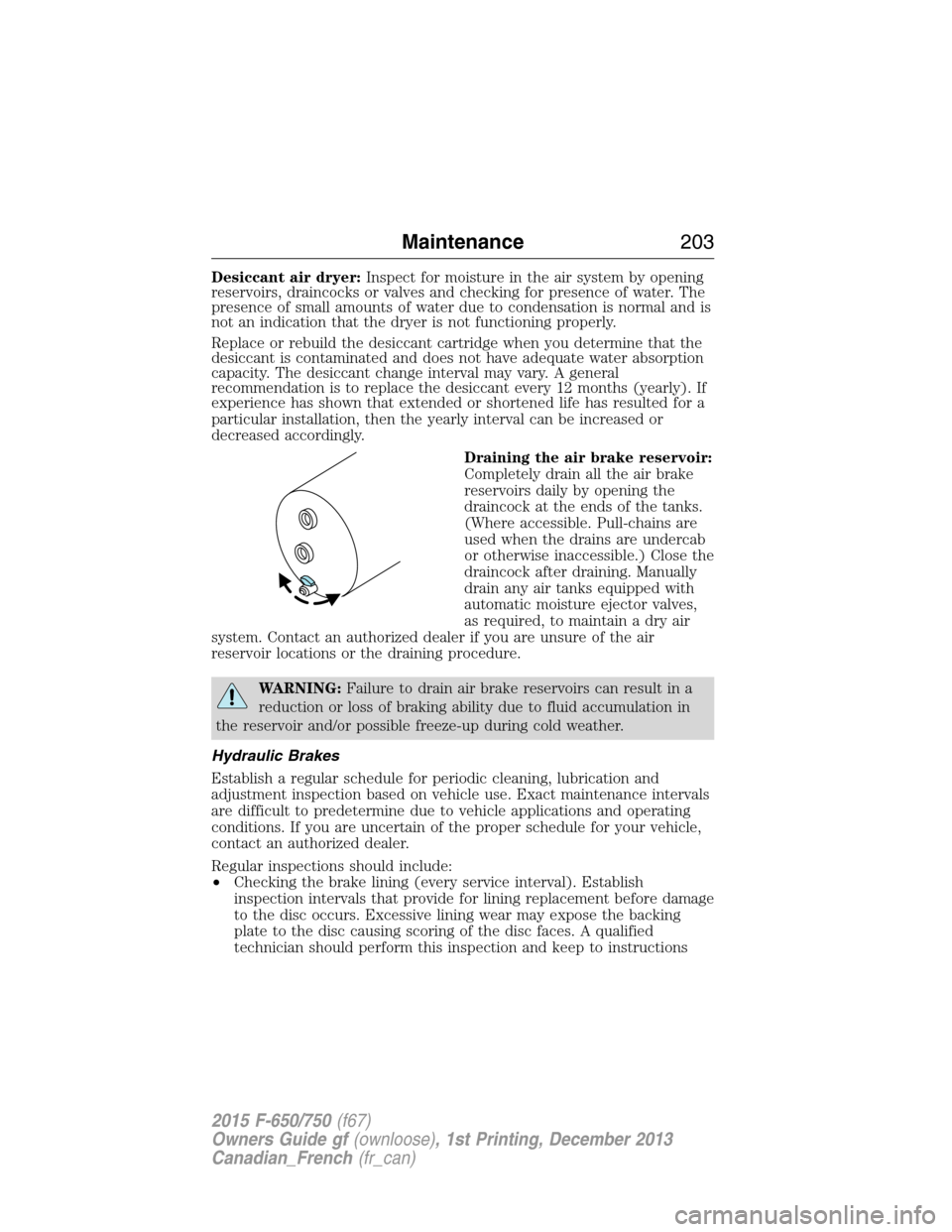
Draining the air brake reservoir:
Completely drain all the air brake
reservoirs daily by opening the
draincock at the ends of the tanks.
(Where accessible. Pull-chains are
used when the drains are undercab
or otherwise inaccessible.) Close the
draincock after draining. Manually
drain any air tanks equipped with
automatic moisture ejector valves,
as required, to maintain a dry air
system. Contact an authorized dealer if you are unsure of the air
reservoir locations or the draining procedure.
WARNING:Failure to drain air brake reservoirs can result in a
reduction or loss of braking ability due to fluid accumulation in
the reservoir and/or possible freeze-up during cold weather.
Hydraulic Brakes
Establish a regular schedule for periodic cleaning, lubrication and
adjustment inspection based on vehicle use. Exact maintenance intervals
are difficult to predetermine due to vehicle applications and operating
conditions. If you are uncertain of the proper schedule for your vehicle,
contact an authorized dealer.
Regular inspections should include:
•Checking the brake lining (every service interval). Establish
inspection intervals that provide for lining replacement before damage
to the disc occurs. Excessive lining wear may expose the backing
plate to the disc causing scoring of the disc faces. A qualified
technician should perform this inspection and keep to instructions
Maintenance203
2015 F-650/750(f67)
Owners Guide gf(ownloose), 1st Printing, December 2013
Canadian_French(fr_can)
Page 206 of 384
•Checking that the pitman arm (steering arm at steering gear)
mounting is tight and locked. Check system for leaks or hose chafing.
Repair immediately, if necessary.
•Maintaining proper steering gear and power steering pump lubricant
levels.
•Checking steering column joint bolts and steering linkage, particularly
for body-to-chassis clearance.
Steering Column Joint Bolts
As a good maintenance practice, check steering column joint bolt
tightness every 60000 miles (96000 kilometers) or annually, whichever
occurs first. Do not overtighten the bolts.
Hydraulic System
Whenever draining and refilling the power steering’s hydraulic system for
any reason, bleed air from the system before returning the vehicle to
service. Failure to bleed the hydraulic system properly can result in
degradation of power system performance.
Consult an authorized dealer who is aware of the proper procedures for
filling and bleeding the system.
Catalytic Converter (Diesel Engine)
Note:If your vehicle is equipped with a catalytic converter or muffler,
do not blend waste oil with diesel fuel. Operate only on ultra-low sulfur
(less than 15 parts per million sulfur) diesel fuel with a cetane value of
45 or higher.
If your diesel engine is equipped with a catalytic converter, it is
important to review the maintenance schedule to make sure proper
functioning of the catalytic converter. Also, take precautions not to
damage the catalytic converter when servicing your engine or storing
your vehicle.
Diesel Exhaust Fluid (DEF), Diesel Particulate Filter (DPF) and
Select Catalyst Reduction (SCR) System
See your engine operator’s manual for information about DEF, DPF and
SCR system service
Air Induction System
WARNING:When performing maintenance to any turbocharged
engine with engine air inlet piping disconnected, keep loose
clothing, jewelry and long hair away from the engine air inlet piping. A
turbocharger compressor air inlet protective shield should be installed
over the turbocharger air inlet to reduce the risk of personal injury or
death.
Maintenance205
2015 F-650/750(f67)
Owners Guide gf(ownloose), 1st Printing, December 2013
Canadian_French(fr_can)
Page 213 of 384
Gasoline Engine
Checking the Engine Coolant
When the engine is cold, check the concentration and level of engine
coolant at the intervals listed in theScheduled Maintenancechapter.
Note:Make sure that the level is between the MIN and MAX marks on
the coolant reservoir.
Note:Coolant expands when it is hot. The level may extend beyond the
MAX mark.
Note:If the level is at the MIN mark, below the MIN mark, or empty,
add coolant immediately. SeeAdding engine coolantin this section.
Note:For best results, coolant concentration should be tested with a
refractometer such as Rotunda tool 300-ROB75240 available from an
authorized dealer. Ford does not recommend the use of hydrometers or
coolant test strips for measuring coolant concentrations.
Note:Automotive fluids are not interchangeable; do not use engine
coolant, antifreeze or windshield washer fluid outside of its specified
function and vehicle location.
Adding Engine Coolant
WARNING:Do not add engine coolant when the engine is hot.
Steam and scalding liquids released from a hot cooling system
can burn you badly. Also, you can be burned if you spill coolant on hot
engine parts.
WARNING:Do not put engine coolant in the windshield washer
fluid container. If sprayed on the windshield, engine coolant
could make it difficult to see through the windshield.
WARNING:To reduce the risk of personal injury, make sure the
engine is cool before unscrewing the coolant pressure relief cap.
The cooling system is under pressure; steam and hot liquid can come
out forcefully when the cap is loosened slightly.
WARNING:Do not add coolant further than the MAX mark.
212Maintenance
2015 F-650/750(f67)
Owners Guide gf(ownloose), 1st Printing, December 2013
Canadian_French(fr_can)
Page 216 of 384
When Fail-Safe Mode Turns On
WARNING:Never remove the coolant reservoir cap while the
engine is running or hot.
Note:Driving your vehicle without repairing the engine problem
increases the chance of engine damage. Take your vehicle to an
authorized dealer as soon as possible.
You have limited engine power when in the fail-safe mode, so drive your
vehicle with caution. Your vehicle is not able to maintain high-speed
operation and the engine runs rough. Remember that the engine is
capable of completely shutting down automatically to prevent engine
damage; therefore:
1. Pull off the road as soon as safely possible and turn off the engine.
2. Have your vehicle taken to an authorized dealer.
3. If this is not possible, wait a short period for the engine to cool.
4. Check the coolant level and replenish if low.
5. Restart the engine and take your vehicle to an authorized dealer.
TRANSMISSION FLUID CHECK
Allison Automatic Transmissions
See yourAllison Automatic Transmission Operator’s Manualfor
scheduled transmission fluid checks and change intervals. Your
transmission does not consume fluid. However, you should check the
fluid level if the transmission is not working properly. For example, if the
transmission slips or shifts slowly or if you notice some sign of fluid
leakage.
Automatic transmission fluid expands when warmed. To obtain an
accurate fluid check, drive your vehicle until it is at normal operating
temperature, approximately 20 miles (30 kilometers). Verify that the
transmission fluid temperature gauge, located on the instrument cluster,
is within the normal range.
1. Drive your vehicle 20 miles (30 kilometers) or until it reaches normal
operating temperature.
2. Park your vehicle on a level surface and engage the parking brake.
3. With the engine running, parking brake engaged and your foot on the
brake pedal, move the gearshift lever through all of the gear ranges.
Allow sufficient time for each gear to engage.
4. Latch the gearshift lever in positionNorPand leave the engine
running.
5. Remove the dipstick, wiping it clean with a clean, dry, lint-free rag.
Maintenance215
2015 F-650/750(f67)
Owners Guide gf(ownloose), 1st Printing, December 2013
Canadian_French(fr_can)
Page 217 of 384
6. Install the dipstick making sure to seat it fully in the filler tube.
7. Remove the dipstick and inspect the fluid level. The fluid should be
in the designated area for normal operating temperature or ambient
temperature.
If you must add transmission fluid, see yourAllison Automatic
Transmission Operator’s Manualfor the correct fluid type.Use of a
non-approved automatic transmission fluid may cause internal
transmission component damage.
Fluid levels above the safe range may result in transmission failure. An
overfill condition of transmission fluid may cause shift or engagement
concerns or possible damage.
TorqShift® Automatic Transmission
See theScheduled Maintenancechapter for scheduled intervals for
fluid checks and changes. Your transmission does not consume fluid.
However, you should check the fluid level if the transmission is not
working properly. For example, if the transmission slips or shifts slowly
or if you notice some sign of fluid leakage.
Automatic transmission fluid expands when warmed. To obtain an
accurate fluid check, drive your vehicle until it is at normal operating
temperature, approximately 20 miles (30 kilometers). Verify that the
transmission fluid temperature gauge, located on the instrument cluster,
is within the normal range.
1. Drive your vehicle 20 miles (30 kilometers) or until it reaches normal
operating temperature.
2. Park your vehicle on a level surface and engage the parking brake.
3. With the engine running, parking brake engaged and your foot on the
brake pedal, move the gearshift lever through all of the gear ranges.
Allow sufficient time for each gear to engage.
4. Latch the gearshift lever in positionPand leave the engine running.
5. Remove the dipstick, wiping it clean with a clean, dry, lint-free rag.
6. Install the dipstick making sure to seat it fully in the filler tube.
7. Remove the dipstick and inspect the fluid level. The fluid should be
in the designated area for normal operating temperature or ambient
temperature.
216Maintenance
2015 F-650/750(f67)
Owners Guide gf(ownloose), 1st Printing, December 2013
Canadian_French(fr_can)
Page 219 of 384
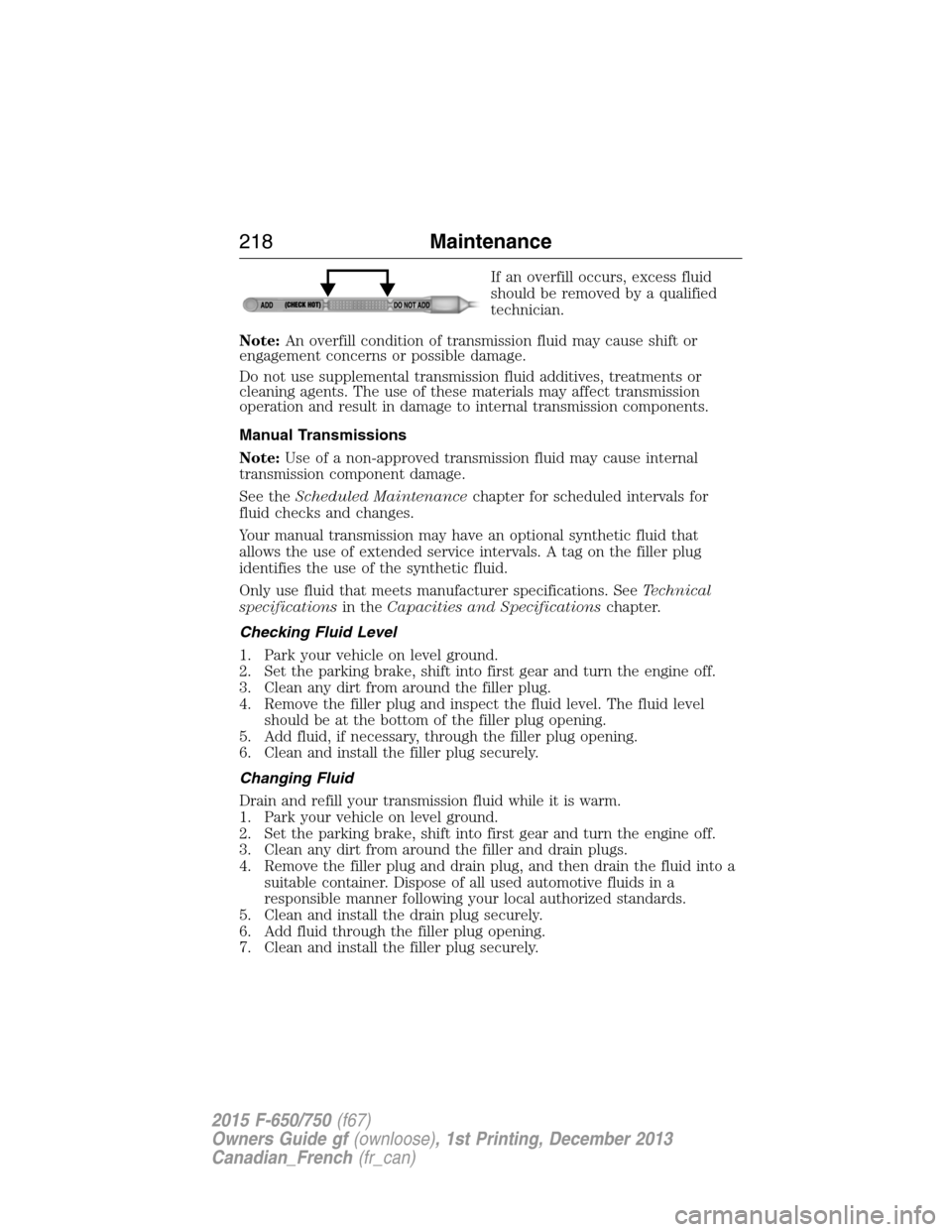
If an overfill occurs, excess fluid
should be removed by a qualified
technician.
Note:An overfill condition of transmission fluid may cause shift or
engagement concerns or possible damage.
Do not use supplemental transmission fluid additives, treatments or
cleaning agents. The use of these materials may affect transmission
operation and result in damage to internal transmission components.
Manual Transmissions
Note:Use of a non-approved transmission fluid may cause internal
transmission component damage.
See theScheduled Maintenancechapter for scheduled intervals for
fluid checks and changes.
Your manual transmission may have an optional synthetic fluid that
allows the use of extended service intervals. A tag on the filler plug
identifies the use of the synthetic fluid.
Only use fluid that meets manufacturer specifications. SeeTechnical
specificationsin theCapacities and Specificationschapter.
Checking Fluid Level
1. Park your vehicle on level ground.
2. Set the parking brake, shift into first gear and turn the engine off.
3. Clean any dirt from around the filler plug.
4. Remove the filler plug and inspect the fluid level. The fluid level
should be at the bottom of the filler plug opening.
5. Add fluid, if necessary, through the filler plug opening.
6. Clean and install the filler plug securely.
Changing Fluid
Drain and refill your transmission fluid while it is warm.
1. Park your vehicle on level ground.
2. Set the parking brake, shift into first gear and turn the engine off.
3. Clean any dirt from around the filler and drain plugs.
4. Remove the filler plug and drain plug, and then drain the fluid into a
suitable container. Dispose of all used automotive fluids in a
responsible manner following your local authorized standards.
5. Clean and install the drain plug securely.
6. Add fluid through the filler plug opening.
7. Clean and install the filler plug securely.
218Maintenance
2015 F-650/750(f67)
Owners Guide gf(ownloose), 1st Printing, December 2013
Canadian_French(fr_can)
Page 220 of 384
DRIVESHAFT
Check the universal joints for any evidence of wear or looseness at the
regular lubrication interval. Stop your vehicle immediately, should
driveshaft vibrations occur, to avoid possible hazardous consequences or
damage to other components.
REAR AXLE FLUID
Your rear axle may have an optional synthetic lubricant that allows the
use of extended service intervals. A tag on the filler plug identifies the
use of the synthetic lubricant.
Only use a lubricant that meets manufacturer specifications. See the
Capacities and Specificationschapter.Use of a non-approved rear
axle lubricant may cause internal axle component damage.
Checking the Fluid Level
See theScheduled Maintenancechapter for lubricant check intervals.
1. Park your vehicle on level ground.
2. Set the parking brake and shift into positionNorP(automatic
transmission), or first gear (manual transmission). Turn the engine
off.
3. Clean any dirt from around the axle filler plug.
4. Remove the filler plug and inspect the lubricant level. It should be at
the bottom of the filler plug opening.
5. Add lubricant, if necessary, through the filler plug opening.
6. Clean and install the filler plug securely.
Changing the Fluid
See theScheduled Maintenancechapter for lubricant change intervals.
1. Drain the rear axle while the lubricant is warm.
2. Park your vehicle on level ground.
3. Set the parking brake and shift into positionNorP(automatic
transmission), or first gear (manual transmission). Turn the engine
off.
4. Clean any dirt from around the rear axle filler and drain plugs.
5. Remove the filler and drain plugs. Drain the lubricant into a suitable
container. Dispose of all used automotive fluids in a responsible
manner following your local authorized standards.
6. Clean and install the drain plug securely.
7. Add lubricant through the filler plug opening.
8. Clean and install the filler plug securely.
Maintenance219
2015 F-650/750(f67)
Owners Guide gf(ownloose), 1st Printing, December 2013
Canadian_French(fr_can)
Page 222 of 384
WARNING:If you use a brake fluid that is not DOT 3, you will
cause permanent damage to your brakes.
WARNING:Do not let the reservoir for the master cylinder run
dry. This may cause the brakes to fail.
Check and refill the Full Power brake fluid reservoir using the following
procedure. See theScheduled Maintenancechapter for the service
interval.
1. Clean the reservoir caps before removal to prevent dirt or water from
entering the reservoir.
2. Visually inspect the fluid level. It should be at the bottom of the fill
ports.
3. Add brake fluid, if necessary, from a clean, unopened container until
the level reaches the bottom of the fill ports. Do not fill above this
line.
Only use a DOT 3 brake fluid certified to meet manufacturer
specifications. See theCapacities and Specificationschapter.
CLUTCH FLUID AND LINKAGE
Clutch Fluid
WARNING:Carefully read cautionary information on product
label. For MEDICAL EMERGENCY INFORMATION, contact a
physician or Poison Control Center immediately; on Ford-Motorcraft®
products call: 1-800-959-3673 (FORD). Failure to follow these
instructions may result in personal injury.
Use only a DOT 3 brake fluid designed to meet manufacturer
specifications. See theCapacities and Specificationschapter.
During normal operation, the fluid level in the clutch reservoir should
remain constant. If the fluid level drops, fill to the step in the reservoir.
Maintenance221
2015 F-650/750(f67)
Owners Guide gf(ownloose), 1st Printing, December 2013
Canadian_French(fr_can)
Page 223 of 384
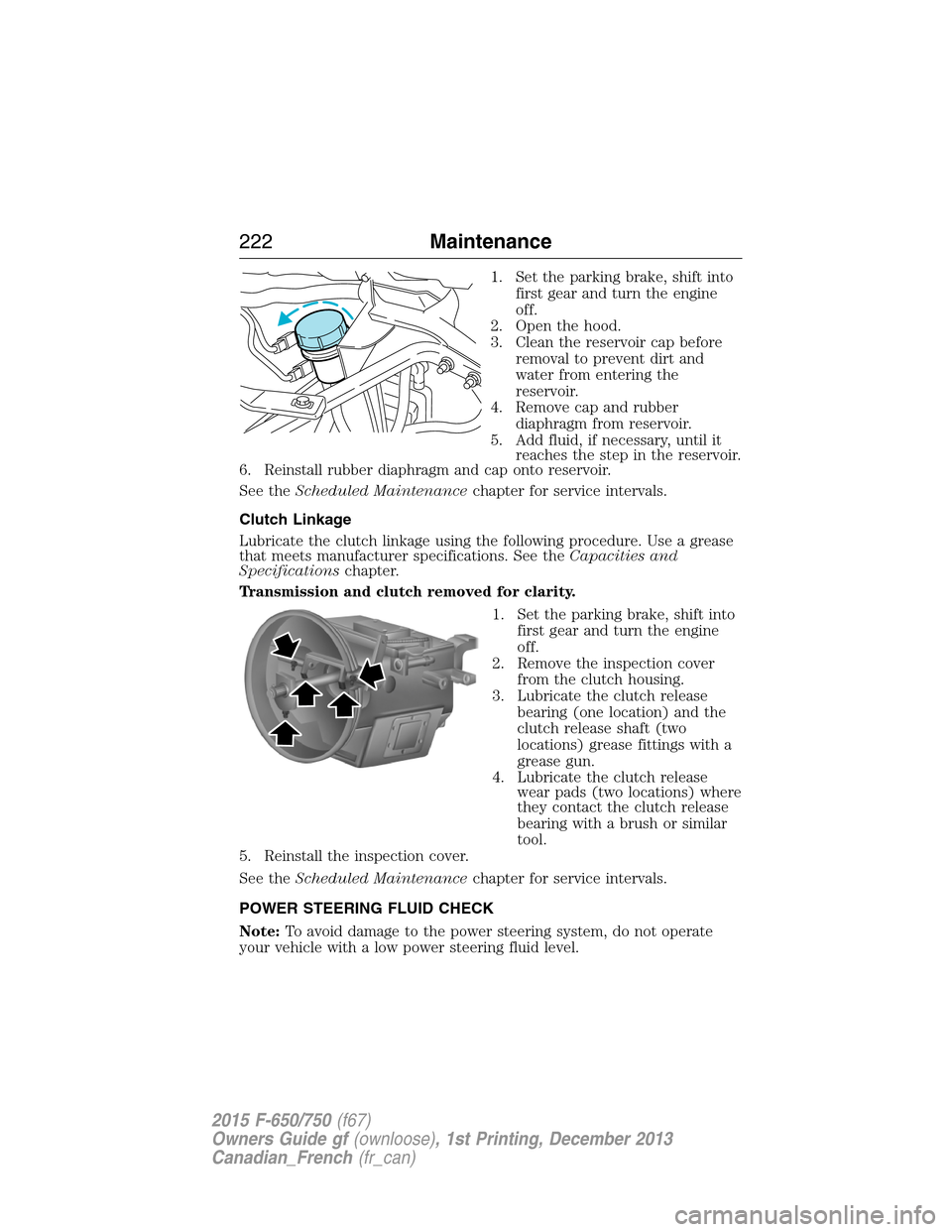
1. Set the parking brake, shift into
first gear and turn the engine
off.
2. Open the hood.
3. Clean the reservoir cap before
removal to prevent dirt and
water from entering the
reservoir.
4. Remove cap and rubber
diaphragm from reservoir.
5. Add fluid, if necessary, until it
reaches the step in the reservoir.
6. Reinstall rubber diaphragm and cap onto reservoir.
See theScheduled Maintenancechapter for service intervals.
Clutch Linkage
Lubricate the clutch linkage using the following procedure. Use a grease
that meets manufacturer specifications. See theCapacities and
Specificationschapter.
Transmission and clutch removed for clarity.
1. Set the parking brake, shift into
first gear and turn the engine
off.
2. Remove the inspection cover
from the clutch housing.
3. Lubricate the clutch release
bearing (one location) and the
clutch release shaft (two
locations) grease fittings with a
grease gun.
4. Lubricate the clutch release
wear pads (two locations) where
they contact the clutch release
bearing with a brush or similar
tool.
5. Reinstall the inspection cover.
See theScheduled Maintenancechapter for service intervals.
POWER STEERING FLUID CHECK
Note:To avoid damage to the power steering system, do not operate
your vehicle with a low power steering fluid level.
222Maintenance
2015 F-650/750(f67)
Owners Guide gf(ownloose), 1st Printing, December 2013
Canadian_French(fr_can)