schedule FORD F750 2015 13.G Owners Manual
[x] Cancel search | Manufacturer: FORD, Model Year: 2015, Model line: F750, Model: FORD F750 2015 13.GPages: 384, PDF Size: 4.95 MB
Page 7 of 384
SYNC® 286
Pairing your phone for the first time.......................291
911 Assist™.........................................308
Vehicle Health Report..................................311
Appendices 332
Scheduled Maintenance 340
Index 378
The information contained in this publication was correct at the time of going to
print. In the interest of continuous development, we reserve the right to change
specifications, design or equipment at any time without notice or obligation. No
part of this publication may be reproduced, transmitted, stored in a retrieval
system or translated into any language in any form by any means without our
written permission. Errors and omissions excepted.
© Ford Motor Company 2013
6Table of Contents
2015 F-650/750(f67)
Owners Guide gf(ownloose), 1st Printing, December 2013
Canadian_French(fr_can)
Page 11 of 384
CALIFORNIA PROPOSITION 65
WARNING:Some constituents of engine exhaust, certain vehicle
components, certain fluids contained in vehicles and certain
products of component wear contain or emit chemicals known to the
State of California to cause cancer and birth defects or other
reproductive harm.
PERCHLORATE MATERIAL
Note:Certain components in your vehicle, such as airbag modules,
safety belt pretensioners, and remote control batteries, may contain
perchlorate material. Special handling may apply for service or vehicle
end of life disposal. See www.dtsc.ca.gov/hazardouswaste/perchlorate for
more information.
FORD CREDIT (U.S. ONLY)
Ford Credit offers a full range of financing and lease plans to help you
acquire your vehicle. If you have financed or leased your vehicle through
Ford Credit, thank you for your business.
For your convenience, we offer a number of ways to contact us, as well
as help manage your account.
Phone: 1-800-727-7000
For more information regarding Ford Credit, as well as access to
Account Manager, please go to www.fordcredit.com.
REPLACEMENT PARTS RECOMMENDATION
Your vehicle has been built to the highest standards using quality parts.
We recommend that you demand the use of genuine Ford and Motorcraft
parts whenever your vehicle requires scheduled maintenance or repair.
You can clearly identify genuine Ford and Motorcraft parts by looking for
the Ford, FoMoCo or Motorcraft branding on the parts or their
packaging.
Scheduled Maintenance and Mechanical Repairs
One of the best ways for you to make sure that your vehicle provides
years of service is to have it maintained in line with our
recommendations using parts that conform to the specifications detailed
in this owner’s manual. Genuine Ford and Motorcraft parts meet or
exceed these specifications.
10Introduction
2015 F-650/750(f67)
Owners Guide gf(ownloose), 1st Printing, December 2013
Canadian_French(fr_can)
Page 122 of 384
•DEF freezes below 12°F (-11°C). Your vehicle is equipped with an
automatic pre-heating system which allows the DEF system to
operate below 12°F (-11°C).
•Do not store the DEF bottle in your vehicle. If it leaks, it could cause
damage to interior components or release an ammonia odor inside
your vehicle.
•Store DEF out of direct sunlight and in temperatures between
23°F–68°F (-5°C–20°C).
NOISE EMISSIONS
In order to keep to the federal exterior noise regulations, your vehicle
may be equipped with noise emission items. Depending on your vehicle
configuration, it may have all or some of the following items:
Air Intake System:Inspect the air cleaner. Do not alter its location. Do
not alter inlet and outlet piping.
Body:Inspect wheel well splash shields, cab shields and under hood
insulation for deterioration, dislocation and orientation.
Cooling System:
•Inspect the fan for blade damage. If you find any damage, replace
with the recommended parts. Inspect for fan-to-shroud interference
and any damage to shroud, such as cracks and holes.
•Do not change fan ratio or alter fan spacer dimensions and positions.
•Inspect fan clutch for proper operation. Make sure the fan is
disengaged when cooling of the engine is not required.
•Inspect radiator shutters (if equipped) for proper operation. The
shutters should be open during normal operating temperatures.
Engine:Valve covers and block covers damp-out engine mechanical
noise. If they need replacing, make sure to replace them with the
recommended parts. Check for mechanical isolations.
Transmission Enclosure:Inspect for cracks, holes and tears. Clean any
deposits, such as oil, dirt and stones.
Exhaust System:
•Inspect for leaks at various joint connections and loose clamps.
•
Perform a visual inspection for cracks or holes in the muffler and tail pipe.
•Always use the recommended replacement parts.
•Do not change the tail pipe elbow or offset tail pipe orientation from the
standard position as originally received.
•To avoid abnormal changes in vehicle sound levels, it is necessary for the
owner to perform inspections and necessary maintenance at the intervals
shown in theScheduled Maintenancechapter.
Fuel and Refueling121
2015 F-650/750(f67)
Owners Guide gf(ownloose), 1st Printing, December 2013
Canadian_French(fr_can)
Page 124 of 384
more quickly. If you force the gearshift lever into position, this action
defeats the purpose of the synchronizer by causing gear clash.
Shifting with a Non-Synchronized Transmission
SeeClutch brakeandDouble clutch proceduresin theClutchsection
of this chapter.
Clutch
Do not ride or slip the clutch as this causes unnecessary heat and wear.
Maintain the specified clutch adjustment to prolong its life and regularly
inspect the clutch control linkage for tightness. See theScheduled
Maintenancechapter for other maintenance information. When
adjustment of the clutch is necessary, it is very important that the work
be performed properly or early clutch failure may result and a costly
clutch overhaul may become necessary. Only a qualified technician
should perform clutch work.
Note:Continued use of a damaged or worn clutch, prolonged clutch
slippage or downshifting at excessive speeds can result in a failure of the
engine, transmission or clutch components.
Note:To avoid premature clutch wear and failure, do not drive with
your foot resting on the clutch pedal or use it to hold your vehicle at a
standstill on an upgrade as when waiting for a traffic light.
Engaging the Clutch
•Always start in the proper gear. An empty vehicle can start in a
higher gear than a fully loaded vehicle. Starting in too high a gear can
cause clutch slippage and excessive heat and wear on the clutch. A
gear that starts the vehicle moving at idle speed is the correct gear. If
you have to rev the engine to get your vehicle going, the gear
selection is too high.
•Do not shift until your vehicle has reached the proper speed.
Upshifting before your vehicle has reached the proper speed can
cause clutch slippage and excessive heat and wear on the clutch.
•Never hold a vehicle on a grade with the clutch. This causes the
clutch to slip and can actually burn up the clutch.
•Never coast with the clutch disengaged. The high RPM (sometimes
over 10000) can actually burst the facing material of the clutch.
•Never engage the clutch while coasting. Re-engaging the clutch after
coasting may not only cause a great shock to the clutch, but the
whole drivetrain. Internal engine damage or clutch and flywheel
failure can result from this.
Transmission123
2015 F-650/750(f67)
Owners Guide gf(ownloose), 1st Printing, December 2013
Canadian_French(fr_can)
Page 142 of 384
A qualified service technician should perform air brake inspection and
adjustment or repairs keeping to the instructions in the service manual.
Cam Brakes - Automatic Slack Adjusters
WARNING:Do not manually adjust the automatic slack adjusters
to correct excessive push rod stroke as it may result in reduced
brake effectiveness and a vehicle crash. Excessive push rod stroke
indicates that a problem exists with the automatic adjuster, with the
installation of the adjuster, or with foundation brake components that
manual adjustment does not remedy. Seek service from a qualified
facility for excessive push rod stroke.
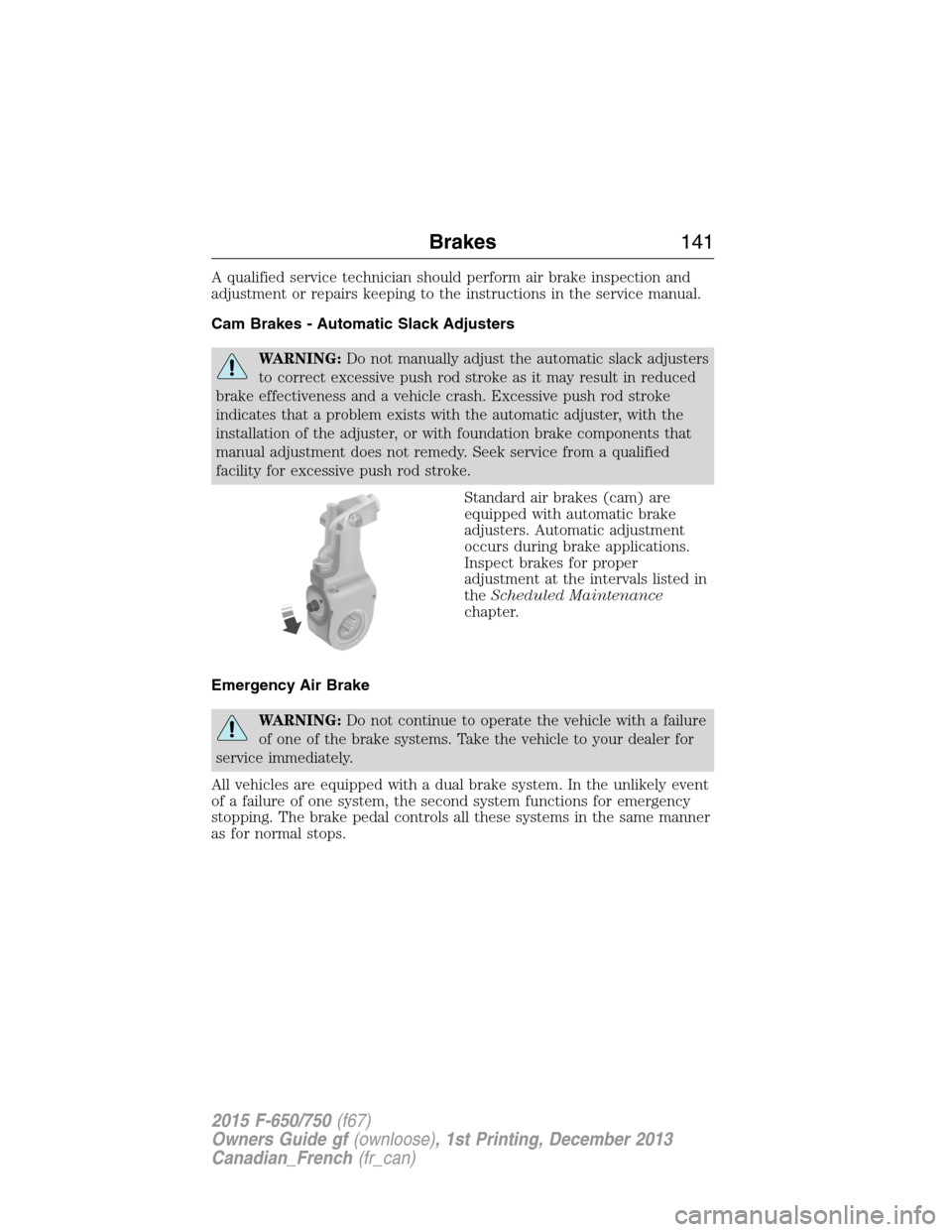
Standard air brakes (cam) are
equipped with automatic brake
adjusters. Automatic adjustment
occurs during brake applications.
Inspect brakes for proper
adjustment at the intervals listed in
theScheduled Maintenance
chapter.
Emergency Air Brake
WARNING:Do not continue to operate the vehicle with a failure
of one of the brake systems. Take the vehicle to your dealer for
service immediately.
All vehicles are equipped with a dual brake system. In the unlikely event
of a failure of one system, the second system functions for emergency
stopping. The brake pedal controls all these systems in the same manner
as for normal stops.
Brakes141
2015 F-650/750(f67)
Owners Guide gf(ownloose), 1st Printing, December 2013
Canadian_French(fr_can)
Page 169 of 384
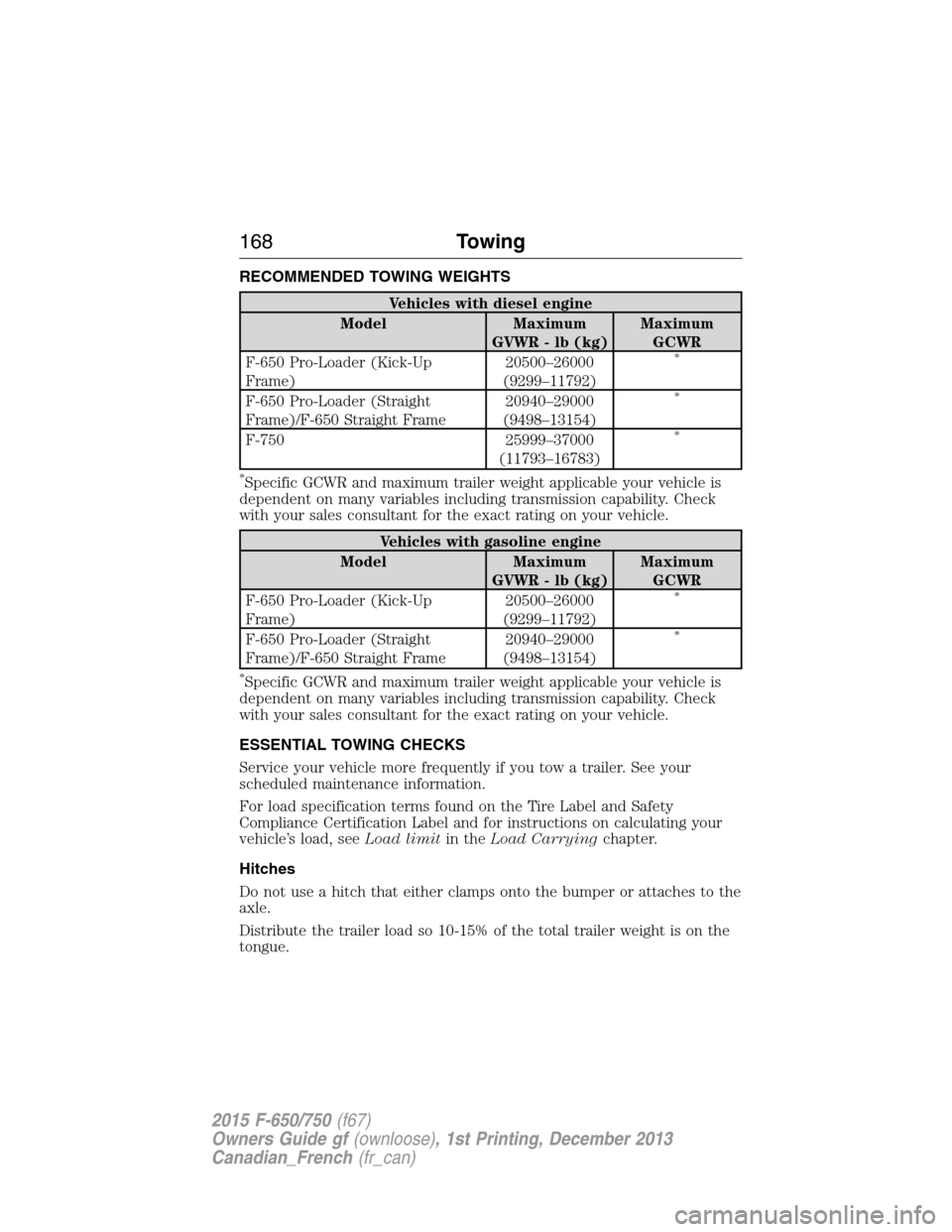
RECOMMENDED TOWING WEIGHTS
Vehicles with diesel engine
Model Maximum
GVWR - lb (kg)Maximum
GCWR
F-650 Pro-Loader (Kick-Up
Frame)20500–26000
(9299–11792)
*
F-650 Pro-Loader (Straight
Frame)/F-650 Straight Frame20940–29000
(9498–13154)*
F-750 25999–37000
(11793–16783)*
*
Specific GCWR and maximum trailer weight applicable your vehicle is
dependent on many variables including transmission capability. Check
with your sales consultant for the exact rating on your vehicle.
Vehicles with gasoline engine
Model Maximum
GVWR - lb (kg)Maximum
GCWR
F-650 Pro-Loader (Kick-Up
Frame)20500–26000
(9299–11792)
*
F-650 Pro-Loader (Straight
Frame)/F-650 Straight Frame20940–29000
(9498–13154)*
*
Specific GCWR and maximum trailer weight applicable your vehicle is
dependent on many variables including transmission capability. Check
with your sales consultant for the exact rating on your vehicle.
ESSENTIAL TOWING CHECKS
Service your vehicle more frequently if you tow a trailer. See your
scheduled maintenance information.
For load specification terms found on the Tire Label and Safety
Compliance Certification Label and for instructions on calculating your
vehicle’s load, seeLoad limitin theLoad Carryingchapter.
Hitches
Do not use a hitch that either clamps onto the bumper or attaches to the
axle.
Distribute the trailer load so 10-15% of the total trailer weight is on the
tongue.
168Towing
2015 F-650/750(f67)
Owners Guide gf(ownloose), 1st Printing, December 2013
Canadian_French(fr_can)
Page 176 of 384
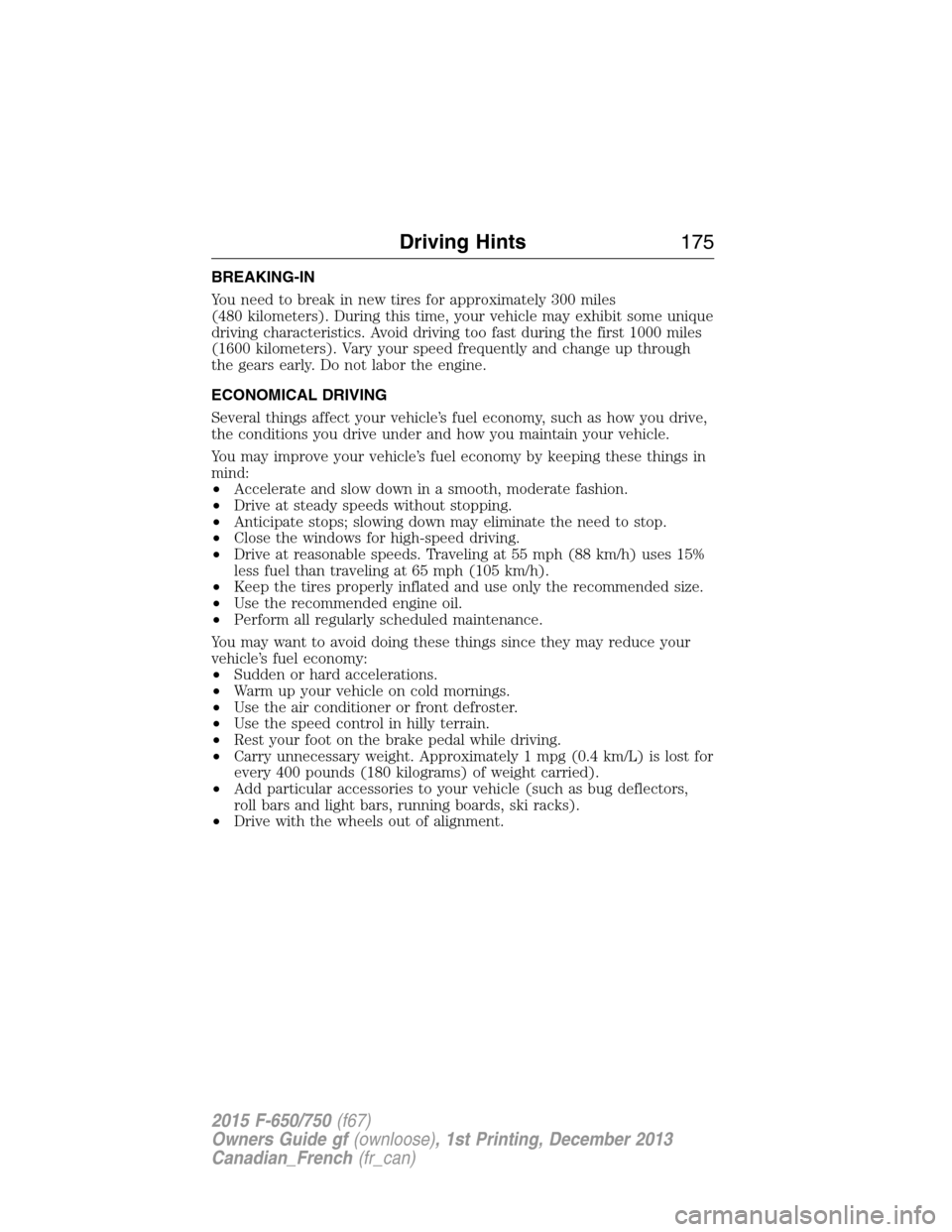
BREAKING-IN
You need to break in new tires for approximately 300 miles
(480 kilometers). During this time, your vehicle may exhibit some unique
driving characteristics. Avoid driving too fast during the first 1000 miles
(1600 kilometers). Vary your speed frequently and change up through
the gears early. Do not labor the engine.
ECONOMICAL DRIVING
Several things affect your vehicle’s fuel economy, such as how you drive,
the conditions you drive under and how you maintain your vehicle.
You may improve your vehicle’s fuel economy by keeping these things in
mind:
•Accelerate and slow down in a smooth, moderate fashion.
•Drive at steady speeds without stopping.
•Anticipate stops; slowing down may eliminate the need to stop.
•Close the windows for high-speed driving.
•Drive at reasonable speeds. Traveling at 55 mph (88 km/h) uses 15%
less fuel than traveling at 65 mph (105 km/h).
•Keep the tires properly inflated and use only the recommended size.
•Use the recommended engine oil.
•Perform all regularly scheduled maintenance.
You may want to avoid doing these things since they may reduce your
vehicle’s fuel economy:
•Sudden or hard accelerations.
•Warm up your vehicle on cold mornings.
•Use the air conditioner or front defroster.
•Use the speed control in hilly terrain.
•Rest your foot on the brake pedal while driving.
•Carry unnecessary weight. Approximately 1 mpg (0.4 km/L) is lost for
every 400 pounds (180 kilograms) of weight carried).
•Add particular accessories to your vehicle (such as bug deflectors,
roll bars and light bars, running boards, ski racks).
•Drive with the wheels out of alignment.
Driving Hints175
2015 F-650/750(f67)
Owners Guide gf(ownloose), 1st Printing, December 2013
Canadian_French(fr_can)
Page 183 of 384
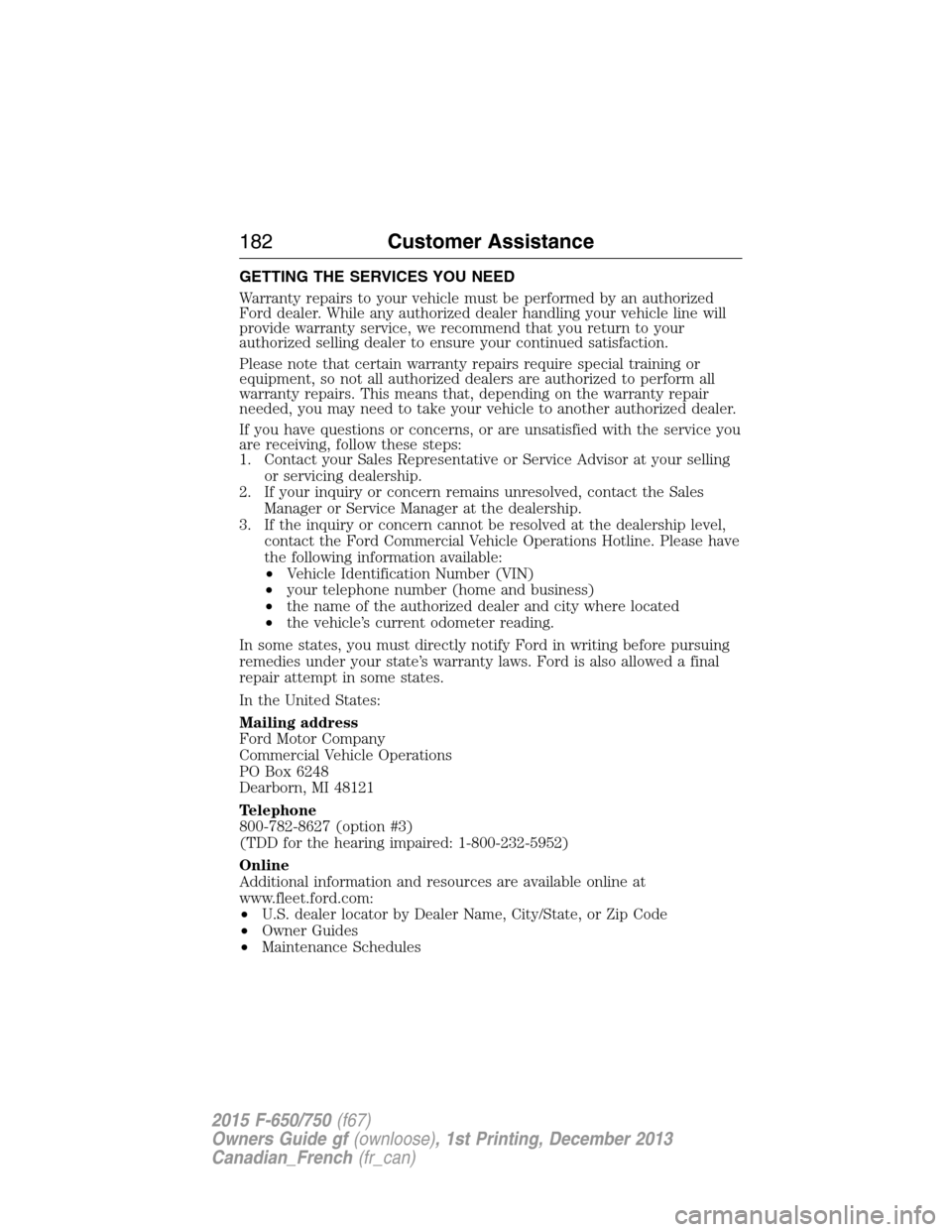
GETTING THE SERVICES YOU NEED
Warranty repairs to your vehicle must be performed by an authorized
Ford dealer. While any authorized dealer handling your vehicle line will
provide warranty service, we recommend that you return to your
authorized selling dealer to ensure your continued satisfaction.
Please note that certain warranty repairs require special training or
equipment, so not all authorized dealers are authorized to perform all
warranty repairs. This means that, depending on the warranty repair
needed, you may need to take your vehicle to another authorized dealer.
If you have questions or concerns, or are unsatisfied with the service you
are receiving, follow these steps:
1. Contact your Sales Representative or Service Advisor at your selling
or servicing dealership.
2. If your inquiry or concern remains unresolved, contact the Sales
Manager or Service Manager at the dealership.
3. If the inquiry or concern cannot be resolved at the dealership level,
contact the Ford Commercial Vehicle Operations Hotline. Please have
the following information available:
•Vehicle Identification Number (VIN)
•your telephone number (home and business)
•the name of the authorized dealer and city where located
•the vehicle’s current odometer reading.
In some states, you must directly notify Ford in writing before pursuing
remedies under your state’s warranty laws. Ford is also allowed a final
repair attempt in some states.
In the United States:
Mailing address
Ford Motor Company
Commercial Vehicle Operations
PO Box 6248
Dearborn, MI 48121
Telephone
800-782-8627 (option #3)
(TDD for the hearing impaired: 1-800-232-5952)
Online
Additional information and resources are available online at
www.fleet.ford.com:
•U.S. dealer locator by Dealer Name, City/State, or Zip Code
•Owner Guides
•Maintenance Schedules
182Customer Assistance
2015 F-650/750(f67)
Owners Guide gf(ownloose), 1st Printing, December 2013
Canadian_French(fr_can)
Page 199 of 384
Quality service parts are available through an authorized dealer. If dealer
parts are not used, make sure the replacement parts are of equivalent
quality.
WARNING:The use of inferior parts can adversely affect the
quality and reliability of your vehicle which, in turn, can result in
property damage, personal injury or death.
To avoid damage to your vehicle’s electrical components before electric
welding:
•Disconnect both battery cables.
•Attach the welder ground cable as close as possible to the part being
welded.
•We recommend temporarily removing the component if welding close
to an electrical component.
Follow the checks and services in theScheduled Maintenancechapter.
Have an authorized dealer or service center inspect your vehicle at least
once a year. Remember that regular maintenance and inspections usually
prevent serious problems from developing later.
If the owner or operator of the vehicle is a skilled technician and intends
on performing the vehicle maintenance and service, he is strongly urged
to purchase a service manual.
Electrical System
Periodically inspect electrical connectors on the outside of the cab and
on the engine and frame for corrosion and tightness. Exposed terminals,
such as the fuel sender, cranking motor, alternator and feed-through
studs, should be cleaned and re-coated with a lubricant sealing grease
such as Motorcraft Silicone Brake Caliper Grease and Dielectric
Compound XG-3, or equivalent. This should include the ground cable
connector for batteries, engine and cab as well as the jump-starting stud.
Accessory Feed Connections
Vehicle electrical systems are complex and often include powertrain
components, such as engine and transmission controls, instrument panels
and ABS. While most systems operate on battery voltage (12 volts),
some systems can be as high as 90 volts or as low as five volts. See the
Electrical Circuit Diagram Manuals,available from your vehicle’s
manufacturer, to make sure that any extra body lights and accessory
connections to circuits are both appropriate and not overloaded. Do not
make modifications to any vehicle control system without first contacting
an authorized dealer.
198Maintenance
2015 F-650/750(f67)
Owners Guide gf(ownloose), 1st Printing, December 2013
Canadian_French(fr_can)
Page 200 of 384
Climate Control System
Have the air conditioning system checked each spring. The refrigerant
charge, cleanliness of the condenser-evaporator cores and belt condition
are essential to system performance.
When the air conditioning system is being used daily, remove the fresh
air filter (if equipped) once each season and check for things such as
dirt and lint. Replace the filter if necessary. Vehicles operating in
unusually dusty conditions may require more frequent filter inspection
and replacement.
Front Axle
Maintaining the front axle alignment to specifications is very important.
A qualified technician should check and maintain the alignment. Regular
inspections should include:
•Toe-in inspection and adjustment (if necessary), particularly with
radial tires.
•Checking for proper tightness of axle mounting U-bolt nuts, attaching
or mounting bolts and nuts.
•Checking the axle for damage, binding, worn parts and adequate
lubrication..
•Checking the kingpins for excessive wear. Also, perform this check
during other scheduled maintenance (such as tire rotation or service,
wheel bearing service and alignment). See the workshop manual for
proper procedures.
Toe-in
It is essential to maintain correct toe-in and tire pressure for optimum
tire wear.
Inspecting steer axle tires in the first 3000–10000 service miles
(5000–16000 service kilometers) generally shows if tires are wearing
normally.
Rapid outside shoulder wear on both tires indicates too much toe-in.
Rapid inside shoulder wear on both tires indicates too much toe-out.
In P&D-type service, there can be a left-to-right steer tire tread life
differential up to 40% depending on routes and other variables.
Follow the tire manufacturer’s recommended cold inflation pressure for
the tire size, load range (ply rating) and steer axle loading typical for
their operation (each steer axle tire equals
12steer axle loading).
Maintenance199
2015 F-650/750(f67)
Owners Guide gf(ownloose), 1st Printing, December 2013
Canadian_French(fr_can)