oil level FORD F750 2015 13.G Owners Manual
[x] Cancel search | Manufacturer: FORD, Model Year: 2015, Model line: F750, Model: FORD F750 2015 13.GPages: 384, PDF Size: 4.95 MB
Page 15 of 384
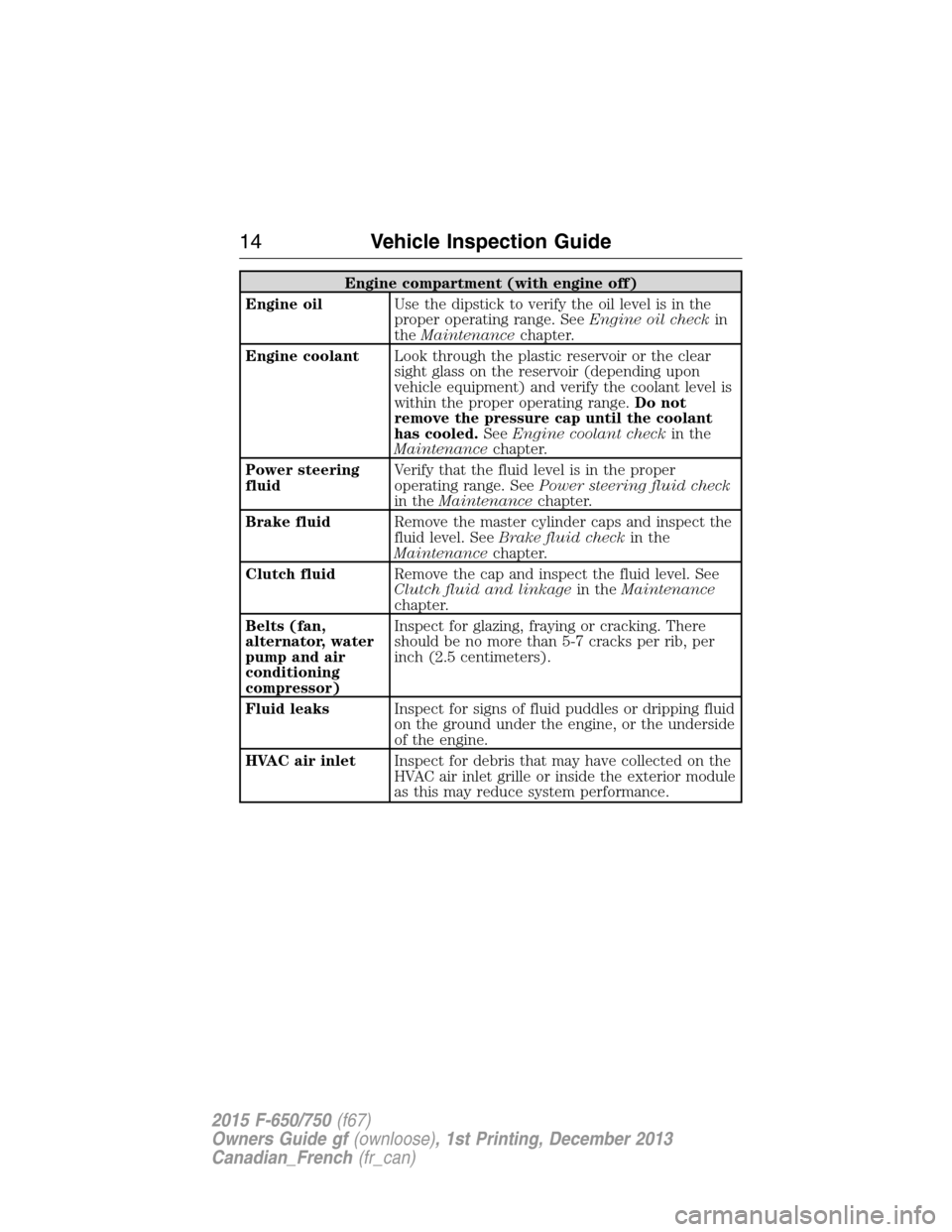
Engine compartment (with engine off)
Engine oilUse the dipstick to verify the oil level is in the
proper operating range. SeeEngine oil checkin
theMaintenancechapter.
Engine coolantLook through the plastic reservoir or the clear
sight glass on the reservoir (depending upon
vehicle equipment) and verify the coolant level is
within the proper operating range.Do not
remove the pressure cap until the coolant
has cooled.SeeEngine coolant checkin the
Maintenancechapter.
Power steering
fluidVerify that the fluid level is in the proper
operating range. SeePower steering fluid check
in theMaintenancechapter.
Brake fluidRemove the master cylinder caps and inspect the
fluid level. SeeBrake fluid checkin the
Maintenancechapter.
Clutch fluidRemove the cap and inspect the fluid level. See
Clutch fluid and linkagein theMaintenance
chapter.
Belts (fan,
alternator, water
pump and air
conditioning
compressor)Inspect for glazing, fraying or cracking. There
should be no more than 5-7 cracks per rib, per
inch (2.5 centimeters).
Fluid leaksInspect for signs of fluid puddles or dripping fluid
on the ground under the engine, or the underside
of the engine.
HVAC air inletInspect for debris that may have collected on the
HVAC air inlet grille or inside the exterior module
as this may reduce system performance.
14Vehicle Inspection Guide
2015 F-650/750(f67)
Owners Guide gf(ownloose), 1st Printing, December 2013
Canadian_French(fr_can)
Page 19 of 384
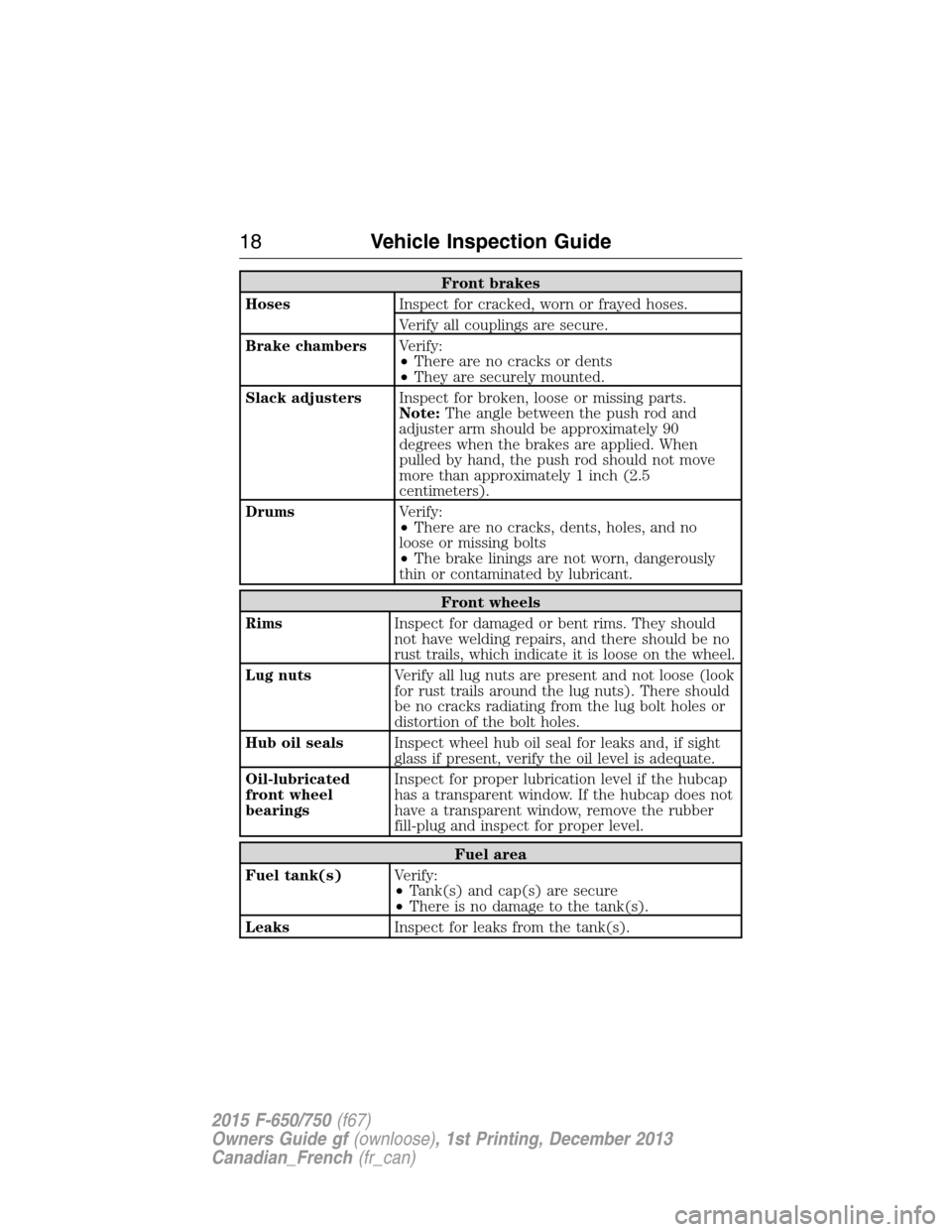
Front brakes
HosesInspect for cracked, worn or frayed hoses.
Verify all couplings are secure.
Brake chambersVerify:
•There are no cracks or dents
•They are securely mounted.
Slack adjustersInspect for broken, loose or missing parts.
Note:The angle between the push rod and
adjuster arm should be approximately 90
degrees when the brakes are applied. When
pulled by hand, the push rod should not move
more than approximately 1 inch (2.5
centimeters).
DrumsVerify:
•There are no cracks, dents, holes, and no
loose or missing bolts
•The brake linings are not worn, dangerously
thin or contaminated by lubricant.
Front wheels
RimsInspect for damaged or bent rims. They should
not have welding repairs, and there should be no
rust trails, which indicate it is loose on the wheel.
Lug nutsVerify all lug nuts are present and not loose (look
for rust trails around the lug nuts). There should
be no cracks radiating from the lug bolt holes or
distortion of the bolt holes.
Hub oil sealsInspect wheel hub oil seal for leaks and, if sight
glass if present, verify the oil level is adequate.
Oil-lubricated
front wheel
bearingsInspect for proper lubrication level if the hubcap
has a transparent window. If the hubcap does not
have a transparent window, remove the rubber
fill-plug and inspect for proper level.
Fuel area
Fuel tank(s)Verify:
•Tank(s) and cap(s) are secure
•There is no damage to the tank(s).
LeaksInspect for leaks from the tank(s).
18Vehicle Inspection Guide
2015 F-650/750(f67)
Owners Guide gf(ownloose), 1st Printing, December 2013
Canadian_French(fr_can)
Page 64 of 384
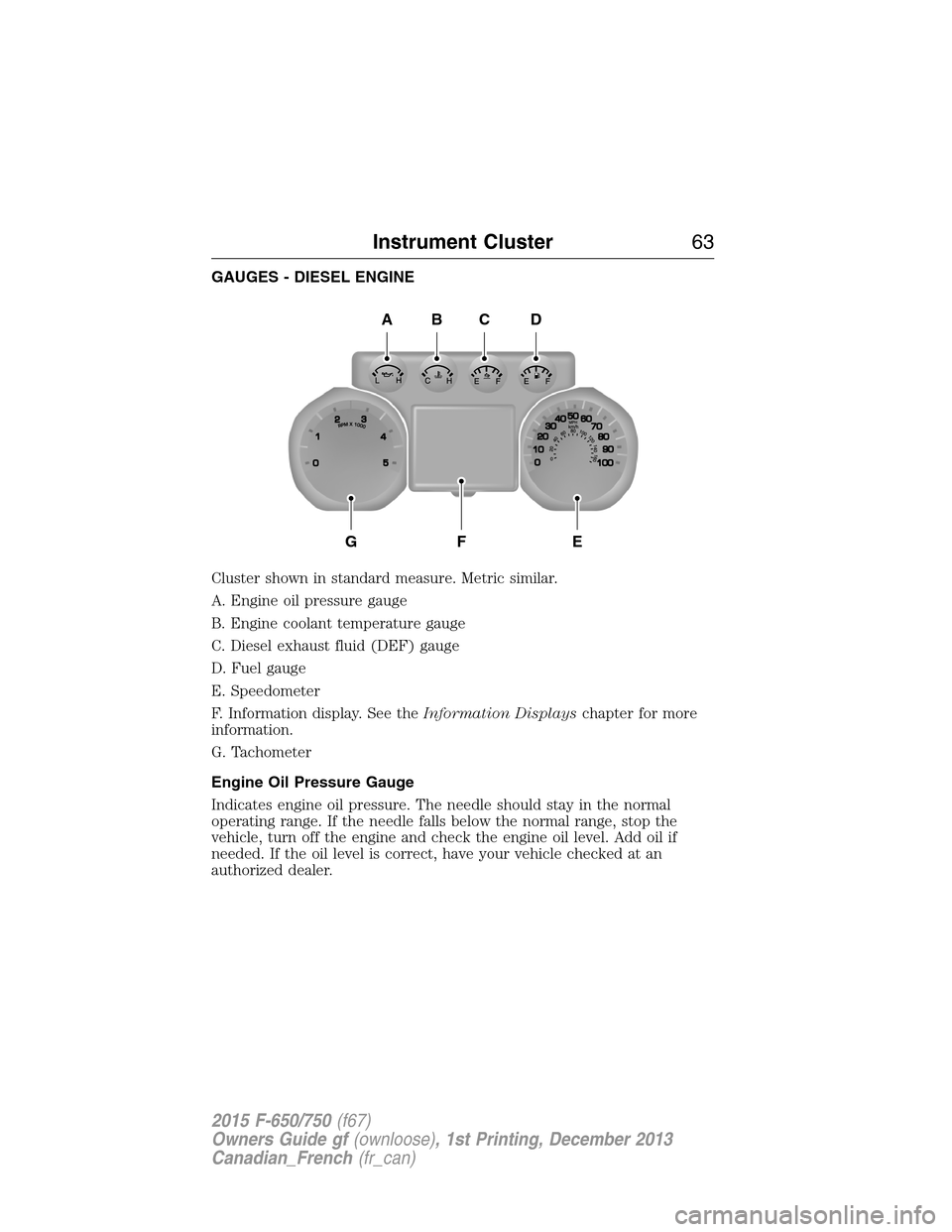
GAUGES - DIESEL ENGINE
Cluster shown in standard measure. Metric similar.
A. Engine oil pressure gauge
B. Engine coolant temperature gauge
C. Diesel exhaust fluid (DEF) gauge
D. Fuel gauge
E. Speedometer
F. Information display. See theInformation Displayschapter for more
information.
G. Tachometer
Engine Oil Pressure Gauge
Indicates engine oil pressure. The needle should stay in the normal
operating range. If the needle falls below the normal range, stop the
vehicle, turn off the engine and check the engine oil level. Add oil if
needed. If the oil level is correct, have your vehicle checked at an
authorized dealer.
A
GFE
BCD
Instrument Cluster63
2015 F-650/750(f67)
Owners Guide gf(ownloose), 1st Printing, December 2013
Canadian_French(fr_can)
Page 66 of 384
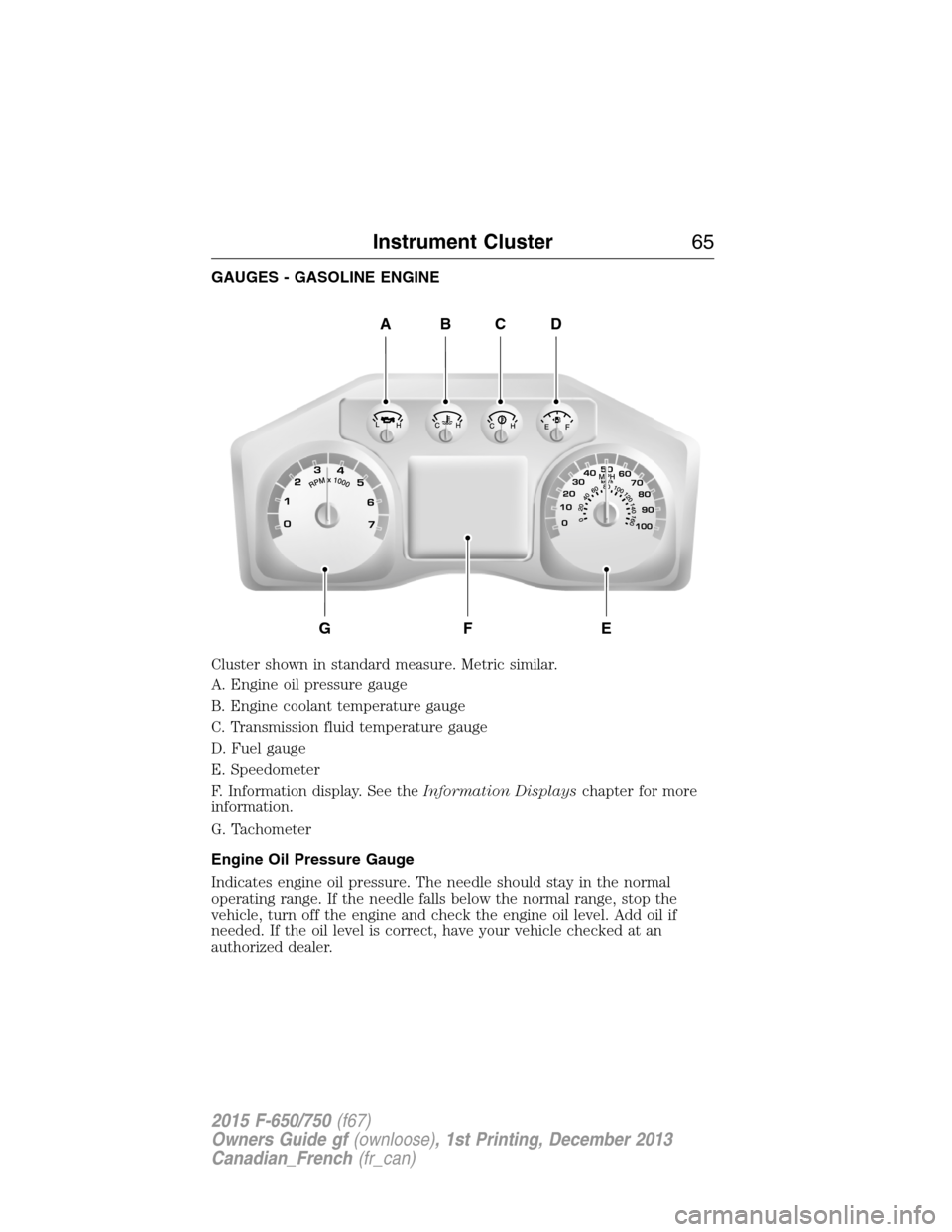
GAUGES - GASOLINE ENGINE
Cluster shown in standard measure. Metric similar.
A. Engine oil pressure gauge
B. Engine coolant temperature gauge
C. Transmission fluid temperature gauge
D. Fuel gauge
E. Speedometer
F. Information display. See theInformation Displayschapter for more
information.
G. Tachometer
Engine Oil Pressure Gauge
Indicates engine oil pressure. The needle should stay in the normal
operating range. If the needle falls below the normal range, stop the
vehicle, turn off the engine and check the engine oil level. Add oil if
needed. If the oil level is correct, have your vehicle checked at an
authorized dealer.
ABCD
GFE
Instrument Cluster65
2015 F-650/750(f67)
Owners Guide gf(ownloose), 1st Printing, December 2013
Canadian_French(fr_can)
Page 70 of 384
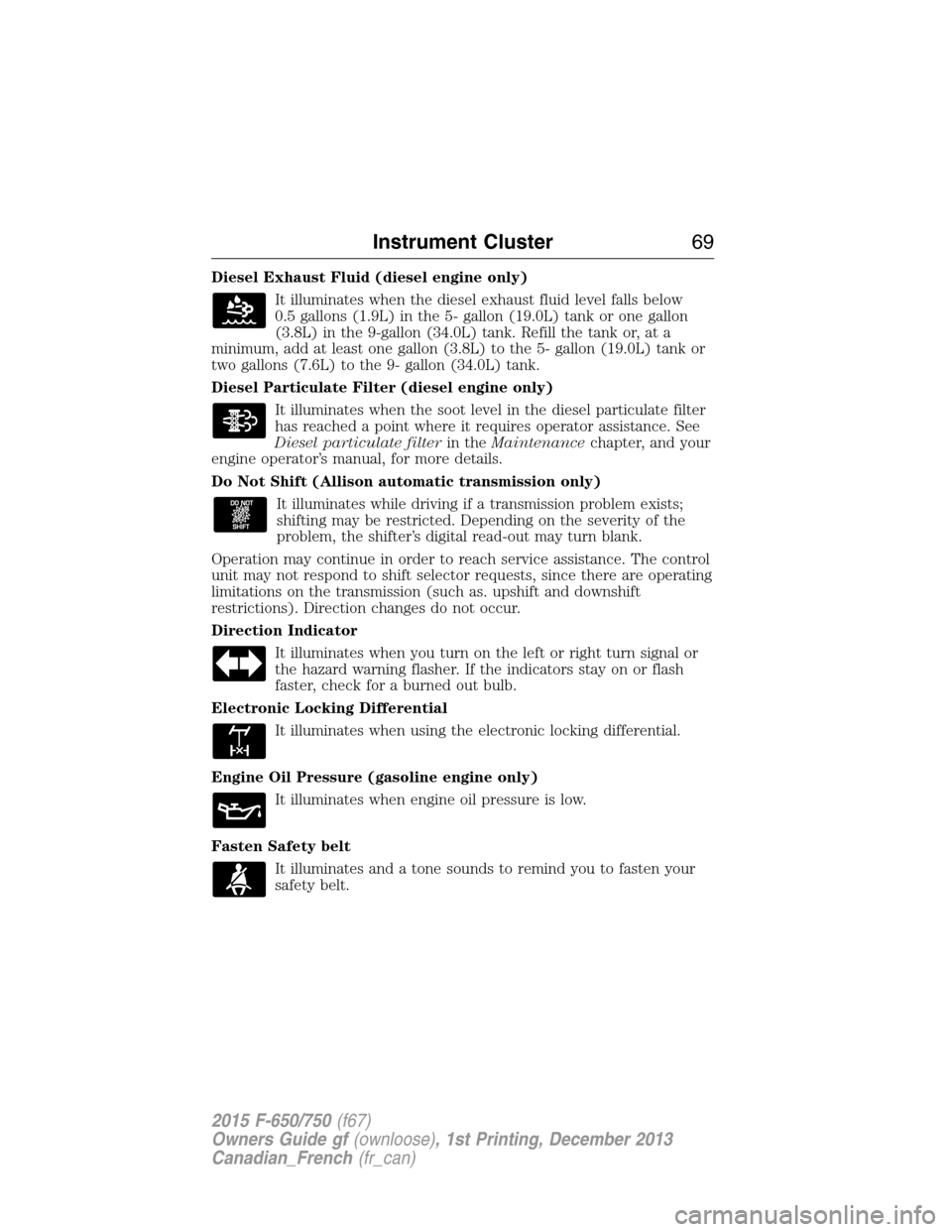
Diesel Exhaust Fluid (diesel engine only)
It illuminates when the diesel exhaust fluid level falls below
0.5 gallons (1.9L) in the 5- gallon (19.0L) tank or one gallon
(3.8L) in the 9-gallon (34.0L) tank. Refill the tank or, at a
minimum, add at least one gallon (3.8L) to the 5- gallon (19.0L) tank or
two gallons (7.6L) to the 9- gallon (34.0L) tank.
Diesel Particulate Filter (diesel engine only)
It illuminates when the soot level in the diesel particulate filter
has reached a point where it requires operator assistance. See
Diesel particulate filterin theMaintenancechapter, and your
engine operator’s manual, for more details.
Do Not Shift (Allison automatic transmission only)
It illuminates while driving if a transmission problem exists;
shifting may be restricted. Depending on the severity of the
problem, the shifter’s digital read-out may turn blank.
Operation may continue in order to reach service assistance. The control
unit may not respond to shift selector requests, since there are operating
limitations on the transmission (such as. upshift and downshift
restrictions). Direction changes do not occur.
Direction Indicator
It illuminates when you turn on the left or right turn signal or
the hazard warning flasher. If the indicators stay on or flash
faster, check for a burned out bulb.
Electronic Locking Differential
It illuminates when using the electronic locking differential.
Engine Oil Pressure (gasoline engine only)
It illuminates when engine oil pressure is low.
Fasten Safety belt
It illuminates and a tone sounds to remind you to fasten your
safety belt.
Instrument Cluster69
2015 F-650/750(f67)
Owners Guide gf(ownloose), 1st Printing, December 2013
Canadian_French(fr_can)
Page 100 of 384
3. Do not press the accelerator pedal, service brake pedal, or clutch
pedal (manual transmission).
4. The parking brake must remain set.
On average, depending on filter level and other factors, the process takes
20–30 minutes to complete. The DPF lamp turns off when the process is
complete. Repeat Steps 1–5, if parked regeneration is interrupted.
To Discontinue Parked Regeneration
Press any of the floor pedals to discontinue parked regeneration.
Maintenance and Service
The DPF can retain a relatively large amount of residual ash and provide
many miles and hours of maintenance-free operation. At some point,
generally beyond 150000 miles (240000 kilometers) or 5000 hours of
operation (whichever comes first), the DPF requires professional
cleaning to remove the accumulated ash.
The exact number of miles or hours of operation vary greatly depending
upon vehicle and engine loading and operating conditions, ash content of
the engine oil, and quality of the diesel fuel used in your truck. Adhering
to your engine manufacturer’s recommended oil and fuel specifications
maximizes the miles and hours of operation before a DPF professional
cleaning is required. See your engine manufacturer’s owner’s manual for
more details about recommended maintenance and service of your DPF.
Exhaust Outlet Assembly
WARNING:The normal operating temperature of the exhaust
system is very high. Never work around or attempt to repair any
part of the exhaust system until it has cooled. Failure to follow these
instructions may result in serious personal injury.
Note:Do not modify or remove this device. Modification of the system
or additions of aftermarket devices can reduce the effectiveness of the
system, as well as cause damage to the exhaust system or engine. Any
modifications may also invalidate the vehicle or engine warranty. See
your warranty information.
Note:Blocked or plugged holes or modification to, or removal of, the
outlet assembly could result in elevated exhaust temperatures that may
result in vehicle or property damage or personal injury.
The exhaust outlet assembly on your vehicle is a uniquely functioning
device that accompanies the DPF assembly. It can help control the
temperature of the exhaust during the DPF regeneration process.
Starting and Stopping the Engine99
2015 F-650/750(f67)
Owners Guide gf(ownloose), 1st Printing, December 2013
Canadian_French(fr_can)
Page 101 of 384
The inlet holes in the side of the assembly are functional. These holes
allow outside air to enter into the outlet assembly. Keep the holes clear
of mud and other foreign material to maintain proper functionality of the
system. One way to keep the holes clear is to spray the outlet assembly
with a hose when washing your vehicle. Failure to keep the functional
holes clear of foreign material may result in blocking or plugging of the
holes.
SWITCHING OFF A DIESEL ENGINE
Allow the engine to idle for three to five minutes before shutting it
down. The larger the engine, the greater the need is for this idling
period.
Note:Try to limit engine idle to 10 minutes. Excessive idling reduces
fuel economy.
ENGINE AUTOMATIC SHUTDOWN (IF EQUIPPED)
WARNING:In the event of engine shutdown, make sure the
vehicle is safely off the road and the problem is remedied prior to
returning to the road. Failure to remove the vehicle from the road
could result in an accident, causing serious injury or death.
This feature either illuminates a light in the instrument cluster or sounds
a tone (or both) indicating that the engine is being shut down due to
high coolant temperature, low engine oil pressure, high diesel particulate
filter soot loading or low engine coolant level. If any of these conditions
exist, the engine automatically shuts down.
If the engine shuts down, you can restart and operate it for 30 seconds
at a time or until you correct the problem. Do not attempt to use this
restarting feature to drive your vehicle very far as serious engine damage
could result.
ENGINE BLOCK HEATER (IF EQUIPPED)
WARNING:Failure to follow engine block heater instructions
could result in property damage or personal injury.
WARNING:Do not use your heater with ungrounded electrical
systems or two-pronged (cheater) adapters. There is a risk of
electrical shock.
100Starting and Stopping the Engine
2015 F-650/750(f67)
Owners Guide gf(ownloose), 1st Printing, December 2013
Canadian_French(fr_can)
Page 122 of 384
•DEF freezes below 12°F (-11°C). Your vehicle is equipped with an
automatic pre-heating system which allows the DEF system to
operate below 12°F (-11°C).
•Do not store the DEF bottle in your vehicle. If it leaks, it could cause
damage to interior components or release an ammonia odor inside
your vehicle.
•Store DEF out of direct sunlight and in temperatures between
23°F–68°F (-5°C–20°C).
NOISE EMISSIONS
In order to keep to the federal exterior noise regulations, your vehicle
may be equipped with noise emission items. Depending on your vehicle
configuration, it may have all or some of the following items:
Air Intake System:Inspect the air cleaner. Do not alter its location. Do
not alter inlet and outlet piping.
Body:Inspect wheel well splash shields, cab shields and under hood
insulation for deterioration, dislocation and orientation.
Cooling System:
•Inspect the fan for blade damage. If you find any damage, replace
with the recommended parts. Inspect for fan-to-shroud interference
and any damage to shroud, such as cracks and holes.
•Do not change fan ratio or alter fan spacer dimensions and positions.
•Inspect fan clutch for proper operation. Make sure the fan is
disengaged when cooling of the engine is not required.
•Inspect radiator shutters (if equipped) for proper operation. The
shutters should be open during normal operating temperatures.
Engine:Valve covers and block covers damp-out engine mechanical
noise. If they need replacing, make sure to replace them with the
recommended parts. Check for mechanical isolations.
Transmission Enclosure:Inspect for cracks, holes and tears. Clean any
deposits, such as oil, dirt and stones.
Exhaust System:
•Inspect for leaks at various joint connections and loose clamps.
•
Perform a visual inspection for cracks or holes in the muffler and tail pipe.
•Always use the recommended replacement parts.
•Do not change the tail pipe elbow or offset tail pipe orientation from the
standard position as originally received.
•To avoid abnormal changes in vehicle sound levels, it is necessary for the
owner to perform inspections and necessary maintenance at the intervals
shown in theScheduled Maintenancechapter.
Fuel and Refueling121
2015 F-650/750(f67)
Owners Guide gf(ownloose), 1st Printing, December 2013
Canadian_French(fr_can)
Page 161 of 384
If you install an electrical back up alarm, connect it to the backup lamp
circuit.
Parking
WARNING:When parking your vehicle, do not leave the
transmission in gear; if the key is in the on position and the
vehicle rolls, the engine could start. Failure to follow these instructions
could result in an unattended vehicle moving, possibly causing personal
injury or property damage.
Always use the parking brake. When parking on a grade, block the
wheels and turn the front wheels to one side so that if your vehicle rolls,
the front tires act against the curb to stop your vehicle. The front wheels
are more effective at stopping a rolling vehicle than the rear wheels.
Cold Weather
Note:Idling in cold weather does not heat the engine to its normal
operating temperature. Long periods of idling in cold weather can cause
a build-up of heavy deposits of carbon and rust on valve stems causing
them to stick which, in turn, can cause valvetrain damage.
Note:We recommend against using winter fronts, or other air-restrictive
devices mounted in front of the radiator on vehicles with
chassis-mounted charge air coolers, unless extremely cold weather
conditions exist. Airflow restriction can cause high exhaust temperatures,
power loss, excessive fan usage and a reduction in fuel economy. If you
must use a winter front, the device should have a permanent opening of
at least 120 square inches (774 square centimeters) directly in line with
the fan hub.
For best engine operation in temperatures of 32°F (0°C) or lower:
•Make sure the batteries are the correct type and are fully charged.
Check other electrical components to make sure they are in optimum
condition.
•Use a permanent-type engine coolant to protect the engine against
damage from freezing.
•If your vehicle is equipped with a water-fuel separator, drain it daily.
Fill the fuel tank at the end of daily operation to prevent
condensation in the fuel system.
•Use the proper engine oil and maintain it at its proper level.
160Driving Aids
2015 F-650/750(f67)
Owners Guide gf(ownloose), 1st Printing, December 2013
Canadian_French(fr_can)
Page 206 of 384
•Checking that the pitman arm (steering arm at steering gear)
mounting is tight and locked. Check system for leaks or hose chafing.
Repair immediately, if necessary.
•Maintaining proper steering gear and power steering pump lubricant
levels.
•Checking steering column joint bolts and steering linkage, particularly
for body-to-chassis clearance.
Steering Column Joint Bolts
As a good maintenance practice, check steering column joint bolt
tightness every 60000 miles (96000 kilometers) or annually, whichever
occurs first. Do not overtighten the bolts.
Hydraulic System
Whenever draining and refilling the power steering’s hydraulic system for
any reason, bleed air from the system before returning the vehicle to
service. Failure to bleed the hydraulic system properly can result in
degradation of power system performance.
Consult an authorized dealer who is aware of the proper procedures for
filling and bleeding the system.
Catalytic Converter (Diesel Engine)
Note:If your vehicle is equipped with a catalytic converter or muffler,
do not blend waste oil with diesel fuel. Operate only on ultra-low sulfur
(less than 15 parts per million sulfur) diesel fuel with a cetane value of
45 or higher.
If your diesel engine is equipped with a catalytic converter, it is
important to review the maintenance schedule to make sure proper
functioning of the catalytic converter. Also, take precautions not to
damage the catalytic converter when servicing your engine or storing
your vehicle.
Diesel Exhaust Fluid (DEF), Diesel Particulate Filter (DPF) and
Select Catalyst Reduction (SCR) System
See your engine operator’s manual for information about DEF, DPF and
SCR system service
Air Induction System
WARNING:When performing maintenance to any turbocharged
engine with engine air inlet piping disconnected, keep loose
clothing, jewelry and long hair away from the engine air inlet piping. A
turbocharger compressor air inlet protective shield should be installed
over the turbocharger air inlet to reduce the risk of personal injury or
death.
Maintenance205
2015 F-650/750(f67)
Owners Guide gf(ownloose), 1st Printing, December 2013
Canadian_French(fr_can)