drum FORD FESTIVA 1991 User Guide
[x] Cancel search | Manufacturer: FORD, Model Year: 1991, Model line: FESTIVA, Model: FORD FESTIVA 1991Pages: 454, PDF Size: 9.53 MB
Page 38 of 454
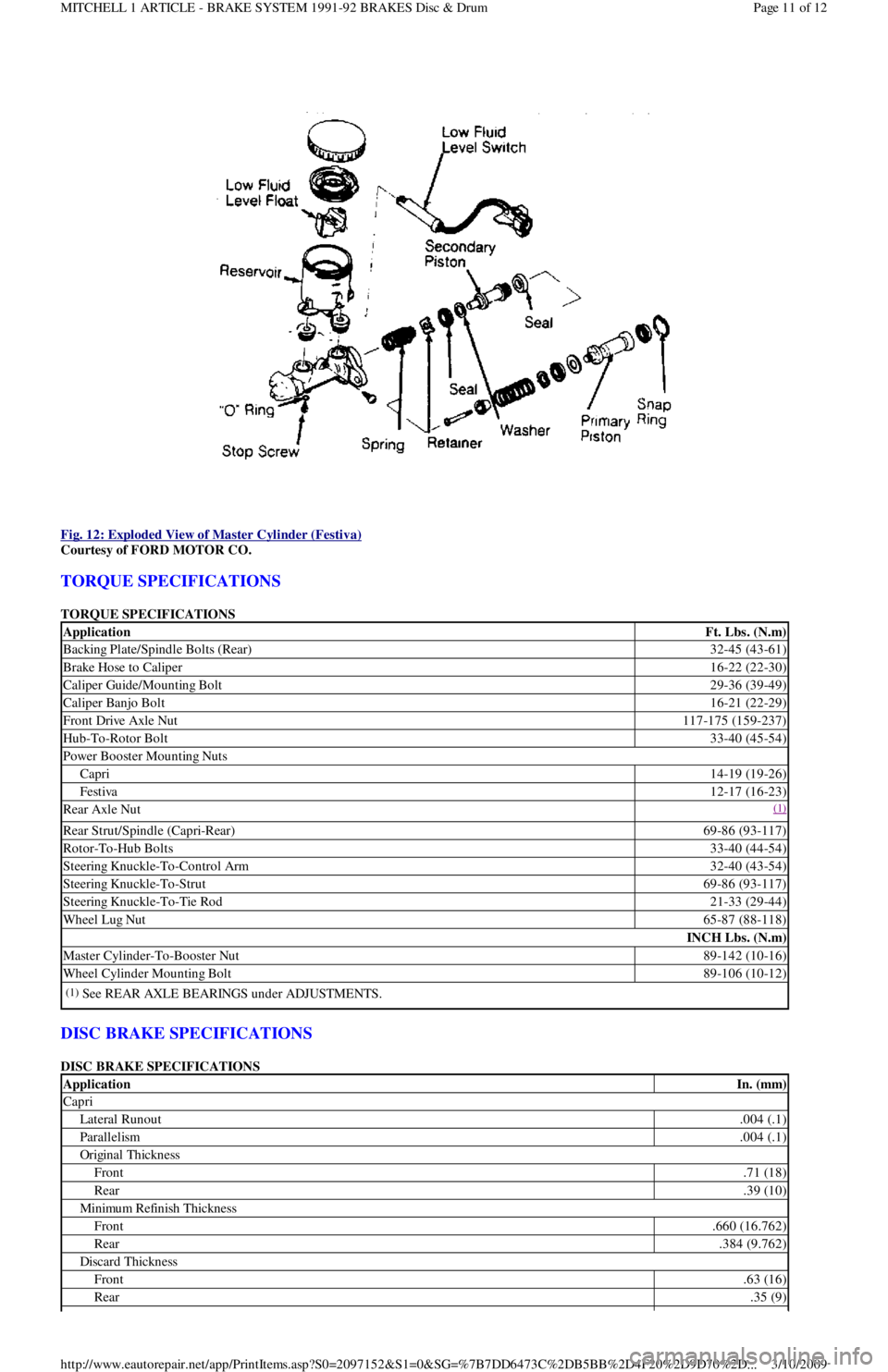
Fig. 12: Exploded View of Master Cylinder (Festiva)
Courtesy of FORD MOTOR CO.
TORQUE SPECIFICATIONS
TORQUE SPECIFICATIONS
DISC BRAKE SPECIFICATIONS
DISC BRAKE SPECIFICATIONS
ApplicationFt. Lbs. (N.m)
Backing Plate/Spindle Bolts (Rear)32-45 (43-61)
Brake Hose to Caliper16-22 (22-30)
Caliper Guide/Mounting Bolt29-36 (39-49)
Caliper Banjo Bolt16-21 (22-29)
Front Drive Axle Nut117-175 (159-237)
Hub-To-Rotor Bolt33-40 (45-54)
Power Booster Mounting Nuts
Capri14-19 (19-26)
Festiva12-17 (16-23)
Rear Axle Nut(1)
Rear Strut/Spindle (Capri-Rear)69-86 (93-117)
Rotor-To-Hub Bolts33-40 (44-54)
Steering Knuckle-To-Control Arm32-40 (43-54)
Steering Knuckle-To-Strut69-86 (93-117)
Steering Knuckle-To-Tie Rod21-33 (29-44)
Wheel Lug Nut65-87 (88-118)
INCH Lbs. (N.m)
Master Cylinder-To-Booster Nut89-142 (10-16)
Wheel Cylinder Mounting Bolt89-106 (10-12)
(1)See REAR AXLE BEARINGS under ADJUSTMENTS.
ApplicationIn. (mm)
Capri
Lateral Runout.004 (.1)
Parallelism.004 (.1)
Original Thickness
Front.71 (18)
Rear.39 (10)
Min imu m Refin ish Th ickn ess
Front.660 (16.762)
Rear.384 (9.762)
Discard Thickness
Front.63 (16)
Rear.35 (9)
Page 11 of 12 MITCHELL 1 ARTICLE - BRAKE SYSTEM 1991-92 BRAKES Disc & Drum
3/10/2009 http://www.eautorepair.net/app/PrintItems.asp?S0=2097152&S1=0&SG=%7B7DD6473C%2DB5BB%2D4F20%2D9D70%2D
...
Page 39 of 454
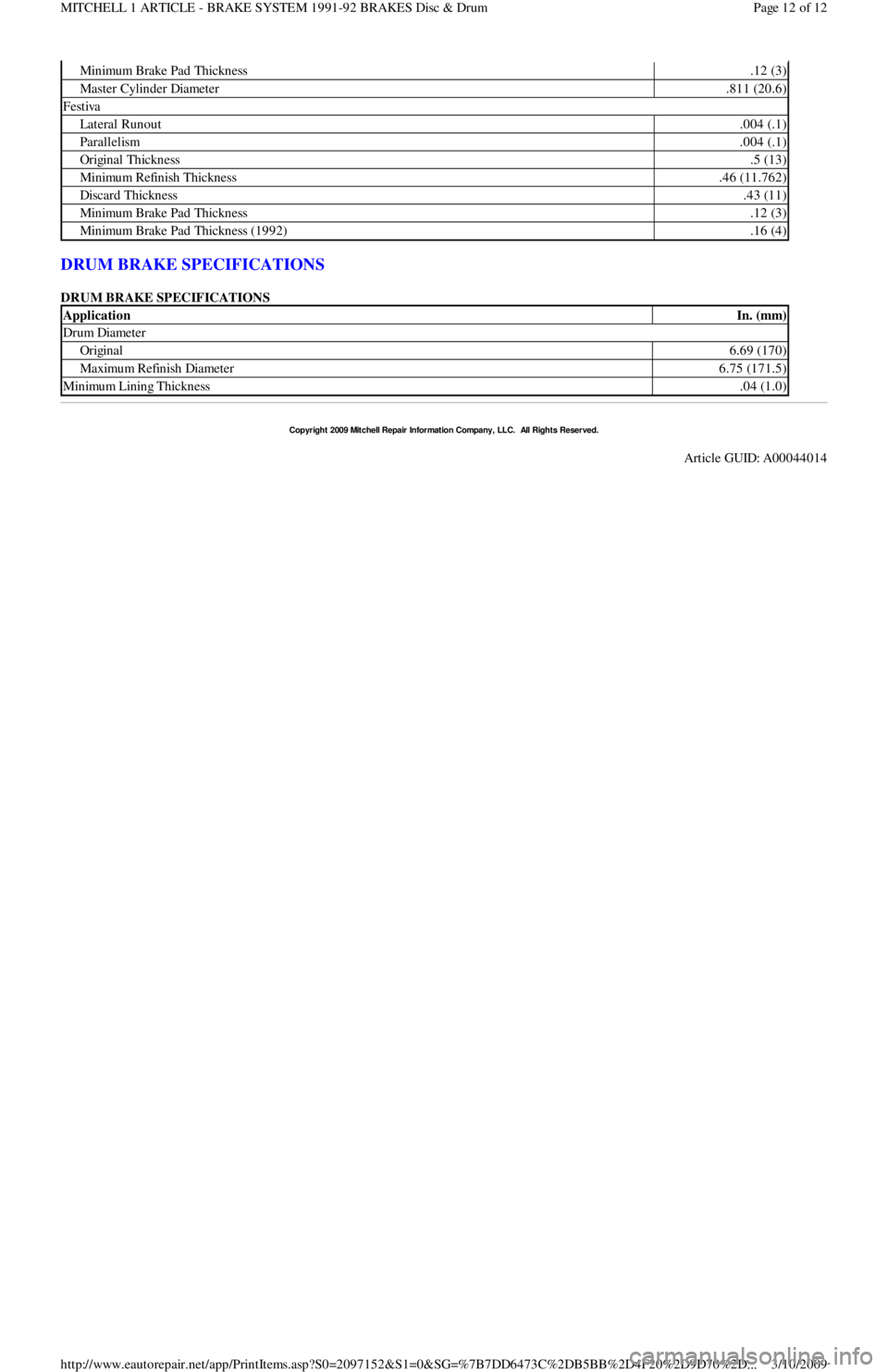
DRUM BRAKE SPECIFICATIONS
DRUM BRAKE SPECIFICATIONS
Minimum Brake Pad Thickness.12 (3)
Master Cylinder Diameter.811 (20.6)
Festiva
Lateral Runout.004 (.1)
Parallelism.004 (.1)
Original Thickness.5 (13)
Min imu m Refin ish Th ickn ess.46 (11.762)
Discard Thickness.43 (11)
Minimum Brake Pad Thickness.12 (3)
Minimum Brake Pad Thickness (1992).16 (4)
ApplicationIn. (mm)
Drum Diameter
Original6.69 (170)
Maximum Refinish Diameter6.75 (171.5)
Min imu m Lin in g Th ickn ess.04 (1.0)
Copyr ight 2009 Mitchell Repair Information Company, LLC. All Rights Reserved.
Article GUID: A00044014
Page 12 of 12 MITCHELL 1 ARTICLE - BRAKE SYSTEM 1991-92 BRAKES Disc & Drum
3/10/2009 http://www.eautorepair.net/app/PrintItems.asp?S0=2097152&S1=0&SG=%7B7DD6473C%2DB5BB%2D4F20%2D9D70%2D
...
Page 220 of 454
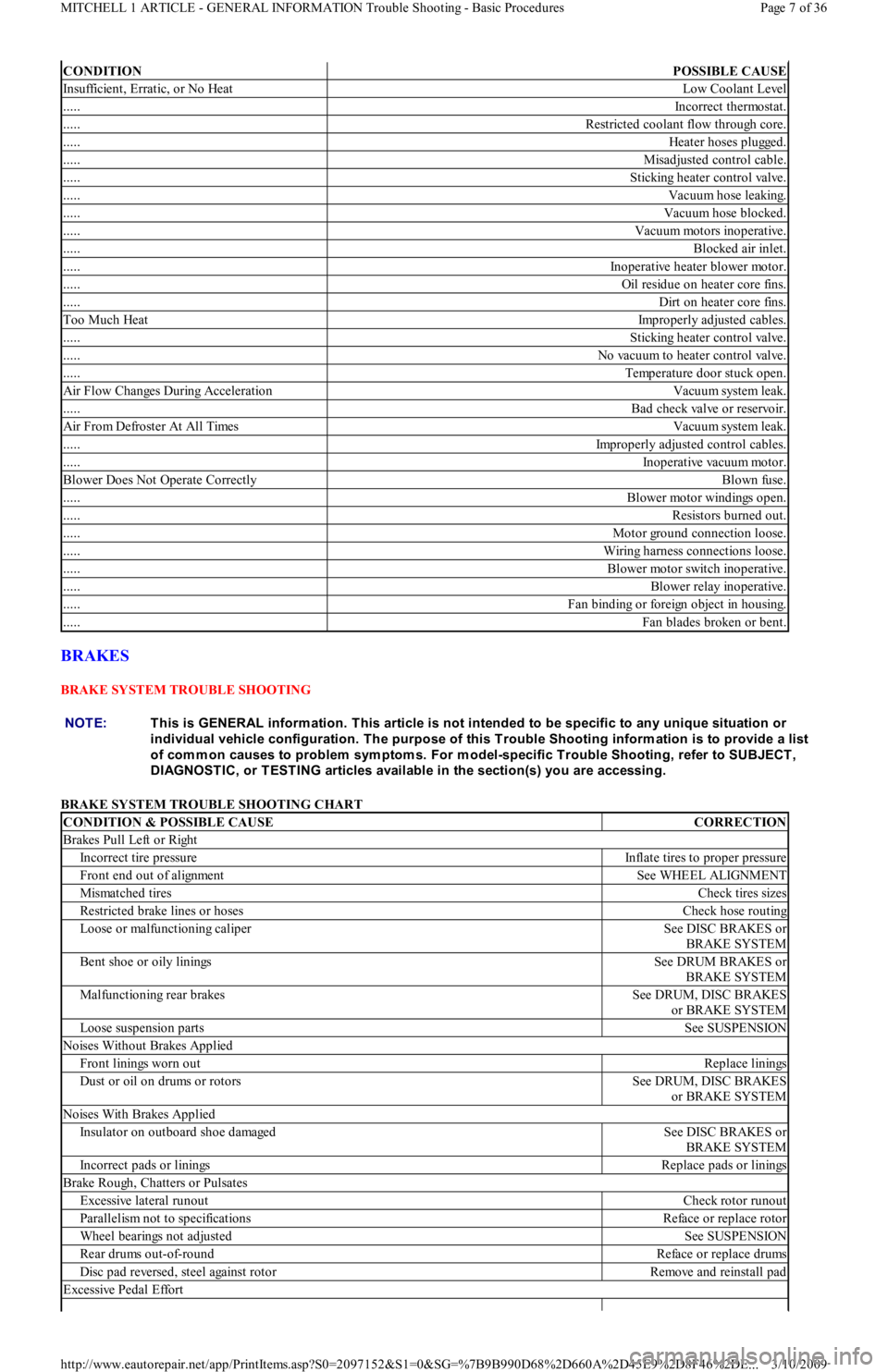
BRAKES
BRAKE SYSTEM TROUBLE SHOOTING
BRAKE SYSTEM TROUBLE SHOOTING CHART
CONDITIONPOSSIBLE CAUSE
Insufficient, Erratic, or No HeatLow Coolant Level
.....Incorrect thermostat.
.....Restricted coolant flow through core.
.....Heater hoses plugged.
.....Misadjusted control cable.
.....Sticking heater control valve.
.....Vacuum hose leaking.
.....Vacuum hose blocked.
.....Vacuum motors inoperative.
.....Blocked air inlet.
.....Inoperative heater blower motor.
.....Oil residue on heater core fins.
.....Dirt on heater core fins.
Too Much HeatImproperly adjusted cables.
.....Sticking heater control valve.
.....No vacuum to heater control valve.
.....Temperature door stuck open.
Air Flow Changes During AccelerationVacuum system leak.
.....Bad check valve or reservoir.
Air From Defroster At All TimesVacuum system leak.
.....Improperly adjusted control cables.
.....Inoperative vacuum motor.
Blower Does Not Operate CorrectlyBlown fuse.
.....Blower motor windings open.
.....Resistors burned out.
.....Motor ground connection loose.
.....Wiring harness connections loose.
.....Blower motor switch inoperative.
.....Blower relay inoperative.
.....Fan binding or foreign object in housing.
.....Fan blades broken or bent.
NOTE:This is GENERAL inform ation. This article is not intended to be specific to any unique situation or
individual vehicle configuration. T he purpose of this T rouble Shooting inform ation is to provide a list
of com m on causes to problem sym ptom s. For m odel-specific T rouble Shooting, refer to SUBJECT ,
DIAGNOST IC, or T EST ING articles available in the section(s) you are accessing.
CONDITION & POSSIBLE CAUSECORRECTION
Brakes Pull Left or Right
Incorrect tire pressureInflate tires to proper pressure
Front end out of alignmentSee WHEEL ALIGNMENT
Mismatched tiresCheck tires sizes
Restricted brake lines or hosesCheck hose routing
Loose or malfunctioning caliperSee DISC BRAKES or
BRAKE SYSTEM
Bent shoe or oily liningsSee DRUM BRAKES or
BRAKE SYSTEM
Malfunctioning rear brakesSee DRUM, DISC BRAKES
or BRAKE SYSTEM
Loose suspension partsSee SUSPENSION
Noises Without Brakes Applied
Front linings worn outReplace linings
Dust or oil on drums or rotorsSee DRUM, DISC BRAKES
or BRAKE SYSTEM
Noises With Brakes Applied
Insulator on outboard shoe damagedSee DISC BRAKES or
BRAKE SYSTEM
Incorrect pads or liningsReplace pads or linings
Brake Rough, Chatters or Pulsates
Excessive lateral runoutCheck rotor runout
Parallelism not to specificationsReface or replace rotor
Wheel bearings not adjustedSee SUSPENSION
Rear drums out-of-roundReface or replace drums
Disc pad reversed, steel against rotorRemove and reinstall pad
Excessive Pedal Effort
Page 7 of 36 MITCHELL 1 ARTICLE - GENERAL INFORMATION Trouble Shooting - Basic Procedures
3/10/2009 http://www.eautorepair.net/app/PrintItems.asp?S0=2097152&S1=0&SG=%7B9B990D68%2D660A%2D45E9%2D8F46%2DE
...
Page 221 of 454
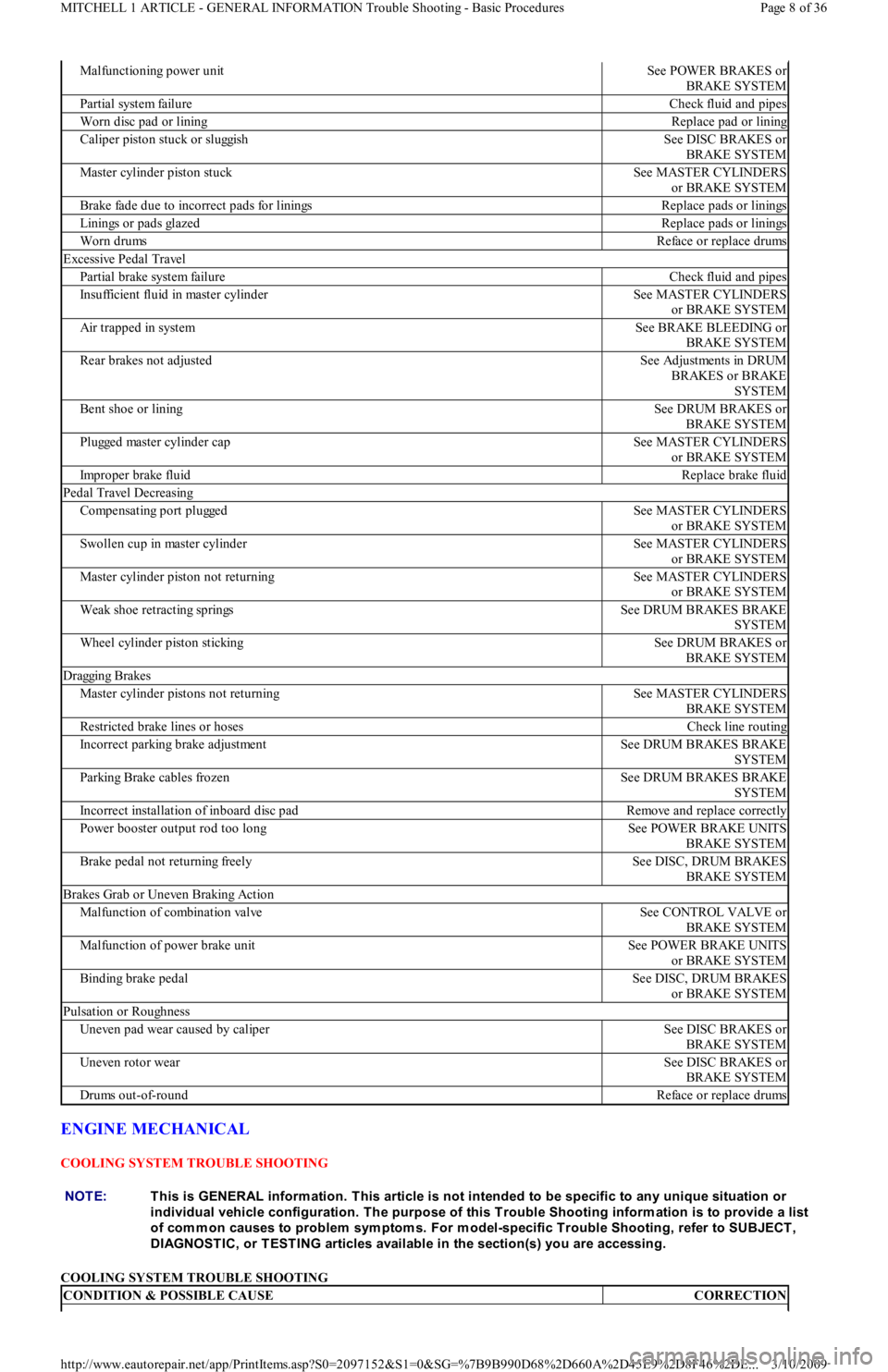
ENGINE MECHANICAL
COOLING SYSTEM TROUBLE SHOOTING
COOLING SYSTEM TROUBLE SHOOTING
Malfunctioning power unitSee POWER BRAKES or
BRAKE SYSTEM
Partial system failureCheck fluid and pipes
Worn disc pad or liningReplace pad or lining
Caliper piston stuck or sluggishSee DISC BRAKES or
BRAKE SYSTEM
Master cylinder piston stuckSee MASTER CYLINDERS
or BRAKE SYSTEM
Brake fade due to incorrect pads for liningsReplace pads or linings
Linings or pads glazedReplace pads or linings
Worn drumsReface or replace drums
Excessive Pedal Travel
Partial brake system failureCheck fluid and pipes
Insufficient fluid in master cylinderSee MASTER CYLINDERS
or BRAKE SYSTEM
Air trapped in systemSee BRAKE BLEEDING or
BRAKE SYSTEM
Rear brakes not adjustedSee Adjustments in DRUM
BRAKES or BRAKE
SYSTEM
Bent shoe or liningSee DRUM BRAKES or
BRAKE SYSTEM
Plugged master cylinder capSee MASTER CYLINDERS
or BRAKE SYSTEM
Improper brake fluidReplace brake fluid
Pedal Travel Decreasing
Compensating port pluggedSee MASTER CYLINDERS
or BRAKE SYSTEM
Swollen cup in master cylinderSee MASTER CYLINDERS
or BRAKE SYSTEM
Master cylinder piston not returningSee MASTER CYLINDERS
or BRAKE SYSTEM
Weak shoe retracting springsSee DRUM BRAKES BRAKE
SYSTEM
Wheel cylinder piston stickingSee DRUM BRAKES or
BRAKE SYSTEM
Dragging Brakes
Master cylinder pistons not returningSee MASTER CYLINDERS
BRAKE SYSTEM
Restricted brake lines or hosesCheck line routing
Incorrect parking brake adjustmentSee DRUM BRAKES BRAKE
SYSTEM
Parking Brake cables frozenSee DRUM BRAKES BRAKE
SYSTEM
Incorrect installation of inboard disc padRemove and replace correctly
Power booster output rod too longSee POWER BRAKE UNITS
BRAKE SYSTEM
Brake pedal not returning freelySee DISC, DRUM BRAKES
BRAKE SYSTEM
Brakes Grab or Uneven Braking Action
Malfunction of combination valveSee CONTROL VALVE or
BRAKE SYSTEM
Malfunction of power brake unitSee POWER BRAKE UNITS
or BRAKE SYSTEM
Binding brake pedalSee DISC, DRUM BRAKES
or BRAKE SYSTEM
Pulsation or Roughness
Uneven pad wear caused by caliperSee DISC BRAKES or
BRAKE SYSTEM
Uneven rotor wearSee DISC BRAKES or
BRAKE SYSTEM
Drums out-of-roundReface or replace drums
NOTE:This is GENERAL inform ation. This article is not intended to be specific to any unique situation or
individual vehicle configuration. T he purpose of this T rouble Shooting inform ation is to provide a list
of com m on causes to problem sym ptom s. For m odel-specific T rouble Shooting, refer to SUBJECT ,
DIAGNOST IC, or T EST ING articles available in the section(s) you are accessing.
CONDITION & POSSIBLE CAUSECORRECTION
Page 8 of 36 MITCHELL 1 ARTICLE - GENERAL INFORMATION Trouble Shooting - Basic Procedures
3/10/2009 http://www.eautorepair.net/app/PrintItems.asp?S0=2097152&S1=0&SG=%7B9B990D68%2D660A%2D45E9%2D8F46%2DE
...
Page 397 of 454
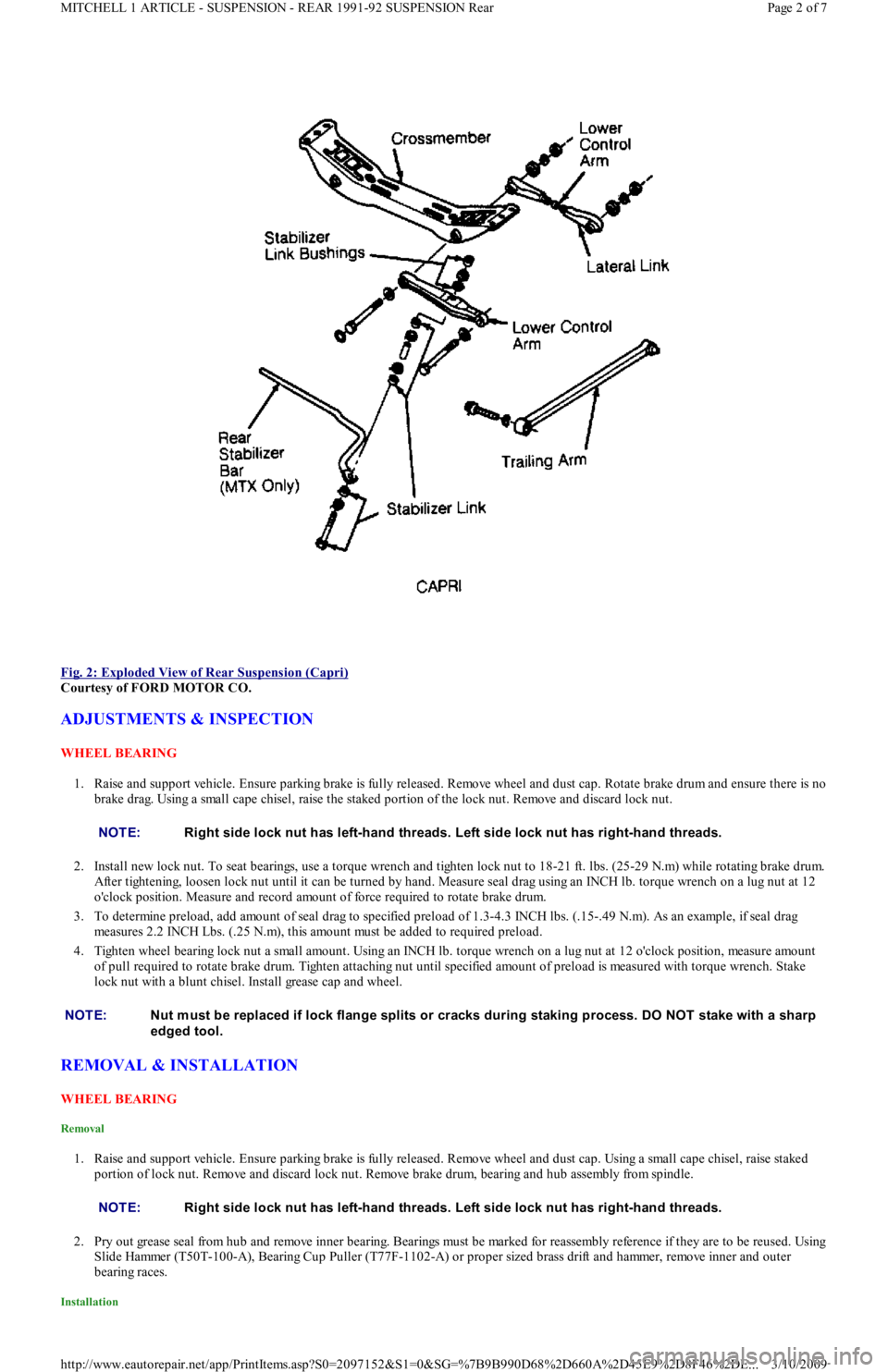
Fig. 2: Exploded View of Rear Suspension (Capri)
Courtesy of FORD MOTOR CO.
ADJUSTMENTS & INSPECTION
WHEEL BEARING
1. Raise and support vehicle. Ensure parking brake is fully released. Remove wheel and dust cap. Rotate brake drum and ensure there is no
brake drag. Using a small cape chisel, raise the staked portion of the lock nut. Remove and discard lock nut.
2. Install new lock nut. To seat bearings, use a torque wrench and tighten lock nut to 18-21 ft. lbs. (25-29 N.m) while rotating brake drum.
After tightening, loosen lock nut until it can be turned by hand. Measure seal drag using an INCH lb. torque wrench on a lug nut at 12
o'clock position. Measure and record amount of force required to rotate brake drum.
3. To determine preload, add amount of seal drag to specified preload of 1.3-4.3 INCH lbs. (.15-.49 N.m). As an example, if seal drag
measures 2.2 INCH Lbs. (.25 N.m), this amount must be added to required preload.
4. Tighten wheel bearing lock nut a small amount. Using an INCH lb. torque wrench on a lug nut at 12 o'clock position, measure amo u n t
of pull required to rotate brake drum. Tighten attaching nut until specified amount of preload is measured with torque wrench. Stake
lock nut with a blunt chisel. Install grease cap and wheel.
REMOVAL & INSTALLATION
WHEEL BEARING
Removal
1. Raise and support vehicle. Ensure parking brake is fully released. Remove wheel and dust cap. Using a small cape chisel, raise staked
portion of lock nut. Remove and discard lock nut. Remove brake drum, bearing and hub assembly from spindle.
2. Pry out grease seal from hub and remove inner bearing. Bearings must be marked for reassembly reference if they are to be reused. Using
Slide Hammer (T50T-100-A), Bearing Cup Puller (T77F-1102-A) or proper sized brass drift and hammer, remove inner and outer
bearing races.
Installation
NOTE:Right side lock nut has left-hand threads. Left side lock nut has right-hand threads.
NOTE:Nut m ust be replaced if lock flange splits or cracks during staking process. DO NOT stake with a sharp
edged tool.
NOTE:Right side lock nut has left-hand threads. Left side lock nut has right-hand threads.
Page 2 of 7 MITCHELL 1 ARTICLE - SUSPENSION - REAR 1991-92 SUSPENSION Rear
3/10/2009 http://www.eautorepair.net/app/PrintItems.asp?S0=2097152&S1=0&SG=%7B9B990D68%2D660A%2D45E9%2D8F46%2DE
...
Page 398 of 454
1. Using Installer (T77F-1217-A), Driver Handle (T80T-4000-W) or proper sized brass drift and hammer, install inner and outer bearing
races. Pack bearings and hub area with Lubricant (C1AZ-1959D-B, C, D or E).
2. Position inner bearing in bearing hub. Lubricate grease seal lips and install seal. Ensure bearings and hub have sufficient lubricant. Place
brake drum bearings and hub assembly on spindle. To prevent damage to grease seal and spindle threads, ensure hub is correctly
centered on spindle.
3. Install outer bearing, washer and new lock nut. Stake lock nut with a blunt chisel. Adjust bearing preload. See ADJUSTMENTS &
INSPECTION.
SPINDLE
Removal & Installation (Capri)
Remove wheel, caliper and brake rotor. Loosen spindle-to-strut attaching bolts. Loosen outer rear control arm common bolt and nut. Remove
spindle-to-strut mount bolts and common control arm bolt. Remove spindle from strut. To install, reverse removal procedure.
Removal & Installation (Festiva)
Remove brake drum assembly. Remove 4 spindle attaching nuts located on inboard side of torsion beam. Support backing plate with wire and
remove spindle. To install, reverse removal procedure. Tighten spindle attaching nuts to 32-45 ft. lbs. (43-61 N.m).
STRUTS
Removal & Installation (Capri)
1. Remove wheel, caliper and brake rotor. Remove trailing arm bolt and spindle-to-strut attaching bolts. Put index mark on strut rubber
mounting bracket. Remove upper strut attaching nuts from inside vehicle. Remove strut.
2. Compress strut coil spring with Spring Compressor (T18P-5310-A) or similar. Remove strut nut while spring is compressed. Remove
rubber mounting bracket, upper and lower spring seats. Slowly release coil spring and remove spring compressor. Remove coil spring,
dust boot and rebound bumpers. To install, reverse removal procedure.
Removal (Festiva)
1. Raise and support vehicle. Remove rear wheels. Using Spring Compressor (T81P-5310-A), compress spring to unload strut. Remove rear
quarter trim panel from cargo compartment.
2. Remove jam nut and flanged nut from strut rod. Remove bushing washer and upper bushing. Remove strut lower end mounting bolt
from wheel support arm. Remove strut and separate it from spring and seat insulator. Remove lower bushing and jounce bumper seat
from strut rod. Slide jounce bumper and shield off strut. See Fig. 3
. NOTE:Nut m ust be replaced if lock flange splits or cracks during staking process. DO NOT stake with a sharp-
edged tool.
Page 3 of 7 MITCHELL 1 ARTICLE - SUSPENSION - REAR 1991-92 SUSPENSION Rear
3/10/2009 http://www.eautorepair.net/app/PrintItems.asp?S0=2097152&S1=0&SG=%7B9B990D68%2D660A%2D45E9%2D8F46%2DE
...
Page 418 of 454
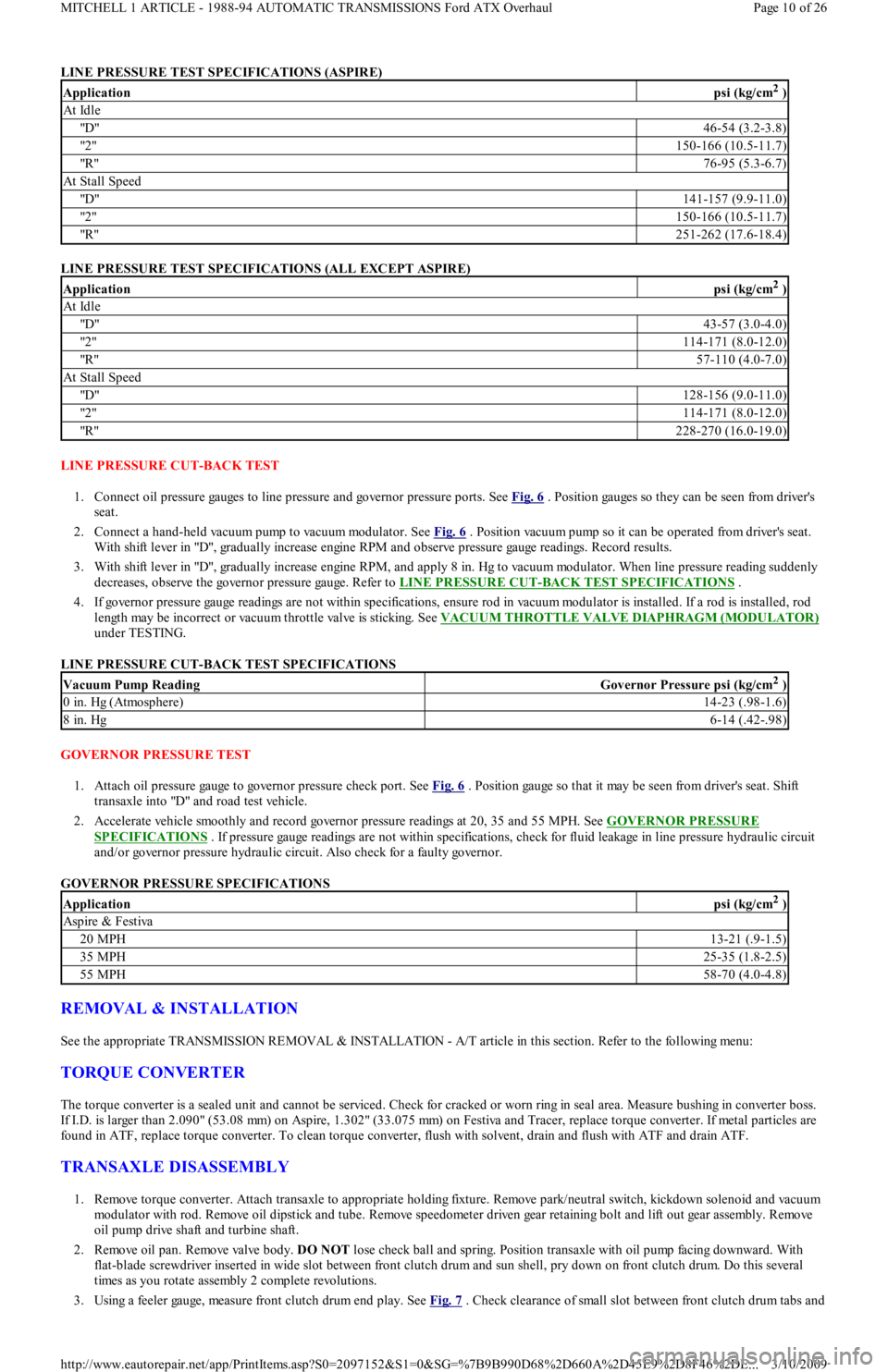
LINE PRESSURE TEST SPECIFICATIONS (ASPIRE)
LINE PRESSURE TEST SPECIFICATIONS (ALL EXCEPT ASPIRE)
LINE PRESSURE CUT-BACK TEST
1. Connect oil pressure gauges to line pressure and governor pressure ports. See Fig. 6
. Position gauges so they can be seen from driver's
seat.
2. Connect a hand-held vacuum pump to vacuum modulator. See Fig. 6
. Position vacuum pump so it can be operated from driver's seat.
With shift lever in "D", gradually increase engine RPM and observe pressure gauge readings. Record results.
3. With shift lever in "D", gradually increase engine RPM, and apply 8 in. Hg to vacuum modulator. When line pressure reading suddenly
decreases, observe the governor pressure gauge. Refer to LINE PRESSURE CUT
-BACK TEST SPECIFICATIONS .
4. If governor pressure gauge readings are not within specifications, ensure rod in vacuum modulator is installed. If a rod is installed, rod
length may be incorrect or vacuum throttle valve is sticking. See VACUUM THROTTLE VALVE DIAPHRAGM (MODULATOR)
under TESTING.
LINE PRESSURE CUT-BACK TEST SPECIFICATIONS
GOVERNOR PRESSURE TEST
1. Attach oil pressure gauge to governor pressure check port. See Fig. 6
. Position gauge so that it may be seen from driver's seat. Shift
transaxle into "D" and road test vehicle.
2. Accelerate vehicle smoothly and record governor pressure readings at 20, 35 and 55 MPH. See GOVERNOR PRESSURE
SPECIFICATIONS . If pressure gauge readings are not within specifications, check for fluid leakage in line pressure hydraulic circuit
and/or governor pressure hydraulic circuit. Also check for a faulty governor.
GOVERNOR PRESSURE SPECIFICATIONS
REMOVAL & INSTALLATION
See the appropriate TRANSMISSION REMOVAL & INSTALLATION - A/T article in this section. Refer to the following menu:
TORQUE CONVERTER
The torque converter is a sealed unit and cannot be serviced. Check for cracked or worn ring in seal area. Measure bushing in converter boss.
If I.D. is larger than 2.090" (53.08 mm) on Aspire, 1.302" (33.075 mm) on Festiva and Tracer, replace torque converter. If metal particles are
found in ATF, replace torque converter. To clean torque converter, flush with solvent, drain and flush with ATF and drain ATF.
TRANSAXLE DISASSEMBLY
1. Remove torque converter. Attach transaxle to appropriate holding fixture. Remove park/neutral switch, kickdown solenoid and vacuum
modulator with rod. Remove oil dipstick and tube. Remove speedometer driven gear retaining bolt and lift out gear assembly. Remove
oil pump drive shaft and turbine shaft.
2. Remove oil pan. Remove valve body. DO NOT lose check ball and spring. Position transaxle with oil pump facing downward. With
flat-blade screwdriver inserted in wide slot between front clutch drum and sun shell, pry down on front clutch drum. Do this seve r a l
times as you rotate assembly 2 complete revolutions.
3. Using a feeler gauge, measure front clutch drum end play. See Fig. 7
. Check clearance of small slot between front clutch drum tabs and
Applicationpsi (kg/cm2 )
At Idle
"D"46-54 (3.2-3.8)
"2 "150-166 (10.5-11.7)
"R"76-95 (5.3-6.7)
At Stall Speed
"D"141-157 (9.9-11.0)
"2 "150-166 (10.5-11.7)
"R"251-262 (17.6-18.4)
Applicationpsi (kg/cm2 )
At Idle
"D"43-57 (3.0-4.0)
"2 "114-171 (8.0-12.0)
"R"57-110 (4.0-7.0)
At Stall Speed
"D"128-156 (9.0-11.0)
"2 "114-171 (8.0-12.0)
"R"228-270 (16.0-19.0)
Vacuum Pump ReadingGovernor Pressure psi (kg/cm2 )
0 in. Hg (Atmosphere)14-23 (.98-1.6)
8 in. Hg6-14 (.42-.98)
Applicationpsi (kg/cm2 )
Aspire & Festiva
20 MPH13-21 (.9-1.5)
35 MPH25-35 (1.8-2.5)
55 MPH58-70 (4.0-4.8)
Page 10 of 26 MITCHELL 1 ARTICLE - 1988-94 AUTOMATIC TRANSMISSIONS Ford ATX Overhaul
3/10/2009 http://www.eautorepair.net/app/PrintItems.asp?S0=2097152&S1=0&SG=%7B9B990D68%2D660A%2D45E9%2D8F46%2DE
...
Page 419 of 454
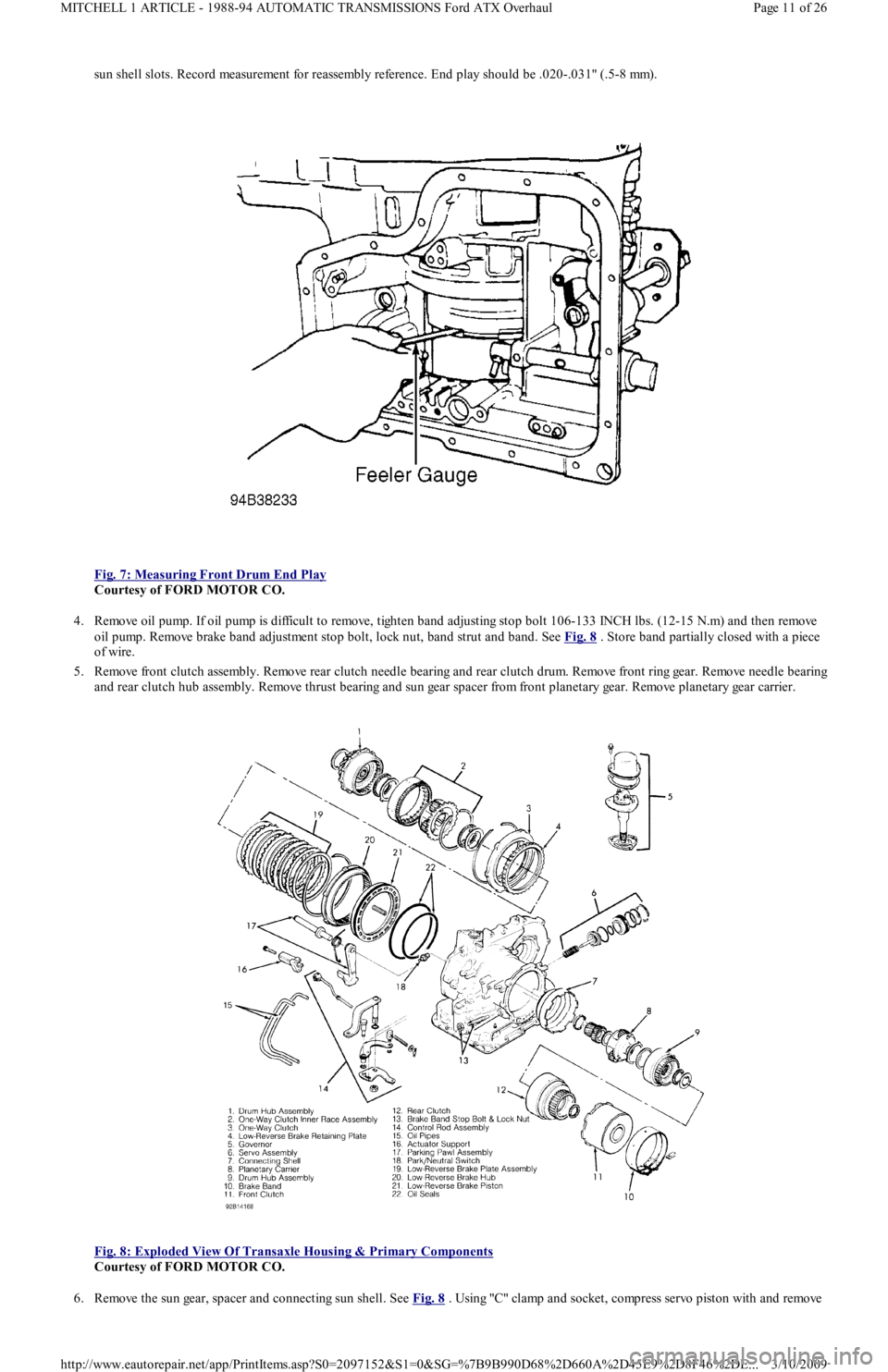
sun shell slots. Record measurement for reassembly reference. End play should be .020-.031" (.5-8 mm).
Fig. 7: Measuring Front Drum End Play
Courtesy of FORD MOTOR CO.
4. Remove oil pump. If oil pump is difficult to remove, tighten band adjusting stop bolt 106-133 INCH lbs. (12-15 N.m) and then remove
oil pump. Remove brake band adjustment stop bolt, lock nut, band strut and band. See Fig. 8
. Store band partially closed with a piece
of wire.
5. Remove front clutch assembly. Remove rear clutch needle bearing and rear clutch drum. Remove front ring gear. Remove needle bearing
and rear clutch hub assembly. Remove thrust bearing and sun gear spacer from front planetary gear. Remove planetary gear carrier.
Fig. 8: Exploded View Of Transaxle Housing & Primary Components
Courtesy of FORD MOTOR CO.
6. Remove the sun gear, spacer and connecting sun shell. See Fig. 8
. Using "C" clamp and socket, compress servo piston with and remove
Page 11 of 26 MITCHELL 1 ARTICLE - 1988-94 AUTOMATIC TRANSMISSIONS Ford ATX Overhaul
3/10/2009 http://www.eautorepair.net/app/PrintItems.asp?S0=2097152&S1=0&SG=%7B9B990D68%2D660A%2D45E9%2D8F46%2DE
...
Page 420 of 454
snap ring. Release the "C" clamp and remove the servo piston. See Fig. 2 . R e mo ve go ve r n o r c o ve r a n d p u l l go ve r n o r fr o m t r a n sa xl e
case. Remove transaxle case-to-torque converter housing bolts. Separate case halves.
7. Remove differential assembly. Remove oil pipes and parking pawl assembly. Remove drum hub assembly. Remove one-way clutch inner
race assembly. See Fig. 8
. Remove rear planetary carrier with needle bearing and thrust washer. Before disassembling one-way clutch,
measure and record clearance between one-way clutch and low-reverse brake retaining plate. Clearance should .032-.041" (.8-1.05
mm).
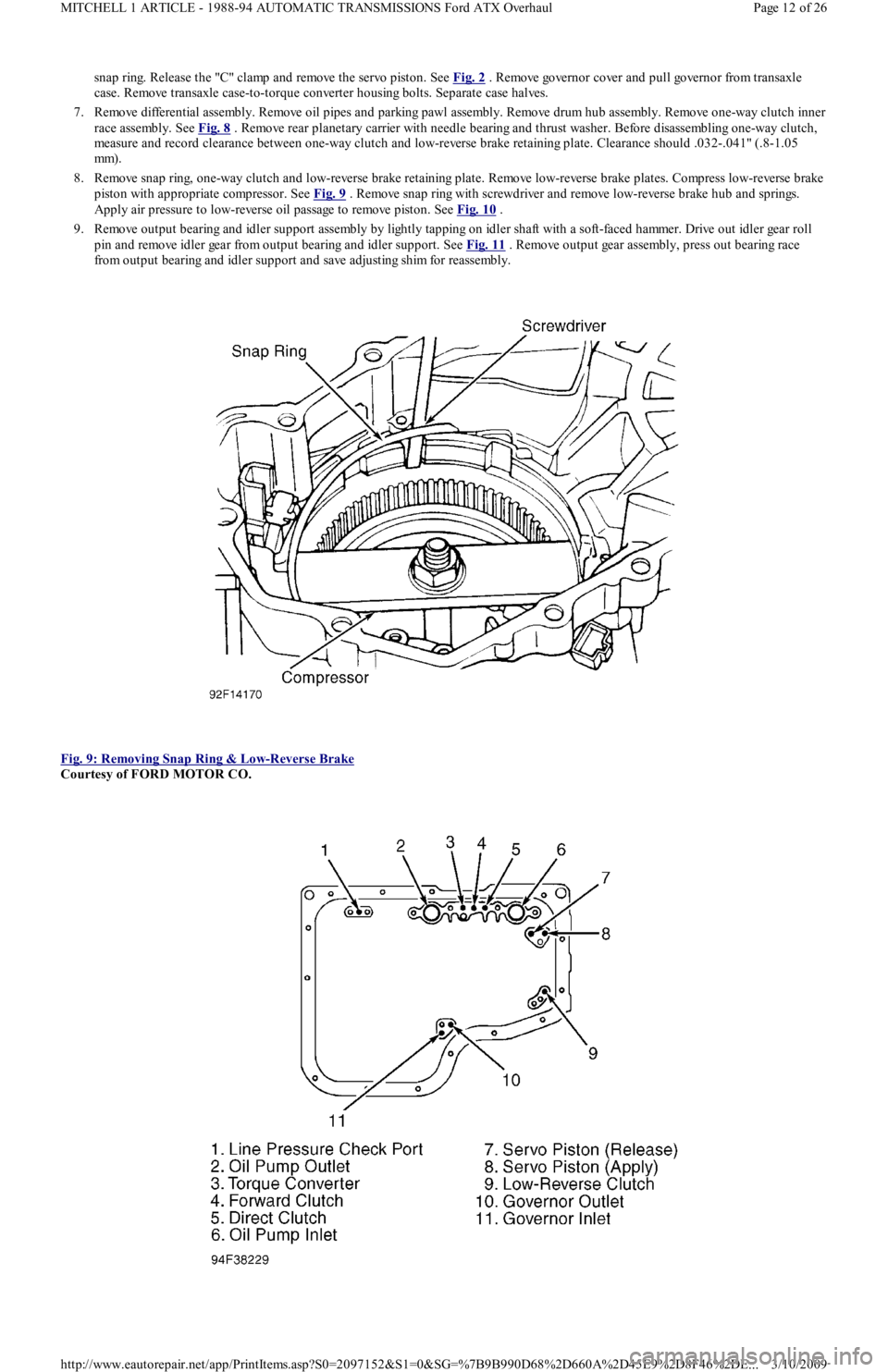
8. Remove snap ring, one-way clutch and low-reverse brake retaining plate. Remove low-reverse brake plates. Compress low-reverse brake
piston with appropriate compressor. See Fig. 9
. Remove snap ring with screwdriver and remove low-reverse brake hub and springs.
Apply air pressure to low-reverse oil passage to remove piston. See Fig. 10
.
9. Remove output bearing and idler support assembly by lightly tapping on idler shaft with a soft-faced hammer. Drive out idler gear roll
pin and remove idler gear from output bearing and idler support. See Fig. 11
. Remove output gear assembly, press out bearing race
from output bearing and idler support and save adjusting shim for reassembly.
Fig. 9: Removing Snap Ring & Low
-Reverse Brake
Courtesy of FORD MOTOR CO.
Page 12 of 26 MITCHELL 1 ARTICLE - 1988-94 AUTOMATIC TRANSMISSIONS Ford ATX Overhaul
3/10/2009 http://www.eautorepair.net/app/PrintItems.asp?S0=2097152&S1=0&SG=%7B9B990D68%2D660A%2D45E9%2D8F46%2DE
...
Page 422 of 454
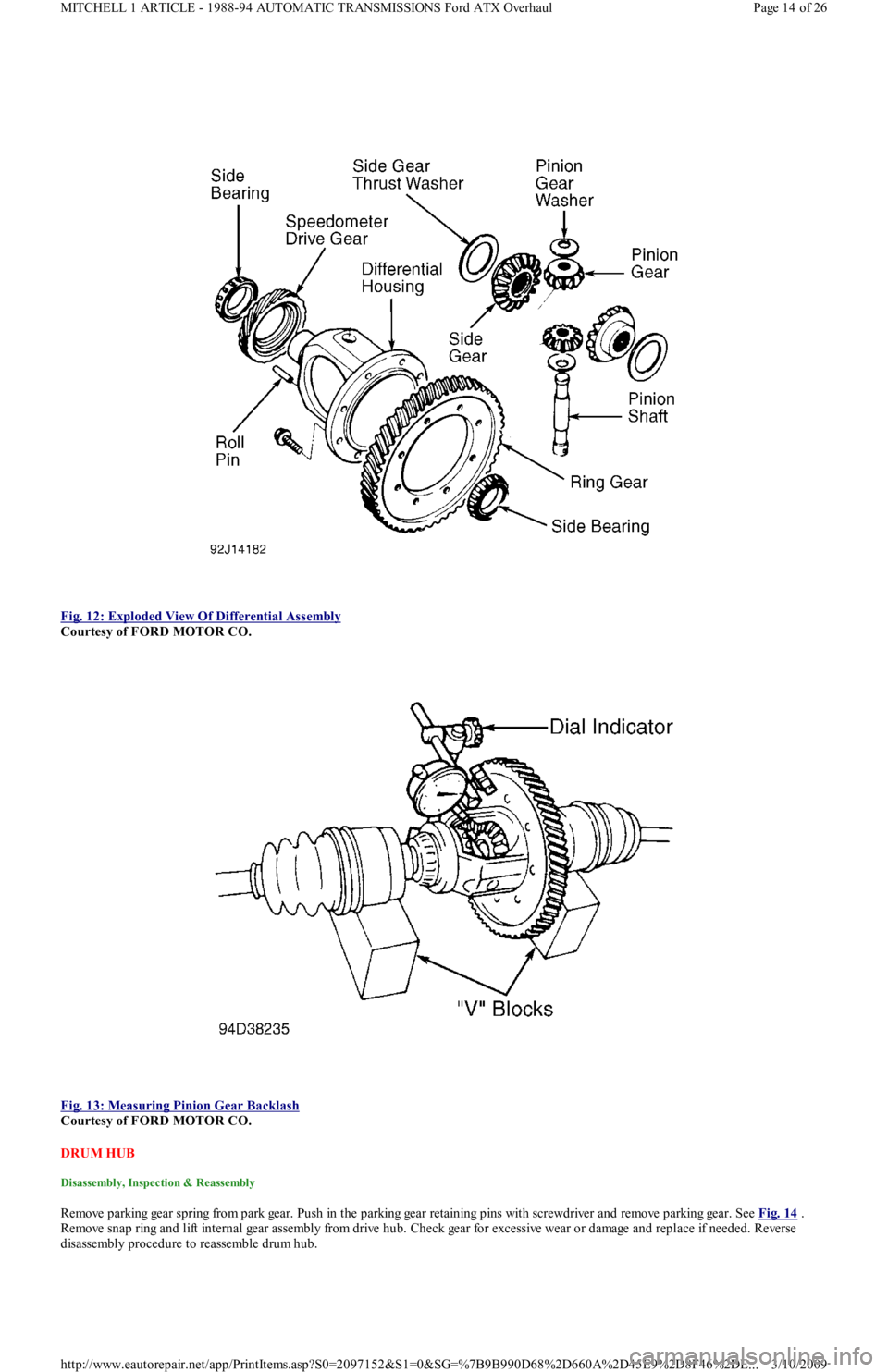
Fig. 12: Exploded View Of Differential Assembly
Courtesy of FORD MOTOR CO.
Fig. 13: Measuring Pinion Gear Backlash
Courtesy of FORD MOTOR CO.
DRUM HUB
Disassembly, Inspection & Reassembly
Remove parking gear spring from park gear. Push in the parking gear retaining pins with screwdriver and remove parking gear. See Fig. 14 .
Remove snap ring and lift internal gear assembly from drive hub. Check gear for excessive wear or damage and replace if needed. Reverse
disassembly procedure to reassemble drum hub.
Page 14 of 26 MITCHELL 1 ARTICLE - 1988-94 AUTOMATIC TRANSMISSIONS Ford ATX Overhaul
3/10/2009 http://www.eautorepair.net/app/PrintItems.asp?S0=2097152&S1=0&SG=%7B9B990D68%2D660A%2D45E9%2D8F46%2DE
...