fuel reserve FORD FESTIVA 1991 User Guide
[x] Cancel search | Manufacturer: FORD, Model Year: 1991, Model line: FESTIVA, Model: FORD FESTIVA 1991Pages: 454, PDF Size: 9.53 MB
Page 190 of 454
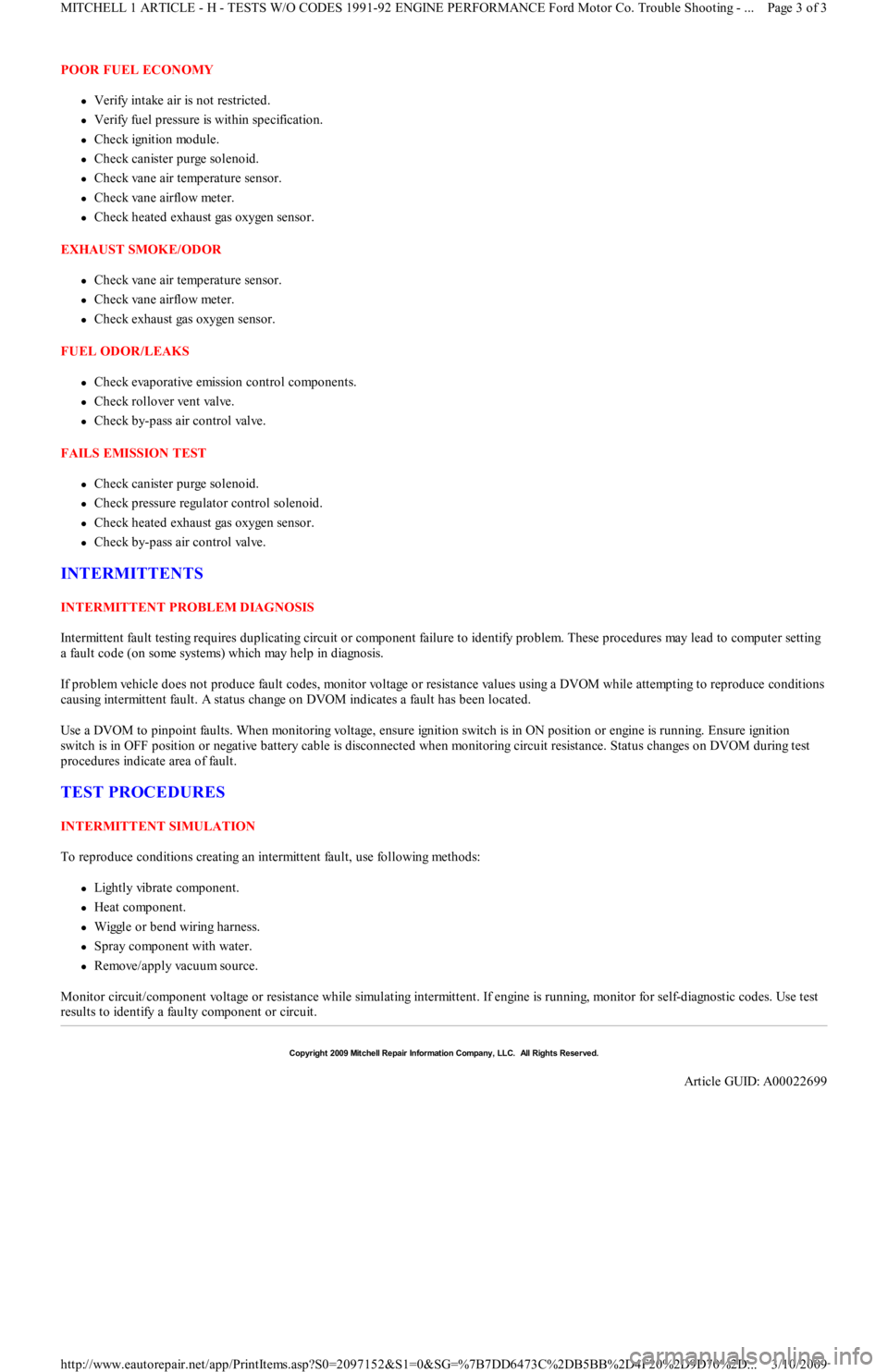
POOR FUEL ECONOMY
Verify intake air is not restricted.
Verify fuel pressure is within specification.
Check ignition module.
Check canister purge solenoid.
Check vane air temperature sensor.
Check vane airflow meter.
Check heated exhaust gas oxygen sensor.
EXHAUST SMOKE/ODOR
Check vane air temperature sensor.
Check vane airflow meter.
Check exhaust gas oxygen sensor.
FUEL ODOR/LEAKS
Check evaporative emission control components.
Check rollover vent valve.
Check by-pass air control valve.
FAILS EMISSION TEST
Check canister purge solenoid.
Check pressure regulator control solenoid.
Check heated exhaust gas oxygen sensor.
Check by-pass air control valve.
INTERMITTENTS
INTERMITTENT PROBLEM DIAGNOSIS
Intermittent fault testing requires duplicating circuit or component failure to identify problem. These procedures may lead to computer setting
a fault code (on some systems) which may help in diagnosis.
If problem vehicle does not produce fault codes, monitor voltage or resistance values using a DVOM while attempting to reproduce conditions
causing intermittent fault. A status change on DVOM indicates a fault has been located.
Use a DVOM to pinpoint faults. When monitoring voltage, ensure ignition switch is in ON position or engine is running. Ensure ign it io n
switch is in OFF position or negative battery cable is disconnected when monitoring circuit resistance. Status changes on DVOM during test
procedures indicate area of fault.
TEST PROCEDURES
INTERMITTENT SIMULATION
To reproduce conditions creating an intermittent fault, use following methods:
Lightly vibrate component.
Heat component.
Wiggle or bend wiring harness.
Spray component with water.
Remove/apply vacuum source.
Monitor circuit/component voltage or resistance while simulating intermittent. If engine is running, monitor for self-diagnostic codes. Use test
results to identify a faulty component or circuit.
Copyr ight 2009 Mitchell Repair Information Company, LLC. All Rights Reserved.
Article GUID: A00022699
Page 3 of 3 MITCHELL 1 ARTICLE - H - TESTS W/O CODES 1991-92 ENGINE PERFORMANCE Ford Motor Co. Trouble Shooting -
...
3/10/2009 http://www.eautorepair.net/app/PrintItems.asp?S0=2097152&S1=0&SG=%7B7DD6473C%2DB5BB%2D4F20%2D9D70%2D
...
Page 203 of 454
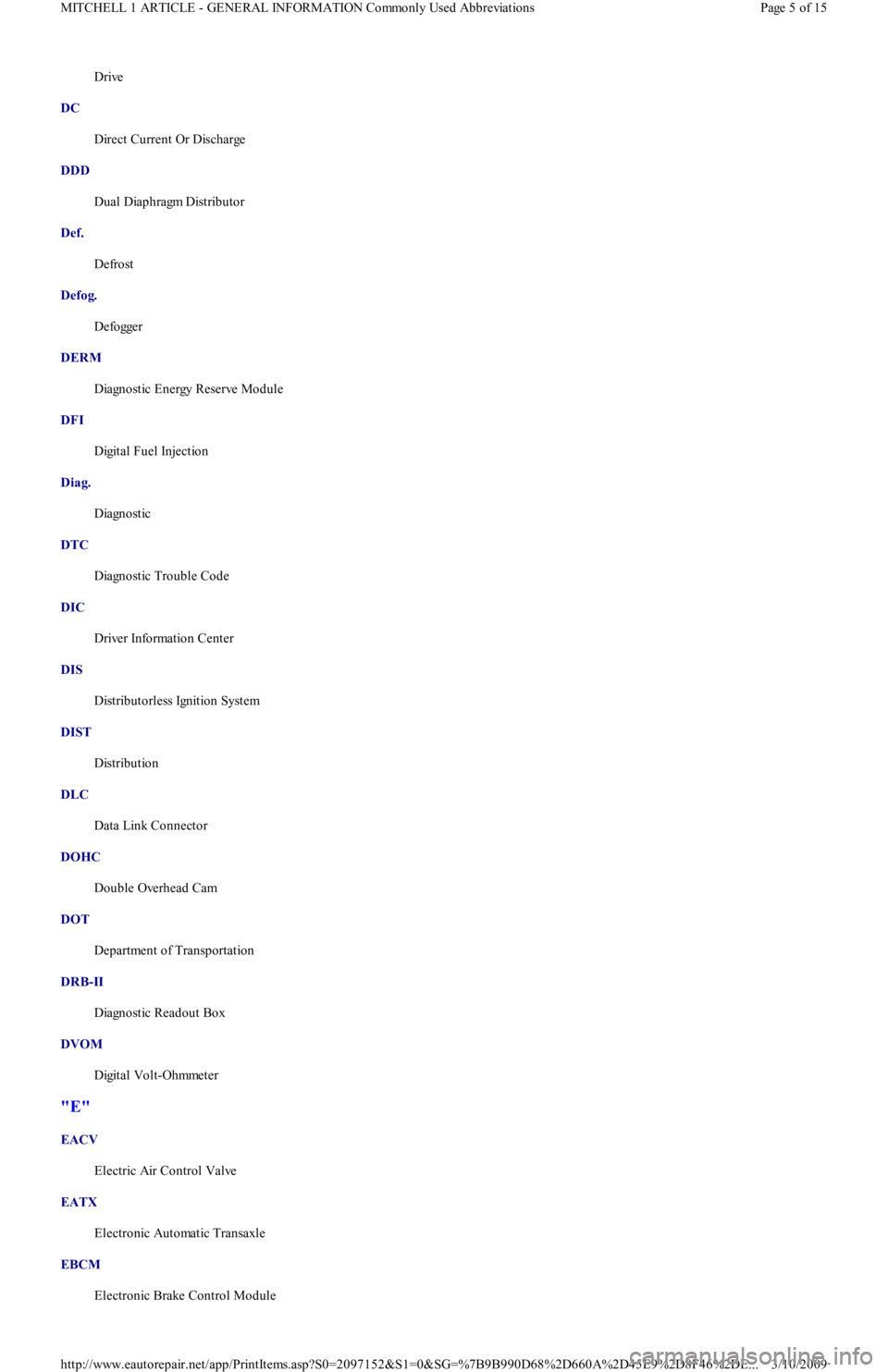
Drive
DC
Direct Current Or Discharge
DDD
Dual Diaphragm Distributor
Def.
Defrost
Defog.
De fo gge r
DERM
Diagnostic Energy Reserve Module
DFI
Digital Fuel Injection
Diag.
Diagnostic
DTC
Diagnostic Trouble Code
DIC
Driver Information Center
DIS
Distributorless Ignition System
DIST
Distribution
DLC
Data Link Connector
DOHC
Double Overhead Cam
DOT
Department of Transportation
DRB-II
Diagnostic Readout Box
DVOM
Digital Volt-Ohmmeter
"E"
EACV
Electric Air Control Valve
EATX
Electronic Automatic Transaxle
EBCM
Electronic Brake Control Module
Page 5 of 15 MITCHELL 1 ARTICLE - GENERAL INFORMATION Commonly Used Abbreviations
3/10/2009 http://www.eautorepair.net/app/PrintItems.asp?S0=2097152&S1=0&SG=%7B9B990D68%2D660A%2D45E9%2D8F46%2DE
...
Page 252 of 454
Back To Article
GENERAL INFORMATION
Com puter Relearn Procedures
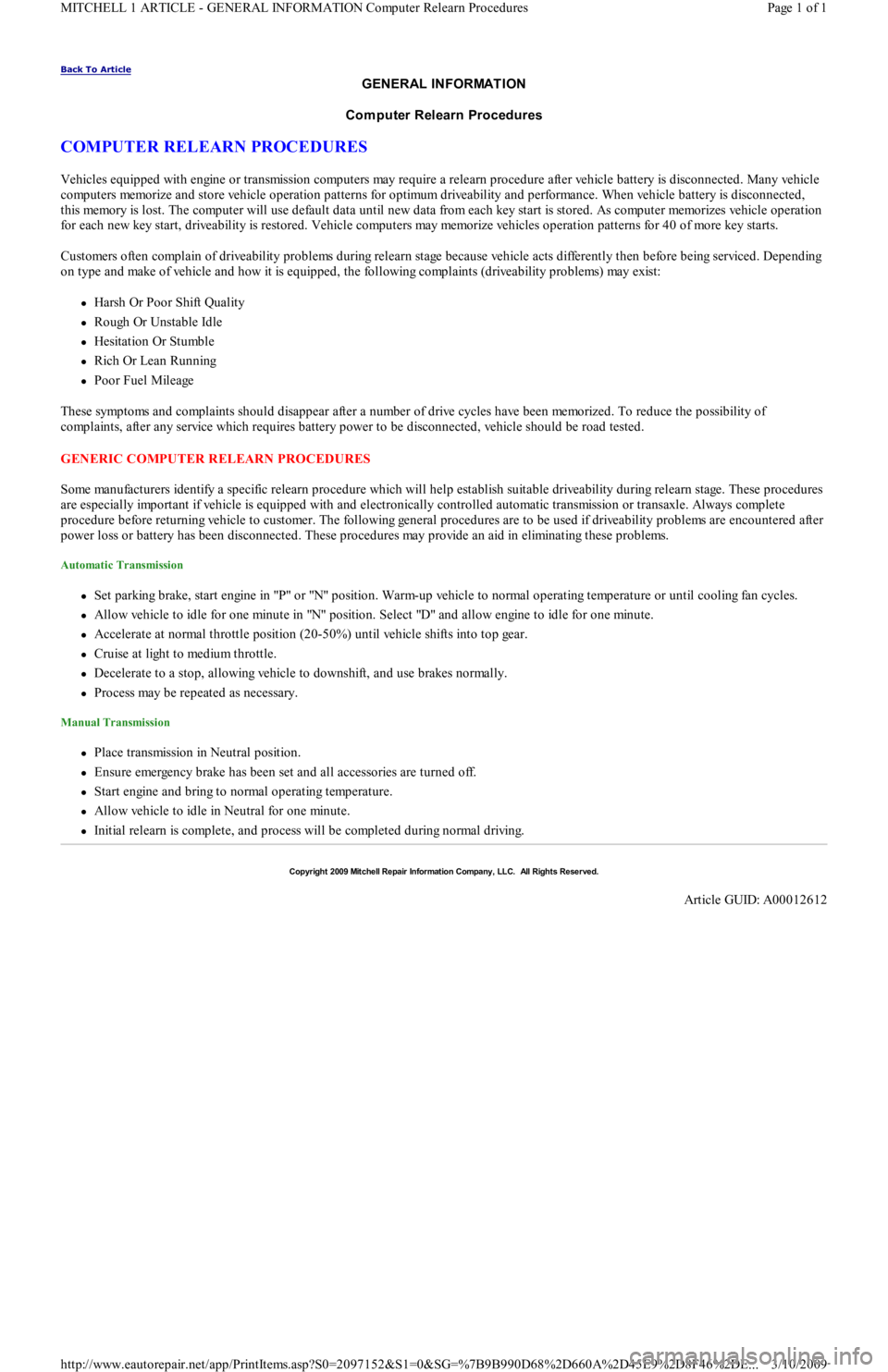
COMPUTER RELEARN PROCEDURES
Vehicles equipped with engine or transmission computers may require a relearn procedure after vehicle battery is disconnected. Many vehicle
computers memorize and store vehicle operation patterns for optimum driveability and performance. When vehicle battery is disconnected,
this memory is lost. The computer will use default data until new data from each key start is stored. As computer memorizes vehicle operation
for each new key start, driveability is restored. Vehicle computers may memorize vehicles operation patterns for 40 of more key starts.
Customers often complain of driveability problems during relearn stage because vehicle acts differently then before being serviced. Depending
on type and make of vehicle and how it is equipped, the following complaints (driveability problems) may exist:
Harsh Or Poor Shift Quality
Rough Or Unstable Idle
Hesitation Or Stumble
Rich Or Lean Running
Poor Fuel Mileage
These symptoms and complaints should disappear after a number of drive cycles have been memorized. To reduce the possibility of
complaints, after any service which requires battery power to be disconnected, vehicle should be road tested.
GENERIC COMPUTER RELEARN PROCEDURES
Some manufacturers identify a specific relearn procedure which will help establish suitable driveability during relearn stage. These procedures
are especially important if vehicle is equipped with and electronically controlled automatic transmission or transaxle. Always complete
procedure before returning vehicle to customer. The following general procedures are to be used if driveability problems are encountered after
power loss or battery has been disconnected. These procedures may provide an aid in eliminating these problems.
Automatic Transmission
Set parking brake, start engine in "P" or "N" position. Warm-up vehicle to normal operating temperature or until cooling fan cycles.
Allow vehicle to idle for one minute in "N" position. Select "D" and allow engine to idle for one minute.
Accelerate at normal throttle position (20-50%) until vehicle shifts into top gear.
Cruise at light to medium throttle.
Decelerate to a stop, allowing vehicle to downshift, and use brakes normally.
Process may be repeated as necessary.
Manual Transmission
Place transmission in Neutral position.
Ensure emergency brake has been set and all accessories are turned off.
Start engine and bring to normal operating temperature.
Allow vehicle to idle in Neutral for one minute.
Initial relearn is complete, and process will be completed during normal driving.
Copyr ight 2009 Mitchell Repair Information Company, LLC. All Rights Reserved.
Article GUID: A00012612
Page 1 of 1 MITCHELL 1 ARTICLE - GENERAL INFORMATION Computer Relearn Procedures
3/10/2009 http://www.eautorepair.net/app/PrintItems.asp?S0=2097152&S1=0&SG=%7B9B990D68%2D660A%2D45E9%2D8F46%2DE
...
Page 273 of 454
Back To Article
GENERAL INFORMATION
Engine Perform ance Diagnostic Routine Outline
* PLEASE READ THIS FIRST *
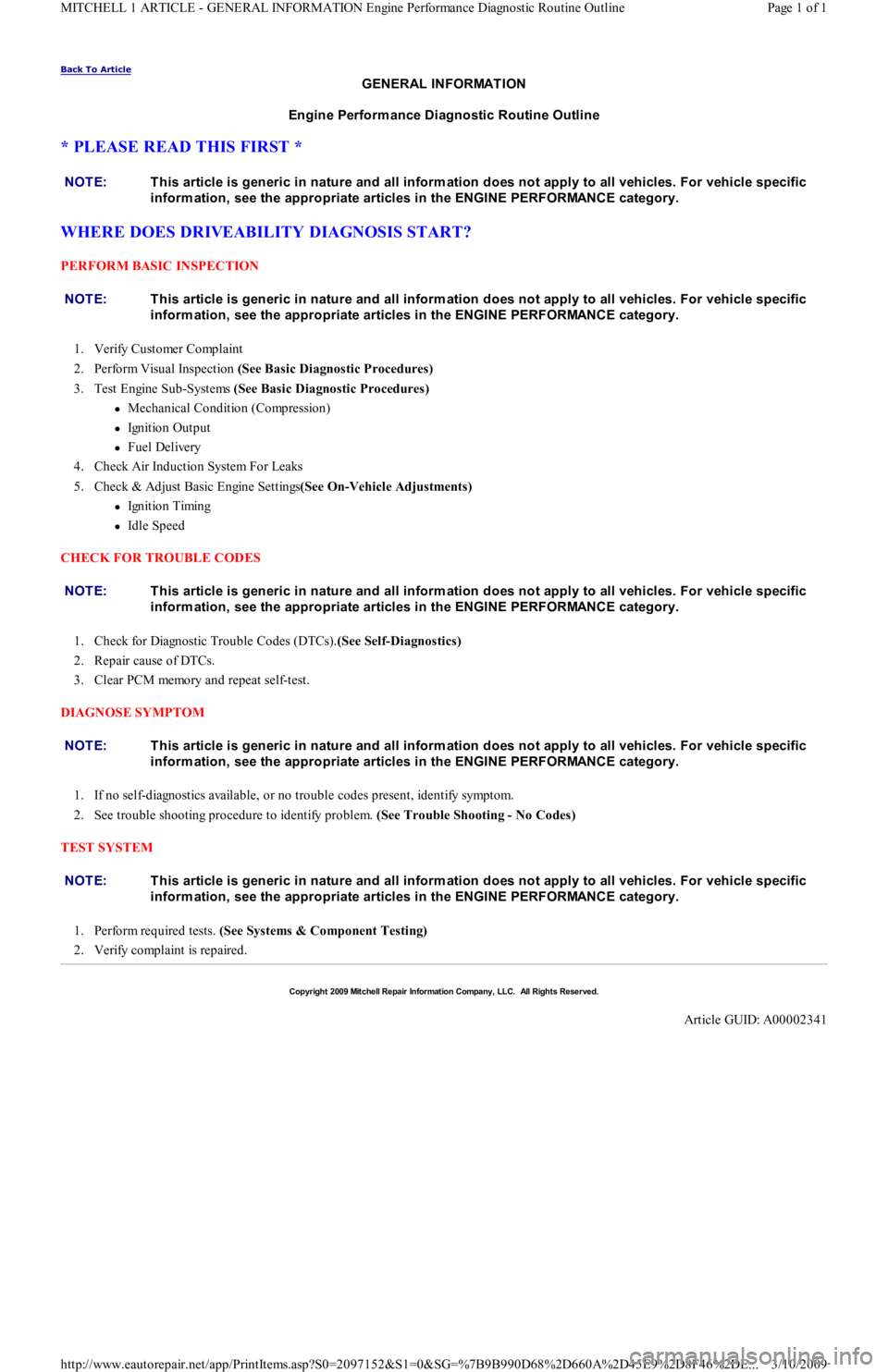
WHERE DOES DRIVEABILITY DIAGNOSIS START?
PERFORM BASIC INSPECTION
1. Verify Customer Complaint
2. Perform Visual Inspection (See Basic Diagnostic Procedures)
3. Test Engine Sub-Systems (See Basic Diagnostic Procedures)
Mechanical Condition (Compression)
Ignition Output
Fuel Delivery
4. Check Air Induction System For Leaks
5. Check & Adjust Basic Engine Settings(See On-Vehicle Adjustments)
Ignition Timing
Idle Speed
CHECK FOR TROUBLE CODES
1. Check for Diagnostic Trouble Codes (DTCs).(See Self-Diagnostics)
2. Repair cause of DTCs.
3. Clear PCM memory and repeat self-test.
DIAGNOSE SYMPTOM
1. If no self-diagnostics available, or no trouble codes present, identify symptom.
2. See trouble shooting procedure to identify problem. (See Trouble Shooting - No Codes)
TEST SYSTEM
1. Perform required tests. (See Systems & Component Testing)
2. Verify complaint is repaired. NOTE:T his article is generic in nature and all inform ation does not apply to all vehicles. For vehicle specific
inform ation, see the appropriate articles in the ENGINE PERFORMANCE category.
NOTE:T his article is generic in nature and all inform ation does not apply to all vehicles. For vehicle specific
inform ation, see the appropriate articles in the ENGINE PERFORMANCE category.
NOTE:T his article is generic in nature and all inform ation does not apply to all vehicles. For vehicle specific
inform ation, see the appropriate articles in the ENGINE PERFORMANCE category.
NOTE:T his article is generic in nature and all inform ation does not apply to all vehicles. For vehicle specific
inform ation, see the appropriate articles in the ENGINE PERFORMANCE category.
NOTE:T his article is generic in nature and all inform ation does not apply to all vehicles. For vehicle specific
inform ation, see the appropriate articles in the ENGINE PERFORMANCE category.
Copyr ight 2009 Mitchell Repair Information Company, LLC. All Rights Reserved.
Article GUID: A00002341
Page 1 of 1 MITCHELL 1 ARTICLE - GENERAL INFORMATION Engine Performance Diagnostic Routine Outline
3/10/2009 http://www.eautorepair.net/app/PrintItems.asp?S0=2097152&S1=0&SG=%7B9B990D68%2D660A%2D45E9%2D8F46%2DE
...
Page 274 of 454
Back To Article
GENERAL INFORMATION
Engine Perform ance Safety Precautions
Always refer to Emission Decal in engine compartment before servicing vehicle. If manual and decal differ, always use decal
specifications.
Do not allow or create a condition of misfire in more than one cylinder for an extended period of time. Damage to converter may occur
due to loading converter with unburned air/fuel mixture.
Always turn ignition off and disconnect negative battery cable BEFORE disconnecting or connecting computer or other electrical
components.
DO NOT drop or shock electrical components such as computer, airflow meter, etc.
DO NOT use fuel system cleaning compounds that are not recommended by the manufacturer. Damage to gaskets, diaphragm materials
and catalytic converter may result.
Before performing a compression test or cranking engine using a remote starter switch, disconnect coil wire from distributor and secure it
to a good engine ground, or disable ignition.
Before disconnecting any fuel system component, ensure fuel system pressure is released.
Use a shop towel to absorb any spilled fuel to prevent fire.
DO NOT create sparks or have an open flame near battery.
If any fuel system components such as hoses or clamps are replaced, ensure they are replaced with components designed for fuel system
use.
Always reassemble throttle body components with new gaskets, "O" rings and seals.
If equipped with an inertia switch, DO NOT reset switch until fuel system has been inspected for leaks.
We a r sa fe t y go ggl e s wh e n d r il l in g o r gr in d in g.
Wear proper clothing which protects against chemicals and other hazards.
Copyr ight 2009 Mitchell Repair Information Company, LLC. All Rights Reserved.
Article GUID: A00002342
Page 1 of 1 MITCHELL 1 ARTICLE - GENERAL INFORMATION Engine Performance Safety Precautions
3/10/2009 http://www.eautorepair.net/app/PrintItems.asp?S0=2097152&S1=0&SG=%7B9B990D68%2D660A%2D45E9%2D8F46%2DE
...
Page 404 of 454
Back To Article
1983-95 WHEEL ALIGNMENT
Pre-Alignm ent Inspection Procedures
PRE-ALIGNMENT CHECKS
Before making wheel alignment adjustment, perform the following checks:
1. Tires should be equal in size and runout must not be excessive. Tires and wheels should be in balance, and inflated to manufacturer's
specifications.
2. Wheel bearings must be properly adjusted. Steering linkage and suspension must not have excessive looseness. Check for wear in tie rod
ends and ball joints.
3. Steering gear box must not have excessive play. Check and adjust to manufacturer's specifications.
4. Vehicle must be at curb height with full fuel load and spare tire in vehicle. No extra load should be on vehicle.
5. Vehicle must be level with floor and with suspension settled. Jounce front and rear of vehicle several times and allow it to settle to
normal curb height.
6. If steering wheel is not centered with front wheels in straight-ahead position, correct by shortening one tie rod adjusting sleeve and
lengthening opposite sleeve equal amounts.
7. Ensure wheel lug nuts are tightened to torque specifications.
Copyr ight 2009 Mitchell Repair Information Company, LLC. All Rights Reserved.
Article GUID: A00060347
Page 1 of 1 MITCHELL 1 ARTICLE - 1983-95 WHEEL ALIGNMENT Pre-Alignment Inspection Procedures
3/10/2009 http://www.eautorepair.net/app/PrintItems.asp?S0=2097152&S1=0&SG=%7B9B990D68%2D660A%2D45E9%2D8F46%2DE
...