tow FORD FESTIVA 1991 User Guide
[x] Cancel search | Manufacturer: FORD, Model Year: 1991, Model line: FESTIVA, Model: FORD FESTIVA 1991Pages: 454, PDF Size: 9.53 MB
Page 90 of 454
Back To Article
DRIVE BELT ROUTING
1991-92 ENGINE COOLING BELT ROUT ING
BELT ADJUSTMENT
Tensioners may be used to automatically adjust belt tension to specification. Check belt for fraying. If fraying exists, ensure both belt and
tensioner are properly aligned. See Fig. 1
. Tensioners may contain a belt-wear indicator. See Fig. 2 . If tensioner reaches travel limit, as
indicated by marks on tensioner, replace belt. Ensure serpentine belts are properly installed. See Fig. 3
-Fig. 7 . On models without
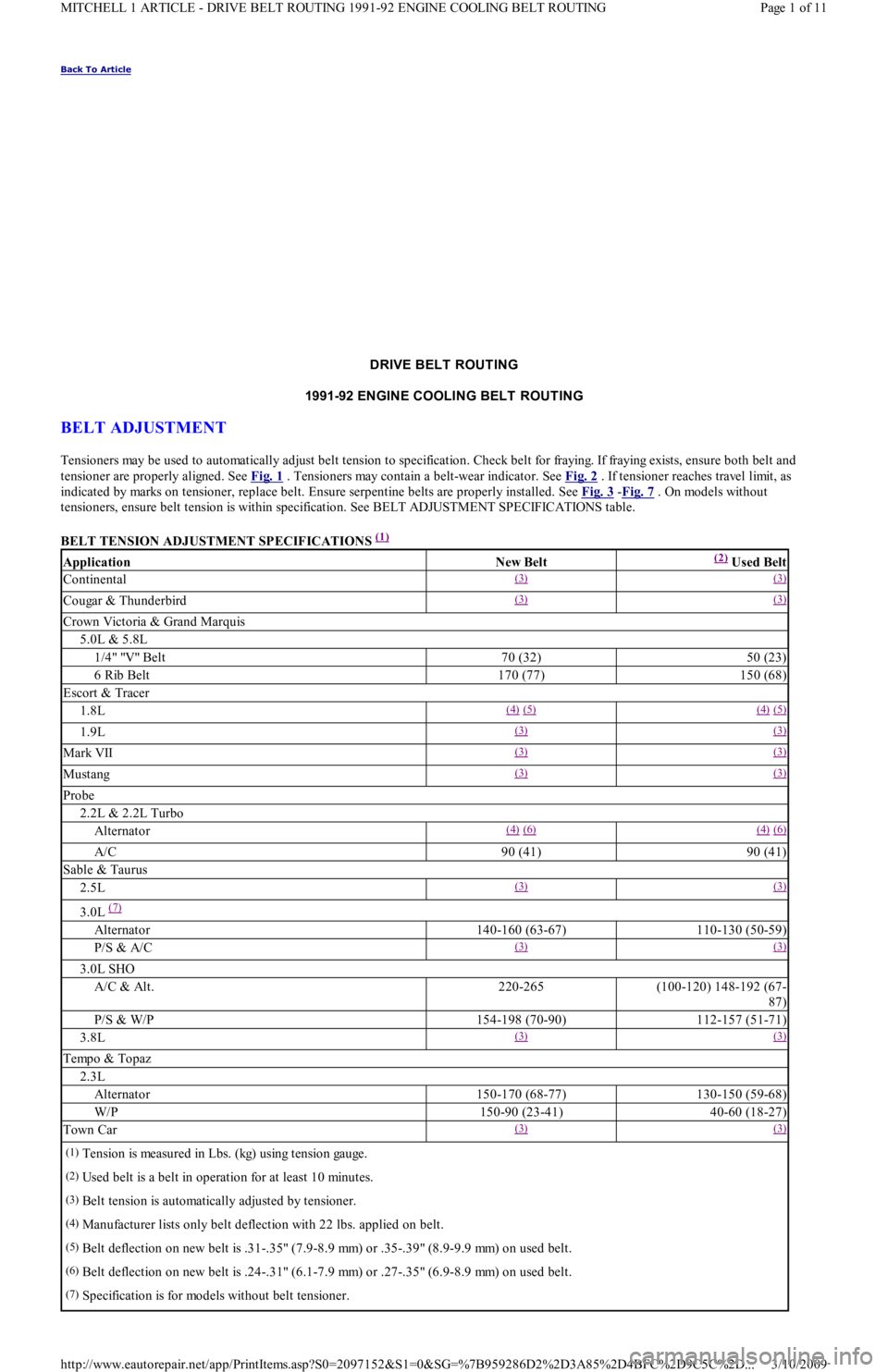
tensioners, ensure belt tension is within specification. See BELT ADJUSTMENT SPECIFICATIONS table.
BELT TENSION ADJUSTMENT SPECIFICATIONS
(1)
ApplicationNew Belt(2) Used Belt
Continental(3) (3)
Cougar & Thunderbird(3) (3)
Crown Victoria & Grand Marquis
5.0L & 5.8L
1/4" "V" Belt70 (32)50 (23)
6 Rib Belt170 (77)150 (68)
Escort & Tracer
1.8L(4) (5) (4) (5)
1.9L(3) (3)
Mark VII(3) (3)
Mustang(3) (3)
Probe
2.2L & 2.2L Turbo
Alternator(4) (6) (4) (6)
A/C90 (41)90 (41)
Sable & Taurus
2.5L(3) (3)
3.0L (7)
Alternator140-160 (63-67)110-130 (50-59)
P/S & A/C(3) (3)
3.0L SHO
A/C & Alt.220-265(100-120) 148-192 (67-
87)
P/S & W/P154-198 (70-90)112-157 (51-71)
3.8L(3) (3)
Tempo & Topaz
2.3L
Alternator150-170 (68-77)130-150 (59-68)
W/P150-90 (23-41)40-60 (18-27)
Town Car(3) (3)
(1)Tension is measured in Lbs. (kg) using tension gauge.
(2)Used belt is a belt in operation for at least 10 minutes.
(3)Belt tension is automatically adjusted by tensioner.
(4)Manufacturer lists only belt deflection with 22 lbs. applied on belt.
(5)Belt deflection on new belt is .31-.35" (7.9-8.9 mm) or .35-.39" (8.9-9.9 mm) on used belt.
(6)Belt deflection on new belt is .24-.31" (6.1-7.9 mm) or .27-.35" (6.9-8.9 mm) on used belt.
(7)Specification is for models without belt tensioner.
Page 1 of 11 MITCHELL 1 ARTICLE - DRIVE BELT ROUTING 1991-92 ENGINE COOLING BELT ROUTING
3/10/2009 http://www.eautorepair.net/app/PrintItems.asp?S0=2097152&S1=0&SG=%7B959286D2%2D3A85%2D4BFC%2D9C5C%2D
...
Page 100 of 454
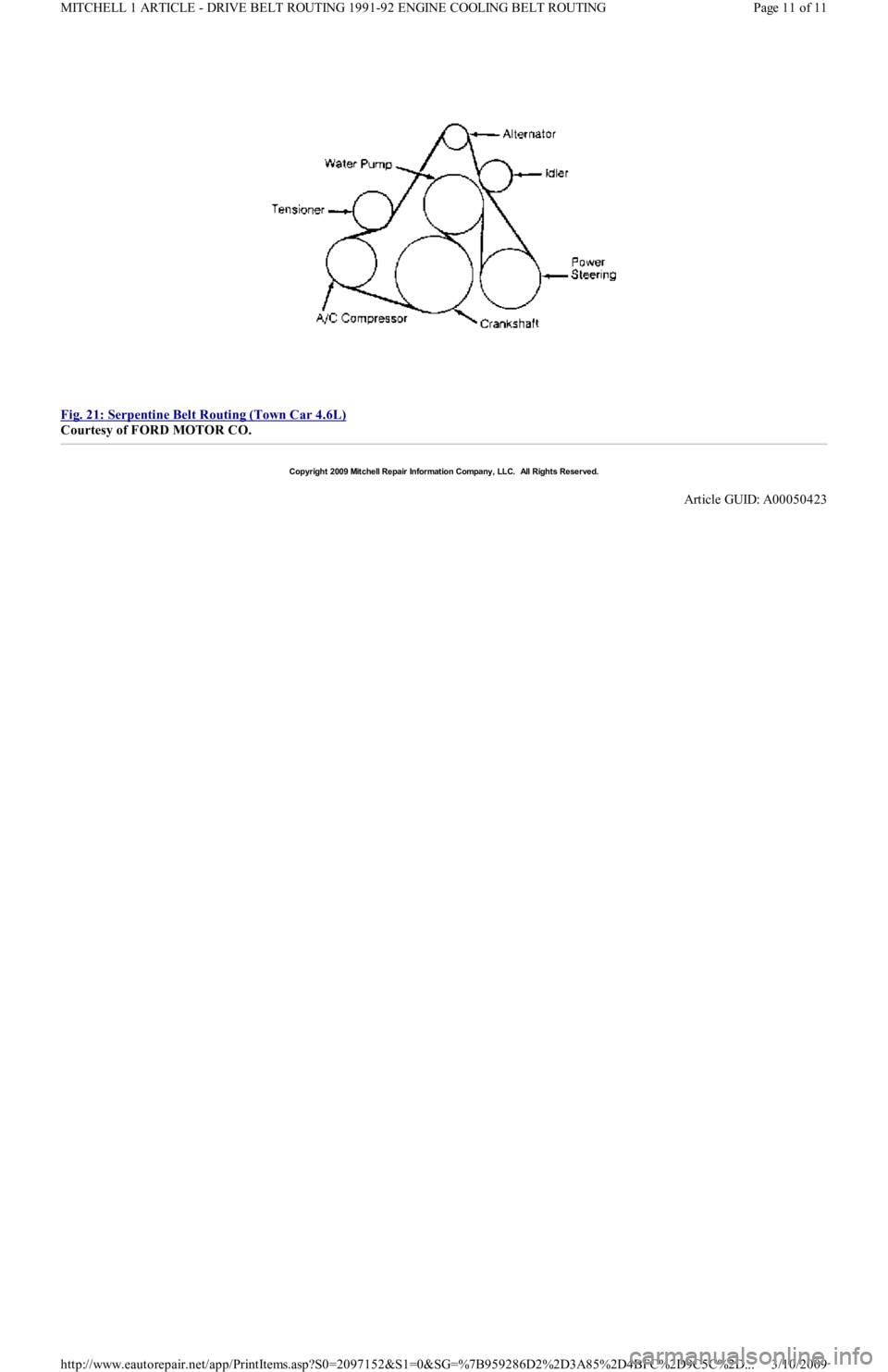
Fig. 21: Serpentine Belt Routing (Town Car 4.6L)
Courtesy of FORD MOTOR CO.
Copyr ight 2009 Mitchell Repair Information Company, LLC. All Rights Reserved.
Article GUID: A00050423
Page 11 of 11 MITCHELL 1 ARTICLE - DRIVE BELT ROUTING 1991-92 ENGINE COOLING BELT ROUTING
3/10/2009 http://www.eautorepair.net/app/PrintItems.asp?S0=2097152&S1=0&SG=%7B959286D2%2D3A85%2D4BFC%2D9C5C%2D
...
Page 113 of 454
replace hydraulic lash adjuster. Adjustment on valve lash adjusters is NOT possible or necessary.
PISTON & ROD ASSEMBLY
1. Remove cylinder head assembly. Remove oil pan. Mark connecting rod caps for reassembly reference. Remove rod nuts. Remove lower
rod cap and bearing. Tap piston out top of cylinder block. DO NOT scratch crank journal or cylinder walls during removal.
2. Repeat procedure for remaining pistons. Keep removed parts in order to ensure installation to original position. Position piston assembly
in correct cylinder bore. Align piston mark "F" (1.3L), or notch (1.6L) located at piston pin bore area, and connecting rod oil gr o o ve
toward engine front. To complete installation, reverse removal procedure. Tighten all bolts and nuts to specification. See TORQUE
SPECIFICATIONS table at end of article.
FITTING PISTONS
1. With piston assembly removed, remove piston rings and clean piston. Measure piston outer diameter in thrust direction, below oil ring
groove. Diameter is 2.793-2.794" (70.954-70.974 mm) for 1.3L engines and 3.0690-3.0698 (77.954-77.974) for 1.6L engines.
2. Place piston upside down in cylinder from which it was removed. Using a feeler gauge, measure clearance between piston and cylinder
bore. If clearance is not within specification, bore cylinder and replace piston as necessary. See CYLINDER BLOCK
table in ENGINE
SPECIFICATIONS at end of article.
PISTON RINGS
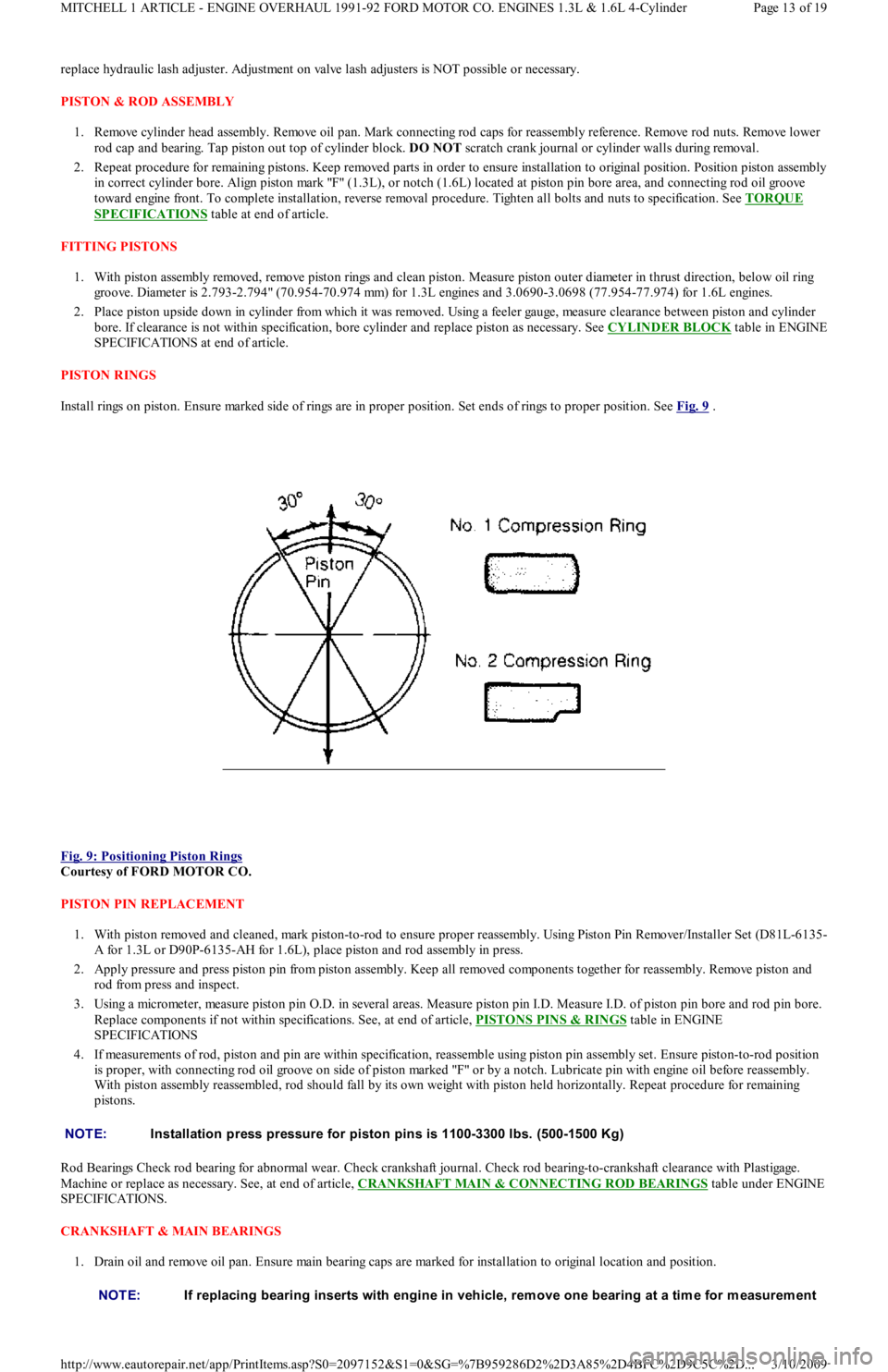
Install rings on piston. Ensure marked side of rings are in proper position. Set ends of rings to proper position. See Fig. 9
.
Fig. 9: Positioning Piston Rings
Courtesy of FORD MOTOR CO.
PISTON PIN REPLACEMENT
1. With piston removed and cleaned, mark piston-to-rod to ensure proper reassembly. Using Piston Pin Remover/Installer Set (D81L-6135-
A for 1.3L or D90P-6135-AH for 1.6L), place piston and rod assembly in press.
2. Apply pressure and press piston pin from piston assembly. Keep all removed components together for reassembly. Remove piston and
rod from press and inspect.
3. Using a micrometer, measure piston pin O.D. in several areas. Measure piston pin I.D. Measure I.D. of piston pin bore and rod pin bore.
Replace components if not within specifications. See, at end of article, PISTONS PINS & RINGS
table in ENGINE
SPECIFICATIONS
4. If measurements of rod, piston and pin are within specification, reassemble using piston pin assembly set. Ensure piston-to-rod position
is proper, with connecting rod oil groove on side of piston marked "F" or by a notch. Lubricate pin with engine oil before reassembly.
With piston assembly reassembled, rod should fall by its own weight with piston held horizontally. Repeat procedure for remaining
pistons.
Rod Bearings Check rod bearing for abnormal wear. Check crankshaft journal. Check rod bearing-to-crankshaft clearance with Plastigage.
Machine or replace as necessary. See, at end of article, CRANKSHAFT MAIN & CONNECTING ROD BEARINGS
table under ENGINE
SPECIFICATIONS.
CRANKSHAFT & MAIN BEARINGS
1. Drain oil and remove oil pan. Ensure main bearing caps are marked for installation to original location and position.
NOTE:Installation press pressure for piston pins is 1100-3300 lbs. (500-1500 Kg)
NOTE:If replacing bearing inserts with engine in vehicle, rem ove one bearing at a tim e for m easurem ent
Page 13 of 19 MITCHELL 1 ARTICLE - ENGINE OVERHAUL 1991-92 FORD MOTOR CO. ENGINES 1.3L & 1.6L 4-Cylinder
3/10/2009 http://www.eautorepair.net/app/PrintItems.asp?S0=2097152&S1=0&SG=%7B959286D2%2D3A85%2D4BFC%2D9C5C%2D
...
Page 121 of 454
3. If voltage is not present or is less than 8 volts at starter solenoid terminal "S", malfunction in circuit to terminal "S" is indicated. Proceed
to the following tests.
IGNITION SWITCH TEST
1. Locate ignition switch connector under dash. Using a 12-volt test light or voltmeter, ensure voltage is present on Black/Yellow wire
when ignition switch is turned to RUN or ON position. This will verify proper operation of ignition switch.
2. If there is no voltage on Black/Yellow wire, the problem is either ignition switch or circuit between battery and ignition switch.
CLUTCH ENGAGE SWITCH (M/T) TEST
Unplug clutch engage switch from main wiring harness. Using an ohmmeter, check for continuity across switch terminals. Continuity should
exist when switch plunger is pushed in and should not exist when switch plunger is released. If clutch engage switch does not operate as
specified, replace switch.
NEUTRAL SAFETY SWITCH (A/T) TEST
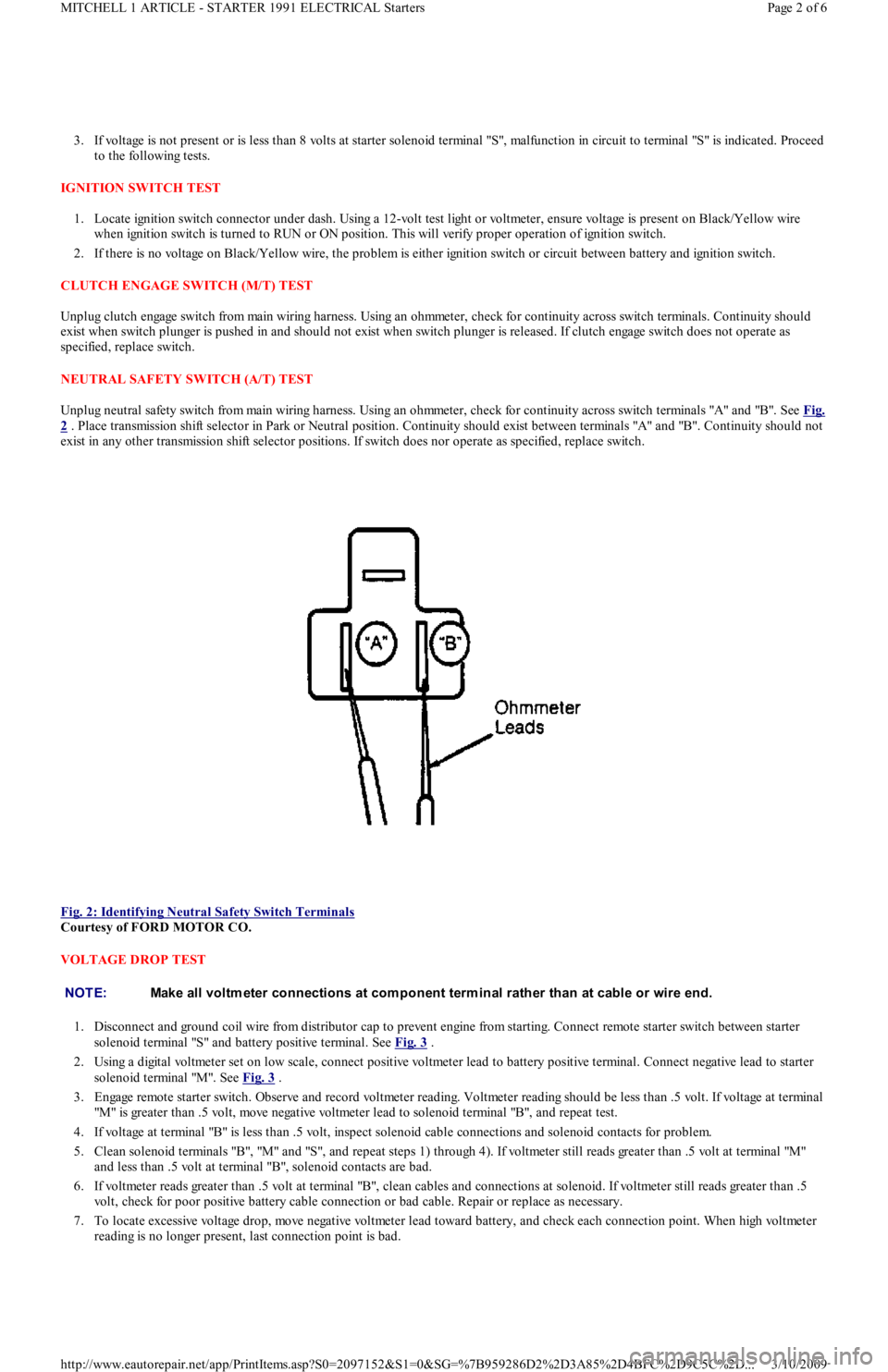
Unplug neutral safety switch from main wiring harness. Using an ohmmeter, check for continuity across switch terminals "A" and "B". See Fig.
2 . Place transmission shift selector in Park or Neutral position. Continuity should exist between terminals "A" and "B". Continuity should not
exist in any other transmission shift selector positions. If switch does nor operate as specified, replace switch.
Fig. 2: Identifying Neutral Safety Switch Terminals
Courtesy of FORD MOTOR CO.
VOLTAGE DROP TEST
1. Disconnect and ground coil wire from distributor cap to prevent engine from starting. Connect remote starter switch between starter
solenoid terminal "S" and battery positive terminal. See Fig. 3
.
2. Using a digital voltmeter set on low scale, connect positive voltmeter lead to battery positive terminal. Connect negative lead to starter
solenoid terminal "M". See Fig. 3
.
3. Engage remote starter switch. Observe and record voltmeter reading. Voltmeter reading should be less than .5 volt. If voltage at terminal
"M" is greater than .5 volt, move negative voltmeter lead to solenoid terminal "B", and repeat test.
4. If voltage at terminal "B" is less than .5 volt, inspect solenoid cable connections and solenoid contacts for problem.
5 . Cl ean so l en o id t ermin al s "B", "M" an d "S", an d rep eat st ep s 1 ) through 4). If voltmeter still reads greater than .5 volt at termin al "M"
and less than .5 volt at terminal "B", solenoid contacts are bad.
6. If voltmeter reads greater than .5 volt at terminal "B", clean cables and connections at solenoid. If voltmeter still reads greater than .5
volt, check for poor positive battery cable connection or bad cable. Repair or replace as necessary.
7. To locate excessive voltage drop, move negative voltmeter lead toward battery, and check each connection point. When high voltmeter
reading is no longer present, last connection point is bad.
NOTE:Make all voltm eter connections at com ponent term inal rather than at cable or wire end.
Page 2 of 6 MITCHELL 1 ARTICLE - STARTER 1991 ELECTRICAL Starters
3/10/2009 http://www.eautorepair.net/app/PrintItems.asp?S0=2097152&S1=0&SG=%7B959286D2%2D3A85%2D4BFC%2D9C5C%2D
...
Page 148 of 454
Removal
Drain radiator and remove negative battery cable. Disconnect throttle cable. Remove air duct from throttle body. Disconnect throttle position
sensor/switch connector. Mark all coolant and vacuum hoses for reassembly reference and remove from throttle body. See Fig. 4
. Remove
intake plenum bolts and remove intake plenum and gasket.
Installation
To install, reverse removal procedure. Use NEW intake plenum-to-intake manifold gasket. Tighten bolts to specification, see TORQUE
SPECIFICATIONS at end of article.
OXYGEN (O2) SENSOR
Removal & Installation
Disconnect negative battery cable. Disconnect wire harness connector, and remove oxygen sensor. If exhaust sensor is difficult to remove, use
rust penetrant to avoid possible damage to exhaust threads. If new sensor is not pre-coated with anti-seize, apply anti-seize compound to
sensor threads. DO NOT remove anti-seize from sensor. To install, tighten sensor and attach wire harness connector.
THROTTLE BODY
Removal & Installation
Drain radiator and remove negative battery cable. Remove resonance chamber. Disconnect throttle cable. Remove air duct. Mark all coolant
and vacuum hoses for reassembly reference and remove from throttle body. Disconnect throttle position sensor/switch connector. Remove
throttle body nuts and bolts. Remove throttle body and gasket. To install, reverse removal procedure using NEW throttle body-to-intake
plenum gasket.
THROTTLE POSITION SENSOR/SWITCH
Removal & Installation
Disconnect negative battery cable. Disconnect throttle position sensor/switch connector. Remove attaching bolts. Remove sensor/switch from
throttle body. To install, reverse removal procedure.
TURBOCHARGER
Removal
1. Drain radiator and remove negative battery cable. Remove throttle body air intake tube. Disconnect intercooler hose from turbocharger
assembly. Disconnect O2 sensor. Remove lower heat shield retaining bolts and lower heat shield from turbocharger. Remove upper heat
shield retaining bolts and upper heat shield from exhaust manifold.
2. Slide O2 sensor wire and guide through upper heat shield. Remove side heat shield retaining bolts from turbocharger, and remove sid e
heat shield. Remove power steering belt. Remove power steering pump through bolt and adjuster nuts and bolts. Disconnect lower
radiator hose from water pump.
3. Pull pump from bracket, and position pump to access mounting bracket retaining nut and bolts. Remove mounting bracket-to-engine nut
and bolts and remove bracket. Remove air cleaner duct retaining screws. Loosen clamp at turbocharger and move duct tube out of way.
Disconnect coolant supply hose at turbocharger.
4. Remove bolt and sealing washers attaching oil supply line at engine block. Raise vehicle on hoist. Remove nuts and washers from
exhaust pipe flange. Remove bolts attaching exhaust hanger to engine block. Slide rubber exhaust hangers from catalytic converter. Pull
exhaust pipe downward and to left side of vehicle. Disconnect oil return hose from turbocharger. Disconnect coolant return hose fro m
turbocharger.
5. Remove turbocharger support bracket retaining bolts. Remove coolant by-pass tube outlet-to-water pump bolts. Lower vehicle. Loosen
retaining clamp bolt on coolant by-pass tube at rear of cylinder head. Remove 11 retaining nuts from exhaust manifold. Position coolant
by-pass tube out of way after pulling bracket from exhaust stud.
6. Remove exhaust manifold by pulling off studs and moving assembly towards right side of engine compartment, clearing cooling fan.
With assembly removed from vehicle, remove turbocharger-to-exhaust manifold nuts. Separate assembly and discard gasket.
Installation
1. Install NEW gasket on exhaust manifold and install turbocharger onto studs. Install turbocharger-to-exhaust manifold nuts. Remo ve o il
supply line from turbocharger. Install NEW exhaust gasket on cylinder head. Install turbocharger and exhaust manifold assembly onto
studs. Install coolant by-pass tube bracket onto exhaust stud. Install 11 retaining nuts onto exhaust manifold.
2. Securely tighten heater tube clamp bolt. Raise vehicle. Install coolant by-pass tube outlet-to-water pump bolts. Install turbocharger
support bracket retaining bolts. Connect coolant return hose to turbocharger. Connect oil return hose to turbocharger. Install exhaust
pipe onto turbocharger, and hand tighten nuts and washers. Install bolts attaching exhaust hanger to engine block.
3. Slide rubber exhaust hangers onto catalytic converter. Tighten exhaust pipe nuts and washers. Lower vehicle. Install bolt and sealing
washers attaching oil supply line at engine block. Install oil supply line onto turbocharger. To complete installation, reverse removal
procedure. Tighten bolts and nuts to specification, see TORQUE SPECIFICATIONS
at end of article. NOTE:T o prevent dust and dirt from entering intake m anifold ports, cover ports with clean cloth after
rem oving intake plenum .
WARNING:DO NOT rem ove oxygen sensor when engine is hot.
NOTE:Clean throttle body exterior before rem oval.
CAUT ION: Before installing turbocharger, put .8 oz. (25 m l) engine oil into turbocharger oil inlet.
Page 4 of 5 MITCHELL 1 ARTICLE - N - REMOVE/INSTALL/OVERHAUL 1991 ENGINE PERFORMANCE Ford/Mercury Removal, O
...
3/10/2009 http://www.eautorepair.net/app/PrintItems.asp?S0=2097152&S1=0&SG=%7B959286D2%2D3A85%2D4BFC%2D9C5C%2D
...
Page 156 of 454
Back To Article
F - BASIC TESTING
1991-92 ENGINE PERFORMANCE Ford Motor Co. Basic Diagnostic Procedures
INTRODUCTION
The following diagnostic steps help prevent overlooking simple problems and begin diagnosis for a no-start condition.
The first step in diagnosing any driveability problem is to verify the complaint. Test drive the vehicle under the conditions in which the
problem reportedly occurred.
Before entering self-diagnostics, perform a careful and complete visual inspection. Most engine control problems result from mechanical
breakdowns, poor electrical connections or damaged/misrouted vacuum hoses. Before condemning the computerized system, perform each test
listed in this article.
PRELIMINARY INSPECTION & ADJUSTMENTS
VISUAL INSPECTION
Perform a visual inspection of all electrical wiring. Look for chafed, stretched, cut or pinched wiring. Ensure electrical connections fit tightly
and are not corroded. Ensure vacuum hoses are properly routed and are not cut or pinched. If necessary, see VACUUM DIAGRAMS article in
the ENGINE PERFORMANCE Section to verify routing and connections. Inspect air induction system for possible vacuum leaks.
MECHANICAL INSPECTION
Compression
Engine mechanical condition can be checked using a compression gauge, vacuum gauge or engine analyzer. See engine analyzer instruction
manual for specific instructions. Lowest compression reading must be not less than 75 percent of highest reading.
Exhaust System Backpressure
Exhaust system can be checked with a vacuum gauge or a 0-5 psi pressure gauge. If a pressure gauge is used, remove O2 sensor. Connect gauge
to O2 sensor port. Start engine, and run at 2500 RPM. If exhaust system backpressure is more than 2 psi, exhaust system or catalytic converter
is plugged.
If a vacuum gauge is used, connect it to intake manifold vacuum. Start engine. Observe vacuum gauge. Open throttle part way and hold steady.
If vacuum gauge drops slowly after stabilizing, check exhaust system for a restriction.
FUEL PRESSURE
Fuel Pressure Release
Start engine (if possible), and unplug VAF meter connector. When engine stalls, turn ignition off and reconnect VAF meter wiring. Usin g sh o p
towel, cover fitting to absorb leakage when opening fuel system.
Fuel Pressure Check
1. Connect fuel pressure gauge between fuel filter and fuel rail. Open main valve, and close drain valve. Locate fuel pump check connector
in engine compartment, near left strut. Connect jumper wire between fuel pump test terminals (Black and Green/White wires on Capri
or Black and Green/Red wires on Festiva).
2. Turn ignition on to activate fuel pump. If pump does not run, check fuel pump circuit. If possible, start engine. Measure and record fuel
pressure. For fuel pressure specifications, see FUEL PRESSURE SPECIFICATIONS
article. Disconnect vacuum from pressure
regulator. Turn engine off. Wait 5 minutes and ensure residual pressure is at least 21 psi (1.5 kg/cm
2 ).
3. Operate fuel pump by reconnecting jumper wire at fuel pump check connector. Check fuel pump performance. Pinch hose between
pressure gauge and fuel filter. Do not hold longer than necessary to check pressure.For fuel pressure specifications, see FUEL
PRESSURE SPECIFICATIONS article. If pump does not meet specifications, check fuel pump circuit, fuel pump, fuel tank and fuel
filter or replace fuel pump.
FUEL PUMP PERFORMANCE NOTE:Unless stated otherwise in test procedure, perform all voltage tests with a Digital Volt-Ohm m eter
(DVOM) with a m inim um 10-m egohm input im pedance.
CAUT ION: DO NOT use ignition switch during com pression tests on fuel injected vehicles. Fuel injectors are
triggered by ignition switch during cranking m ode. Use a rem ote starter to crank engine to prevent fire
hazard and catalytic converter and engine oiling system contam ination.
WARNING:ALWAYS relieve fuel pressure before disconnecting any fuel injection system com ponent. DO NOT
allow fuel to contact engine or electrical com ponents.
NOTE:For 1991 fuel pressure specifications, see FUEL PRESSURE SPECIFICAT IONS
article. For 1992 fuel
pressure specifications, see FUEL PRESSURE SPECIFICAT IONS
article.
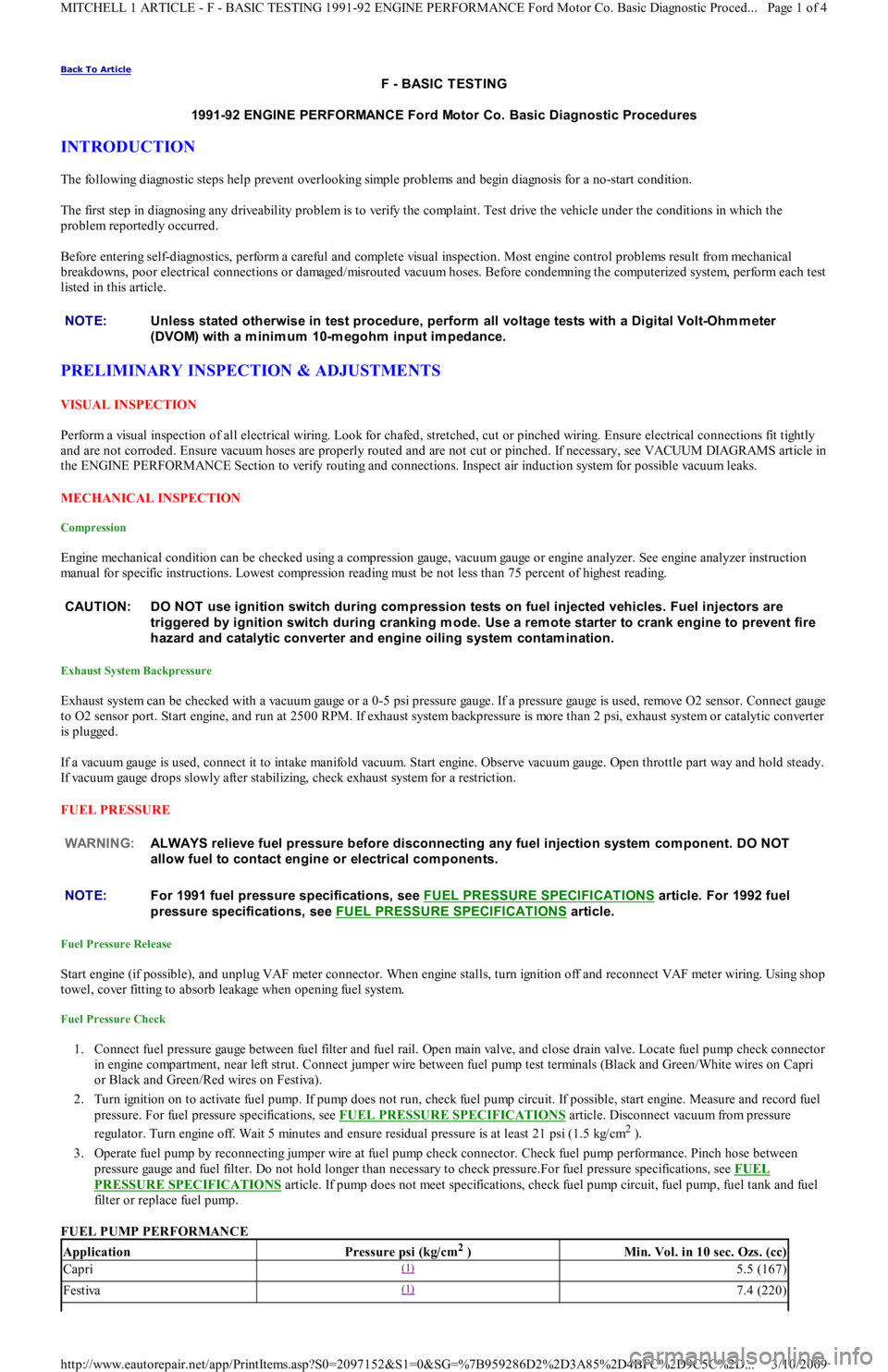
ApplicationPressure psi (kg/cm2 )Min. Vol. in 10 sec. Ozs. (cc)
Capri(1) 5.5 (167)
Festiva(1) 7.4 (220)
Page 1 of 4 MITCHELL 1 ARTICLE - F - BASIC TESTING 1991-92 ENGINE PERFORMANCE Ford Motor Co. Basic Diagnostic Proced
...
3/10/2009 http://www.eautorepair.net/app/PrintItems.asp?S0=2097152&S1=0&SG=%7B959286D2%2D3A85%2D4BFC%2D9C5C%2D
...
Page 157 of 454
Fuel Pump Circuit
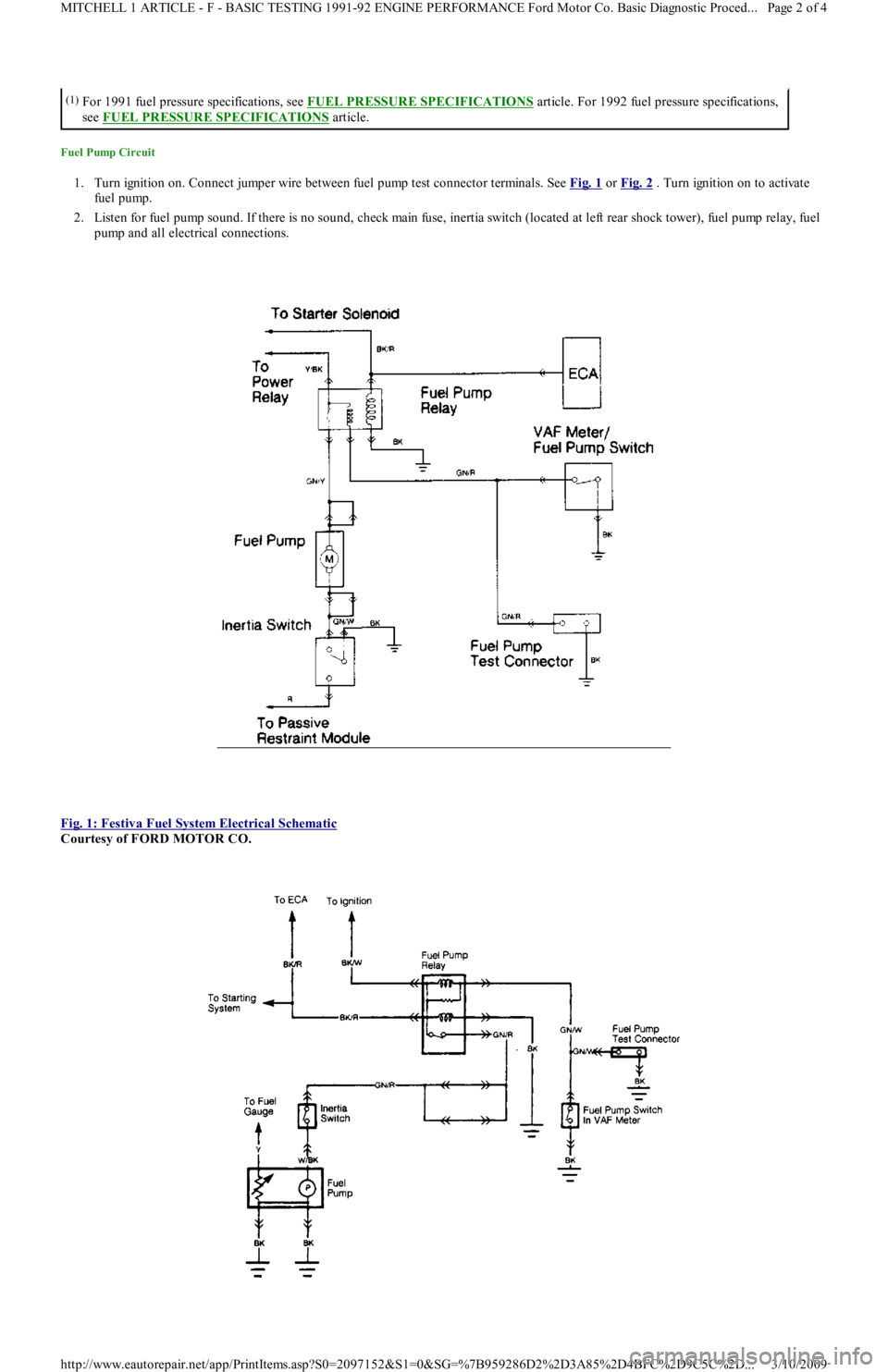
1. Turn ignition on. Connect jumper wire between fuel pump test connector terminals. See Fig. 1 or Fig. 2 . Turn ignition on to activate
fuel pump.
2. Listen for fuel pump sound. If there is no sound, check main fuse, inertia switch (located at left rear shock tower), fuel pump rel ay, fu el
pump and all electrical connections.
Fig. 1: Festiva Fuel System Electrical Schematic
Courtesy of FORD MOTOR CO.
(1)For 1991 fuel pressure specifications, see FUEL PRESSURE SPECIFICATIONS article. For 1992 fuel pressure specifications,
see FUEL PRESSURE SPECIFICATIONS
article.
Page 2 of 4 MITCHELL 1 ARTICLE - F - BASIC TESTING 1991-92 ENGINE PERFORMANCE Ford Motor Co. Basic Diagnostic Proced
...
3/10/2009 http://www.eautorepair.net/app/PrintItems.asp?S0=2097152&S1=0&SG=%7B959286D2%2D3A85%2D4BFC%2D9C5C%2D
...
Page 158 of 454
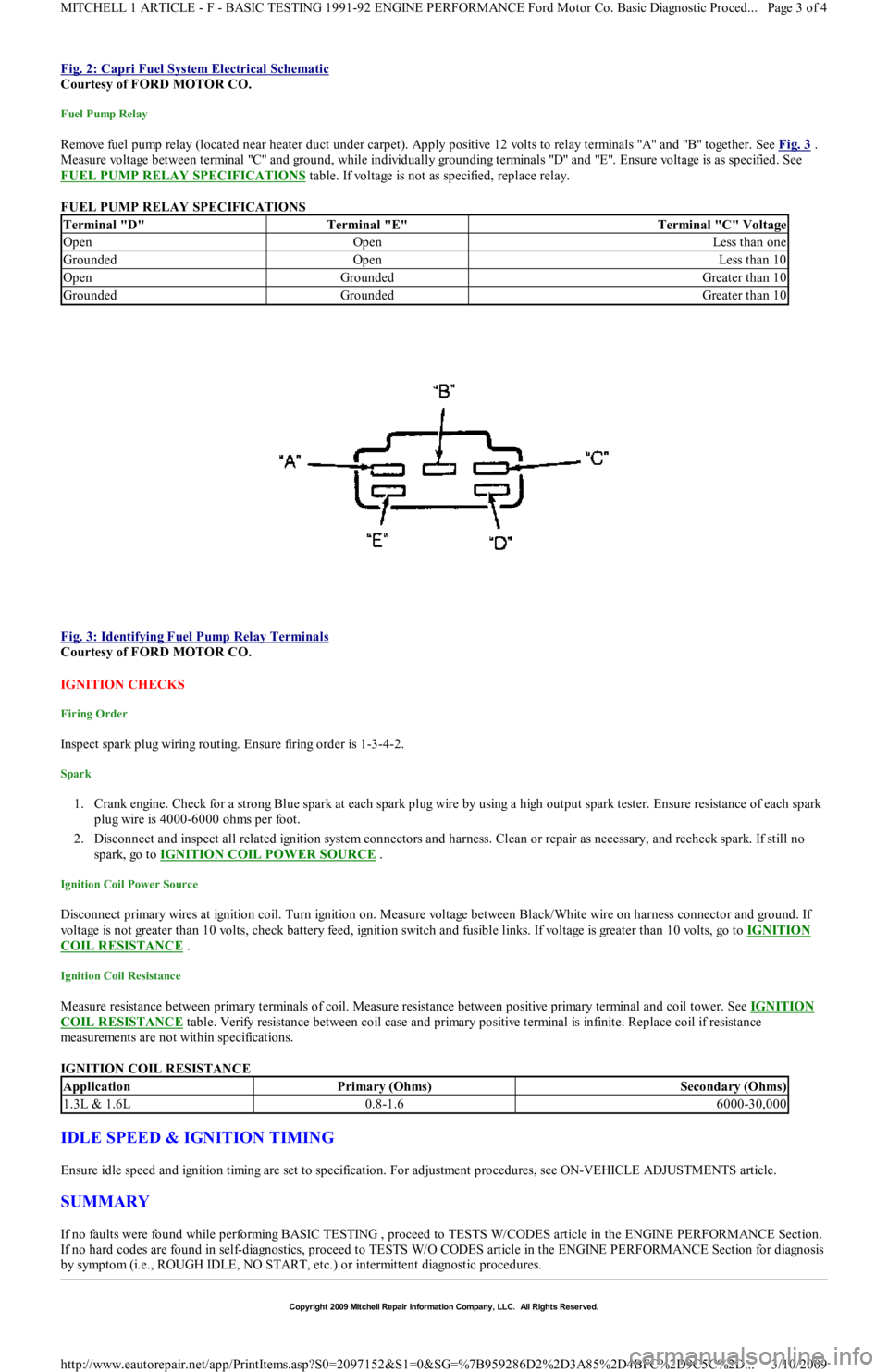
Fig. 2: Capri Fuel System Electrical Schematic
Courtesy of FORD MOTOR CO.
Fuel Pump Relay
Remove fuel pump relay (located near heater duct under carpet). Apply positive 12 volts to relay terminals "A" and "B" together. See Fig. 3 .
Measure voltage between terminal "C" and ground, while individually grounding terminals "D" and "E". Ensure voltage is as specified. See
FUEL PUMP RELAY SPECIFICATIONS
table. If voltage is not as specified, replace relay.
FUEL PUMP RELAY SPECIFICATIONS
Fig. 3: Identifying Fuel Pump Relay Terminals
Courtesy of FORD MOTOR CO.
IGNITION CHECKS
Firing Order
Inspect spark plug wiring routing. Ensure firing order is 1-3-4-2.
Spark
1. Crank engine. Check for a strong Blue spark at each spark plug wire by using a high output spark tester. Ensure resistance of each spark
plug wire is 4000-6000 ohms per foot.
2. Disconnect and inspect all related ignition system connectors and harness. Clean or repair as necessary, and recheck spark. If st il l n o
spark, go to IGNITION COIL POWER SOURCE
.
Ignition Coil Power Source
Disconnect primary wires at ignition coil. Turn ignition on. Measure voltage between Black/White wire on harness connector and ground. If
voltage is not greater than 10 volts, check battery feed, ignition switch and fusible links. If voltage is greater than 10 volts, go to IGNITION
COIL RESISTANCE .
Ignition Coil Resistance
Measure resistance between primary terminals of coil. Measure resistance between positive primary terminal and coil tower. See IGNITION
COIL RESISTANCE table. Verify resistance between coil case and primary positive terminal is infinite. Replace coil if resistance
measurements are not within specifications.
IGNITION COIL RESISTANCE
IDLE SPEED & IGNITION TIMING
Ensure idle speed and ignition timing are set to specification. For adjustment procedures, see ON-VEHICLE ADJUSTMENTS article.
SUMMARY
If no faults were found while performing BASIC TESTING , proceed to TESTS W/CODES article in the ENGINE PERFORMANCE Section.
If no hard codes are found in self-diagnostics, proceed to TESTS W/O CODES article in the ENGINE PERFORMANCE Section for diagnosis
by symptom (i.e., ROUGH IDLE, NO START, etc.) or intermittent diagnostic procedures.
Terminal "D"Terminal "E"Terminal "C" Voltage
OpenOpenLess than one
GroundedOpenLess than 10
OpenGroundedGreater than 10
GroundedGroundedGreater than 10
ApplicationPrimary (Ohms)Secondary (Ohms)
1.3L & 1.6L0.8-1.66000-30,000
Copyr ight 2009 Mitchell Repair Information Company, LLC. All Rights Reserved.
Page 3 of 4 MITCHELL 1 ARTICLE - F - BASIC TESTING 1991-92 ENGINE PERFORMANCE Ford Motor Co. Basic Diagnostic Proced
...
3/10/2009 http://www.eautorepair.net/app/PrintItems.asp?S0=2097152&S1=0&SG=%7B959286D2%2D3A85%2D4BFC%2D9C5C%2D
...
Page 172 of 454
WIGGLE TEST
Checking Circuitry
1. Visually inspect suspected sensor, switch, or solenoid. Enter WIGGLE TEST if using Super Star II tester. If using VOM, connect it to
STO terminal on self-test connector, and ground STI self-test connector terminal. Lightly tap sensor, switch, or solenoid.
2. Push and pull on suspected sensor, switch, or solenoid connector, but DO NOT unplug it. Test and wiggle harness vigorously, working
in small sections, from suspected device toward dash panel, and from dash panel to ECA.
3. If VOM or Super Star II tester does not display a positive indication of an intermittent defect, carefully disconnect suspected device.
Remove terminals from connector.
4. Inspect terminals at both ends for corrosion, bad crimps, or improperly seated terminals. Reconnect after inspection. Unplug harness
fro m E CA.
5. Inspect ECA and harness connector terminals for corrosion, bad crimps, or improperly seated terminals. If VOM does not indicate any
intermittent defect, reconnect wiring and erase codes.
PINPOINT TESTS
HOW TO USE PINPOINT TESTS
1. DO NOT perform any PINPOINT TEST unless directed by a QUICK TESTS procedure. Ensure all non-EEC related defects are
corrected. Follow each test step in order until defect is found. DO NOT replace any part unless so directed. When more than one service
code exists, start with first code displayed.
2. PINPOINT TESTS require ensuring electrical circuits are okay before replacing sensors or any other components. Always test circuits
for continuity between sensor and ECA. Test all circuits for shorts to power, opens, or shorts to ground. VREF and VPWR circuits
should be tested with KOEO or as specified in PINPOINT TESTS.
3. DO NOT measure voltage or resistance at ECA, or connect any test light unless specified in testing procedure. DO NOT pierce wiring.
Isolate both ends of a circuit and turn key off whenever checking for shorts or continuity, unless otherwise specified.
4. Disconnect solenoids and switches before checking circuit continuity or energizing solenoids.
5. An open is defined as any resistance greater than 10,000 ohms, unless otherwise specified.
6. To help diagnose circuits to ECA, turn ignition off and disconnect ECA harness. Connect BOB between ECA and ECA harness to
perform circuit and pinpoint tests.
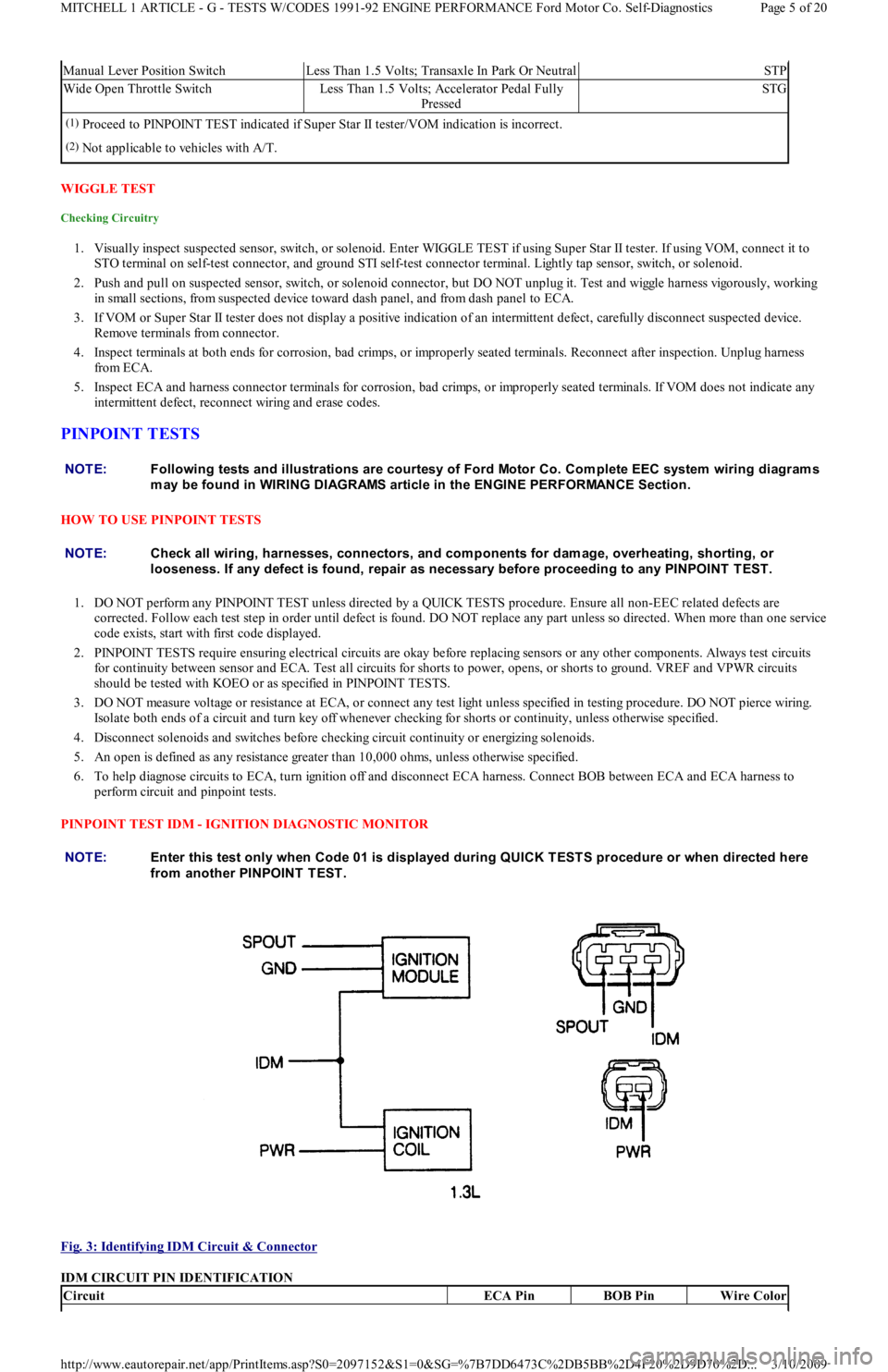
PINPOINT TEST IDM - IGNITION DIAGNOSTIC MONITOR
Fig. 3: Identifying IDM Circuit & Connector
IDM CIRCUIT PIN IDENTIFICATION
Manual Lever Position SwitchLess Than 1.5 Volts; Transaxle In Park Or NeutralSTP
Wide Open Throttle SwitchLess Than 1.5 Volts; Accelerator Pedal Fully
PressedSTG
(1)Proceed to PINPOINT TEST indicated if Super Star II tester/VOM indication is incorrect.
(2)Not applicable to vehicles with A/T.
NOTE:Following tests and illustrations are courtesy of Ford Motor Co. Com plete EEC system wiring diagram s
m ay be found in WIRING DIAGRAMS article in the ENGINE PERFORMANCE Section.
NOTE:Check all wiring, harnesses, connectors, and com ponents for dam age, overheating, shorting, or
looseness. If any defect is found, repair as necessary before proceeding to any PINPOINT T EST .
NOTE:Enter this test only when Code 01 is displayed during QUICK T EST S procedure or when directed here
from another PINPOINT TEST.
CircuitECA PinBOB PinWire Color
Page 5 of 20 MITCHELL 1 ARTICLE - G - TESTS W/CODES 1991-92 ENGINE PERFORMANCE Ford Motor Co. Self-Diagnostics
3/10/2009 http://www.eautorepair.net/app/PrintItems.asp?S0=2097152&S1=0&SG=%7B7DD6473C%2DB5BB%2D4F20%2D9D70%2D
...
Page 235 of 454
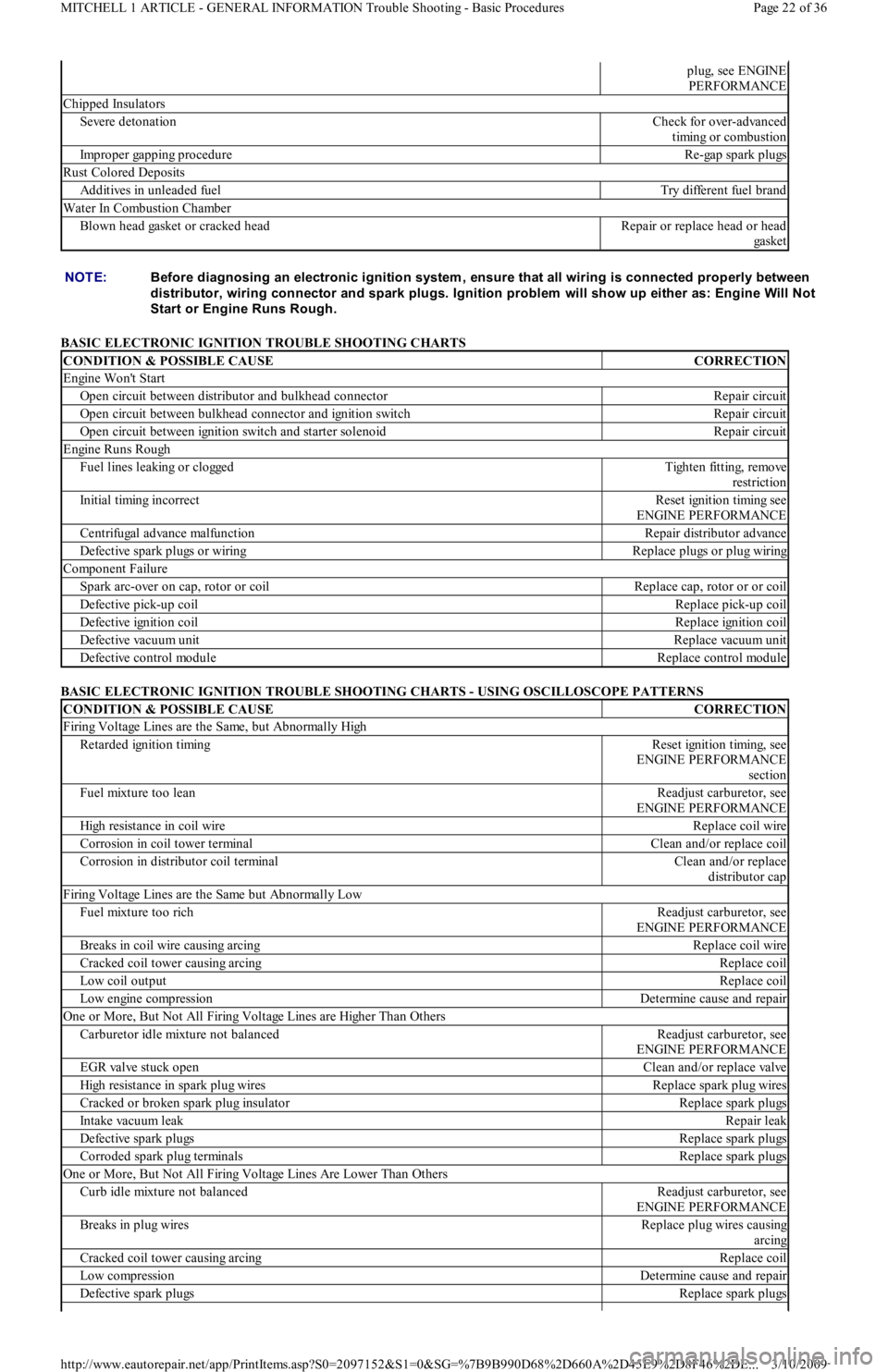
BASIC ELECTRONIC IGNITION TROUBLE SHOOTING CHARTS
BASIC ELECTRONIC IGNITION TROUBLE SHOOTING CHARTS - USING OSCILLOSCOPE PATTERNS
plug, see ENGINE
PERFORMANCE
Chipped Insulators
Severe detonationCheck for over-advanced
timing or combustion
Improper gapping procedureRe-gap spark plugs
Rust Colored Deposits
Additives in unleaded fuelTry different fuel brand
Water In Combustion Chamber
Blown head gasket or cracked headRepair or replace head or head
ga ske t
NOTE:Before diagnosing an electronic ignition system , ensure that all wiring is connected properly between
distributor, wiring connector and spark plugs. Ignition problem will show up either as: Engine Will Not
Start or Engine Runs Rough.
CONDITION & POSSIBLE CAUSECORRECTION
Engine Won't Start
Open circuit between distributor and bulkhead connectorRepair circuit
Open circuit between bulkhead connector and ignition switchRepair circuit
Open circuit between ignition switch and starter solenoidRepair circuit
Engine Runs Rough
Fuel lines leaking or cloggedTigh t e n fit t in g, r e mo ve
restriction
Initial timing incorrectReset ignition timing see
ENGINE PERFORMANCE
Centrifugal advance malfunctionRepair distributor advance
Defective spark plugs or wiringReplace plugs or plug wiring
Component Failure
Spark arc-over on cap, rotor or coilReplace cap, rotor or or coil
Defective pick-up coilReplace pick-up coil
Defective ignition coilReplace ignition coil
Defective vacuum unitReplace vacuum unit
Defective control moduleReplace control module
CONDITION & POSSIBLE CAUSECORRECTION
Firing Voltage Lines are the Same, but Abnormally High
Retarded ignition timingReset ignition timing, see
ENGINE PERFORMANCE
section
Fuel mixture too leanReadjust carburetor, see
ENGINE PERFORMANCE
High resistance in coil wireReplace coil wire
Corrosion in coil tower terminalClean and/or replace coil
Corrosion in distributor coil terminalClean and/or replace
distributor cap
Firing Voltage Lines are the Same but Abnormally Low
Fuel mixture too richReadjust carburetor, see
ENGINE PERFORMANCE
Breaks in coil wire causing arcingReplace coil wire
Cracked coil tower causing arcingReplace coil
Low coil outputReplace coil
Low engine compressionDetermine cause and repair
One or More, But Not All Firing Voltage Lines are Higher Than Others
Carburetor idle mixture not balancedReadjust carburetor, see
ENGINE PERFORMANCE
EGR valve stuck openClean and/or replace valve
High resistance in spark plug wiresReplace spark plug wires
Cracked or broken spark plug insulatorReplace spark plugs
Intake vacuum leakRepair leak
Defective spark plugsReplace spark plugs
Corroded spark plug terminalsReplace spark plugs
One or More, But Not All Firing Voltage Lines Are Lower Than Others
Curb idle mixture not balancedReadjust carburetor, see
ENGINE PERFORMANCE
Breaks in plug wiresReplace plug wires causing
arcing
Cracked coil tower causing arcingReplace coil
Low compressionDetermine cause and repair
Defective spark plugsReplace spark plugs
Page 22 of 36 MITCHELL 1 ARTICLE - GENERAL INFORMATION Trouble Shooting - Basic Procedures
3/10/2009 http://www.eautorepair.net/app/PrintItems.asp?S0=2097152&S1=0&SG=%7B9B990D68%2D660A%2D45E9%2D8F46%2DE
...