length FORD FIESTA 1989 Service User Guide
[x] Cancel search | Manufacturer: FORD, Model Year: 1989, Model line: FIESTA, Model: FORD FIESTA 1989Pages: 296, PDF Size: 10.65 MB
Page 47 of 296
the crankshaft pulley, then with a spanner
engaged on the crankshaft pulley bolt, turn
the crankshaft over to set the engine at TDC
for No 1 piston on compression (see Sec-
tion 3).
8Remove the camshaft sprocket as
described in Section 9.
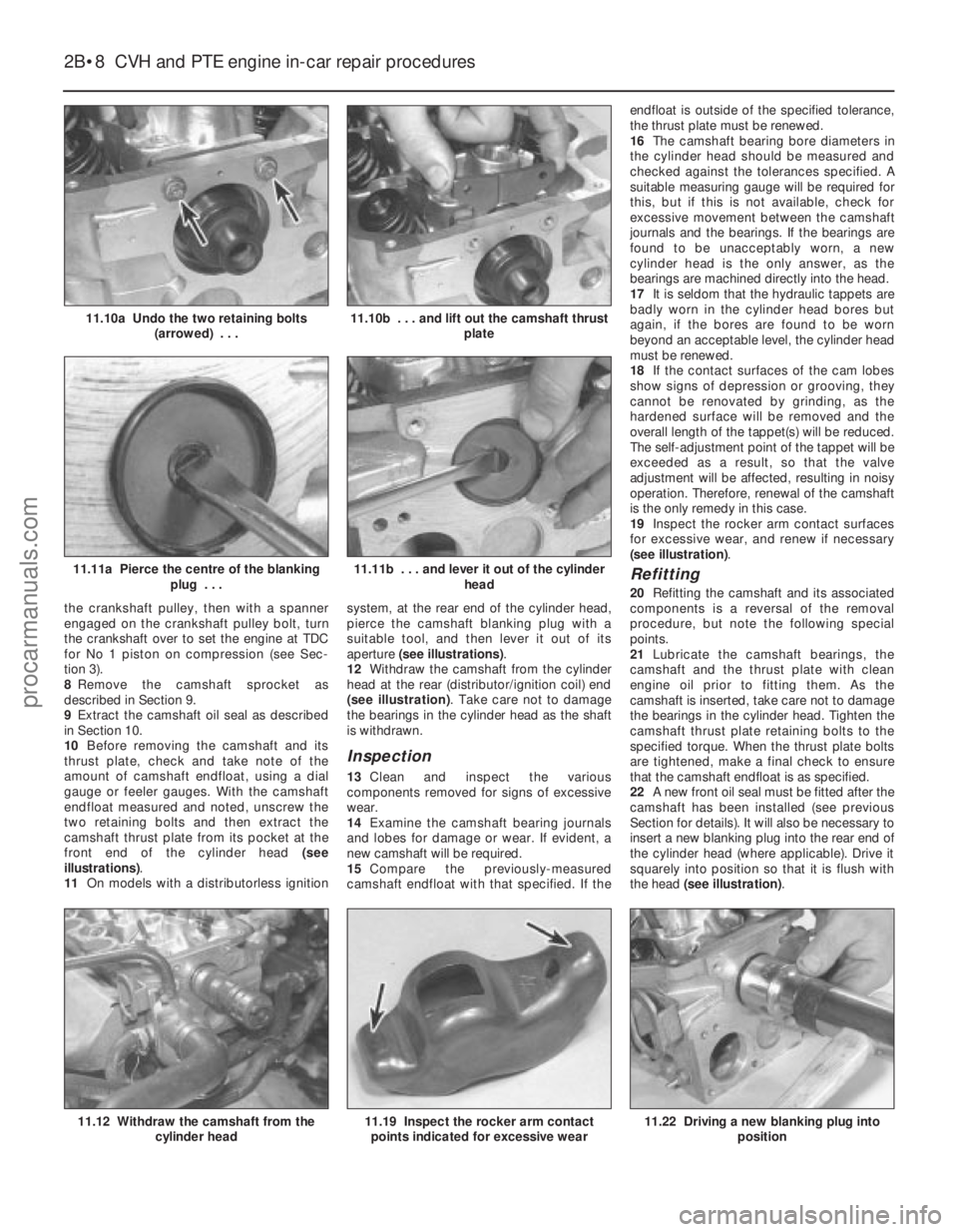
9 Extract the camshaft oil seal as described
in Section 10.
10 Before removing the camshaft and its
thrust plate, check and take note of the
amount of camshaft endfloat, using a dial
gauge or feeler gauges. With the camshaft
endfloat measured and noted, unscrew the
two retaining bolts and then extract the
camshaft thrust plate from its pocket at the
front end of the cylinder head (see
illustrations) .
11 On models with a distributorless ignition system, at the rear end of the cylinder head,
pierce the camshaft blanking plug with a
suitable tool, and then lever it out of its
aperture
(see illustrations) .
12 Withdraw the camshaft from the cylinder
head at the rear (distributor/ignition coil) end
(see illustration) . Take care not to damage
the bearings in the cylinder head as the shaft
is withdrawn.
Inspection
13 Clean and inspect the various
components removed for signs of excessive
wear.
14 Examine the camshaft bearing journals
and lobes for damage or wear. If evident, a
new camshaft will be required.
15 Compare the previously-measured
camshaft endfloat with that specified. If the endfloat is outside of the specified tolerance,
the thrust plate must be renewed.
16
The camshaft bearing bore diameters in
the cylinder head should be measured and
checked against the tolerances specified. A
suitable measuring gauge will be required for
this, but if this is not available, check for
excessive movement between the camshaft
journals and the bearings. If the bearings are
found to be unacceptably worn, a new
cylinder head is the only answer, as the
bearings are machined directly into the head.
17 It is seldom that the hydraulic tappets are
badly worn in the cylinder head bores but
again, if the bores are found to be worn
beyond an acceptable level, the cylinder head
must be renewed.
18 If the contact surfaces of the cam lobes
show signs of depression or grooving, they
cannot be renovated by grinding, as the
hardened surface will be removed and the
overall length of the tappet(s) will be reduced.
The self-adjustment point of the tappet will be
exceeded as a result, so that the valve
adjustment will be affected, resulting in noisy
operation. Therefore, renewal of the camshaft
is the only remedy in this case.
19 Inspect the rocker arm contact surfaces
for excessive wear, and renew if necessary
(see illustration) .
Refitting
20Refitting the camshaft and its associated
components is a reversal of the removal
procedure, but note the following special
points.
21 Lubricate the camshaft bearings, the
camshaft and the thrust plate with clean
engine oil prior to fitting them. As the
camshaft is inserted, take care not to damage
the bearings in the cylinder head. Tighten the
camshaft thrust plate retaining bolts to the
specified torque. When the thrust plate bolts
are tightened, make a final check to ensure
that the camshaft endfloat is as specified.
22 A new front oil seal must be fitted after the
camshaft has been installed (see previous
Section for details). It will also be necessary to
insert a new blanking plug into the rear end of
the cylinder head (where applicable). Drive it
squarely into position so that it is flush with
the head (see illustration) .
2B•8 CVH and PTE engine in-car repair procedures
11.22 Driving a new blanking plug into
position11.19 Inspect the rocker arm contactpoints indicated for excessive wear11.12 Withdraw the camshaft from the cylinder head
11.11b . . . and lever it out of the cylinder
head11.11a Pierce the centre of the blankingplug . . .
11.10b . . . and lift out the camshaft thrust plate11.10a Undo the two retaining bolts(arrowed) . . .
1595Ford Fiesta Remakeprocarmanuals.com
http://vnx.su
Page 58 of 296
home by hand, then tighten them securely, to
the specified torque wrench settings, where
given.
11Refit the auxiliary drivebelt as described in
Chapter 1 on completion.
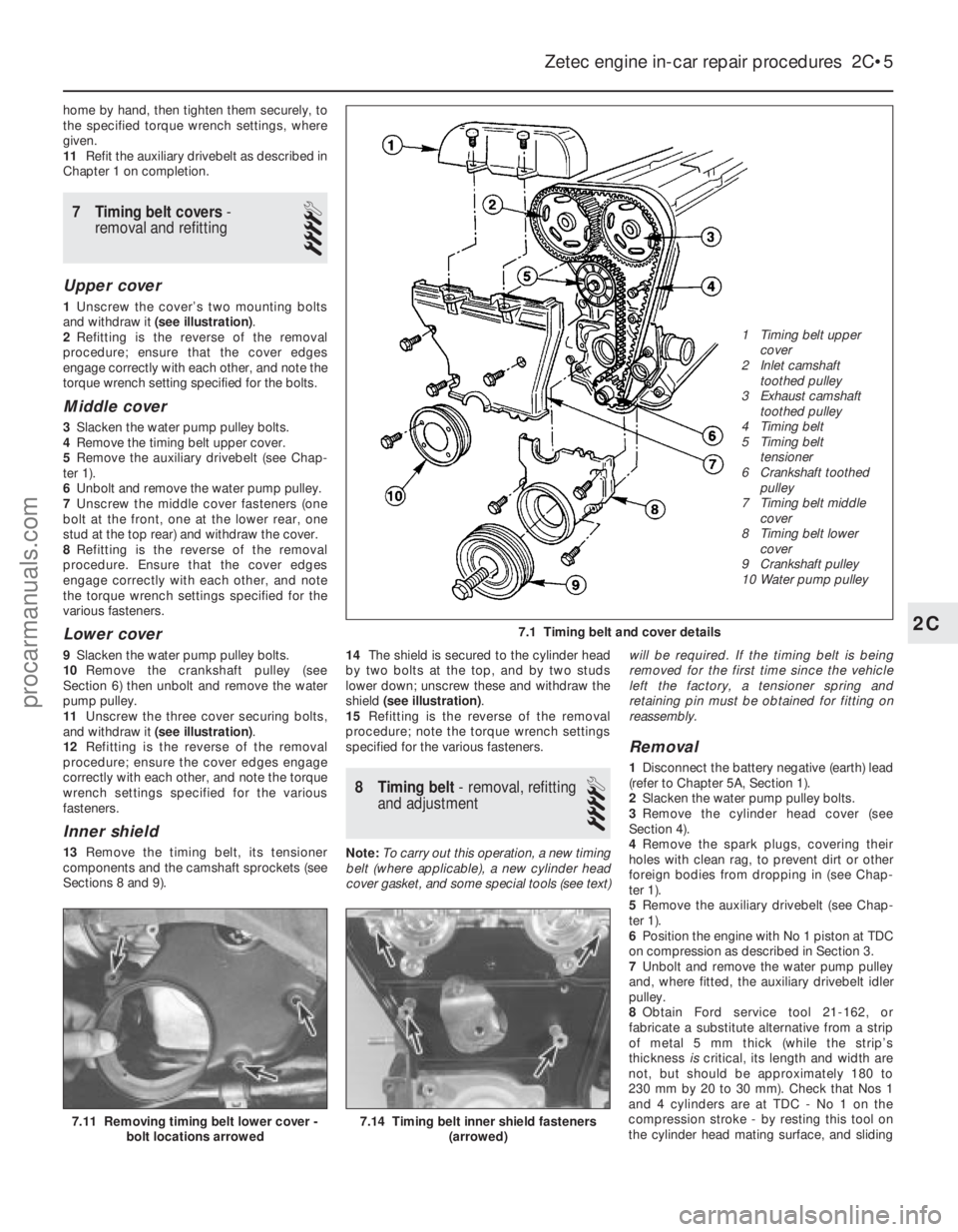
7 Timing belt covers -
removal and refitting
4
Upper cover
1 Unscrew the cover’s two mounting bolts
and withdraw it (see illustration) .
2 Refitting is the reverse of the removal
procedure; ensure that the cover edges
engage correctly with each other, and note the
torque wrench setting specified for the bolts.
Middle cover
3 Slacken the water pump pulley bolts.
4 Remove the timing belt upper cover.
5 Remove the auxiliary drivebelt (see Chap-
ter 1).
6 Unbolt and remove the water pump pulley.
7 Unscrew the middle cover fasteners (one
bolt at the front, one at the lower rear, one
stud at the top rear) and withdraw the cover.
8 Refitting is the reverse of the removal
procedure. Ensure that the cover edges
engage correctly with each other, and note
the torque wrench settings specified for the
various fasteners.
Lower cover
9 Slacken the water pump pulley bolts.
10 Remove the crankshaft pulley (see
Section 6) then unbolt and remove the water
pump pulley.
11 Unscrew the three cover securing bolts,
and withdraw it (see illustration) .
12 Refitting is the reverse of the removal
procedure; ensure the cover edges engage
correctly with each other, and note the torque
wrench settings specified for the various
fasteners.
Inner shield
13 Remove the timing belt, its tensioner
components and the camshaft sprockets (see
Sections 8 and 9). 14
The shield is secured to the cylinder head
by two bolts at the top, and by two studs
lower down; unscrew these and withdraw the
shield (see illustration) .
15 Refitting is the reverse of the removal
procedure; note the torque wrench settings
specified for the various fasteners.
8 Timing belt - removal, refitting
and adjustment
4
Note: To carry out this operation, a new timing
belt (where applicable), a new cylinder head
cover gasket, and some special tools (see text) will be required. If the timing belt is being
removed for the first time since the vehicle
left the factory, a tensioner spring and
retaining pin must be obtained for fitting on
reassembly.
Removal
1
Disconnect the battery negative (earth) lead
(refer to Chapter 5A, Section 1).
2 Slacken the water pump pulley bolts.
3 Remove the cylinder head cover (see
Section 4).
4 Remove the spark plugs, covering their
holes with clean rag, to prevent dirt or other
foreign bodies from dropping in (see Chap-
ter 1).
5 Remove the auxiliary drivebelt (see Chap-
ter 1).
6 Position the engine with No 1 piston at TDC
on compression as described in Section 3.
7 Unbolt and remove the water pump pulley
and, where fitted, the auxiliary drivebelt idler
pulley.
8 Obtain Ford service tool 21-162, or
fabricate a substitute alternative from a strip
of metal 5 mm thick (while the strip’s
thickness iscritical, its length and width are
not, but should be approximately 180 to
230 mm by 20 to 30 mm). Check that Nos 1
and 4 cylinders are at TDC - No 1 on the
compression stroke - by resting this tool on
the cylinder head mating surface, and sliding
Zetec engine in-car repair procedures 2C•5
7.11 Removing timing belt lower cover - bolt locations arrowed7.14 Timing belt inner shield fasteners (arrowed)
7.1 Timing belt and cover details2C
1595Ford Fiesta Remake 1 Timing belt upper
cover
2 Inlet camshaft
toothed pulley
3 Exhaust camshaft
toothed pulley
4 Timing belt
5 Timing belt
tensioner
6 Crankshaft toothed pulley
7 Timing belt middle cover
8 Timing belt lower
cover
9 Crankshaft pulley
10 Water pump pulleyprocarmanuals.com
http://vnx.su
Page 59 of 296
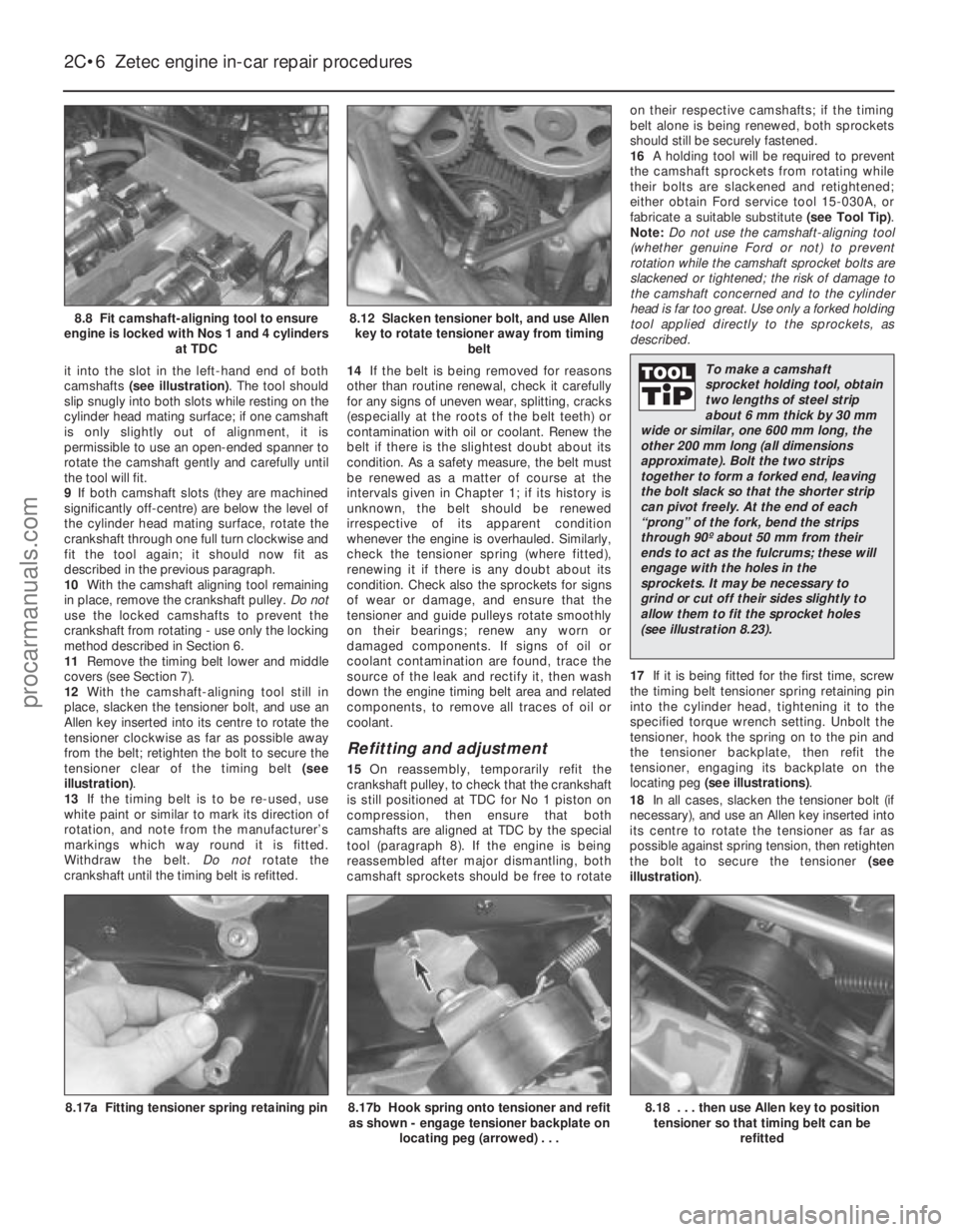
it into the slot in the left-hand end of both
camshafts (see illustration) . The tool should
slip snugly into both slots while resting on the
cylinder head mating surface; if one camshaft
is only slightly out of alignment, it is
permissible to use an open-ended spanner to
rotate the camshaft gently and carefully until
the tool will fit.
9 If both camshaft slots (they are machined
significantly off-centre) are below the level of
the cylinder head mating surface, rotate the
crankshaft through one full turn clockwise and
fit the tool again; it should now fit as
described in the previous paragraph.
10 With the camshaft aligning tool remaining
in place, remove the crankshaft pulley. Do not
use the locked camshafts to prevent the
crankshaft from rotating - use only the locking
method described in Section 6.
11 Remove the timing belt lower and middle
covers (see Section 7).
12 With the camshaft-aligning tool still in
place, slacken the tensioner bolt, and use an
Allen key inserted into its centre to rotate the
tensioner clockwise as far as possible away
from the belt; retighten the bolt to secure the
tensioner clear of the timing belt (see
illustration) .
13 If the timing belt is to be re-used, use
white paint or similar to mark its direction of
rotation, and note from the manufacturer’s
markings which way round it is fitted.
Withdraw the belt. Do notrotate the
crankshaft until the timing belt is refitted. 14
If the belt is being removed for reasons
other than routine renewal, check it carefully
for any signs of uneven wear, splitting, cracks
(especially at the roots of the belt teeth) or
contamination with oil or coolant. Renew the
belt if there is the slightest doubt about its
condition. As a safety measure, the belt must
be renewed as a matter of course at the
intervals given in Chapter 1; if its history is
unknown, the belt should be renewed
irrespective of its apparent condition
whenever the engine is overhauled. Similarly,
check the tensioner spring (where fitted),
renewing it if there is any doubt about its
condition. Check also the sprockets for signs
of wear or damage, and ensure that the
tensioner and guide pulleys rotate smoothly
on their bearings; renew any worn or
damaged components. If signs of oil or
coolant contamination are found, trace the
source of the leak and rectify it, then wash
down the engine timing belt area and related
components, to remove all traces of oil or
coolant.
Refitting and adjustment
15 On reassembly, temporarily refit the
crankshaft pulley, to check that the crankshaft
is still positioned at TDC for No 1 piston on
compression, then ensure that both
camshafts are aligned at TDC by the special
tool (paragraph 8). If the engine is being
reassembled after major dismantling, both
camshaft sprockets should be free to rotate on their respective camshafts; if the timing
belt alone is being renewed, both sprockets
should still be securely fastened.
16
A holding tool will be required to prevent
the camshaft sprockets from rotating while
their bolts are slackened and retightened;
either obtain Ford service tool 15-030A, or
fabricate a suitable substitute (see Tool Tip).
Note: Do not use the camshaft-aligning tool
(whether genuine Ford or not) to prevent
rotation while the camshaft sprocket bolts are
slackened or tightened; the risk of damage to
the camshaft concerned and to the cylinder
head is far too great. Use only a forked holding
tool applied directly to the sprockets, as
described.
17 If it is being fitted for the first time, screw
the timing belt tensioner spring retaining pin
into the cylinder head, tightening it to the
specified torque wrench setting. Unbolt the
tensioner, hook the spring on to the pin and
the tensioner backplate, then refit the
tensioner, engaging its backplate on the
locating peg (see illustrations) .
18 In all cases, slacken the tensioner bolt (if
necessary), and use an Allen key inserted into
its centre to rotate the tensioner as far as
possible against spring tension, then retighten
the bolt to secure the tensioner (see
illustration) .
2C•6Zetec engine in-car repair procedures
8.18 . . . then use Allen key to position
tensioner so that timing belt can be
refitted8.17b Hook spring onto tensioner and refitas shown - engage tensioner backplate on
locating peg (arrowed) . . .8.17a Fitting tensioner spring retaining pin
8.12 Slacken tensioner bolt, and use Allenkey to rotate tensioner away from timing belt8.8 Fit camshaft-aligning tool to ensure
engine is locked with Nos 1 and 4 cylinders at TDC
1595Ford Fiesta Remake
To make a camshaft
sprocket holding tool, obtain
two lengths of steel strip
about 6 mm thick by 30 mm
wide or similar, one 600 mm long, the
other 200 mm long (all dimensions
approximate). Bolt the two strips
together to form a forked end, leaving
the bolt slack so that the shorter strip
can pivot freely. At the end of each
“prong” of the fork, bend the strips
through 90º about 50 mm from their
ends to act as the fulcrums; these will
engage with the holes in the
sprockets. It may be necessary to
grind or cut off their sides slightly to
allow them to fit the sprocket holes
(see illustration 8.23).
procarmanuals.com
http://vnx.su
Page 70 of 296
 . . . . . . . . . . . . . . . . . . . . . . . . . . . . . . . . . . . .\")
2D
1595Ford Fiesta Remake
HCS engines
Cylinder head
Maximum permissible gasket surface distortion (measured over
full length) . . . . . . . . . . . . . . . . . . . . . . . . . . . . . . . . . . . .\
. . . . . . . . . . . . 0.15 mm
Valve seat angle (inlet and exhaust) . . . . . . . . . . . . . . . . . . . . . . . . . . . . 45º
Valve seat width (inlet and exhaust) . . . . . . . . . . . . . . . . . . . . . . . . . . . . 1.18 to 1.75 mm*
*The inlet and exhaust valves have special inserts which cannot be recut\
using conventional tools.
Valves - generalInletExhaust
Valve length . . . . . . . . . . . . . . . . . . . . . . . . . . . . . . . . . . . .\
. . . . . . . . . . 103.7 to 104.4 mm 104.2 to 104.7 mm
Valve head diameter: 1.0 and 1.1 litre engines . . . . . . . . . . . . . . . . . . . . . . . . . . . . . . . . . . . 32.90 to 33.10 mm 28.90 to 29.10 mm
1.3 litre engines . . . . . . . . . . . . . . . . . . . . . . . . . . . . . . . . . . . .\
. . . . . . 34.40 to 34.60 mm 28.90 to 29.10 mm
Valve stem diameter . . . . . . . . . . . . . . . . . . . . . . . . . . . . . . . . . . . .\
. . . . 7.0 mm 7.0 mm
Valve stem-to-guide clearance . . . . . . . . . . . . . . . . . . . . . . . . . . . . . . . . 0.020 to 0.069 0.046 to 0.095
Cylinder block
Cylinder bore diameter: 1.0 and 1.1 litre engines:
Standard class 1 (or A) . . . . . . . . . . . . . . . . . . . . . . . . . . . . . . . . . . 68.68 to 68.69 mm
Standard class 2 (or B) . . . . . . . . . . . . . . . . . . . . . . . . . . . . . . . . . . 68.69 to 68.70 mm
Standard class 3 (or C) . . . . . . . . . . . . . . . . . . . . . . . . . . . . . . . . . . 68.70 to 68.71 mm
Oversize 0.5 mm . . . . . . . . . . . . . . . . . . . . . . . . . . . . . . . . . . . .\
. . . 69.20 to 69.21 mm
Oversize 1.0 mm . . . . . . . . . . . . . . . . . . . . . . . . . . . . . . . . . . . .\
. . . 69.70 to 69.71 mm
1.3 litre engines:
Standard class 1 . . . . . . . . . . . . . . . . . . . . . . . . . . . . . . . . . . . .\
. . . 73.94 to 73.95 mm
Standard class 2 . . . . . . . . . . . . . . . . . . . . . . . . . . . . . . . . . . . .\
. . . 73.50 to 73.96 mm
Standard class 3 . . . . . . . . . . . . . . . . . . . . . . . . . . . . . . . . . . . .\
. . . 73.96 to 73.97 mm
Oversize 0.5 mm . . . . . . . . . . . . . . . . . . . . . . . . . . . . . . . . . . . .\
. . . 74.50 to 74.51 mm
Oversize 1.0 mm . . . . . . . . . . . . . . . . . . . . . . . . . . . . . . . . . . . .\
. . . 75.00 to 75.01 mm
Chapter 2 Part D:
Engine removal and overhaul procedures
Camshaft and tappets - removal, inspection and refitting (HCS engines) . . . . . . . . . . . . . . . . . . . . . . . . . . . . . . . . . . . .\
. . . . 10
Crankshaft - refitting and main bearing running clearance check . . . . . . . . . . . . . . . . . . . . . . . . . . . . . . . . . . . .\
. . . . . . . . . . . 17
Crankshaft - removal and inspection . . . . . . . . . . . . . . . . . . . . . . . . 12
Cylinder block/crankcase - cleaning and inspection . . . . . . . . . . . . 13
Cylinder head - dismantling . . . . . . . . . . . . . . . . . . . . . . . . . . . . . . . 7
Cylinder head - reassembly . . . . . . . . . . . . . . . . . . . . . . . . . . . . . . . 9
Cylinder head and valve components - cleaning and inspection . . . 8
Engine - initial start-up after overhaul . . . . . . . . . . . . . . . . . . . . . . . . 19
Engine - removal and refitting (HCS engines) . . . . . . . . . . . . . . . . . . 3
Engine overhaul - preliminary information . . . . . . . . . . . . . . . . . . . . . 6 Engine overhaul - reassembly sequence . . . . . . . . . . . . . . . . . . . . . 15
Engine/transmission removal - preparation and precautions . . . . . . 2
Engine/transmission - removal and refitting (CVH and
PTE engines) . . . . . . . . . . . . . . . . . . . . . . . . . . . . . . . . . . . .\
. . . . . 4
Engine/transmission - removal and refitting (Zetec engines) . . . . . . 5
General information . . . . . . . . . . . . . . . . . . . . . . . . . . . . . . . . . . . .\
. . 1
Main and big-end bearings - inspection . . . . . . . . . . . . . . . . . . . . . . 14
Piston/connecting rod assemblies - refitting and big-end
bearing running clearance check . . . . . . . . . . . . . . . . . . . . . . . . . 18
Piston/connecting rod assemblies - removal and inspection . . . . . . 11
Piston rings - refitting . . . . . . . . . . . . . . . . . . . . . . . . . . . . . . . . . . . .\
16
2D•1
Specifications Contents
Easy, suitable for
novice with little
experience Fairly easy,
suitable
for beginner with
some experience Fairly difficult,
suitable for competent
DIY mechanic
Difficult,
suitable for
experienced DIY
mechanic Very difficult,
suitable for expert DIY
or professional
Degrees of difficulty
54321
procarmanuals.com
http://vnx.su
Page 71 of 296
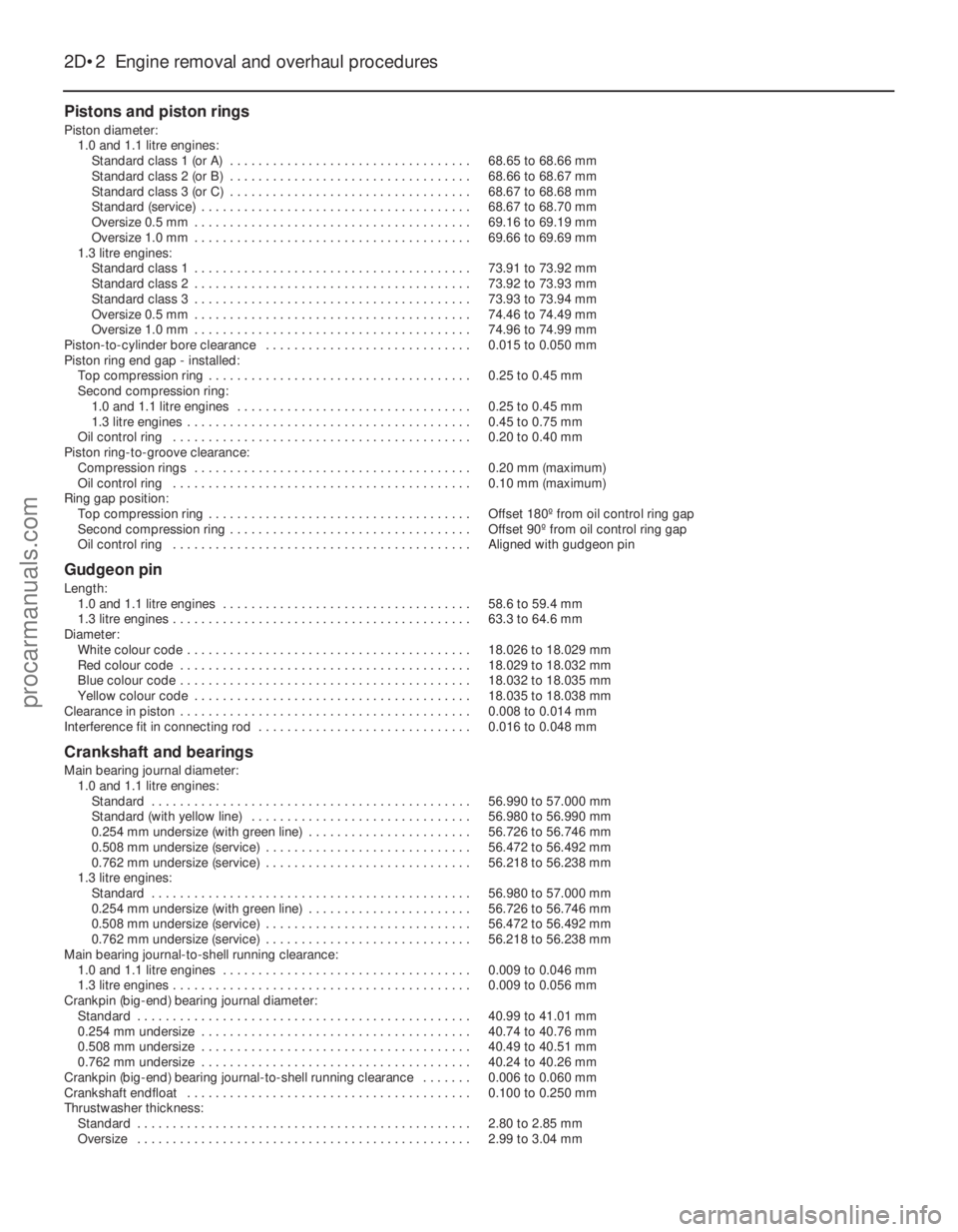
Pistons and piston rings
Piston diameter:1.0 and 1.1 litre engines:
Standard class 1 (or A) . . . . . . . . . . . . . . . . . . . . . . . . . . . . . . . . . . 68.65 to 68.66 mm
Standard class 2 (or B) . . . . . . . . . . . . . . . . . . . . . . . . . . . . . . . . . . 68.66 to 68.67 mm
Standard class 3 (or C) . . . . . . . . . . . . . . . . . . . . . . . . . . . . . . . . . . 68.67 to 68.68 mm
Standard (service) . . . . . . . . . . . . . . . . . . . . . . . . . . . . . . . . . . . .\
. . 68.67 to 68.70 mm
Oversize 0.5 mm . . . . . . . . . . . . . . . . . . . . . . . . . . . . . . . . . . . .\
. . . 69.16 to 69.19 mm
Oversize 1.0 mm . . . . . . . . . . . . . . . . . . . . . . . . . . . . . . . . . . . .\
. . . 69.66 to 69.69 mm
1.3 litre engines:
Standard class 1 . . . . . . . . . . . . . . . . . . . . . . . . . . . . . . . . . . . .\
. . . 73.91 to 73.92 mm
Standard class 2 . . . . . . . . . . . . . . . . . . . . . . . . . . . . . . . . . . . .\
. . . 73.92 to 73.93 mm
Standard class 3 . . . . . . . . . . . . . . . . . . . . . . . . . . . . . . . . . . . .\
. . . 73.93 to 73.94 mm
Oversize 0.5 mm . . . . . . . . . . . . . . . . . . . . . . . . . . . . . . . . . . . .\
. . . 74.46 to 74.49 mm
Oversize 1.0 mm . . . . . . . . . . . . . . . . . . . . . . . . . . . . . . . . . . . .\
. . . 74.96 to 74.99 mm
Piston-to-cylinder bore clearance . . . . . . . . . . . . . . . . . . . . . . . . . . . . . 0.015 to 0.050 mm
Piston ring end gap - installed: Top compression ring . . . . . . . . . . . . . . . . . . . . . . . . . . . . . . . . . . . .\
. 0.25 to 0.45 mmSecond compression ring: 1.0 and 1.1 litre engines . . . . . . . . . . . . . . . . . . . . . . . . . . . . . . . . . 0.25 to 0.45 mm
1.3 litre engines . . . . . . . . . . . . . . . . . . . . . . . . . . . . . . . . . . . .\
. . . . 0.45 to 0.75 mm
Oil control ring . . . . . . . . . . . . . . . . . . . . . . . . . . . . . . . . . . . .\
. . . . . . 0.20 to 0.40 mm
Piston ring-to-groove clearance: Compression rings . . . . . . . . . . . . . . . . . . . . . . . . . . . . . . . . . . . .\
. . . 0.20 mm (maximum)
Oil control ring . . . . . . . . . . . . . . . . . . . . . . . . . . . . . . . . . . . .\
. . . . . . 0.10 mm (maximum)
Ring gap position: Top compression ring . . . . . . . . . . . . . . . . . . . . . . . . . . . . . . . . . . . .\
. Offset 180º from oil control ring gap
Second compression ring . . . . . . . . . . . . . . . . . . . . . . . . . . . . . . . . . . Offset 90º from oil control ring gap
Oil control ring . . . . . . . . . . . . . . . . . . . . . . . . . . . . . . . . . . . .\
. . . . . . Aligned with gudgeon pin
Gudgeon pin
Length: 1.0 and 1.1 litre engines . . . . . . . . . . . . . . . . . . . . . . . . . . . . . . . . . . . 58.6 to 59.4 mm
1.3 litre engines . . . . . . . . . . . . . . . . . . . . . . . . . . . . . . . . . . . .\
. . . . . . 63.3 to 64.6 mm
Diameter:
White colour code . . . . . . . . . . . . . . . . . . . . . . . . . . . . . . . . . . . .\
. . . . 18.026 to 18.029 mm
Red colour code . . . . . . . . . . . . . . . . . . . . . . . . . . . . . . . . . . . .\
. . . . . 18.029 to 18.032 mm
Blue colour code . . . . . . . . . . . . . . . . . . . . . . . . . . . . . . . . . . . .\
. . . . . 18.032 to 18.035 mm
Yellow colour code . . . . . . . . . . . . . . . . . . . . . . . . . . . . . . . . . . . .\
. . . 18.035 to 18.038 mm
Clearance in piston . . . . . . . . . . . . . . . . . . . . . . . . . . . . . . . . . . . .\
. . . . . 0.008 to 0.014 mm
Interference fit in connecting rod . . . . . . . . . . . . . . . . . . . . . . . . . . . . . . 0.016 to 0.048 mm
Crankshaft and bearings
Main bearing journal diameter: 1.0 and 1.1 litre engines:
Standard . . . . . . . . . . . . . . . . . . . . . . . . . . . . . . . . . . . .\
. . . . . . . . . 56.990 to 57.000 mm
Standard (with yellow line) . . . . . . . . . . . . . . . . . . . . . . . . . . . . . . . 56.980 to 56.990 mm
0.254 mm undersize (with green line) . . . . . . . . . . . . . . . . . . . . . . . 56.726 to 56.746 mm
0.508 mm undersize (service) . . . . . . . . . . . . . . . . . . . . . . . . . . . . . 56.472 to 56.492 mm
0.762 mm undersize (service) . . . . . . . . . . . . . . . . . . . . . . . . . . . . . 56.218 to 56.238 mm
1.3 litre engines: Standard . . . . . . . . . . . . . . . . . . . . . . . . . . . . . . . . . . . .\
. . . . . . . . . 56.980 to 57.000 mm
0.254 mm undersize (with green line) . . . . . . . . . . . . . . . . . . . . . . . 56.726 to 56.746 mm
0.508 mm undersize (service) . . . . . . . . . . . . . . . . . . . . . . . . . . . . . 56.472 to 56.492 mm
0.762 mm undersize (service) . . . . . . . . . . . . . . . . . . . . . . . . . . . . . 56.218 to 56.238 mm
Main bearing journal-to-shell running clearance:
1.0 and 1.1 litre engines . . . . . . . . . . . . . . . . . . . . . . . . . . . . . . . . . . . 0.009 to 0.046 mm
1.3 litre engines . . . . . . . . . . . . . . . . . . . . . . . . . . . . . . . . . . . .\
. . . . . . 0.009 to 0.056 mm
Crankpin (big-end) bearing journal diameter:
Standard . . . . . . . . . . . . . . . . . . . . . . . . . . . . . . . . . . . .\
. . . . . . . . . . . 40.99 to 41.01 mm
0.254 mm undersize . . . . . . . . . . . . . . . . . . . . . . . . . . . . . . . . . . . .\
. . 40.74 to 40.76 mm
0.508 mm undersize . . . . . . . . . . . . . . . . . . . . . . . . . . . . . . . . . . . .\
. . 40.49 to 40.51 mm
0.762 mm undersize . . . . . . . . . . . . . . . . . . . . . . . . . . . . . . . . . . . .\
. . 40.24 to 40.26 mm
Crankpin (big-end) bearing journal-to-shell running clearance . . . . . . . 0.006 to 0.060 mm
Crankshaft endfloat . . . . . . . . . . . . . . . . . . . . . . . . . . . . . . . . . . . .\
. . . . 0.100 to 0.250 mm
Thrustwasher thickness: Standard . . . . . . . . . . . . . . . . . . . . . . . . . . . . . . . . . . . .\
. . . . . . . . . . . 2.80 to 2.85 mm
Oversize . . . . . . . . . . . . . . . . . . . . . . . . . . . . . . . . . . . .\
. . . . . . . . . . . 2.99 to 3.04 mm
2D•2 Engine removal and overhaul procedures
1595Ford Fiesta Remakeprocarmanuals.com
http://vnx.su
Page 72 of 296

Camshaft
Endfloat . . . . . . . . . . . . . . . . . . . . . . . . . . . . . . . . . . . .\
. . . . . . . . . . . . . . 0.02 to 0.19 mm
Torque wrench settingsNmlbf ft
Main bearing cap . . . . . . . . . . . . . . . . . . . . . . . . . . . . . . . . . . . .\
. . . . . . 9570
* Crankpin (big-end) bearing cap bolts:
Stage 1 . . . . . . . . . . . . . . . . . . . . . . . . . . . . . . . . . . . .\
. . . . . . . . . . . . 4 3
Stage 2 . . . . . . . . . . . . . . . . . . . . . . . . . . . . . . . . . . . .\
. . . . . . . . . . . . Angle-tighten a further 90º
Engine-to-transmission bolts . . . . . . . . . . . . . . . . . . . . . . . . . . . . . . . . . 4130
* New bolts must be used
Note: Refer to Part A of this Chapter for remaining torque wrench settings.
CVH and PTE engines
Cylinder head
Maximum permissible gasket surface distortion (measured over
full length) . . . . . . . . . . . . . . . . . . . . . . . . . . . . . . . . . . . .\
. . . . . . . . . . . . 0.15 mm
Camshaft bearing bore diameters in cylinder head (standard): Bearing 1 . . . . . . . . . . . . . . . . . . . . . . . . . . . . . . . . . . . .\
. . . . . . . . . . . 44.783 to 44.808 mm
Bearing 2 . . . . . . . . . . . . . . . . . . . . . . . . . . . . . . . . . . . .\
. . . . . . . . . . . 45.033 to 45.058 mm
Bearing 3 . . . . . . . . . . . . . . . . . . . . . . . . . . . . . . . . . . . .\
. . . . . . . . . . . 45.283 to 45.308 mm
Bearing 4 . . . . . . . . . . . . . . . . . . . . . . . . . . . . . . . . . . . .\
. . . . . . . . . . . 45.533 to 45.558 mm
Bearing 5 . . . . . . . . . . . . . . . . . . . . . . . . . . . . . . . . . . . .\
. . . . . . . . . . . 45.783 to 45.808 mm
Camshaft bearing bore diameters in cylinder head (oversize): Bearing 1 . . . . . . . . . . . . . . . . . . . . . . . . . . . . . . . . . . . .\
. . . . . . . . . . . 45.188 to 45.163 mm
Bearing 2 . . . . . . . . . . . . . . . . . . . . . . . . . . . . . . . . . . . .\
. . . . . . . . . . . 45.438 to 45.413 mm
Bearing 3 . . . . . . . . . . . . . . . . . . . . . . . . . . . . . . . . . . . .\
. . . . . . . . . . . 45.668 to 45.663 mm
Bearing 4 . . . . . . . . . . . . . . . . . . . . . . . . . . . . . . . . . . . .\
. . . . . . . . . . . 45.938 to 45.913 mm
Bearing 5 . . . . . . . . . . . . . . . . . . . . . . . . . . . . . . . . . . . .\
. . . . . . . . . . . 46.188 to 46.163 mm
Valve tappet bore diameter (standard) . . . . . . . . . . . . . . . . . . . . . . . . . . 22.235 to 22.265 mm
Valve tappet bore diameter (oversize) . . . . . . . . . . . . . . . . . . . . . . . . . . 22.489 to 22.519 mm
Valve seat angle (inlet and exhaust) . . . . . . . . . . . . . . . . . . . . . . . . . . . . 44º 30’ to 45º 30’
Valve seat width (inlet and exhaust) . . . . . . . . . . . . . . . . . . . . . . . . . . . . 1.75 to 2.32 mm*
*The cylinder head has valve seat rings on the exhaust side. These valve\
seats cannot be recut with conventional tools.
Valves - generalInlet Exhaust
Valve length: 1.4 litre engine . . . . . . . . . . . . . . . . . . . . . . . . . . . . . . . . . . . .\
. . . . . . 136.29 to 136.75 mm 132.97 to 133.43 mm
1.6 litre engine . . . . . . . . . . . . . . . . . . . . . . . . . . . . . . . . . . . .\
. . . . . . 134.54 to 135.00 mm 131.57 to 132.03 mm
Valve head diameter:
1.4 litre engine . . . . . . . . . . . . . . . . . . . . . . . . . . . . . . . . . . . .\
. . . . . . 39.90 to 40.10 mm 33.90 to 34.10 mm
1.6 litre engine . . . . . . . . . . . . . . . . . . . . . . . . . . . . . . . . . . . .\
. . . . . . 41.90 to 42.10 mm 36.90 to 37.10 mm
Valve stem diameter (standard) . . . . . . . . . . . . . . . . . . . . . . . . . . . . . . . 8.025 to 8.043 mm 7.999 to 8.017 mm
Valve stem diameter (0.2 mm oversize) . . . . . . . . . . . . . . . . . . . . . . . . . 8.225 to 8.243 mm 8.199 to 8.217 mm
Valve stem diameter (0.4 mm oversize) . . . . . . . . . . . . . . . . . . . . . . . . . 8.425 to 8.443 mm 8.399 to 8.417 mm
Valve stem-to-guide clearance . . . . . . . . . . . . . . . . . . . . . . . . . . . . . . . . 0.020 to 0.063 mm 0.046 to 0.089 mm
Cylinder block
Cylinder bore diameter:
1.4 litre engine: Standard 1 . . . . . . . . . . . . . . . . . . . . . . . . . . . . . . . . . . . .\
. . . . . . . 77.22 to 77.23 mm
Standard 2 . . . . . . . . . . . . . . . . . . . . . . . . . . . . . . . . . . . .\
. . . . . . . 77.23 to 77.24 mm
Standard 3 . . . . . . . . . . . . . . . . . . . . . . . . . . . . . . . . . . . .\
. . . . . . . 77.24 to 77.25 mm
Standard 4 . . . . . . . . . . . . . . . . . . . . . . . . . . . . . . . . . . . .\
. . . . . . . 77.25 to 77.26 mm
Oversize A . . . . . . . . . . . . . . . . . . . . . . . . . . . . . . . . . . . .\
. . . . . . . . 77.51 to 77.52 mm
Oversize B . . . . . . . . . . . . . . . . . . . . . . . . . . . . . . . . . . . .\
. . . . . . . . 77.52 to 77.53 mm
Oversize C . . . . . . . . . . . . . . . . . . . . . . . . . . . . . . . . . . . .\
. . . . . . . . 77.53 to 77.54 mm
1.6 litre engine: Standard 1 . . . . . . . . . . . . . . . . . . . . . . . . . . . . . . . . . . . .\
. . . . . . . 79.94 to 79.95 mm
Standard 2 . . . . . . . . . . . . . . . . . . . . . . . . . . . . . . . . . . . .\
. . . . . . . 79.95 to 79.96 mm
Standard 3 . . . . . . . . . . . . . . . . . . . . . . . . . . . . . . . . . . . .\
. . . . . . . 79.96 to 79.97 mm
Standard 4 . . . . . . . . . . . . . . . . . . . . . . . . . . . . . . . . . . . .\
. . . . . . . 79.97 to 79.98 mm
Oversize A . . . . . . . . . . . . . . . . . . . . . . . . . . . . . . . . . . . .\
. . . . . . . . 80.23 to 80.24 mm
Oversize B . . . . . . . . . . . . . . . . . . . . . . . . . . . . . . . . . . . .\
. . . . . . . . 80.24 to 80.25 mm
Oversize C . . . . . . . . . . . . . . . . . . . . . . . . . . . . . . . . . . . .\
. . . . . . . . 80.25 to 80.26 mm
Engine removal and overhaul procedures 2D•3
2D
1595Ford Fiesta Remakeprocarmanuals.com
http://vnx.su
Page 73 of 296
:1.4 litre engine:
Standard 1 . . . . . . . . . . . . . . . . . . . . . . . . . . . . . . . . . . . .\
. . . . . . . 77.190 to 77.200 mm
Standard")
Pistons and piston ringsPiston diameter (production):1.4 litre engine:
Standard 1 . . . . . . . . . . . . . . . . . . . . . . . . . . . . . . . . . . . .\
. . . . . . . 77.190 to 77.200 mm
Standard 2 . . . . . . . . . . . . . . . . . . . . . . . . . . . . . . . . . . . .\
. . . . . . . 77.200 to 77.210 mm
Standard 3 . . . . . . . . . . . . . . . . . . . . . . . . . . . . . . . . . . . .\
. . . . . . . 77.210 to 77.220 mm
Standard 4 . . . . . . . . . . . . . . . . . . . . . . . . . . . . . . . . . . . .\
. . . . . . . 77.220 to 77.230 mm
Oversize A . . . . . . . . . . . . . . . . . . . . . . . . . . . . . . . . . . . .\
. . . . . . . . 77.480 to 77.490 mm
Oversize B . . . . . . . . . . . . . . . . . . . . . . . . . . . . . . . . . . . .\
. . . . . . . . 77.490 to 77.500 mm
Oversize C . . . . . . . . . . . . . . . . . . . . . . . . . . . . . . . . . . . .\
. . . . . . . . 77.500 to 77.510 mm
1.6 litre carburettor engine and turbocharged engine:
Standard 1 . . . . . . . . . . . . . . . . . . . . . . . . . . . . . . . . . . . .\
. . . . . . . 79.910 to 79.920 mm
Standard 2 . . . . . . . . . . . . . . . . . . . . . . . . . . . . . . . . . . . .\
. . . . . . . 79.920 to 79.930 mm
Standard 3 . . . . . . . . . . . . . . . . . . . . . . . . . . . . . . . . . . . .\
. . . . . . . 79.930 to 79.940 mm
Standard 4 . . . . . . . . . . . . . . . . . . . . . . . . . . . . . . . . . . . .\
. . . . . . . 79.940 to 79.950 mm
Oversize A . . . . . . . . . . . . . . . . . . . . . . . . . . . . . . . . . . . .\
. . . . . . . . 80.200 to 80.210 mm
Oversize B . . . . . . . . . . . . . . . . . . . . . . . . . . . . . . . . . . . .\
. . . . . . . . 80.210 to 80.220 mm
Oversize C . . . . . . . . . . . . . . . . . . . . . . . . . . . . . . . . . . . .\
. . . . . . . . 80.220 to 80.230 mm
1.6 litre EFi (non-turbo) fuel injection engine: Standard 1 . . . . . . . . . . . . . . . . . . . . . . . . . . . . . . . . . . . .\
. . . . . . . 79.915 to 79.925 mm
Standard 2 . . . . . . . . . . . . . . . . . . . . . . . . . . . . . . . . . . . .\
. . . . . . . 79.925 to 79.935 mm
Standard 3 . . . . . . . . . . . . . . . . . . . . . . . . . . . . . . . . . . . .\
. . . . . . . 79.935 to 79.945 mm
Standard 4 . . . . . . . . . . . . . . . . . . . . . . . . . . . . . . . . . . . .\
. . . . . . . 79.945 to 79.955 mm
Oversize A . . . . . . . . . . . . . . . . . . . . . . . . . . . . . . . . . . . .\
. . . . . . . . 80.205 to 80.215 mm
Oversize B . . . . . . . . . . . . . . . . . . . . . . . . . . . . . . . . . . . .\
. . . . . . . . 80.215 to 80.225 mm
Oversize C . . . . . . . . . . . . . . . . . . . . . . . . . . . . . . . . . . . .\
. . . . . . . . 80.225 to 80.235 mm
Piston-to-cylinder bore clearance: 1.4 litre engine . . . . . . . . . . . . . . . . . . . . . . . . . . . . . . . . . . . .\
. . . . . . 0.020 to 0.040 mm
1.6 litre carburettor engine and turbocharged engine . . . . . . . . . . . . 0.020 to 0.040 mm
1.6 litre EFi (non-turbo) fuel injection engine . . . . . . . . . . . . . . . . . . . 0.015 to 0.035 mm
Piston ring end gaps - installed:
Compression rings . . . . . . . . . . . . . . . . . . . . . . . . . . . . . . . . . . . .\
. . . 0.30 to 0.50 mm
Oil control rings:1.4 litre engine . . . . . . . . . . . . . . . . . . . . . . . . . . . . . . . . . . . .\
. . . . . 0.40 to 1.40 mm
1.6 litre carburettor engine and turbocharged engine . . . . . . . . . . 0.40 to 1.40 mm
1.6 litre EFi (non-turbo) fuel injection engine . . . . . . . . . . . . . . . . . 0.25 to 0.40 mm
Gudgeon pins
Length:1.4 litre engine . . . . . . . . . . . . . . . . . . . . . . . . . . . . . . . . . . . .\
. . . . . . 63.000 to 63.800 mm
1.6 litre carburettor engine . . . . . . . . . . . . . . . . . . . . . . . . . . . . . . . . . 66.200 to 67.000 mm
1.6 litre EFi (non-turbo) fuel injection engine . . . . . . . . . . . . . . . . . . . 63.000 to 63.800 mm
1.6 litre turbocharged engine . . . . . . . . . . . . . . . . . . . . . . . . . . . . . . . 63.600 to 64.400 mm
Diameter: White colour code . . . . . . . . . . . . . . . . . . . . . . . . . . . . . . . . . . . .\
. . . . 20.622 to 20.625 mm
Red colour code . . . . . . . . . . . . . . . . . . . . . . . . . . . . . . . . . . . .\
. . . . . 20.625 to 20.628 mm
Blue colour code . . . . . . . . . . . . . . . . . . . . . . . . . . . . . . . . . . . .\
. . . . . 20.628 to 20.631 mm
Yellow colour code . . . . . . . . . . . . . . . . . . . . . . . . . . . . . . . . . . . .\
. . . 20.631 to 20.634 mm
Clearance in piston . . . . . . . . . . . . . . . . . . . . . . . . . . . . . . . . . . . .\
. . . . . 0.005 to 0.011 mm
Interference fit in connecting rod . . . . . . . . . . . . . . . . . . . . . . . . . . . . . . 0.013 to 0.045 mm
Crankshaft and bearings
Main bearing journal diameter:
Standard . . . . . . . . . . . . . . . . . . . . . . . . . . . . . . . . . . . .\
. . . . . . . . . . . 57.98 to 58.00 mm
0.25 mm undersize . . . . . . . . . . . . . . . . . . . . . . . . . . . . . . . . . . . .\
. . . 57.73 to 57.75 mm
0.50 mm undersize . . . . . . . . . . . . . . . . . . . . . . . . . . . . . . . . . . . .\
. . . 57.48 to 57.50 mm
0.75 mm undersize . . . . . . . . . . . . . . . . . . . . . . . . . . . . . . . . . . . .\
. . . 57.23 to 57.25 mm
Main bearing journal-to-shell running clearance . . . . . . . . . . . . . . . . . . 0.011 to 0.058 mm
Crankpin (big-end) bearing journal diameter: Standard . . . . . . . . . . . . . . . . . . . . . . . . . . . . . . . . . . . .\
. . . . . . . . . . . 47.89 to 47.91 mm
0.25 mm undersize . . . . . . . . . . . . . . . . . . . . . . . . . . . . . . . . . . . .\
. . . 47.64 to 47.66 mm
0.50 mm undersize . . . . . . . . . . . . . . . . . . . . . . . . . . . . . . . . . . . .\
. . . 47.39 to 47.41 mm
0.75 mm undersize . . . . . . . . . . . . . . . . . . . . . . . . . . . . . . . . . . . .\
. . . 47.14 to 47.16 mm
1.00 mm undersize . . . . . . . . . . . . . . . . . . . . . . . . . . . . . . . . . . . .\
. . . 46.89 to 46.91 mm
Crankpin (big-end) bearing journal-to-shell running clearance . . . . . . . 0.006 to 0.060 mm
Crankshaft endfloat . . . . . . . . . . . . . . . . . . . . . . . . . . . . . . . . . . . .\
. . . . 0.09 to 0.30 mm
Thrustwasher thickness: Standard . . . . . . . . . . . . . . . . . . . . . . . . . . . . . . . . . . . .\
. . . . . . . . . . . 2.301 to 2.351 mm
Oversize . . . . . . . . . . . . . . . . . . . . . . . . . . . . . . . . . . . .\
. . . . . . . . . . . 2.491 to 2.541 mm
2D•4 Engine removal and overhaul procedures
1595Ford Fiesta Remakeprocarmanuals.com
http://vnx.su
Page 74 of 296
 bearing caps . . . . . . . . . . . . . .")
Torque wrench settingsNmlbf ft
Main bearing caps . . . . . . . . . . . . . . . . . . . . . . . . . . . . . . . . . . . .\
. . . . . 9570
Crankpin (big-end) bearing caps . . . . . . . . . . . . . . . . . . . . . . . . . . . . . . 3324
Engine-to-transmission bolts . . . . . . . . . . . . . . . . . . . . . . . . . . . . . . . . . 4130
Note: Refer to Part B of this Chapter for remaining torque wrench settings.
Zetec engines
Cylinder head
Maximum permissible gasket surface distortion . . . . . . . . . . . . . . . . . . 0.10 mm
Valve seat included angle . . . . . . . . . . . . . . . . . . . . . . . . . . . . . . . . . . . .\
90º
Valve guide bore . . . . . . . . . . . . . . . . . . . . . . . . . . . . . . . . . . . .\
. . . . . . . 6.060 to 6.091 mm
Valves - generalInlet Exhaust
Valve length . . . . . . . . . . . . . . . . . . . . . . . . . . . . . . . . . . . .\
. . . . . . . . . . 96.870 to 97.330 mm 96.470 to 96.930 mm
Valve head diameter: 1.6 litre engine . . . . . . . . . . . . . . . . . . . . . . . . . . . . . . . . . . . .\
. . . . . . 26.0 mm 24.5 mm
1.8 litre engine . . . . . . . . . . . . . . . . . . . . . . . . . . . . . . . . . . . .\
. . . . . . 32.0 mm 28.0 mm
Valve stem diameter . . . . . . . . . . . . . . . . . . . . . . . . . . . . . . . . . . . .\
. . . . 6.028 to 6.043 mm 6.010 to 6.025 mm
Valve stem-to-guide clearance . . . . . . . . . . . . . . . . . . . . . . . . . . . . . . . . 0.017 to 0.064 mm 0.035 to 0.081 mm
Cylinder block
Cylinder bore diameter: 1.6 litre engine: Class 1 . . . . . . . . . . . . . . . . . . . . . . . . . . . . . . . . . . . .\
. . . . . . . . . . 76.000 to 76.010 mm
Class 2 . . . . . . . . . . . . . . . . . . . . . . . . . . . . . . . . . . . .\
. . . . . . . . . . 76.010 to 76.020 mm
Class 3 . . . . . . . . . . . . . . . . . . . . . . . . . . . . . . . . . . . .\
. . . . . . . . . . 76.020 to 76.030 mm
1.8 litre engine:
Class 1 . . . . . . . . . . . . . . . . . . . . . . . . . . . . . . . . . . . .\
. . . . . . . . . . 80.600 to 80.610 mm
Class 2 . . . . . . . . . . . . . . . . . . . . . . . . . . . . . . . . . . . .\
. . . . . . . . . . 80.610 to 80.620 mm
Class 3 . . . . . . . . . . . . . . . . . . . . . . . . . . . . . . . . . . . .\
. . . . . . . . . . 80.620 to 80.630 mm
Pistons and piston rings
Piston diameter1.6 litre engine: Class 1 . . . . . . . . . . . . . . . . . . . . . . . . . . . . . . . . . . . .\
. . . . . . . . . . 75.975 to 75.985 mm
Class 2 . . . . . . . . . . . . . . . . . . . . . . . . . . . . . . . . . . . .\
. . . . . . . . . . 75.985 to 75.995 mm
Class 3 . . . . . . . . . . . . . . . . . . . . . . . . . . . . . . . . . . . .\
. . . . . . . . . . 75.995 to 76.005 mm
1.8 litre engine:
Class 1 . . . . . . . . . . . . . . . . . . . . . . . . . . . . . . . . . . . .\
. . . . . . . . . . 80.570 to 80.580 mm
Class 2 . . . . . . . . . . . . . . . . . . . . . . . . . . . . . . . . . . . .\
. . . . . . . . . . 80.580 to 80.590 mm
Class 3 . . . . . . . . . . . . . . . . . . . . . . . . . . . . . . . . . . . .\
. . . . . . . . . . 80.590 to 80.600 mm
Oversizes - all engines . . . . . . . . . . . . . . . . . . . . . . . . . . . . . . . . . . . .\
None available
Piston-to-cylinder bore clearance . . . . . . . . . . . . . . . . . . . . . . . . . . . . . Not specified
Piston ring end gaps - installed: Compression rings . . . . . . . . . . . . . . . . . . . . . . . . . . . . . . . . . . . .\
. . . 0.30 to 0.50 mm
Oil control ring: 1.6 litre engine . . . . . . . . . . . . . . . . . . . . . . . . . . . . . . . . . . . .\
. . . . . 0.25 to 1.00 mm
1.8 litre engine . . . . . . . . . . . . . . . . . . . . . . . . . . . . . . . . . . . .\
. . . . . 0.38 to 1.14 mm
Gudgeon pin
Diameter:
White colour code/piston crown marked “A” . . . . . . . . . . . . . . . . . . . 20.622 to 20.625 mm
Red colour code/piston crown marked “B” . . . . . . . . . . . . . . . . . . . . 20.625 to 20.628 mm
Blue colour code/piston crown marked “C” . . . . . . . . . . . . . . . . . . . . 20.628 to 20.631 mm
Clearance in piston . . . . . . . . . . . . . . . . . . . . . . . . . . . . . . . . . . . .\
. . . . . 0.010 to 0.016 mm
Interference fit in connecting rod . . . . . . . . . . . . . . . . . . . . . . . . . . . . . . 0.011 to 0.042 mm
Crankshaft and bearings
Main bearing journal standard diameter . . . . . . . . . . . . . . . . . . . . . . . . . 57.980 to 58.000 mm Main bearing journal-to-shell running clearance . . . . . . . . . . . . . . . . . . 0.011 to 0.058 mm
Main bearing shell undersizes available . . . . . . . . . . . . . . . . . . . . . . . . . 0.02 mm, 0.25 mmCrankpin (big-end) bearing journal standard diameter . . . . . . . . . . . . . . 46.890 to 46.910 mm
Crankpin (big-end) bearing journal-to-shell running clearance . . . . . . . 0.016 to 0.070 mm
Big-end bearing shell undersizes available . . . . . . . . . . . . . . . . . . . . . . 0.02 mm, 0.25 mm
Crankshaft endfloat . . . . . . . . . . . . . . . . . . . . . . . . . . . . . . . . . . . .\
. . . . 0.090 to 0.310 mm
Engine removal and overhaul procedures 2D•5
2D
1595Ford Fiesta Remakeprocarmanuals.com
http://vnx.su
Page 84 of 296
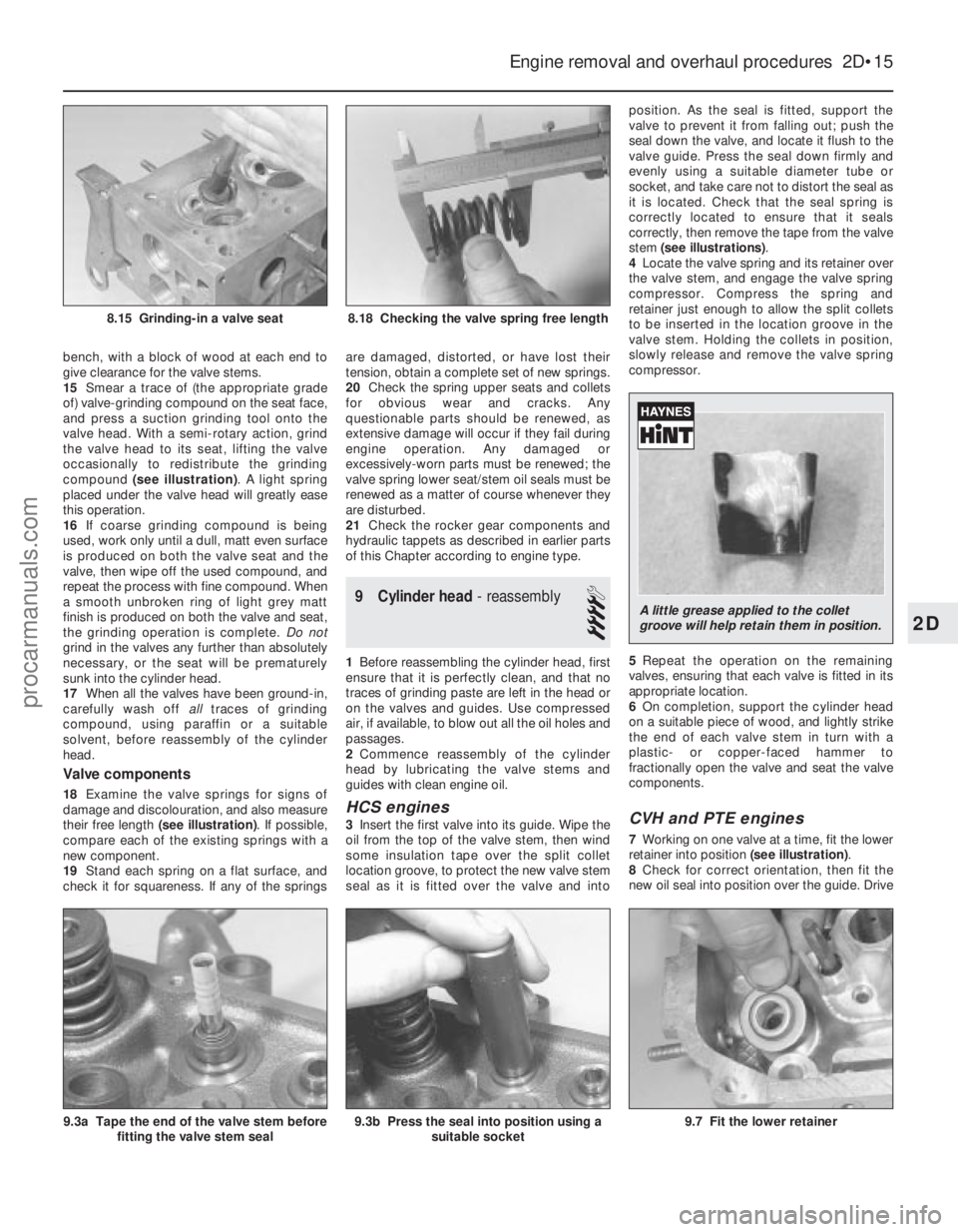
bench, with a block of wood at each end to
give clearance for the valve stems.
15Smear a trace of (the appropriate grade
of) valve-grinding compound on the seat face,
and press a suction grinding tool onto the
valve head. With a semi-rotary action, grind
the valve head to its seat, lifting the valve
occasionally to redistribute the grinding
compound (see illustration) . A light spring
placed under the valve head will greatly ease
this operation.
16 If coarse grinding compound is being
used, work only until a dull, matt even surface
is produced on both the valve seat and the
valve, then wipe off the used compound, and
repeat the process with fine compound. When
a smooth unbroken ring of light grey matt
finish is produced on both the valve and seat,
the grinding operation is complete. Do not
grind in the valves any further than absolutely
necessary, or the seat will be prematurely
sunk into the cylinder head.
17 When all the valves have been ground-in,
carefully wash off alltraces of grinding
compound, using paraffin or a suitable
solvent, before reassembly of the cylinder
head.
Valve components
18 Examine the valve springs for signs of
damage and discolouration, and also measure
their free length (see illustration) . If possible,
compare each of the existing springs with a
new component.
19 Stand each spring on a flat surface, and
check it for squareness. If any of the springs are damaged, distorted, or have lost their
tension, obtain a complete set of new springs.
20
Check the spring upper seats and collets
for obvious wear and cracks. Any
questionable parts should be renewed, as
extensive damage will occur if they fail during
engine operation. Any damaged or
excessively-worn parts must be renewed; the
valve spring lower seat/stem oil seals must be
renewed as a matter of course whenever they
are disturbed.
21 Check the rocker gear components and
hydraulic tappets as described in earlier parts
of this Chapter according to engine type.
9 Cylinder head - reassembly
4
1Before reassembling the cylinder head, first
ensure that it is perfectly clean, and that no
traces of grinding paste are left in the head or
on the valves and guides. Use compressed
air, if available, to blow out all the oil holes and
passages.
2 Commence reassembly of the cylinder
head by lubricating the valve stems and
guides with clean engine oil.
HCS engines
3 Insert the first valve into its guide. Wipe the
oil from the top of the valve stem, then wind
some insulation tape over the split collet
location groove, to protect the new valve stem
seal as it is fitted over the valve and into position. As the seal is fitted, support the
valve to prevent it from falling out; push the
seal down the valve, and locate it flush to the
valve guide. Press the seal down firmly and
evenly using a suitable diameter tube or
socket, and take care not to distort the seal as
it is located. Check that the seal spring is
correctly located to ensure that it seals
correctly, then remove the tape from the valve
stem (see illustrations)
.
4 Locate the valve spring and its retainer over
the valve stem, and engage the valve spring
compressor. Compress the spring and
retainer just enough to allow the split collets
to be inserted in the location groove in the
valve stem. Holding the collets in position,
slowly release and remove the valve spring
compressor.
5 Repeat the operation on the remaining
valves, ensuring that each valve is fitted in its
appropriate location.
6 On completion, support the cylinder head
on a suitable piece of wood, and lightly strike
the end of each valve stem in turn with a
plastic- or copper-faced hammer to
fractionally open the valve and seat the valve
components.CVH and PTE engines
7 Working on one valve at a time, fit the lower
retainer into position (see illustration).
8 Check for correct orientation, then fit the
new oil seal into position over the guide. Drive
Engine removal and overhaul procedures 2D•15
9.3a Tape the end of the valve stem before fitting the valve stem seal
8.18 Checking the valve spring free length8.15 Grinding-in a valve seat
9.7 Fit the lower retainer9.3b Press the seal into position using a suitable socket
2D
1595Ford Fiesta Remake
A little grease applied to the collet
groove will help retain them in position.
procarmanuals.com
http://vnx.su
Page 99 of 296
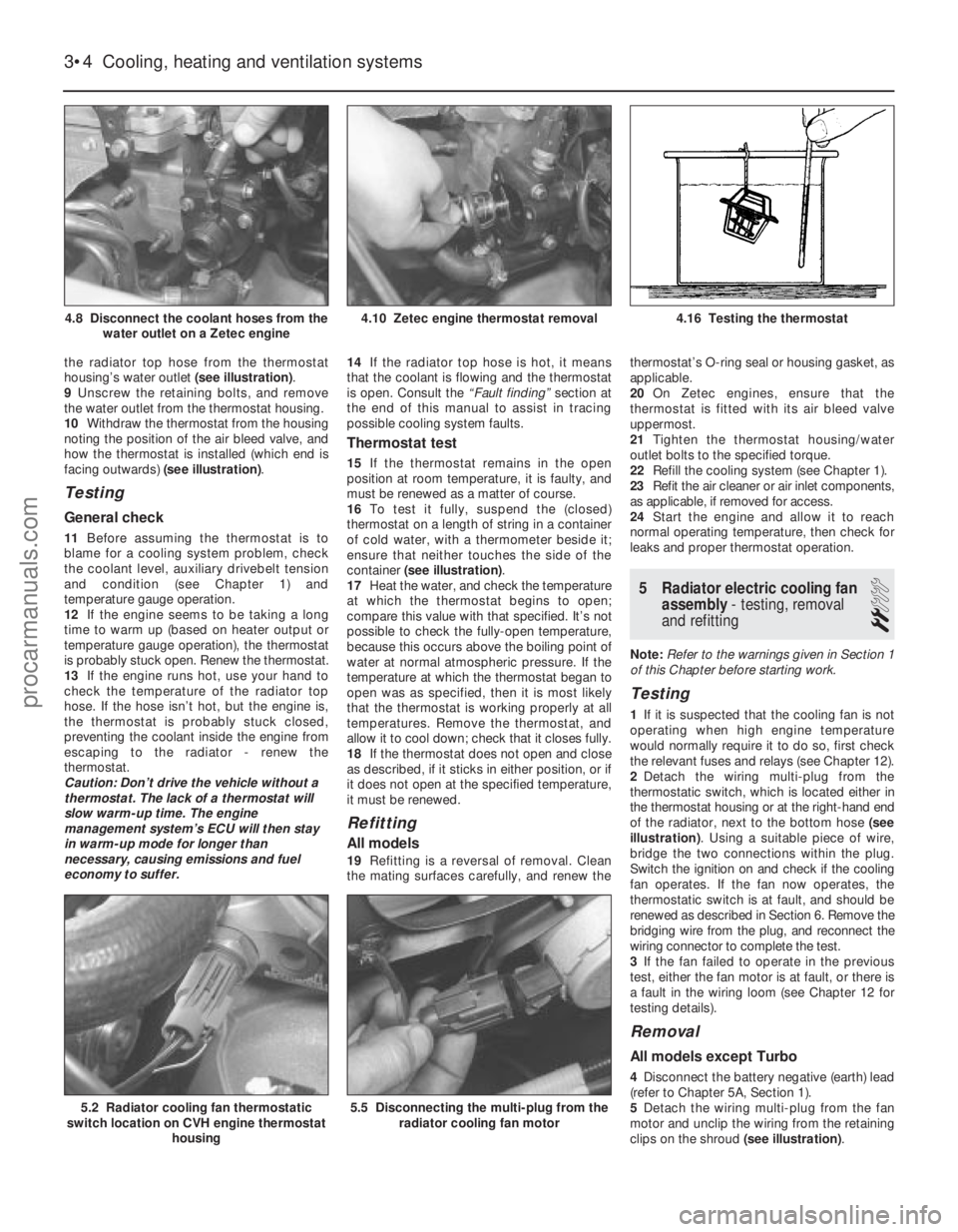
the radiator top hose from the thermostat
housing’s water outlet (see illustration).
9 Unscrew the retaining bolts, and remove
the water outlet from the thermostat housing.
10 Withdraw the thermostat from the housing
noting the position of the air bleed valve, and
how the thermostat is installed (which end is
facing outwards) (see illustration).
Testing
General check
11Before assuming the thermostat is to
blame for a cooling system problem, check
the coolant level, auxiliary drivebelt tension
and condition (see Chapter 1) and
temperature gauge operation.
12 If the engine seems to be taking a long
time to warm up (based on heater output or
temperature gauge operation), the thermostat
is probably stuck open. Renew the thermostat.
13 If the engine runs hot, use your hand to
check the temperature of the radiator top
hose. If the hose isn’t hot, but the engine is,
the thermostat is probably stuck closed,
preventing the coolant inside the engine from
escaping to the radiator - renew the
thermostat.
Caution: Don’t drive the vehicle without a
thermostat. The lack of a thermostat will
slow warm-up time. The engine
management system’s ECU will then stay
in warm-up mode for longer than
necessary, causing emissions and fuel
economy to suffer. 14
If the radiator top hose is hot, it means
that the coolant is flowing and the thermostat
is open. Consult the “Fault finding” section at
the end of this manual to assist in tracing
possible cooling system faults.
Thermostat test
15 If the thermostat remains in the open
position at room temperature, it is faulty, and
must be renewed as a matter of course.
16 To test it fully, suspend the (closed)
thermostat on a length of string in a container
of cold water, with a thermometer beside it;
ensure that neither touches the side of the
container (see illustration) .
17 Heat the water, and check the temperature
at which the thermostat begins to open;
compare this value with that specified. It’s not
possible to check the fully-open temperature,
because this occurs above the boiling point of
water at normal atmospheric pressure. If the
temperature at which the thermostat began to
open was as specified, then it is most likely
that the thermostat is working properly at all
temperatures. Remove the thermostat, and
allow it to cool down; check that it closes fully.
18 If the thermostat does not open and close
as described, if it sticks in either position, or if
it does not open at the specified temperature,
it must be renewed.
Refitting
All models
19 Refitting is a reversal of removal. Clean
the mating surfaces carefully, and renew the thermostat’s O-ring seal or housing gasket, as
applicable.
20
On Zetec engines, ensure that the
thermostat is fitted with its air bleed valve
uppermost.
21 Tighten the thermostat housing/water
outlet bolts to the specified torque.
22 Refill the cooling system (see Chapter 1).
23 Refit the air cleaner or air inlet components,
as applicable, if removed for access.
24 Start the engine and allow it to reach
normal operating temperature, then check for
leaks and proper thermostat operation.
5 Radiator electric cooling fan assembly - testing, removal
and refitting
2
Note: Refer to the warnings given in Section 1
of this Chapter before starting work.
Testing
1 If it is suspected that the cooling fan is not
operating when high engine temperature
would normally require it to do so, first check
the relevant fuses and relays (see Chapter 12).
2 Detach the wiring multi-plug from the
thermostatic switch, which is located either in
the thermostat housing or at the right-hand end
of the radiator, next to the bottom hose (see
illustration) . Using a suitable piece of wire,
bridge the two connections within the plug.
Switch the ignition on and check if the cooling
fan operates. If the fan now operates, the
thermostatic switch is at fault, and should be
renewed as described in Section 6. Remove the
bridging wire from the plug, and reconnect the
wiring connector to complete the test.
3 If the fan failed to operate in the previous
test, either the fan motor is at fault, or there is
a fault in the wiring loom (see Chapter 12 for
testing details).
Removal
All models except Turbo
4 Disconnect the battery negative (earth) lead
(refer to Chapter 5A, Section 1).
5 Detach the wiring multi-plug from the fan
motor and unclip the wiring from the retaining
clips on the shroud (see illustration).
3•4 Cooling, heating and ventilation systems
5.5 Disconnecting the multi-plug from the
radiator cooling fan motor5.2 Radiator cooling fan thermostatic
switch location on CVH engine thermostat
housing
4.16 Testing the thermostat4.10 Zetec engine thermostat removal4.8 Disconnect the coolant hoses from thewater outlet on a Zetec engine
1595Ford Fiesta Remakeprocarmanuals.com
http://vnx.su