check engine FORD FIESTA 1989 Service Manual PDF
[x] Cancel search | Manufacturer: FORD, Model Year: 1989, Model line: FIESTA, Model: FORD FIESTA 1989Pages: 296, PDF Size: 10.65 MB
Page 77 of 296
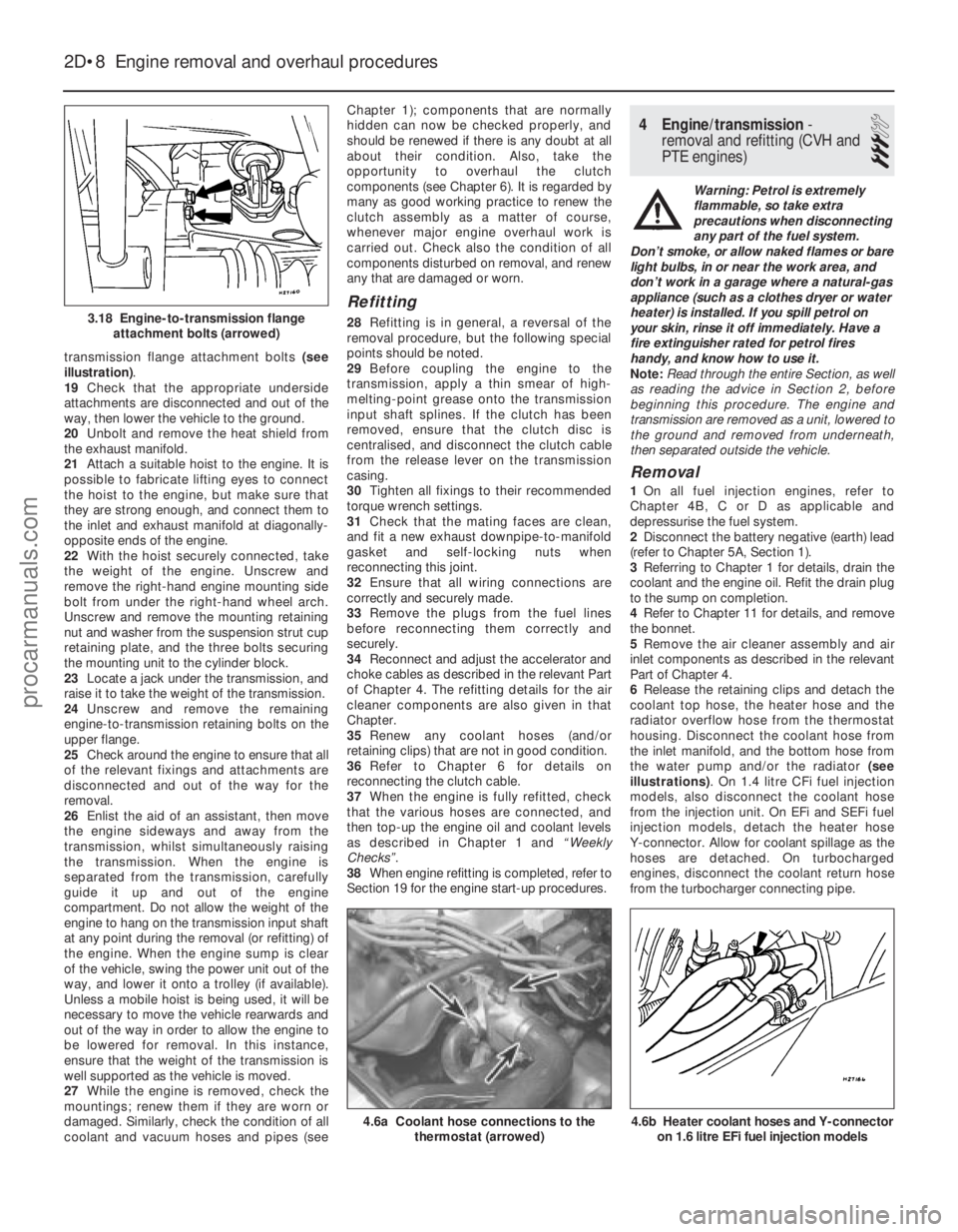
transmission flange attachment bolts (see
illustration) .
19 Check that the appropriate underside
attachments are disconnected and out of the
way, then lower the vehicle to the ground.
20 Unbolt and remove the heat shield from
the exhaust manifold.
21 Attach a suitable hoist to the engine. It is
possible to fabricate lifting eyes to connect
the hoist to the engine, but make sure that
they are strong enough, and connect them to
the inlet and exhaust manifold at diagonally-
opposite ends of the engine.
22 With the hoist securely connected, take
the weight of the engine. Unscrew and
remove the right-hand engine mounting side
bolt from under the right-hand wheel arch.
Unscrew and remove the mounting retaining
nut and washer from the suspension strut cup
retaining plate, and the three bolts securing
the mounting unit to the cylinder block.
23 Locate a jack under the transmission, and
raise it to take the weight of the transmission.
24 Unscrew and remove the remaining
engine-to-transmission retaining bolts on the
upper flange.
25 Check around the engine to ensure that all
of the relevant fixings and attachments are
disconnected and out of the way for the
removal.
26 Enlist the aid of an assistant, then move
the engine sideways and away from the
transmission, whilst simultaneously raising
the transmission. When the engine is
separated from the transmission, carefully
guide it up and out of the engine
compartment. Do not allow the weight of the
engine to hang on the transmission input shaft
at any point during the removal (or refitting) of
the engine. When the engine sump is clear
of the vehicle, swing the power unit out of the
way, and lower it onto a trolley (if available).
Unless a mobile hoist is being used, it will be
necessary to move the vehicle rearwards and
out of the way in order to allow the engine to
be lowered for removal. In this instance,
ensure that the weight of the transmission is
well supported as the vehicle is moved.
27 While the engine is removed, check the
mountings; renew them if they are worn or
damaged. Similarly, check the condition of all
coolant and vacuum hoses and pipes (see Chapter 1); components that are normally
hidden can now be checked properly, and
should be renewed if there is any doubt at all
about their condition. Also, take the
opportunity to overhaul the clutch
components (see Chapter 6). It is regarded by
many as good working practice to renew the
clutch assembly as a matter of course,
whenever major engine overhaul work is
carried out. Check also the condition of all
components disturbed on removal, and renew
any that are damaged or worn.
Refitting
28
Refitting is in general, a reversal of the
removal procedure, but the following special
points should be noted.
29 Before coupling the engine to the
transmission, apply a thin smear of high-
melting-point grease onto the transmission
input shaft splines. If the clutch has been
removed, ensure that the clutch disc is
centralised, and disconnect the clutch cable
from the release lever on the transmission
casing.
30 Tighten all fixings to their recommended
torque wrench settings.
31 Check that the mating faces are clean,
and fit a new exhaust downpipe-to-manifold
gasket and self-locking nuts when
reconnecting this joint.
32 Ensure that all wiring connections are
correctly and securely made.
33 Remove the plugs from the fuel lines
before reconnecting them correctly and
securely.
34 Reconnect and adjust the accelerator and
choke cables as described in the relevant Part
of Chapter 4. The refitting details for the air
cleaner components are also given in that
Chapter.
35 Renew any coolant hoses (and/or
retaining clips) that are not in good condition.
36 Refer to Chapter 6 for details on
reconnecting the clutch cable.
37 When the engine is fully refitted, check
that the various hoses are connected, and
then top-up the engine oil and coolant levels
as described in Chapter 1 and “Weekly
Checks”.
38 When engine refitting is completed, refer to
Section 19 for the engine start-up procedures.
4 Engine/transmission -
removal and refitting (CVH and
PTE engines)
3
Warning: Petrol is extremely
flammable, so take extra
precautions when disconnecting
any part of the fuel system.
Don’t smoke, or allow naked flames or bare
light bulbs, in or near the work area, and
don’t work in a garage where a natural-gas
appliance (such as a clothes dryer or water
heater) is installed. If you spill petrol on
your skin, rinse it off immediately. Have a
fire extinguisher rated for petrol fires
handy, and know how to use it.
Note: Read through the entire Section, as well
as reading the advice in Section 2, before
beginning this procedure. The engine and
transmission are removed as a unit, lowered to
the ground and removed from underneath,
then separated outside the vehicle.
Removal
1 On all fuel injection engines, refer to
Chapter 4B, C or D as applicable and
depressurise the fuel system.
2 Disconnect the battery negative (earth) lead
(refer to Chapter 5A, Section 1).
3 Referring to Chapter 1 for details, drain the
coolant and the engine oil. Refit the drain plug
to the sump on completion.
4 Refer to Chapter 11 for details, and remove
the bonnet.
5 Remove the air cleaner assembly and air
inlet components as described in the relevant
Part of Chapter 4.
6 Release the retaining clips and detach the
coolant top hose, the heater hose and the
radiator overflow hose from the thermostat
housing. Disconnect the coolant hose from
the inlet manifold, and the bottom hose from
the water pump and/or the radiator (see
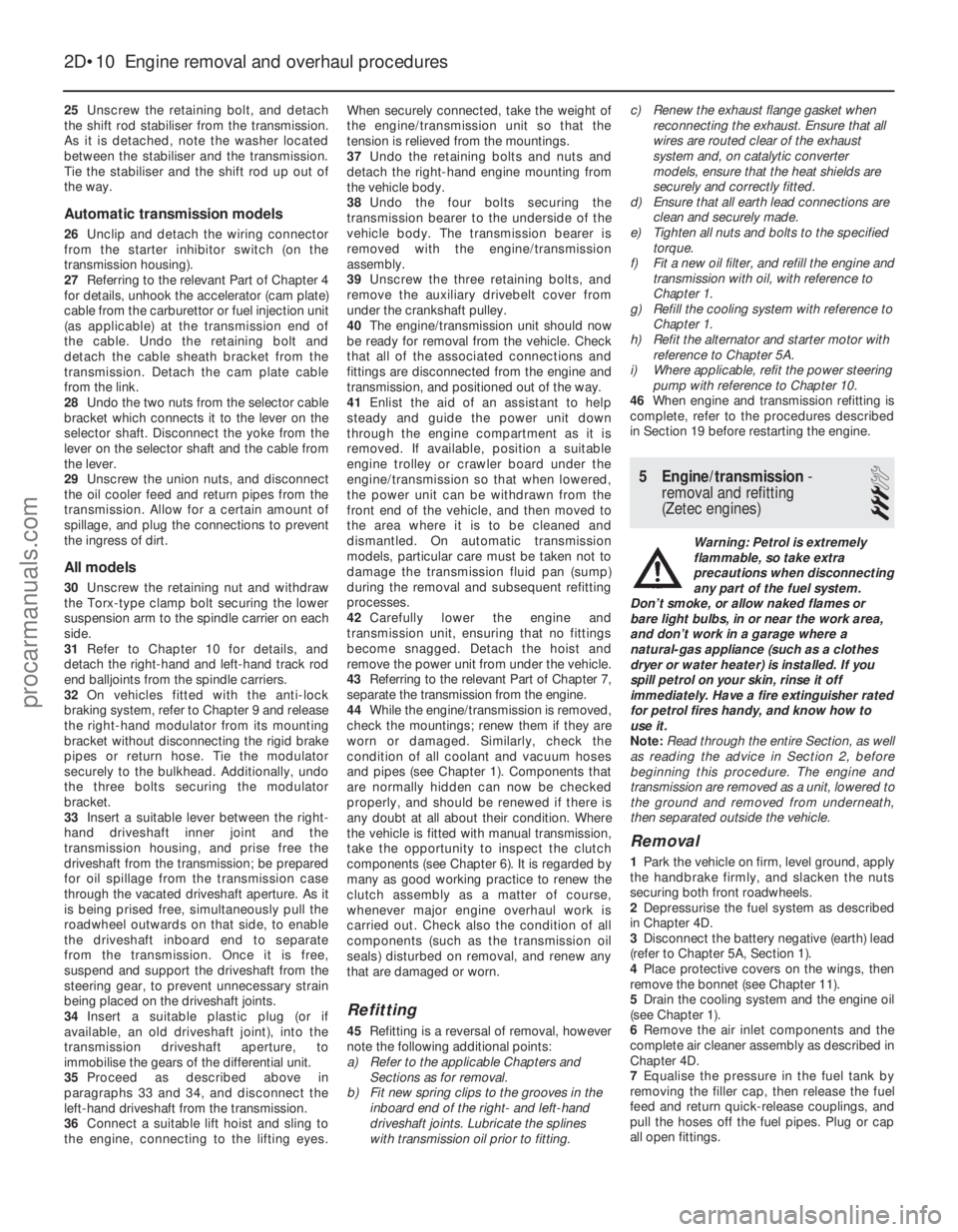
illustrations) . On 1.4 litre CFi fuel injection
models, also disconnect the coolant hose
from the injection unit. On EFi and SEFi fuel
injection models, detach the heater hose
Y-connector. Allow for coolant spillage as the
hoses are detached. On turbocharged
engines, disconnect the coolant return hose
from the turbocharger connecting pipe.
2D•8 Engine removal and overhaul procedures
4.6b Heater coolant hoses and Y-connector on 1.6 litre EFi fuel injection models4.6a Coolant hose connections to the thermostat (arrowed)
3.18 Engine-to-transmission flangeattachment bolts (arrowed)
1595Ford Fiesta Remakeprocarmanuals.com
http://vnx.su
Page 79 of 296
25Unscrew the retaining bolt, and detach
the shift rod stabiliser from the transmission.
As it is detached, note the washer located
between the stabiliser and the transmission.
Tie the stabiliser and the shift rod up out of
the way.
Automatic transmission models
26 Unclip and detach the wiring connector
from the starter inhibitor switch (on the
transmission housing).
27 Referring to the relevant Part of Chapter 4
for details, unhook the accelerator (cam plate)
cable from the carburettor or fuel injection unit
(as applicable) at the transmission end of
the cable. Undo the retaining bolt and
detach the cable sheath bracket from the
transmission. Detach the cam plate cable
from the link.
28 Undo the two nuts from the selector cable
bracket which connects it to the lever on the
selector shaft. Disconnect the yoke from the
lever on the selector shaft and the cable from
the lever.
29 Unscrew the union nuts, and disconnect
the oil cooler feed and return pipes from the
transmission. Allow for a certain amount of
spillage, and plug the connections to prevent
the ingress of dirt.
All models
30 Unscrew the retaining nut and withdraw
the Torx-type clamp bolt securing the lower
suspension arm to the spindle carrier on each
side.
31 Refer to Chapter 10 for details, and
detach the right-hand and left-hand track rod
end balljoints from the spindle carriers.
32 On vehicles fitted with the anti-lock
braking system, refer to Chapter 9 and release
the right-hand modulator from its mounting
bracket without disconnecting the rigid brake
pipes or return hose. Tie the modulator
securely to the bulkhead. Additionally, undo
the three bolts securing the modulator
bracket.
33 Insert a suitable lever between the right-
hand driveshaft inner joint and the
transmission housing, and prise free the
driveshaft from the transmission; be prepared
for oil spillage from the transmission case
through the vacated driveshaft aperture. As it
is being prised free, simultaneously pull the
roadwheel outwards on that side, to enable
the driveshaft inboard end to separate
from the transmission. Once it is free,
suspend and support the driveshaft from the
steering gear, to prevent unnecessary strain
being placed on the driveshaft joints.
34 Insert a suitable plastic plug (or if
available, an old driveshaft joint), into the
transmission driveshaft aperture, to
immobilise the gears of the differential unit.
35 Proceed as described above in
paragraphs 33 and 34, and disconnect the
left-hand driveshaft from the transmission.
36 Connect a suitable lift hoist and sling to
the engine, connecting to the lifting eyes. When securely connected, take the weight of
the engine/transmission unit so that the
tension is relieved from the mountings.
37
Undo the retaining bolts and nuts and
detach the right-hand engine mounting from
the vehicle body.
38 Undo the four bolts securing the
transmission bearer to the underside of the
vehicle body. The transmission bearer is
removed with the engine/transmission
assembly.
39 Unscrew the three retaining bolts, and
remove the auxiliary drivebelt cover from
under the crankshaft pulley.
40 The engine/transmission unit should now
be ready for removal from the vehicle. Check
that all of the associated connections and
fittings are disconnected from the engine and
transmission, and positioned out of the way.
41 Enlist the aid of an assistant to help
steady and guide the power unit down
through the engine compartment as it is
removed. If available, position a suitable
engine trolley or crawler board under the
engine/transmission so that when lowered,
the power unit can be withdrawn from the
front end of the vehicle, and then moved to
the area where it is to be cleaned and
dismantled. On automatic transmission
models, particular care must be taken not to
damage the transmission fluid pan (sump)
during the removal and subsequent refitting
processes.
42 Carefully lower the engine and
transmission unit, ensuring that no fittings
become snagged. Detach the hoist and
remove the power unit from under the vehicle.
43 Referring to the relevant Part of Chapter 7,
separate the transmission from the engine.
44 While the engine/transmission is removed,
check the mountings; renew them if they are
worn or damaged. Similarly, check the
condition of all coolant and vacuum hoses
and pipes (see Chapter 1). Components that
are normally hidden can now be checked
properly, and should be renewed if there is
any doubt at all about their condition. Where
the vehicle is fitted with manual transmission,
take the opportunity to inspect the clutch
components (see Chapter 6). It is regarded by
many as good working practice to renew the
clutch assembly as a matter of course,
whenever major engine overhaul work is
carried out. Check also the condition of all
components (such as the transmission oil
seals) disturbed on removal, and renew any
that are damaged or worn.
Refitting
45 Refitting is a reversal of removal, however
note the following additional points:
a) Refer to the applicable Chapters and Sections as for removal.
b) Fit new spring clips to the grooves in the
inboard end of the right- and left-hand
driveshaft joints. Lubricate the splines
with transmission oil prior to fitting. c) Renew the exhaust flange gasket when
reconnecting the exhaust. Ensure that all
wires are routed clear of the exhaust
system and, on catalytic converter
models, ensure that the heat shields are
securely and correctly fitted.
d) Ensure that all earth lead connections are
clean and securely made.
e) Tighten all nuts and bolts to the specified torque.
f) Fit a new oil filter, and refill the engine and transmission with oil, with reference to
Chapter 1.
g) Refill the cooling system with reference to Chapter 1.
h) Refit the alternator and starter motor with reference to Chapter 5A.
i) Where applicable, refit the power steering pump with reference to Chapter 10.
46 When engine and transmission refitting is
complete, refer to the procedures described
in Section 19 before restarting the engine.
5 Engine/transmission -
removal and refitting
(Zetec engines)
3
Warning: Petrol is extremely
flammable, so take extra
precautions when disconnecting
any part of the fuel system.
Don’t smoke, or allow naked flames or
bare light bulbs, in or near the work area,
and don’t work in a garage where a
natural-gas appliance (such as a clothes
dryer or water heater) is installed. If you
spill petrol on your skin, rinse it off
immediately. Have a fire extinguisher rated
for petrol fires handy, and know how to
use it.
Note: Read through the entire Section, as well
as reading the advice in Section 2, before
beginning this procedure. The engine and
transmission are removed as a unit, lowered to
the ground and removed from underneath,
then separated outside the vehicle.
Removal
1 Park the vehicle on firm, level ground, apply
the handbrake firmly, and slacken the nuts
securing both front roadwheels.
2 Depressurise the fuel system as described
in Chapter 4D.
3 Disconnect the battery negative (earth) lead
(refer to Chapter 5A, Section 1).
4 Place protective covers on the wings, then
remove the bonnet (see Chapter 11).
5 Drain the cooling system and the engine oil
(see Chapter 1).
6 Remove the air inlet components and the
complete air cleaner assembly as described in
Chapter 4D.
7 Equalise the pressure in the fuel tank by
removing the filler cap, then release the fuel
feed and return quick-release couplings, and
pull the hoses off the fuel pipes. Plug or cap
all open fittings.
2D•10 Engine removal and overhaul procedures
1595Ford Fiesta Remakeprocarmanuals.com
http://vnx.su
Page 81 of 296
25On automatic transmission models, clean
around the unions, then disconnect the fluid
pipes from the transmission. Plug the
openings in the transmission and the pipe
unions after removal.
26 Refer to Chapter 10 and remove the front
suspension crossmember.
27 Unscrew the nuts to disconnect the
exhaust system front downpipe from the
manifold. Undo the nuts securing the catalytic
converter to the rear part of the exhaust
system, and remove the converter and
downpipe assembly.
28 On vehicles fitted with the anti-lock braking
system, refer to Chapter 9 and release the
right-hand modulator from its mounting
bracket without disconnecting the rigid brake
pipes or return hose. Tie the modulator
securely to the bulkhead. Additionally, undo
the three bolts securing the modulator bracket.
29 Disconnect both anti-roll bar links from
their respective suspension struts, and both
track rod end ball joints from their spindle
carriers (see Chapter 10).
30 Unscrew the retaining nut and withdraw
the Torx-type clamp bolt securing the lower
suspension arm to the spindle carrier on each
side.
31 Insert a suitable lever between the right-
hand driveshaft inner joint and the
transmission housing, and prise free the
driveshaft from the transmission; be prepared
for oil spillage from the transmission case
through the vacated driveshaft aperture. As it
is being prised free, simultaneously pull the
roadwheel outwards on that side to enable the
driveshaft inboard end to separate from the
transmission. Once it is free, suspend and
support the driveshaft from the steering gear,
to prevent unnecessary strain being placed on
the driveshaft joints.
32 Insert a suitable plastic plug (or if
available, an old driveshaft joint), into the
transmission driveshaft aperture, to
immobilise the gears of the differential unit.
33 Proceed as described above in
paragraphs 31 and 32, and disconnect the
left-hand driveshaft from the transmission.
34 Remove the oil filter, referring to Chapter 1
if necessary.
35 Connect a suitable lift hoist and sling to
the engine, connecting to the lift eyes. When
securely connected, take the weight of the
engine/transmission unit so that the tension is
relieved from the mountings.
36 Unbolt the engine rear right-hand
mounting from the body (one bolt in the wheel
arch, one nut in the engine compartment),
then unbolt the engine front right-hand
mounting from the alternator mounting
bracket. Unbolt the transmission bearer from
the underbody.
37 The engine/transmission unit should now
be hanging on the hoist only, with all
components which connect it to the rest of
the vehicle disconnected or removed, and
secured well clear of the unit. Make a final
check that this is the case. 38
Lower the engine/transmission to the
ground, and withdraw it from under the
vehicle.
39 Referring to the relevant Part of Chapter 7,
separate the transmission from the engine.
40 While the engine/transmission is removed,
check the mountings; renew them if they are
worn or damaged. Similarly, check the
condition of all coolant and vacuum hoses
and pipes (see Chapter 1); components that
are normally hidden can now be checked
properly, and should be renewed if there is
any doubt at all about their condition. Where
the vehicle is fitted with manual transmission,
take the opportunity to overhaul the clutch
components (see Chapter 6). It is regarded by
many as good working practice to renew the
clutch assembly as a matter of course,
whenever major engine overhaul work is
carried out. Check also the condition of all
components (such as the transmission oil
seals) disturbed on removal, and renew any
that are damaged or worn.
Refitting
41 Refitting is a reversal of removal, however
note the following additional points:
a) Refer to the applicable Chapters and Sections as for removal.
b) Fit new spring clips to the grooves in the
inboard end of the right- and left-hand
driveshaft joints. Lubricate the splines
with transmission oil prior to fitting.
c) Renew the exhaust flange gaskets when reconnecting the exhaust. Ensure that all
wires are routed clear of the exhaust
system, and that the heat shields are
securely and correctly fitted.
d) Ensure that all earth lead connections are
clean and securely made.
e) Tighten all nuts and bolts to the specified
torque.
f) Fit a new oil filter, and refill the engine and transmission with oil, with reference to
Chapter 1.
g) Refill the cooling system with reference to
Chapter 1.
h) Bleed the power steering system with reference to Chapter 10.
42 When engine and transmission refitting is
complete, refer to the procedures described
in Section 19 before restarting the engine.
6 Engine overhaul - preliminary information
It is much easier to dismantle and work on
the engine if it is mounted on a portable
engine stand. These stands can often be hired
from a tool hire shop. Before the engine is
mounted on a stand, the flywheel/driveplate
should be removed so that the stand bolts
can be tightened into the end of the cylinder
block/crankcase. If a stand is not available, it is possible to
dismantle the engine with it suitably supported on a sturdy, workbench or on the
floor. Be careful not to tip or drop the engine
when working without a stand.
If you intend to obtain a reconditioned
engine, all ancillaries must be removed first, to
be transferred to the replacement engine (just
as they will if you are doing a complete engine
overhaul yourself). These components include
the following:
a) Alternator/power steering pump and
mounting brackets.
b) DIS/E-DIS ignition coil unit (and mounting
bracket), distributor, HT leads and spark
plugs.
c) The thermostat and housing cover.
d) Carburettor/fuel injection system
components.
e) Inlet and exhaust manifolds.
f) Oil filter.
g) Fuel pump.
h) Engine mountings.
i) Flywheel/driveplate.
j) Water pump.
Note: When removing the external
components from the engine, pay close
attention to details that may be helpful or
important during refitting. Note the fitted
positions of gaskets, seals, washers, bolts and
other small items. If you are obtaining a “short” engine
(cylinder block/crankcase, crankshaft, pistons
and connecting rods all assembled), then the
cylinder head, timing chain/belt (together with
tensioner, tensioner and idler pulleys and
covers) sump and oil pump will have to be
removed also. If a complete overhaul is planned, the
engine can be dismantled in the order given
below, referring to Part A, B or C of this
Chapter unless otherwise stated.
a) Inlet and exhaust manifolds.
b) Timing chain/belt, tensioner and
sprockets.
c) Cylinder head.
d) Flywheel/driveplate.
e) Sump.
f) Oil pump.
g) Pistons (with connecting rods).
h) Crankshaft.
i) Camshaft and tappets (HCS engines).
7 Cylinder head - dismantling
4
Note:New and reconditioned cylinder heads
are available from the manufacturers, and from
engine overhaul specialists. Due to the fact
that some specialist tools are required for the
dismantling and inspection procedures, and
new components may not be readily available,
it may be more practical and economical for
the home mechanic to purchase a
reconditioned head, rather than to dismantle,
inspect and recondition the original head.
1 Remove the cylinder head as described in
Part A, B or C of this Chapter (as applicable).
2D•12 Engine removal and overhaul procedures
1595Ford Fiesta Remakeprocarmanuals.com
http://vnx.su
Page 83 of 296
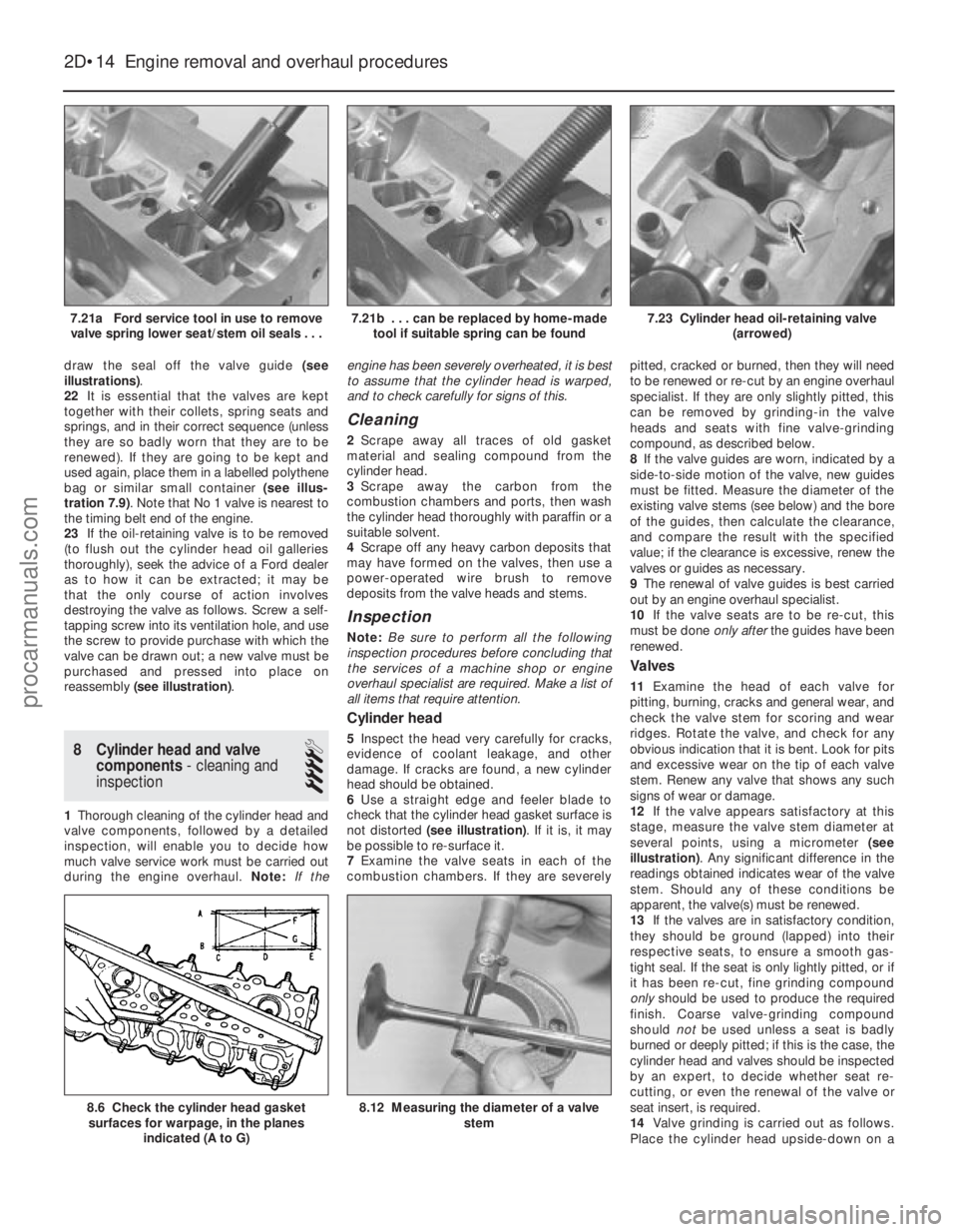
draw the seal off the valve guide (see
illustrations) .
22 It is essential that the valves are kept
together with their collets, spring seats and
springs, and in their correct sequence (unless
they are so badly worn that they are to be
renewed). If they are going to be kept and
used again, place them in a labelled polythene
bag or similar small container (see illus-
tration 7.9) . Note that No 1 valve is nearest to
the timing belt end of the engine.
23 If the oil-retaining valve is to be removed
(to flush out the cylinder head oil galleries
thoroughly), seek the advice of a Ford dealer
as to how it can be extracted; it may be
that the only course of action involves
destroying the valve as follows. Screw a self-
tapping screw into its ventilation hole, and use
the screw to provide purchase with which the
valve can be drawn out; a new valve must be
purchased and pressed into place on
reassembly (see illustration) .
8 Cylinder head and valve
components - cleaning and
inspection
4
1 Thorough cleaning of the cylinder head and
valve components, followed by a detailed
inspection, will enable you to decide how
much valve service work must be carried out
during the engine overhaul. Note:If the engine has been severely overheated, it is best
to assume that the cylinder head is warped,
and to check carefully for signs of this.
Cleaning
2
Scrape away all traces of old gasket
material and sealing compound from the
cylinder head.
3 Scrape away the carbon from the
combustion chambers and ports, then wash
the cylinder head thoroughly with paraffin or a
suitable solvent.
4 Scrape off any heavy carbon deposits that
may have formed on the valves, then use a
power-operated wire brush to remove
deposits from the valve heads and stems.
Inspection
Note: Be sure to perform all the following
inspection procedures before concluding that
the services of a machine shop or engine
overhaul specialist are required. Make a list of
all items that require attention.
Cylinder head
5 Inspect the head very carefully for cracks,
evidence of coolant leakage, and other
damage. If cracks are found, a new cylinder
head should be obtained.
6 Use a straight edge and feeler blade to
check that the cylinder head gasket surface is
not distorted (see illustration) . If it is, it may
be possible to re-surface it.
7 Examine the valve seats in each of the
combustion chambers. If they are severely pitted, cracked or burned, then they will need
to be renewed or re-cut by an engine overhaul
specialist. If they are only slightly pitted, this
can be removed by grinding-in the valve
heads and seats with fine valve-grinding
compound, as described below.
8
If the valve guides are worn, indicated by a
side-to-side motion of the valve, new guides
must be fitted. Measure the diameter of the
existing valve stems (see below) and the bore
of the guides, then calculate the clearance,
and compare the result with the specified
value; if the clearance is excessive, renew the
valves or guides as necessary.
9 The renewal of valve guides is best carried
out by an engine overhaul specialist.
10 If the valve seats are to be re-cut, this
must be done only afterthe guides have been
renewed.
Valves
11 Examine the head of each valve for
pitting, burning, cracks and general wear, and
check the valve stem for scoring and wear
ridges. Rotate the valve, and check for any
obvious indication that it is bent. Look for pits
and excessive wear on the tip of each valve
stem. Renew any valve that shows any such
signs of wear or damage.
12 If the valve appears satisfactory at this
stage, measure the valve stem diameter at
several points, using a micrometer (see
illustration) . Any significant difference in the
readings obtained indicates wear of the valve
stem. Should any of these conditions be
apparent, the valve(s) must be renewed.
13 If the valves are in satisfactory condition,
they should be ground (lapped) into their
respective seats, to ensure a smooth gas-
tight seal. If the seat is only lightly pitted, or if
it has been re-cut, fine grinding compound
only should be used to produce the required
finish. Coarse valve-grinding compound
should notbe used unless a seat is badly
burned or deeply pitted; if this is the case, the
cylinder head and valves should be inspected
by an expert, to decide whether seat re-
cutting, or even the renewal of the valve or
seat insert, is required.
14 Valve grinding is carried out as follows.
Place the cylinder head upside-down on a
2D•14 Engine removal and overhaul procedures
8.12 Measuring the diameter of a valve
stem8.6 Check the cylinder head gasketsurfaces for warpage, in the planes
indicated (A to G)
7.23 Cylinder head oil-retaining valve (arrowed)7.21b . . . can be replaced by home-madetool if suitable spring can be found7.21a Ford service tool in use to removevalve spring lower seat/stem oil seals . . .
1595Ford Fiesta Remakeprocarmanuals.com
http://vnx.su
Page 84 of 296
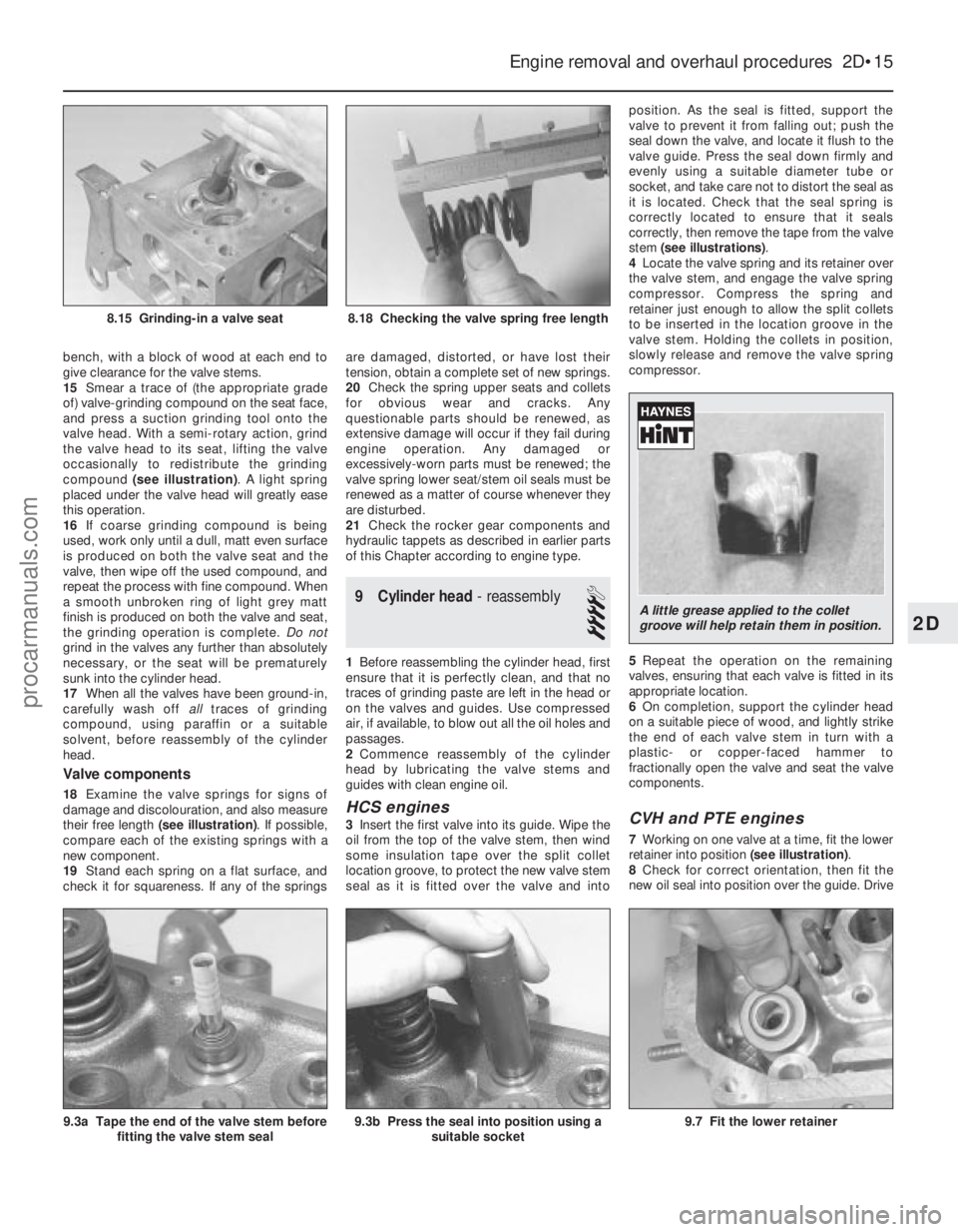
bench, with a block of wood at each end to
give clearance for the valve stems.
15Smear a trace of (the appropriate grade
of) valve-grinding compound on the seat face,
and press a suction grinding tool onto the
valve head. With a semi-rotary action, grind
the valve head to its seat, lifting the valve
occasionally to redistribute the grinding
compound (see illustration) . A light spring
placed under the valve head will greatly ease
this operation.
16 If coarse grinding compound is being
used, work only until a dull, matt even surface
is produced on both the valve seat and the
valve, then wipe off the used compound, and
repeat the process with fine compound. When
a smooth unbroken ring of light grey matt
finish is produced on both the valve and seat,
the grinding operation is complete. Do not
grind in the valves any further than absolutely
necessary, or the seat will be prematurely
sunk into the cylinder head.
17 When all the valves have been ground-in,
carefully wash off alltraces of grinding
compound, using paraffin or a suitable
solvent, before reassembly of the cylinder
head.
Valve components
18 Examine the valve springs for signs of
damage and discolouration, and also measure
their free length (see illustration) . If possible,
compare each of the existing springs with a
new component.
19 Stand each spring on a flat surface, and
check it for squareness. If any of the springs are damaged, distorted, or have lost their
tension, obtain a complete set of new springs.
20
Check the spring upper seats and collets
for obvious wear and cracks. Any
questionable parts should be renewed, as
extensive damage will occur if they fail during
engine operation. Any damaged or
excessively-worn parts must be renewed; the
valve spring lower seat/stem oil seals must be
renewed as a matter of course whenever they
are disturbed.
21 Check the rocker gear components and
hydraulic tappets as described in earlier parts
of this Chapter according to engine type.
9 Cylinder head - reassembly
4
1Before reassembling the cylinder head, first
ensure that it is perfectly clean, and that no
traces of grinding paste are left in the head or
on the valves and guides. Use compressed
air, if available, to blow out all the oil holes and
passages.
2 Commence reassembly of the cylinder
head by lubricating the valve stems and
guides with clean engine oil.
HCS engines
3 Insert the first valve into its guide. Wipe the
oil from the top of the valve stem, then wind
some insulation tape over the split collet
location groove, to protect the new valve stem
seal as it is fitted over the valve and into position. As the seal is fitted, support the
valve to prevent it from falling out; push the
seal down the valve, and locate it flush to the
valve guide. Press the seal down firmly and
evenly using a suitable diameter tube or
socket, and take care not to distort the seal as
it is located. Check that the seal spring is
correctly located to ensure that it seals
correctly, then remove the tape from the valve
stem (see illustrations)
.
4 Locate the valve spring and its retainer over
the valve stem, and engage the valve spring
compressor. Compress the spring and
retainer just enough to allow the split collets
to be inserted in the location groove in the
valve stem. Holding the collets in position,
slowly release and remove the valve spring
compressor.
5 Repeat the operation on the remaining
valves, ensuring that each valve is fitted in its
appropriate location.
6 On completion, support the cylinder head
on a suitable piece of wood, and lightly strike
the end of each valve stem in turn with a
plastic- or copper-faced hammer to
fractionally open the valve and seat the valve
components.CVH and PTE engines
7 Working on one valve at a time, fit the lower
retainer into position (see illustration).
8 Check for correct orientation, then fit the
new oil seal into position over the guide. Drive
Engine removal and overhaul procedures 2D•15
9.3a Tape the end of the valve stem before fitting the valve stem seal
8.18 Checking the valve spring free length8.15 Grinding-in a valve seat
9.7 Fit the lower retainer9.3b Press the seal into position using a suitable socket
2D
1595Ford Fiesta Remake
A little grease applied to the collet
groove will help retain them in position.
procarmanuals.com
http://vnx.su
Page 85 of 296
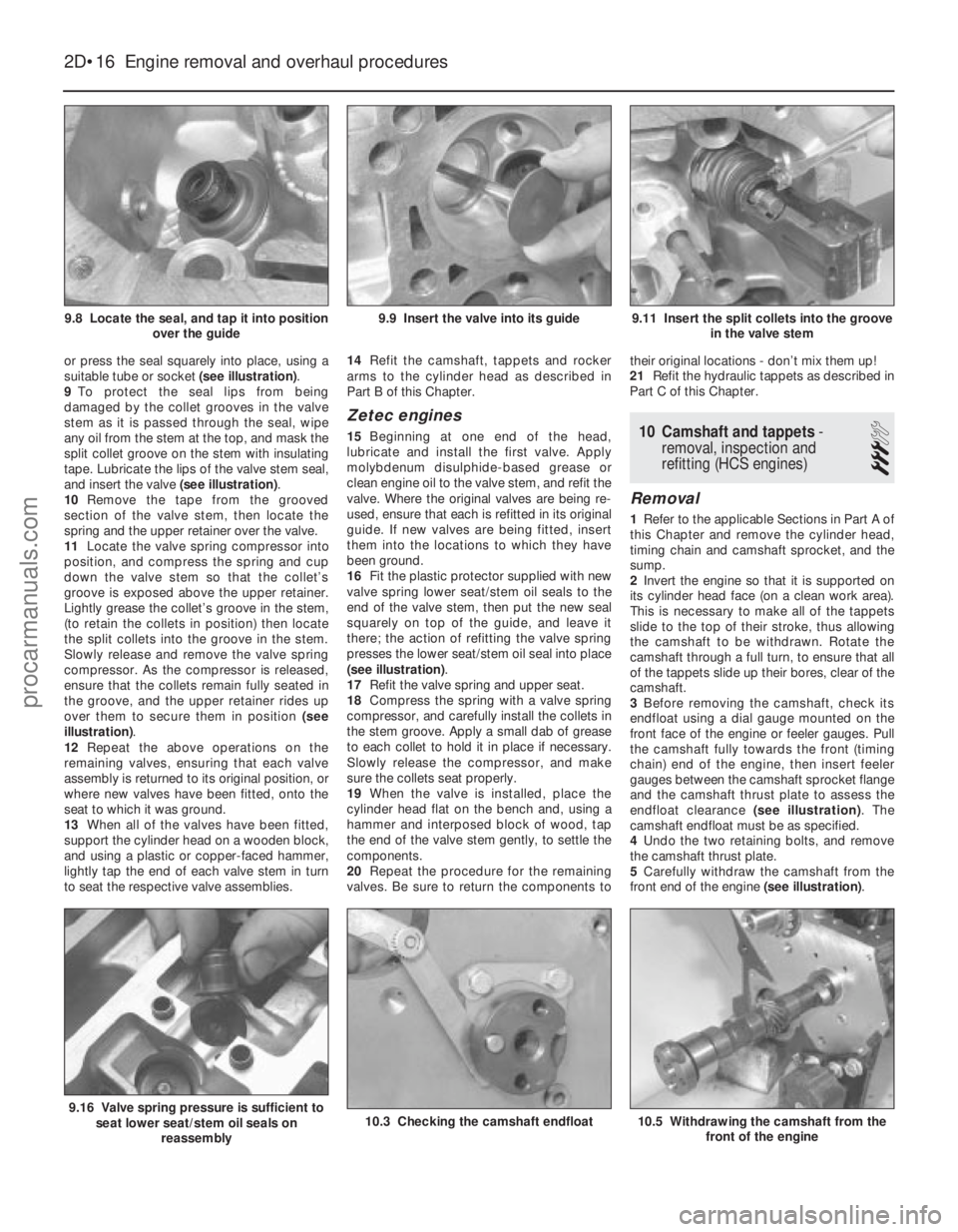
or press the seal squarely into place, using a
suitable tube or socket (see illustration).
9 To protect the seal lips from being
damaged by the collet grooves in the valve
stem as it is passed through the seal, wipe
any oil from the stem at the top, and mask the
split collet groove on the stem with insulating
tape. Lubricate the lips of the valve stem seal,
and insert the valve (see illustration).
10 Remove the tape from the grooved
section of the valve stem, then locate the
spring and the upper retainer over the valve.
11 Locate the valve spring compressor into
position, and compress the spring and cup
down the valve stem so that the collet’s
groove is exposed above the upper retainer.
Lightly grease the collet’s groove in the stem,
(to retain the collets in position) then locate
the split collets into the groove in the stem.
Slowly release and remove the valve spring
compressor. As the compressor is released,
ensure that the collets remain fully seated in
the groove, and the upper retainer rides up
over them to secure them in position (see
illustration) .
12 Repeat the above operations on the
remaining valves, ensuring that each valve
assembly is returned to its original position, or
where new valves have been fitted, onto the
seat to which it was ground.
13 When all of the valves have been fitted,
support the cylinder head on a wooden block,
and using a plastic or copper-faced hammer,
lightly tap the end of each valve stem in turn
to seat the respective valve assemblies. 14
Refit the camshaft, tappets and rocker
arms to the cylinder head as described in
Part B of this Chapter.
Zetec engines
15 Beginning at one end of the head,
lubricate and install the first valve. Apply
molybdenum disulphide-based grease or
clean engine oil to the valve stem, and refit the
valve. Where the original valves are being re-
used, ensure that each is refitted in its original
guide. If new valves are being fitted, insert
them into the locations to which they have
been ground.
16 Fit the plastic protector supplied with new
valve spring lower seat/stem oil seals to the
end of the valve stem, then put the new seal
squarely on top of the guide, and leave it
there; the action of refitting the valve spring
presses the lower seat/stem oil seal into place
(see illustration) .
17 Refit the valve spring and upper seat.
18 Compress the spring with a valve spring
compressor, and carefully install the collets in
the stem groove. Apply a small dab of grease
to each collet to hold it in place if necessary.
Slowly release the compressor, and make
sure the collets seat properly.
19 When the valve is installed, place the
cylinder head flat on the bench and, using a
hammer and interposed block of wood, tap
the end of the valve stem gently, to settle the
components.
20 Repeat the procedure for the remaining
valves. Be sure to return the components to their original locations - don’t mix them up!
21 Refit the hydraulic tappets as described in
Part C of this Chapter.10 Camshaft and tappets -
removal, inspection and
refitting (HCS engines)
3
Removal
1 Refer to the applicable Sections in Part A of
this Chapter and remove the cylinder head,
timing chain and camshaft sprocket, and the
sump.
2 Invert the engine so that it is supported on
its cylinder head face (on a clean work area).
This is necessary to make all of the tappets
slide to the top of their stroke, thus allowing
the camshaft to be withdrawn. Rotate the
camshaft through a full turn, to ensure that all
of the tappets slide up their bores, clear of the
camshaft.
3 Before removing the camshaft, check its
endfloat using a dial gauge mounted on the
front face of the engine or feeler gauges. Pull
the camshaft fully towards the front (timing
chain) end of the engine, then insert feeler
gauges between the camshaft sprocket flange
and the camshaft thrust plate to assess the
endfloat clearance (see illustration). The
camshaft endfloat must be as specified.
4 Undo the two retaining bolts, and remove
the camshaft thrust plate.
5 Carefully withdraw the camshaft from the
front end of the engine (see illustration).
2D•16 Engine removal and overhaul procedures
10.5 Withdrawing the camshaft from the
front of the engine10.3 Checking the camshaft endfloat9.16 Valve spring pressure is sufficient toseat lower seat/stem oil seals on
reassembly
9.11 Insert the split collets into the groove in the valve stem9.9 Insert the valve into its guide9.8 Locate the seal, and tap it into position over the guide
1595Ford Fiesta Remakeprocarmanuals.com
http://vnx.su
Page 86 of 296
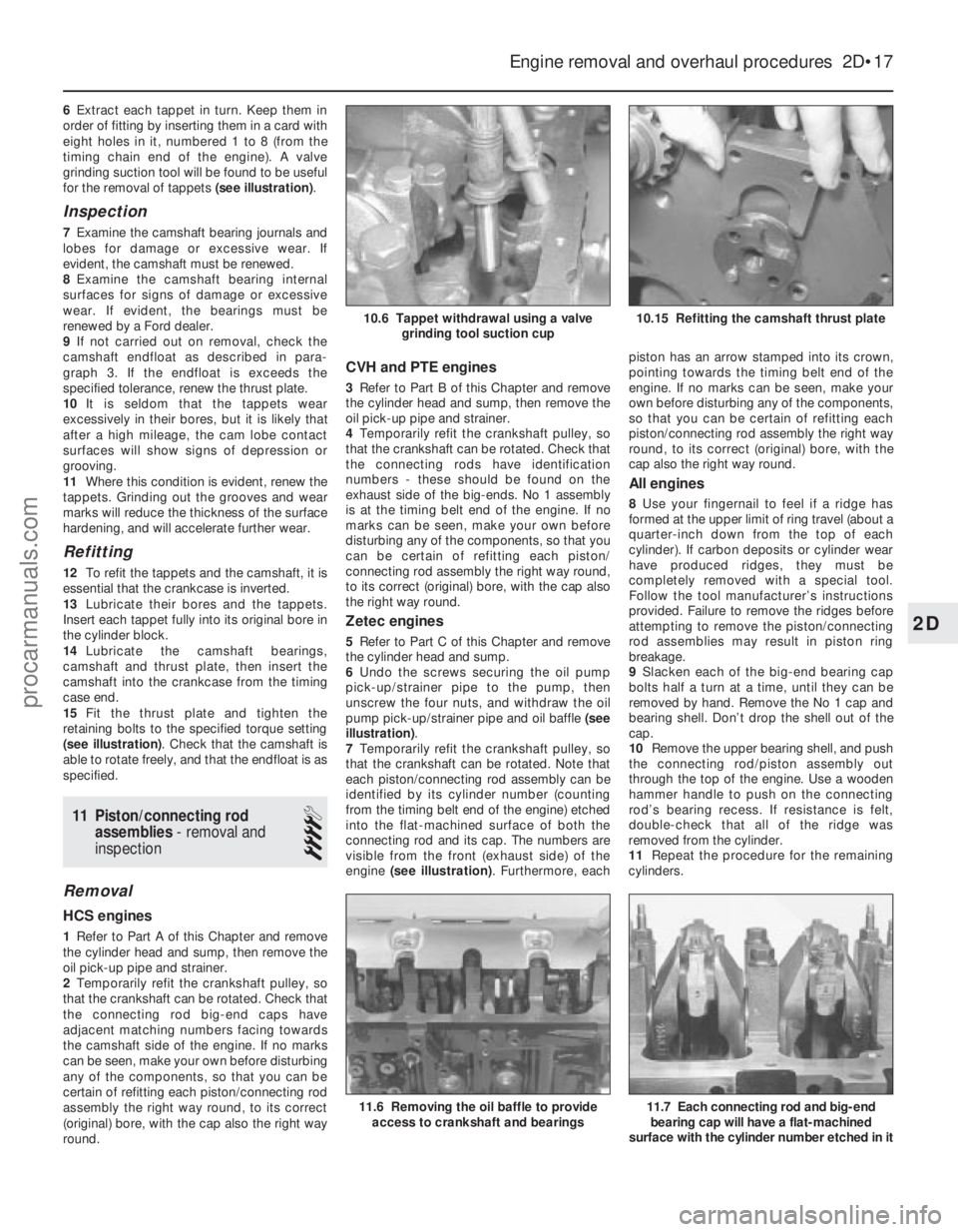
6Extract each tappet in turn. Keep them in
order of fitting by inserting them in a card with
eight holes in it, numbered 1 to 8 (from the
timing chain end of the engine). A valve
grinding suction tool will be found to be useful
for the removal of tappets (see illustration).
Inspection
7Examine the camshaft bearing journals and
lobes for damage or excessive wear. If
evident, the camshaft must be renewed.
8 Examine the camshaft bearing internal
surfaces for signs of damage or excessive
wear. If evident, the bearings must be
renewed by a Ford dealer.
9 If not carried out on removal, check the
camshaft endfloat as described in para-
graph 3. If the endfloat is exceeds the
specified tolerance, renew the thrust plate.
10 It is seldom that the tappets wear
excessively in their bores, but it is likely that
after a high mileage, the cam lobe contact
surfaces will show signs of depression or
grooving.
11 Where this condition is evident, renew the
tappets. Grinding out the grooves and wear
marks will reduce the thickness of the surface
hardening, and will accelerate further wear.
Refitting
12 To refit the tappets and the camshaft, it is
essential that the crankcase is inverted.
13 Lubricate their bores and the tappets.
Insert each tappet fully into its original bore in
the cylinder block.
14 Lubricate the camshaft bearings,
camshaft and thrust plate, then insert the
camshaft into the crankcase from the timing
case end.
15 Fit the thrust plate and tighten the
retaining bolts to the specified torque setting
(see illustration) . Check that the camshaft is
able to rotate freely, and that the endfloat is as
specified.
11 Piston/connecting rod
assemblies - removal and
inspection
4
Removal
HCS engines
1 Refer to Part A of this Chapter and remove
the cylinder head and sump, then remove the
oil pick-up pipe and strainer.
2 Temporarily refit the crankshaft pulley, so
that the crankshaft can be rotated. Check that
the connecting rod big-end caps have
adjacent matching numbers facing towards
the camshaft side of the engine. If no marks
can be seen, make your own before disturbing
any of the components, so that you can be
certain of refitting each piston/connecting rod
assembly the right way round, to its correct
(original) bore, with the cap also the right way
round.
CVH and PTE engines
3 Refer to Part B of this Chapter and remove
the cylinder head and sump, then remove the
oil pick-up pipe and strainer.
4 Temporarily refit the crankshaft pulley, so
that the crankshaft can be rotated. Check that
the connecting rods have identification
numbers - these should be found on the
exhaust side of the big-ends. No 1 assembly
is at the timing belt end of the engine. If no
marks can be seen, make your own before
disturbing any of the components, so that you
can be certain of refitting each piston/
connecting rod assembly the right way round,
to its correct (original) bore, with the cap also
the right way round.
Zetec engines
5 Refer to Part C of this Chapter and remove
the cylinder head and sump.
6 Undo the screws securing the oil pump
pick-up/strainer pipe to the pump, then
unscrew the four nuts, and withdraw the oil
pump pick-up/strainer pipe and oil baffle (see
illustration) .
7 Temporarily refit the crankshaft pulley, so
that the crankshaft can be rotated. Note that
each piston/connecting rod assembly can be
identified by its cylinder number (counting
from the timing belt end of the engine) etched
into the flat-machined surface of both the
connecting rod and its cap. The numbers are
visible from the front (exhaust side) of the
engine (see illustration) . Furthermore, each piston has an arrow stamped into its crown,
pointing towards the timing belt end of the
engine. If no marks can be seen, make your
own before disturbing any of the components,
so that you can be certain of refitting each
piston/connecting rod assembly the right way
round, to its correct (original) bore, with the
cap also the right way round.
All engines
8
Use your fingernail to feel if a ridge has
formed at the upper limit of ring travel (about a
quarter-inch down from the top of each
cylinder). If carbon deposits or cylinder wear
have produced ridges, they must be
completely removed with a special tool.
Follow the tool manufacturer’s instructions
provided. Failure to remove the ridges before
attempting to remove the piston/connecting
rod assemblies may result in piston ring
breakage.
9 Slacken each of the big-end bearing cap
bolts half a turn at a time, until they can be
removed by hand. Remove the No 1 cap and
bearing shell. Don’t drop the shell out of the
cap.
10 Remove the upper bearing shell, and push
the connecting rod/piston assembly out
through the top of the engine. Use a wooden
hammer handle to push on the connecting
rod’s bearing recess. If resistance is felt,
double- check that all of the ridge was
removed from the cylinder.
11 Repeat the procedure for the remaining
cylinders.
Engine removal and overhaul procedures 2D•17
10.15 Refitting the camshaft thrust plate10.6 Tappet withdrawal using a valve grinding tool suction cup
11.7 Each connecting rod and big-endbearing cap will have a flat-machined
surface with the cylinder number etched in it11.6 Removing the oil baffle to provide access to crankshaft and bearings
2D
1595Ford Fiesta Remakeprocarmanuals.com
http://vnx.su
Page 87 of 296
12After removal, reassemble the big-end
bearing caps and shells on their respective
connecting rods, and refit the bolts finger-
tight. Leaving the old shells in place until
reassembly will help prevent the bearing
recesses from being accidentally nicked or
gouged. New shells should be used on
reassembly.
Inspection
13 Before the inspection process can begin,
the piston/connecting rod assemblies must
be cleaned, and the original piston rings
removed from the pistons.
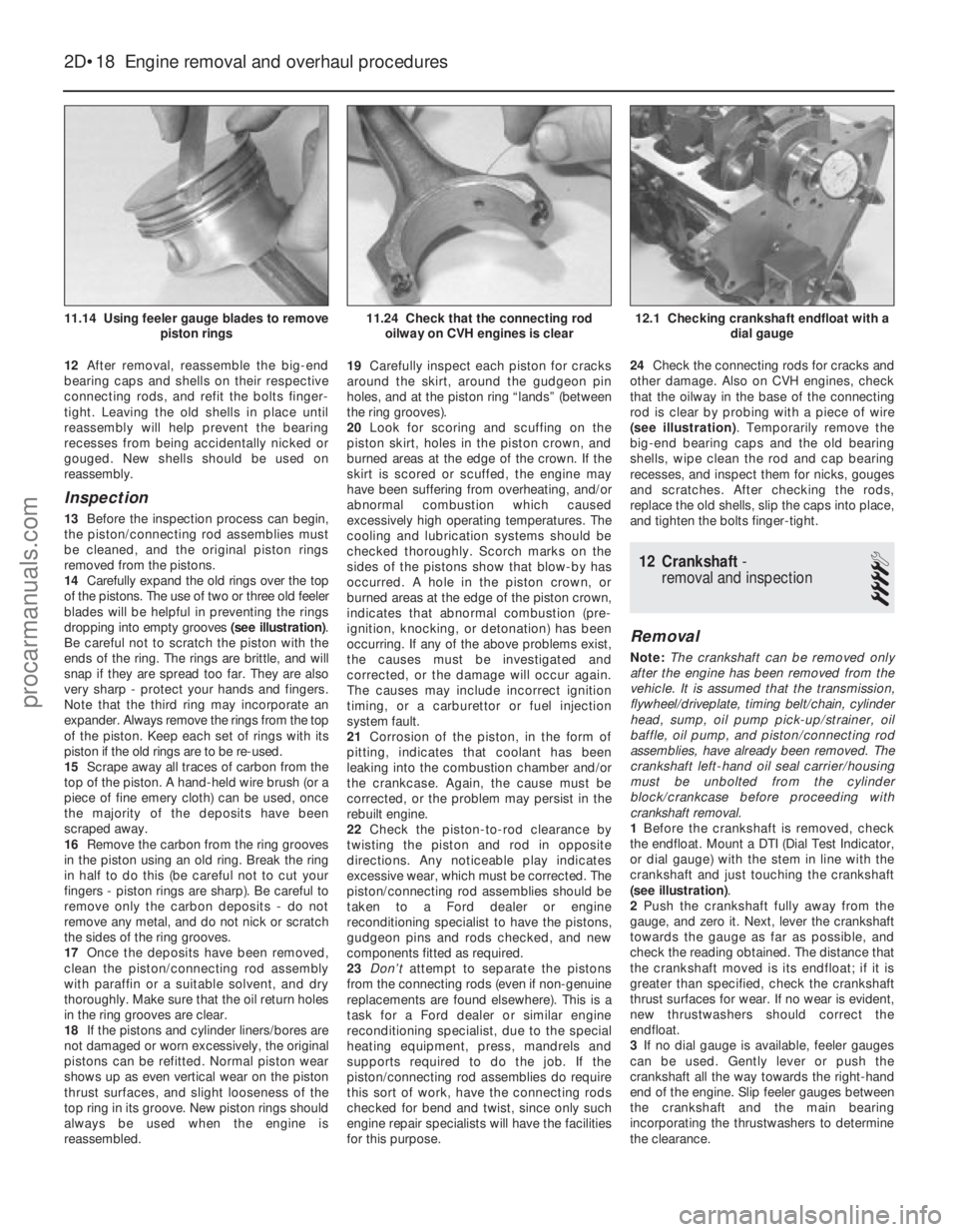
14 Carefully expand the old rings over the top
of the pistons. The use of two or three old feeler
blades will be helpful in preventing the rings
dropping into empty grooves (see illustration).
Be careful not to scratch the piston with the
ends of the ring. The rings are brittle, and will
snap if they are spread too far. They are also
very sharp - protect your hands and fingers.
Note that the third ring may incorporate an
expander. Always remove the rings from the top
of the piston. Keep each set of rings with its
piston if the old rings are to be re-used.
15 Scrape away all traces of carbon from the
top of the piston. A hand-held wire brush (or a
piece of fine emery cloth) can be used, once
the majority of the deposits have been
scraped away.
16 Remove the carbon from the ring grooves
in the piston using an old ring. Break the ring
in half to do this (be careful not to cut your
fingers - piston rings are sharp). Be careful to
remove only the carbon deposits - do not
remove any metal, and do not nick or scratch
the sides of the ring grooves.
17 Once the deposits have been removed,
clean the piston/connecting rod assembly
with paraffin or a suitable solvent, and dry
thoroughly. Make sure that the oil return holes
in the ring grooves are clear.
18 If the pistons and cylinder liners/bores are
not damaged or worn excessively, the original
pistons can be refitted. Normal piston wear
shows up as even vertical wear on the piston
thrust surfaces, and slight looseness of the
top ring in its groove. New piston rings should
always be used when the engine is
reassembled. 19
Carefully inspect each piston for cracks
around the skirt, around the gudgeon pin
holes, and at the piston ring “lands” (between
the ring grooves).
20 Look for scoring and scuffing on the
piston skirt, holes in the piston crown, and
burned areas at the edge of the crown. If the
skirt is scored or scuffed, the engine may
have been suffering from overheating, and/or
abnormal combustion which caused
excessively high operating temperatures. The
cooling and lubrication systems should be
checked thoroughly. Scorch marks on the
sides of the pistons show that blow-by has
occurred. A hole in the piston crown, or
burned areas at the edge of the piston crown,
indicates that abnormal combustion (pre-
ignition, knocking, or detonation) has been
occurring. If any of the above problems exist,
the causes must be investigated and
corrected, or the damage will occur again.
The causes may include incorrect ignition
timing, or a carburettor or fuel injection
system fault.
21 Corrosion of the piston, in the form of
pitting, indicates that coolant has been
leaking into the combustion chamber and/or
the crankcase. Again, the cause must be
corrected, or the problem may persist in the
rebuilt engine.
22 Check the piston-to-rod clearance by
twisting the piston and rod in opposite
directions. Any noticeable play indicates
excessive wear, which must be corrected. The
piston/connecting rod assemblies should be
taken to a Ford dealer or engine
reconditioning specialist to have the pistons,
gudgeon pins and rods checked, and new
components fitted as required.
23 Don’t attempt to separate the pistons
from the connecting rods (even if non-genuine
replacements are found elsewhere). This is a
task for a Ford dealer or similar engine
reconditioning specialist, due to the special
heating equipment, press, mandrels and
supports required to do the job. If the
piston/connecting rod assemblies do require
this sort of work, have the connecting rods
checked for bend and twist, since only such
engine repair specialists will have the facilities
for this purpose. 24
Check the connecting rods for cracks and
other damage. Also on CVH engines, check
that the oilway in the base of the connecting
rod is clear by probing with a piece of wire
(see illustration) . Temporarily remove the
big-end bearing caps and the old bearing
shells, wipe clean the rod and cap bearing
recesses, and inspect them for nicks, gouges
and scratches. After checking the rods,
replace the old shells, slip the caps into place,
and tighten the bolts finger-tight.
12 Crankshaft -
removal and inspection
4
Removal
Note: The crankshaft can be removed only
after the engine has been removed from the
vehicle. It is assumed that the transmission,
flywheel/driveplate, timing belt/chain, cylinder
head, sump, oil pump pick-up/strainer, oil
baffle, oil pump, and piston/connecting rod
assemblies, have already been removed. The
crankshaft left-hand oil seal carrier/housing
must be unbolted from the cylinder
block/crankcase before proceeding with
crankshaft removal.
1 Before the crankshaft is removed, check
the endfloat. Mount a DTI (Dial Test Indicator,
or dial gauge) with the stem in line with the
crankshaft and just touching the crankshaft
(see illustration) .
2 Push the crankshaft fully away from the
gauge, and zero it. Next, lever the crankshaft
towards the gauge as far as possible, and
check the reading obtained. The distance that
the crankshaft moved is its endfloat; if it is
greater than specified, check the crankshaft
thrust surfaces for wear. If no wear is evident,
new thrustwashers should correct the
endfloat.
3 If no dial gauge is available, feeler gauges
can be used. Gently lever or push the
crankshaft all the way towards the right-hand
end of the engine. Slip feeler gauges between
the crankshaft and the main bearing
incorporating the thrustwashers to determine
the clearance.
2D•18 Engine removal and overhaul procedures
12.1 Checking crankshaft endfloat with a dial gauge11.24 Check that the connecting rodoilway on CVH engines is clear11.14 Using feeler gauge blades to remove piston rings
1595Ford Fiesta Remakeprocarmanuals.com
http://vnx.su
Page 88 of 296
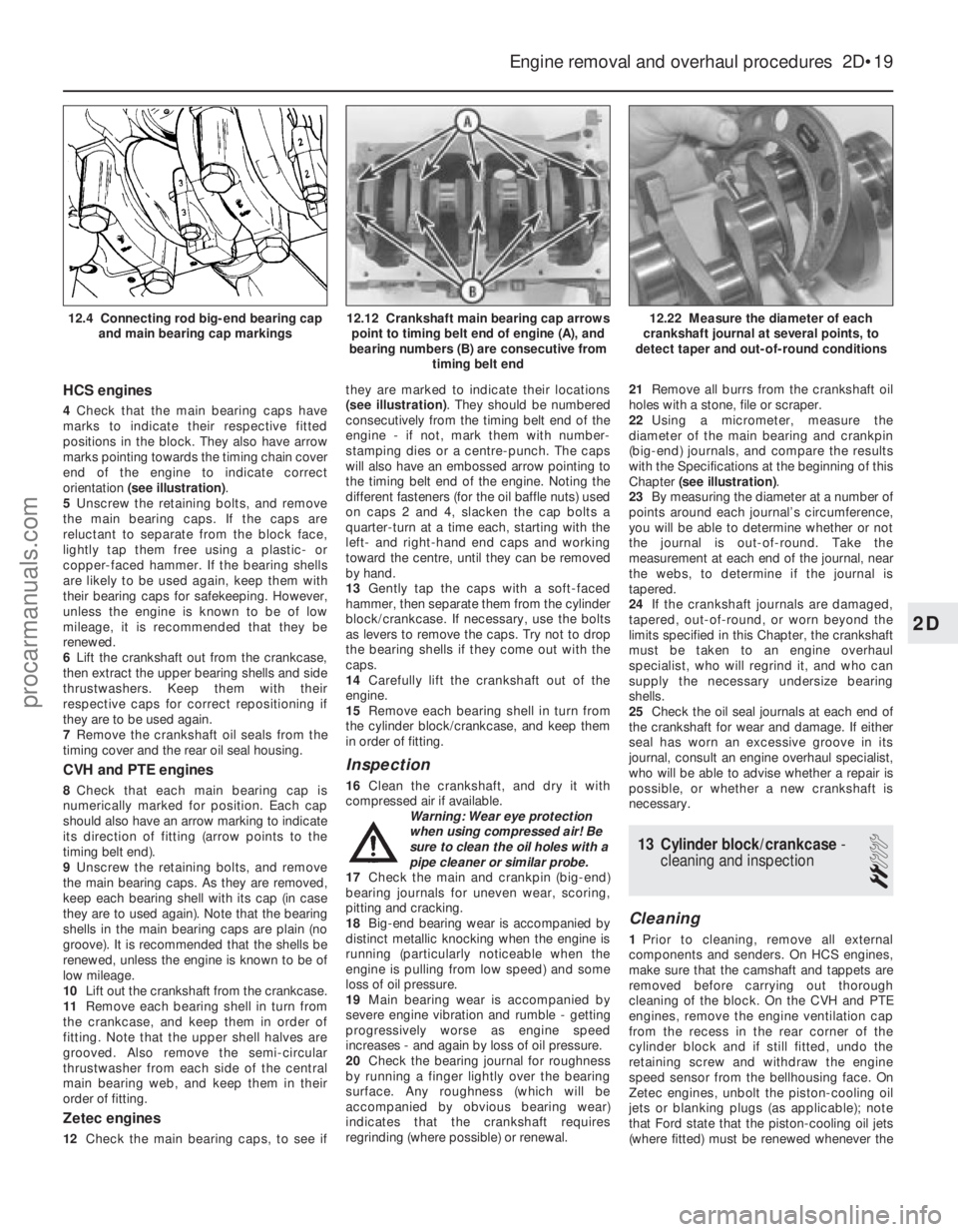
HCS engines
4Check that the main bearing caps have
marks to indicate their respective fitted
positions in the block. They also have arrow
marks pointing towards the timing chain cover
end of the engine to indicate correct
orientation (see illustration) .
5 Unscrew the retaining bolts, and remove
the main bearing caps. If the caps are
reluctant to separate from the block face,
lightly tap them free using a plastic- or
copper-faced hammer. If the bearing shells
are likely to be used again, keep them with
their bearing caps for safekeeping. However,
unless the engine is known to be of low
mileage, it is recommended that they be
renewed.
6 Lift the crankshaft out from the crankcase,
then extract the upper bearing shells and side
thrustwashers. Keep them with their
respective caps for correct repositioning if
they are to be used again.
7 Remove the crankshaft oil seals from the
timing cover and the rear oil seal housing.
CVH and PTE engines
8 Check that each main bearing cap is
numerically marked for position. Each cap
should also have an arrow marking to indicate
its direction of fitting (arrow points to the
timing belt end).
9 Unscrew the retaining bolts, and remove
the main bearing caps. As they are removed,
keep each bearing shell with its cap (in case
they are to used again). Note that the bearing
shells in the main bearing caps are plain (no
groove). It is recommended that the shells be
renewed, unless the engine is known to be of
low mileage.
10 Lift out the crankshaft from the crankcase.
11 Remove each bearing shell in turn from
the crankcase, and keep them in order of
fitting. Note that the upper shell halves are
grooved. Also remove the semi-circular
thrustwasher from each side of the central
main bearing web, and keep them in their
order of fitting.
Zetec engines
12 Check the main bearing caps, to see if they are marked to indicate their locations
(see illustration)
. They should be numbered
consecutively from the timing belt end of the
engine - if not, mark them with number-
stamping dies or a centre-punch. The caps
will also have an embossed arrow pointing to
the timing belt end of the engine. Noting the
different fasteners (for the oil baffle nuts) used
on caps 2 and 4, slacken the cap bolts a
quarter-turn at a time each, starting with the
left- and right-hand end caps and working
toward the centre, until they can be removed
by hand.
13 Gently tap the caps with a soft-faced
hammer, then separate them from the cylinder
block/crankcase. If necessary, use the bolts
as levers to remove the caps. Try not to drop
the bearing shells if they come out with the
caps.
14 Carefully lift the crankshaft out of the
engine.
15 Remove each bearing shell in turn from
the cylinder block/crankcase, and keep them
in order of fitting.
Inspection
16 Clean the crankshaft, and dry it with
compressed air if available.
Warning: Wear eye protection
when using compressed air! Be
sure to clean the oil holes with a
pipe cleaner or similar probe.
17 Check the main and crankpin (big-end)
bearing journals for uneven wear, scoring,
pitting and cracking.
18 Big-end bearing wear is accompanied by
distinct metallic knocking when the engine is
running (particularly noticeable when the
engine is pulling from low speed) and some
loss of oil pressure.
19 Main bearing wear is accompanied by
severe engine vibration and rumble - getting
progressively worse as engine speed
increases - and again by loss of oil pressure.
20 Check the bearing journal for roughness
by running a finger lightly over the bearing
surface. Any roughness (which will be
accompanied by obvious bearing wear)
indicates that the crankshaft requires
regrinding (where possible) or renewal. 21
Remove all burrs from the crankshaft oil
holes with a stone, file or scraper.
22 Using a micrometer, measure the
diameter of the main bearing and crankpin
(big-end) journals, and compare the results
with the Specifications at the beginning of this
Chapter (see illustration) .
23 By measuring the diameter at a number of
points around each journal’s circumference,
you will be able to determine whether or not
the journal is out-of-round. Take the
measurement at each end of the journal, near
the webs, to determine if the journal is
tapered.
24 If the crankshaft journals are damaged,
tapered, out-of-round, or worn beyond the
limits specified in this Chapter, the crankshaft
must be taken to an engine overhaul
specialist, who will regrind it, and who can
supply the necessary undersize bearing
shells.
25 Check the oil seal journals at each end of
the crankshaft for wear and damage. If either
seal has worn an excessive groove in its
journal, consult an engine overhaul specialist,
who will be able to advise whether a repair is
possible, or whether a new crankshaft is
necessary.
13 Cylinder block/crankcase -
cleaning and inspection
2
Cleaning
1 Prior to cleaning, remove all external
components and senders. On HCS engines,
make sure that the camshaft and tappets are
removed before carrying out thorough
cleaning of the block. On the CVH and PTE
engines, remove the engine ventilation cap
from the recess in the rear corner of the
cylinder block and if still fitted, undo the
retaining screw and withdraw the engine
speed sensor from the bellhousing face. On
Zetec engines, unbolt the piston-cooling oil
jets or blanking plugs (as applicable); note
that Ford state that the piston-cooling oil jets
(where fitted) must be renewed whenever the
Engine removal and overhaul procedures 2D•19
12.22 Measure the diameter of each
crankshaft journal at several points, to
detect taper and out-of-round conditions12.12 Crankshaft main bearing cap arrows point to timing belt end of engine (A), and
bearing numbers (B) are consecutive from timing belt end12.4 Connecting rod big-end bearing capand main bearing cap markings
2D
1595Ford Fiesta Remakeprocarmanuals.com
http://vnx.su
Page 89 of 296
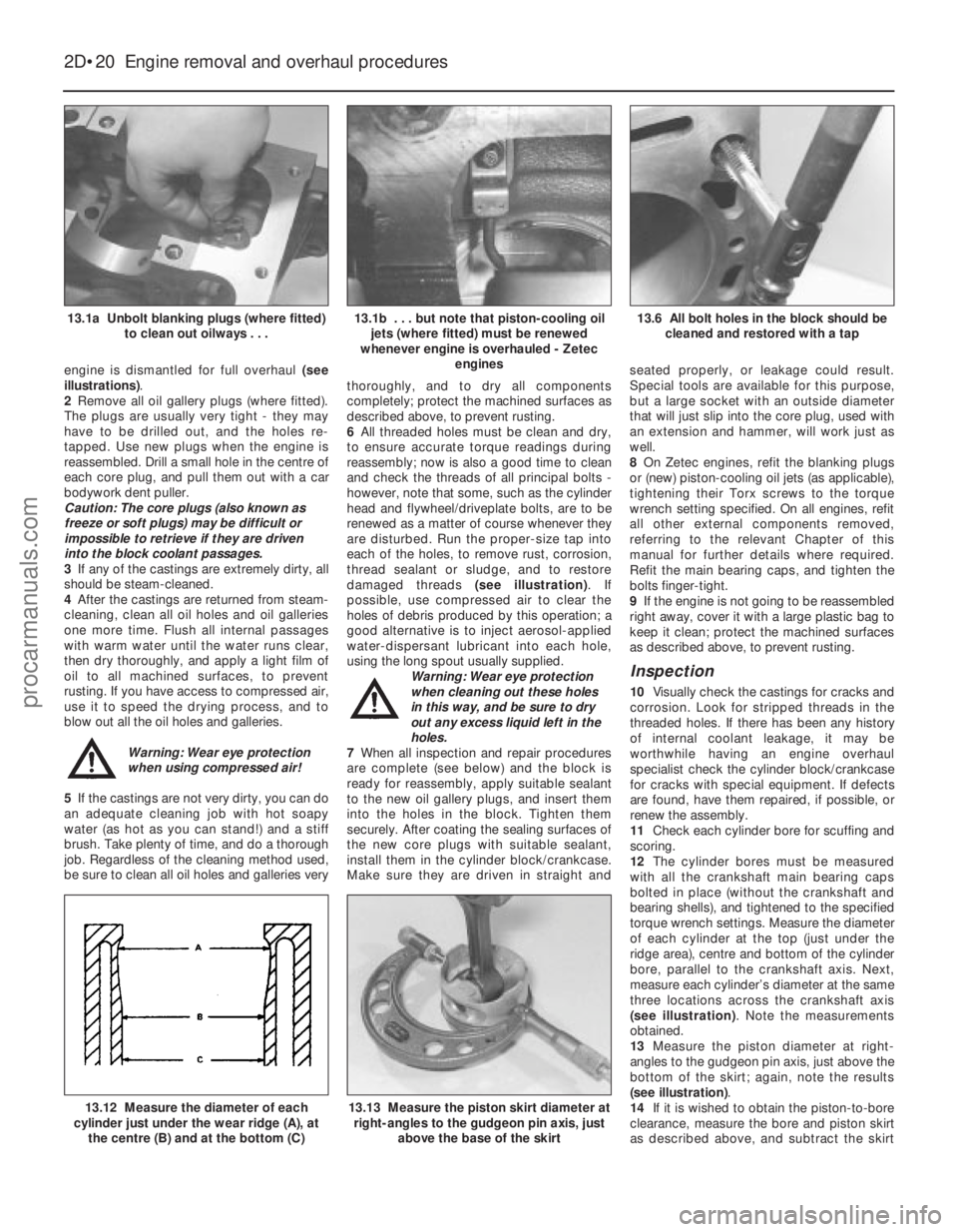
engine is dismantled for full overhaul (see
illustrations) .
2 Remove all oil gallery plugs (where fitted).
The plugs are usually very tight - they may
have to be drilled out, and the holes re-
tapped. Use new plugs when the engine is
reassembled. Drill a small hole in the centre of
each core plug, and pull them out with a car
bodywork dent puller.
Caution: The core plugs (also known as
freeze or soft plugs) may be difficult or
impossible to retrieve if they are driven
into the block coolant passages.
3 If any of the castings are extremely dirty, all
should be steam-cleaned.
4 After the castings are returned from steam-
cleaning, clean all oil holes and oil galleries
one more time. Flush all internal passages
with warm water until the water runs clear,
then dry thoroughly, and apply a light film of
oil to all machined surfaces, to prevent
rusting. If you have access to compressed air,
use it to speed the drying process, and to
blow out all the oil holes and galleries.
Warning: Wear eye protection
when using compressed air!
5 If the castings are not very dirty, you can do
an adequate cleaning job with hot soapy
water (as hot as you can stand!) and a stiff
brush. Take plenty of time, and do a thorough
job. Regardless of the cleaning method used,
be sure to clean all oil holes and galleries very thoroughly, and to dry all components
completely; protect the machined surfaces as
described above, to prevent rusting.
6
All threaded holes must be clean and dry,
to ensure accurate torque readings during
reassembly; now is also a good time to clean
and check the threads of all principal bolts -
however, note that some, such as the cylinder
head and flywheel/driveplate bolts, are to be
renewed as a matter of course whenever they
are disturbed. Run the proper-size tap into
each of the holes, to remove rust, corrosion,
thread sealant or sludge, and to restore
damaged threads (see illustration). If
possible, use compressed air to clear the
holes of debris produced by this operation; a
good alternative is to inject aerosol-applied
water-dispersant lubricant into each hole,
using the long spout usually supplied. Warning: Wear eye protection
when cleaning out these holes
in this way, and be sure to dry
out any excess liquid left in the
holes.
7 When all inspection and repair procedures
are complete (see below) and the block is
ready for reassembly, apply suitable sealant
to the new oil gallery plugs, and insert them
into the holes in the block. Tighten them
securely. After coating the sealing surfaces of
the new core plugs with suitable sealant,
install them in the cylinder block/crankcase.
Make sure they are driven in straight and seated properly, or leakage could result.
Special tools are available for this purpose,
but a large socket with an outside diameter
that will just slip into the core plug, used with
an extension and hammer, will work just as
well.
8
On Zetec engines, refit the blanking plugs
or (new) piston-cooling oil jets (as applicable),
tightening their Torx screws to the torque
wrench setting specified. On all engines, refit
all other external components removed,
referring to the relevant Chapter of this
manual for further details where required.
Refit the main bearing caps, and tighten the
bolts finger-tight.
9 If the engine is not going to be reassembled
right away, cover it with a large plastic bag to
keep it clean; protect the machined surfaces
as described above, to prevent rusting.
Inspection
10 Visually check the castings for cracks and
corrosion. Look for stripped threads in the
threaded holes. If there has been any history
of internal coolant leakage, it may be
worthwhile having an engine overhaul
specialist check the cylinder block/crankcase
for cracks with special equipment. If defects
are found, have them repaired, if possible, or
renew the assembly.
11 Check each cylinder bore for scuffing and
scoring.
12 The cylinder bores must be measured
with all the crankshaft main bearing caps
bolted in place (without the crankshaft and
bearing shells), and tightened to the specified
torque wrench settings. Measure the diameter
of each cylinder at the top (just under the
ridge area), centre and bottom of the cylinder
bore, parallel to the crankshaft axis. Next,
measure each cylinder’s diameter at the same
three locations across the crankshaft axis
(see illustration) . Note the measurements
obtained.
13 Measure the piston diameter at right-
angles to the gudgeon pin axis, just above the
bottom of the skirt; again, note the results
(see illustration) .
14 If it is wished to obtain the piston-to-bore
clearance, measure the bore and piston skirt
as described above, and subtract the skirt
2D•20 Engine removal and overhaul procedures
13.13 Measure the piston skirt diameter at
right-angles to the gudgeon pin axis, just
above the base of the skirt13.12 Measure the diameter of each
cylinder just under the wear ridge (A), at
the centre (B) and at the bottom (C)
13.6 All bolt holes in the block should be cleaned and restored with a tap13.1b . . . but note that piston-cooling oiljets (where fitted) must be renewed
whenever engine is overhauled - Zetec engines13.1a Unbolt blanking plugs (where fitted)to clean out oilways . . .
1595Ford Fiesta Remakeprocarmanuals.com
http://vnx.su