ignition FORD FIESTA 2007 User Guide
[x] Cancel search | Manufacturer: FORD, Model Year: 2007, Model line: FIESTA, Model: FORD FIESTA 2007Pages: 1226, PDF Size: 61.26 MB
Page 202 of 1226
Brake System - General Information
DIAGNOSIS AND TESTING
evidence of a brake concern. Check for the brake
warning indicator illumination and the fluid level in
the master cylinder reservoir.
Normal Conditions
The following conditions are considered normal
and are not indications that the brake master
cylinder is in need of service.
- Modern brake systems are not designed to
produce as hard a pedal effort as in the past.
Complaints of light pedal efforts should be
compared to pedal efforts of another vehicle, of
the same model and year.
- During normal operation of the brake the fluid
level in the reservoir will rise during brake
application and fall during release. The net fluid
level
(i.e., after brake application and release)
will remain unchanged.
- A trace of brake fluid will exists on the brake
booster shell below the master cylinder
mounting flange. This results from the normal
lubricating action of the master cylinder bore
end seal.
- The fluid level will fall with brake shoe and lining
wear.
Abnormal Conditions
N0TE:Prior to performing any diagnosis, make
sure the brake system warning indicator is
functional.
Changes in brake pedal feel or travel are indicators
that something could be wrong with the braking system. The diagnostic procedure and techniques
use brake pedal feel, warning indicator illumination
and low brake fluid level as indicators in diagnosing
braking system concerns. The following conditions
are considered abnormal and indicate that the
brake master cylinder is in need of service.
- The brake pedal effort is excessive. This may
be caused by a bind or obstruction in the pedal
.
or linkage, clogged fluid control valve or ( ' insufficient booster vacuum.
- The rear brakes lock up during light pedal force.
This may be caused by incorrect tire pressures,
grease or fluid on the brake shoes and linings,
damaged brake shoes and linings, incorrectly
adjusted parking brake, or damaged or
contaminated brake pressure control valves.
- The brake pedal effort is erratic. This condition
could be caused by a brake booster malfunction,
extreme caliper piston knock back or incorrectly
installed brake shoes and linings.
- The brake warning indicator is ON. This may
be caused by low fluid level, ignition wire routing
too close to the fluid level indicator assembly,
or float assembly damage.
Bypass Condition Test
1. Check the fluid in brake master cylinder. Fill the
brake master cylinder reservoir if low or empty.
2. Observe the fluid level in the brake master
cylinder reservoir. If after several brake
applications, the fluid level remains the same,
measure the wheel turning torque required to
rotate the wheels with the brakes applied as
follows:
Place the transaxle in NEUTRAL and raise and
support the vehicle. REFER to: (1 00-02 Jacking
and Lifting)
Jacking (Description and Operation),
Lifting (Description and Operation).
Apply the brakes with a minimum of 445 N (100
Ib) and hold for approximately 15 seconds. With
the brakes still applied, exert a torque on the front
wheels of 10.1 Nm (75
1b.R). If either wheel rotates,
install a new brake master cylinder. REFER to:
(206-06 Hydraulic Brake Actuation)
- The brake pedal goes down fast. This could be Brake Master Cylinder - RHD (Removal and
caused by an external or internal leak. Installation),
- The brake
pedal eases down slowly. This could Brake Master Cylinder - LHD
(Removal and
be caused by an external or internal leak. Installation).
- The
brake pedal is low and or feels spongy. This
condition may be caused by no fluid in the brake
Non-Pressure Leaks master cylinder reservoir, reservoir cap vent
holes clogged or air in the hydraulic system.
Any empty brake master cylinder reservoir
condition may be caused by two types of
non-pressure external leaks.
2006.0 Fiesta 1212006
procarmanuals.com
Page 277 of 1226
206-09A-3 Anti-Lock Control 206-09A-3
DESCRIPTION AND OPERATION
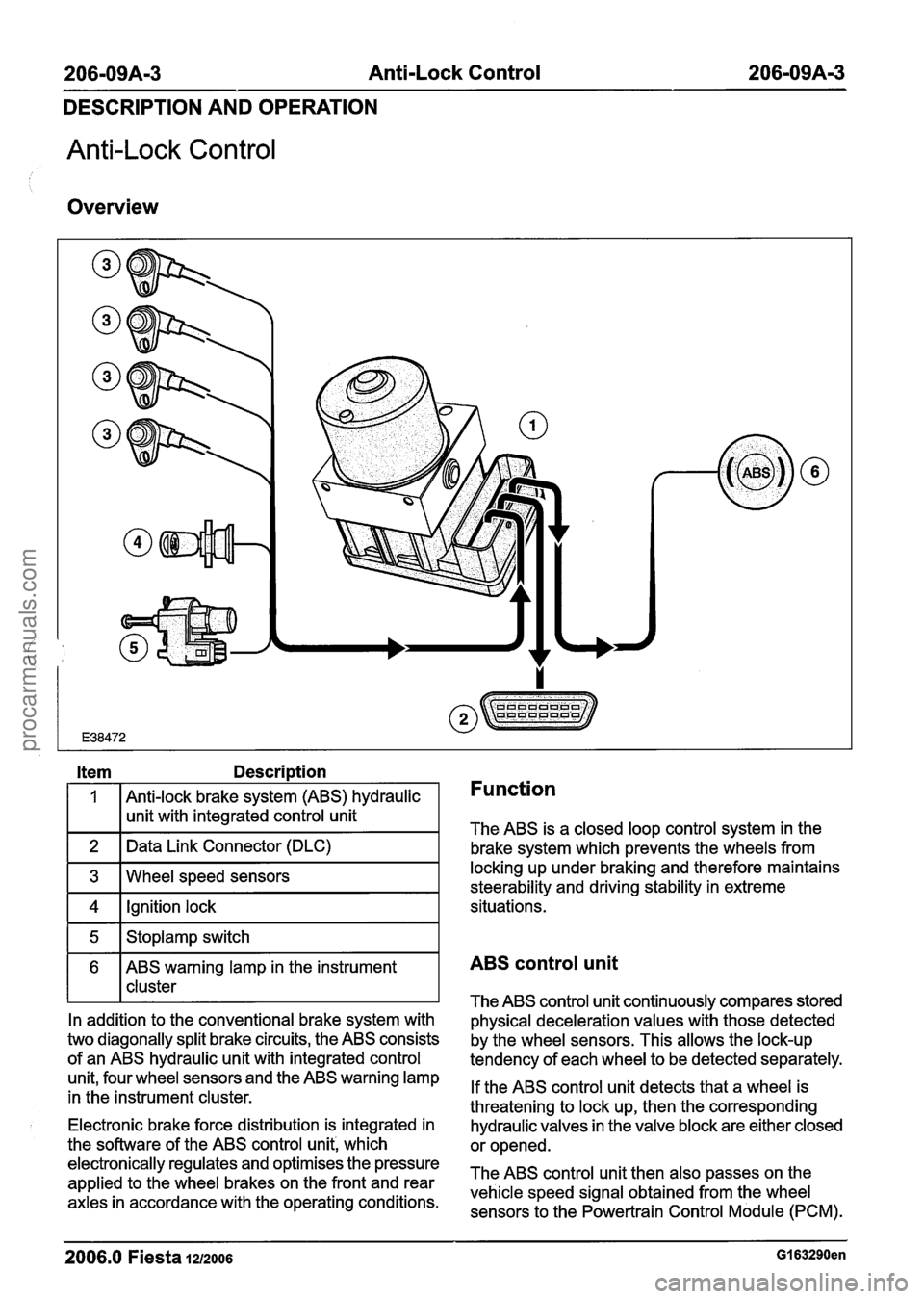
Anti-Lock Control
Overview
Function
The ABS is a closed loop control system in the
brake system which prevents the wheels from
1 4 1 Ignition lock I situations.
3
1 5 1 Stoplamp switch I
6 ABS warning lamp in the instrument
I 1 cluster
Wheel
speed sensors
In addition to the conventional brake system with
two diagonally split brake circuits, the ABS consists
of an ABS hydraulic unit with integrated control
unit, four wheel sensors and the ABS warning lamp
in the instrument cluster. locking up under
braking and therefore maintains
steerability and driving stability in extreme
Electronic brake force distribution is integrated in
the software of the ABS control unit', which
electronically regulates and optimises the pressure
applied to the wheel brakes on the front and rear
axles in accordance with the operating conditions.
ABS control unit
The ABS control unit continuously compares stored
physical deceleration values with those detected
by the wheel sensors. This allows the lock-up
tendency of each wheel to be detected separately.
If the ABS control unit detects that a wheel is
threatening to lock up, then the corresponding
hydraulic valves in the valve block are either closed
or opened.
The ABS control unit then also passes on the
vehicle speed signal obtained from the wheel sensors to the Powertrain Control Module (PCM).
2006.0 Fiesta 1212oo6 GI 63290en
procarmanuals.com
Page 278 of 1226
206-09A-4 Anti-Lock Control 206-09A-4
DESCRIPTION AND OPERATION
The warning lamp in the instrument cluster is
actuated by the ABS control unit after switching on
the ignition. It remains on up to the end of the ABS
self-test, and is also actuated in the event of
system errors.
It continuously monitors the system for possible
faults and stores these as and when they occur.
The corresponding trouble codes can be
interrogated with the aid of WDS via the DLC
.
The ABS control unit is directly connected via a
diagnostic data link to the DLC.
Valve block
The valve block contains four inlet valves and four
outlet valves. There is one inlet valve and one
outlet valve for each wheel.
When there is no electrical supply the inlet valves
are open and the outlet valves are closed.
The valve block also contains the low-pressure
reservoir and sound damping chambers.
Pump motor
In the event of an ABS intervention the pump motor
ensures that the pressure can be provided to the
regulating channels independently of the brake
master cylinder.
ABS regulating cycle
An ABS regulating cycle has three phases:
Phase
1 - holding pressure
The inlet valve is closed, and the brake pressure
to the wheel brake cannot be increased any
further, even if the actuation pressure (brake
pedal) is increased further.
Phase
2 - pressure reduction
The outlet valve is temporarily opened, and the
brake pressure to the wheel brake is reduced
in a controlled manner.
Phase
3 - pressure build-up
The inlet valve is opened in stages, and the
brake pressure is increased in a controlled
manner to achieve the greatest possible
deceleration.
2006.0 Fiesta 1212006 GI 63290en
procarmanuals.com
Page 280 of 1226
206-09A-6 Anti-Lock Control 206-09A-6
DESCRIPTION AND OPERATION
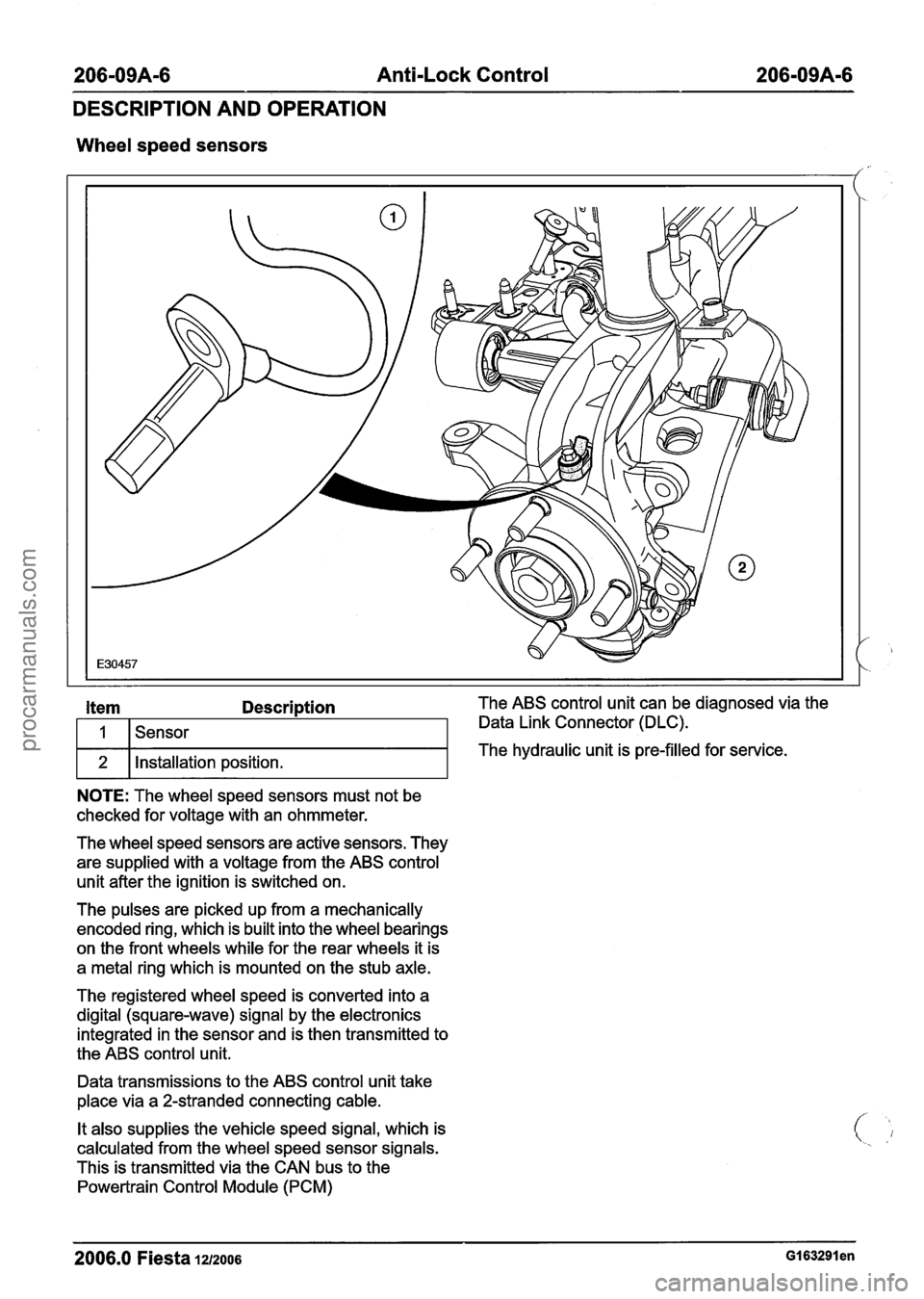
Wheel speed sensors
I f
The wheel speed sensors are active sensors. They
are supplied with a voltage from the ABS control
unit after the ignition is switched on.
Item Description The ABS control unit can be diagnosed via the
The pulses are picked up from a mechanically
encoded ring, which is built into the wheel bearings
on the front wheels while for the rear wheels it is
a metal ring which is mounted on the stub axle.
The registered wheel speed is converted into a
digital (square-wave) signal by the electronics
integrated in the sensor and is then transmitted to
the ABS control unit. Data Link Connector
(DLC).
The hydraulic unit is pre-filled for service.
1
2
Data transmissions to the ABS control unit take
place via a 2-stranded connecting cable.
NOTE: The wheel speed sensors must not be
checked for voltage with an ohmmeter.
Sensor
Installation position.
It also supplies the vehicle speed signal, which is
calculated from the wheel speed sensor signals.
This is transmitted via the CAN bus to the
Powertrain Control Module (PCM)
2006.0 Fiesta 1212006 GI 63291 en
procarmanuals.com
Page 338 of 1226
211 -00-1 8 Steering System - General Information 211 -00-1 8
DIAGNOSIS AND TESTING
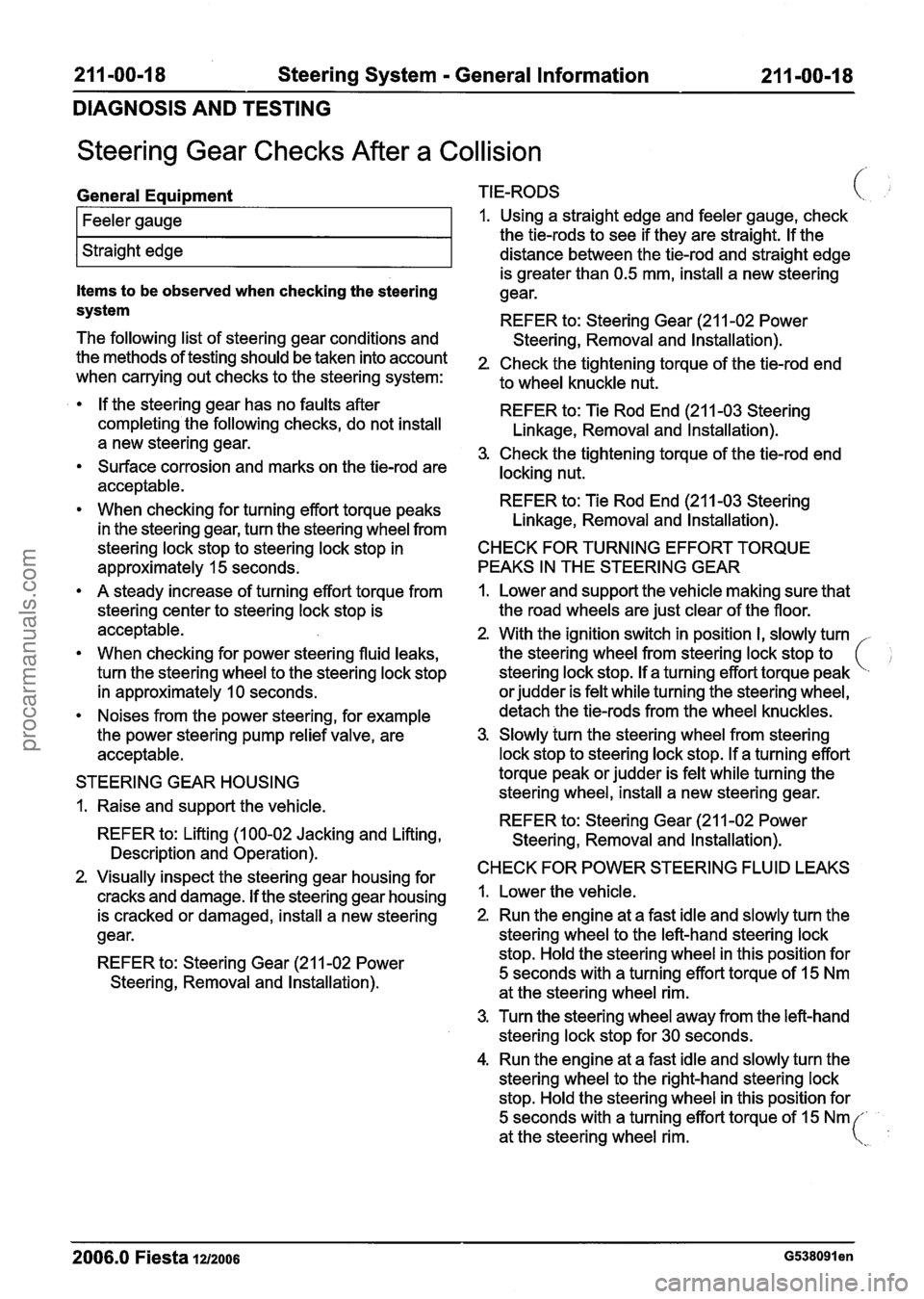
Steering Gear Checks After a Collision
f
system REFER to: Steering Gear (211-02 Power
The following list of steering gear conditions and
Steering, Removal and Installation).
the methods
of testing should be taken into ~CCOU~~ 2. Check the tightening torque of the tiemrod end when carrying out checks to the steering system:
to wheel knuckle nut.
General
Equipment TIE-RODS (.
If
the steering gear has no faults after
REFER to: Tie Rod End (21 1-03 Steering
completing the following checks, do not install
Linkage, Removal and Installation).
a new steering gear.
3. Check the tightening torque of the tie-rod end
Surface corrosion and marks on the tie-rod are
locking nut.
acceptable.
When checking for turning effort torque peaks REFER to: Tie
Rod End
(211-03 Steering
in the steering gear, turn the steering wheel from Linkage,
Removal and lnstallation).
Feeler gauge
Straight edge
steering lock-stop to steering lock
stop in CHECK FOR TURNING EFFORT TORQUE
approximately 15 seconds. PEAKS
IN THE STEERING GEAR
1.
Using a straight edge and feeler gauge, check
the tie-rods to see if they are straight. If the
distance between the tie-rod and straight edge
A steady increase of turning effort torque from
steering center to steering lock stop is
acceptable.
When checking for power steering fluid leaks,
turn the steering wheel to the steering lock stop
in approximately
10 seconds.
Noises from the power steering, for example
the power steering pump relief valve, are
acceptable. is
greater than 0.5 mm, install a new steering
Items to be observed when checking the steering gear.
STEERING GEAR HOUSING
I. Raise and support the vehicle.
REFER to: Lifting
(1 00-02 Jacking and Lifting,
Description and Operation).
2. Visually inspect the steering gear housing for
cracks and damage. If the steering gear housing
is cracked or damaged, install a new steering
gear.
REFER to: Steering Gear
(21 1-02 Power
Steering, Removal and lnstallation).
1. Lower and support the vehicle making sure that
the road wheels are just clear of the floor.
2. With the ignition switch in position
I, slowly turn
the steering wheel from steering lock stop to
steering lock stop. If a turning effort torque peak
or judder is felt while turning the steering wheel,
detach the tie-rods from the wheel knuckles.
3. Slowly turn the steering wheel from steering
lock stop to steering lock stop. If a turning effort
torque peak or judder is felt while turning the
steering wheel, install a new steering gear.
REFER to: Steering Gear
(211-02 Power
Steering, Removal and lnstallation).
CHECK FOR POWER STEERING FLUID LEAKS
1. Lower the vehicle.
2. Run the engine at a fast idle and slowly turn the
steering wheel to the left-hand steering lock
stop. Hold the steering wheel in this position for
5 seconds with a turning effort torque of
15 Nm
at the steering wheel rim.
3. Turn the steering wheel away from the left-hand
steering lock stop for 30 seconds.
4. Run the engine at a fast idle and slowly turn the
steering wheel to the right-hand steering lock
stop. Hold the steering wheel in this position for
5 seconds with a turning effort torque of
15 Nm '
at the steering wheel rim. (\,
2006.0 Fiesta 1212006 ~538091 en
procarmanuals.com
Page 344 of 1226
21 1-00-24 Steering System - General Information 21 1-00-24
GENERAL PROCEDURES
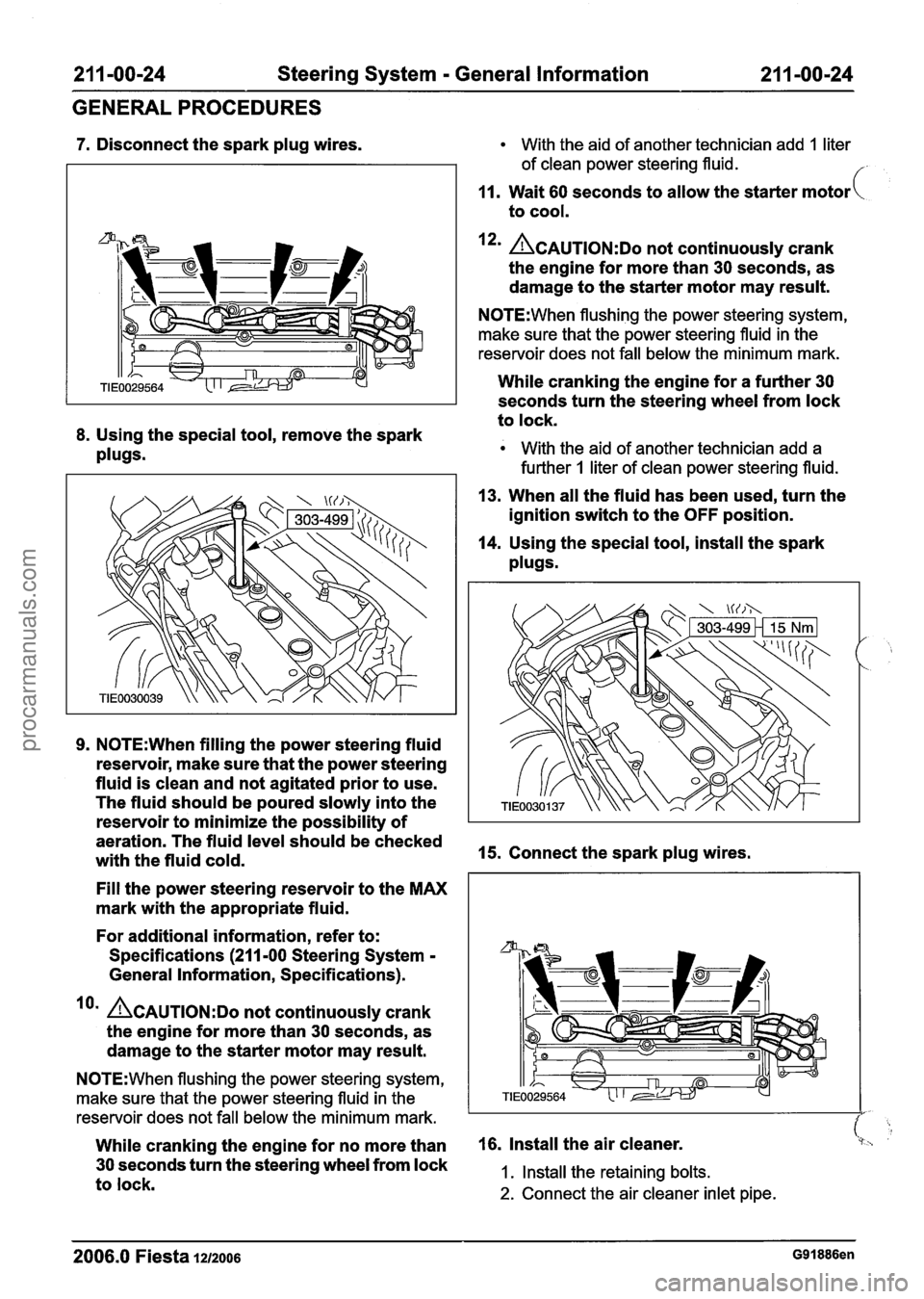
7. Disconnect the spark plug wires. With the aid of another technician add 1 liter
of clean power steering fluid.
11. Wait 60 seconds to allow the starter motor
to cool.
*' ACAUTION:DO not continuously crank
the engine for more than
30 seconds, as
damage to the starter motor may result.
N0TE:When flushing the power steering system,
make sure that the power steering fluid in the
reservoir does not fall below the minimum mark.
While cranking the engine for a further 30
seconds turn the steering wheel from lock
to lock.
8. Using the special tool, remove the spark
plugs. With the aid of another technician add a
further
1 liter of clean power steering fluid.
13. When all the fluid has been used, turn the
ignition switch to the OFF position.
14. Using the special tool, install the spark
plugs.
9. N0TE:When filling the power steering fluid
reservoir, make sure that the power steering
fluid is clean and not agitated prior to use.
The fluid should be poured slowly into the
reservoir to minimize the possibility of
aeration. The fluid level should be checked
with the fluid cold.
15. Connect the spark plug wires.
Fill the power steering reservoir to the
MAX
mark with the appropriate fluid.
For additional information, refer to:
Specifications
(211 -00 Steering System -
General Information, Specifications).
lo' ACAUTION:D~ not continuously crank
the engine for more than
30 seconds, as
damage to the starter motor may result.
N0TE:When flushing the power steering system,
make sure that the power steering fluid in the
reservoir does not fall below the minimum mark.
While cranking the engine for no more than
30 seconds turn the steering wheel from lock
to lock.
16. Install the air cleaner.
I. Install the retaining bolts.
2. Connect the air cleaner inlet pipe.
2006.0 Fiesta la2006 G91886en
procarmanuals.com
Page 347 of 1226
211 -00-27 Steering System - General Information 21 1 -00-27
GENERAL PROCEDURES
6. Raise the vehicle until the road wheels are
clear of the floor. Support the vehicle. For
/ j additional information, refer to: (1 00-02
Jacking and Lifting)
Jacking (Description and Operation),
Lifting (Description and Operation).
7.
N0TE:When filling the power steering fluid
reservoir, make sure that the steering fluid
is clean and not agitated prior to use. The
steering fluid must be poured slowly into the
power steering fluid reservoir to minimize
the possibility of aeration. The steering fluid
level must be checked with the steering fluid
cold.
Fill the power steering fluid reservoir to the
MAX mark with the appropriate steering fluid.
For additional information, refer to:
Specifications (21 1-00 Steering System
-
General Information, Specifications).
8. CAUTIONS:
ADO not continuously crank the engine for
more than 30 seconds.
A~hen flushing the power steering system,
( make sure that the steering fluid in the power
steering fluid reservoir does not fall below
the MIN mark.
N0TE:When filling the power steering fluid
reservoir, make sure that the steering fluid is clean
and not agitated prior to use. The steering fluid
must be poured slowly into the power steering fluid
reservoir to minimize the possibility of aeration.
While cranking the engine turn the steering
wheel from lock to lock.
With the aid of another technician, add a
further
1 liter of clean steering fluid to the
power steering fluid reservoir.
11. When the clean steering fluid has been
added to the power steering fluid reservoir,
turn the ignition switch to the OFF position.
12. Lower the vehicle.
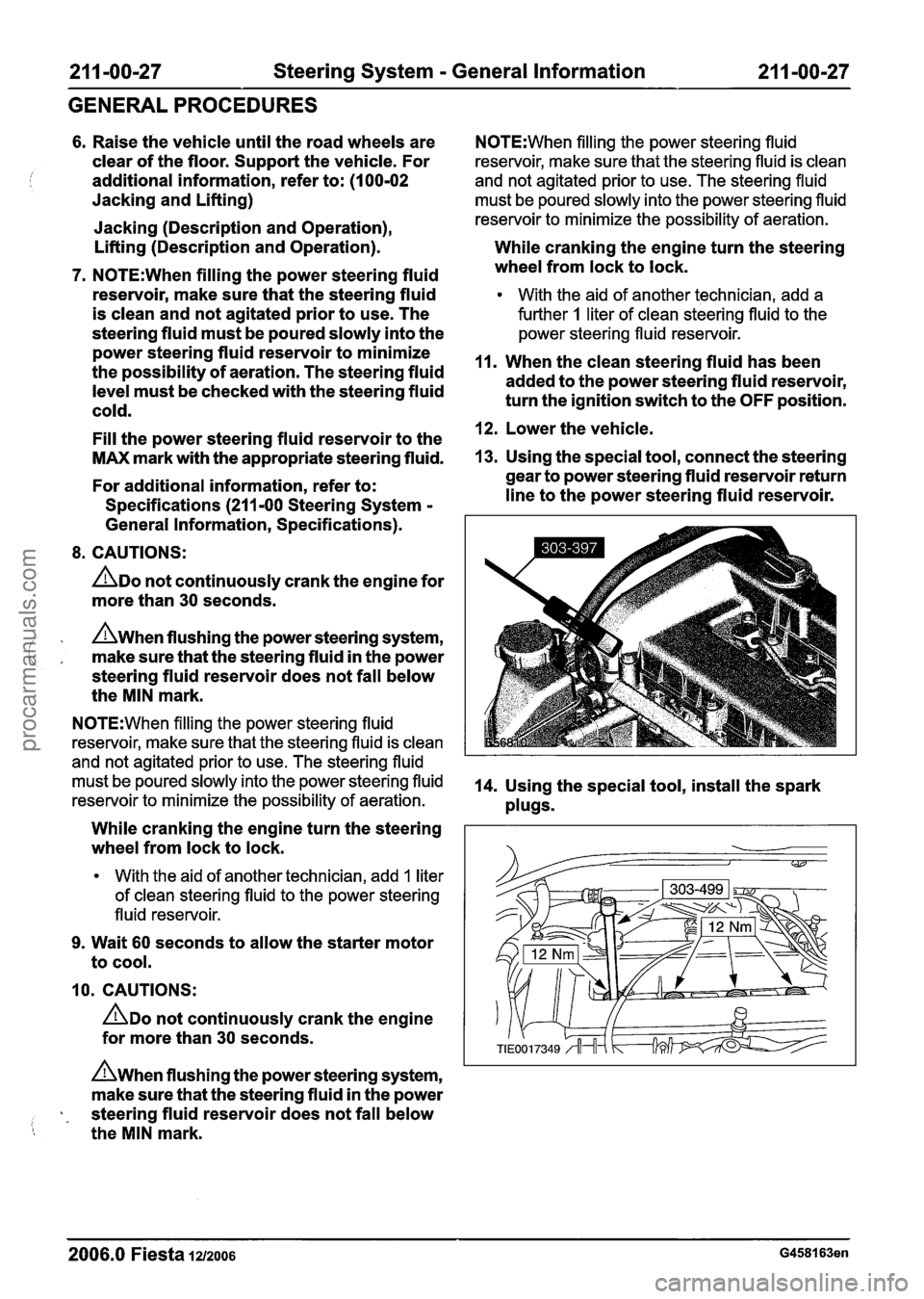
13. Using the special tool, connect the steering
gear to power steering fluid reservoir return
line to the power steering fluid reservoir.
N0TE:When filling the power steering fluid
reservoir, make sure that the steering fluid is clean
and not agitated prior to use. The
steering fluid
must be poured slowly into the power steering fluid 14. Using the special tool, install the spark reservoir to minimize the possibility of aeration. plugs.
While cranking the engine turn the steering
wheel from lock to lock.
With the aid of another technician, add 1 liter
of clean steering fluid to the power steering
fluid reservoir.
9. Wait 60 seconds to allow the starter motor
to cool.
10. CAUTIONS:
ADO not continuously crank the engine
for more than 30 seconds.
Awhen flushing the power steering system,
make sure that the steering fluid in the power
- steering fluid reservoir does not fall below
I, the MIN mark.
- -- - -
2006.0 Fiesta 1212006 G458163en
procarmanuals.com
Page 414 of 1226
2 1 1 -04-6 Steering Column 21 1 -04-6
REMOVAL AND INSTALLATION
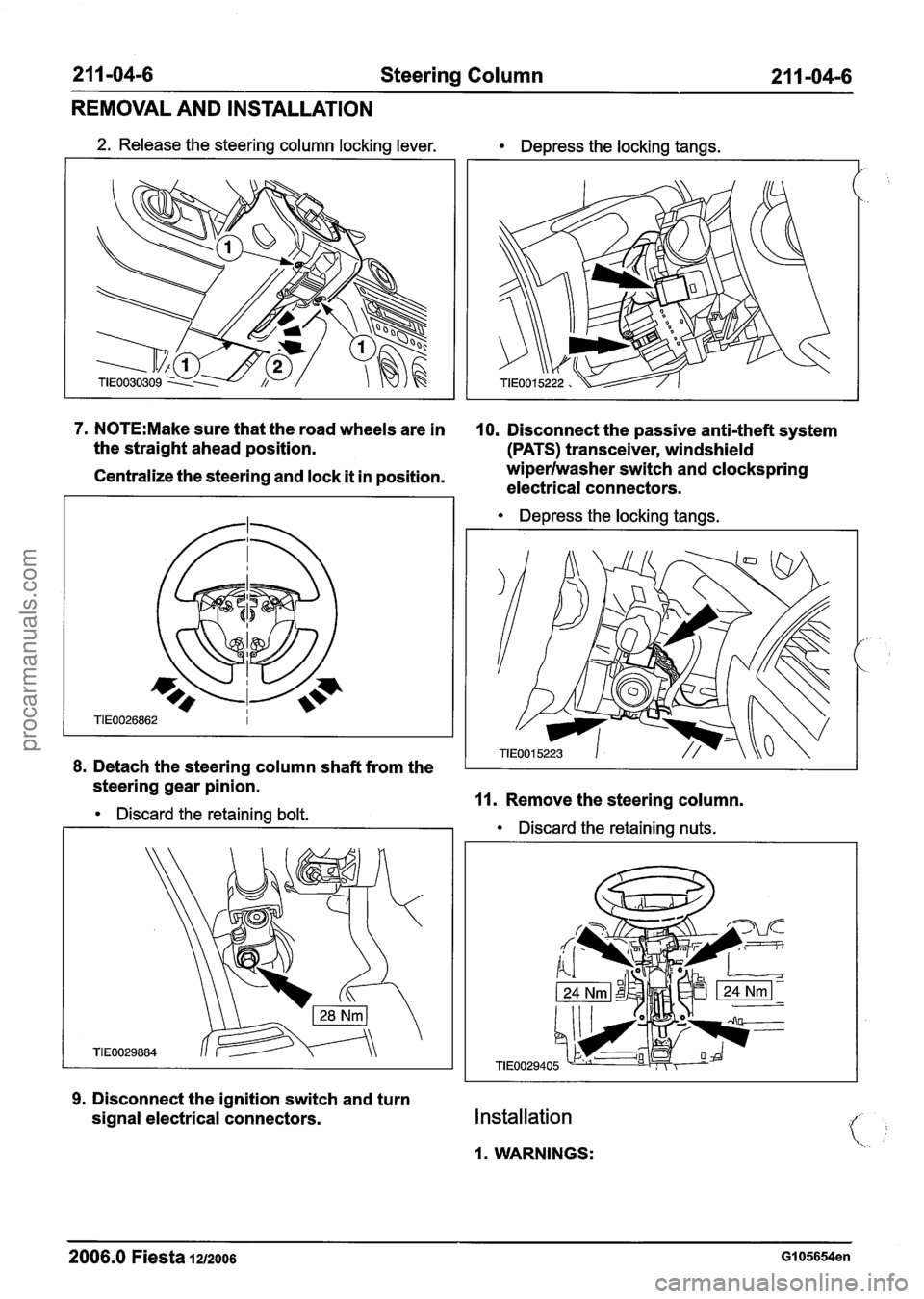
2. Release the steering column locking lever. Depress the locking tangs.
1--
7. N0TE:Make sure that the road wheels are in 10. Disconnect the passive anti-theft system
the straight ahead position.
(PATS) transceiver, windshield
Centralize the steering and lock it in position. wiperlwasher
switch and clockspring
electrical connectors.
Depress the locking tangs.
8. Detach the steering column shaft from the
steering gear pinion.
Discard the retaining bolt. 11. Remove the steering column.
Discard the retaining nuts.
9. Disconnect the ignition switch and turn
signal electrical connectors.
Installation
1. WARNINGS:
2006.0 Fiesta 1212006 GI 05654en
procarmanuals.com
Page 416 of 1226
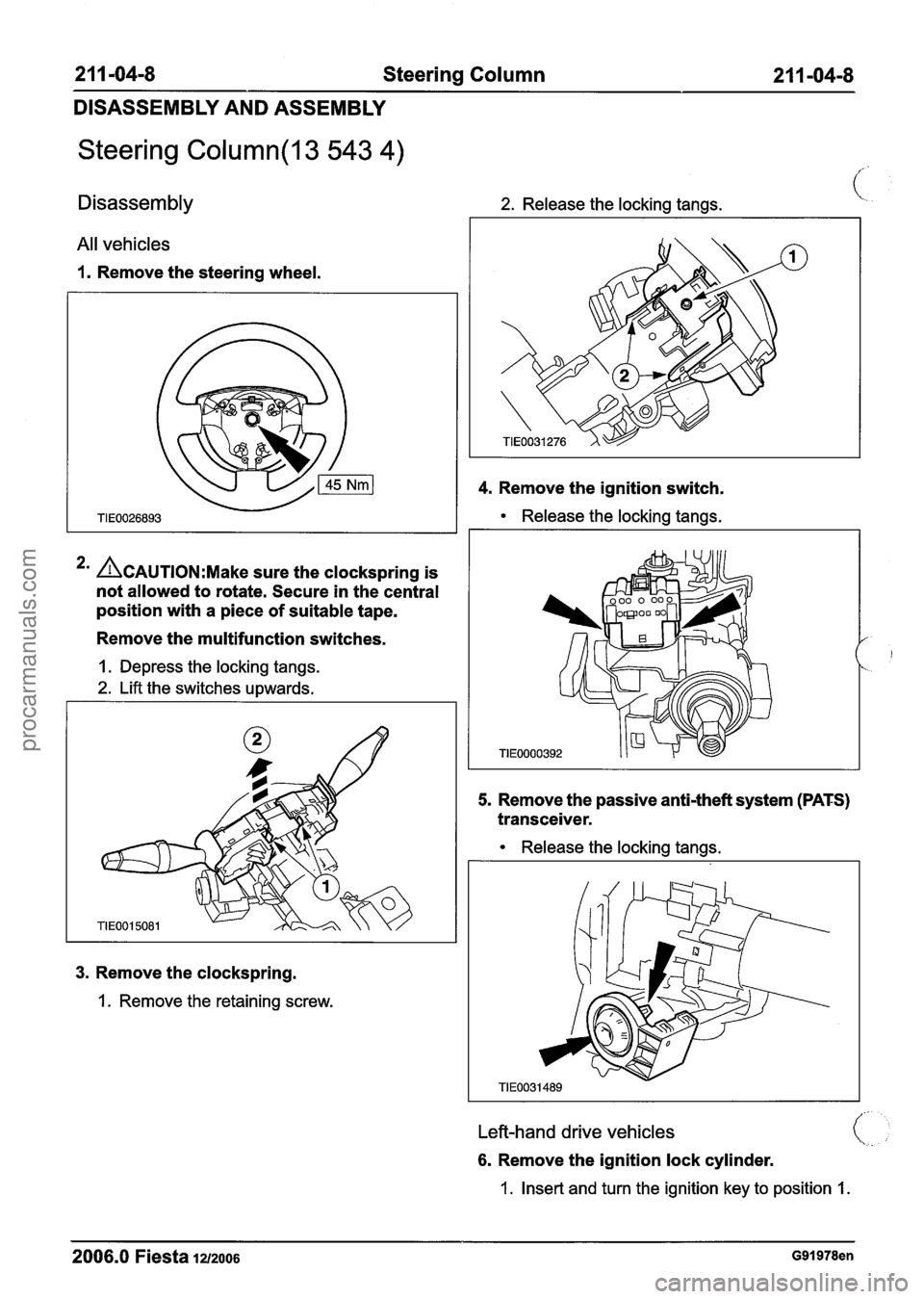
2 1 1 -04-8 Steering Column 2 1 1 -04-8
DISASSEMBLY AND ASSEMBLY
Steering Column(l3 543 4)
Disassembly 2. Release the locking tangs. (:
All vehicles
1. Remove the steering wheel.
4. Remove the ignition switch.
Release the locking tangs.
3. Remove the clockspring.
1. Remove the retaining screw.
*' ACAUTION:M~~~ sure the clockspring is
not allowed to rotate. Secure in the central
position with a piece of suitable tape.
Remove the multifunction switches.
1. Depress the locking tangs.
2. Lift the switches upwards.
5. Remove the passive anti-theft system (PATS)
transceiver.
1
TIE0000392
Release the locking tangs.
Left-hand drive vehicles
6. Remove the ignition lock cylinder.
1. Insert and turn the ignition key to position 1.
2006.0 Fiesta 12/2006 G91978en
procarmanuals.com
Page 417 of 1226
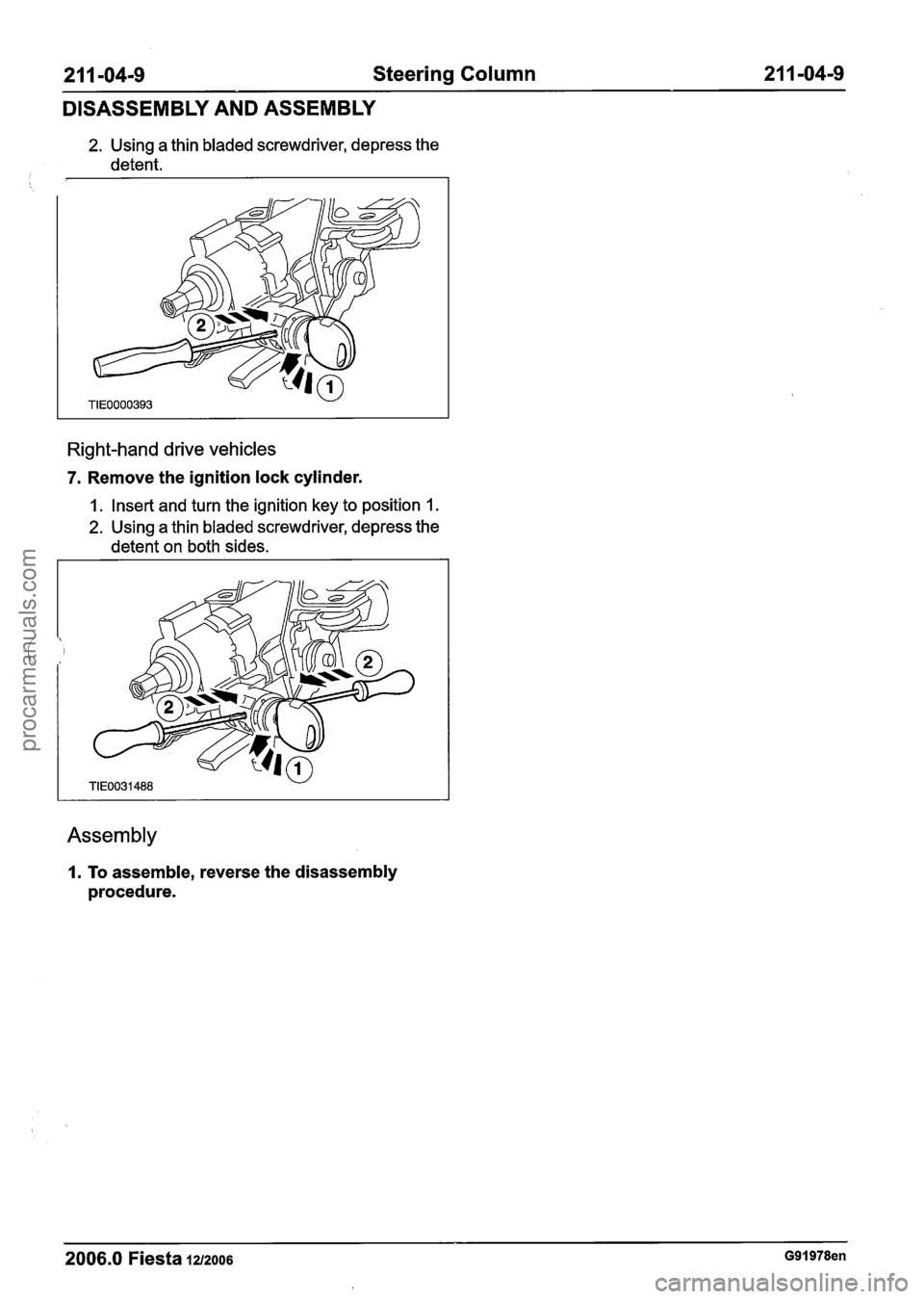
21 I -04-9 Steering Column 2 1 1 -04-9
DISASSEMBLY AND ASSEMBLY
2. Using a thin bladed screwdriver, depress the
detent.
Right-hand drive vehicles
7. Remove the ignition lock cylinder.
1. Insert and turn the ignition key to position 1.
2. Using a thin bladed screwdriver, depress the
detent on both sides.
Assembly
1. To assemble, reverse the disassembly
procedure.
2006.0 Fiesta 1212006 G91978en
procarmanuals.com