Cylinder FORD FIESTA 2007 Workshop Manual
[x] Cancel search | Manufacturer: FORD, Model Year: 2007, Model line: FIESTA, Model: FORD FIESTA 2007Pages: 1226, PDF Size: 61.26 MB
Page 17 of 1226
100-00-1 General Information 100-00-1
. SECTION 100-00 General lnformation
VEHICLE APPLICATION:2006.0 Fiesta
CONTENTS
DESCRIPTION AND OPERATION
About This Manual
........................................................................\
......................................
........................................................................\
................................................. Introduction
Special Tools
........................................................................\
..............................................
Important Safety Instructions ........................................................................\
......................
Warnings. Cautions and Notes in This Manual ..................................................................
How to Use This Manual ........................................................................\
............................
Special Tools and Torque Figures ........................................................................\
..............
Health and Safety Precautions ........................................................................\
...................
........................................................................\
................................................. Introduction
........................................................................\
........................................ Acids and Alkalis
Air Bags
........................................................................\
......................................................
Air Conditioning Refrigerant ........................................................................\
.......................
........................................................................\
............................... Adhesives and Sealers
........................................................................\
................................................... Antifreeze
........................................................................\
..................................................... Asbestos
Battery Acids
........................................................................\
..............................................
Brake and Clutch Linings and Pads ........................................................................\
...........
Brake Fluids (Polyalkylene Glycols) ........................................................................\
...........
........................................................................\
....................................................... Brazing
Chemical Materials
........................................................................\
.....................................
................................................................... Chlorofluorocarbons (CFC) ... ..........................
Clutch Fluids ........................................................................\
...............................................
Clutch Linings and Pads ........................................................................\
.............................
Corrosion Protection Materials ........................................................................\
...................
........................................................................\
........................................................ Cutting
........................................................................\
.................................................... Dewaxing
........................................................................\
.......................................................... Dusts
Electric Shock
........................................................................\
.............................................
Engine Oils ........................................................................\
.................................................
Exhaust Fumes ........................................................................\
...........................................
........................................................................\
........................................... Fibre Insulation
Fire
........................................................................\
.............................................................
First Aid ........................................................................\
......................................................
........................................................................\
.......................................... Fluoroelastomer
Foams
. Polyurethane ........................................................................\
................................
........................................................................\
.......................................................... Freon
........................................................................\
........................................................... Fuels
........................................................................\
.............................................. Gas Cylinders
........................................................................\
......................................................... Gases
Gaskets (Fluoroelastomer)
........................................................................\
.........................
General Workshop Tools and Equipment ........................................................................\
...
High Pressure Air. Lubrication and Oil Test Equipment ......................................................
........................................................................\
.......................................................... Halon
........................................................................\
............................................. Legal Aspects
PAGE
procarmanuals.com
Page 28 of 1226
100-00-12 General Information 100-00-12
DESCRIPTION AND OPERATION
Gross or prolonged skin contact with high boiling
point gas oils may also cause serious skin
disorders including skin cancer.
Kerosene (Paraffin)
Used also as heating fuel, solvent and cleaning
agent.
Flammable
- observe No Smoking policy.
Irritation of the mouth and throat may result from
swallowing. The main hazard from swallowing
arises if liquid aspiration into the lungs occurs.
Liquid contact dries the skin and can cause
irritation or dermatitis. Splashes in the eye may be
slightly irritating.
In normal circumstances the low volatility does not
give rise to harmful vapors. Exposure to mists and
vapors from kerosene at elevated temperature
should be avoided (mists may arise in dewaxing).
Avoid skin and eye contact and make sure there
is adequate ventilation.
Alternative Fuel
Highly flammable. Observe "NO SMOKING" signs.
Make sure there is adequate ventilation when
working on alternative fuelled vehicles. Great care
must be taken to avoid the serious consequences
of inhalation in the event of vapor build up in
confined spaces.
Inhalation in high concentrations may cause
dizziness, headache, nausea and loss of
co-ordination. Very high concentrations may result
in loss of consciousness.
Contact with liquefied petroleum gas (LPG) or
compressed natural gas (CNG) to the skin may
cause cold burns and frost bite.
Long sleeved cotton overalls, steel toe capped
safety boots and rubber neoprene gloves should
be worn during removal and installation of
LPGICNG fuel system components.
LPGICNG fuel leaks could cause a fire and be a
hazard to health that can lead to personal injury,
illness or even death.
If a leak is detected, under no circumstances
attempt to seal the leak by tightening the
unionlconnection until the fuel in the system or
component is depressurized. Once tightened the
system should be checked for integrity following
the specified procedures. If
the fuel tank is to be removed for service or repair
the fuel must be evacuated using dedicated
equipment and following the specified
procedures. (
Gas Cylinders
See also Fire.
Gases such as oxygen, acetylene, argon and
propane are normally stored in cylinders at
pressures of up to
138 bar (2000 psi) and great
care should be taken in handling these cylinders
to avoid mechanical damage to them or to the valve
gear attached. The contents of each cylinder
should be clearly identified by appropriate
markings.
Cylinders should be stored in well-ventilated
enclosures, and protected from ice and snow, or
direct sunlight. Fuel gases, for example acetylene
and propane, should not be stored in close
proximity to oxygen cylinders.
Care should be exercised to prevent leaks from
gas cylinders and lines, and to avoid sources of
ignition.
Only trained personnel should undertake work
involving gas cylinders.
Gases
See Gas Cylinders.
Gaskets (Fluoroelastomer)
See Viton.
General Workshop Tools and
Equipment
It is essential that all tools and equipment are
maintained in good condition and that the correct
safety equipment is used where required.
Never use tools or equipment for any purpose other
than that for which they were designed. Never
overload equipment such as hoists, jacks, axle and
chassis stands or
lifting slings. Damage caused by
overloading is not always immediately apparent
and may result in a fatal failure the next time that
the equipment is used.
2006.0 Fiesta 1212006 GI 7372en
procarmanuals.com
Page 32 of 1226
100-00-1 6 General Information 100-00-1 6 '
DESCRIPTION AND OPERATION
Transmission Brake Bands
See Asbestos.
Underseal Welding
See
also Fire, Electric Shock, Gas Cylinders. (
Welding processes include Resistance Welding
(Spot Welding), Arc Welding and Gas Welding.
See Corrosion Protection.
Resistance Welding
Viton
In common with many other manufacturers
vehicles, some components have O-rings, seals
or gaskets, which contain a material known as
'Viton'.
Viton is a fluoroelastomer, that is a synthetic rubber
type material, which contains Fluorine. It is
commonly used for O-rings, gaskets and seals of
all types. Although Viton is the most well known
fluoroelastomer, there are others, including
Fluorel
and Tecmoflon.
When used under design conditions
fluoroelastomers are perfectly safe. If, however,
they are exposed to temperatures in excess of
400°C, the material will not burn, but will
decompose, and one of the products formed is
hydrofluoric acid.
This acid is extremely corrosive and may be
absorbed directly, through contact, into the general
body system.
O-rings, seals or gaskets which have been exposed
to very high temperatures will appear charred or
as a black sticky substance.
DO NOT; under any circumstances touch them or
the attached components.
Enquiries should be made to determine whether
Viton or any other fluoroelastomer has been used
in the affected O-ring, seal or gasket. If they are of
natural rubber or
nitrile there is no hazard. If in
doubt, be cautious, as the material may be Viton
or any fluoroelastomer.
If Viton or any other fluoroelastomers have been
used, the affected area should be decontaminated
before the commencement of work.
Disposable heavy duty plastic gloves should be
worn at all times, and the affected area washed
down using wire wool and a limewater (calcium
hydroxide) solution to neutralize the acid before
disposing of the decomposed Viton residue and
final cleaning of the area. After use, the plastic
gloves should be discarded carefully and safely. This process may cause particles of molten metal
to
be emitted at a high velocity, and the eyes and
skin must be protected.
Arc Welding
This process emits a high level of ultra-violet radiation, which may cause arc-eye, and skin burns
to the operator and to other persons nearby.
Gas-shielded welding processes are particularly
hazardous in this respect. Personal protection must
be worn, and screens used to shield other
~eo~le. . .
CONTACT LENS WEARERS ARE ADVISED TO
REVERT TO ORDINARY SPECTACLES WHEN
ARC WELDING as the arc spectrum is believed to
emit microwaves which dry out the fluid between
the lens and the eye. This may result in blindness
when the lens is removed from the eve.
Metal spatter will also occur, and appropriate eye
and skin protection is necessary.
The heat of the welding arc will produce fumes and
gases from the metals being welded, the rods and
from any applied coatings or contamination on the
surfaces being worked on. These gases and fumes
may be toxic and inhalation of these should be
avoided. The use of extraction ventilation to remove
the fumes from the working area may be necessary
particularly in cases where the general ventilation
is poor, or where considerable welding work is
anticipated. In extreme cases or confined spaces
where adequate ventilation cannot be provided,
air-fed respirators may be necessary.
Gas Welding (and Cutting)
Oxy-acetylene torches may be used for welding
and cutting, and special care must be taken to
prevent leakage of these gases, with consequent
risk of fire and explosion.
("
The process will produce metal spatter and eye "
and skin protection is necessary.
2006.0 Fiesta 1212006 GI 7372en
procarmanuals.com
Page 132 of 1226
204-02-1 0 Rear Suspension 204-02-1 0
REMOVAL AND INSTALLATION
Beam Axle(l5 231 0)
f
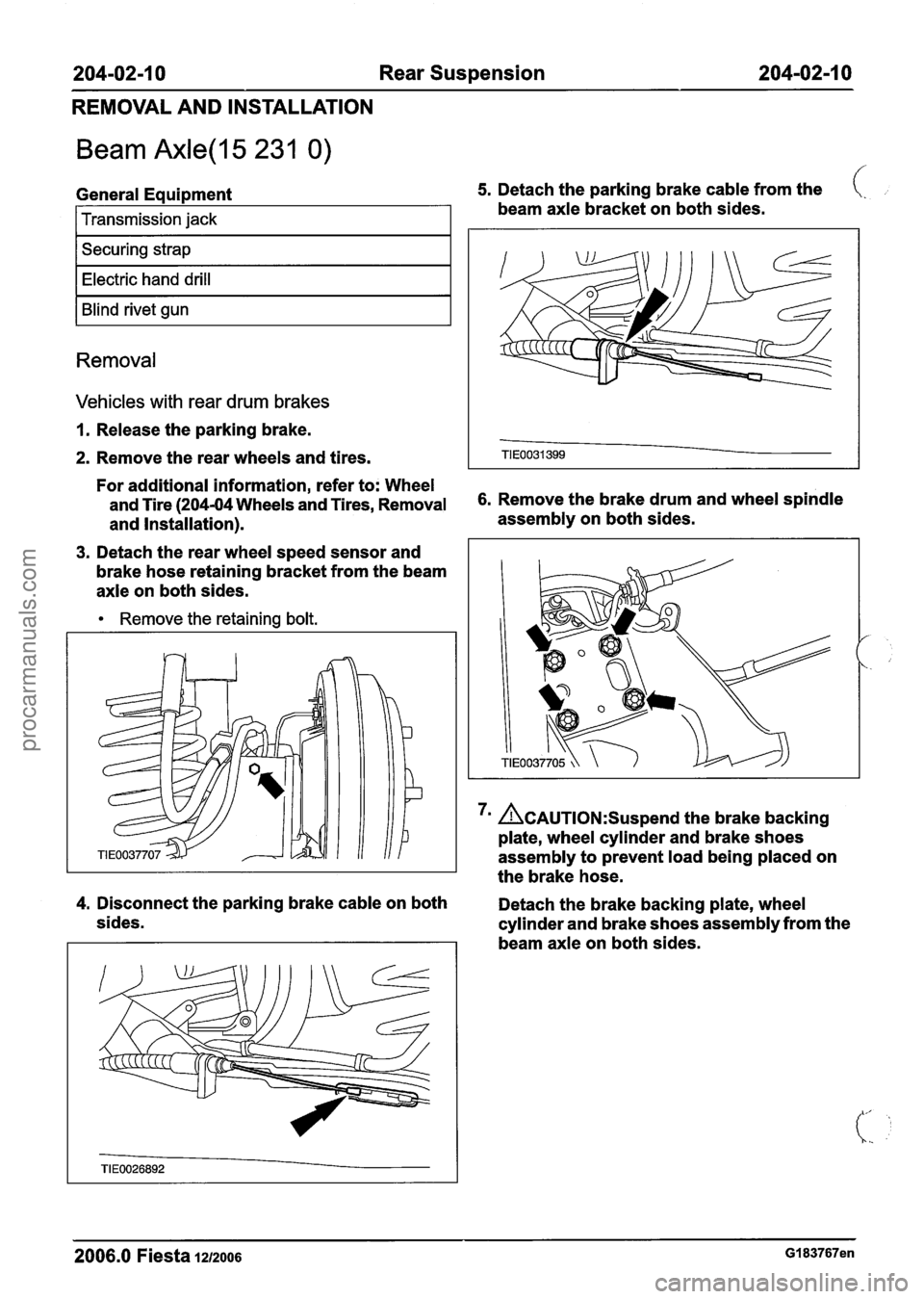
General Equipment 5. Detach the parking brake cable from the (.
beam axle bracket on both sides. I Transmission jack
I Securing strap I
I Electric hand drill I
I Blind rivet gun I
Removal
Vehicles with rear drum brakes
1. Release the parking brake.
2. Remove the rear wheels and tires.
For additional information, refer to: Wheel
and Tire (204.04 Wheels and Tires, Removal 6. Remove the brake dIIlm and wheel spindle
and Installation). assembly
on both sides.
3. Detach the rear wheel speed sensor and
brake hose retaining bracket from the beam
axle on both sides.
Remove the retaining bolt.
7m &AUTION:S~~~~~~ the brake backing
plate, wheel cylinder and brake shoes
assembly to prevent load being placed on
the brake hose.
4. Disconnect the parking brake cable on both
Detach the brake backing plate, wheel
sides. cylinder and brake shoes assembly from the
beam axle on both sides.
2006.0 Fiesta 1212006 G183767en
procarmanuals.com
Page 135 of 1226
204-02-1 3 Rear Suspension 204-02-1 3
REMOVAL AND INSTALLATION
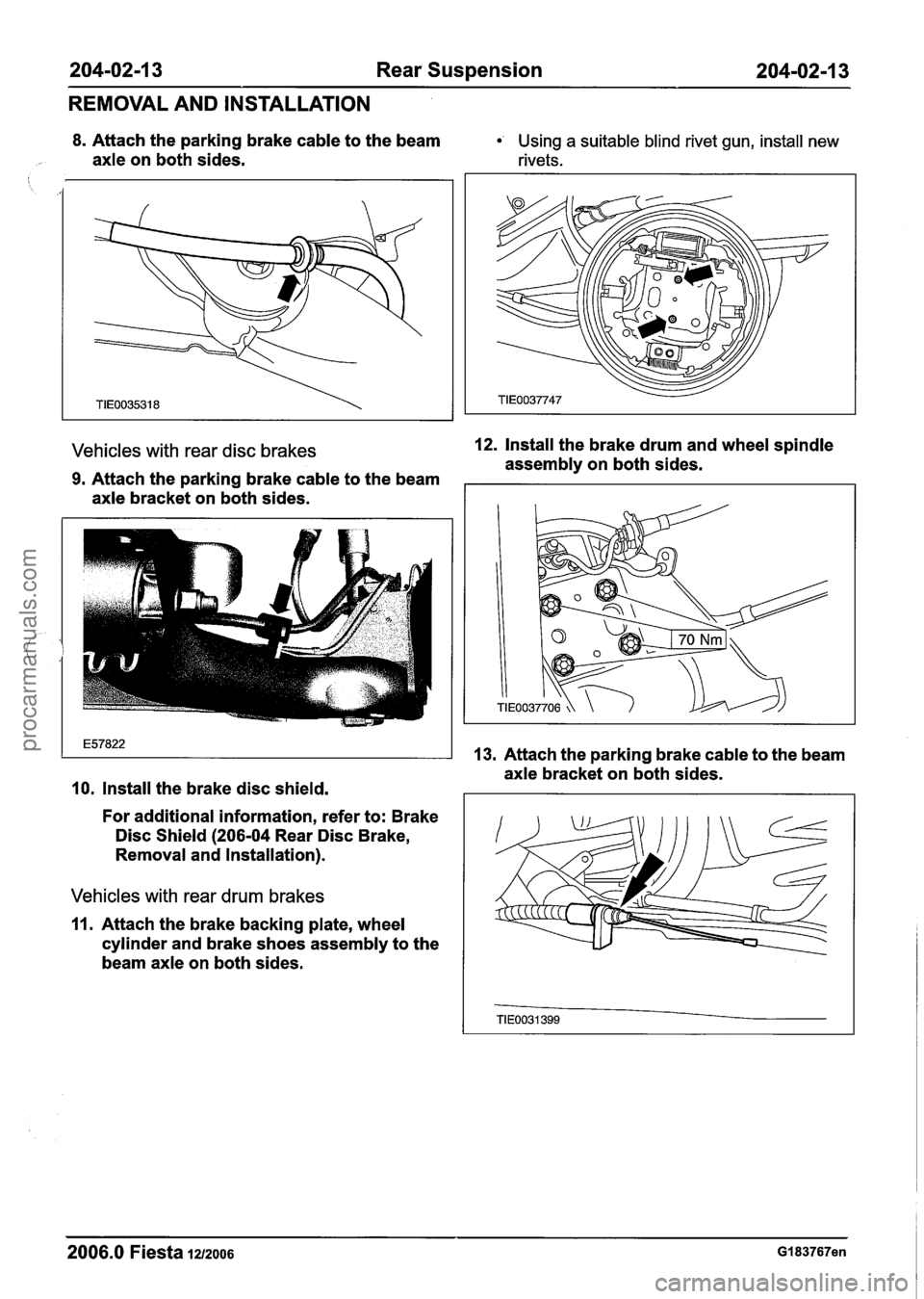
8. Attach the parking brake cable to the beam Using a suitable blind rivet gun, install new
axle on both sides. rivets.
Vehicles with rear disc brakes 12. Install the brake drum and wheel spindle
assembly on both sides.
9. Attach the parking brake cable to the beam
axle bracket on both sides.
10. Install the brake disc shield.
For additional information, refer to: Brake
Disc Shield
(206-04 Rear Disc Brake,
Removal and Installation).
Vehicles with rear drum brakes
11. Attach the brake backing plate, wheel
cylinder and brake shoes assembly to the
beam axle on both sides.
13. Attach the parking brake cable to the beam
axle bracket on both sides.
2006.0 Fiesta 1212006 GI 83767en
procarmanuals.com
Page 174 of 1226
206-00-2 Brake System - General Information 206-00-2
DESCRIPTION AND OPERATION
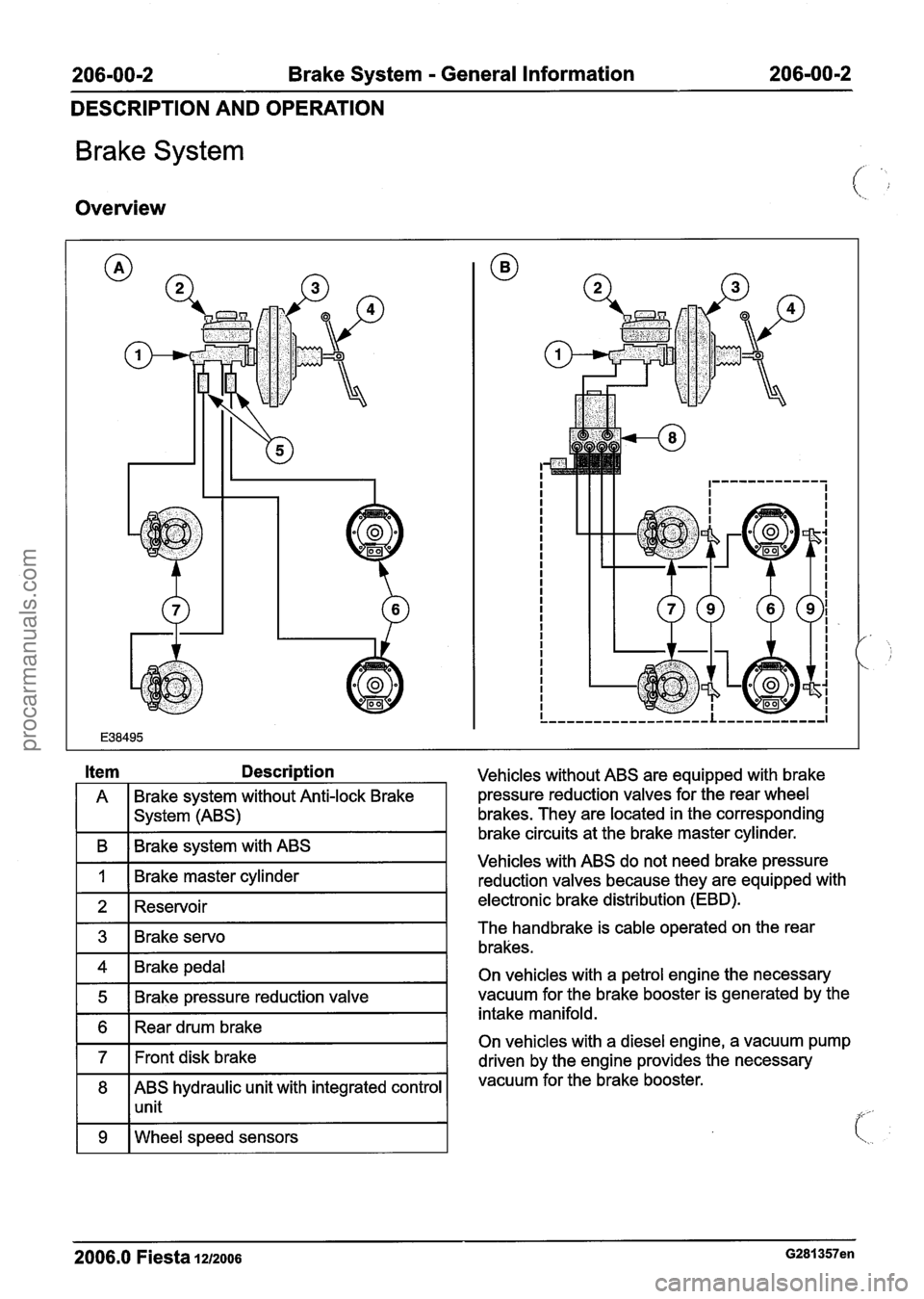
Brake System
Overview
A Brake system without Anti-lock
Brake
I I system (ABS)
I B I Brake system with ABS I
I 1 I Brake master cylinder I -
1 2 1 Reservoir I
1 4 1 Brake pedal I
1 5 1 Brake pressure reduction valve I
1 6 1 Rear drum brake I
171t disk brake I
8 ABS hydraulic unit with integrated control
1 1 unit
1 9 I Wheel speed sensors I
Vehicles without ABS are equipped with brake
pressure reduction valves for the rear wheel
brakes. They are located in the corresponding
brake circuits at the brake master cylinder.
Vehicles with ABS do not need brake pressure
reduction valves because they are equipped with
electronic brake distribution (EBD).
The handbrake is cable operated on the rear
brakes.
On vehicles with a petrol engine the necessary
vacuum for the brake booster is generated by the
intake manifold.
On vehicles with a diesel engine, a vacuum pump
driven by the engine provides the necessary
vacuum for the brake booster.
2006.0 Fiesta lu2006 G281357en
procarmanuals.com
Page 177 of 1226
206-00-5 Brake System - General Information 206-00-5
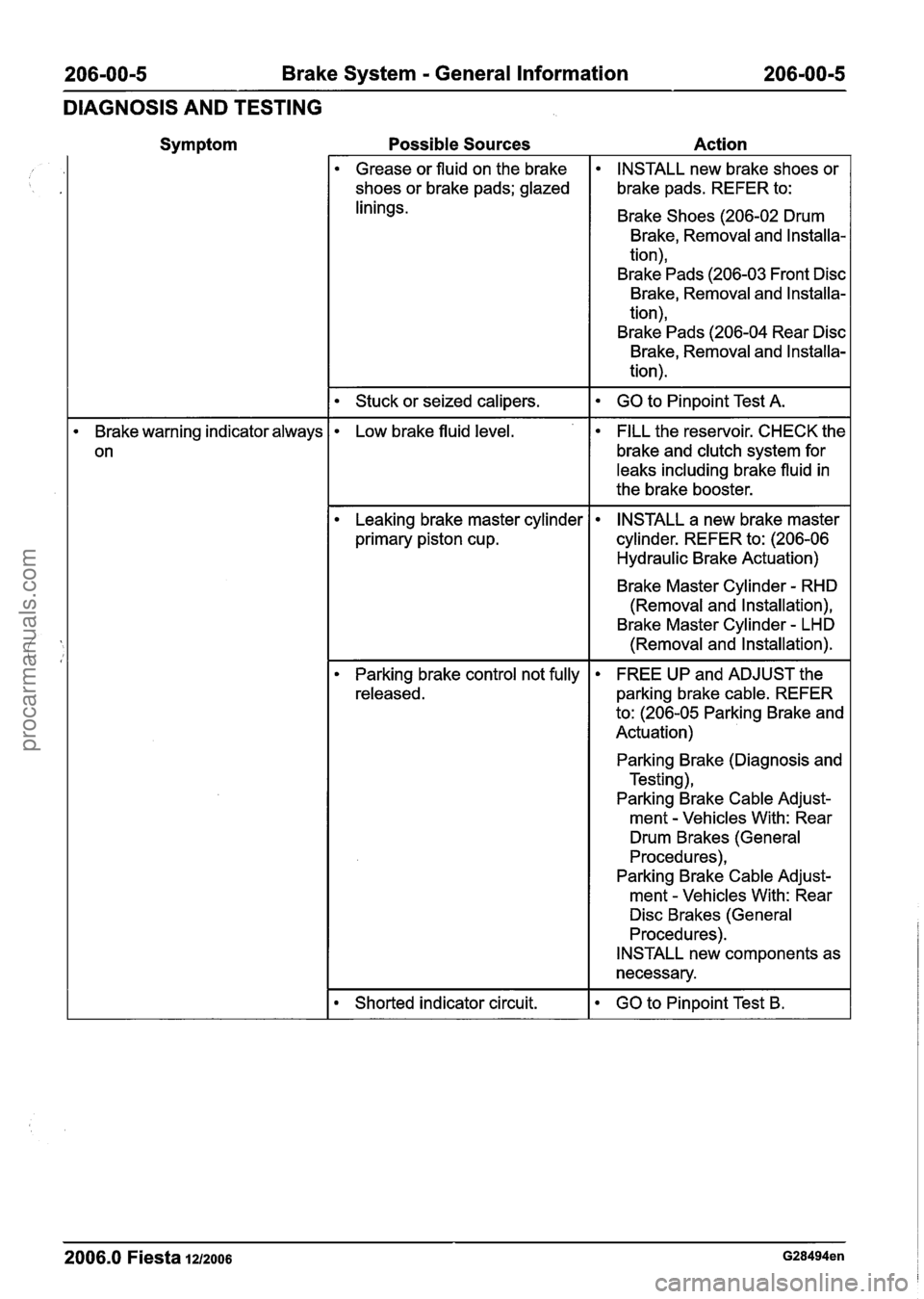
DIAGNOSIS AND TESTING
Symptom Possible Sources
Action
Grease or fluid on the brake
shoes or brake pads; glazed
linings. INSTALL
new brake shoes or
brake pads. REFER to:
Brake Shoes (206-02 Drum Brake, Removal and Installa-
tion),
Brake Pads (206-03 Front Disc
Brake, Removal and Installa-
tion),
Brake Pads (206-04 Rear Disc Brake, Removal and Installa-
tion).
I Stuck or seized calipers. I GO to Pinpoint Test A. I
Brake warning indicator always
on Low
brake fluid level. FILL the reservoir. CHECK the
brake and clutch system for
leaks including brake fluid in
the brake booster.
--
Leaking brake master cylinder
primary piston cup. INSTALL a new brake master
cylinder. REFER to: (206-06
Hydraulic Brake Actuation)
Brake Master Cylinder
- RHD
(Removal and Installation),
Brake Master Cylinder
- LHD
(Removal and Installation).
Parking brake control not fully
released. FREE UP and
ADJUST the
parking brake cable. REFER
to: (206-05 Parking Brake and
Actuation)
Parking Brake (Diagnosis and Testing),
Parking Brake Cable Adjust-
ment
- Vehicles With: Rear
Drum Brakes (General
Procedures),
Parking Brake Cable Adjust-
ment
- Vehicles With: Rear
Disc Brakes (General
Procedures).
INSTALL new components as
necessary.
I Shorted indicator circuit. I GO to Pinpoint Test B. I
2006.0 Fiesta 12/2006 G28494en
procarmanuals.com
Page 179 of 1226
206-00-7 Brake System - General Information 206-00-7
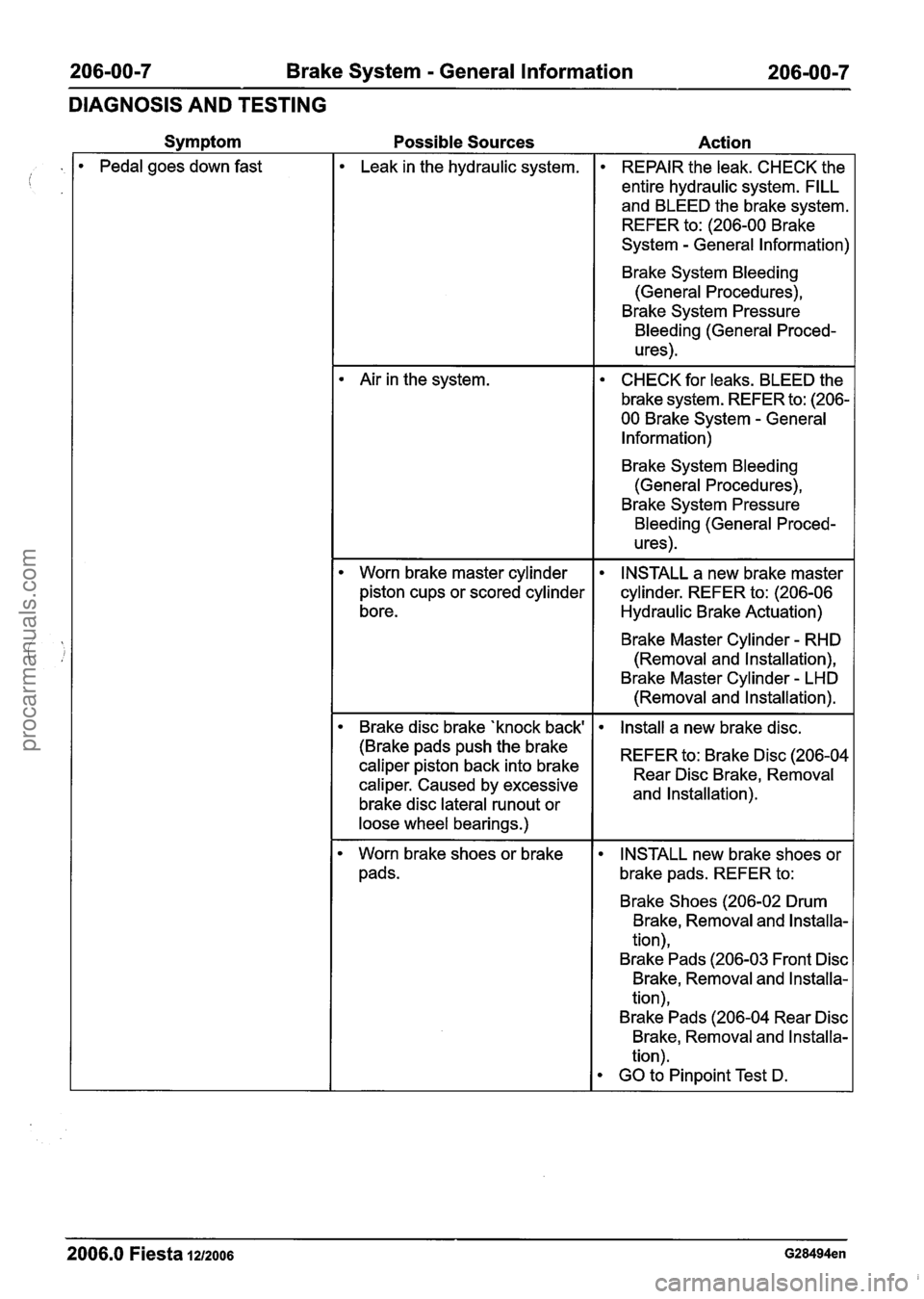
DIAGNOSIS AND TESTING
1 Pedal goes down fast
Possible Sources Action
Leak in the hydraulic system. REPAIR the leak. CHECK the
entire hydraulic system. FILL
and BLEED the brake system.
REFER to: (206-00 Brake
System
- General Information)
Brake System Bleeding
(General Procedures),
Brake System Pressure
Bleeding (General Proced-
ures).
Air in the system.
CHECK for leaks. BLEED the
brake system. REFER to: (206-
00 Brake System
- General
Information)
Brake System Bleeding
(General Procedures),
Brake System Pressure
Bleeding (General Proced-
u res).
Worn brake master cylinder piston cups or scored cylinder
bore. INSTALL
a new brake master
cylinder. REFER to: (206-06
Hydraulic Brake Actuation)
Brake Master Cylinder
- RHD
(Removal and lnstallation),
Brake Master Cylinder
- LHD
(Removal and lnstallation).
I Brake disc brake 'knock back' I Install a new brake disc. I
I loose wheel bearings.) I I
(Brake pads push the brake
caliper piston back into brake
caliper. Caused by excessive
brake disc lateral
runout or
Worn brake shoes or brake
pads. REFER to:
Brake Disc (206-04
Rear Disc Brake, Removal
and Installation). INSTALL new brake shoes or
brake pads. REFER to:
Brake Shoes (206-02 Drum
Brake, Removal and Installa-
tion),
Brake Pads (206-03 Front Disc
Brake, Removal and Installa-
tion),
Brake Pads (206-04 Rear Disc Brake, Removal and Installa-
tion).
GO to Pinpoint Test D.
2006.0 Fiesta 1212006 G28494en
procarmanuals.com
Page 180 of 1226
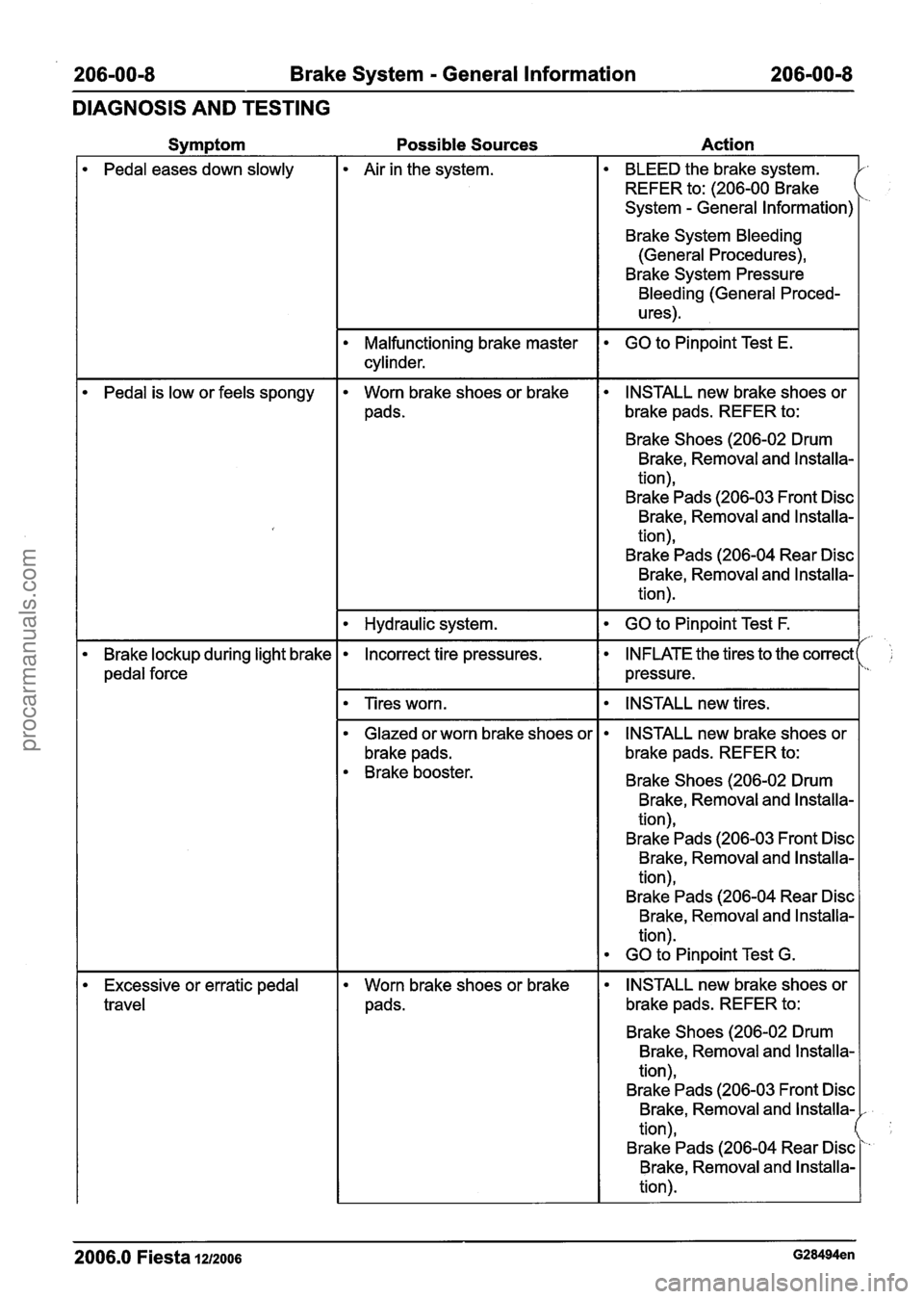
206-00-8 Brake System - General Information 206-00-8
DIAGNOSIS AND TESTING
Svm~tom Possible Sources Action
Pedal eases down slowly Air in the system.
Malfunctioning brake master
cylinder.
BLEED the brake system.
REFER to: (206-00 Brake
System
- General Information)
Brake System Bleeding (General Procedures),
Brake System Pressure Bleeding (General Proced-
ures).
GO to Pinpoint Test E.
Brake, Removal and Installa-
tion),
Brake Pads (206-03 Front Disc
Brake, Removal and Installa-
tion),
Brake Pads (206-04 Rear Disc
Brake, Removal and Installa-
Pedal is low or feels spongy
I tion). I
Brake lockup during light brake I
Worn brake shoes or brake
pads.
pedal force INSTALL new brake shoes or
brake pads. REFER to:
Hydraulic system.
Incorrect tire pressures.
Tires worn.
Glazed or worn brake shoes or
brake pads.
Brake booster.
GO to Pinpoint Test F. I
INFLATE the tires to the correct
pressure.
INSTALL new tires. I
brake pads. REFER to:
Brake Shoes (206-02 Drum
Brake, Removal and Installa-
tion),
Brake Pads (206-03 Front Disc Brake, Removal and Installa-
tion),
Brake Pads (206-04 Rear Disc
Brake, Removal and Installa-
tion).
GO to Pinpoint Test G.
Excessive or erratic pedal
travel Worn brake shoes or brake
pads. INSTALL new brake shoes or
brake pads. REFER to:
Brake Shoes (206-02 Drum Brake, Removal and Installa-
tion),
Brake Pads (206-03 Front Disc Brake, Removal and Installa-
tion),
I
Brake Pads (206-04 Rear Disc
Brake, Removal and Installa-
tion).
2006.0 Fiesta 1212006 G28494en
procarmanuals.com
Page 181 of 1226
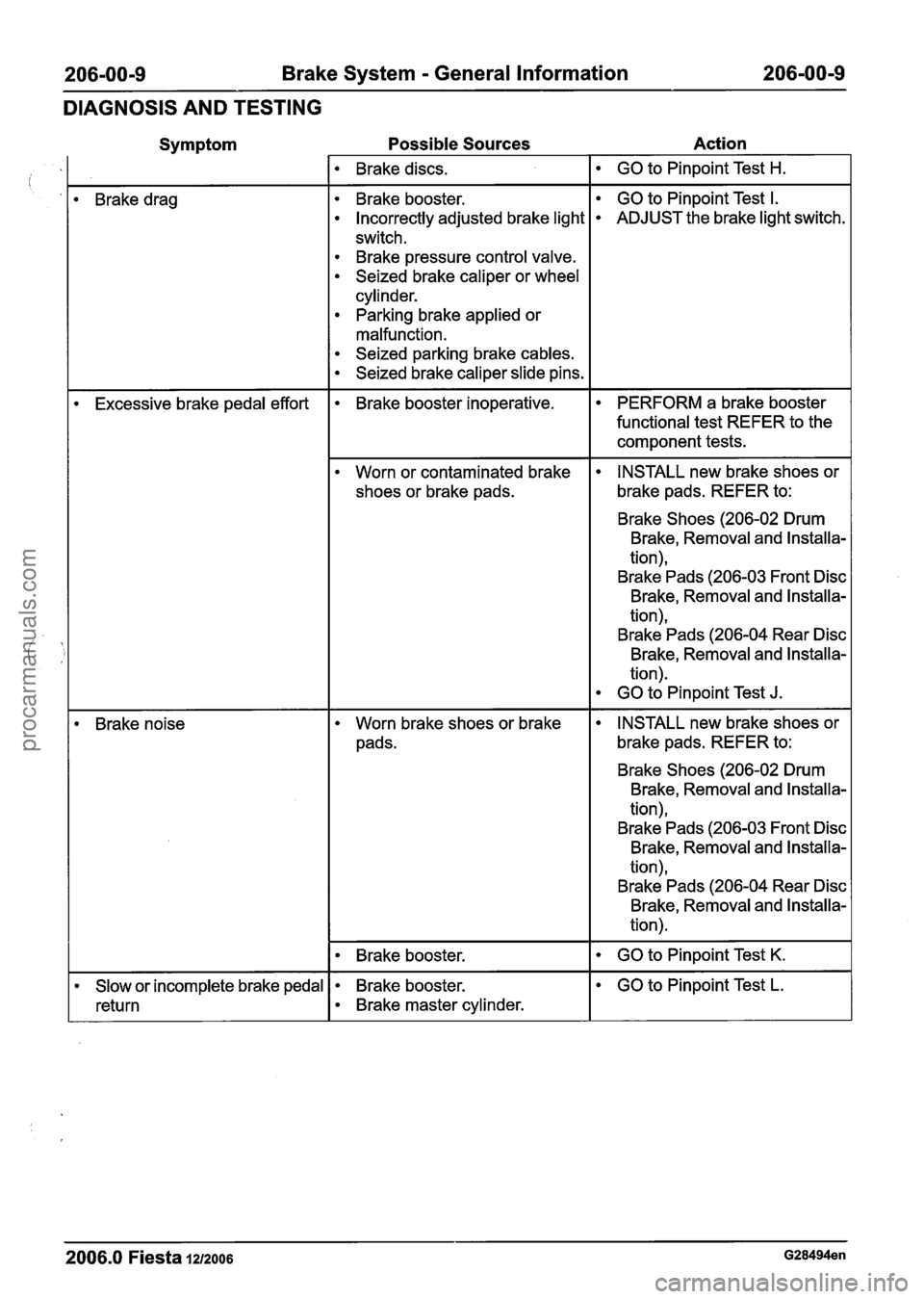
206-00-9 Brake System - General Information 206-00-9
DIAGNOSIS AND TESTING
Symptom
Brakedrag
Excessive brake pedal effort
Brake noise
I
i
i
Slow or incomplete brake pedal
return Possible Sources
Action
Brake discs.
Brake booster.
Incorrectly adjusted brake light
switch. Brake pressure control valve.
Seized brake caliper or wheel
cylinder. Parking brake applied or
malfunction.
Seized parking brake cables.
Seized brake caliper slide pins.
Brake booster inoperative.
Worn or contaminated brake
shoes or brake pads.
Worn brake shoes or brake
pads.
Brake booster.
Brake booster.
Brake master cylinder.
GO to Pinpoint Test H.
GO to Pinpoint Test I.
ADJUST the brake light switch.
PERFORM a brake booster
functional test REFER to the
component tests.
INSTALL new brake shoes or
brake pads. REFER to:
Brake Shoes (206-02 Drum Brake, Removal and Installa-
tion),
Brake Pads (206-03 Front Disc
Brake, Removal and Installa-
tion),
Brake Pads (206-04 Rear Disc Brake, Removal and Installa-
tion).
GO to Pinpoint Test J.
INSTALL new brake shoes or
brake pads. REFER to:
Brake Shoes (206-02 Drum Brake, Removal and Installa-
tion),
Brake Pads (206-03 Front Disc
Brake, Removal and Installa-
tion),
Brake Pads (206-04 Rear Disc
Brake, Removal and Installa-
tion).
GO to Pinpoint Test K.
GO to Pinpoint Test L.
2006.0 Fiesta 1212006 G28494en
procarmanuals.com