fuel FORD FIESTA 2007 Workshop Manual
[x] Cancel search | Manufacturer: FORD, Model Year: 2007, Model line: FIESTA, Model: FORD FIESTA 2007Pages: 1226, PDF Size: 61.26 MB
Page 3 of 1226
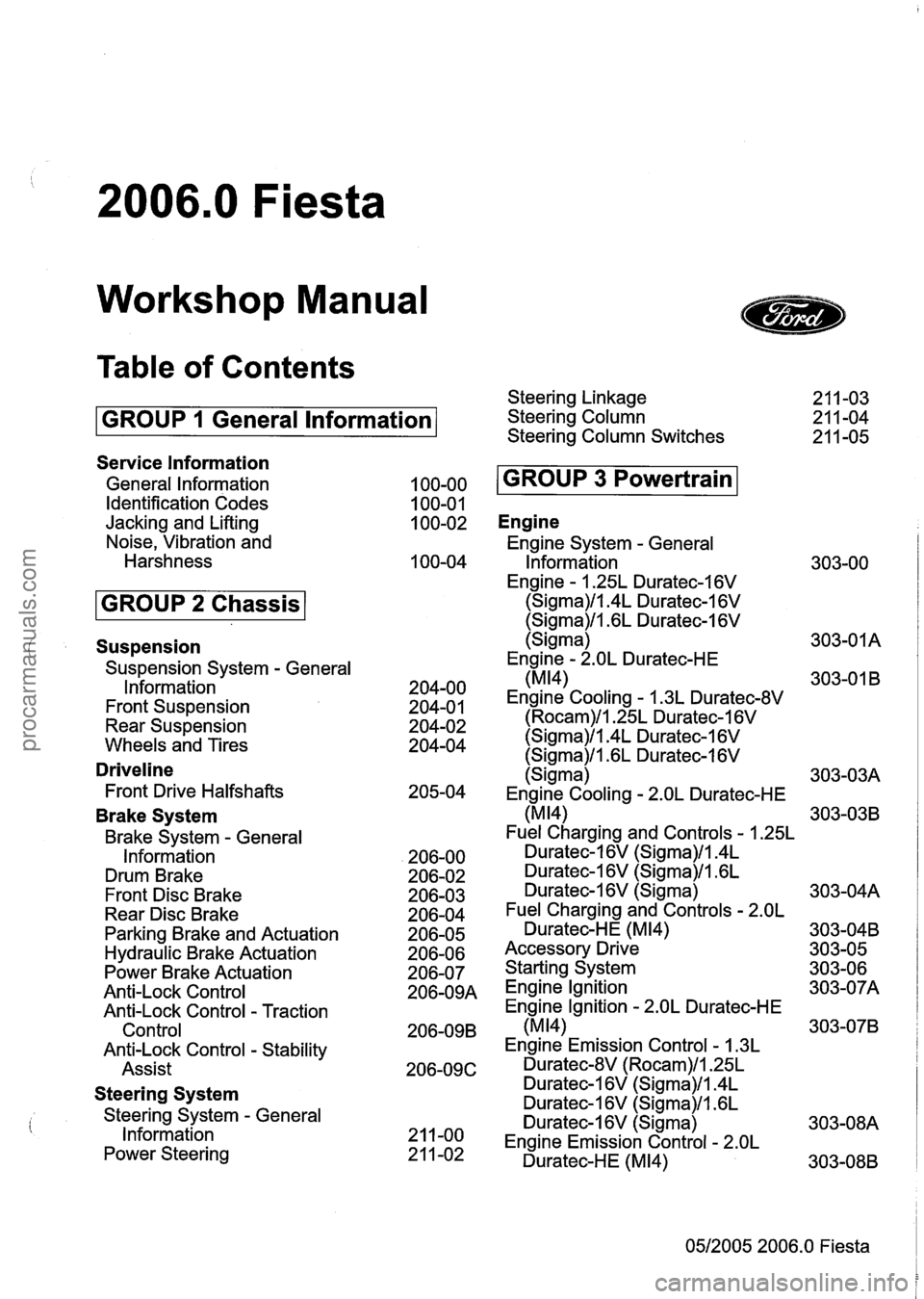
2006.0 Fiesta
Workshop Manual
Table of Contents
GROUP 1 General lnformation
Service lnformation
General lnformation
Identification Codes
Jacking and Lifting
Noise, Vibration and
Harshness
Suspension
Suspension System - General
lnformation
Front Suspension
Rear Suspension
Wheels and Tires
Driveline
Front Drive Halfshafts
Brake System
Brake System - General
Information
Drum Brake
Front Disc Brake
Rear Disc Brake
Parking Brake and Actuation
Hydraulic Brake Actuation
Power Brake Actuation
Anti-Lock Control
Anti-Lock Control
- Traction
Control
Anti-Lock Control
- Stability
Assist
Steering System
Steering System - General
lnformation
Power Steering Steering Linkage
Steering Column
Steering Column Switches
Engine
Engine System - General
lnformation
Engine
- 1.25L Duratec-1 6V
(Sigma)/l.4L Duratec-1 6V
(Sigma)/l.GL Duratec-I 6V
(Sigma)
Engine
- 2.OL Duratec-HE
(MI41
Engine Cooling - 1.3L Duratec-8V
(Rocam)/l.25L Duratec-1 6V
(Sigma)/l.4L Duratec-1 6V
(Sigma)/l .6L Duratec-1 6V
(Sigma)
Engine Cooling
- 2.OL Duratec-HE
(MI41
Fuel Charging and Controls - 1.25L
Duratec-1 6V (Sigma)/l.4L
Duratec-16V (Sigma)/l.GL
Duratec-1 6V (Sigma)
Fuel Charging and Controls
- 2.OL
Duratec-HE (M14)
Accessory Drive
Starting System
Engine lgnition
Engine Ignition
- 2.OL Duratec-HE
(M14)
Engine Emission Control - 1.3L
Duratec-8V (Rocam)/l.25L
Duratec-1 6V (Sigma)/l.4L
Duratec-1 6V (Sigma)/l .6L
Duratec-1
6V (Sigma)
Engine Emission Control
- 2.OL
Duratec-HE (M14)
05/2005 2006.0 Fiesta
procarmanuals.com
Page 4 of 1226
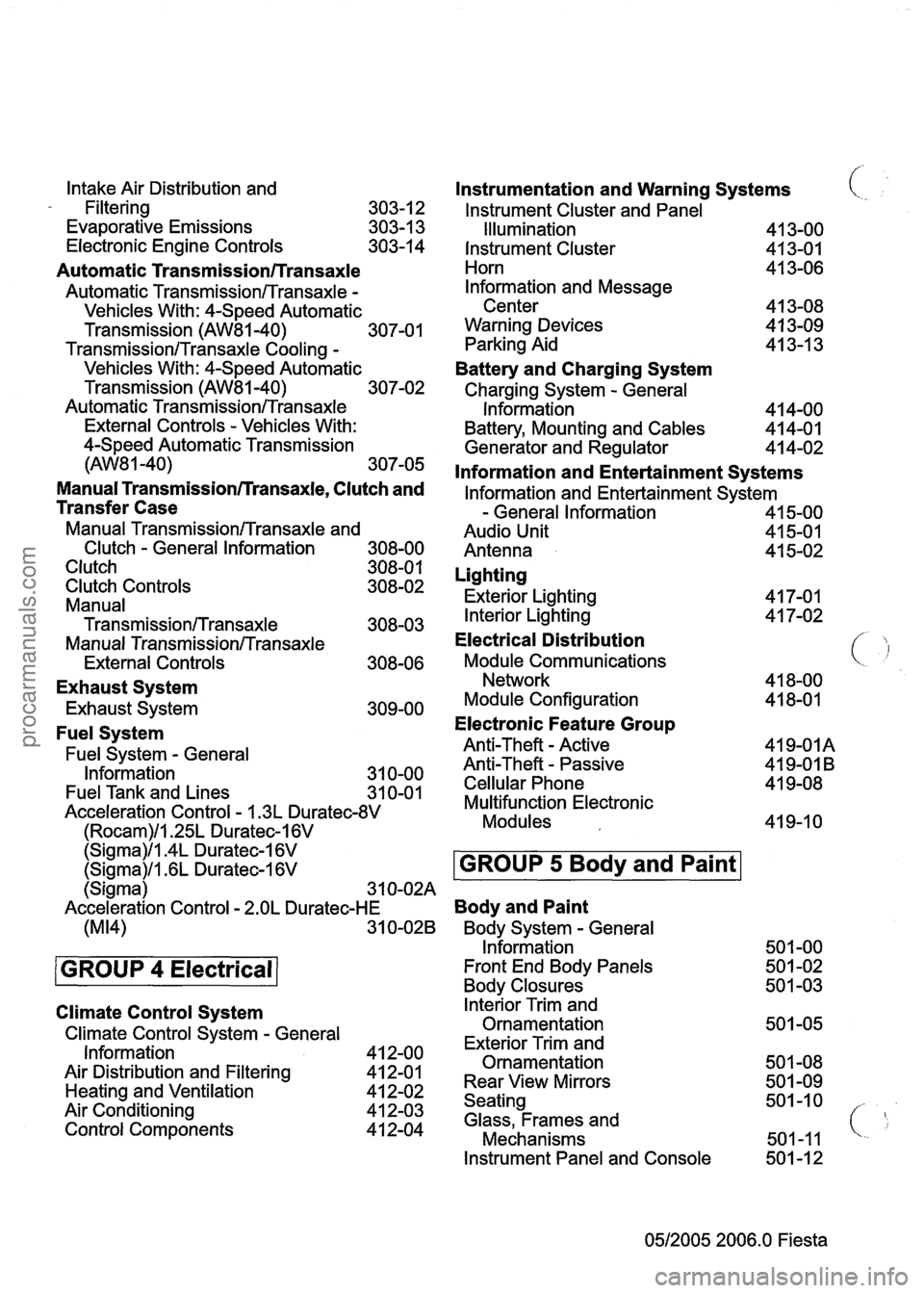
Intake Air Distribution and
- Filtering
303-1 2
Evaporative Emissions 303-1 3
Electronic Engine Controls 303-14
Automatic Transmission/Transaxle
Automatic TransmissionlTransaxle -
Vehicles With: 4-Speed Automatic
Transmission
(AW81-40) 307-01
TransmissionlTransaxle Cooling -
Vehicles With: 4-Speed Automatic
Transmission
(AW81-40) 307-02
Automatic
TransmissionlTransaxle
External Controls - Vehicles With:
4-Speed Automatic Transmission
(AW8 1 -40) 307-05
Manual Transmissionrrransaxle, Clutch and
Transfer Case
Manual TransmissionlTransaxle and
Clutch
- General Information 308-00
Clutch 308-0 1
Clutch Controls 308-02
Manual
Transmission/Transaxle 308-03
Manual TransmissionlTransaxle
External Controls 308-06
Exhaust System
Exhaust System 309-00
Fuel System
Fuel System - General
Information 31 0-00
Fuel Tank and Lines
31 0-01
Acceleration Control - I .3L Duratec-8V
(Rocam)ll.25L Duratec-I 6V
Instrumentation and Warning Systems
lnstrument Cluster and Panel
(
Illumination 41 3-00
Instrument Cluster
413-01
Horn 41 3-06
lnformation and Message
Center 41 3-08
Warning Devices
4 1 3-09
Parking Aid 41 3-1 3
Battery and Charging System
Charging System - General
Information 4 14-00
Battery, Mounting and Cables 414-01
Generator and Regulator 41 4-02
lnformation and Entertainment Systems
lnformation and Entertainment System
- General Information 41 5-00
Audio Unit 41 5-01
Antenna 41 5-02
Lighting
Exterior Lighting 41 7-01
Interior Lighting 4 1 7-02
Electrical Distribution
Module Communications ( 'j
Network 41 8-00
Module Configuration 41 8-01
Electronic Feature Group
Anti-Theft - Active 419-01A
Anti-Theft
- Passive 41 9-01 B
Cellular Phone 41 9-08
Multifunction Electronic
Modules 41 9-1 0
Climate Control System
Climate Control System - General
Information
Air Distribution and Filtering
Heating and Ventilation
Air Conditioning
Control Components
(Sigma)ll.4L Duratec-I 6V
lnterior Trim and
Ornamentation
Exterior Trim and
Ornamentation
Rear View Mirrors
Seating
Glass, Frames and
Mechanisms
(Sigma)/l .6L Duratec-1 6V
Instrument Panel and Console 501 -1 2
0512005 2006.0 Fiesta
GROUP 5 Body and Paint
(Sigma) 3 1 0-02A
Acceleration Control
- 2.OL Duratec-HE Body and Paint
(M14) 31 0-028 Body System - General
Information 501 -00
GROUP 4 Electrical Front End Body Panels 50 1 -02
Body Closures 50 1 -03
procarmanuals.com
Page 11 of 1226

GROUP
Powertrain
SECTION TITLE PAGE
Engine
Engine System . General Information ........................................................................\
.... 303-00
Enginel.25L Duratec-I 6V (Sigma)ll.4L Duratec-1 6V (Sigma)ll . 6L Duratec-I 6V
........................................................................\
.............................................. (Sigma) -303-0 I A
........................................................................\
............... Engine2.0L Duratec-HE (M14) .30 3-01 B
Engine
Cooling1.3L Duratec-8V (Rocam)ll.25L Duratec-I 6V (Sigma)ll.4L
Duratec-1 6V (Sigma)ll . 6L Duratec-1 6V (Sigma) ...................................................... .30 3-03A
Engine
Cooling2.0L Duratec-HE (M14) ........................................................................\
.. 303-038
Fuel Charging and Controlsl.25L Duratec-1 6V (Sigma)ll.4L Duratec-1 6V
........................................................................\
... (Sigma)ll . 6L Duratec-1 6V (Sigma) .30 3-0414
Fuel Charging
and Controls2.0L Duratec-HE (M14) ....................................................... 303-04B
........................................................................\
.................................... Accessory Drive .30 3-05
Starting System
........................................................................\
...................................... 303-06
Engine Ignition
........................................................................\
....................................... 303-07A
Engine Ignition2.01 Duratec-HE (M14) ........................................................................\
... 303-07B
Engine Emission
Controll.3L Duratec-8V (Rocam)ll.25L Duratec-1 6V (Sigma)ll.4L
Duratec-1 6V (Sigma)ll . 6L Duratec-1 6V (Sigma) ...................................................... .30 3-08A
Engine Emission
Control2.0L Duratec-HE (M14) ........................................................... 303-088
........................................................................\
........ Intake Air Distribution and Filtering 303-1 2
........................................................................\
.......................... Evaporative
Emissions .30 3-13
........................................................................\
.................... Electronic Engine Controls .304 3-1
Automatic Transmission/Transaxle
Automatic Transmission/TransaxleVehicles With: 4-Speed Automatic Transmission
........................................................................\
......................................... (AW8 1 .40) .301 7.0
Transmission/Transaxle CoolingVehicles With: 4-Speed Automatic Transmission
........................................................................\
.......................................... (AW81-40) 307-02
Automatic
TransmissionlTransaxle External ControlsVehicles With: 4-Speed
........................................................................\
.. Automatic Transmission (AW81-40) .30 7.05
Manual Transmission/Transaxle. Clutch and Transfer Case
Manual Transmission/Transaxle and Clutch . General Information ............................... 308-00
........................................................................\
.................................................... Clutch .301 8.0
........................................................................\
..................................... Clutch Controls .30 8.02
Manual
TransmissionlTransaxle ........................................................................\
............ 308-03
Manual
TransmissionlTransaxle External Controls ........................................................ 308-06
0512005 2006.0 Fiesta
procarmanuals.com
Page 12 of 1226

Exhaust System (I
Exhaust System ........................................................................\
..................................... 309-00
Fuel System
Fuel System
- General Information ........................................................................\
.... 310-00
Fuel Tank and Lines..
........................................................................\
............................ .310-01
Acceleration Controll.3L Duratec-8V (Rocam)ll.25L Duratec-1 6V (Sigma)ll.4L
Duratec-1 6V (Sigma)ll .6L Duratec-1 6V (Sigma) ....................................................... 310-02A
Acceleration
Control2.0L Duratec-HE (M14) .............................................................. 30-02B
0512005 2006.0 Fiesta
procarmanuals.com
Page 17 of 1226
100-00-1 General Information 100-00-1
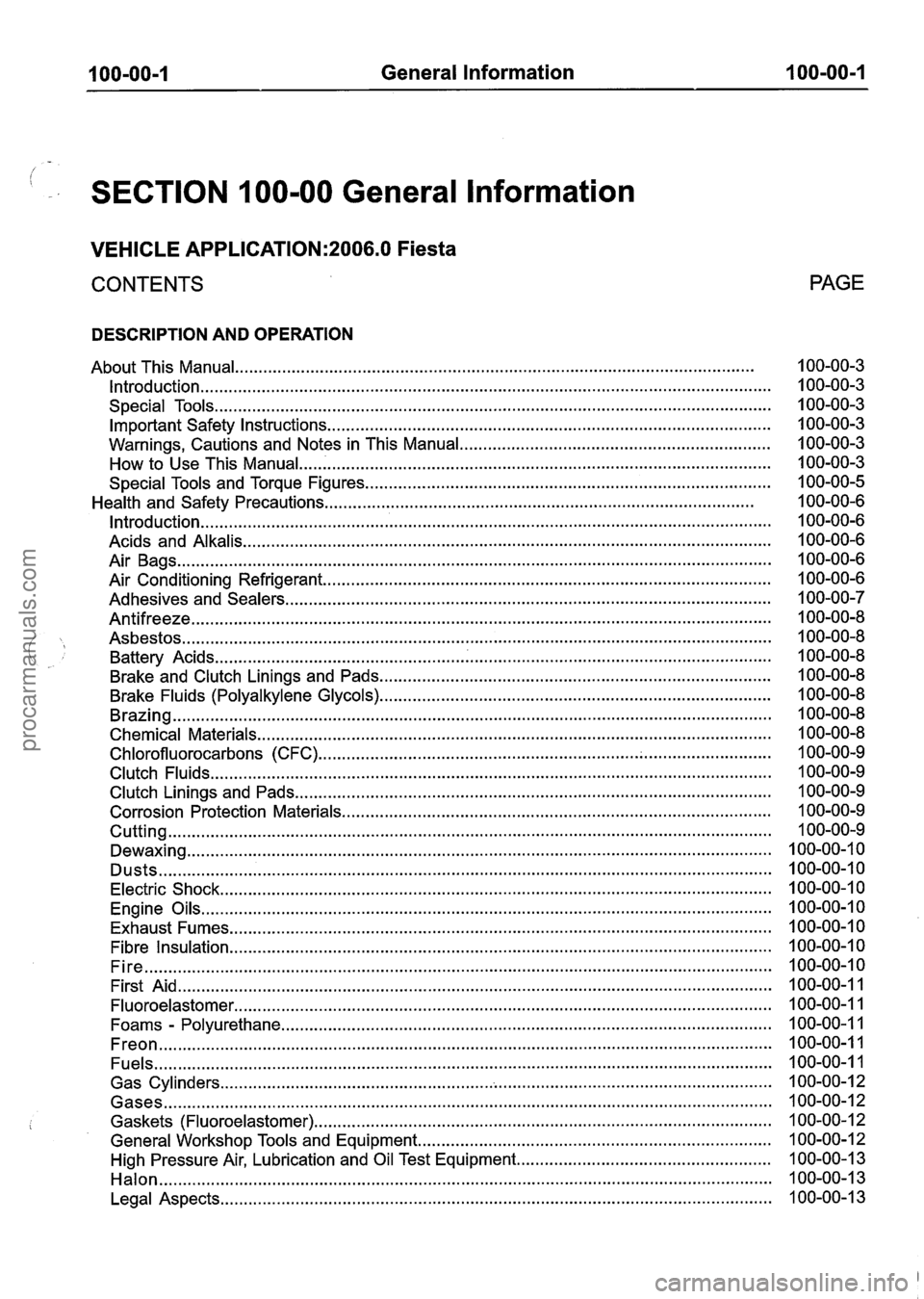
. SECTION 100-00 General lnformation
VEHICLE APPLICATION:2006.0 Fiesta
CONTENTS
DESCRIPTION AND OPERATION
About This Manual
........................................................................\
......................................
........................................................................\
................................................. Introduction
Special Tools
........................................................................\
..............................................
Important Safety Instructions ........................................................................\
......................
Warnings. Cautions and Notes in This Manual ..................................................................
How to Use This Manual ........................................................................\
............................
Special Tools and Torque Figures ........................................................................\
..............
Health and Safety Precautions ........................................................................\
...................
........................................................................\
................................................. Introduction
........................................................................\
........................................ Acids and Alkalis
Air Bags
........................................................................\
......................................................
Air Conditioning Refrigerant ........................................................................\
.......................
........................................................................\
............................... Adhesives and Sealers
........................................................................\
................................................... Antifreeze
........................................................................\
..................................................... Asbestos
Battery Acids
........................................................................\
..............................................
Brake and Clutch Linings and Pads ........................................................................\
...........
Brake Fluids (Polyalkylene Glycols) ........................................................................\
...........
........................................................................\
....................................................... Brazing
Chemical Materials
........................................................................\
.....................................
................................................................... Chlorofluorocarbons (CFC) ... ..........................
Clutch Fluids ........................................................................\
...............................................
Clutch Linings and Pads ........................................................................\
.............................
Corrosion Protection Materials ........................................................................\
...................
........................................................................\
........................................................ Cutting
........................................................................\
.................................................... Dewaxing
........................................................................\
.......................................................... Dusts
Electric Shock
........................................................................\
.............................................
Engine Oils ........................................................................\
.................................................
Exhaust Fumes ........................................................................\
...........................................
........................................................................\
........................................... Fibre Insulation
Fire
........................................................................\
.............................................................
First Aid ........................................................................\
......................................................
........................................................................\
.......................................... Fluoroelastomer
Foams
. Polyurethane ........................................................................\
................................
........................................................................\
.......................................................... Freon
........................................................................\
........................................................... Fuels
........................................................................\
.............................................. Gas Cylinders
........................................................................\
......................................................... Gases
Gaskets (Fluoroelastomer)
........................................................................\
.........................
General Workshop Tools and Equipment ........................................................................\
...
High Pressure Air. Lubrication and Oil Test Equipment ......................................................
........................................................................\
.......................................................... Halon
........................................................................\
............................................. Legal Aspects
PAGE
procarmanuals.com
Page 18 of 1226

General Information
........................................................................\
............................. Lubricants and Greases
Transmission Fluids
........................................................................\
....................................
........................................................................\
.......................................................... Noise
Noise Insulation Materials
........................................................................\
..........................
0-Rings (Fluoroelastomer) ........................................................................\
.........................
........................................................................\
.......................................................... Paints
........................................................................\
.............................. Pressurized Equipment . . ........................................................................\
......................................................... Solder
........................................................................\
...................................................... Solvents
Sound Insulation
........................................................................\
.........................................
Suspended Loads ........................................................................\
.......................................
Transmission Brake Bands ........................................................................\
.........................
........................................................................\
................................................... Underseal
........................................................................\
............................................................ Viton
........................................................................\
....................................................... Welding
........................................................................\
.................... Warning Symbols on Vehicles
........................................................................\
................................................. White Spirit
Standard Workshop Practices
........................................................................\
....................
Vehicle in Workshop ........................................................................\
...................................
Alternative Fuel ........................................................................\
...........................................
Alternative Fuel - Do's ........................................................................\
..............................
Alternative Fuel - Do Nots ........................................................................\
........................
Towing the Vehicle ........................................................................\
......................................
Connecting a Slave Battery Using Jumper Cables ............................................................
Component Cleaning ........................................................................\
..................................
Calibration of Essential Measuring Equipment ...................................................................
Solvents. Sealants and Adhesives ........................................................................\
.............
........................................................................\
................................................. Introduction
RoadlRoller Testing ........................................................................\
....................................
Pre-Test Checks ........................................................................\
.........................................
Starting the Engine ........................................................................\
.....................................
Road or Roller Testing ........................................................................\
................................
Brake Testing ........................................................................\
..............................................
procarmanuals.com
Page 24 of 1226
100=00=8 General Information 100=00=8
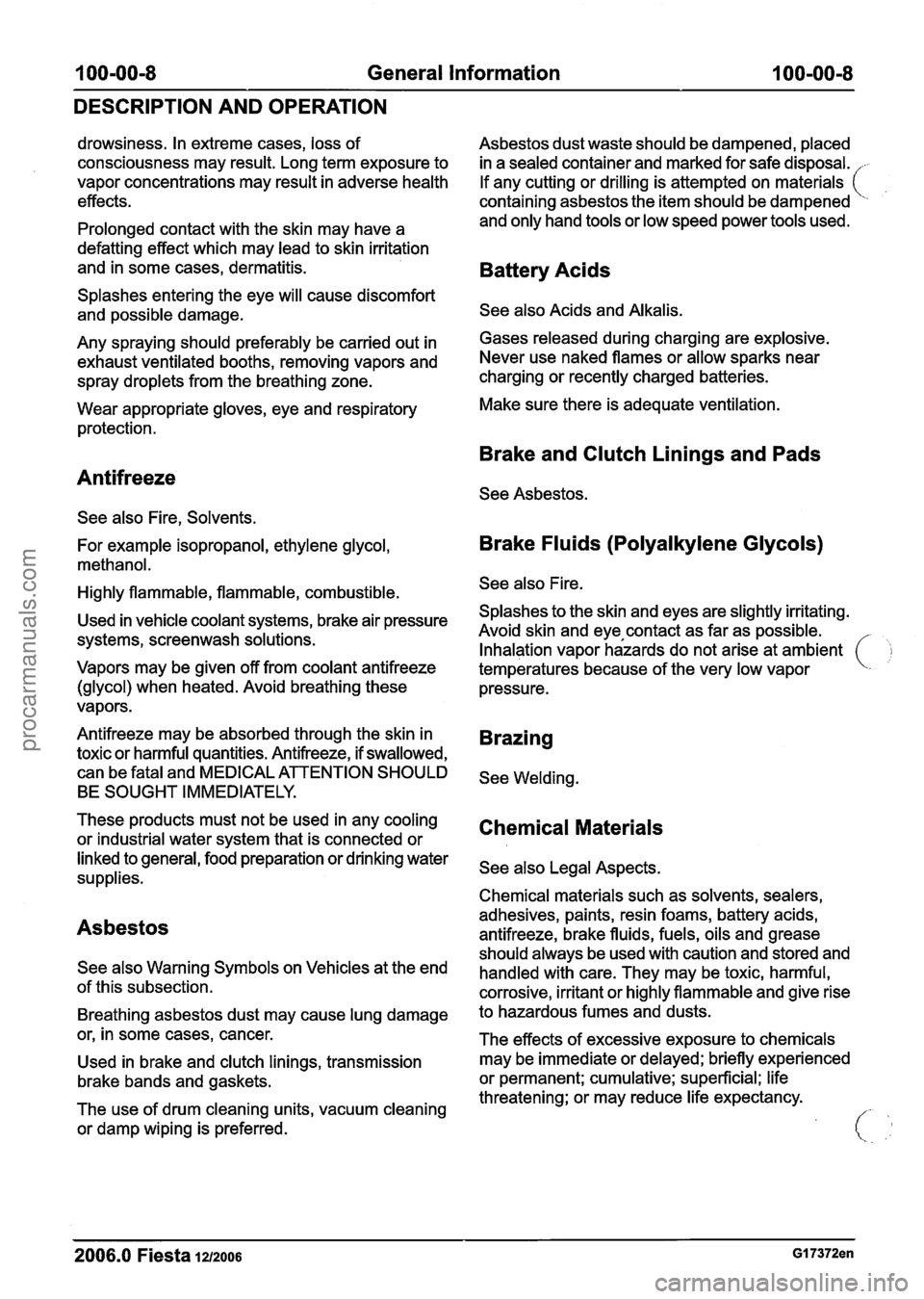
DESCRIPTION AND OPERATION
drowsiness. In extreme cases, loss of
consciousness may result. Long term exposure to
vapor concentrations may result in adverse health
effects.
Prolonged contact with the skin may have a
defatting effect which may lead to skin irritation
and in some cases, dermatitis.
Splashes entering the eye will cause discomfort
and possible damage.
Any spraying should preferably be carried out in
exhaust ventilated booths, removing vapors and
spray droplets from the breathing zone.
Wear appropriate gloves, eye and respiratory
protection. Asbestos dust
waste should be dampened, placed
in a sealed container and marked for safe disposal.
If any cutting or drilling is attempted on materials
(
containing asbestos the item should be dampened "
and only hand tools or low speed power tools used.
Battery Acids
See also Acids and Alkalis.
Gases released during charging are explosive.
Never use naked flames or allow sparks near
charging or recently charged batteries.
Make sure there is adequate ventilation.
Brake and Clutch Linings and Pads
Antifreeze
See Asbestos.
See also Fire, Solvents.
For example isopropanol, ethylene glycol,
methanol.
Highly flammable, flammable, combustible.
Used in vehicle coolant systems, brake air pressure
systems, screenwash solutions.
Vapors may be given off from coolant antifreeze
(glycol) when heated. Avoid breathing these
vapors.
Antifreeze may be absorbed through the skin in
toxic or harmful quantities. Antifreeze, if swallowed,
can be fatal and MEDICAL ATTENTION SHOULD
BE SOUGHT IMMEDIATELY.
These products must not be used in any cooling
or industrial water system that is connected or
linked to general, food preparation or drinking water
supplies.
Asbestos
See also Warning Symbols on Vehicles at the end
of this subsection.
Breathing asbestos dust may cause lung damage
or, in some cases, cancer.
Used in brake and clutch linings, transmission
brake bands and gaskets.
The use of drum cleaning units, vacuum cleaning
or damp wiping is preferred.
Brake Fluids (Polyal kylene Glycols)
See also Fire.
Splashes to the skin and eyes are slightly irritating.
Avoid skin and
eye'contact as far as possible.
Inhalation vapor hazards do not arise at ambient
temperatures because of the very low vapor
pressure.
Brazing
See Welding.
Chemical Materials
See also Legal Aspects.
Chemical materials such as solvents, sealers,
adhesives, paints, resin foams, battery acids,
antifreeze, brake fluids, fuels, oils and grease
should always be used with caution and stored and
handled with care. They may be toxic, harmful,
corrosive, irritant or highly flammable and give rise
to hazardous fumes and dusts.
The effects of excessive exposure to chemicals may be immediate or delayed; briefly experienced
or permanent; cumulative; superficial; life
threatening; or may reduce life expectancy.
2006.0 Fiesta 1212006 GI 7372en
procarmanuals.com
Page 25 of 1226
100-00-9 General Information 100-00-9
DESCRIPTION AND OPERATION
Chemical Materials - Do's
/ I - Do carefully read and observe hazard and
precaution warnings given on material
containers (labels) and in any accompanying
leaflets, posters or other instructions. Material
health and safety data sheets can be obtained
from manufacturers.
- Do remove chemical materials from the skin
and clothing as soon as practicable after soiling.
Change heavily soiled clothing and have it
cleaned.
- Do organize work practices and protective
clothing to avoid soiling of the skin and eyes;
breathing vapors, aerosols, dusts or fumes;
inadequate container labeling; fire and explosion
hazards.
- Do wash before job breaks, before eating,
smoking, drinking or using toilet facilities when
handling chemical materials.
- Do keep work areas clean, uncluttered and free
of spills.
- Do store chemical materials according to
national and local regulations.
- Do keep chemical materials out of the reach of
( ' children.
- Do not clean hands or clothing with chemicals.
Chemicals, particularly solvents and fuels, will
dry the skin and may cause irritation leading to
dermatitis or be absorbed through the skin in
toxic or harmful quantities.
- Do not use emptied containers for other
materials except when they have been cleaned
under supervised conditions.
- Do not sniff or smell chemical materials. Brief
exposure to high concentrations of fumes can
be toxic or harmful.
Chlorofluorocarbons (CFC)
There is concern in the scientific community that
CFCs and Halons are depleting the upper ozone
layer which filters out harmful ultraviolet radiation.
Decreased filtration of ultraviolet radiation may
result in increases in skin cancer, cataracts and
immune system suppression in humans, as well
as decreased productivity of crops and aquatic
systems.
CFCs are used primarily as refrigerants in vehicle
air conditioning systems and as aerosol
propellants. Halons are used as fire extinguishants.
Clutch Fluids
Chemical Materials - Do Nots
See Brake fluids.
- Do not mix chemical materials except under the
manufacturers instructions; some chemicals can
form other toxic or harmful chemicals, give off
toxic or harmful fumes or become explosive
when mixed together.
- Do not spray chemical materials, particularly
those based on solvents, in confined spaces,
for example when people are inside a vehicle.
- Do not apply heat or flame to chemical materials
except under the manufacturers instructions. Some are highly flammable and some may
release toxic or harmful fumes.
- Do not leave containers open. Fumes given off
can build up to toxic, harmful or explosive
concentrations. Some fumes are heavier than
air and will accumulate in confined areas such
as pits.
- Do not transfer chemical materials to unlabelled
containers.
Clutch Linings and Pads
See Asbestos.
Corrosion Protection Materials
See also Solvents, Fire.
Highly flammable, flammable
- observe No
Smoking policy.
These materials are varied and the manufacturers instructions must be followed. They may contain
solvents, resins or petroleum products. Skin and
eye contact should be avoided. They should only be sprayed in conditions of adequate ventilation
and not in confined spaces.
Cutting
See Welding.
2006.0 Fiesta 1212006 GI 7372en
procarmanuals.com
Page 26 of 1226
1 OO=OO-10 General Information 100-00-1 0
DESCRIPTION AND OPERATION
Dewaxing Engine Oils
See Solvents and Fuels (Kerosene). See Lubricants and Grease.
Dusts Exhaust Fumes
Powder, dusts or clouds may be irritant, harmful These contain asphyxiating, harmful and toxic
or toxic. Avoid breathing dusts from powdery chemicals and particles such as carbon oxides,
chemical materials or those arising from dry nitrogen oxides, aldehydes, lead and aromatic
abrasion operations. Wear respiratory protection hydrocarbons. Engines should be run only under
if ventilation is inadequate. conditions of adequate exhaust extraction or
Fine dusts of combustible material can present an general ventilation
and not in confined spaces.
explosion hazard. Avoid explosive limits and
sources of ignition.
Gasoline (petrol) engine
Electric Shock There may not be adequate warning of odor or of
irritation before toxic or harmful effects arise. These
Electric shock can result from the use of faulty may be immediate
or delayed.
electrical equipment or from the misuse of
equipment in good condition.
Diesel engine Make sure that electrical equipment is maintained
in good condition and frequently tested. Faulty
Soot, discomfort and irritation usually give
equipment should be labeled and preferably
adequate warning of hazardous fume
removed from the workstation. concentrations.
Make sure that flexes, cables, plugs and sockets
are not frayed, kinked, cut, cracked or otherwise
Fibre damaged.
Make sure that electrical equipment and flexes do
See also Dusts.
not come into contact with water.
Used in noise and sound insulation.
Make sure that electrical is protected The fibrous nature of surfaces and cut edges can by the correct rated fuse.
cause skin irritation. This is usually a physical and
Never misuse electrical equipment and never use
not a chemical effect.
equipment that is in any way faulty. The results
could be fatal. Precautions should
be taken to avoid excessive
skin contact through careful organization of work
Make sure that the cables of mobile electrical
practices and the
;se of gloves.
equipment cannot get trapped and damaged, such
as in a vehicle hoist.
-. Fire Make sure that the designated electrical workers
are trained in basic First Aid.
See also Welding, Foams, Legal Aspects.
In cases of electrocution:
Many of the materials found on or associated with
- switch off the power supply before approaching the repair of vehicles are highly flammable. Some
the victim. give
off toxic or harmful fumes if burnt.
- if this is not possible push or drag the victim
Observe strict fire safety when storing and handling
from the source of electricity using dry flammable materials
or solvents, particularly near
non-conductive material. electrical equipment or welding processes.
/
- commence resuscitation if trained to do so.
Make sure, before using electrical or welding 'L '
- SUMMON MEDICAL ASSISTANCE. equipment,
that there is no fire hazard present.
Have a suitable fire extinguisher available when
using welding or heating equipment.
procarmanuals.com
Page 27 of 1226
100-00-1 1 General Information 100-00-1 1
DESCRIPTION AND OPERATION
First Aid
Apart from meeting any legal requirements it is
desirable for someone in the workshop to be
trained in First Aid procedures.
Splashes in the eye should be flushed carefully
with clean water for at least ten minutes.
Soiled skin should be washed with soap and water.
In case of cold burns, from alternative fuels, place
affected area in cool to cold water.
Individuals affected by inhalation of gases and
fumes should be removed to fresh air immediately.
If effects persist, consult a doctor.
If liquids are swallowed inadvertently, consult a
doctor giving him the information on the container
or label. Do not induce vomiting unless this action
is indicated on the label.
Fluoroelastomer
See Viton.
Foams - Polyurethane
See also Fire.
Used in sound and noise insulation. Cured foams
used in seat and trim cushioning.
Follow manufacturers instructions.
Unreacted components are irritating and may be
harmful to the skin and eyes. Wear gloves and
goggles.
Individuals with chronic respiratory diseases,
asthma, bronchial medical problems, or histories
of allergic diseases should not work in or near
uncured materials.
The components, vapors or spray mists can cause
direct irritation, sensitivity reactions and may be
toxic or harmful.
Vapors and spray mists must not be inhaled. These
materials must be applied with adequate ventilation
and respiratory protection. Do not remove the
respirator immediately after spraying; wait until the
vapors/mists have cleared.
Burning of the uncured components and the cured
foams can generate toxic and harmful fumes.
Smoking, naked flames or the use of electrical
equipment during foaming operations and until
vapors/mists have cleared should not be allowed.
Any heat cutting of cured foams or partially cured foams
should be conducted with extraction
ventilation. See also the vehicle Body Repair
Manual.
Freon
See Air Conditioning Refrigerant.
Fuels
See also, Fire, Legal Aspects, Chemicals and
Solvents.
Avoid skin contact with fuel where possible. Should
contact occur, wash the affected skin with soap
and water.
Gasoline (Petrol)
Highly flammable - observe No Smoking policy.
Swallowing can result in mouth and throat irritation
and absorption from the stomach can result in
drowsiness and unconsciousness. Small amounts
can be fatal to children. Aspiration of liquid into the
lungs, through vomiting, is a very serious hazard.
Gasoline dries the skin and can cause irritation
and dermatitis on prolonged or repeated contact.
Liquid in the eye causes severe smarting.
Motor gasoline may contain appreciable quantities
of benzene, which is toxic upon inhalation, and the
concentration of gasoline vapors must be kept very
low. High concentrations will cause eye, nose and
throat irritation, nausea, headache, depression and
symptoms of drunkenness. Very high
concentrations will result in rapid loss of
CO~SC~OUS~~SS.
Make sure there is adequate ventilation when
handling and using gasoline. Great care must be
taken to avoid the serious consequences of
inhalation in the event of vapor build up arising
from spillages in confined spaces.
Special precautions apply to cleaning and
maintenance operations on gasoline storage tanks.
Gasoline should not be used as a cleaning agent.
It must not be siphoned by mouth. See First Aid.
Gasoil (Diesel Fuel)
Com busti ble.
2006.0 Fiesta 1212006 GI 7372en
procarmanuals.com