service FORD FIESTA 2007 Workshop Manual
[x] Cancel search | Manufacturer: FORD, Model Year: 2007, Model line: FIESTA, Model: FORD FIESTA 2007Pages: 1226, PDF Size: 61.26 MB
Page 3 of 1226
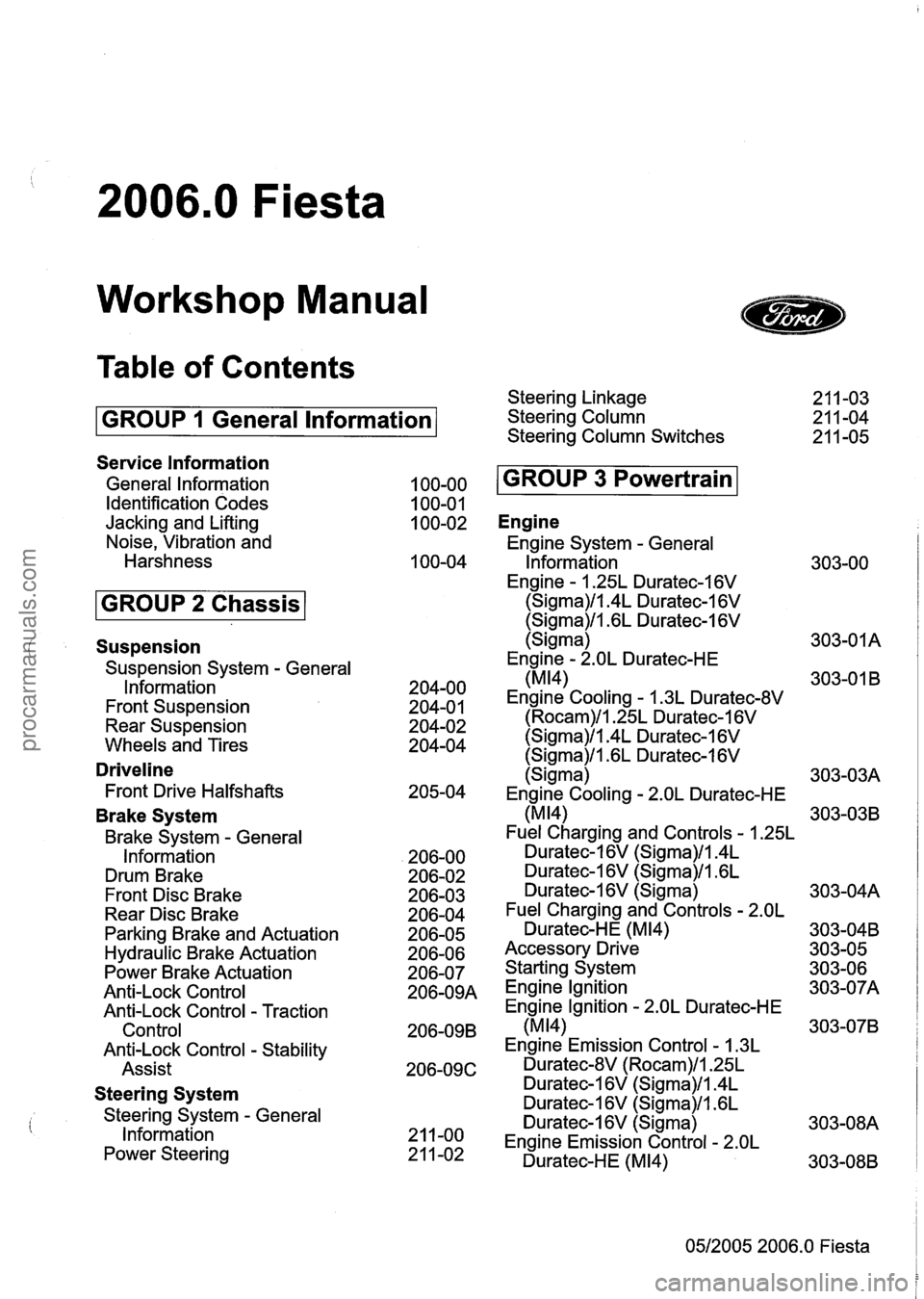
2006.0 Fiesta
Workshop Manual
Table of Contents
GROUP 1 General lnformation
Service lnformation
General lnformation
Identification Codes
Jacking and Lifting
Noise, Vibration and
Harshness
Suspension
Suspension System - General
lnformation
Front Suspension
Rear Suspension
Wheels and Tires
Driveline
Front Drive Halfshafts
Brake System
Brake System - General
Information
Drum Brake
Front Disc Brake
Rear Disc Brake
Parking Brake and Actuation
Hydraulic Brake Actuation
Power Brake Actuation
Anti-Lock Control
Anti-Lock Control
- Traction
Control
Anti-Lock Control
- Stability
Assist
Steering System
Steering System - General
lnformation
Power Steering Steering Linkage
Steering Column
Steering Column Switches
Engine
Engine System - General
lnformation
Engine
- 1.25L Duratec-1 6V
(Sigma)/l.4L Duratec-1 6V
(Sigma)/l.GL Duratec-I 6V
(Sigma)
Engine
- 2.OL Duratec-HE
(MI41
Engine Cooling - 1.3L Duratec-8V
(Rocam)/l.25L Duratec-1 6V
(Sigma)/l.4L Duratec-1 6V
(Sigma)/l .6L Duratec-1 6V
(Sigma)
Engine Cooling
- 2.OL Duratec-HE
(MI41
Fuel Charging and Controls - 1.25L
Duratec-1 6V (Sigma)/l.4L
Duratec-16V (Sigma)/l.GL
Duratec-1 6V (Sigma)
Fuel Charging and Controls
- 2.OL
Duratec-HE (M14)
Accessory Drive
Starting System
Engine lgnition
Engine Ignition
- 2.OL Duratec-HE
(M14)
Engine Emission Control - 1.3L
Duratec-8V (Rocam)/l.25L
Duratec-1 6V (Sigma)/l.4L
Duratec-1 6V (Sigma)/l .6L
Duratec-1
6V (Sigma)
Engine Emission Control
- 2.OL
Duratec-HE (M14)
05/2005 2006.0 Fiesta
procarmanuals.com
Page 5 of 1226
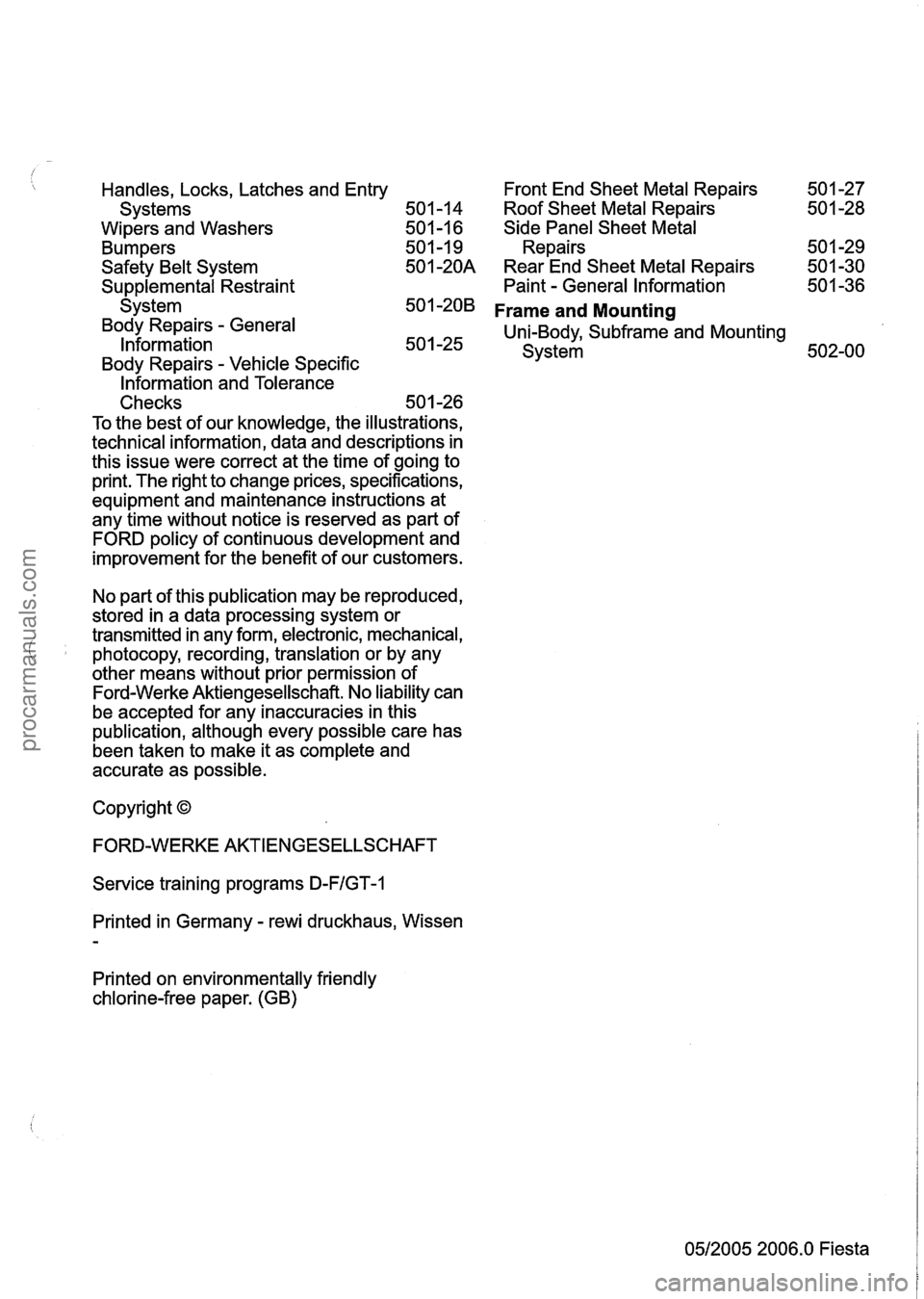
Handles, Locks, Latches and Entry Systems 501-14
Wipers and Washers 501-16
Bumpers 501-19
Safety Belt System 50
I -20A
Supplemental Restraint
System 501 -20B
Body Repairs
- General
Information 501 -25
Body Repairs
- Vehicle Specific
lnformation and Tolerance
Checks 501 -26
To the best of our knowledge, the illustrations,
technical information, data and descriptions in
this issue were correct at the time of going to
print. The right to change prices, specifications,
equipment and maintenance instructions at
any time without notice is reserved as part of
FORD policy of continuous development and
improvement for the benefit of our customers.
No part of this publication may be reproduced,
stored in a data processing system or
transmitted in any form, electronic, mechanical,
photocopy, recording, translation or by any
other means without prior permission of
Ford-Werke Aktiengesellschaft. No liability can
be accepted for any inaccuracies in this
publication, although every possible care has
been taken to make it as complete and
accurate as possible.
Copyright
O
FORD-WERKE AKTIENGESELLSCHAFT
Service training programs D-FIGT-1
Printed in Germany
- rewi druckhaus, Wissen -
Printed on environmentally friendly
chlorine-free paper. (GB) Front End Sheet Metal Repairs
50 1 -27
Roof Sheet Metal Repairs 50 1 -28
Side Panel Sheet Metal Repairs 501 -29
Rear End Sheet Metal Repairs 501
-30
Paint
- General Information 501
-36
Frame and Mounting
Uni-Body, Subframe and Mounting
System 502-00
0512005 2006.0 Fiesta
procarmanuals.com
Page 7 of 1226

GROUP
General Information
SECTION TITLE PAGE
Service Information
General Information ........................................................................\
............................. 100-00
Identification Codes
........................................................................\
............................. 100-01
Jacking and Lifting
........................................................................\
............................... 100-02
Noise, Vibration and Harshness
........................................................................\
........ 100-04
0562005 2006.0 Fiesta
procarmanuals.com
Page 19 of 1226
100-00-3 General Information 100-00-3
DESCRIPTION AND OPERATION
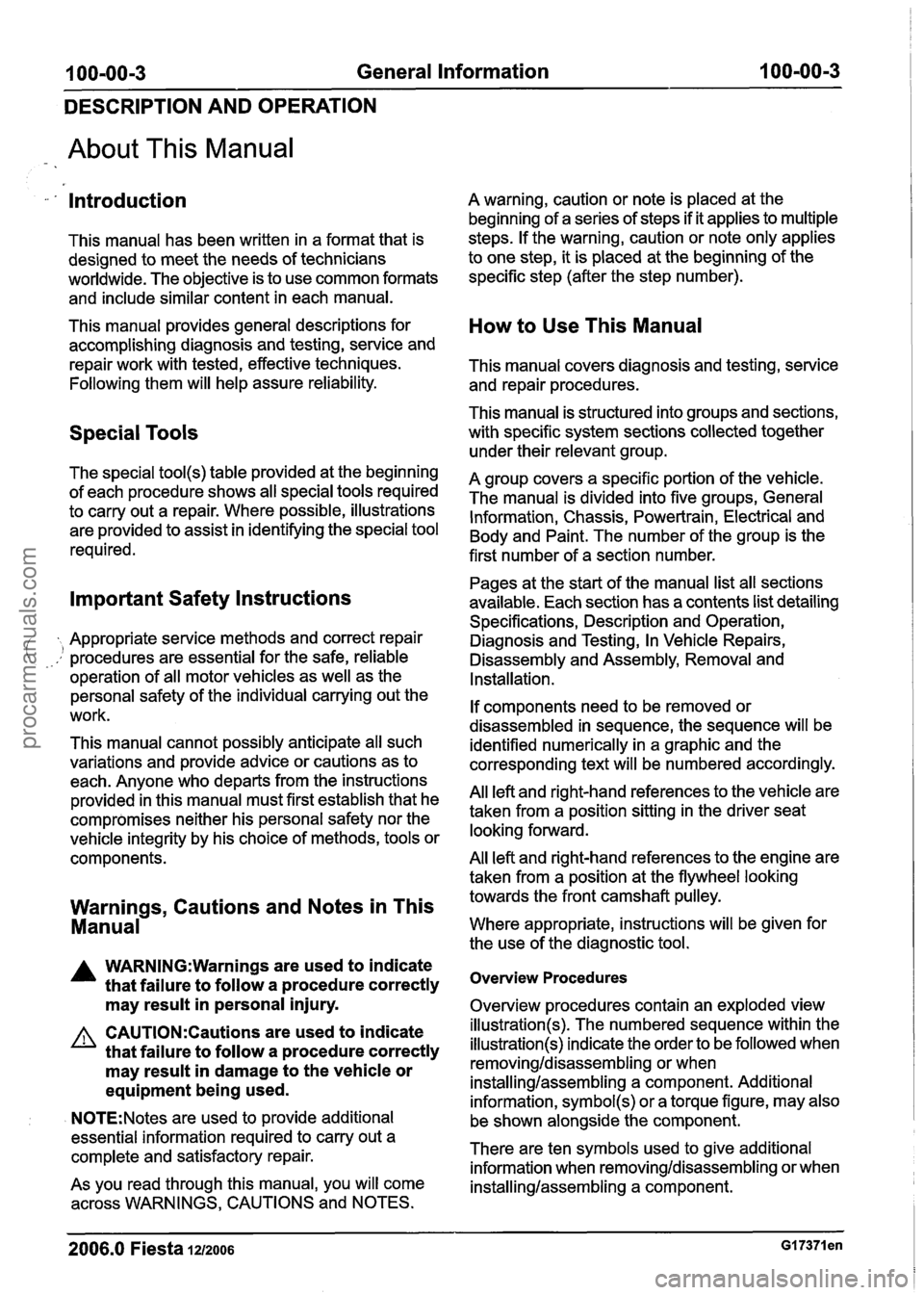
About This Manual
-- . Introduction
This manual has been written in a format that is
designed to meet the needs of technicians
worldwide. The objective is to use common formats
and include similar content in each manual.
This manual provides general descriptions for accomplishing diagnosis and testing, service and
repair work with tested, effective techniques.
Following them will help assure reliability.
Special Tools
The special tool(s) table provided at the beginning
of each procedure shows all special tools required
to carry out a repair. Where possible, illustrations
are provided to assist in identifying the special tool
required.
Important Safety Instructions
Appropriate service methods and correct repair
--.! procedures are essential for the safe, reliable
operation of all motor vehicles as well as the
personal safety of the individual carrying out the
work.
This manual cannot possibly anticipate all such
variations and provide advice or cautions as to
each. Anyone who departs from the instructions
provided in this manual must first establish that he
compromises neither his personal safety nor the
vehicle integrity by his choice of methods, tools or
components.
Warnings, Cautions and Notes in This
Manual
A WARN1NG:Warnings are used to indicate
that failure to follow a procedure correctly
may result in personal injury.
A warning, caution or note is placed at the
beginning of a series of steps if it applies to multiple
steps. If the warning, caution or note only applies
to one step, it is placed at the beginning of the
specific step (after the step number).
How to Use This Manual
This manual covers diagnosis and testing, service
and repair procedures.
This manual is structured into groups and sections,
with specific system sections collected together
under their relevant group.
A group covers a specific portion of the vehicle.
The manual is divided into five groups, General
Information, Chassis, Powertrain, Electrical and
Body and Paint. The number of the group is the
first number of a section number.
Pages at the start of the manual list all sections
available. Each section has a contents list detailing
Specifications, Description and Operation,
Diagnosis and Testing, In Vehicle Repairs,
Disassembly and Assembly, Removal and
Installation.
If components need to be removed or
disassembled in sequence, the sequence will be
identified numerically in a graphic and the
corresponding text will be numbered accordingly.
All left and right-hand references to the vehicle are
taken from a position sitting in the driver seat
looking forward.
All left and right-hand references to the engine are
taken from a position at the flywheel looking
towards the front camshaft pulley.
Where appropriate, instructions will be given for
the use of the diagnostic tool.
Overview Procedures
Overview procedures contain an exploded view
A CAUTI0N:Cautions are used to indicate illustration(s). The numbered sequence within the
that failure to follow a procedure correctly illustration(s) indicate the order to be followed when
may result in damage to the vehicle or removingldisassem bling or when
equipment being used. installinglassembling a component. Additional
information,
symbol(s) or a torque figure, may also
, , N0TE:Notes are used to provide additional
be shown alonaside the com~onent.
essential information required to carry out a
complete and satisfactory repair. There are
ten symbols used to give additional
information when
removina/disassemblincr or when V AS YOU read through this manual, YOU will come /"itallinglassembling a c&ponent.
across WARNINGS, CAUTIONS and NOTES.
2006.0 Fiesta 1212006 GI 7371 en
procarmanuals.com
Page 28 of 1226
100-00-12 General Information 100-00-12
DESCRIPTION AND OPERATION
Gross or prolonged skin contact with high boiling
point gas oils may also cause serious skin
disorders including skin cancer.
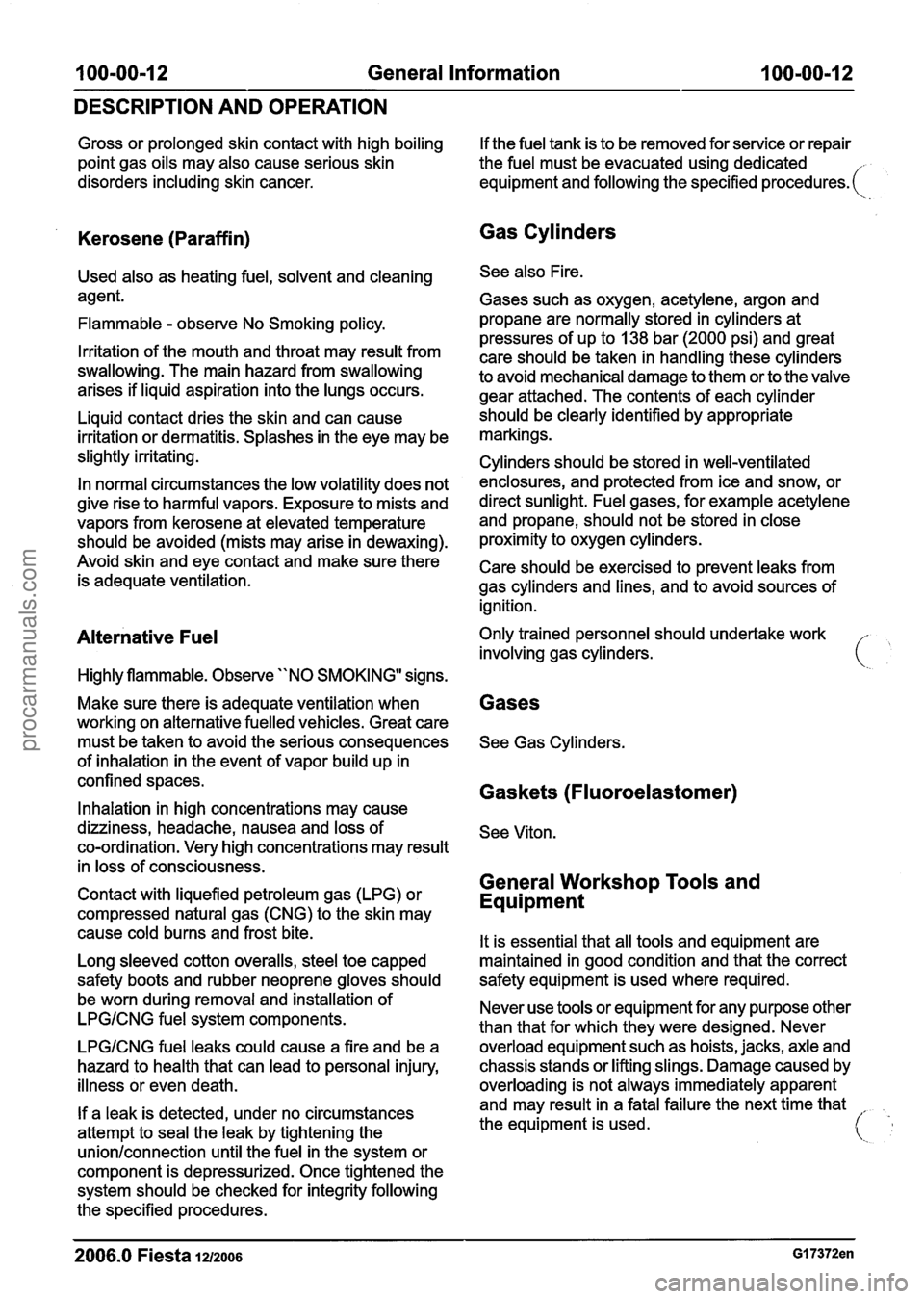
Kerosene (Paraffin)
Used also as heating fuel, solvent and cleaning
agent.
Flammable
- observe No Smoking policy.
Irritation of the mouth and throat may result from
swallowing. The main hazard from swallowing
arises if liquid aspiration into the lungs occurs.
Liquid contact dries the skin and can cause
irritation or dermatitis. Splashes in the eye may be
slightly irritating.
In normal circumstances the low volatility does not
give rise to harmful vapors. Exposure to mists and
vapors from kerosene at elevated temperature
should be avoided (mists may arise in dewaxing).
Avoid skin and eye contact and make sure there
is adequate ventilation.
Alternative Fuel
Highly flammable. Observe "NO SMOKING" signs.
Make sure there is adequate ventilation when
working on alternative fuelled vehicles. Great care
must be taken to avoid the serious consequences
of inhalation in the event of vapor build up in
confined spaces.
Inhalation in high concentrations may cause
dizziness, headache, nausea and loss of
co-ordination. Very high concentrations may result
in loss of consciousness.
Contact with liquefied petroleum gas (LPG) or
compressed natural gas (CNG) to the skin may
cause cold burns and frost bite.
Long sleeved cotton overalls, steel toe capped
safety boots and rubber neoprene gloves should
be worn during removal and installation of
LPGICNG fuel system components.
LPGICNG fuel leaks could cause a fire and be a
hazard to health that can lead to personal injury,
illness or even death.
If a leak is detected, under no circumstances
attempt to seal the leak by tightening the
unionlconnection until the fuel in the system or
component is depressurized. Once tightened the
system should be checked for integrity following
the specified procedures. If
the fuel tank is to be removed for service or repair
the fuel must be evacuated using dedicated
equipment and following the specified
procedures. (
Gas Cylinders
See also Fire.
Gases such as oxygen, acetylene, argon and
propane are normally stored in cylinders at
pressures of up to
138 bar (2000 psi) and great
care should be taken in handling these cylinders
to avoid mechanical damage to them or to the valve
gear attached. The contents of each cylinder
should be clearly identified by appropriate
markings.
Cylinders should be stored in well-ventilated
enclosures, and protected from ice and snow, or
direct sunlight. Fuel gases, for example acetylene
and propane, should not be stored in close
proximity to oxygen cylinders.
Care should be exercised to prevent leaks from
gas cylinders and lines, and to avoid sources of
ignition.
Only trained personnel should undertake work
involving gas cylinders.
Gases
See Gas Cylinders.
Gaskets (Fluoroelastomer)
See Viton.
General Workshop Tools and
Equipment
It is essential that all tools and equipment are
maintained in good condition and that the correct
safety equipment is used where required.
Never use tools or equipment for any purpose other
than that for which they were designed. Never
overload equipment such as hoists, jacks, axle and
chassis stands or
lifting slings. Damage caused by
overloading is not always immediately apparent
and may result in a fatal failure the next time that
the equipment is used.
2006.0 Fiesta 1212006 GI 7372en
procarmanuals.com
Page 29 of 1226
100-00-1 3 General Information 100-00-1 3
DESCRIPTION AND OPERATION
Do not use damaged or defective tools or
equipment, particularly high-speed equipment such
i as grinding wheels. A damaged grinding wheel can
disintegrate without warning and cause serious
injury.
Wear suitable eye protection when using grinding,
chiseling or sand blasting equipment.
Wear a suitable breathing mask when using
abrasive blasting equipment, working with
asbestos-based materials or using spraying
equipment.
Make sure there is adequate ventilation to control
dusts, mists and fumes.
High Pressure Air, Lubrication and Oil
Test Equipment
See also Lubricants and Greases.
Always keep high-pressure equipment in good
condition, and regularly maintained, particularly at
joints and unions.
Never direct a high-pressure nozzle, for example
diesel injector, at the skin as the fluid may
, penetrate to the underlying tissue, and cause
serious injury.
Halon
See CFCs.
Legal Aspects
There are many laws and regulations relating to
health and safety in the use and disposal of
materials and equipment in a workshop.
For a safe working environment and to avoid
environmental pollution, workshops should be
familiar, in detail, with the many health and safety
laws and regulations within their country, published
by both national and local authorities.
Lubricants and Greases
Avoid all prolonged and repeated contact with
mineral oils. All lubricants and greases may be
irritating to the eyes and skin.
'
Transmission Fluids
Safety instructions
Certain Transmission and Power Steering fluids
supplied to Ford may contain additives which have
the potential to cause skin disease (dermatitis) to
exposed persons. The dermatitis may be irritant
or allergic in nature. Risks are higher where
prolonged or repeated skin contact with a fluid may
occur. These fluids are used for vehicle initial
fill
and service purposes. This sub-section is to:
Inform Service personnel who may come into
contact with these vehicle fluids (hazard
communication).
Summarise appropriate workplace control
measures and personal protective equipment
requirements.
Draw attention to the existence of Material
Safety Datasheets (MSDS's) for the fluids
(available from Ford Customer Service Division).
These MSDS's contain detailed information on
hazards and appropriate controls.
Control measures
Workplace risk assessments made under national
chemical control regulations should identify
operations involving the fluids as potentially
hazardous and specify workplace control and
worker awareness measures. In such
circumstances, the relevant Material Safety
Datasheet (see the details specified below) which
specifies hazards and control measures in detail
should be made available for guidance.
Avoid unprotected skin contact with the fluids, and
in particular, avoid prolonged or repeated skin
contact. Work practices should be organised so as
to minimise the potential for skin contact. This may
include the use of drip trays, absorbents, correct
fluid handling equipment (funnels etc), and
workplace housekeeping measures such as the
cleaning of contaminated surfaces.
Personnel engaged in operations where skin
contact could occur (such as fluid draining or filling)
should wear impervious gloves made from
nitrile
rubber, certified to a chemical protection standard,
e.g. Europe Standard EN374. This glove type is
widely available from reputable suppliers of gloves
for chemical protection [including the manufacturers
Ansell-Admont
(Solvex Range), North Safety
products (North
Nitrile Latex Gloves range), and
2006.0 Fiesta 1212006 GI 7372en
procarmanuals.com
Page 33 of 1226
100-00-1 7 General Information 100-00-1 7
DESCRIPTION AND OPERATION
The flame is bright, and eye protection should be - used, but the ultra-violet emission is much less
than that from arc welding, and lighter filters may
be used.
The process itself produces few toxic fumes, but
such fumes and gases may be produced from
coatings on the work, particularly during cutting
away of damaged body parts, and inhalation of the
fumes should be avoided.
In brazing, toxic fumes may be produced from the
metals in the brazing rod, and a severe hazard
may arise if brazing rods containing cadmium are
used. In this event particular care must be taken
2. Components or assemblies displaying the
to avoid inhalation of fumes and expert advice may
warning triangle with the 'electrified' arrow and
be required. open book symbol
give warning of inherent high
SPECIAL PRECAUTIONS MUST BE TAKEN voltages.
Never touch these with the engine
BEFORE ANY WELDING OR CUTTING TAKES running
or the ignition switched on. See Electric
PLACE ON VESSELS, WHICH HAVE Shock
in this subsection.
CONTAINED COMBUSTIBLE MATERIALS, FOR
EXAMPLE BOILING OR STEAMING OUT OF
FUEL TANKS.
Warning Symbols on Vehicles
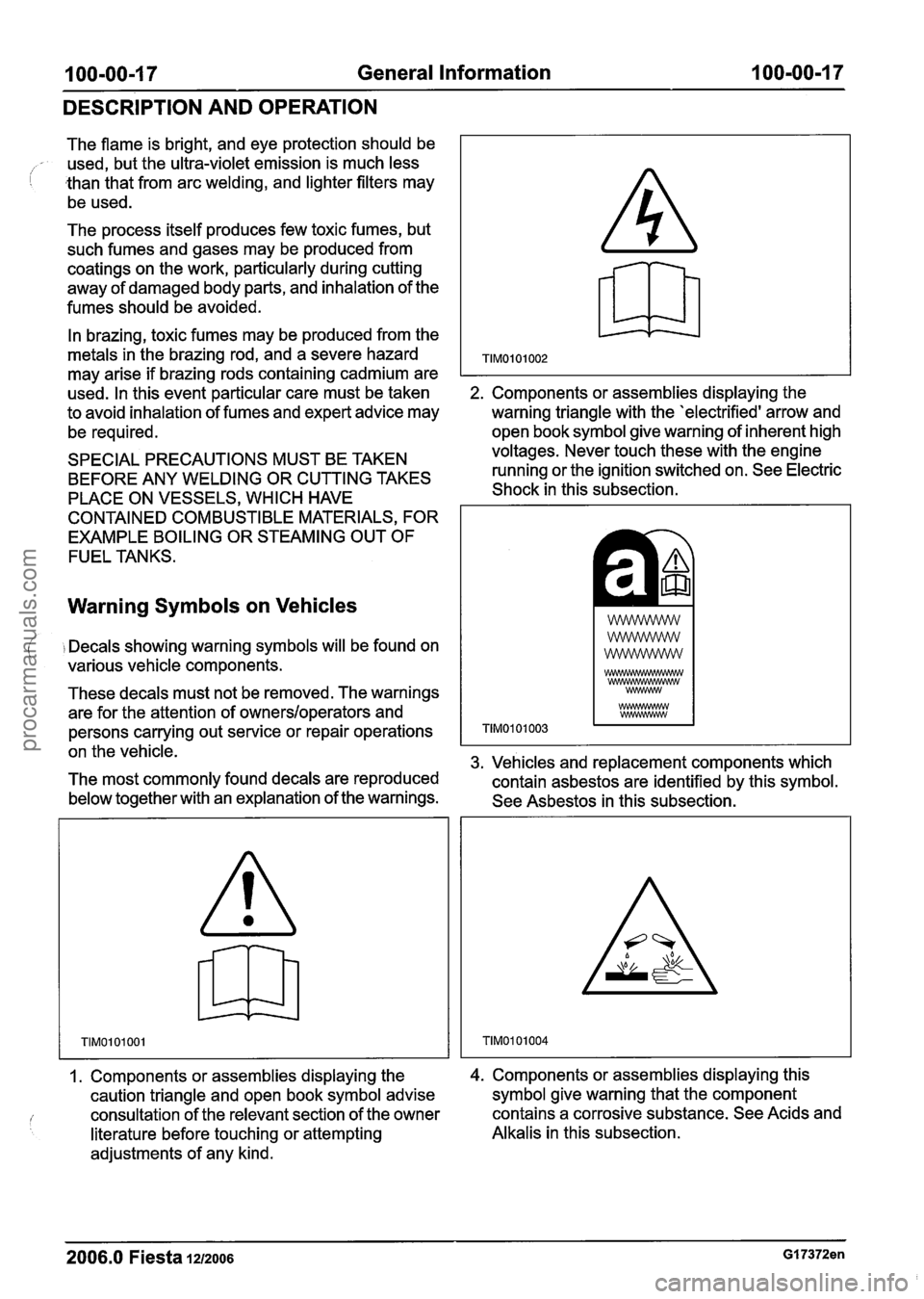
( i Decals showing warning symbols will be found on
various vehicle components.
These decals must not be removed. The warnings
are for the attention of
owners/operators and
persons carrying out service or repair operations
on the vehicle.
3. Vehicles and replacement components which
The most commonly found decals are reproduced
contain asbestos are identified by this symbol.
below together with an explanation of the warnings.
See Asbestos in this subsection.
1. Components or assemblies displaying the
caution triangle and open book symbol advise
consultation of the relevant section of the owner
literature before touching or attempting
adjustments of any kind. 4. Components or assemblies displaying this
symbol give warning that the component
contains a corrosive substance. See Acids and
Alkalis in this subsection.
2006.0 Fiesta 1212006 GI 7372en
procarmanuals.com
Page 35 of 1226
100-00-1 9 General Information 100-00-1 9
DESCRIPTION AND OPERATION
Standard Workshop Practices
Vehicle in Workshop
When working on a vehicle in the workshop always
make sure that:
- the parking brake is applied or the wheels are
securely chocked to prevent the vehicle moving
forwards or backwards.
- the key is removed from key operated hood
locks before any work is carried out around the
front of the vehicle.
- if the engine is to be run, there is adequate
ventilation, or an extraction hose to remove
exhaust fumes.
- there is adequate room to raise the vehicle and
remove the wheels, if necessary.
- fender covers are always fitted if any work is to
be carried out in the engine compartment.
- the battery is disconnected if working on the
engine, underneath the vehicle, or if the vehicle
is raised.
Alternative Fuel - Dons
- Do work on the vehicle in a designated area,
that is well ventilated and with access restricted
to qualified personnel only.
- Install new warning labels to their original
locations.
- If possible always isolate the alternative fuel
tank, and run the vehicle on the alternative fuel
until it automatically switches to its normal fuel
prior to taking the vehicle into the workshop
service area.
- Only use tested and approved components and
pipes when repairing or servicing
LPG and CNG
systems.
Alternative Fuel - Do Nots
- Do not vent off LPG fuel.
- Do not use shop air pressure to force LPG fuel
from the fuel tank.
( A CAUTION:When electric arc welding on a - Do not use paint drying ovens above 40°C for vehicle, always disconnect the generator any alternative fuel vehicle. LPG and CNG fuel wiring to prevent the possibility of a surge tanks must be removed from the vehicle prior of current causing damage to the internal to being put into paint drying ovens above 40°C. components of the generator. - Do not modify the system or install new - if using welding equipment on the vehicle, a
components that are not designed for gas
suitable fire extinguisher is readily available.
vehicles.
Alternative Fuel
A WARNING:When servicing the fuel system
always follow the recommended
procedures. Failure to follow these
instructions may result in personal injury.
If the odor of liquefied petroleum gas (LPG) or
compressed natural gas
(CNG) is present in the
air in the workshop, warn all persons in the area
to:
- extinguish all flames and lighted tobacco.
- shut off electrical and air powered equipment.
- evacuate the area.
- ventilate the area.
- contact the fire control authorities.
- remove the vehicle to a dedicated, ventilated
area.
- Do not evacuate fuel tanks unless there is repair
that requires the removal of the fuel tank.
- Do not work on the fuel lines or system
components unless the alternative fuel has been
evacuated and the pressure in the system
reduced to atmospheric or less.
- Do not use anything other than the specified
leak detector fluid to trace fuel leaks.
Be aware of situations that may cause the
LPG or I
CNG fuel system to vent off fuel, such as: I
- extremely hot days.
- parking by a space heater.
- hoisting a vehicle up near a ceiling heater.
Only fully trained personnel, who are conversant
with local standards, are to work on alternative fuel
vehicles.
2006.0 Fiesta 1212006 GI 7373en
procarmanuals.com
Page 58 of 1226
100-04-2 Noise, Vibration and Harshness 100-04-2
DESCRIPTION AND OPERATION
Noise, Vibration and Harshness (NVH)
Noise, vibration and harshness (NVH) is becoming
more important as vehicles become more '
Know the History of the Condition
sophisticated and passenger comfort levels
increase. This section is designed to aid in the
- Did it start suddenly or appear gradually?
diagnosis and testing and repair of NVH concerns.
- Was it related to some other occurrence such
- Noise is defined as sounds not associated with
as a collision or previous part replacement?
the operation of passenger compartment
- Know how the condition made itself known; it
equipment that interface with customer
may be an important clue to the cause.
satisfaction.
- Vibration is defined as impulses felt by the
customer that are not caused by road surface Know the Probability of Certain
changes. Conditions Develop~ng
- Harshness is a ride quality issue where the - Look for the simple rather than the complex.
customer feels that the vehicle response to the
road surface is sharply transmitted to the
- For example:
customer.
- Electrical conditions usually occur at
connections rather than components.
Diagnostic Theory - An engine no-start is more likely to be caused
by a loose wire or small adjustment rather
than a sheared-off
camshafi. Diagnosis is more than just following a series of
interrelated steps in order to find the solution to the - Know the difference between impossible and
specific condition. It is a way of looking at systems improbable. Certain failures
in a system can be
that are not functioning the way they should and improbable
but still happen.
finding out why. Also it is knowing how the system
- New parts are just that, new. It does not mean
should work and whether it is working correctly. they are always
good functioning parts.
There are basic rules for diagnosis. If these rules
are followed, the cause of the condition is usually
Do Not Cure the Symptom and Leave
found the first time through the system. the Cause
Know the System
- Know how the parts go together. Lowering
the pressure in a front tire may correct
the condition of a vehicle leaning to one side, but
it does not correct the original condition.
- Know how the system operates as well as its
limits and what happens when the system goes
Be Positive the Cause is Found
wrong.
- Sometimes this means checking the system - Double check findings.
against one that is known to be working
- What caused a worn component?
correctly.
- A loose transmission or engine mount could
indicate that other mounts are also loose.
Know the History of the System
Diagnostic Charts
A clue in any one of these areas may save time:
- How old or new is the system? Charts are a simple
way of expressing the
relationship between basic logic and a physical
- What kind of treatment has it had?
system of components. They help discover the ,.
- Has it been serviced in the past in such a
cause of a condition in the least time. Diagnostic (,-
manner that might relate to the present
charts combine many areas of diagnosis into one
condition? visual display:
- What is the service history?
2006.0 Fiesta 12/2006 G28448en
procarmanuals.com
Page 62 of 1226
100-04-6 Noise, Vibration and Harshness 100-04-6
DIAGNOSIS AND TESTING
2. AccelerationIDeceleration: With slow
acceleration and deceleration, a shake is
sometimes noticed in the steering
wheellcolumn,
seats, front floor panel, front door trim panel or
front end sheet metal. It is a low frequency
vibration (around
9-1 5 cycles per second). It
may or may not be increased by applying the
brakes lightly. REFER to
Idle
BoomIShakeNibration in the Driveline Noise
and Vibration Symptom Chart.
High Speed: A vibration is felt in the front floor
panel or seats with no visible shake, but with
an accompanying sound or rumble, buzz, hum,
drone or booming noise. Coast with the clutch
pedal depressed (manual transmission) or shift
control selector lever in "N" (NEUTRAL)
(automatic transmission) and engine idling. If
vibration is still evident, it may be related to
wheels, tires, front brake discs, wheel hubs or
front wheel bearings. REFER to Shake and
Vibration While Driving in the Driveline Noise
and Vibration Symptom Chart.
4. Engine rpm Sensitive: A vibration is felt
whenever the engine reaches a particular rpm.
It will disappear in neutral coasts. The vibration
can be duplicated by operating the engine at
the problem rpm while the vehicle is stationary.
It can be caused by any component, from the
accessory drive belt to the clutch or torque
converter which turns at engine speed when the
vehicle is stopped. REFER to Shake and
Vibration While Driving in the Driveline Noise
and Vibration Symptom Chart.
5. Noise and Vibration While Turning: Clicking,
popping or grinding noises may be due to the
following:
worn, damaged or incorrectly installed front
wheel bearing.
damaged
powertrainldrivetrain mounts.
Road Conditions
An experienced technician will always establish a
route that will be used for all NVH diagnosis road
tests. The road selected should be reasonably
smooth, level and free of undulations (unless a
particular condition needs to be identified). A
smooth asphalt road that allows driving over a
range of speeds is best. Gravel or bumpy roads
are unsuitable because of the additional road noise produced.
Once the route is established and
consistently used, the road noise variable is
eliminated from the test results.
N0TE:Some concerns may be apparent only on
smooth asphalt roads.
If a customer complains of a noise or vibration on
a particular road and only on a particular road, the
source of the concern may be the road surface. If
possible, try to test the vehicle on the same type
of road.
Vehicle Preparation
Carry out a thorough visual inspection of the
vehicle before carrying out the road test. Note
anything which is unusual. Do not repair or adjust
any condition until the road test is carried out,
unless the vehicle is inoperative or the condition
could pose a hazard to the technician. After
verifying that the condition has been corrected,
make sure all components removed have been
installed.
Power Steering Conditions
c !
Check for the noise in the following conditions to
verify the customer concern.
Check for the noise in several temperature
conditions.
Is the noise from when the vehicle was new?
Can the noise be repeated constantly or is it
random?
Check the condition of the vehicle age, mileage
and service record.
Interview the customer to find the operating
condition in which the noise will occur. Test the
vehicle based on the
detail(s) from the customer
interview.
Follow the power steering operation noise
condition tables below, to find which condition
the noise will occur.
Power Steering Operation Noise Check
Step 1 : Check for NVH concerns from non-steering
components, which may sound like noises coming
from the steering system.
I:. ':
2006.0 Fiesta 121zoo6 G37349en
procarmanuals.com