service FORD FIESTA 2007 Owner's Manual
[x] Cancel search | Manufacturer: FORD, Model Year: 2007, Model line: FIESTA, Model: FORD FIESTA 2007Pages: 1226, PDF Size: 61.26 MB
Page 775 of 1226
303-03B-5 Engine Cooling - 2.OL Duratec-HE (M14) 303-03B-5
DESCRIPTION AND OPERATION
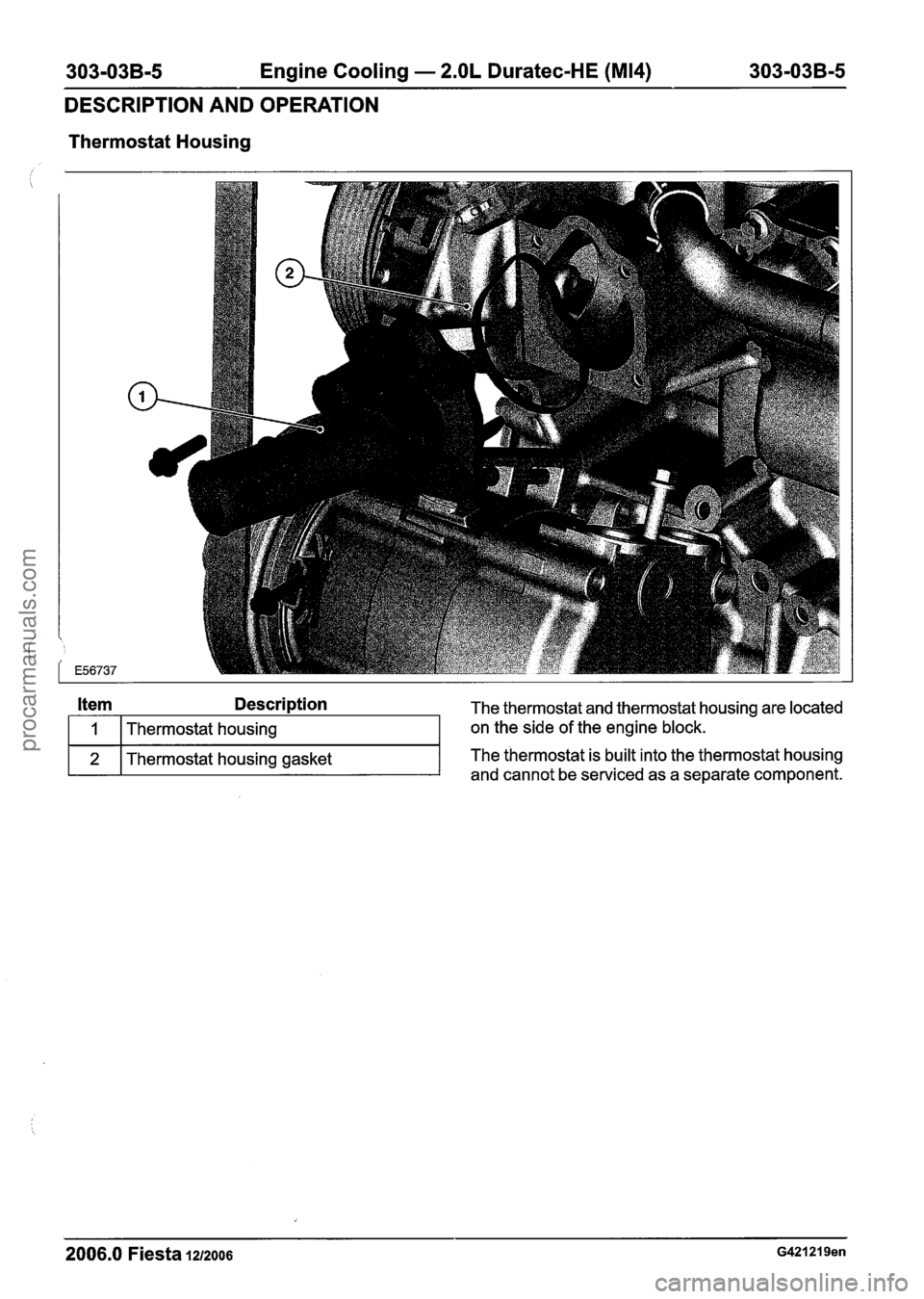
Thermostat Housing
Item Description The thermostat and thermostat housing are located
2006.0 Fiesta 1212006 G421219en
I 1 I Thermostat housing
2
on the side of the engine block.
and cannot be serviced as a separate component.
Thermostat housing gasket
The thermostat
is built into the thermostat housing
procarmanuals.com
Page 777 of 1226
303-03B-7 Engine Cooling - 2.OL Duratec-HE (M14) 303-03B-7
DESCRIPTION AND OPERATION
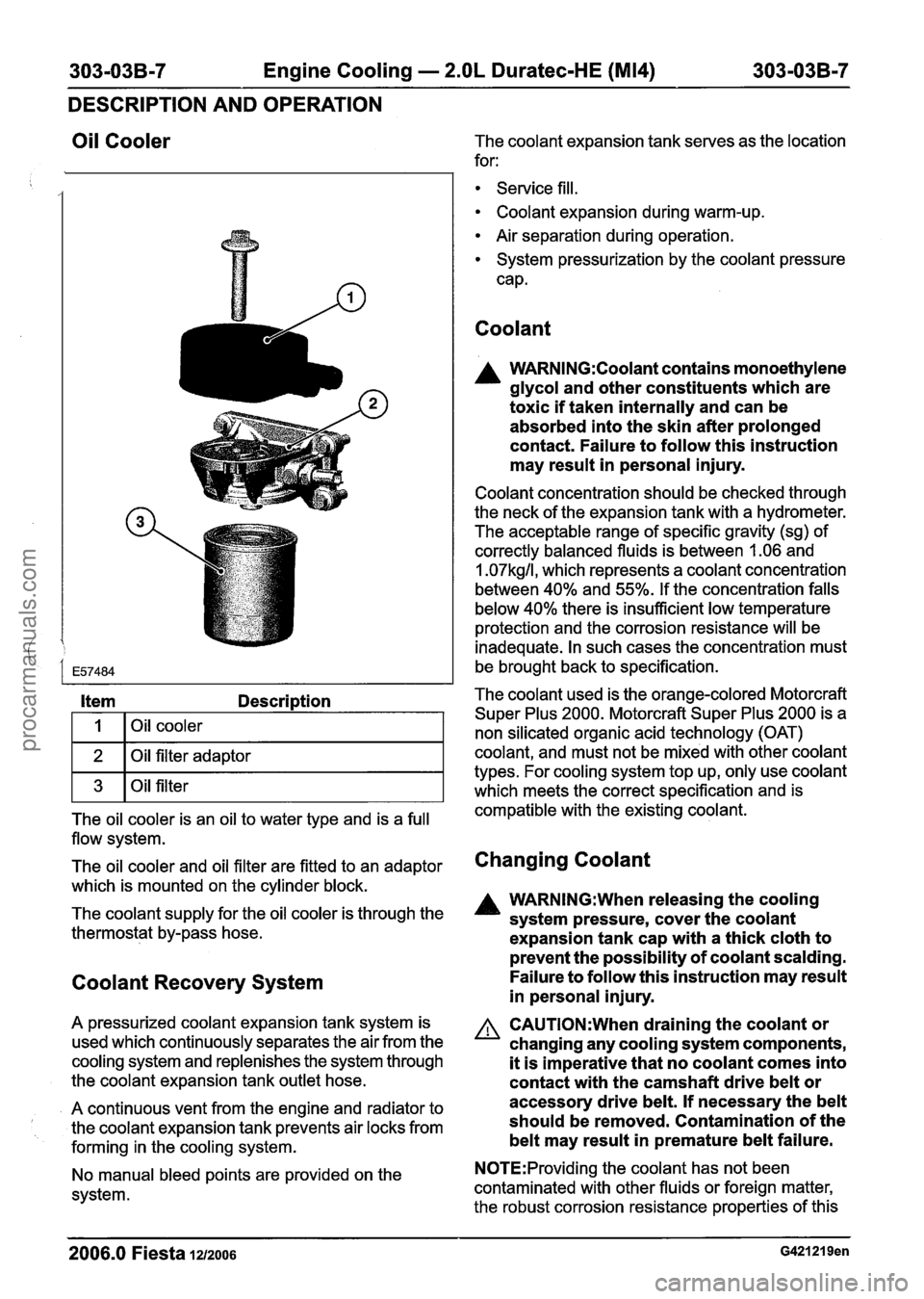
Oil Cooler
Item Description
I I I Oil cooler I
1 2 1 Oil filter adaptor I
1 3 1 Oil filter I
The oil cooler is an oil to water type and is a full
flow system.
The oil cooler and oil filter are fitted to an adaptor
which is mounted on the cylinder block.
The coolant supply for the oil cooler is through the
thermostat by-pass hose.
Coolant Recovery System
A pressurized coolant expansion tank system is
used which continuously separates the air from the
cooling system and replenishes the system through
the coolant expansion tank outlet hose.
A continuous vent from the engine and radiator to
I the coolant expansion tank prevents air locks from
forming in the cooling system.
No manual bleed points are provided on the
system. The coolant expansion tank serves
as the location
for:
Service fill.
Coolant expansion during warm-up.
Air separation during operation.
System pressurization by the coolant pressure
cap.
Coolant
A WARN1NG:Coolant contains monoethylene
glycol and other constituents which are
toxic if taken internally and can be
absorbed into the skin after prolonged
contact. Failure to follow this instruction
may result in personal injury.
Coolant concentration should be checked through
the neck of the expansion tank with a hydrometer.
The acceptable range of specific gravity (sg) of
correctly balanced fluids is between
1.06 and
1.07kg/l, which represents a coolant concentration
between 40% and 55%. If the concentration falls
below 40% there is insufficient low temperature
protection and the corrosion resistance will be
inadequate. In such cases the concentration must
be brought back to specification.
The coolant used is the orange-colored Motorcraft
Super Plus 2000. Motorcraft Super Plus 2000 is a
non silicated organic acid technology (OAT)
coolant, and must not be mixed with other coolant
types. For cooling system top up, only use coolant
which meets the correct specification and is
compatible with the existing coolant.
Changing Coolant
A WARN1NG:When releasing the cooling
system pressure, cover the coolant
expansion tank cap with a thick cloth to
prevent the possibility of coolant scalding.
Failure to follow this instruction may result
in personal injury.
A CAUTI0N:When draining the coolant or
changing any cooling system components,
it is imperative that no coolant comes into
contact with the camshaft drive belt or
accessory drive belt. If necessary the belt
should be removed. Contamination of the
belt may result in premature belt failure.
N0TE:Providing the coolant has not been
contaminated with other fluids or foreign matter,
the robust corrosion resistance properties of this
2006.0 Fiesta 1212006 G421219en
procarmanuals.com
Page 846 of 1226
303-0518 Accessory Drive 303-0518
DIAGNOSIS AND TESTING
5. Heavy deposits in the grooves. Possible
noise and stability concern. INSTALL a new
belt.
REFER to: Accessory Drive Belt - 1.3L
Duratec-8V (Rocam) (303-05 Accessory
Drive,
Removal and lnstallation)
1 Accessory Drive Belt - 1.4L Duratec-I 6V
(Sigma)ll .6L Duratec-1 6V (Sigma),
Vehicles With: Air Conditioning (303-05
Accessory Drive,
Removal and lnstallation)
1 Power Steering Pump Belt - 1.4L
Duratec-1 6V (Sigma)ll .6L Duratec-1 6V
(Sigma), Vehicles With: Air Conditioning
(303-05 Accessory Drive, Removal and
Installation)
1 Accessory Drive Belt - I .4L Duratec-I 6V
(Sigma)ll .6L Duratec-1 6V (Sigma),
Vehicles Without: Air Conditioning (303-05
Accessory Drive,
Removal and Installation)
1 Accessory Drive Belt - I .4L Duratorq-TDCi
(DV)
Diesel (303-05 Accessory Drive,
Removal and lnstallation)
1 Accessory Drive Belt - I .6L Duratorq-TDCi
(DV)
Diesel (303-05 Accessory Drive,
Removal and lnstallation)
1 Accessory Drive Belt - 2.OL Duratec-HE
(M14) (303-05 Accessory Drive, Removal
and lnstallation).
6. Heavy deposits in the grooves. Possible
noise and stability concern. INSTALL a new
belt.
REFER to: Accessory Drive Belt - I .3L
Duratec-8V
(Rocam) (303-05 Accessory
Drive,
Removal and Installation)
1 Accessory Drive Belt - I .4L Duratec-I 6V
(Sigma)ll .6L Duratec-1 6V (Sigma),
Vehicles With: Air Conditioning (303-05
Accessory Drive, Removal and
lnstallation)
1 Power Steering Pump Belt - I .4L
Duratec-1
6V (Sigma)ll .6L Duratec-1 6V
(Sigma), Vehicles With: Air Conditioning
(303-05 Accessory Drive,
Removal and
Installation)
1 Accessory Drive Belt - I .4L Duratec-16V
(Sigma)ll .6L Duratec-1 6V (Sigma),
Vehicles Without: Air Conditioning (303-05
Accessory Drive,
Removal and lnstallation)
1 Accessory Drive Belt - 1.4L Duratorq-TDCi
(DV)
Diesel (303-05 Accessory Drive,
Removal and Installation)
I Accessory Drive Belt - 1.6L Duratorq-TDCi
(DV)
Diesel (303-05 Accessory Drive,
Removal and Installation)
1 Accessory Drive Belt - 2.OL Duratec-HE
(M14) (303-05 Accessory Drive, Removal (
and lnstallation).
Fraying - Vehicles without accessory drive belt
tensioner built up to
0212003
Due to the manufacturing process, the belt edge
may appear frayed, but this frayed appearance
does not
necessarily affect the durability or
performance of the
belt. If a concern is raised
during a service or repair over the
level of fraying,
the condition of the
belt should be compared
against the
illustrations.
2006.0 Fiesta 1212006 G346263en
procarmanuals.com
Page 992 of 1226
Automatic Transmission/Transaxle -
Vehicles With: 4-Speed Automatic
307-01 -32 Transmission
(AW81-40) 307-01 -32
DESCRIPTION AND OPERATION
This is influenced by the following variables:
Engine speed,
Engine load,
Transmission input speed,
Vehicle speed.
The following are actuated:
PCM (torque reduction request signal via the
CAN databus).
Pressure control during gearshifts
In order to ensure that the engagement of the
clutches and brakes is as judder-free as possible,
the main line pressure is reduced during gearshifts.
This is influenced by the following variables:
Enginespeed,
Engine load,
Transmission input speed,
Vehicle speed.
The following are actuated:
Main regulating valve.
Shift timing adaptation during upshifts
In order to ensure that the engagement of the
clutches and brakes is as judder-free as possible,
the timing of the gearshift processes is monitored
during upshifts.
In the event of any discrepancy from the target
values, the main line pressure is adapted
accordingly during the next gearshift.
The shift timing adaptation during upshifts is only
active at transmission fluid temperatures between
50
"C and 120 "C.
This is influenced by the following variables:
Engine load,
Accelerator pedal position,
Transmission input speed,
Vehicle speed,
Transmission fluid temperature,
Selector lever position.
The following are actuated:
Main regulating valve.
Shift timing adaptation during shifts from
3rd to 4th gear
The shift from 3rd gear into 4th gear is the only
gearshift during which a clutch is disengaged and
a brake is engaged simultaneously.
In order to control the synchronized switching of
the two components as exactly as possible, the
shifl timing solenoid valve is actuated accordingly.
In order to ensure that this particular gearshift is
performed as judder-free as possible throughout
the service life of the transmission, the gearshift is
monitored by the two rotational speed sensors and
the actuation of the shift timing solenoid valve is
adapted accordingly.
The shift timing adaptation for gearshifts from 3rd
gear into 4th gear is only active at transmission
fluid temperatures between 30
"C and 120 "C.
This is influenced by the following variables:
Engine load,
Accelerator pedal position,
Transmission input speed,
Vehicle speed,
Transmission fluid temperature,
Selector lever position.
The following are actuated:
Shift timing solenoid valve.
Shift timing adaptation during shifts from
4th to 3rd gear
The shift from 4th gear into 3rd gear is the only
gearshift during which a brake is disengaged and
a clutch is engaged simultaneously.
In order to control the engagement of the clutch as
precisely as possible, the main regulating valve is
actuated accordingly in order to build up the
actuating pressure at exactly the right time.
In order to ensure that this particular gearshift is
performed as judder-free as possible throughout
the service life of the transmission, the gearshift is
monitored by the two rotational speed sensors and
the actuation of the main regulating valve is
adapted accordingly.
The shift timing adaptation for gearshifts from 4th
-
gear into 3rd gear is only active at transmission (
fluid temperatures between 20 "C and 120 "C. .
2006.0 Fiesta 1212006 G380530en
procarmanuals.com
Page 1075 of 1226
308-01 -3 Clutch 308-01 -3
DESCRIPTION AND OPERATION
Clutch
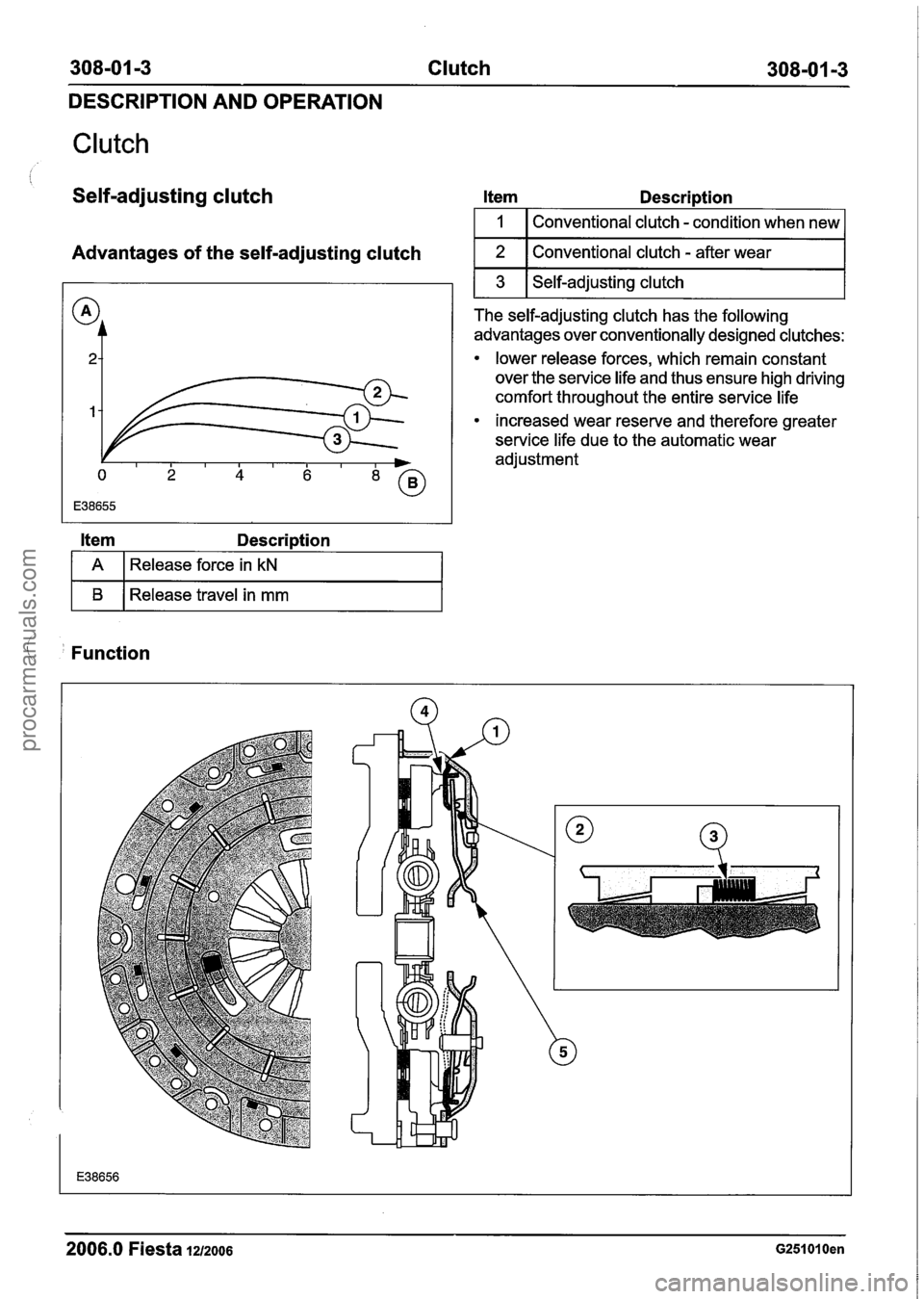
Self-adjusting clutch Item Description
Advantages of the self-adjusting clutch
kern Descri~tion
I A I Release force in kN I
The self-adjusting clutch has the following
advantages over conventionally designed clutches:
lower release forces, which remain constant
over the service life and thus ensure high driving
comfort throughout the entire service life
increased wear reserve and therefore greater
service life due to the automatic wear
adjustment
/ i, ' Function
B
2006.0 Fiesta 1212006 G251010en
Release travel in mm
procarmanuals.com
Page 1077 of 1226
308-01 -5 Clutch 308-01 -5
DESCRIPTION AND OPERATION
When the sensing Belleville washer is displaced
this results in an air gap between the main
i Belleville washer and the clutch cover.
The adjusting ring (ramp ring) arranged around the
circumference immediately compensates for the
air gap. To do this, springs press the adjusting ring
and therefore the ramp against the main Belleville
washer.
This results in a balancing of the clutch actuation
mechanism, which keeps the forces required to
operate the clutch constant throughout the entire
service life of the clutch.
2006.0 Fiesta 1212006 G251010en
procarmanuals.com
Page 1181 of 1226
309-00-5 Exhaust System 309-00-5
DESCRIPTION AND OPERATION
All exhaust systems are single-part systems. The
final muffler can be renewed separately in service.
1 In this case the pipe needs to be cut through, and
the new final muffler needs to be secured with a
servicing clamp.
2006.0 Fiesta 1212006 GI 67275en
procarmanuals.com
Page 1225 of 1226
31 0-02B-3 Acceleration Control - 2.OL Duratec-HE (M14) 31 0-02B-3
DESCRIPTION AND OPERATION
position from the throttle position (TP) sensors to
make sure that the requested position has been
lachieved .
N0TE:Do not install a new accelerator pedal
unless a relevant accelerator pedal DTC has been
stored in the PCM. For additional information refer
to WDS.
The accelerator pedal is a non-serviceable
component which cannot be adjusted and therefore
must not be disassembled or tampered with.
The throttle body is directly controlled by the PCM
and has two TP sensors, TP
1 and TP 2. The TP
sensors output a voltage to the PCM that
corresponds to the actual throttle plate position.
When the throttle body motor is not being powered
up, the throttle plate sits open at approximately 8
degrees from the closed in-bore position. This
position (also referred to as the default position),
is maintained within the throttle body by two internal
compression return springs acting in opposing
directions, these springs are a non-serviceable
item.
The PCM continuously monitors both APP sensors
and both TP sensors to make sure that the system
,is functioning as expected. All acceleration control
( 'system concerns will be detected by the PCM and
the appropriate diagnostic trouble code (DTC) set.
The malfunction indicator lamp (MIL), located in
the instrument cluster will also be illuminated if a
concern is apparent. As the acceleration control
system is of a safety-critical nature, it is possible
that a system concern will result in a reduced
vehicle performance and a DTC stored in the PCM.
For additional information refer to WDS.
2006.0 Fiesta 1212006 G422706en
procarmanuals.com