lights FORD FIESTA 2011 Owner's Manual
[x] Cancel search | Manufacturer: FORD, Model Year: 2011, Model line: FIESTA, Model: FORD FIESTA 2011Pages: 356, PDF Size: 3.12 MB
Page 120 of 356
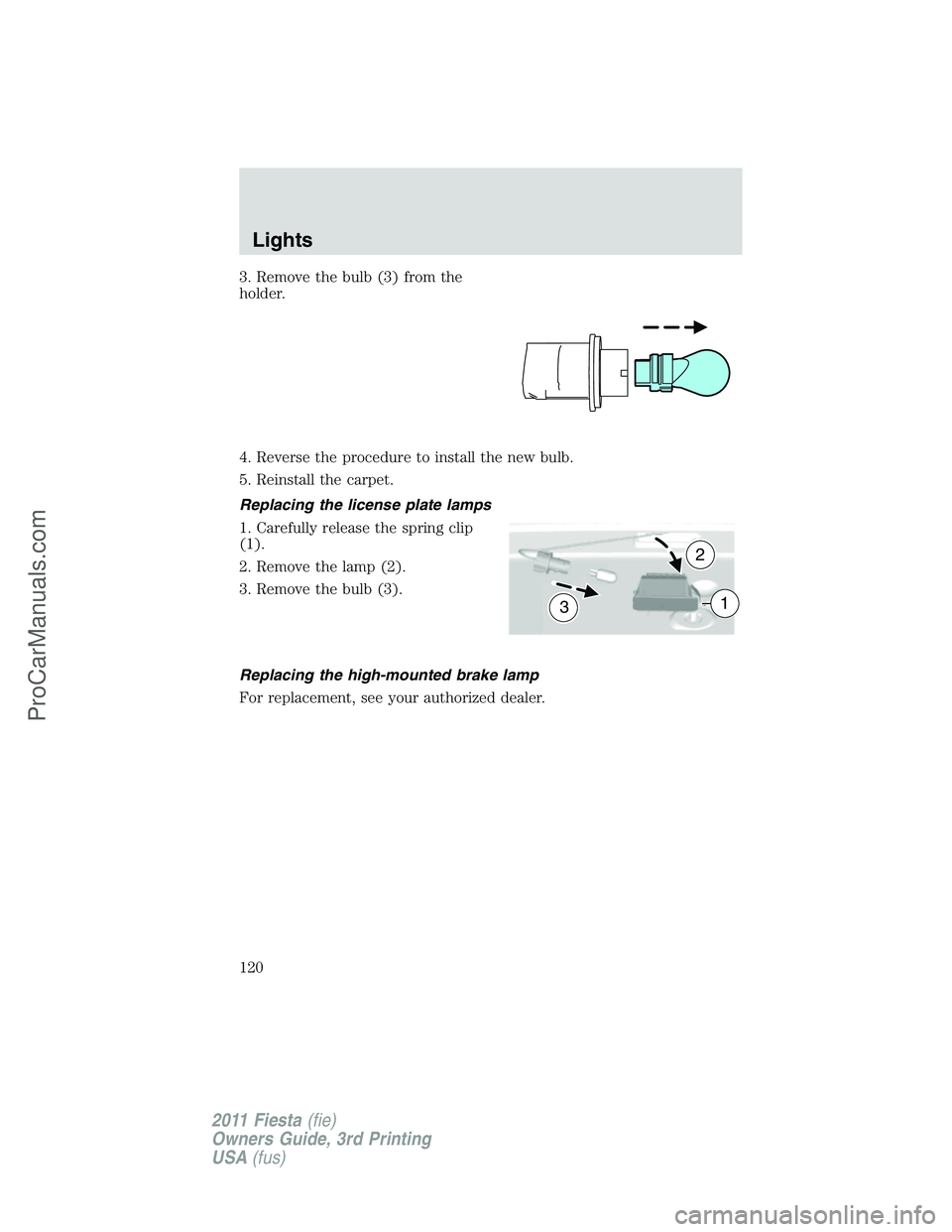
3. Remove the bulb (3) from the
holder.
4. Reverse the procedure to install the new bulb.
5. Reinstall the carpet.
Replacing the license plate lamps
1. Carefully release the spring clip
(1).
2. Remove the lamp (2).
3. Remove the bulb (3).
Replacing the high-mounted brake lamp
For replacement, see your authorized dealer.
3
2
1
Lights
120
2011 Fiesta(fie)
Owners Guide, 3rd Printing
USA(fus)
ProCarManuals.com
Page 126 of 356
Automatic dimming interior rear view mirror (if equipped)
The interior rear view mirror has an auto-dimming function. The
electronic day/night mirror will change from the normal (high reflective)
state to the non-glare (darkened) state when bright lights (glare) reach
the mirror. When the mirror detects bright light from behind the vehicle,
it will automatically adjust (darken) to minimize glare.
The mirror will automatically return to the normal state whenever the
vehicle is placed in R (Reverse) to ensure a bright clear view when
backing up.
Do not block the sensors on the front and back of the interior
rear view mirror since this may impair proper mirror
performance.
Note:A rear center passenger and/or raised rear center headrest (if
equipped) may also block the light from reaching the sensor.
Do not clean the housing or glass of any mirror with harsh
abrasives, fuel or other petroleum-based cleaning products.
EXTERIOR MIRRORS
Power side view mirrors (if equipped)
WARNING:Do not adjust the mirror while the vehicle is in
motion.
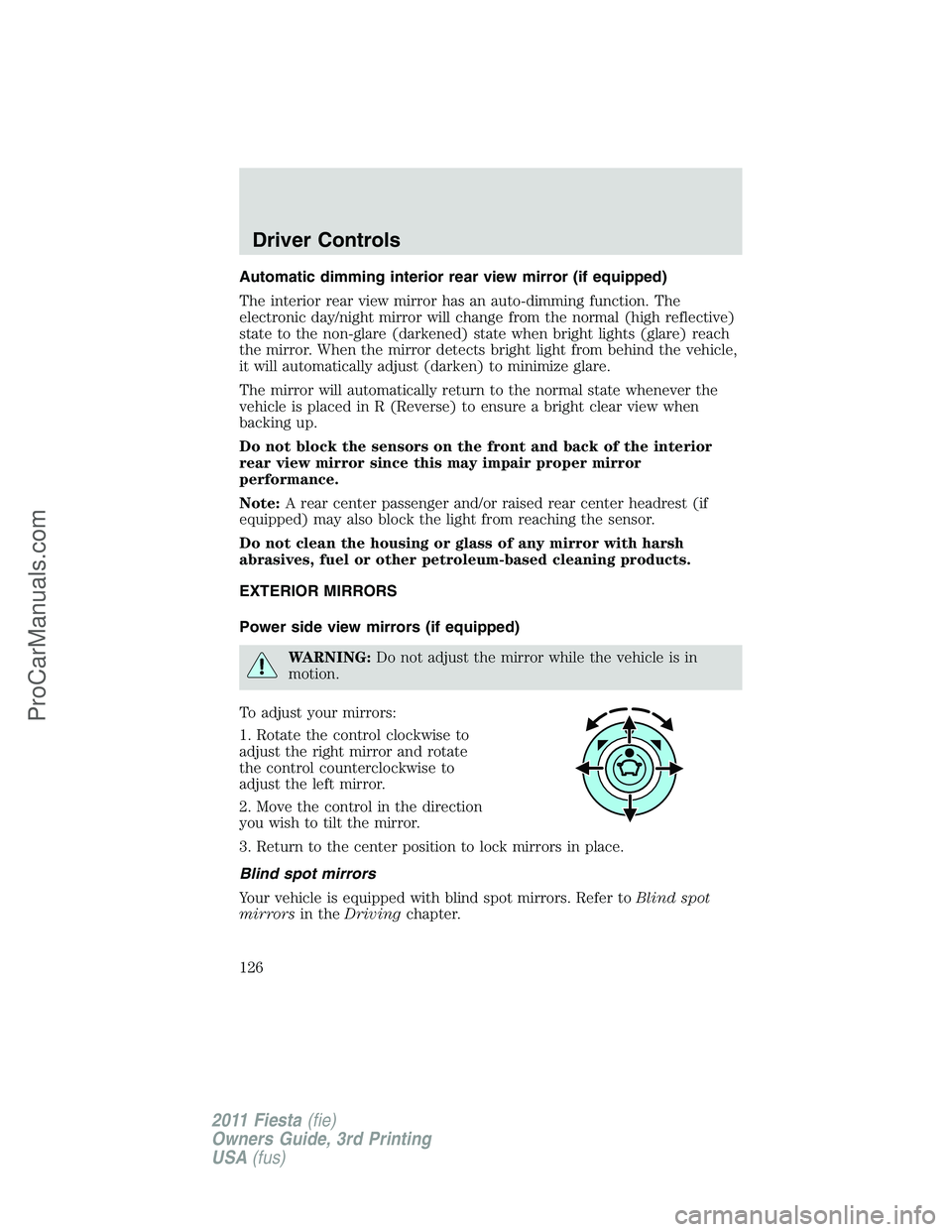
To adjust your mirrors:
1. Rotate the control clockwise to
adjust the right mirror and rotate
the control counterclockwise to
adjust the left mirror.
2. Move the control in the direction
you wish to tilt the mirror.
3. Return to the center position to lock mirrors in place.
Blind spot mirrors
Your vehicle is equipped with blind spot mirrors. Refer toBlind spot
mirrorsin theDrivingchapter.
Driver Controls
126
2011 Fiesta(fie)
Owners Guide, 3rd Printing
USA(fus)
ProCarManuals.com
Page 134 of 356
If both front doors are closed, the vehicle can be locked by any method,
regardless of whether the key is in the ignition or not.
Smart locks for intelligent access keys (IA key) (if equipped)
This feature is intended to prevent you from unintentionally locking your
IA key inside your vehicle.
If your vehicle’s perimeter alarm is in the armed state, the smart locks
feature will not allow you to lock your IA key inside the vehicle. When
the alarm is armed, if the IA key is detected in the vehicle, the vehicle
will automatically unlock. The exterior lights will flash and the horn will
chirp twice to indicate the IA key is inside. If your IA key is detected in
the trunk (if equipped), the trunk lid will reopen though there will be no
feedback from the horn or lights.
Central locking/unlocking
To centrally lock/unlock all doors (from the driver’s side only) using the
key from the outside when they are closed:
•Turn the key counterclockwise to lock all doors. The turn signal lamps
will flash twice.
•Turn the key clockwise once to unlock the driver’s door or twice to
unlock all doors. The turn signal lamps will flash once.
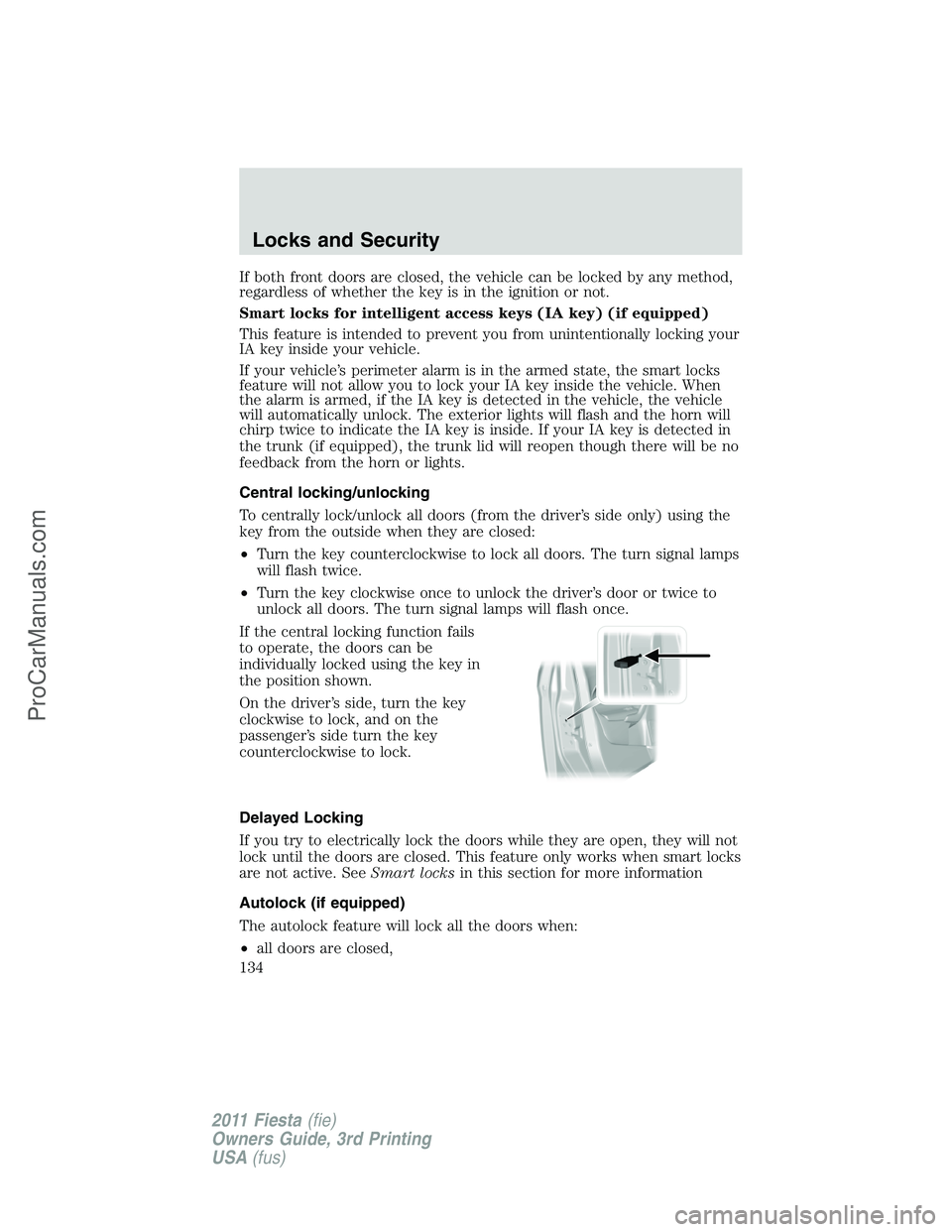
If the central locking function fails
to operate, the doors can be
individually locked using the key in
the position shown.
On the driver’s side, turn the key
clockwise to lock, and on the
passenger’s side turn the key
counterclockwise to lock.
Delayed Locking
If you try to electrically lock the doors while they are open, they will not
lock until the doors are closed. This feature only works when smart locks
are not active. SeeSmart locksin this section for more information
Autolock (if equipped)
The autolock feature will lock all the doors when:
•all doors are closed,
Locks and Security
134
2011 Fiesta(fie)
Owners Guide, 3rd Printing
USA(fus)
ProCarManuals.com
Page 153 of 356
WARNING:Before returning the seatback to its original
position, make sure that cargo or any objects are not trapped
behind the seatback. Make sure that the safety belt is not laying on the
seat latch. After returning the seatback to its original position, pull on
the seatback to ensure that it has fully latched. An unlatched seat may
become dangerous in the event of a sudden stop or collision.
SAFETY RESTRAINTS
Personal Safety System™
The Personal Safety System provides an improved overall level of frontal
crash protection to front seat occupants and is designed to help further
reduce the risk of airbag-related injuries. The system is able to analyze
different occupant conditions and crash severity before activating the
appropriate safety devices to help better protect a range of occupants in
a variety of frontal crash situations.
Your vehicle’s Personal Safety System consists of:
•Driver and passenger dual-stage airbag supplemental restraints.
•Front safety belts with pretensioners, energy management retractors,
and safety belt usage sensors.
•Driver’s seat position sensor.
•Front crash severity sensor.
•Front passenger sensing system.
•“Passenger airbag off” or “pass airbag off” indicator lamp.
•Restraints Control Module (RCM) with impact and safing sensors.
•Restraint system warning light and back-up tone.
•The electrical wiring for the airbags, crash sensor(s), safety belt
pretensioners, front safety belt usage sensors, driver seat position
sensor, and indicator lights.
How does the Personal Safety System work?
The Personal Safety System can adapt the deployment strategy of your
vehicle’s safety devices according to crash severity and conditions. A
collection of crash sensors provides information to the Restraints Control
Module (RCM). During a crash, the RCM may activate the safety belt
pretensioners and/or either none, one, or both stages of the dual-stage
airbag supplemental restraints based on crash severity and conditions.
Seating and Safety Restraints
153
2011 Fiesta(fie)
Owners Guide, 3rd Printing
USA(fus)
ProCarManuals.com
Page 156 of 356
Front outboard safety belt energy management retractors
The front safety belt energy management retractors allow webbing to be
pulled out of the retractor in a gradual and controlled manner in
response to the occupant’s forward momentum. This helps reduce the
risk of force-related injuries to the occupant’s chest by limiting the load
on the occupant.
Determining if the Personal Safety System is operational
The Personal Safety System uses a warning light in the instrument
cluster or a backup tone to indicate the condition of the system. Refer to
theWarning lights and chimessection in theInstrument Cluster
chapter. Routine maintenance of the Personal Safety System is not
required.
The Restraints Control Module (RCM) monitors its own internal circuits
and the circuits for the airbag supplemental restraints, crash sensor(s),
safety belt pretensioners, front safety belt buckle sensors, front
passenger sensing system, and the driver seat position sensor. In
addition, the RCM also monitors the restraints warning light in the
instrument cluster. A difficulty with the system is indicated by one or
more of the following.
•The warning light will either flash or stay lit.
•The warning light will not illuminate immediately after ignition is
turned on.
•A series of five beeps will be heard. The tone pattern will repeat
periodically until the problem and warning light are repaired.
If any of these things happen, even intermittently, have the Personal
Safety System serviced at an authorized dealer immediately. Unless
serviced, the system may not function properly in the event of a
collision.
Safety restraints precautions
WARNING:Always drive and ride with your seatback upright
and the lap belt snug and low across the hips.
WARNING:To reduce the risk of injury, make sure children sit
where they can be properly restrained.
Seating and Safety Restraints
156
2011 Fiesta(fie)
Owners Guide, 3rd Printing
USA(fus)
ProCarManuals.com
Page 176 of 356
WARNING:Any alteration/modification to the front passenger
seat may affect the performance of the front passenger sensing
system.
Determining if the system is operational
The supplemental restraint system uses a warning indicator light in the
instrument cluster or a backup tone to indicate the condition of the
system. Refer to theWarning lights and chimessection in the
Instrument Clusterchapter. Routine maintenance of the airbag is not
required.
A difficulty with the system is indicated by one or more of the following:
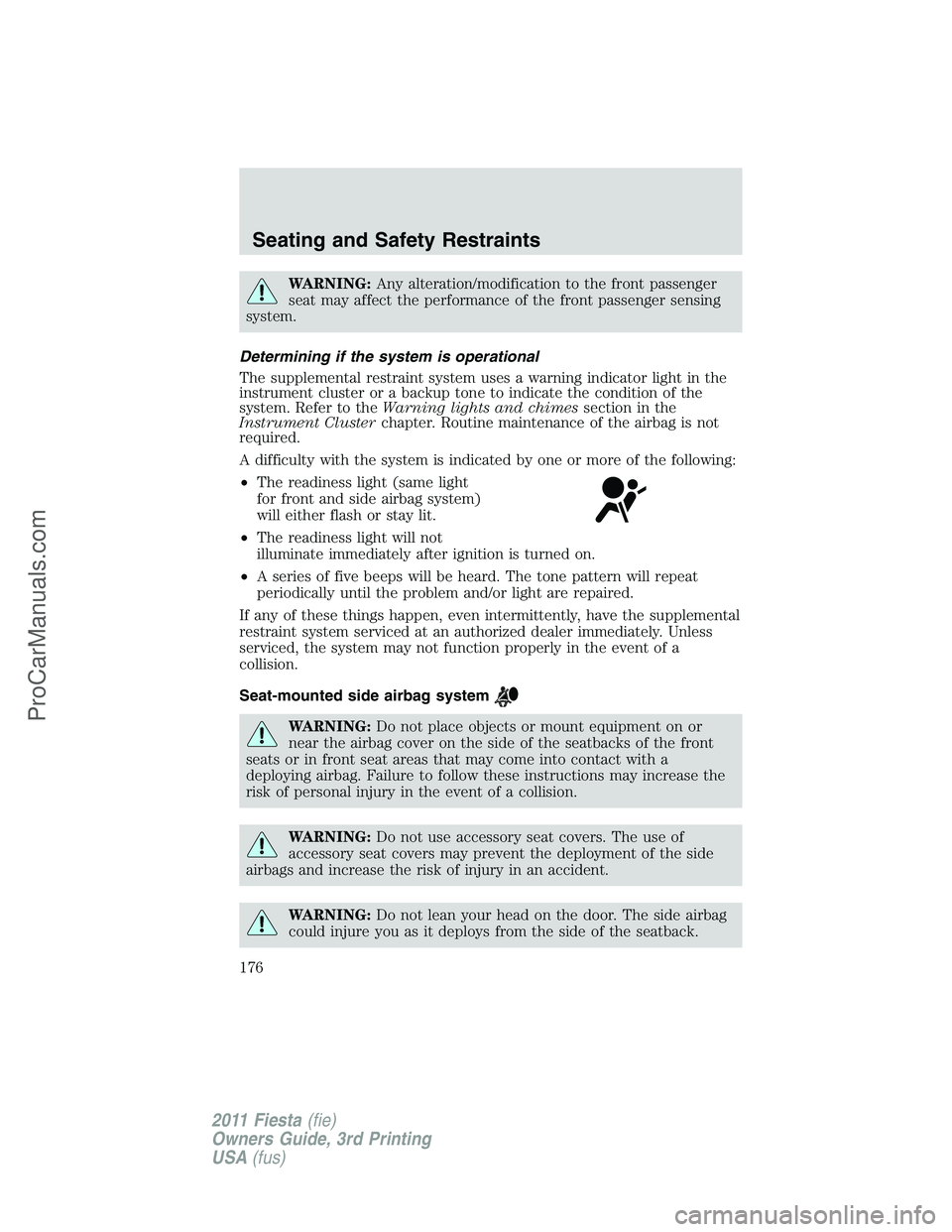
•The readiness light (same light
for front and side airbag system)
will either flash or stay lit.
•The readiness light will not
illuminate immediately after ignition is turned on.
•A series of five beeps will be heard. The tone pattern will repeat
periodically until the problem and/or light are repaired.
If any of these things happen, even intermittently, have the supplemental
restraint system serviced at an authorized dealer immediately. Unless
serviced, the system may not function properly in the event of a
collision.
Seat-mounted side airbag system
WARNING:Do not place objects or mount equipment on or
near the airbag cover on the side of the seatbacks of the front
seats or in front seat areas that may come into contact with a
deploying airbag. Failure to follow these instructions may increase the
risk of personal injury in the event of a collision.
WARNING:Do not use accessory seat covers. The use of
accessory seat covers may prevent the deployment of the side
airbags and increase the risk of injury in an accident.
WARNING:Do not lean your head on the door. The side airbag
could injure you as it deploys from the side of the seatback.
Seating and Safety Restraints
176
2011 Fiesta(fie)
Owners Guide, 3rd Printing
USA(fus)
ProCarManuals.com
Page 181 of 356
provided to occupants in side impact collisions. The seat-mounted side
airbag was designed to inflate between the door panel and occupant to
further enhance the protection provided occupants in side impact
collisions.
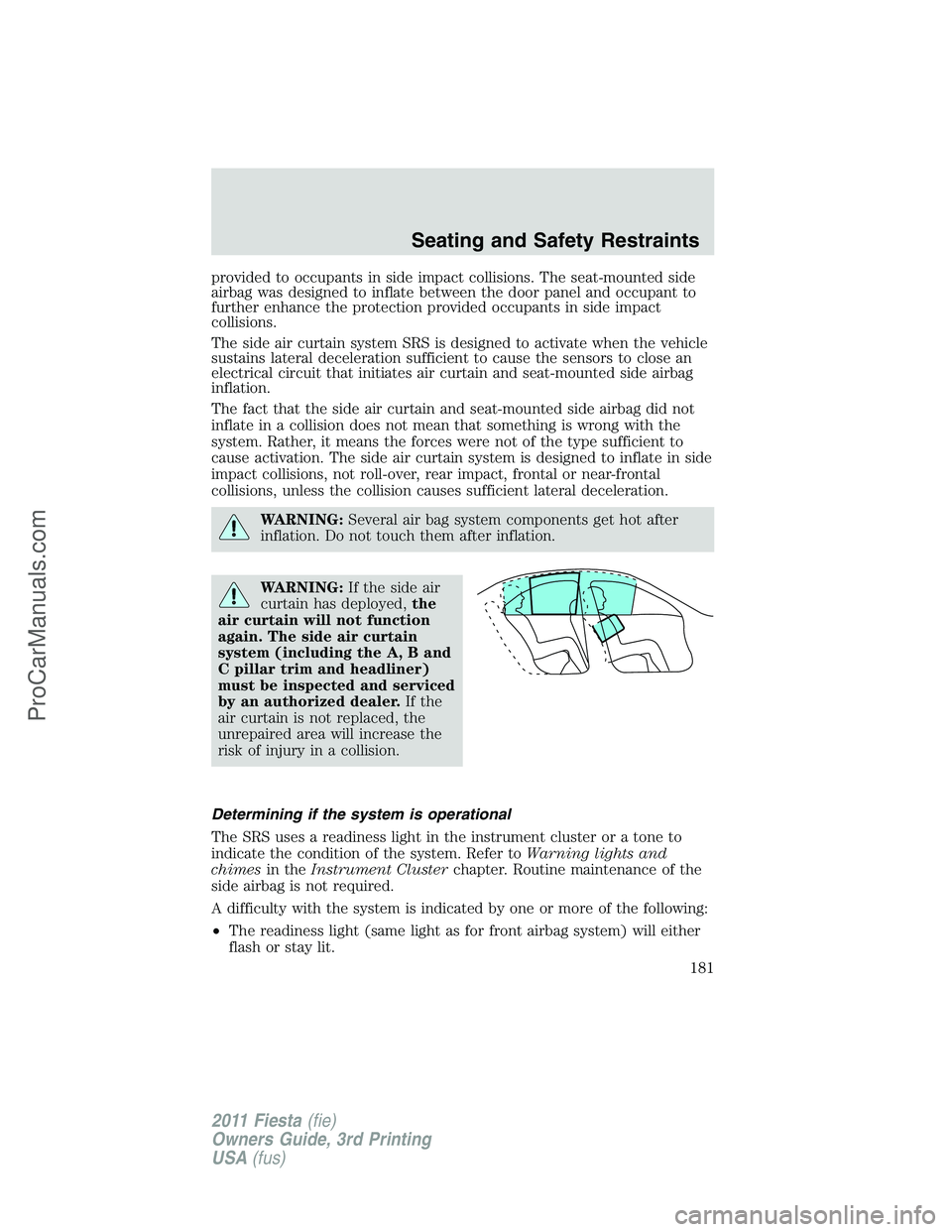
The side air curtain system SRS is designed to activate when the vehicle
sustains lateral deceleration sufficient to cause the sensors to close an
electrical circuit that initiates air curtain and seat-mounted side airbag
inflation.
The fact that the side air curtain and seat-mounted side airbag did not
inflate in a collision does not mean that something is wrong with the
system. Rather, it means the forces were not of the type sufficient to
cause activation. The side air curtain system is designed to inflate in side
impact collisions, not roll-over, rear impact, frontal or near-frontal
collisions, unless the collision causes sufficient lateral deceleration.
WARNING:Several air bag system components get hot after
inflation. Do not touch them after inflation.
WARNING:If the side air
curtain has deployed,the
air curtain will not function
again. The side air curtain
system (including the A, B and
C pillar trim and headliner)
must be inspected and serviced
by an authorized dealer.If the
air curtain is not replaced, the
unrepaired area will increase the
risk of injury in a collision.
Determining if the system is operational
The SRS uses a readiness light in the instrument cluster or a tone to
indicate the condition of the system. Refer toWarning lights and
chimesin theInstrument Clusterchapter. Routine maintenance of the
side airbag is not required.
A difficulty with the system is indicated by one or more of the following:
•The readiness light (same light as for front airbag system) will either
flash or stay lit.
Seating and Safety Restraints
181
2011 Fiesta(fie)
Owners Guide, 3rd Printing
USA(fus)
ProCarManuals.com
Page 219 of 356
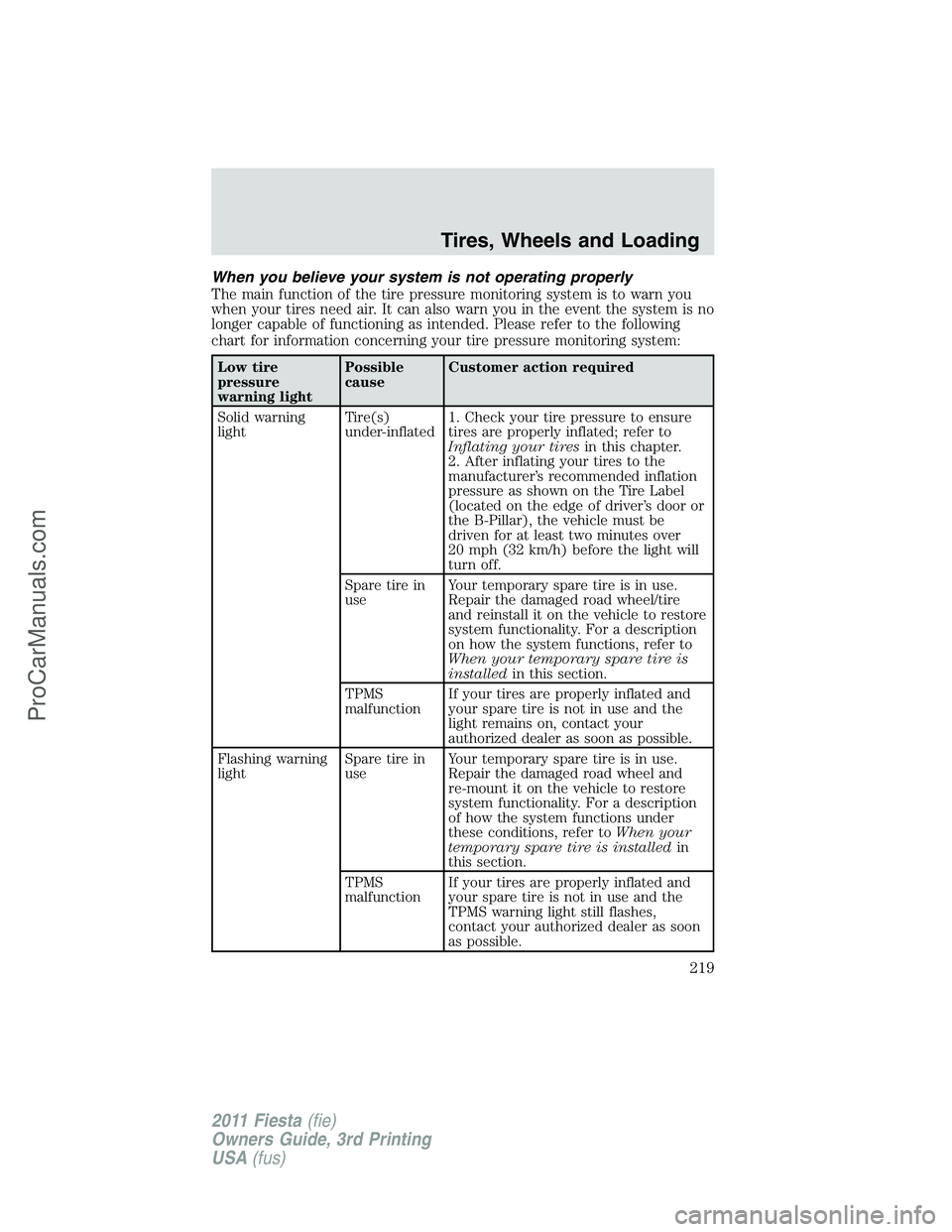
When you believe your system is not operating properly
The main function of the tire pressure monitoring system is to warn you
when your tires need air. It can also warn you in the event the system is no
longer capable of functioning as intended. Please refer to the following
chart for information concerning your tire pressure monitoring system:
Low tire
pressure
warning lightPossible
causeCustomer action required
Solid warning
lightTire(s)
under-inflated1. Check your tire pressure to ensure
tires are properly inflated; refer to
Inflating your tiresin this chapter.
2. After inflating your tires to the
manufacturer’s recommended inflation
pressure as shown on the Tire Label
(located on the edge of driver’s door or
the B-Pillar), the vehicle must be
driven for at least two minutes over
20 mph (32 km/h) before the light will
turn off.
Spare tire in
useYour temporary spare tire is in use.
Repair the damaged road wheel/tire
and reinstall it on the vehicle to restore
system functionality. For a description
on how the system functions, refer to
When your temporary spare tire is
installedin this section.
TPMS
malfunctionIf your tires are properly inflated and
your spare tire is not in use and the
light remains on, contact your
authorized dealer as soon as possible.
Flashing warning
lightSpare tire in
useYour temporary spare tire is in use.
Repair the damaged road wheel and
re-mount it on the vehicle to restore
system functionality. For a description
of how the system functions under
these conditions, refer toWhen your
temporary spare tire is installedin
this section.
TPMS
malfunctionIf your tires are properly inflated and
your spare tire is not in use and the
TPMS warning light still flashes,
contact your authorized dealer as soon
as possible.
Tires, Wheels and Loading
219
2011 Fiesta(fie)
Owners Guide, 3rd Printing
USA(fus)
ProCarManuals.com
Page 230 of 356
STARTING
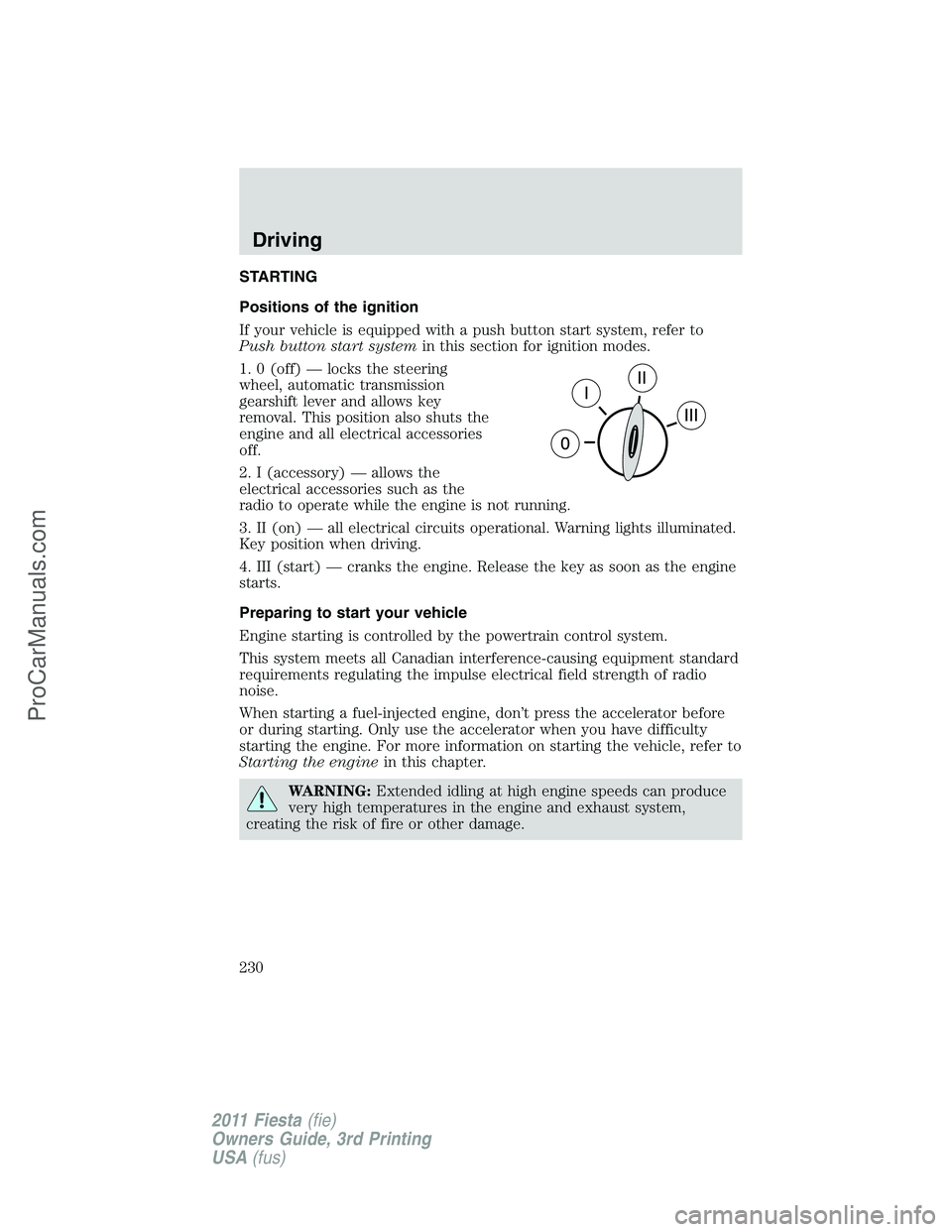
Positions of the ignition
If your vehicle is equipped with a push button start system, refer to
Push button start systemin this section for ignition modes.
1. 0 (off) — locks the steering
wheel, automatic transmission
gearshift lever and allows key
removal. This position also shuts the
engine and all electrical accessories
off.
2. I (accessory) — allows the
electrical accessories such as the
radio to operate while the engine is not running.
3. II (on) — all electrical circuits operational. Warning lights illuminated.
Key position when driving.
4. III (start) — cranks the engine. Release the key as soon as the engine
starts.
Preparing to start your vehicle
Engine starting is controlled by the powertrain control system.
This system meets all Canadian interference-causing equipment standard
requirements regulating the impulse electrical field strength of radio
noise.
When starting a fuel-injected engine, don’t press the accelerator before
or during starting. Only use the accelerator when you have difficulty
starting the engine. For more information on starting the vehicle, refer to
Starting the enginein this chapter.
WARNING:Extended idling at high engine speeds can produce
very high temperatures in the engine and exhaust system,
creating the risk of fire or other damage.
Driving
230
2011 Fiesta(fie)
Owners Guide, 3rd Printing
USA(fus)
ProCarManuals.com
Page 232 of 356
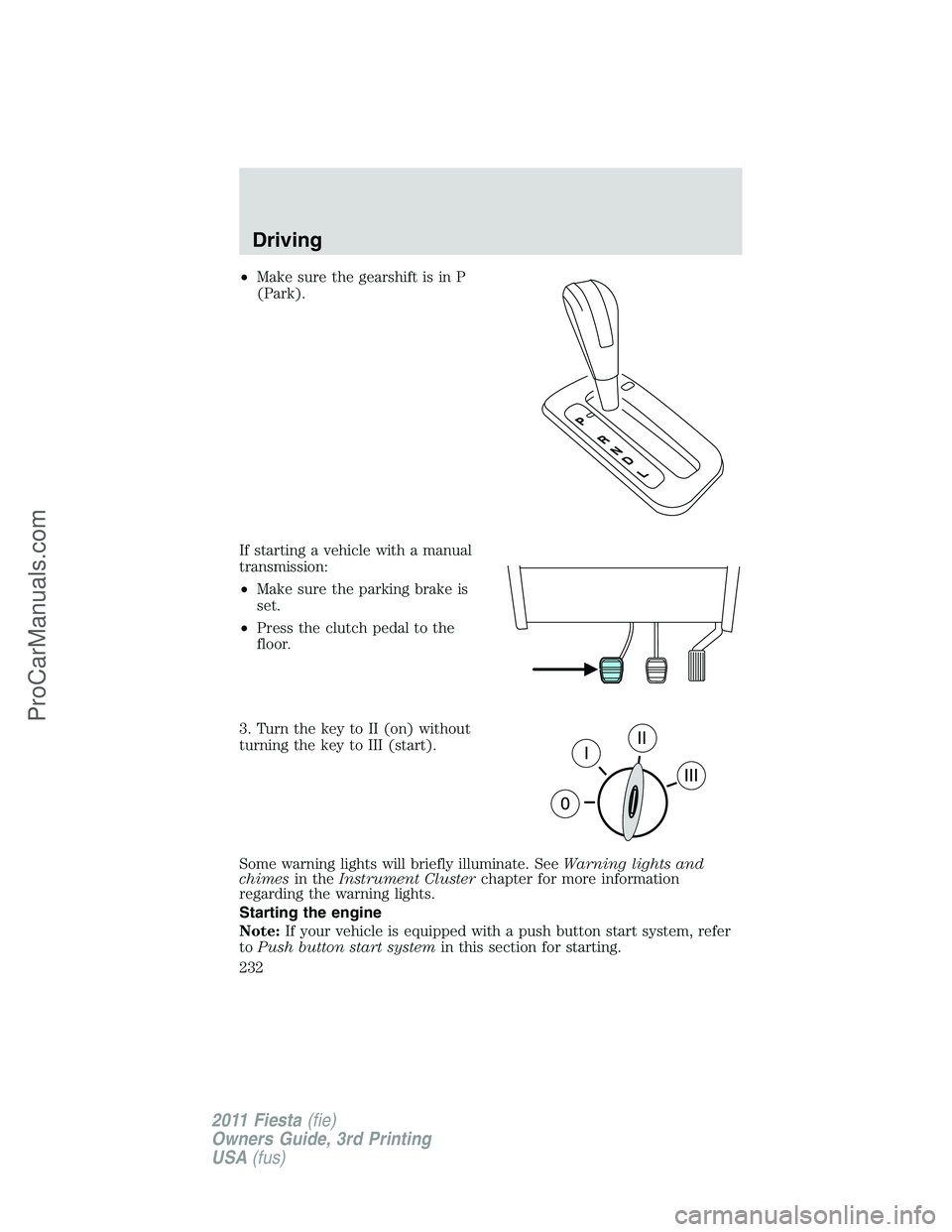
•Make sure the gearshift is in P
(Park).
If starting a vehicle with a manual
transmission:
•Make sure the parking brake is
set.
•Press the clutch pedal to the
floor.
3. Turn the key to II (on) without
turning the key to III (start).
Some warning lights will briefly illuminate. SeeWarning lights and
chimesin theInstrument Clusterchapter for more information
regarding the warning lights.
Starting the engine
Note:If your vehicle is equipped with a push button start system, refer
toPush button start systemin this section for starting.
Driving
232
2011 Fiesta(fie)
Owners Guide, 3rd Printing
USA(fus)
ProCarManuals.com