warning FORD FIESTA 2012 Owners Manual
[x] Cancel search | Manufacturer: FORD, Model Year: 2012, Model line: FIESTA, Model: FORD FIESTA 2012Pages: 360, PDF Size: 3.39 MB
Page 225 of 360
Vehicle Curb Weight– is the weight of your new vehicle when you
picked it up from your authorized dealer plus any aftermarket
equipment.
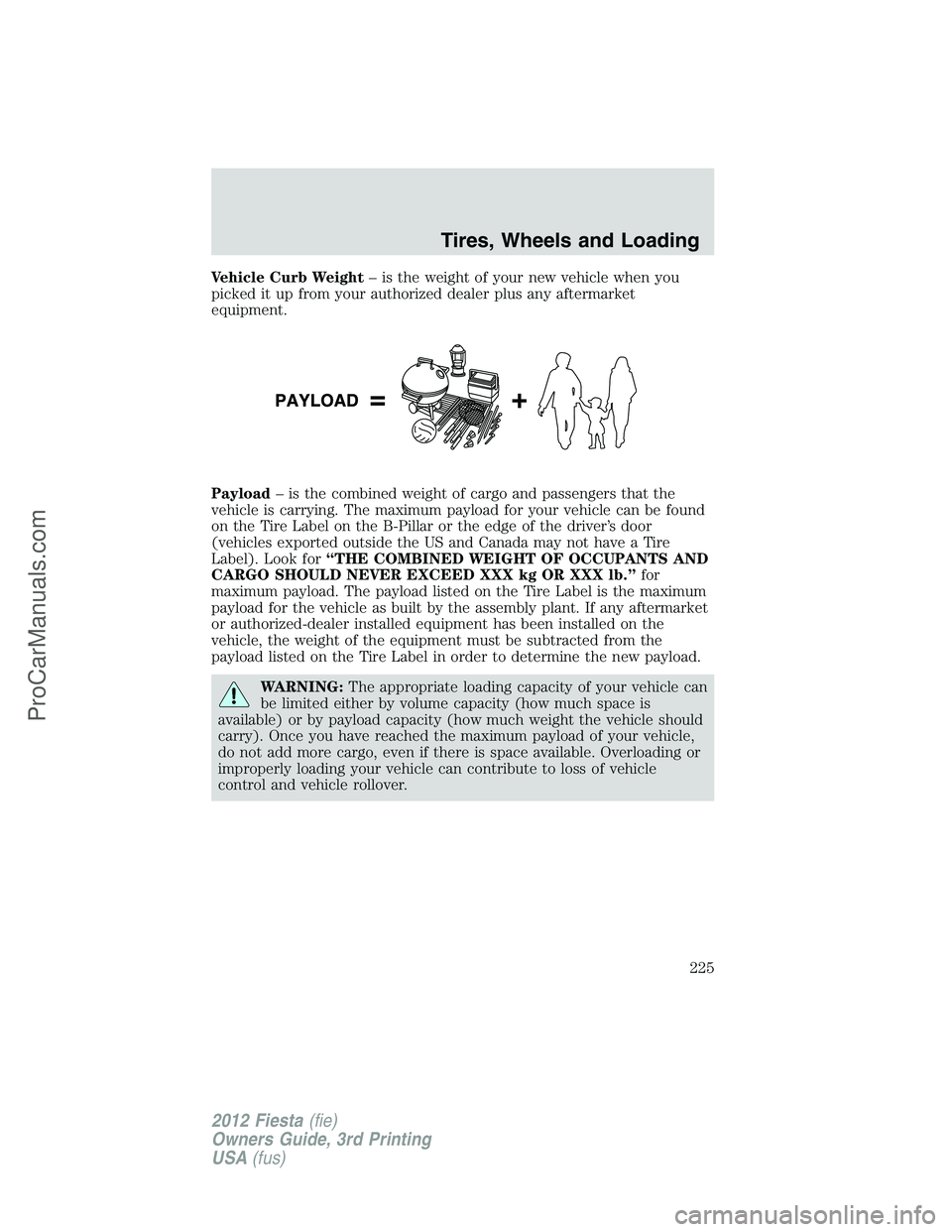
Payload– is the combined weight of cargo and passengers that the
vehicle is carrying. The maximum payload for your vehicle can be found
on the Tire Label on the B-Pillar or the edge of the driver’s door
(vehicles exported outside the US and Canada may not have a Tire
Label). Look for“THE COMBINED WEIGHT OF OCCUPANTS AND
CARGO SHOULD NEVER EXCEED XXX kg OR XXX lb.”for
maximum payload. The payload listed on the Tire Label is the maximum
payload for the vehicle as built by the assembly plant. If any aftermarket
or authorized-dealer installed equipment has been installed on the
vehicle, the weight of the equipment must be subtracted from the
payload listed on the Tire Label in order to determine the new payload.
WARNING:The appropriate loading capacity of your vehicle can
be limited either by volume capacity (how much space is
available) or by payload capacity (how much weight the vehicle should
carry). Once you have reached the maximum payload of your vehicle,
do not add more cargo, even if there is space available. Overloading or
improperly loading your vehicle can contribute to loss of vehicle
control and vehicle rollover.
Tires, Wheels and Loading
225
2012 Fiesta(fie)
Owners Guide, 3rd Printing
USA(fus)
ProCarManuals.com
Page 228 of 360
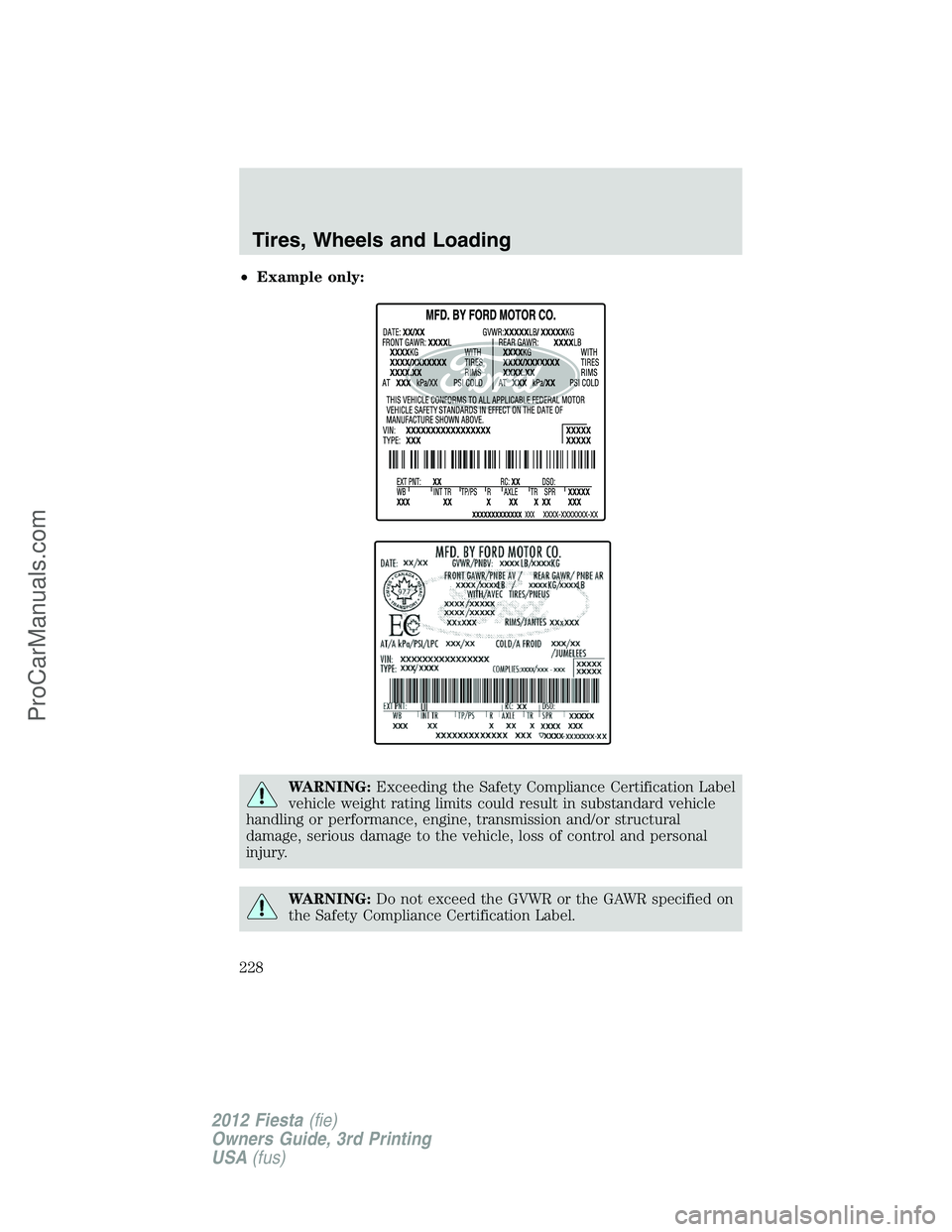
•Example only:
WARNING:Exceeding the Safety Compliance Certification Label
vehicle weight rating limits could result in substandard vehicle
handling or performance, engine, transmission and/or structural
damage, serious damage to the vehicle, loss of control and personal
injury.
WARNING:Do not exceed the GVWR or the GAWR specified on
the Safety Compliance Certification Label.
Tires, Wheels and Loading
228
2012 Fiesta(fie)
Owners Guide, 3rd Printing
USA(fus)
ProCarManuals.com
Page 229 of 360
WARNING:Do not use replacement tires with lower load
carrying capacities than the original tires because they may
lower the vehicle’s GVWR and GAWR limitations. Replacement tires
with a higher limit than the original tires do not increase the GVWR
and GAWR limitations.
WARNING:Exceeding any vehicle weight rating limitation could
result in serious damage to the vehicle and/or personal injury.
Steps for determining the correct load limit:
1. Locate the statement “The combined weight of occupants and cargo
should never exceed XXX kg or XXX lbs.” on your vehicle’s placard.
2. Determine the combined weight of the driver and passengers that will
be riding in your vehicle.
3. Subtract the combined weight of the driver and passengers from XXX
kg or XXX lbs.
4. The resulting figure equals the available amount of cargo and luggage
load capacity. For example, if the “XXX” amount equals 1,400 lbs. and
there will be five 150 lb. passengers in your vehicle, the amount of
available cargo and luggage load capacity is 650 lbs. (1400-750 (5 x 150)
= 650 lb.). In metric units (635-340 (5 x 68) = 295 kg.)
5. Determine the combined weight of luggage and cargo being loaded on
the vehicle. That weight may not safely exceed the available cargo and
luggage load capacity calculated in Step 4.
The following gives you a few examples on how to calculate the available
amount of cargo and luggage load capacity:
•Another example for your vehicle with 1400 lb. (635 kg) of cargo and
luggage capacity. You decide to go golfing. Is there enough load
capacity to carry you, 4 of your friends and all the golf bags? You and
four friends average 220 lb. (99 kg) each and the golf bags weigh
approximately 30 lb. (13.5 kg) each. The calculation would be: 1400 –
(5 x 220) - (5 x 30) = 1400 - 1100 - 150 = 150 lb. Yes, you have
enough load capacity in your vehicle to transport four friends and
your golf bags. In metric units, the calculation would be: 635 kg - (5 x
99 kg) - (5 x 13.5 kg) = 635 - 495 - 67.5 = 72.5 kg.
Tires, Wheels and Loading
229
2012 Fiesta(fie)
Owners Guide, 3rd Printing
USA(fus)
ProCarManuals.com
Page 230 of 360
•A final example for your vehicle with 1400 lb. (635 kg) of cargo and
luggage capacity. You and one of your friends decide to pick up
cement from the local home improvement store to finish that patio
you have been planning for the past 2 years. Measuring the inside of
the vehicle with the rear seat folded down, you have room for
12-100 lb. (45 kg) bags of cement. Do you have enough load capacity
to transport the cement to your home? If you and your friend each
weigh 220 lb. (99 kg), the calculation would be: 1400 - (2 x 220) - (12
x 100) = 1400 - 440 - 1200 = - 240 lb. No, you do not have enough
cargo capacity to carry that much weight. In metric units, the
calculation would be: 635 kg - (2 x 99 kg) - (12 x 45 kg) = 635 - 198 -
540 = -103 kg. You will need to reduce the load weight by at least
240 lb. (104 kg). If you remove 3-100 lb. (45 kg) cement bags, then
the load calculation would be:
1400 - (2 x 220) - (9 x 100) = 1400 - 440 - 900 = 60 lb. Now you have
the load capacity to transport the cement and your friend home. In
metric units, the calculation would be: 635 kg - (2 x 99 kg) - (9 x
45 kg) = 635 - 198 - 405 = 32 kg.
The above calculations also assume that the loads are positioned in your
vehicle in a manner that does not overload the Front or the Rear Gross
Axle Weight Rating specified for your vehicle on the Safety Compliance
Certification Label. The label shall be affixed to either the door hinge
pillar, door-latch post, or the door edge that meets the door-latch post,
next to the driver’s seating position.
TRAILER TOWING
WARNING:Never tow a trailer with this vehicle. Your vehicle is
not equipped to tow. No towing packages are available through
an authorized dealer.
RECREATIONAL TOWING
Note:Put your climate control system in recirculated air mode to
prevent exhaust fumes from entering the vehicle. Refer to theClimate
Controlschapter for more information.
Note:The vehicle must be towed in the forward position to ensure no
damage is done to the internal transmission components. In addition, it is
recommended that you follow the instructions provided by the
aftermarket manufacturer of the towing equipment, if provided.
Tires, Wheels and Loading
230
2012 Fiesta(fie)
Owners Guide, 3rd Printing
USA(fus)
ProCarManuals.com
Page 233 of 360
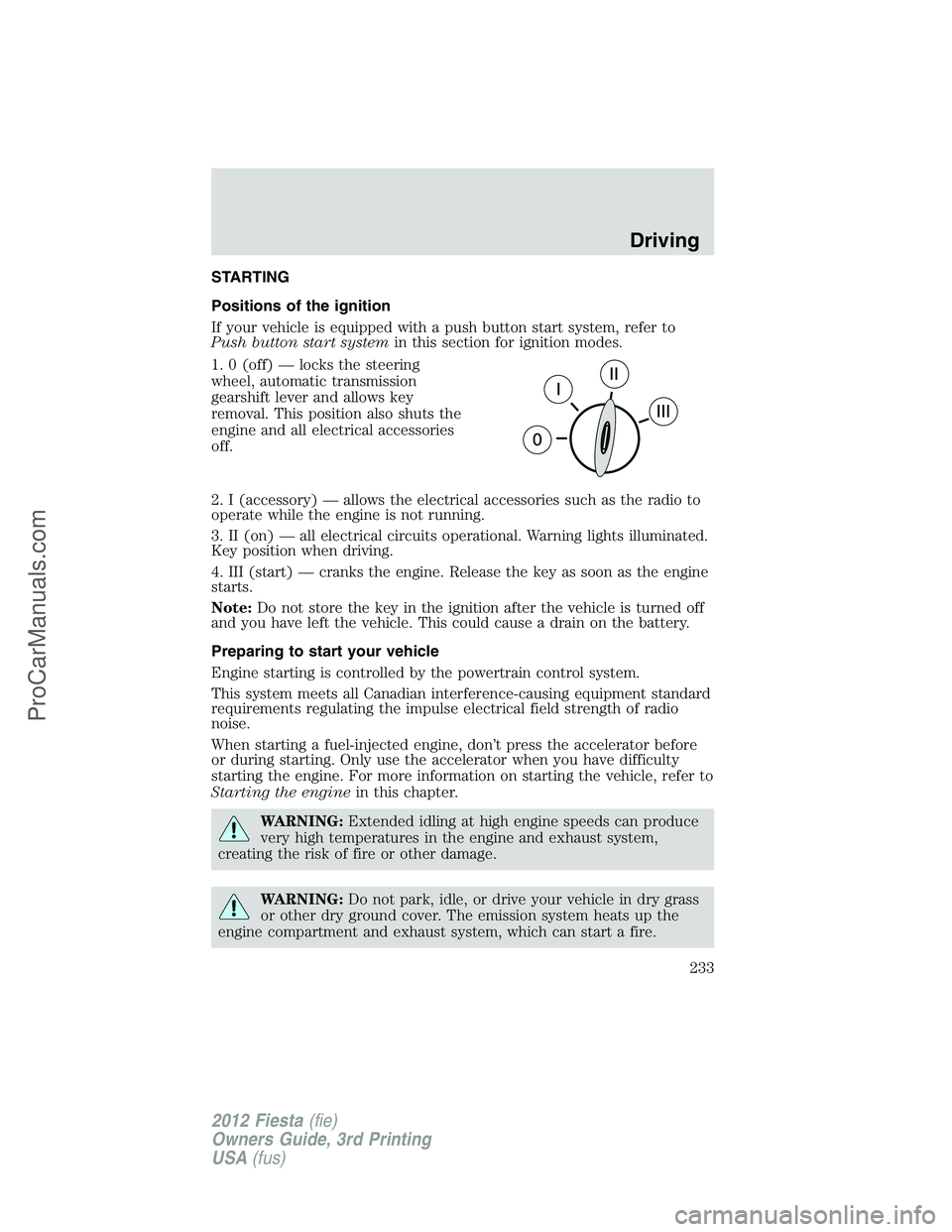
STARTING
Positions of the ignition
If your vehicle is equipped with a push button start system, refer to
Push button start systemin this section for ignition modes.
1. 0 (off) — locks the steering
wheel, automatic transmission
gearshift lever and allows key
removal. This position also shuts the
engine and all electrical accessories
off.
2. I (accessory) — allows the electrical accessories such as the radio to
operate while the engine is not running.
3. II (on) — all electrical circuits operational. Warning lights illuminated.
Key position when driving.
4. III (start) — cranks the engine. Release the key as soon as the engine
starts.
Note:Do not store the key in the ignition after the vehicle is turned off
and you have left the vehicle. This could cause a drain on the battery.
Preparing to start your vehicle
Engine starting is controlled by the powertrain control system.
This system meets all Canadian interference-causing equipment standard
requirements regulating the impulse electrical field strength of radio
noise.
When starting a fuel-injected engine, don’t press the accelerator before
or during starting. Only use the accelerator when you have difficulty
starting the engine. For more information on starting the vehicle, refer to
Starting the enginein this chapter.
WARNING:Extended idling at high engine speeds can produce
very high temperatures in the engine and exhaust system,
creating the risk of fire or other damage.
WARNING:Do not park, idle, or drive your vehicle in dry grass
or other dry ground cover. The emission system heats up the
engine compartment and exhaust system, which can start a fire.
Driving
233
2012 Fiesta(fie)
Owners Guide, 3rd Printing
USA(fus)
ProCarManuals.com
Page 234 of 360
WARNING:Do not start your vehicle in a closed garage or in
other enclosed areas. Exhaust fumes can be toxic. Always open
the garage door before you start the engine. SeeGuarding against
exhaust fumesin this chapter for more instructions.
WARNING:If you smell exhaust fumes inside your vehicle, have
your dealer inspect your vehicle immediately. Do not drive if you
smell exhaust fumes.
Important safety precautions
When the engine starts, the idle RPM runs faster to warm the engine. If
the engine idle speed does not slow down automatically, have the vehicle
checked.
Before starting the vehicle:
1. Make sure all occupants buckle their safety belts. For more
information on safety belts and their proper usage, refer to theSeating
and Safety Restraintschapter.
2. Make sure the headlamps and electrical accessories are off.
If starting a vehicle with an automatic transmission:
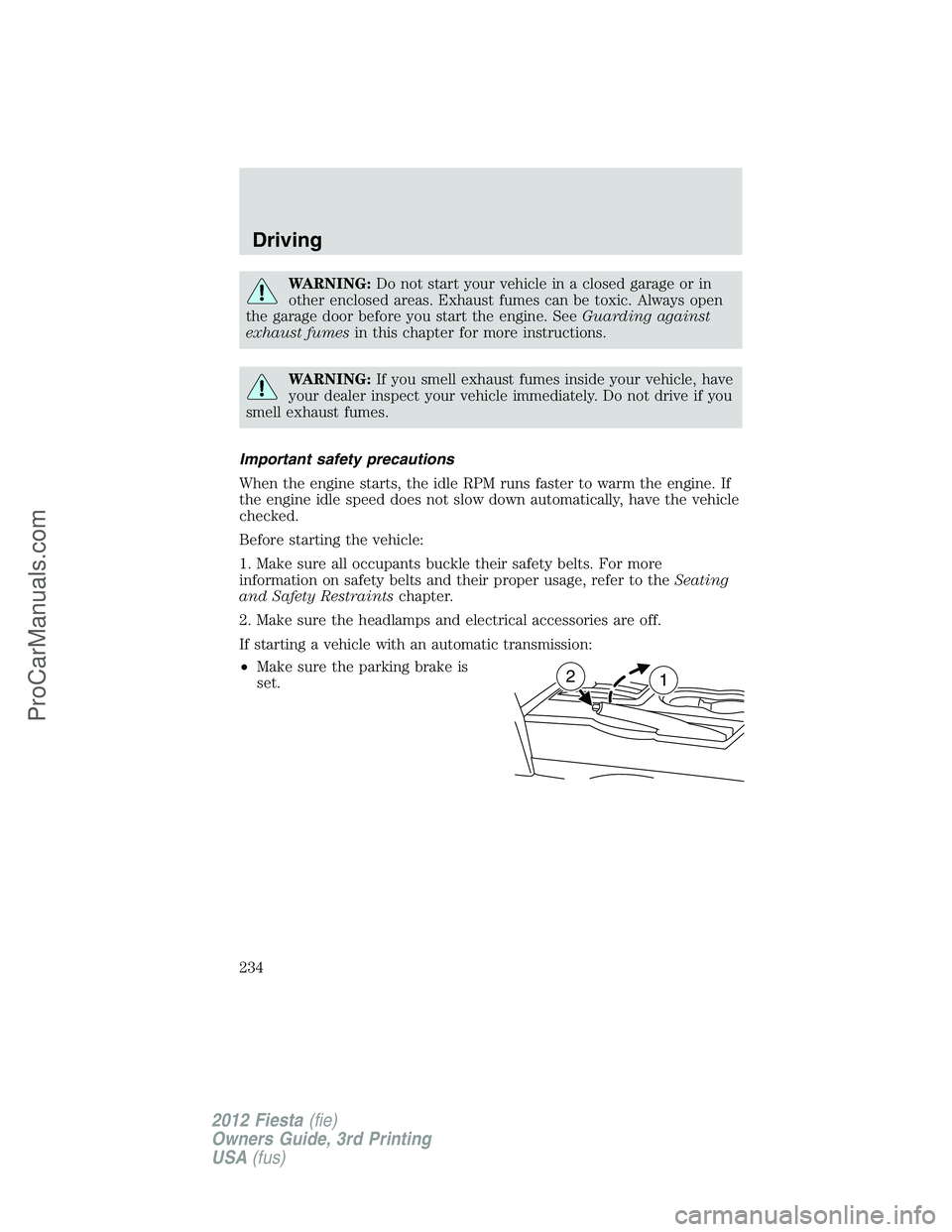
•Make sure the parking brake is
set.
12
Driving
234
2012 Fiesta(fie)
Owners Guide, 3rd Printing
USA(fus)
ProCarManuals.com
Page 235 of 360
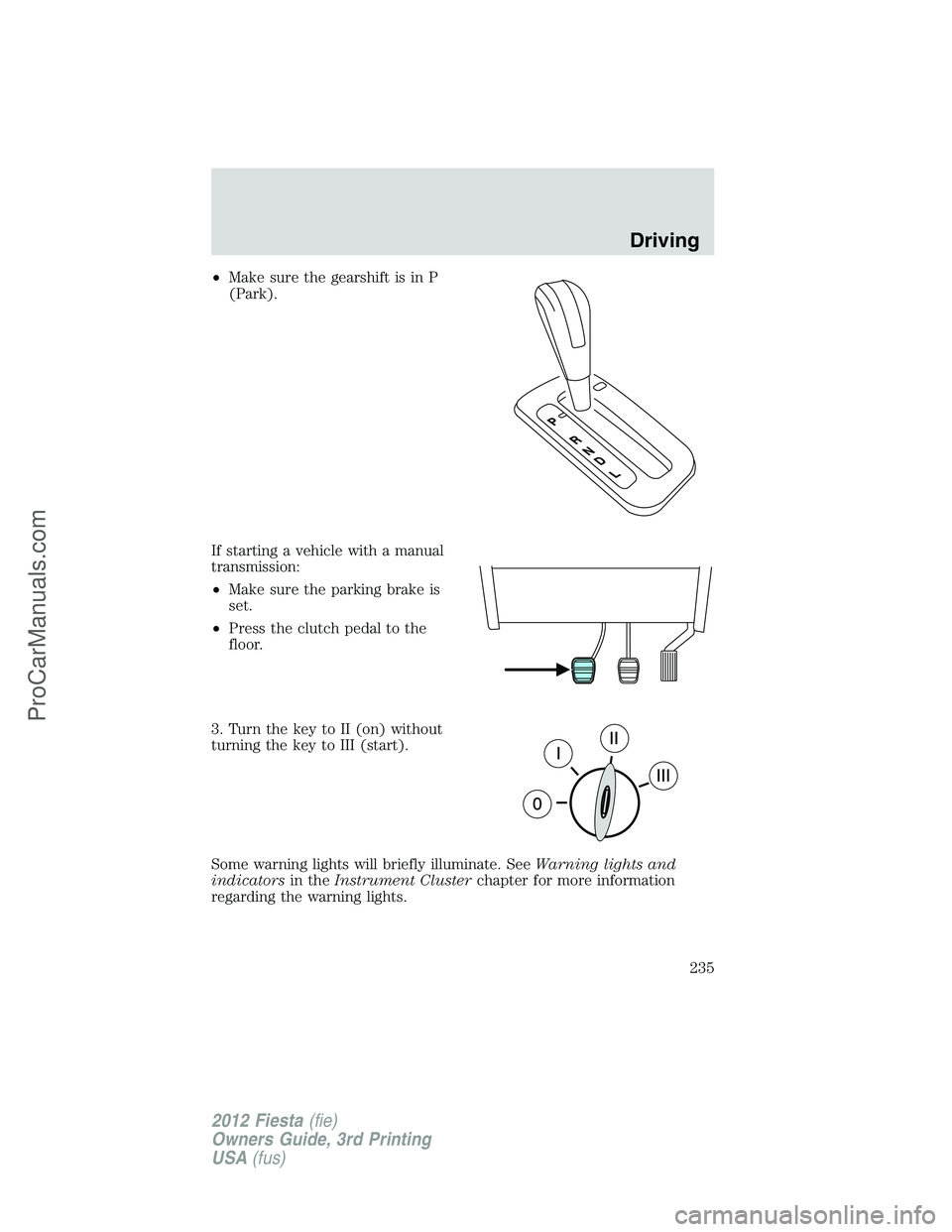
•Make sure the gearshift is in P
(Park).
If starting a vehicle with a manual
transmission:
•Make sure the parking brake is
set.
•Press the clutch pedal to the
floor.
3. Turn the key to II (on) without
turning the key to III (start).
Some warning lights will briefly illuminate. SeeWarning lights and
indicatorsin theInstrument Clusterchapter for more information
regarding the warning lights.
Driving
235
2012 Fiesta(fie)
Owners Guide, 3rd Printing
USA(fus)
ProCarManuals.com
Page 237 of 360
2. On — press the START/STOP button without applying the brake pedal
(automatic transmission) or clutch pedal (manual transmission). This will
power your vehicle’s electrical system and the warning lights in the
instrument cluster will illuminate, but the engine will remain off.
3. Start — press the START/STOP button (for any length of time) while
applying the brake pedal (automatic transmission) or clutch pedal
(manual transmission).Note:The indicator light on the start button will
illuminate when the vehicle is in on mode and when the engine is
started.
There may be areas inside your vehicle where the IA key is not detected.
If the message KEY NOT DETECTED appears on your multifunction
display when you press the START/STOP button, it may be necessary to
move your IA key to another area within the vehicle. The IA key may not
be detected near the roof (between the driver or passenger sunvisor and
the roof, or in the overhead console area) or in the extreme corners of
the rear package tray, near your audio speakers. It is not recommended
that you stow the IA key in these locations. If you move the IA key to a
location where it has been detected before and you still see the KEY
NOT DETECTED message, your IA key’s battery may be low or you may
be in an area with excessive radio frequency interference. If this occurs,
you can use the backup method to start your vehicle (see below).
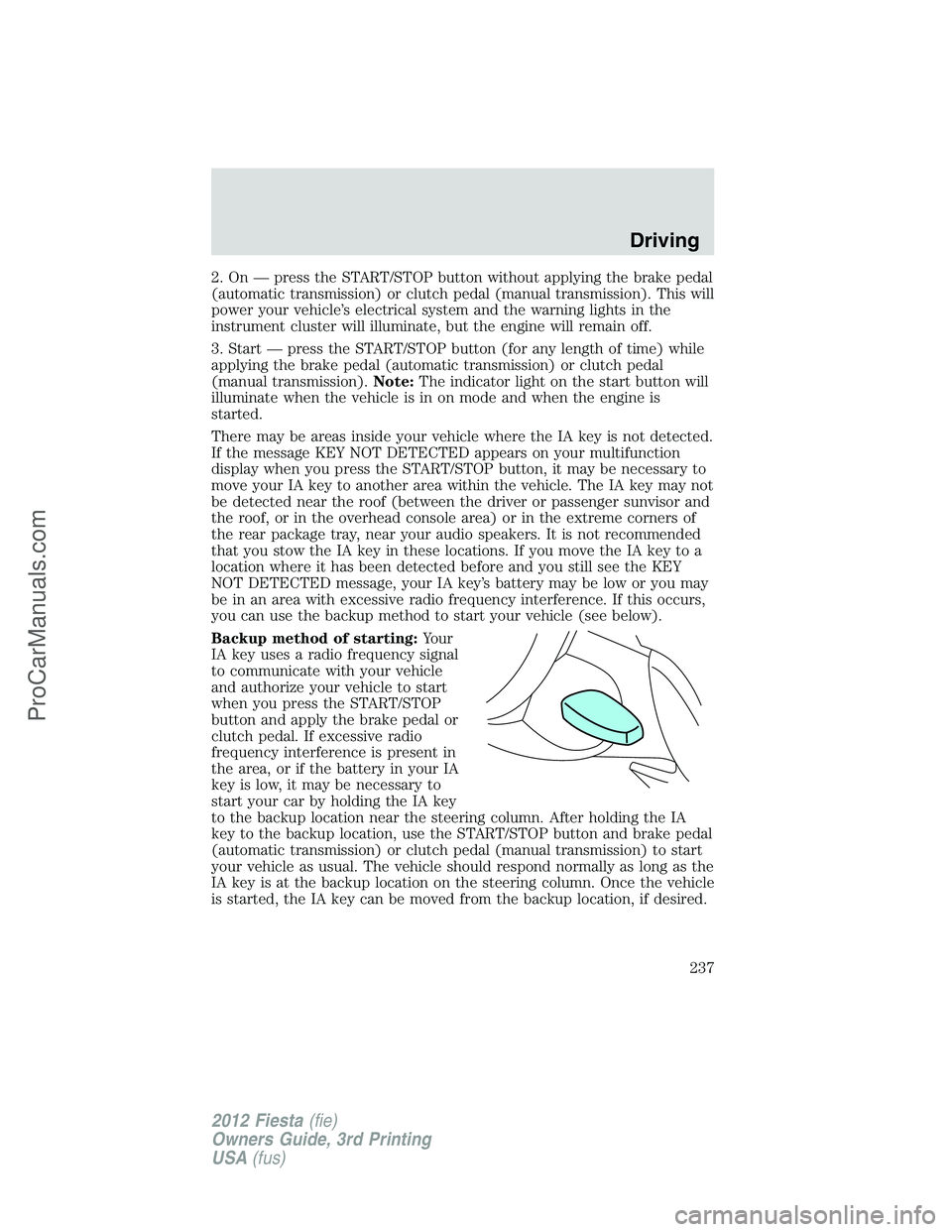
Backup method of starting:Your
IA key uses a radio frequency signal
to communicate with your vehicle
and authorize your vehicle to start
when you press the START/STOP
button and apply the brake pedal or
clutch pedal. If excessive radio
frequency interference is present in
the area, or if the battery in your IA
key is low, it may be necessary to
start your car by holding the IA key
to the backup location near the steering column. After holding the IA
key to the backup location, use the START/STOP button and brake pedal
(automatic transmission) or clutch pedal (manual transmission) to start
your vehicle as usual. The vehicle should respond normally as long as the
IA key is at the backup location on the steering column. Once the vehicle
is started, the IA key can be moved from the backup location, if desired.
Driving
237
2012 Fiesta(fie)
Owners Guide, 3rd Printing
USA(fus)
ProCarManuals.com
Page 238 of 360
Fast restart feature:The fast restart feature allows you to re-start your
vehicle within 10 seconds of switching the vehicle off, if a valid IA key is
not present when the vehicle is switched off. You can re-start the vehicle
(by applying the brake/clutch pedal and pressing the START/STOP button)
for up to 10 seconds, even though the IA key is not present. After
10 seconds have expired, you can no longer start your vehicle without the
IA key present inside the vehicle. If the driver door is opened within this
10 seconds, the fast restart timer expires immediately.
Switching the vehicle off when not in P (Park):It is recommended
that you shift into the P (Park) position before switching your vehicle
off. If you switch your vehicle off with the shifter in any position other
than P (Park), the message SHIFT TO PARK will be displayed in the
multifunction display. If the vehicle is left in this state, your key in
ignition chime will activate when the driver door is opened, and you may
drain your vehicle’s battery. In order to avoid draining your battery, it is
recommended that you always shift to P (Park) before or immediately
after switching your vehicle off.
Absence of the intelligent access key:
Once the vehicle has started,
the vehicle will remain running until being turned off by the START/STOP
button, even if the IA key is no longer found in the vehicle. Whenever a door
is opened and then closed while the vehicle is running, the system will
search for an IA key inside the vehicle and the multifunction display will
display KEY OUTSIDE CAR if the IA key is no longer present. This message
is a reminder that someone else in the vehicle may have taken the IA key
when exiting the vehicle. If the IA key is no longer present in the vehicle,
you will not be able to re-start your vehicle outside of the Fast Restart time
(seeFast Restart Featureabove). It is important to be aware of where your
IA key is located in the vehicle, to avoid becoming stranded without an IA
key.
Guarding Against Exhaust Fumes
WARNING:If you smell exhaust fumes inside your vehicle, have
this checked immediately. Do not drive your vehicle if you smell
exhaust fumes. Carbon monoxide is present in exhaust fumes. Take
precautions to avoid its dangerous effects.
Important Ventilating Information
If you stop your vehicle and leave the engine idling for long periods of time,
we recommend that you do one of the following:
•Open the windows at least 1 inch (2.5 cm).
•Set your climate control to outside air.
Driving
238
2012 Fiesta(fie)
Owners Guide, 3rd Printing
USA(fus)
ProCarManuals.com
Page 239 of 360
ENGINE BLOCK HEATER (IF EQUIPPED)
WARNING:Failure to follow engine block heater instructions
could result in property damage or physical injury.
WARNING:To reduce the risk of electrical shock, do not use
your heater with ungrounded electrical systems or two-pronged
(cheater) adapters.
An engine block heater warms the engine coolant which aids in starting
and allows the heater/defroster system to respond quickly. If your vehicle
is equipped with this system, your equipment includes a heater element
which is installed in your engine block and a wire harness which allows
the user to connect the system to a grounded 120 volt A/C electrical
source. The block heater system is most effective when outdoor
temperatures reach below 0°F (-18°C).
Prior to using the engine block heater, follow these recommendations for
proper and safe operation:
•For your safety, use an outdoor extension cord that is product
certified by Underwriter’s Laboratory (UL) or Canadian Standards
Association (CSA). Use only an extension cord that can be used
outdoors, in cold temperatures, and is clearly marked “Suitable for Use
with Outdoor Appliances.” Never use an indoor extension cord
outdoors; it could result in an electric shock or fire hazard.
•Use a 16-gauge outdoor extension cord, minimum.
•Use as short an extension cord as possible.
•Do not use multiple extension cords. Instead, use one extension cord
which is long enough to reach from the engine block heater cord to
the outlet without stretching.
•Make certain that the extension cord is in excellent condition (not
patched or spliced). Store your extension cord indoors at
temperatures above 32°F (0°C). Outdoor conditions can deteriorate
extension cords over a period of time.
•To reduce the risk of electrical shock, do not use your heater with
ungrounded electrical systems or two pronged (cheater) adapters.
Also ensure that the block heater, especially the cord, is in good
condition before use.
•Make sure that when in operation, the extension cord plug/engine
block heater cord plug connection is free and clear of water in order
to prevent possible shock or fire.
Driving
239
2012 Fiesta(fie)
Owners Guide, 3rd Printing
USA(fus)
ProCarManuals.com