trailer FORD FIESTA 2014 Owners Manual
[x] Cancel search | Manufacturer: FORD, Model Year: 2014, Model line: FIESTA, Model: FORD FIESTA 2014Pages: 398, PDF Size: 6.09 MB
Page 6 of 398
Manual Transmission - 1.6L
EcoBoost™.................................................127
Automatic Transmission............................128
Hill Start Assist..............................................132
Brakes
General Information....................................134
Hints on Driving With Anti-Lock Brakes...........................................................134
Parking Brake
.................................................134
Stability Control
Principle of Operation.................................136
Using Stability Control................................137
Using Stability Control - 1.6L EcoBoost™.................................................137
Parking Aids
Principle of Operation.................................138
Parking Aid
......................................................138
Rear View Camera.......................................139
Cruise Control
Principle of Operation.................................142
Using Cruise Control....................................142
Driving Aids
Steering............................................................144
Load Carrying
General Information....................................145
Load Limit
.......................................................145
Rear Under Floor Storage..........................152
Cargo Nets
.......................................................153
Luggage Covers
.............................................153
Towing
Towing a Trailer
.............................................154
Transporting the Vehicle............................154
Towing the Vehicle on Four Wheels
......154 Driving Hints
Breaking-In......................................................157
Cold Weather Precautions........................157
Driving Through Water
................................157
Economical Driving
......................................157
Floor Mats
.......................................................158
Customer Assistance
Getting the Services You Need...............160
In California (U.S. Only)..............................161
The Better Business Bureau (BBB) Auto Line Program (U.S. Only)......................162
Utilizing the Mediation/Arbitration Program (Canada Only)........................162
Getting Assistance Outside the U.S. and Canada.........................................................163
Ordering Additional Owner's Literature
.....................................................164
Reporting Safety Defects (U.S. Only).............................................................164
Reporting Safety Defects (Canada Only).............................................................165
Roadside Emergencies
Roadside Assistance
..................................166
Hazard Warning Flashers...........................167
Fuel Shutoff
....................................................167
Jump-Starting the Vehicle........................167
Fuses
Fuse Specification Chart
...........................169
Changing a Fuse............................................175
Maintenance
General Information
.....................................177
Opening and Closing the Hood................177
Under Hood Overview - 1.0L EcoBoost™
.................................................179
Under Hood Overview - 1.6L Duratec-16V Ti-VCT (88kW/120PS) - Sigma........180
3
Fiesta (CCT) Vehicles Built From: 01-04-2013, Vehicles Built Up To: 31-12-2013 Table of Contents
ProCarManuals.com
Page 122 of 398

FUEL QUALITY
Choosing the Right Fuel (Gasoline
Vehicles)
Use only unleaded gasoline or unleaded
gasoline blended with a maximum of 15%
ethanol in your gasoline vehicle.
Do not use:
•
Fuels containing more than 15%
ethanol or E-85 fuel.
• Fuels containing methanol.
• Fuels containing metallic based
additives, including manganese-based
compounds.
• Fuels containing the octane booster
additive, methylcyclopentadienyl
manganese tricarbonyl.
• Leaded fuel. The use of leaded fuel is
prohibited by law.
Note: The use of any fuel other than the
recommended fuel can cause powertrain
damage, impair the emission control system
or cause loss of vehicle performance and
repairs may not be covered under warranty,.
Choosing the Right Fuel (Flexible
Fuel Vehicles)
Use only unleaded gasoline or unleaded
gasoline blended with a maximum of 85%
ethanol E-85 in your vehicle. Your vehicle
will have a yellow bezel placed over the
fuel tank filler pipe.
Do not use:
• Fuels containing more than 85%
ethanol or E-100 fuel.
• Fuels containing methanol.
• Fuels containing metallic based
additives, including manganese-based
compounds. •
Fuels containing the octane booster
additive, methylcyclopentadienyl
manganese tricarbonyl.
• Leaded fuel. The use of leaded fuel is
prohibited by law.
Note: The use of any fuel other than the
recommended fuel can cause powertrain
damage, impair the emission control system
or cause loss of vehicle performance and
repairs may not be covered under warranty,.
Octane Recommendations
1.6L Engine
Regular unleaded gasoline with a pump
(R+M)/2 octane rating of 87 is
recommended. Some fuel stations offer
fuels posted as regular with an octane
rating below 87, particularly in high altitude
areas. Fuels with octane levels below 87
are not recommended.
1.0L and 1.6L EcoBoost Engines
Regular unleaded gasoline with a pump
(R+M)/2 octane rating of 87 is
recommended. Some fuel stations offer
fuels posted as regular with an octane
rating below 87, particularly in high altitude
areas. Fuels with octane levels below 87
are not recommended. Premium fuel will
provide improved performance and is
recommended for severe duty usage such
as trailer tow.
Do not be concerned if your engine
sometimes knocks lightly. However, if it
knocks heavily while you are using fuel with
the recommended octane rating, see an
authorized dealer to prevent any engine
damage.
RUNNING OUT OF FUEL
Avoid running out of fuel because this
situation may have an adverse effect on
powertrain components.
119
Fiesta (CCT) Vehicles Built From: 01-04-2013, Vehicles Built Up To: 31-12-2013 Fuel and RefuelingProCarManuals.com
Page 141 of 398
PRINCIPLE OF OPERATION
WARNINGS
The system does not relieve you of
your responsibility to drive with due
care and attention.
If your vehicles has a trailer tow
module not approved by us, the
system may not correctly detect
obstacles. The sensors may not detect objects
in heavy rain or other conditions that
cause disruptive reflections.
The sensors may not detect objects
with surfaces that absorb ultrasonic
waves.
The system does not detect
obstacles moving away from your
vehicle. They will only be detected
shortly after they start to move toward
your vehicle. Take particular care when reversing
with a tow ball arm or rear fitted
accessories e.g. a bicycle carrier, as
the rear parking aid will only indicate the
distance from the bumper to the obstacle. If you use a high pressure spray to
wash your vehicle, only spray the
sensors briefly from a distance not
less than 8 inches (20 centimeters). Note:
If your vehicle has a tow ball arm, the
system is switched off automatically when
any trailer lamps (or lighting boards) are
connected to the 13-pin socket via a trailer
tow module we have approved.
Note: Keep the sensors free from dirt, ice
and snow. Do not clean with sharp objects.
Note: The system may emit false tones if
it detects a signal using the same frequency
as the sensors or if your vehicle is fully laden. Note:
The outer sensors may detect the
side walls of a garage. If the distance
between the outer sensor and the side wall
remains constant for three seconds, the
tone will switch off. As you continue, the
inner sensors will detect rearward objects.
PARKING AID WARNINGS
To help avoid personal injury, read
and understand the limitations of the
system as contained in this section.
Sensing is only an aid for some (generally
large and fixed) objects when moving in
reverse on a flat surface at parking speeds.
Traffic control systems, inclement
weather, air brakes and external motors
and fans may also affect the function of
the sensing system. This may include
reduced performance or a false activation. To help avoid personal injury, always
use caution when moving in reverse
and when using the sensing system.
This system is not designed to
prevent contact with small or moving
objects. The system is designed to
provide a warning to assist the driver in
detecting large stationary objects to avoid
damaging the vehicle. The system may not
detect smaller objects, particularly those
close to the ground. Certain add-on devices such as large
trailer hitches, bike or surfboard racks
and any device that may block the
normal detection zone of the system, may
create false audible warnings. Note:
Keep the sensors located on the
bumper or fascia free from snow, ice and
large accumulations of dirt. If the sensors
are covered, the system ’s accuracy can be
affected. Do not clean the sensors with
sharp objects.
138
Fiesta (CCT) Vehicles Built From: 01-04-2013, Vehicles Built Up To: 31-12-2013 Parking Aids (If Equipped)
ProCarManuals.com
Page 144 of 398
Green - Zone
C
Black - center line of the
projected vehicle path
D
Note: When reversing with a trailer, the lines
on the screen are not shown. The camera
will show your vehicle direction and not the
trailer.
Switching the Rear View Camera
Off
Note: The system will automatically switch
off once your vehicle speed has reached
approximately 6 mph (10 km/h).
Disengage reverse gear.
Vehicles with Parking Aid
The display will additionally show a
colored distance bar. This guide indicates
the distance from the rear bumper to the
detected obstacle.
These are color coded as follows:
• Green - Zone
• Amber - Zone
• Red - Zone
141
Fiesta (CCT) Vehicles Built From: 01-04-2013, Vehicles Built Up To: 31-12-2013 Parking Aids (If Equipped)
ProCarManuals.com
Page 148 of 398
GENERAL INFORMATION
WARNINGS
Use load securing straps to an
approved standard, e.g. DIN.
Make sure that you secure all loose
items properly.
Place luggage and other loads as low
and as far forward as possible within
the luggage or loadspace.
Do not drive with the liftgate or rear
door open. Exhaust fumes may enter
your vehicle.
Do not exceed the maximum front
and rear axle loads for your vehicle.
See Vehicle Certification Label
(page 237). Do not allow items to contact the
rear windows.
LOAD LIMIT
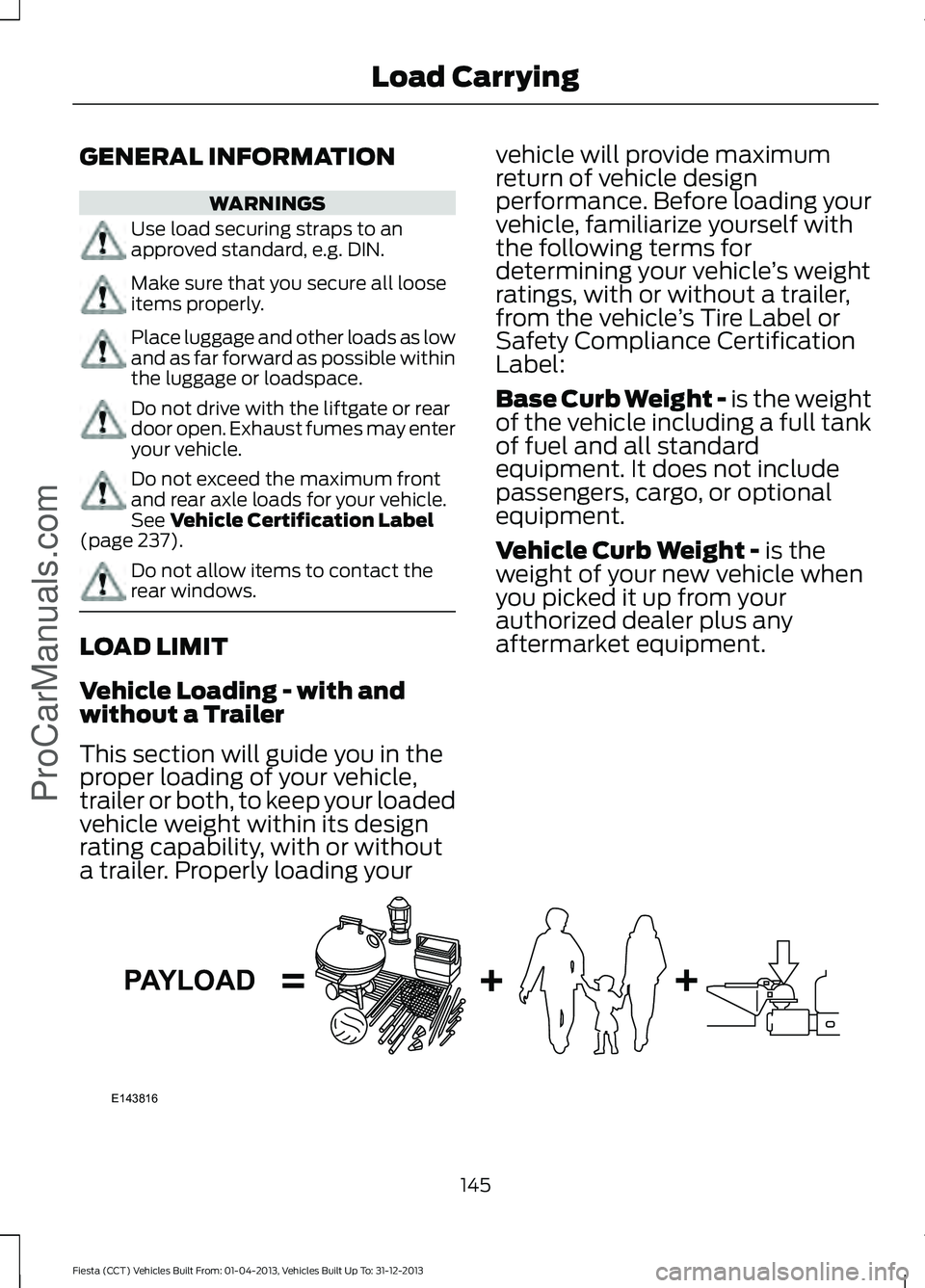
Vehicle Loading - with and
without a Trailer
This section will guide you in the
proper loading of your vehicle,
trailer or both, to keep your loaded
vehicle weight within its design
rating capability, with or without
a trailer. Properly loading your vehicle will provide maximum
return of vehicle design
performance. Before loading your
vehicle, familiarize yourself with
the following terms for
determining your vehicle
’s weight
ratings, with or without a trailer,
from the vehicle ’s Tire Label or
Safety Compliance Certification
Label:
Base Curb Weight -
is the weight
of the vehicle including a full tank
of fuel and all standard
equipment. It does not include
passengers, cargo, or optional
equipment.
Vehicle Curb Weight -
is the
weight of your new vehicle when
you picked it up from your
authorized dealer plus any
aftermarket equipment. 145
Fiesta (CCT) Vehicles Built From: 01-04-2013, Vehicles Built Up To: 31-12-2013 Load Carrying
ProCarManuals.comE143816PAYLOAD
Page 150 of 398
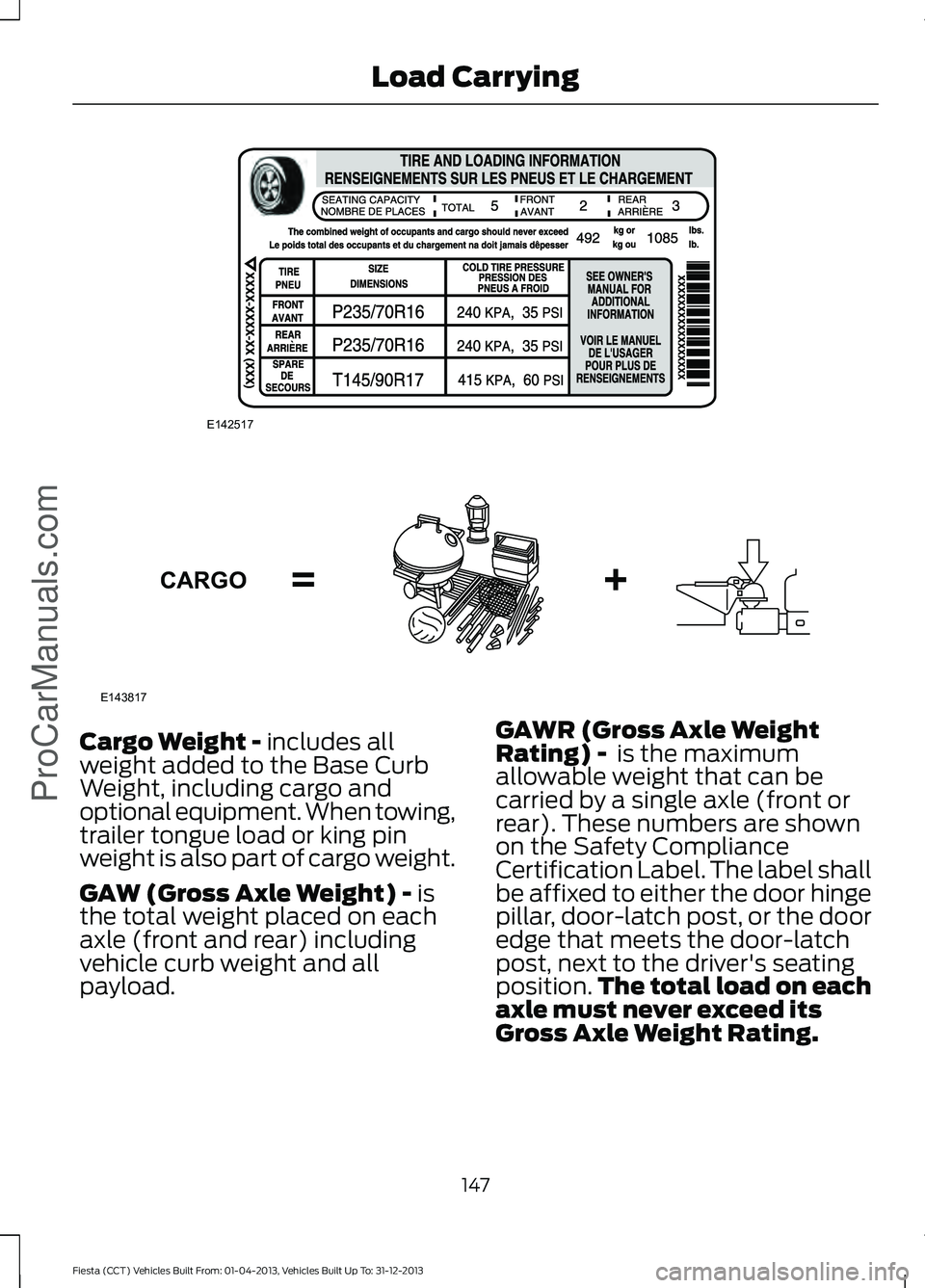
Cargo Weight - includes all
weight added to the Base Curb
Weight, including cargo and
optional equipment. When towing,
trailer tongue load or king pin
weight is also part of cargo weight.
GAW (Gross Axle Weight) -
is
the total weight placed on each
axle (front and rear) including
vehicle curb weight and all
payload. GAWR (Gross Axle Weight
Rating) -
is the maximum
allowable weight that can be
carried by a single axle (front or
rear). These numbers are shown
on the Safety Compliance
Certification Label. The label shall
be affixed to either the door hinge
pillar, door-latch post, or the door
edge that meets the door-latch
post, next to the driver's seating
position. The total load on each
axle must never exceed its
Gross Axle Weight Rating.
147
Fiesta (CCT) Vehicles Built From: 01-04-2013, Vehicles Built Up To: 31-12-2013 Load Carrying
ProCarManuals.comE142517 E143817CARGO
Page 151 of 398
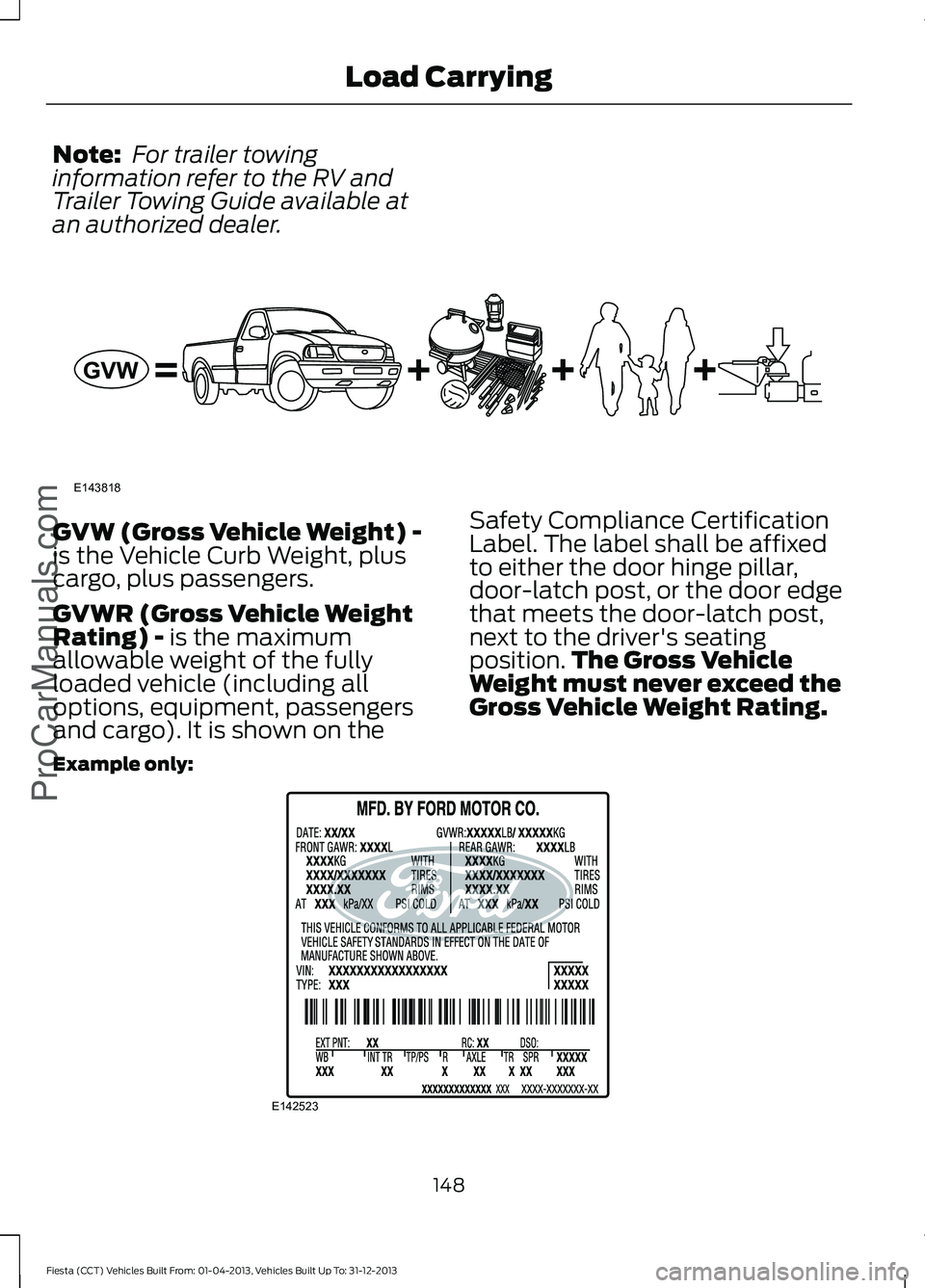
Note:
For trailer towing
information refer to the RV and
Trailer Towing Guide available at
an authorized dealer. GVW (Gross Vehicle Weight) -
is the Vehicle Curb Weight, plus
cargo, plus passengers.
GVWR (Gross Vehicle Weight
Rating) - is the maximum
allowable weight of the fully
loaded vehicle (including all
options, equipment, passengers
and cargo). It is shown on the Safety Compliance Certification
Label. The label shall be affixed
to either the door hinge pillar,
door-latch post, or the door edge
that meets the door-latch post,
next to the driver's seating
position.
The Gross Vehicle
Weight must never exceed the
Gross Vehicle Weight Rating.
Example only: 148
Fiesta (CCT) Vehicles Built From: 01-04-2013, Vehicles Built Up To: 31-12-2013 Load Carrying
ProCarManuals.comE143818GVW E142523
Page 152 of 398
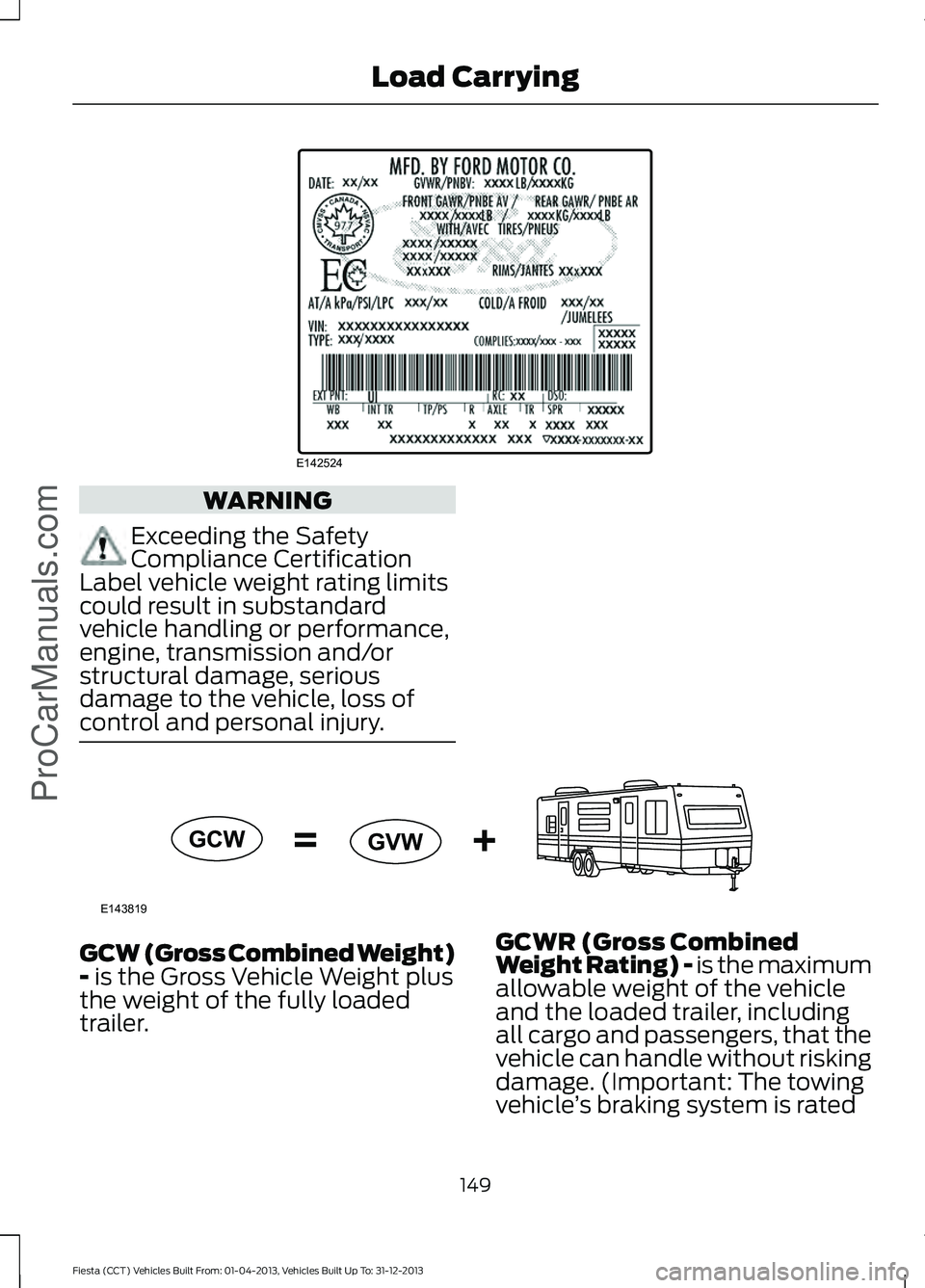
WARNING
Exceeding the Safety
Compliance Certification
Label vehicle weight rating limits
could result in substandard
vehicle handling or performance,
engine, transmission and/or
structural damage, serious
damage to the vehicle, loss of
control and personal injury. GCW (Gross Combined Weight)
- is the Gross Vehicle Weight plus
the weight of the fully loaded
trailer. GCWR (Gross Combined
Weight Rating) - is the maximum
allowable weight of the vehicle
and the loaded trailer, including
all cargo and passengers, that the
vehicle can handle without risking
damage. (Important: The towing
vehicle
’s braking system is rated
149
Fiesta (CCT) Vehicles Built From: 01-04-2013, Vehicles Built Up To: 31-12-2013 Load Carrying
ProCarManuals.comE142524 E143819GCW
GVW
Page 153 of 398
for operation at Gross Vehicle
Weight Rating, not at Gross
Combined Weight Rating.)
Separate functional brakes should
be used for safe control of towed
vehicles and for trailers where the
Gross Combined Weight of the
towing vehicle plus the trailer
exceed the Gross Vehicle Weight
Rating of the towing vehicle.
The
Gross Combined Weight must
never exceed the Gross
Combined Weight Rating.
Maximum Loaded Trailer
Weight - is the highest possible
weight of a fully loaded trailer the
vehicle can tow. It assumes a
vehicle with mandatory options,
driver and front passenger weight
(150 pounds [68 kilograms]
each), no cargo weight (internal
or external) and a tongue load of
10– 15% (conventional trailer) or
king pin weight of 15– 25% (fifth
wheel trailer). Consult an
authorized dealer (or the RV and
Trailer Towing Guide available at
an authorized dealer) for more
detailed information.
Tongue Load or Fifth Wheel
King Pin Weight -
refers to the
amount of the weight that a trailer
pushes down on a trailer hitch. Examples:
For a 5000 pound
(2268 kilogram) conventional
trailer, multiply 5000 by 0.10 and
0.15 to obtain a proper tongue
load range of 500 to 750 pounds
(227 to 340 kilograms). For an
11500 pound (5216 kilogram) fifth
wheel trailer, multiply by 0.15 and
0.25 to obtain a proper king pin
load range of 1725 to 2875 pounds
(782 to 1304 kilograms). WARNINGS
Do not exceed the GVWR or
the GAWR specified on the
Safety Compliance Certification
Label. Do not use replacement tires
with lower load carrying
capacities than the original tires
because they may lower the
vehicle ’s GVWR and GAWR
limitations. Replacement tires
with a higher limit than the original
tires do not increase the GVWR
and GAWR limitations. Exceeding any vehicle weight
rating limitation could result
in serious damage to the vehicle
and/or personal injury. Steps for determining the
correct load limit:
1. Locate the statement "The
combined weight of occupants
and cargo should never exceed
XXX kg or XXX lb." on your
vehicle ’s placard.
150
Fiesta (CCT) Vehicles Built From: 01-04-2013, Vehicles Built Up To: 31-12-2013 Load Carrying
ProCarManuals.com
Page 154 of 398
2.
Determine the combined
weight of the driver and
passengers that will be riding
in your vehicle.
3. Subtract the combined weight
of the driver and passengers
from XXX kg or XXX lb.
4. The resulting figure equals the
available amount of cargo and
luggage load capacity. For
example, if the “XXX” amount
equals 1,400 lb. and there will
be five 150 lb. passengers in
your vehicle, the amount of
available cargo and luggage
load capacity is 650 lb.
(1400-750 (5 x 150) = 650 lb.)
5. Determine the combined
weight of luggage and cargo
being loaded on the vehicle.
That weight may not safely
exceed the available cargo and
luggage load capacity
calculated in Step 4.
6. If your vehicle will be towing a
trailer, load from your trailer
will be transferred to your
vehicle. Consult this manual to
determine how this reduces the
available cargo and luggage
load capacity of your vehicle.
The following gives you a few
examples on how to calculate the
available amount of cargo and
luggage load capacity: *Suppose your vehicle has a
1400-pound (635-kilogram) cargo
and luggage capacity. You decide
to go golfing. Is there enough load
capacity to carry you, four of your
friends and all the golf bags? You
and four friends average 220
pounds (99 kilograms) each and
the golf bags weigh approximately
30 pounds (13.5 kilograms) each.
The calculation would be: 1400 -
(5 x 220) - (5 x 30) = 1400 - 1100
- 150 = 150 pounds. Yes, you have
enough load capacity in your
vehicle to transport four friends
and your golf bags. In metric units,
the calculation would be: 635
kilograms - (5 x 99 kilograms) -
(5 x 13.5 kilograms) = 635 - 495 -
67.5 = 72.5 kilograms.
*Suppose your vehicle has a
1400-pound (635-kilogram) cargo
and luggage capacity. You and
one of your friends decide to pick
up cement from the local home
improvement store to finish that
patio you have been planning for
the past two years. Measuring the
inside of the vehicle with the rear
seat folded down, you have room
for twelve 100-pound
(45-kilogram) bags of cement. Do
you have enough load capacity to
transport the cement to your
home? If you and your friend each
weigh 220 pounds (99 kilograms),
the calculation would be: 1400 -
(2 x 220) - (12 x 100) = 1400 - 440
- 1200 = - 240 pounds. No, you do
not have enough cargo capacity
to carry that much weight. In
metric units, the calculation would
151
Fiesta (CCT) Vehicles Built From: 01-04-2013, Vehicles Built Up To: 31-12-2013 Load CarryingProCarManuals.com