flat tire FORD FLEX 2009 1.G Owner's Guide
[x] Cancel search | Manufacturer: FORD, Model Year: 2009, Model line: FLEX, Model: FORD FLEX 2009 1.GPages: 374
Page 302 of 374
Second stage: Checking tire pressure
Check the air pressure of your tires as follows:
1. Remove the valve cap from the tire valve.
2. Unhook the black hose from the side of the compressor and fasten
firmly on the valve stem by turning clockwise.
WARNING:If you are proceeding from theFirst stage:
Reinflating the tire with sealing compound and airsection
and have injected sealant in the tire and the pressure is below 20 psi
(1.4 bar),stop and call roadside assistance.If tire pressure is
above 20 psi (1.4 bar), continue to the next step.
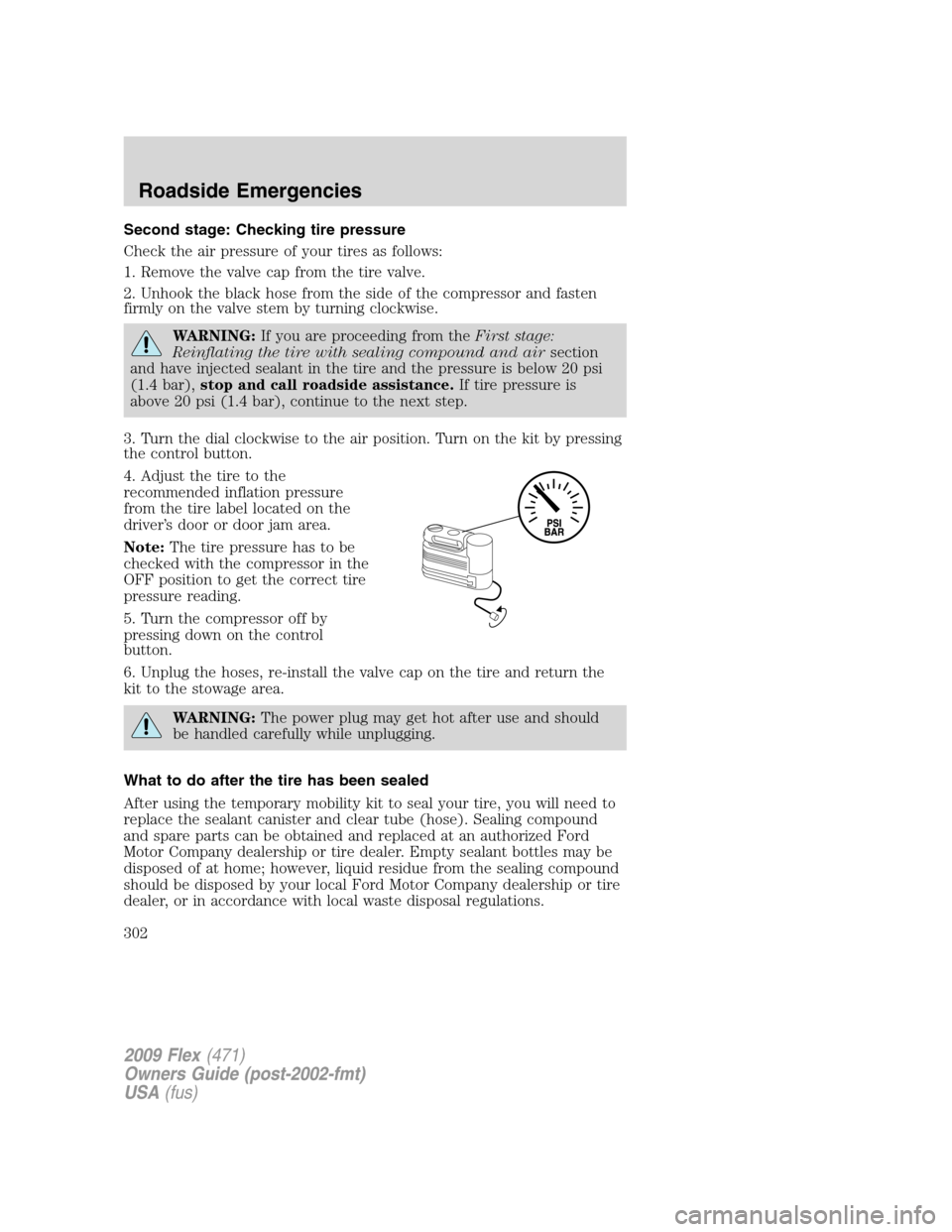
3. Turn the dial clockwise to the air position. Turn on the kit by pressing
the control button.
4. Adjust the tire to the
recommended inflation pressure
from the tire label located on the
driver’s door or door jam area.
Note:The tire pressure has to be
checked with the compressor in the
OFF position to get the correct tire
pressure reading.
5. Turn the compressor off by
pressing down on the control
button.
6. Unplug the hoses, re-install the valve cap on the tire and return the
kit to the stowage area.
WARNING:The power plug may get hot after use and should
be handled carefully while unplugging.
What to do after the tire has been sealed
After using the temporary mobility kit to seal your tire, you will need to
replace the sealant canister and clear tube (hose). Sealing compound
and spare parts can be obtained and replaced at an authorized Ford
Motor Company dealership or tire dealer. Empty sealant bottles may be
disposed of at home; however, liquid residue from the sealing compound
should be disposed by your local Ford Motor Company dealership or tire
dealer, or in accordance with local waste disposal regulations.
2009 Flex(471)
Owners Guide (post-2002-fmt)
USA(fus)
Roadside Emergencies
302
Page 306 of 374
WHEEL LUG NUT TORQUE SPECIFICATIONS
Retighten the lug nuts to the specified torque at 100 miles (160 km)
after any wheel disturbance (tire rotation, changing a flat tire, wheel
removal, etc.).
Bolt size Wheel lug nut torque*
lb.ft. N•m
1/2-20 UNF 100 135
* Torque specifications are for nut and bolt threads free of dirt and
rust. Use only Ford recommended replacement fasteners.
WARNING:When a wheel is installed, always remove any
corrosion, dirt or foreign materials present on the mounting
surfaces of the wheel or the surface of the wheel hub, brake drum or
brake disc that contacts the wheel. Ensure that any fasteners that
attach the rotor to the hub are secured so they do not interfere with
the mounting surfaces of the wheel. Installing wheels without correct
metal-to-metal contact at the wheel mounting surfaces can cause the
wheel nuts to loosen and the wheel to come off while the vehicle is in
motion, resulting in loss of control.
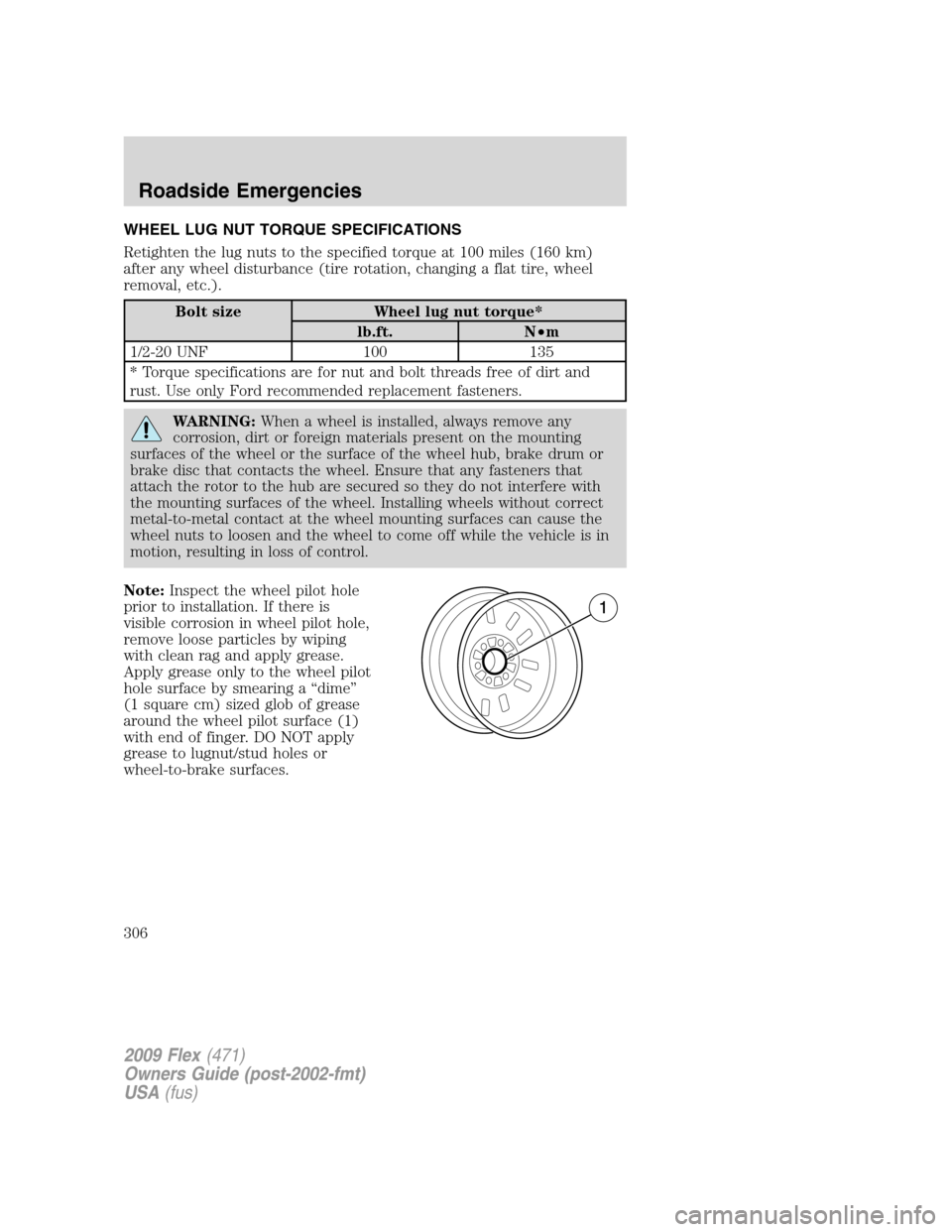
Note:Inspect the wheel pilot hole
prior to installation. If there is
visible corrosion in wheel pilot hole,
remove loose particles by wiping
with clean rag and apply grease.
Apply grease only to the wheel pilot
hole surface by smearing a “dime”
(1 square cm) sized glob of grease
around the wheel pilot surface (1)
with end of finger. DO NOT apply
grease to lugnut/stud holes or
wheel-to-brake surfaces.
2009 Flex(471)
Owners Guide (post-2002-fmt)
USA(fus)
Roadside Emergencies
306
Page 353 of 374
![FORD FLEX 2009 1.G Owners Guide •Slow down gradually.
•Driving at reasonable speeds (traveling at 55 mph [88 km/h] uses 15%
less fuel than traveling at 65 mph [105 km/h]).
•Revving the engine before turning it off may reduce f](/img/11/5104/w960_5104-352.png "FORD FLEX 2009 1.G Owners Guide •Slow down gradually.
•Driving at reasonable speeds (traveling at 55 mph [88 km/h] uses 15%
less fuel than traveling at 65 mph [105 km/h]).
•Revving the engine before turning it off may reduce f")
•Slow down gradually.
•Driving at reasonable speeds (traveling at 55 mph [88 km/h] uses 15%
less fuel than traveling at 65 mph [105 km/h]).
•Revving the engine before turning it off may reduce fuel economy.
•Using the air conditioner or defroster may reduce fuel economy.
•You may want to turn off the speed control in hilly terrain if
unnecessary shifting between the top gears occurs. Unnecessary
shifting of this type could result in reduced fuel economy.
•Warming up a vehicle on cold mornings is not required and may
reduce fuel economy.
•Resting your foot on the brake pedal while driving may reduce fuel
economy.
•Combine errands and minimize stop-and-go driving.
Maintenance
•Keep tires properly inflated and use only recommended size.
•Operating a vehicle with the wheels out of alignment will reduce fuel
economy.
•Use recommended engine oil. Refer toMaintenance product
specifications and capacitiesin this chapter.
•Perform all regularly scheduled maintenance items. Follow the
recommended maintenance schedule and owner maintenance checks
found inscheduled maintenance information.
Conditions
•Heavily loading a vehicle or towing a trailer may reduce fuel economy
at any speed.
•Carrying unnecessary weight may reduce fuel economy (approximately
1 mpg [0.4 km/L] is lost for every 400 lb [180 kg] of weight carried).
•Adding certain accessories to your vehicle (for example bug
deflectors, rollbars/light bars, running boards, ski/luggage racks) may
reduce fuel economy.
•Using fuel blended with alcohol may lower fuel economy.
•Fuel economy may decrease with lower temperatures during the first
8–10 miles (12–16 km) of driving.
•Driving on flat terrain offers improved fuel economy as compared to
driving on hilly terrain.
2009 Flex(471)
Owners Guide (post-2002-fmt)
USA(fus)
Maintenance and Specifications
353
Page 374 of 374
Spare tire
(see Changing the Tire) ...........291
Spark plugs,
specifications .....................361, 364
Specification chart, lubricants..362
Speed control ............................101
Starting your vehicle ........250–252
jump starting ..........................307
Steering wheel
controls ....................................104
tilting .........................................87
Stereo
6-CD in dash .............................16
CD-MP3 .....................................16
SYNC ............................................63
T
Temporary mobility kit .............296
Tilt steering wheel ......................87
Tire Pressure Monitoring
System (TPMS)
Tires, Wheels and Loading ....233
Tires ...................................218–219
alignment ................................226
care ..........................................222
changing ..........................291–292
checking the pressure ............222
inflating ...................................220
label .........................................232
replacing ..................................224
rotating ....................................226
safety practices .......................225
sidewall information ...............228
snow tires and chains ............238
spare tire .................................289
Temporary mobility kit ..........296
terminology .............................219
tire grades ...............................219treadwear ........................218, 223
Towing .......................................244
recreational towing .................249
trailer towing ..........................244
wrecker ....................................312
Transaxle
fluid, refill capacities ..............362
lubricant specifications ..........362
Transmission .............................262
brake-shift interlock (BSI) ....262
fluid, checking and adding
(automatic) .............................358
Turn signal ..................................80
U
USB port ......................................27
V
Vehicle Identification Number
(VIN) ..........................................365
Vehicle loading ..........................239
Ventilating your vehicle ...........253
W
Warning lights (see Lights) .......10
Washer fluid ..............................332
Water, Driving through .............277
Windows
power .........................................96
rear wiper/washer .....................87
Windshield washer fluid and
wipers ..........................................86
checking and adding fluid .....332
replacing wiper blades ...332–333
Wrecker towing .........................312
2009 Flex(471)
Owners Guide (post-2002-fmt)
USA(fus)
Index
374