tow FORD FLEX 2015 1.G Owners Manual
[x] Cancel search | Manufacturer: FORD, Model Year: 2015, Model line: FLEX, Model: FORD FLEX 2015 1.GPages: 571, PDF Size: 5.52 MB
Page 7 of 571
Driving Aids 237
Blind Spot Information System (BLIS) with Cross Traffic Alert
(CTA) .............................................237
Collision warning system................................241
Steering............................................245
Load Carrying 247
Cargonet...........................................247
Roof racks and load carriers.............................247
Vehicle loading.......................................248
Towing 256
Trailertowing........................................256
Wrecker towing......................................264
Recreational towing...................................265
Driving Hints 267
Economical driving....................................267
Floormats..........................................268
Roadside Emergencies 270
Getting roadside assistance..............................270
Hazard warning flashers................................272
Fuel cut-off switch....................................272
Jump-starting the vehicle...............................273
Customer Assistance 276
Reporting safety defects (U.S. only).......................283
Reporting safety defects (Canada only).....................283
Fuses 284
Changing a fuse......................................284
Fuse specification chart................................285
6Table of Contents
2015 Flex(471)
Owners Guide gf, 1st Printing, October 2014
USA(fus)
Page 11 of 571
ABOUT THIS MANUAL
Thank you for choosing Ford. We recommend that you take some time to
get to know your vehicle by reading this manual. The more that you
know about it, the greater the safety and pleasure you will get from
driving it.
WARNING:Always drive with due care and attention when
using and operating the controls and features on your vehicle.
Note:This manual describes product features and options available
throughout the range of available models, sometimes even before they
are generally available. It may describe options not fitted to your vehicle.
Note:Some of the illustrations in this manual may show features as used
in different models, so may appear different to you on your vehicle.
Note:Always use and operate your vehicle in line with all applicable
laws and regulations.
Note:Pass on this manual when selling your vehicle. It is an integral
part of the vehicle.
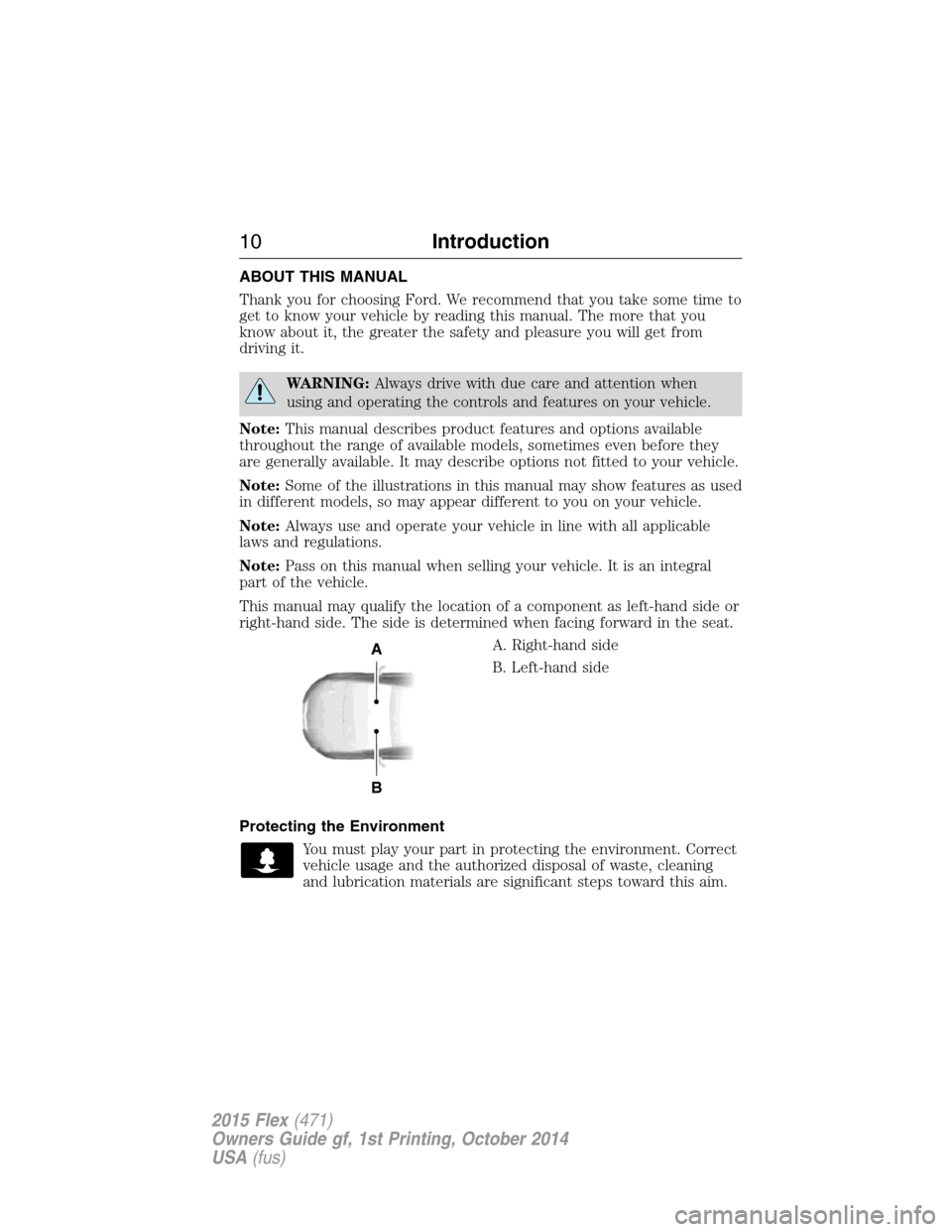
This manual may qualify the location of a component as left-hand side or
right-hand side. The side is determined when facing forward in the seat.
A. Right-hand side
B. Left-hand side
Protecting the Environment
You must play your part in protecting the environment. Correct
vehicle usage and the authorized disposal of waste, cleaning
and lubrication materials are significant steps toward this aim.
A
B
10Introduction
2015 Flex(471)
Owners Guide gf, 1st Printing, October 2014
USA(fus)
Page 22 of 571
•Keep the buckle release button pointing up and away from the safety
seat, with the tongue between the child seat and the release button,
to prevent accidental unbuckling.
•Place the vehicle seat upon which the child seat will be installed in
the upright position.
•For second-row seating positions, the recliner may be adjusted slightly
to improve child seat fit. If needed, the head restraints may be
removed.
•For third-row seating positions, the head restraints may be stowed to
improve child seat fit. See theSeatschapter for information on folding
the head restraints.
•Put the safety belt in the automatic locking mode. See Step 5 below.
This vehicle does not require the use of a locking clip.
Perform the following steps when installing the child seat with
combination lap and shoulder belts:
Note:Although the child seat illustrated is a forward-facing child seat,
the steps are the same for installing a rear-facing child seat.
Note:The lock-off device on some child restraints may not
accommodate the shoulder portion of the inflatable safety belt. Follow all
instructions provided by the manufacturer of the child restraint
regarding the necessary and proper use of the lock-off device. In some
instances these devices have been provided only for use in vehicles with
safety belt systems that would otherwise require a locking clip.
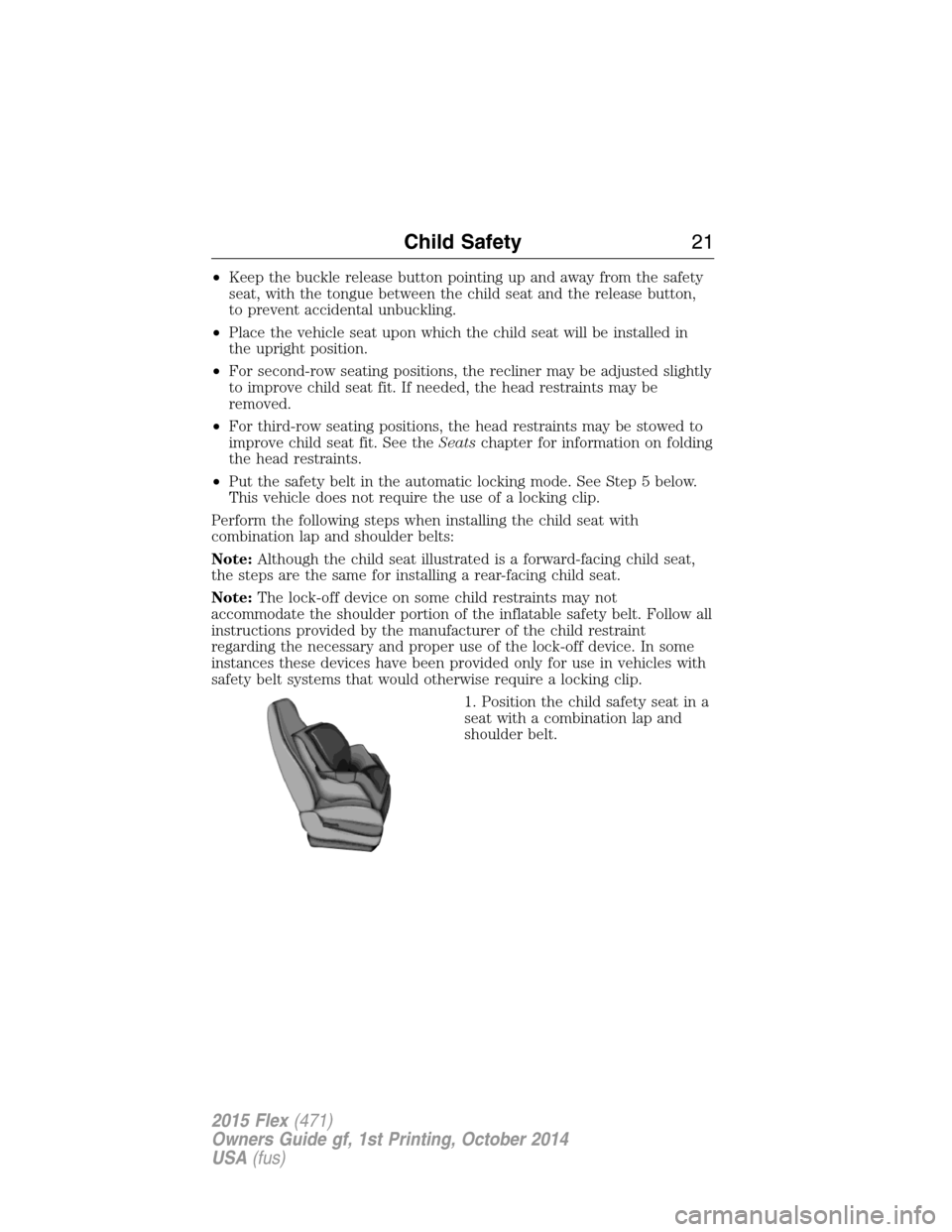
1. Position the child safety seat in a
seat with a combination lap and
shoulder belt.
Child Safety21
2015 Flex(471)
Owners Guide gf, 1st Printing, October 2014
USA(fus)
Page 25 of 571
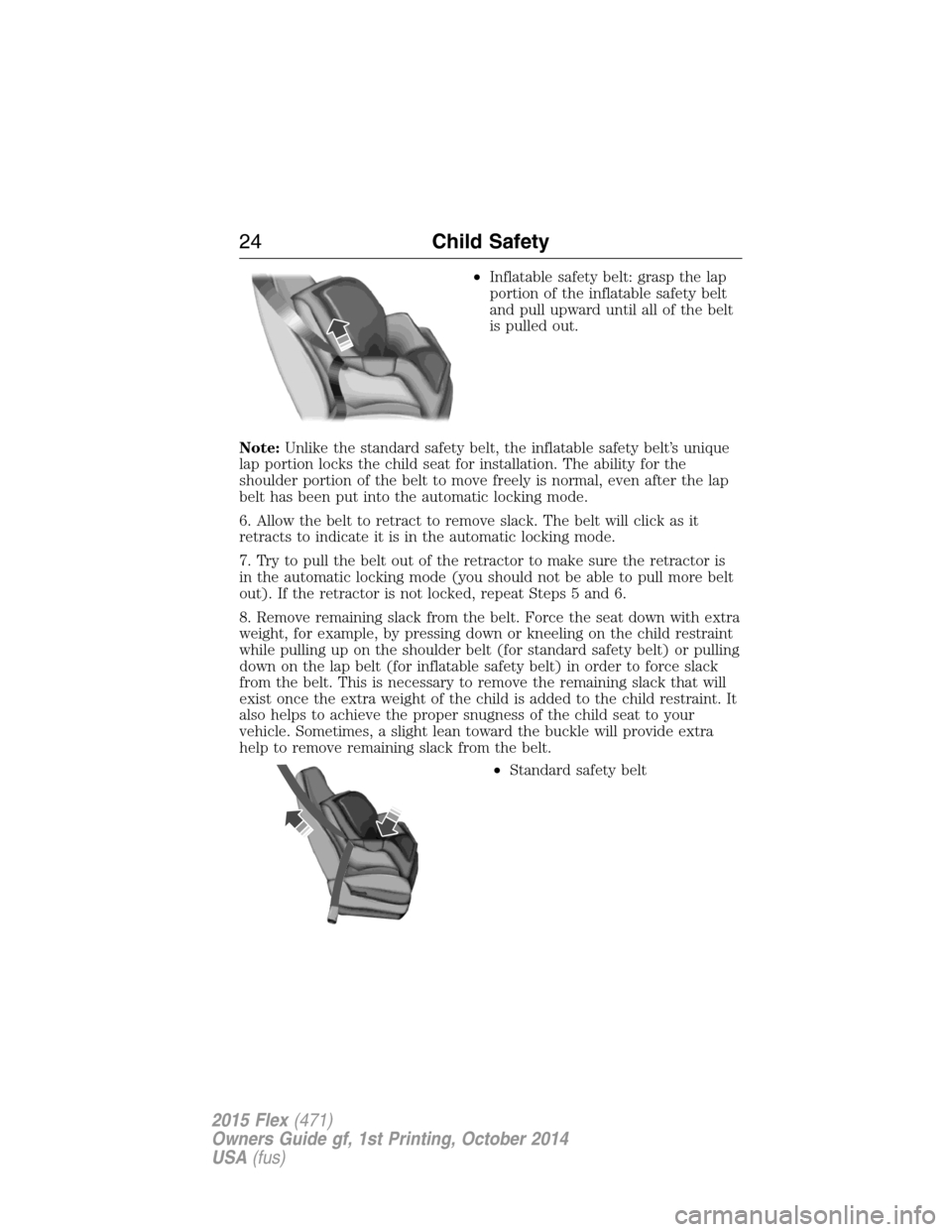
•Inflatable safety belt: grasp the lap
portion of the inflatable safety belt
and pull upward until all of the belt
is pulled out.
Note:Unlike the standard safety belt, the inflatable safety belt’s unique
lap portion locks the child seat for installation. The ability for the
shoulder portion of the belt to move freely is normal, even after the lap
belt has been put into the automatic locking mode.
6. Allow the belt to retract to remove slack. The belt will click as it
retracts to indicate it is in the automatic locking mode.
7. Try to pull the belt out of the retractor to make sure the retractor is
in the automatic locking mode (you should not be able to pull more belt
out). If the retractor is not locked, repeat Steps 5 and 6.
8. Remove remaining slack from the belt. Force the seat down with extra
weight, for example, by pressing down or kneeling on the child restraint
while pulling up on the shoulder belt (for standard safety belt) or pulling
down on the lap belt (for inflatable safety belt) in order to force slack
from the belt. This is necessary to remove the remaining slack that will
exist once the extra weight of the child is added to the child restraint. It
also helps to achieve the proper snugness of the child seat to your
vehicle. Sometimes, a slight lean toward the buckle will provide extra
help to remove remaining slack from the belt.
•Standard safety belt
24Child Safety
2015 Flex(471)
Owners Guide gf, 1st Printing, October 2014
USA(fus)
Page 36 of 571
CHILD SEAT POSITIONING
WARNING:Airbags can kill or injure a child in a child seat.
Never place a rear-facing child seat in front of an active airbag. If
you must use a forward-facing child seat in the front seat, move the
vehicle seat upon which the child seat is installed all the way back.
When possible, all children age 12 and under should be properly
restrained in a rear seating position. If all children cannot be seated and
restrained properly in a rear seating position, properly restrain the
largest child in the front seat.
WARNING:Always carefully follow the instructions and
warnings provided by the manufacturer of any child restraint to
determine if the restraint device is appropriate for your child’s size,
height, weight, or age. Follow the child restraint manufacturer’s
instructions and warnings provided for installation and use in
conjunction with the instructions and warnings provided by your
vehicle manufacturer. A safety seat that is improperly installed or
utilized, is inappropriate for your child’s height, age or weight, or does
not properly fit the child, may increase the risk of serious injury or
death.
WARNING:Never let a passenger hold a child on his or her lap
while your vehicle is moving. The passenger cannot protect the
child from injury in a crash, which may result in serious injury or death.
WARNING:Never use pillows, books, or towels to boost a child.
They can slide around and increase the likelihood of injury or
death in a crash.
WARNING:Always restrain an unoccupied child seat or booster
seat. These objects may become projectiles in a crash or sudden
stop, which may increase the risk of serious injury.
Child Safety35
2015 Flex(471)
Owners Guide gf, 1st Printing, October 2014
USA(fus)
Page 49 of 571
Stowing the Rear Inflatable Safety Belt
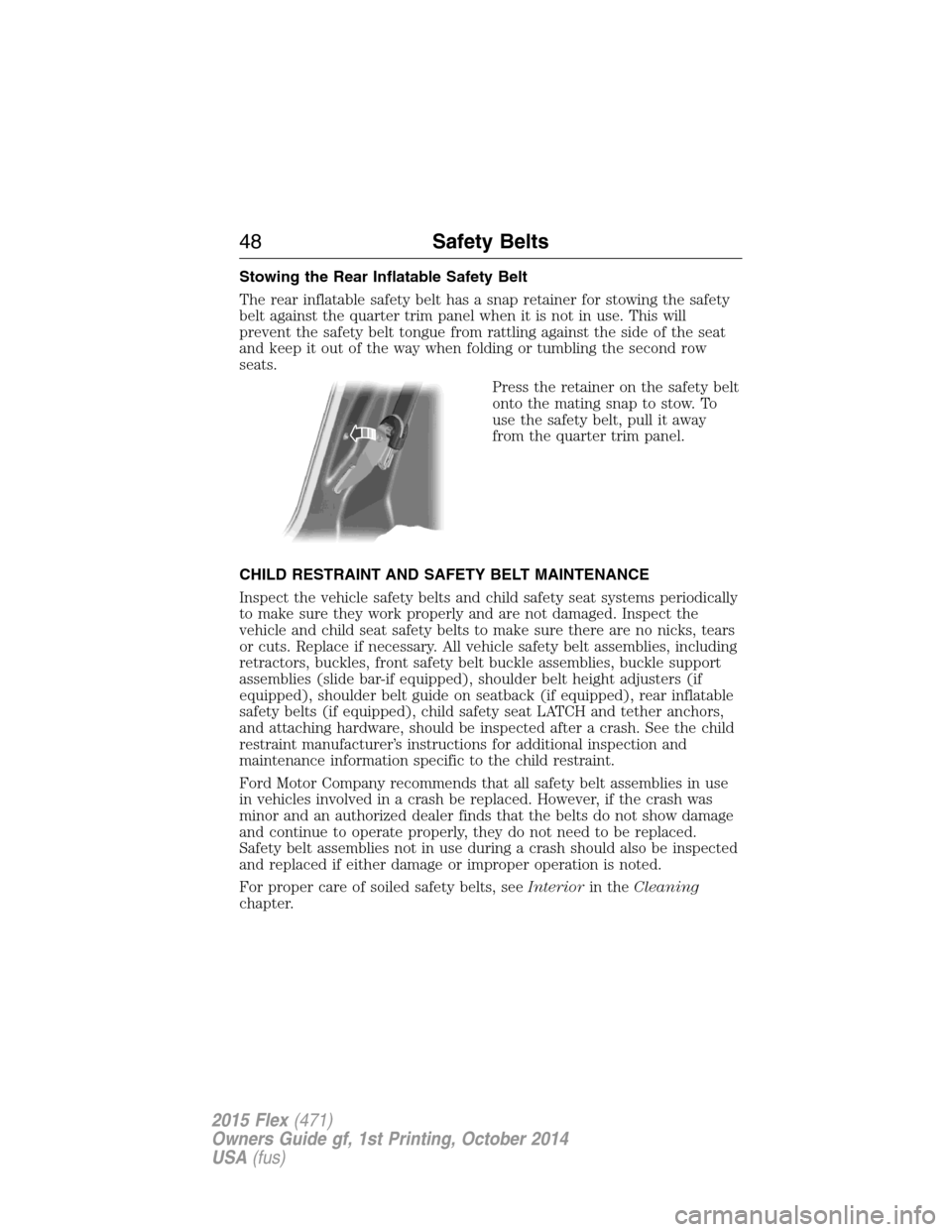
The rear inflatable safety belt has a snap retainer for stowing the safety
belt against the quarter trim panel when it is not in use. This will
prevent the safety belt tongue from rattling against the side of the seat
and keep it out of the way when folding or tumbling the second row
seats.
Press the retainer on the safety belt
onto the mating snap to stow. To
use the safety belt, pull it away
from the quarter trim panel.
CHILD RESTRAINT AND SAFETY BELT MAINTENANCE
Inspect the vehicle safety belts and child safety seat systems periodically
to make sure they work properly and are not damaged. Inspect the
vehicle and child seat safety belts to make sure there are no nicks, tears
or cuts. Replace if necessary. All vehicle safety belt assemblies, including
retractors, buckles, front safety belt buckle assemblies, buckle support
assemblies (slide bar-if equipped), shoulder belt height adjusters (if
equipped), shoulder belt guide on seatback (if equipped), rear inflatable
safety belts (if equipped), child safety seat LATCH and tether anchors,
and attaching hardware, should be inspected after a crash. See the child
restraint manufacturer’s instructions for additional inspection and
maintenance information specific to the child restraint.
Ford Motor Company recommends that all safety belt assemblies in use
in vehicles involved in a crash be replaced. However, if the crash was
minor and an authorized dealer finds that the belts do not show damage
and continue to operate properly, they do not need to be replaced.
Safety belt assemblies not in use during a crash should also be inspected
and replaced if either damage or improper operation is noted.
For proper care of soiled safety belts, seeInteriorin theCleaning
chapter.
48Safety Belts
2015 Flex(471)
Owners Guide gf, 1st Printing, October 2014
USA(fus)
Page 55 of 571
FRONT PASSENGER SENSING SYSTEM
WARNING:Even with Advanced Restraints Systems, children 12
and under should be properly restrained in a rear seating position.
Failure to follow this could seriously increase the risk of injury or death.
WARNING:Sitting improperly out of position or with the seat
back reclined too far can take off weight from the seat cushion
and affect the decision of the front passenger sensing system, resulting
in serious injury or death in a crash.
Always sit upright against your seat back, with your feet on the floor.
WARNING:To reduce the risk of possible serious injury:
Do not stow objects in seatback map pocket or hang objects off
seatback if a child is in the front passenger seat.
Do not place objects underneath the front passenger seat or between
the seat and the center console.
Check the passenger airbag indicator lamp for proper airbag status.
Failure to follow these instructions may interfere with the passenger
seat sensing system.
WARNING:Any alteration or modification to the front passenger
seat may affect the performance of the front passenger sensing
system which could seriously increase the risk of injury or death.
This system works with sensors that are part of the front passenger seat
and safety belt to detect the presence of a properly-seated occupant and
determine if the front passenger frontal airbag should be enabled (may
inflate) or not.
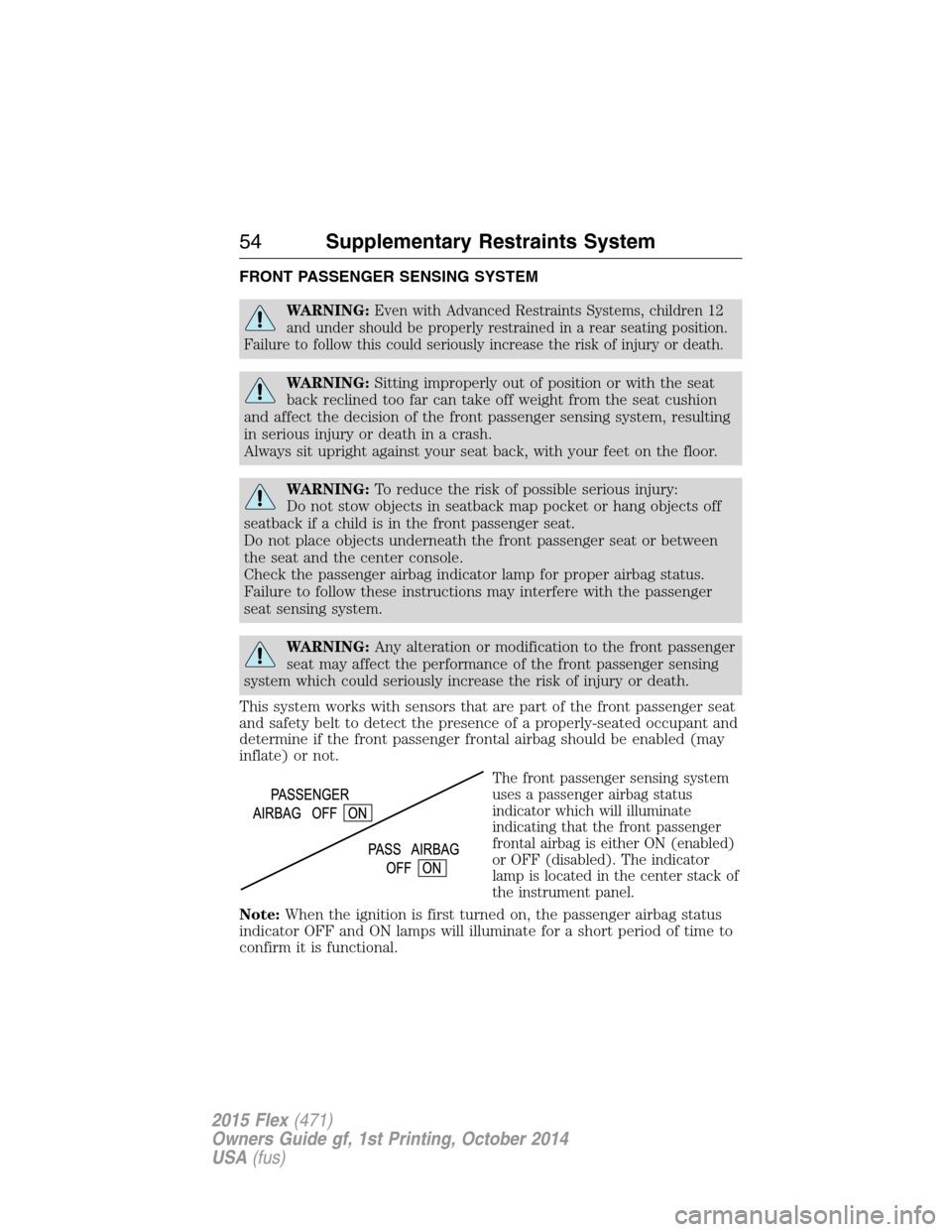
The front passenger sensing system
uses a passenger airbag status
indicator which will illuminate
indicating that the front passenger
frontal airbag is either ON (enabled)
or OFF (disabled). The indicator
lamp is located in the center stack of
the instrument panel.
Note:When the ignition is first turned on, the passenger airbag status
indicator OFF and ON lamps will illuminate for a short period of time to
confirm it is functional.
54Supplementary Restraints System
2015 Flex(471)
Owners Guide gf, 1st Printing, October 2014
USA(fus)
Page 57 of 571
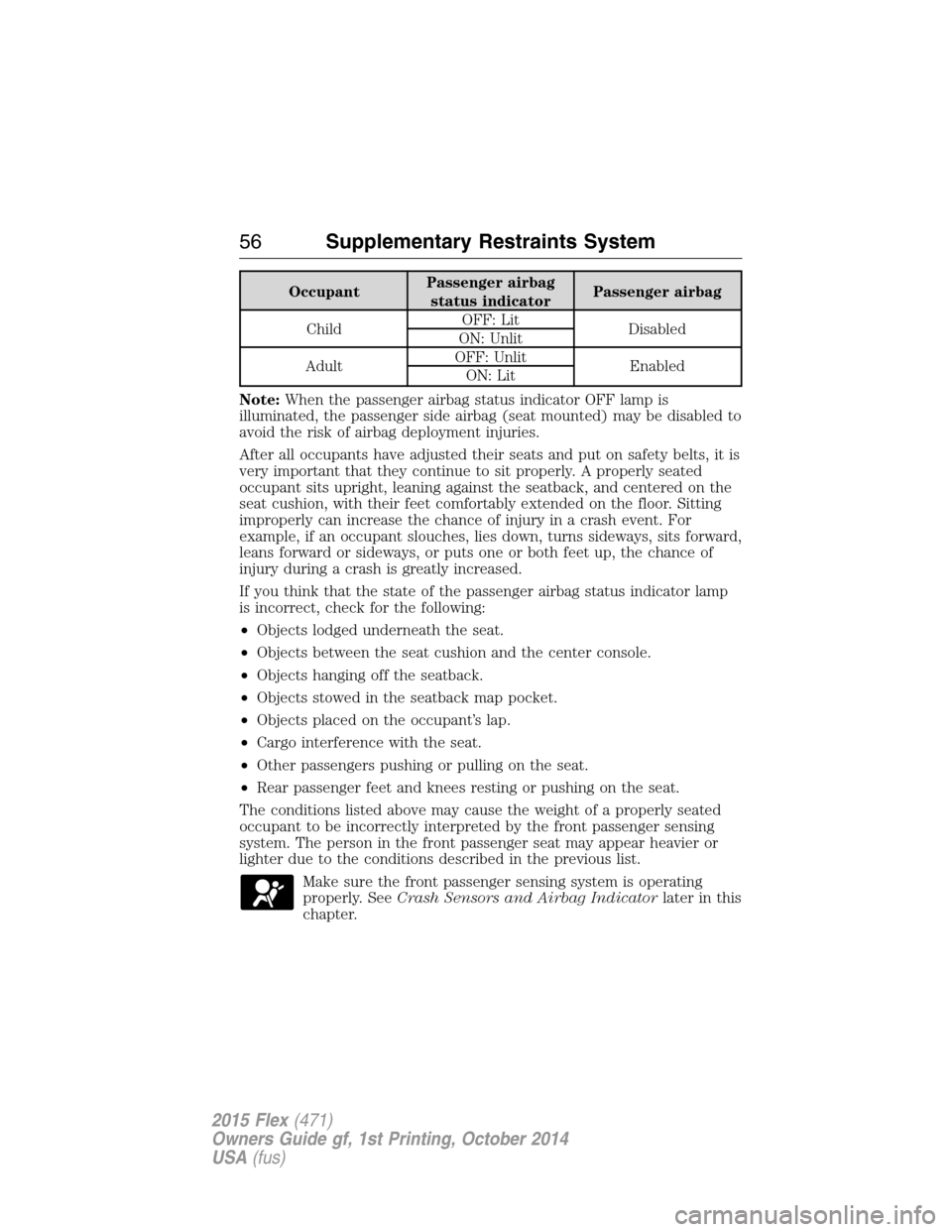
OccupantPassenger airbag
status indicatorPassenger airbag
ChildOFF: Lit
Disabled
ON: Unlit
AdultOFF: Unlit
Enabled
ON: Lit
Note:When the passenger airbag status indicator OFF lamp is
illuminated, the passenger side airbag (seat mounted) may be disabled to
avoid the risk of airbag deployment injuries.
After all occupants have adjusted their seats and put on safety belts, it is
very important that they continue to sit properly. A properly seated
occupant sits upright, leaning against the seatback, and centered on the
seat cushion, with their feet comfortably extended on the floor. Sitting
improperly can increase the chance of injury in a crash event. For
example, if an occupant slouches, lies down, turns sideways, sits forward,
leans forward or sideways, or puts one or both feet up, the chance of
injury during a crash is greatly increased.
If you think that the state of the passenger airbag status indicator lamp
is incorrect, check for the following:
•Objects lodged underneath the seat.
•Objects between the seat cushion and the center console.
•Objects hanging off the seatback.
•Objects stowed in the seatback map pocket.
•Objects placed on the occupant’s lap.
•Cargo interference with the seat.
•Other passengers pushing or pulling on the seat.
•Rear passenger feet and knees resting or pushing on the seat.
The conditions listed above may cause the weight of a properly seated
occupant to be incorrectly interpreted by the front passenger sensing
system. The person in the front passenger seat may appear heavier or
lighter due to the conditions described in the previous list.
Make sure the front passenger sensing system is operating
properly. SeeCrash Sensors and Airbag Indicatorlater in this
chapter.
56Supplementary Restraints System
2015 Flex(471)
Owners Guide gf, 1st Printing, October 2014
USA(fus)
Page 62 of 571
CRASH SENSORS AND AIRBAG INDICATOR
WARNING:Modifying or adding equipment to the front end of
your vehicle (including frame, bumper, front end body structure
and tow hooks) may affect the performance of the airbag system,
increasing the risk of injury. Do not modify the front end of your
vehicle.
Your vehicle has a collection of crash and occupant sensors which
provide information to the restraints control module. The restraints
control module deploys (activates) the front safety belt pretensioners,
rear inflatable safety belts, driver airbag, passenger airbag, seat mounted
side airbags, and the Safety Canopy. Based on the type of accident
(frontal impact, side impact or rollover) the restraints control module
will deploy the appropriate safety devices.
The restraints control module also monitors the readiness of the above
safety devices plus the crash and occupant sensors. The readiness of the
safety system is indicated by a warning indicator light in the instrument
cluster or by a backup tone if the warning light is not working. See the
Instrument Clusterchapter. Routine maintenance of the airbag is not
required.
A difficulty with the system is indicated by one or more of the following:
•The readiness light will either flash or stay lit.
•The readiness light will not illuminate immediately after the
ignition is turned on.
•A series of five beeps will be heard. The tone pattern will repeat
periodically until the problem or light is repaired.
If any of these things happen, even intermittently, have the supplemental
restraint system serviced at an authorized dealer immediately. Unless
serviced, the system may not function properly in the event of a crash.
The safety belt pretensioners, rear inflatable safety belts and the airbag
supplemental restraint system are designed to activate when the vehicle
sustains frontal or sideways deceleration sufficient to cause the restraints
control module to deploy a safety device or when a certain likelihood of
a rollover event is detected by the rollover sensor.
Supplementary Restraints System61
2015 Flex(471)
Owners Guide gf, 1st Printing, October 2014
USA(fus)
Page 64 of 571
GENERAL INFORMATION ON RADIO FREQUENCIES
This device complies with part 15 of the FCC Rules and with Industry
Canada license-exempt RSS standard(s). Operation is subject to the
following two conditions: (1) This device may not cause harmful
interference, and (2) This device must accept any interference received,
including interference that may cause undesired operation.
Note:Changes or modifications not expressly approved by the party
responsible for compliance could void the user’s authority to operate the
equipment. The termICbefore the radio certification number only
signifies that Industry Canada technical specifications were met.
The typical operating range for your transmitter is approximately 33 feet
(10 meters). Vehicles with the remote start feature will have a greater
range. A decrease in operating range could be caused by:
•weather conditions
•nearby radio towers
•structures around your vehicle
•other vehicles parked next to your vehicle.
The radio frequency used by your remote control can also be used by
other short-distance radio transmissions, for example amateur radios,
medical equipment, wireless headphones, remote controls and alarm
systems. If the frequencies are jammed, you will not be able to use your
remote control. You can lock and unlock the doors with the key.
Note:Make sure your vehicle is locked before leaving it unattended.
Note:If you are in range, the remote control will operate if you press
any button unintentionally.
Intelligent Access (If Equipped)
The system uses a radio frequency signal to communicate with your
vehicle and authorize your vehicle to unlock when one of the following
conditions is met:
•You touch the inside of the front exterior door handle.
•You press the luggage compartment button.
•You press a button on the transmitter.
If excessive radio frequency interference is present in the area or if the
transmitter battery is low, it may be necessary to mechanically unlock
your door. You can use the mechanical key blade in your intelligent
access key to open the driver door in this situation. Refer toRemote
Controlin this chapter for more information on the location and use of
the mechanical key blade.
Keys and Remote Control63
2015 Flex(471)
Owners Guide gf, 1st Printing, October 2014
USA(fus)