stop start FORD FOCUS 2012 3.G Owners Manual
[x] Cancel search | Manufacturer: FORD, Model Year: 2012, Model line: FOCUS, Model: FORD FOCUS 2012 3.GPages: 406, PDF Size: 2.68 MB
Page 13 of 406
Solid illumination after the engine is started indicates the on-board
diagnostics system (OBD-II) has detected a malfunction. Refer to
On-board diagnostics (OBD-II)in theMaintenance and Specifications
chapter. If the light is blinking, engine misfire is occurring which could
damage your catalytic converter. Drive in a moderate fashion (avoid
heavy acceleration and deceleration) and have your vehicle serviced
immediately by your authorized dealer.
WARNING:Under engine misfire conditions, excessive exhaust
temperatures could damage the catalytic converter, the fuel
system, interior floor coverings or other vehicle components, possibly
causing a fire.
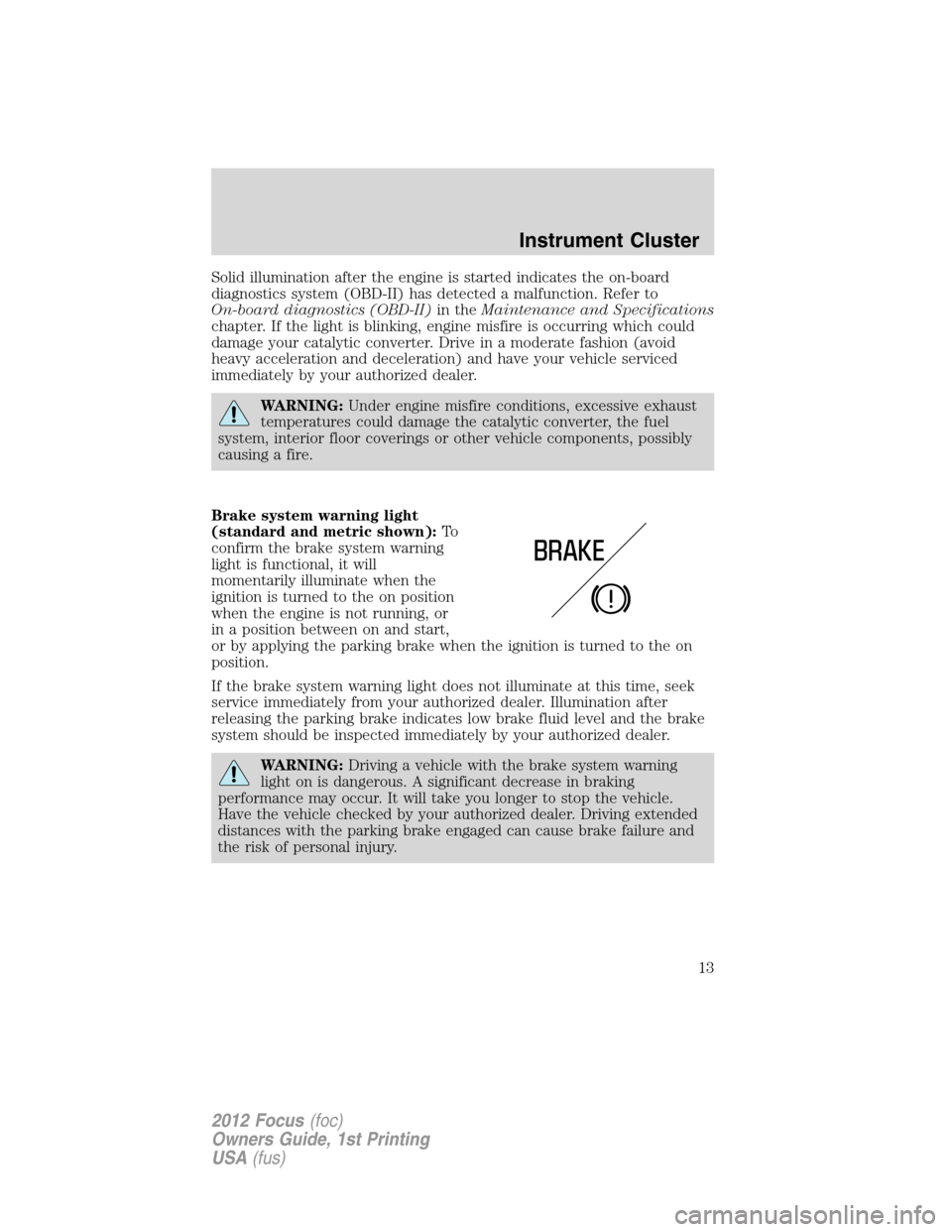
Brake system warning light
(standard and metric shown):To
confirm the brake system warning
light is functional, it will
momentarily illuminate when the
ignition is turned to the on position
when the engine is not running, or
in a position between on and start,
or by applying the parking brake when the ignition is turned to the on
position.
If the brake system warning light does not illuminate at this time, seek
service immediately from your authorized dealer. Illumination after
releasing the parking brake indicates low brake fluid level and the brake
system should be inspected immediately by your authorized dealer.
WARNING:Driving a vehicle with the brake system warning
light on is dangerous. A significant decrease in braking
performance may occur. It will take you longer to stop the vehicle.
Have the vehicle checked by your authorized dealer. Driving extended
distances with the parking brake engaged can cause brake failure and
the risk of personal injury.
Instrument Cluster
13
2012 Focus(foc)
Owners Guide, 1st Printing
USA(fus)
Page 19 of 406
Trip 1 and 2
Trip odometer — shows the accumulated trip distance. Displayed in
the lower line denoted by a 1: or 2:.
Trip timer — shows the elapsed trip time. This timer will stop when
the vehicle is turned off and will restart when the vehicle is restarted.
Distance to empty — shows the approximate distance the vehicle can
travel before running out of fuel.
Average fuel
economy —
shows the
average
distance
traveled per
unit of fuel
used for a given
trip.Economy Overview— better economy is displayed by
more solid pedals in the flower graphic.
Ford EcoMode
Press OK for
More InfoFord EcoMode Anticipation—
Smooth Driving Saves Fuel
Ford EcoMode Speed
Ford EcoMode Shifting (manual
transmission only) Early Shifting
Saves Fuel
*Ford EcoMode See Manual for
More Tips
Outside air temperature — displays the outside air temperature only if
it not visible in the current view.
Total odometer— shows the vehicle’s total accumulated distance
driven.
*Ford EcoMode operation— this system assists the driver in more
efficient driving by monitoring: shifting, driving speeds and anticipation
of start/stop (traffic conditions). Better economy is displayed by more
solid pedals in the flower graphic; the more efficiently you drive, the
more pedals will be earned. Resetting the average fuel economy value
will reset the EcoMode also.
•Anticipation: adjusting your vehicle’s speed and the distance to other
vehicles without the need for heavy braking or acceleration will
improve fuel economy.
•Speed: higher speeds use more fuel. Reducing your cruising speed on
open roads will improve fuel economy.
•Shifting: early shifting saves fuel and using the proper gear for a given
speed increases fuel economy.
Press and hold OK on the current screen to reset the respective trip,
distance, time and average fuel economy (and EcoMode).
Instrument Cluster
19
2012 Focus(foc)
Owners Guide, 1st Printing
USA(fus)
Page 22 of 406
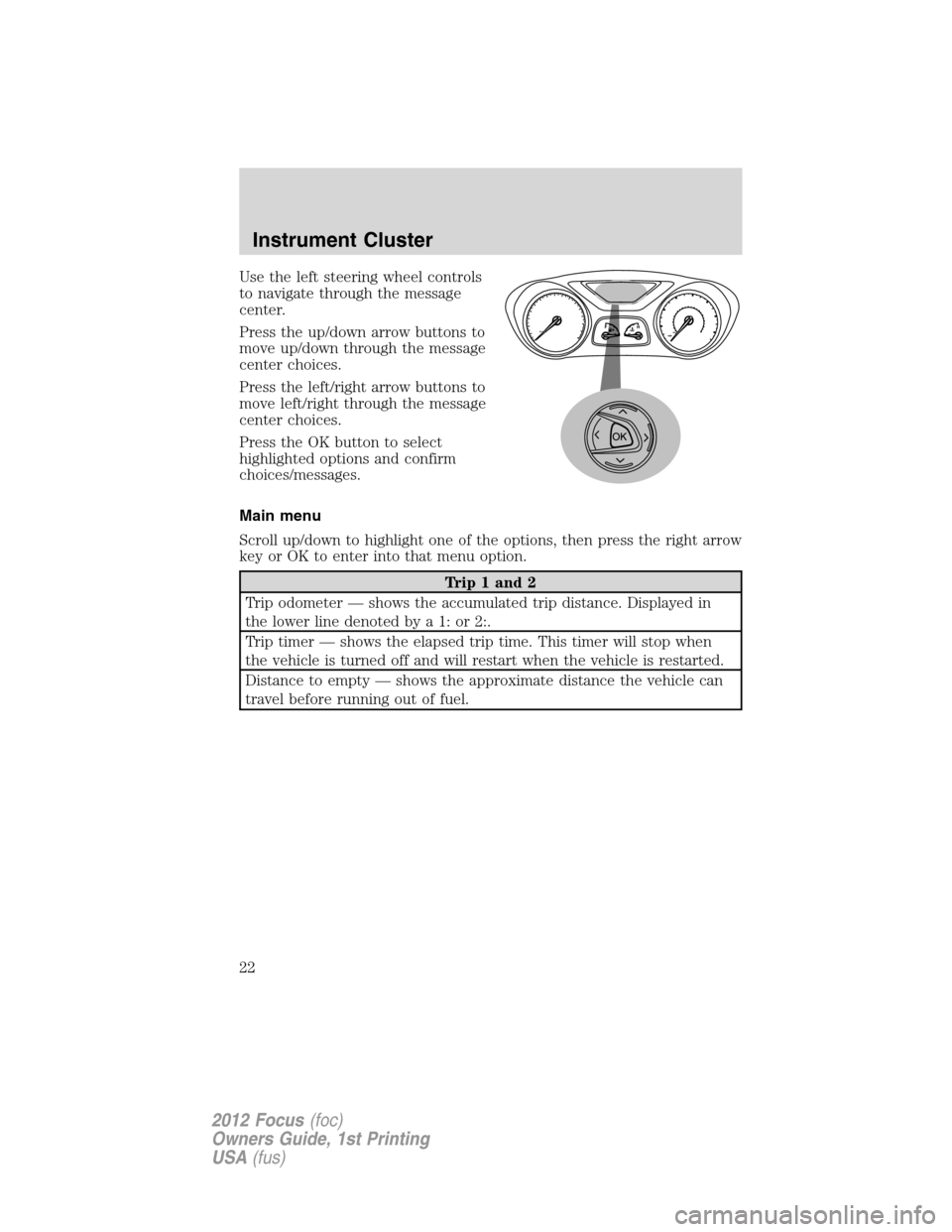
Use the left steering wheel controls
to navigate through the message
center.
Press the up/down arrow buttons to
move up/down through the message
center choices.
Press the left/right arrow buttons to
move left/right through the message
center choices.
Press the OK button to select
highlighted options and confirm
choices/messages.
Main menu
Scroll up/down to highlight one of the options, then press the right arrow
key or OK to enter into that menu option.
Trip 1 and 2
Trip odometer — shows the accumulated trip distance. Displayed in
the lower line denoted by a 1: or 2:.
Trip timer — shows the elapsed trip time. This timer will stop when
the vehicle is turned off and will restart when the vehicle is restarted.
Distance to empty — shows the approximate distance the vehicle can
travel before running out of fuel.
Instrument Cluster
22
2012 Focus(foc)
Owners Guide, 1st Printing
USA(fus)
Page 23 of 406
Trip 1 and 2
Average fuel
economy —
shows the
average distance
traveled per unit
of fuel used for a
given trip.Ford EcoMode
(Better
economy is
displayed by
more solid
pedals in the
flower graphic)Anticipation
Speed
Shifting (manual transmission
only)
OK = More Anticipation
Smooth Driving
Saves Fuel
Speed Current
Score
Early Shifting
Saves Fuel
*Ford EcoMode
See Manual for
More Tips
Outside air temperature — displays the outside air temperature only if
it not visible in the current view.
Total odometer— shows the vehicle’s total accumulated distance
driven.
*Ford EcoMode operation— this system assists the driver in more
efficient driving by monitoring: shifting, driving speeds and anticipation
of start/stop (traffic conditions). Better economy is displayed by more
solid pedals in the flower graphic; the more efficiently you drive, the
more pedals will be earned. Resetting the average fuel economy value
will reset the EcoMode also.
•Anticipation: adjusting your vehicle’s speed and the distance to other
vehicles without the need for heavy braking or acceleration will
improve fuel economy.
•Speed: higher speeds use more fuel. Reducing your cruising speed on
open roads will improve fuel economy.
•Shifting: early shifting saves fuel and using the proper gear for a given
speed increases fuel economy.
Press and hold OK on the current screen to reset the respective trip,
distance, time and average fuel economy (and EcoMode).
Information
MyKey Distance Driven (if MyKey is programmed)
MyKey Information (number of MyKeys and admin keys programmed)
Instrument Cluster
23
2012 Focus(foc)
Owners Guide, 1st Printing
USA(fus)
Page 28 of 406
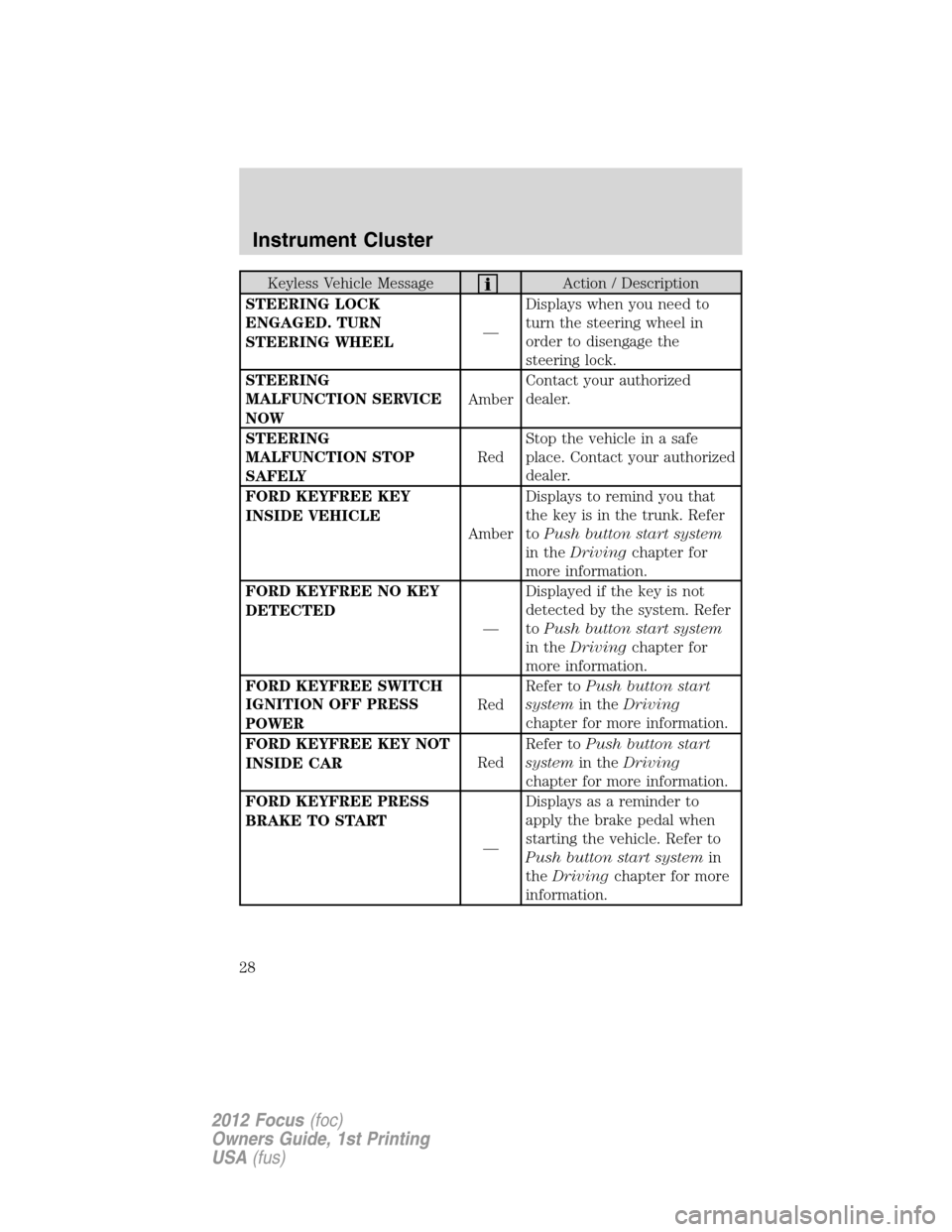
Keyless Vehicle MessageAction / Description
STEERING LOCK
ENGAGED. TURN
STEERING WHEEL—Displays when you need to
turn the steering wheel in
order to disengage the
steering lock.
STEERING
MALFUNCTION SERVICE
NOWAmberContact your authorized
dealer.
STEERING
MALFUNCTION STOP
SAFELYRedStop the vehicle in a safe
place. Contact your authorized
dealer.
FORD KEYFREE KEY
INSIDE VEHICLE
AmberDisplays to remind you that
the key is in the trunk. Refer
toPush button start system
in theDrivingchapter for
more information.
FORD KEYFREE NO KEY
DETECTED
—Displayed if the key is not
detected by the system. Refer
toPush button start system
in theDrivingchapter for
more information.
FORD KEYFREE SWITCH
IGNITION OFF PRESS
POWERRedRefer toPush button start
systemin theDriving
chapter for more information.
FORD KEYFREE KEY NOT
INSIDE CARRedRefer toPush button start
systemin theDriving
chapter for more information.
FORD KEYFREE PRESS
BRAKE TO START
—Displays as a reminder to
apply the brake pedal when
starting the vehicle. Refer to
Push button start systemin
theDrivingchapter for more
information.
Instrument Cluster
28
2012 Focus(foc)
Owners Guide, 1st Printing
USA(fus)
Page 33 of 406
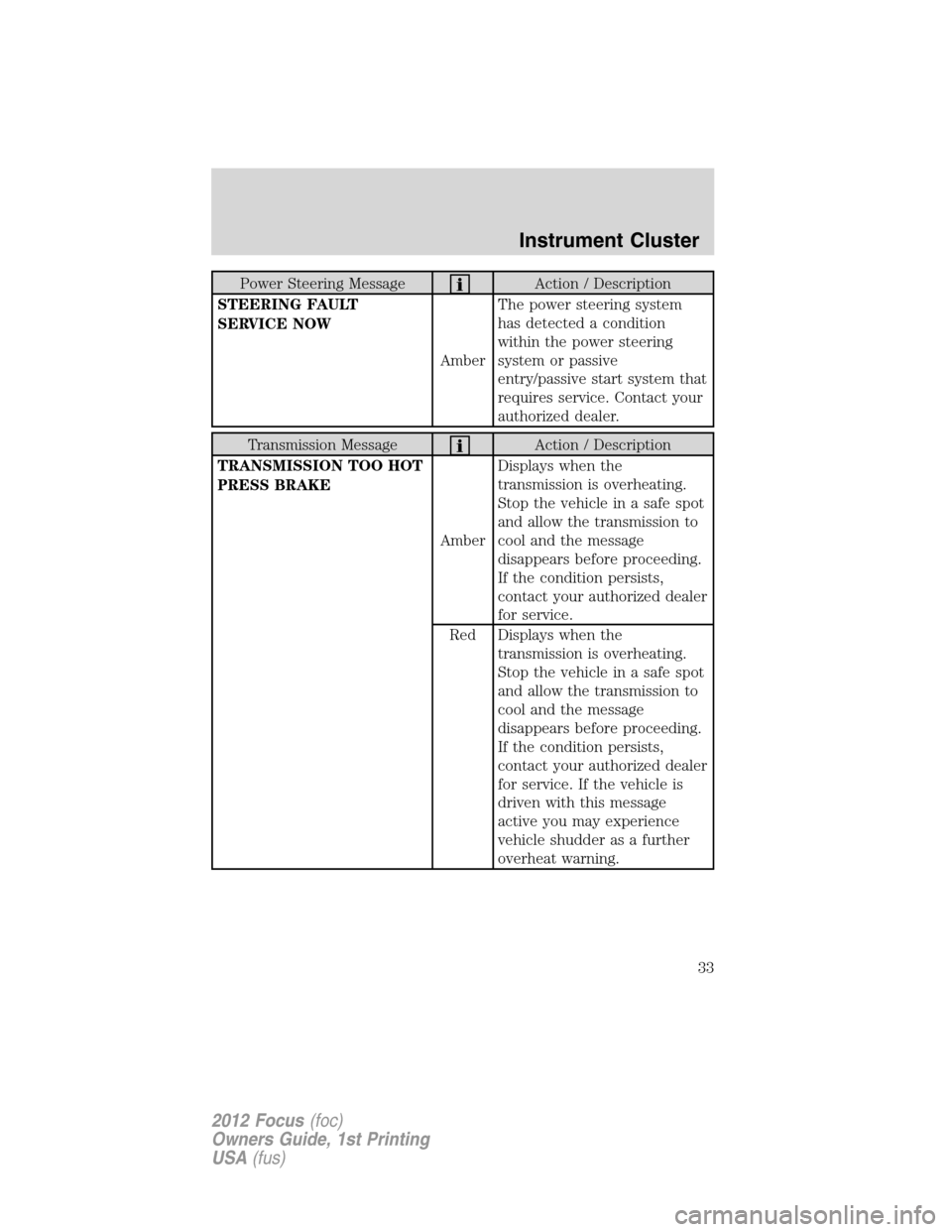
Power Steering MessageAction / Description
STEERING FAULT
SERVICE NOW
AmberThe power steering system
has detected a condition
within the power steering
system or passive
entry/passive start system that
requires service. Contact your
authorized dealer.
Transmission MessageAction / Description
TRANSMISSION TOO HOT
PRESS BRAKE
AmberDisplays when the
transmission is overheating.
Stop the vehicle in a safe spot
and allow the transmission to
cool and the message
disappears before proceeding.
If the condition persists,
contact your authorized dealer
for service.
Red Displays when the
transmission is overheating.
Stop the vehicle in a safe spot
and allow the transmission to
cool and the message
disappears before proceeding.
If the condition persists,
contact your authorized dealer
for service. If the vehicle is
driven with this message
active you may experience
vehicle shudder as a further
overheat warning.
Instrument Cluster
33
2012 Focus(foc)
Owners Guide, 1st Printing
USA(fus)
Page 35 of 406
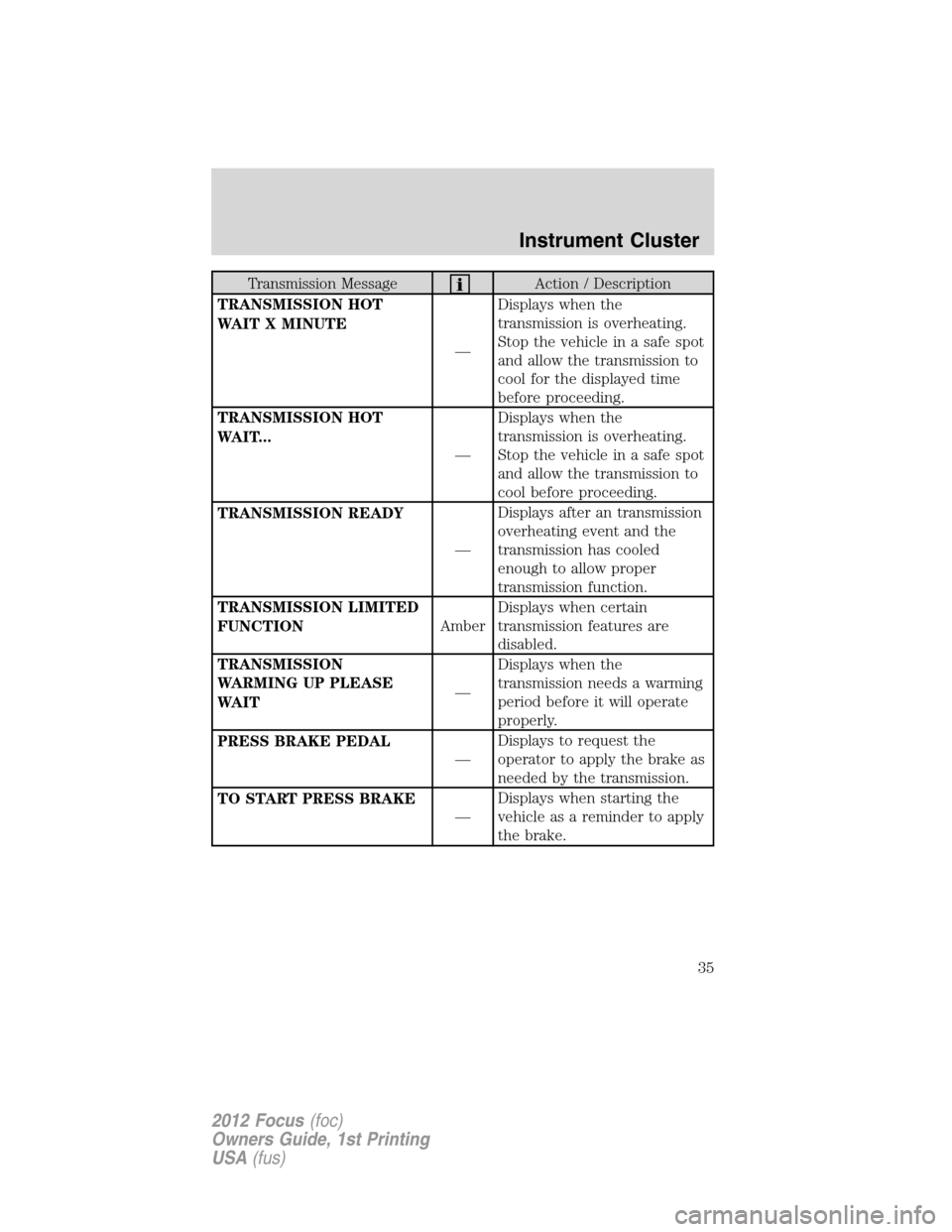
Transmission MessageAction / Description
TRANSMISSION HOT
WAIT X MINUTE
—Displays when the
transmission is overheating.
Stop the vehicle in a safe spot
and allow the transmission to
cool for the displayed time
before proceeding.
TRANSMISSION HOT
WAIT...
—Displays when the
transmission is overheating.
Stop the vehicle in a safe spot
and allow the transmission to
cool before proceeding.
TRANSMISSION READY
—Displays after an transmission
overheating event and the
transmission has cooled
enough to allow proper
transmission function.
TRANSMISSION LIMITED
FUNCTIONAmberDisplays when certain
transmission features are
disabled.
TRANSMISSION
WARMING UP PLEASE
WAIT—Displays when the
transmission needs a warming
period before it will operate
properly.
PRESS BRAKE PEDAL
—Displays to request the
operator to apply the brake as
needed by the transmission.
TO START PRESS BRAKE
—Displays when starting the
vehicle as a reminder to apply
the brake.
Instrument Cluster
35
2012 Focus(foc)
Owners Guide, 1st Printing
USA(fus)
Page 236 of 406
It is recommended that the two front tires or two rear tires generally be
replaced as a pair.
The tire pressure sensors mounted in the wheels (originally installed on
your vehicle) are not designed to be used in aftermarket wheels.
The use of wheels or tires not recommended by Ford Motor Company
may affect the operation of your tire pressure monitoring system.
If the TPMS indicator is flashing, your TPMS is malfunctioning. Your
replacement tire might be incompatible with your TPMS, or some
component of the TPMS may be damaged.
Safety practices
Driving habits have a great deal to do with your tire mileage and safety.
•Observe posted speed limits
•Avoid fast starts, stops and turns
•Avoid potholes and objects on the road
•Do not run over curbs or hit the tire against a curb when parking
WARNING:If your vehicle is stuck in snow, mud, sand, etc.,do
notrapidly spin the tires; spinning the tires can tear the tire and
cause an explosion. A tire can explode in as little as three to five
seconds.
WARNING:Do not spin the wheels at over 35 mph (56 km/h).
The tires may fail and injure a passenger or bystander.
Highway hazards
No matter how carefully you drive there’s always the possibility that you
may eventually have a flat tire on the highway. Drive slowly to the
closest safe area out of traffic. This may further damage the flat tire, but
your safety is more important.
If you feel a sudden vibration or ride disturbance while driving, or you
suspect your tire or vehicle has been damaged, immediately reduce your
speed. Drive with caution until you can safely pull off the road. Stop and
inspect the tires for damage. If a tire is under-inflated or damaged,
deflate it, remove wheel and replace it with your spare tire and wheel. If
you cannot detect a cause, have the vehicle towed to the nearest repair
facility or tire dealer to have the vehicle inspected.
Tires, Wheels and Loading
236
2012 Focus(foc)
Owners Guide, 1st Printing
USA(fus)
Page 243 of 406
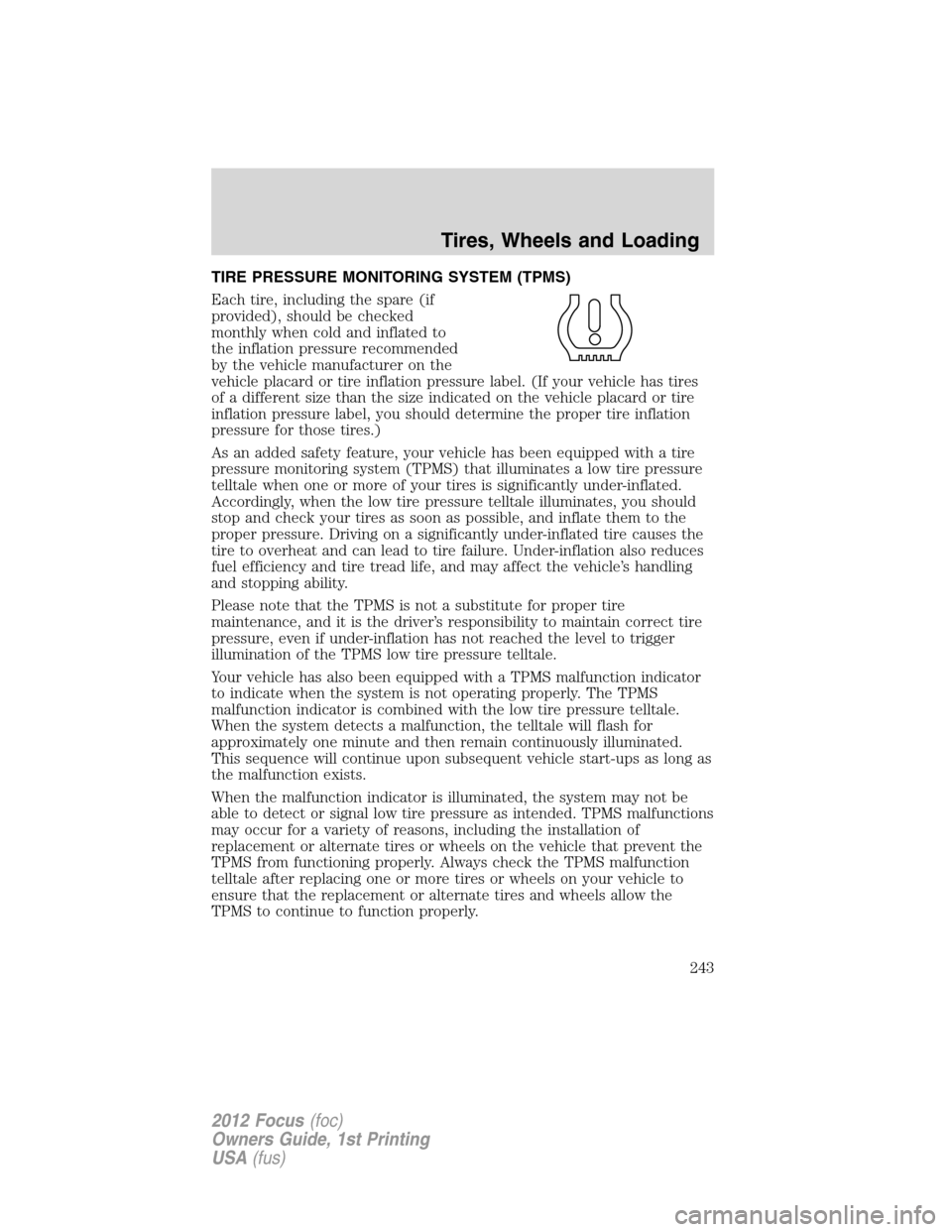
TIRE PRESSURE MONITORING SYSTEM (TPMS)
Each tire, including the spare (if
provided), should be checked
monthly when cold and inflated to
the inflation pressure recommended
by the vehicle manufacturer on the
vehicle placard or tire inflation pressure label. (If your vehicle has tires
of a different size than the size indicated on the vehicle placard or tire
inflation pressure label, you should determine the proper tire inflation
pressure for those tires.)
As an added safety feature, your vehicle has been equipped with a tire
pressure monitoring system (TPMS) that illuminates a low tire pressure
telltale when one or more of your tires is significantly under-inflated.
Accordingly, when the low tire pressure telltale illuminates, you should
stop and check your tires as soon as possible, and inflate them to the
proper pressure. Driving on a significantly under-inflated tire causes the
tire to overheat and can lead to tire failure. Under-inflation also reduces
fuel efficiency and tire tread life, and may affect the vehicle’s handling
and stopping ability.
Please note that the TPMS is not a substitute for proper tire
maintenance, and it is the driver’s responsibility to maintain correct tire
pressure, even if under-inflation has not reached the level to trigger
illumination of the TPMS low tire pressure telltale.
Your vehicle has also been equipped with a TPMS malfunction indicator
to indicate when the system is not operating properly. The TPMS
malfunction indicator is combined with the low tire pressure telltale.
When the system detects a malfunction, the telltale will flash for
approximately one minute and then remain continuously illuminated.
This sequence will continue upon subsequent vehicle start-ups as long as
the malfunction exists.
When the malfunction indicator is illuminated, the system may not be
able to detect or signal low tire pressure as intended. TPMS malfunctions
may occur for a variety of reasons, including the installation of
replacement or alternate tires or wheels on the vehicle that prevent the
TPMS from functioning properly. Always check the TPMS malfunction
telltale after replacing one or more tires or wheels on your vehicle to
ensure that the replacement or alternate tires and wheels allow the
TPMS to continue to function properly.
Tires, Wheels and Loading
243
2012 Focus(foc)
Owners Guide, 1st Printing
USA(fus)
Page 257 of 406
Vehicles with an automatic transmission and push button start
system:
1. Release the parking brake.
2. Activate the ignition by pressing the START/STOP button, butnot
applying the brake pedal.
3. Press the brake pedal, then move the gearshift to the N (Neutral)
position. Theremustbe battery power to properly move the
transmission’s internal components to N (Neutral). Also, moving the
gearshift to the N (Neutral) without first having the ignition on limits the
towing capability to 35 mph (56 km/h) and 50 miles (80 km).
4. Deactivate the ignition by pressing the START/STOP button, butnot
applying the brake pedal.
5. Disconnect the negative (black) cable from the battery. (The door key
[inside the Intelligent Access Key] is needed to lock/unlock doors when
the battery cable is disconnected. Also, the anti-theft system is disabled
until the battery cable is reconnected.) Refer toBatteryin the
Maintenance and Specificationschapter when disconnecting and
reconnecting the battery cable.
6. The maximum towing speed is 70 mph (113 km/h).
7. There is no limitation on towing distance.
8. When done towing, start the engine within 15 minutes of reconnecting
the battery cable. When reconnecting that cable, tighten it until it’s snug
against the terminal; be careful not to overtighten.
Note:The vehicle must be towed in the forward position to ensure no
damage is done to the internal transmission components. In addition, it is
recommended that you follow the instructions provided by the
aftermarket manufacturer of the towing equipment, if provided.
Tires, Wheels and Loading
257
2012 Focus(foc)
Owners Guide, 1st Printing
USA(fus)