drive train FORD FOCUS 2014 3.G User Guide
[x] Cancel search | Manufacturer: FORD, Model Year: 2014, Model line: FOCUS, Model: FORD FOCUS 2014 3.GPages: 492, PDF Size: 7.2 MB
Page 52 of 492
If the airbag readiness lamp is lit, do the following:
The driver or adult passengers should check for any objects that may be
lodged underneath the front passenger seat or cargo interfering with the
seat.
If objects are lodged or cargo is interfering with the seat; please take the
following steps to remove the obstruction:
•Pull the vehicle over.
•Turn the vehicle off.
•Driver or adult passengers should check for any objects lodged
underneath the front passenger seat or cargo interfering with the seat.
•Remove the obstruction(s) (if found).
•Restart the vehicle.
•Wait at least two minutes and verify that the airbag readiness lamp is
no longer illuminated
•If the airbag readiness lamp remains illuminated, this may or may not
be a problem due to the front passenger sensing system.
Do not attempt to repair or service the system. Take your vehicle
immediately to an authorized dealer.
If it is necessary to modify an advanced front airbag system to
accommodate a person with disabilities, contact the Ford Customer
Relationship Center at the phone number shown in theCustomer
Assistancesection of thisOwner’s Manual.
KNEE AIRBAG
A driver’s knee airbag is located under or within the instrument panel.
During a crash, the restraints control module may activate the driver’s
knee airbag based on crash severity and occupant conditions. Under
certain crash and occupant conditions, the driver’s knee airbag may
deploy but the driver’s front airbag may not activate. As with front and
side airbags, it is important to be properly seated and restrained to
reduce the risk of death or serious injury.
To know if the knee airbag is operating properly, seeCrash
Sensors and Airbag Indicatorin this chapter.
Supplementary Restraints System51
2014 Focus(foc)
Owners Guide gf, 1st Printing, October 2012
USA(fus)
Page 54 of 492
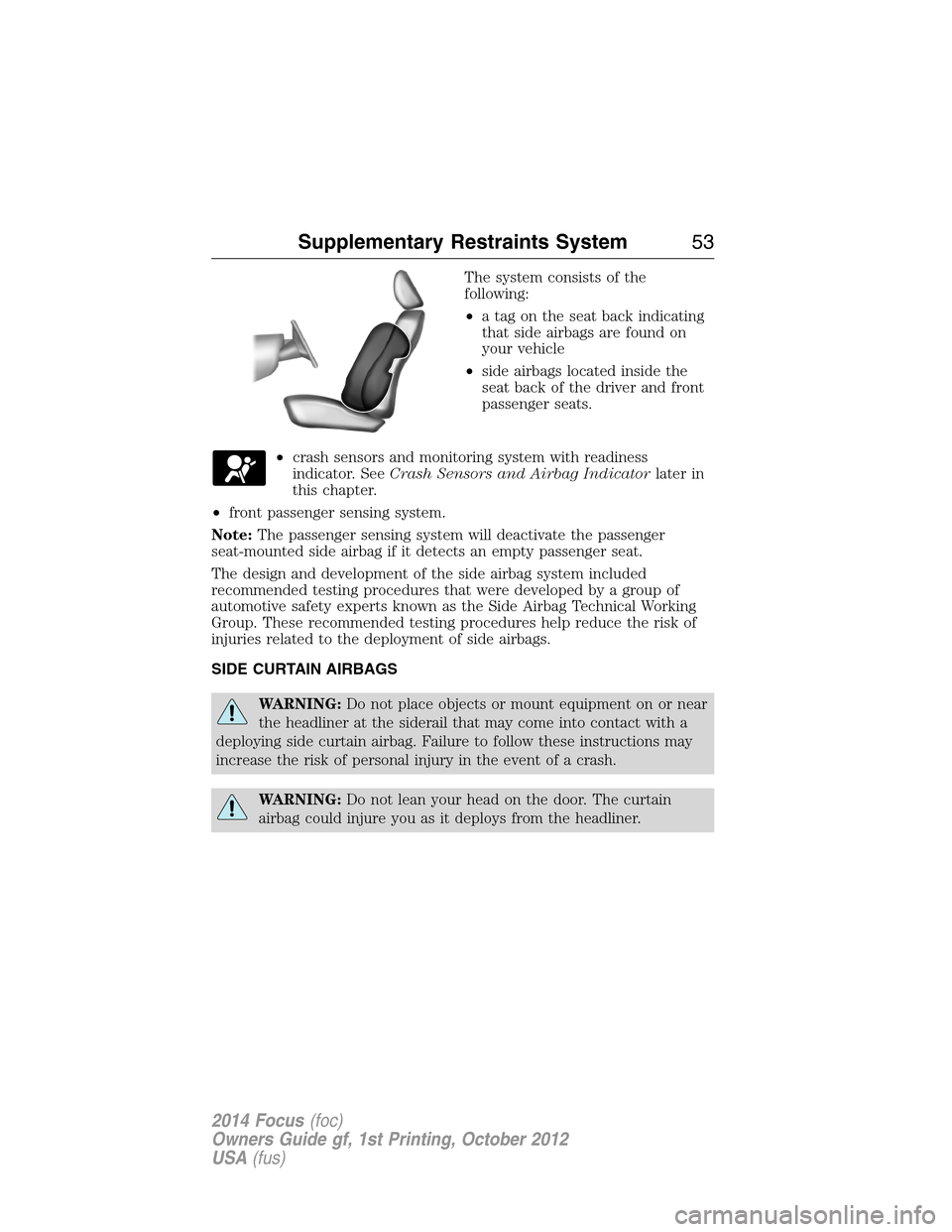
The system consists of the
following:
•a tag on the seat back indicating
that side airbags are found on
your vehicle
•side airbags located inside the
seat back of the driver and front
passenger seats.
•crash sensors and monitoring system with readiness
indicator. SeeCrash Sensors and Airbag Indicatorlater in
this chapter.
•front passenger sensing system.
Note:The passenger sensing system will deactivate the passenger
seat-mounted side airbag if it detects an empty passenger seat.
The design and development of the side airbag system included
recommended testing procedures that were developed by a group of
automotive safety experts known as the Side Airbag Technical Working
Group. These recommended testing procedures help reduce the risk of
injuries related to the deployment of side airbags.
SIDE CURTAIN AIRBAGS
WARNING:Do not place objects or mount equipment on or near
the headliner at the siderail that may come into contact with a
deploying side curtain airbag. Failure to follow these instructions may
increase the risk of personal injury in the event of a crash.
WARNING:Do not lean your head on the door. The curtain
airbag could injure you as it deploys from the headliner.
Supplementary Restraints System53
2014 Focus(foc)
Owners Guide gf, 1st Printing, October 2012
USA(fus)
Page 55 of 492
WARNING:Do not attempt to service, repair, or modify the side
curtain airbags, its fuses, the A, B, or C pillar trim, or the headliner
on a vehicle containing side curtain airbags as you could be seriously
injured or killed. Contact your authorized dealer as soon as possible.
WARNING:All occupants of the vehicle including the driver
should always wear their safety belts even when an airbag
supplemental restraint system and side curtain airbag is provided.
Failure to properly wear your safety belt could seriously increase the
risk of injury or death.
WARNING:To reduce the risk of injury, do not obstruct or place
objects in the deployment path of the side curtain airbag.
WARNING:If the side curtain airbags have deployed, the side
curtain airbags will not function again. The side curtain airbags
(including the A, B and C pillar trim and headliner) must be inspected
and serviced by an authorized dealer. If the side curtain airbag is not
replaced, the unrepaired area will increase the risk of injury in a crash.
A side curtain airbag will deploy during significant side crashes.
The airbags are mounted to the roof side-rail sheet metal, behind the
headliner, above each row of seats. In certain sideways crashes, the side
curtain airbag on the impacted side of the vehicle will be activated.
The side curtain airbags are designed to inflate between the side window
area and occupants to further enhance protection provided in side
impact crashes.
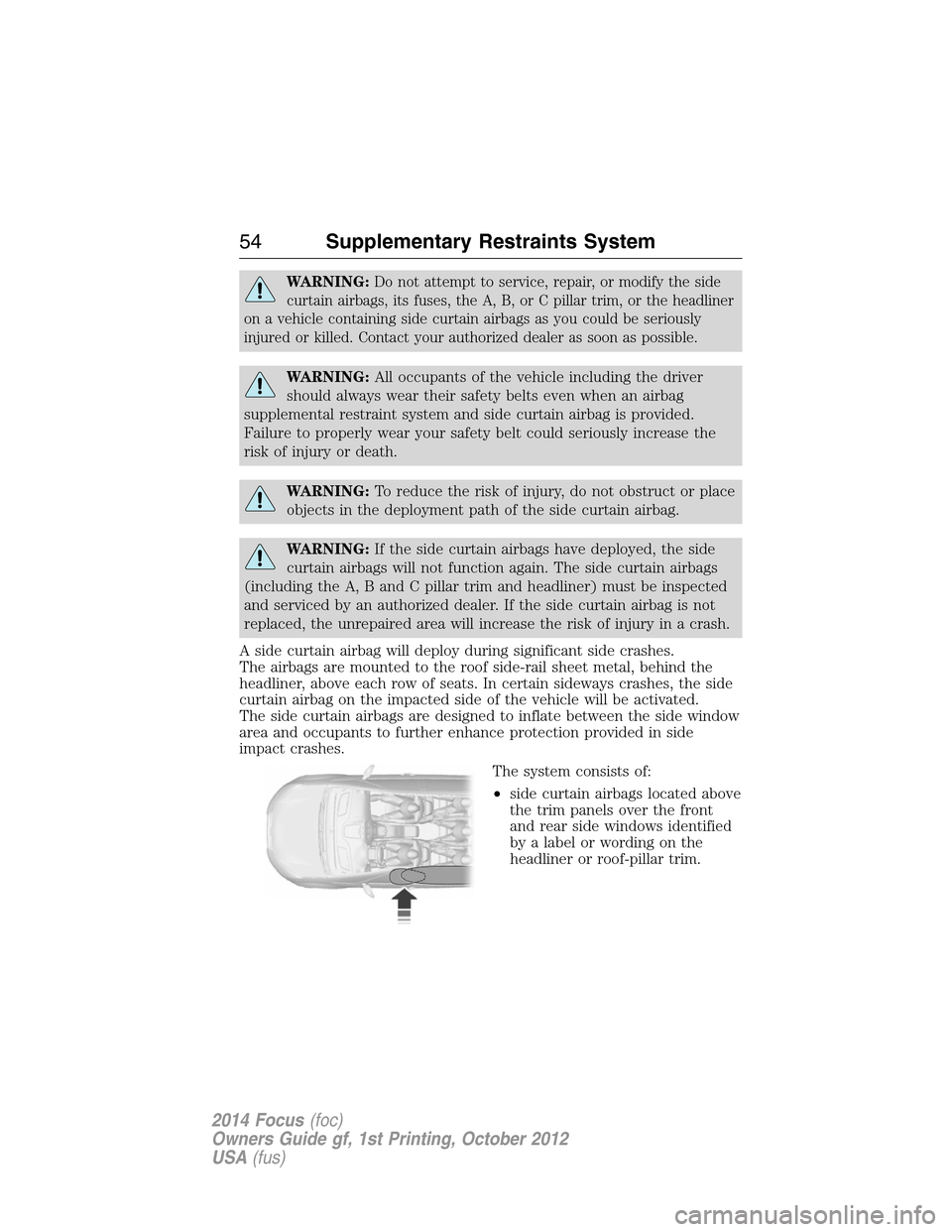
The system consists of:
•side curtain airbags located above
the trim panels over the front
and rear side windows identified
by a label or wording on the
headliner or roof-pillar trim.
54Supplementary Restraints System
2014 Focus(foc)
Owners Guide gf, 1st Printing, October 2012
USA(fus)
Page 56 of 492
•a flexible headliner which opens above the side doors to allow side air
curtain deployment.
•crash sensors and monitoring system with readiness
indicator. SeeCrash sensors and Airbag Indicatorlater in
this chapter.
Children 12 years old and under should always be properly restrained in
the back seats. The side curtain airbags will not interfere with children
restrained using a properly installed child or booster seat because it is
designed to inflate downward from the headliner above the doors along
the side window opening.
The design and development of the side curtain airbags included
recommended testing procedures that were developed by a group of
automotive safety experts known as the Side Airbag Technical Working
Group. These recommended testing procedures help reduce the risk of
injuries related to the deployment of side curtain airbags.
CRASH SENSORS AND AIRBAG INDICATOR
WARNING:Modifying or adding equipment to the front end of
your vehicle (including frame, bumper, front end body structure
and tow hooks) may affect the performance of the airbag system,
increasing the risk of injury. Do not modify the front end of your vehicle.
Your vehicle has a collection of crash and occupant sensors which
provide information to the restraints control module which deploys
(activates) the front safety belt pretensioners, driver airbag, passenger
airbag, knee airbag, seat mounted side airbags, and the side curtain
airbags. Based on the type of crash (frontal impact or side impact) the
restraints control module will deploy the appropriate safety devices.
The restraints control module also monitors the readiness of the above
safety devices plus the crash and occupant sensors. The readiness of the
safety system is indicated by a warning indicator light in the instrument
cluster or by a backup tone if the warning light is not working. See the
Instrument Clusterchapter. Routine maintenance of the airbag is not
required.
Supplementary Restraints System55
2014 Focus(foc)
Owners Guide gf, 1st Printing, October 2012
USA(fus)
Page 57 of 492
A difficulty with the system is indicated by one or more of the following:
•The readiness light will either flash or stay lit.
•The readiness light will not illuminate immediately after the
ignition is turned on.
•A series of five beeps will be heard. The tone pattern will repeat
periodically until the problem or light are repaired.
If any of these things happen, even intermittently, have the supplemental
restraint system serviced at an authorized dealer immediately. Unless
serviced, the system may not function properly in the event of a crash.
The safety belt pretensioners and the airbag supplemental restraint
system are designed to activate when the vehicle sustains frontal
deceleration sufficient to cause the restraints control module to deploy
a safety device.
The fact that the safety belt pretensioners or front airbags did not
activate for both front seat occupants in a crash does not mean that
something is wrong with the system. Rather, it means the restraints
control module determined the accident conditions (such as crash
severity, belt usage) were not appropriate to activate these safety
devices.
•The design of the front airbags is to activate only in frontal and
near-frontal crashes (not rollovers, side impacts or rear impacts)
unless the crash causes sufficient frontal deceleration.
•The design of the safety belt pretensioners is to activate in frontal
and near-frontal crashes, and may also activate when a side curtain
deploys.
•The driver’s knee airbag may deploy based on crash severity and
occupant conditions.
•The design of the side airbags and side curtain airbags is to inflate in
certain side impact crashes. Side airbags may activate in other types
of crashes if the vehicle experiences sufficient sideways motion or
deformation.
AIRBAG DISPOSAL
Contact your authorized dealer as soon as possible. Airbags must be
disposed of by qualified personnel.
56Supplementary Restraints System
2014 Focus(foc)
Owners Guide gf, 1st Printing, October 2012
USA(fus)
Page 134 of 492
•Hold the steering wheel with your arms slightly bent.
•Bend your legs slightly so that you can press the pedals fully.
•Position the shoulder strap of the safety belt over the center of your
shoulder and position the lap strap tightly across your hips.
Make sure that your driving position is comfortable and that you can
maintain full control of your vehicle.
HEAD RESTRAINTS
WARNING:To minimize the risk of neck injury in the event of a
crash, the driver and passenger occupants should not sit in or
operate the vehicle, until the head restraint is placed in its proper
position. The driver should never adjust the head restraint while the
vehicle is in motion.
WARNING:The adjustable head restraint is a safety device.
Whenever possible, it should be installed and properly adjusted
when the seat is occupied.
WARNING:Install the head restraint properly to minimize the
risk of neck injury in the event of a crash.
Note:Adjust the seat back to an upright driving position before
adjusting any head restraint. Adjust the head restraint so that the top
of it is level with the top of your head and as far forward as possible,
remaining comfortable. For occupants of extremely tall stature, adjust
the head restraint to its highest position.
Seats133
2014 Focus(foc)
Owners Guide gf, 1st Printing, October 2012
USA(fus)
Page 145 of 492
GENERAL INFORMATION
WARNING:Extended idling at high engine speeds can produce
very high temperatures in the engine and exhaust system,
creating the risk of fire or other damage.
WARNING:Do not park, idle, or drive your vehicle on dry grass
or other dry ground cover. The emission system heats up the
engine compartment and exhaust system, which can start a fire.
WARNING:Do not start your vehicle in a closed garage or in
other enclosed areas. Exhaust fumes can be toxic. Always open
the garage door before you start the engine.
WARNING:If you smell exhaust fumes inside your vehicle, have
your vehicle checked by an authorized dealer immediately. Do
not drive if you smell exhaust fumes.
If you disconnect the battery, your vehicle may exhibit some unusual driving
characteristics for approximately 5 miles (8 kilometers) after you connect it.
This is because the engine management system must realign itself with the
engine. You may disregard any unusual driving characteristics during this
period.
The powertrain control system meets all Canadian interference-causing
equipment standard requirements regulating the impulse electrical field
or radio noise.
Do not press the accelerator pedal while starting the engine. If you have
difficulty starting the engine, seeFailure to startlater in this section.
144Starting and Stopping the Engine
2014 Focus(foc)
Owners Guide gf, 1st Printing, October 2012
USA(fus)
Page 154 of 492
FUEL QUALITY
Note:Use of any fuel other than those recommended may cause
powertrain damage and a loss of vehicle performance; repairs may not be
covered under warranty.
Choosing the Right Fuel
Use only unleaded fuel or unleaded fuel blended with a maximum of
15% ethanol. Do not use fuel ethanol (E85), diesel fuel, fuel- methanol,
leaded fuel or any other fuel because it could damage or impair the
emission control system.
Choosing the Right Fuel With a Flex Fuel Vehicle (If Equipped)
Note:If your vehicle is flex fuel capable, it will have a yellow bezel
placed over the fuel fill inlet.
Flex fuel vehicles are designed to use unleaded gasoline or an ethanol
fuel blend that contain up to 85% ethanol. It is also acceptable to use
any mixture of unleaded gasoline and ethanol fuel that contains up to
85% ethanol. An ethanol fuel blend that contains 85% ethanol is labeled
as E85 at the service station.
It is best not to alternate repeatedly between gasoline and E85.
If you do switch fuels, it is recommended that you add as much fuel as
possible—at least half a tank. Do not add less than five gallons
(18.9 liters) when refueling. You should drive the vehicle immediately
after refueling for at least 5 miles (8 kilometers) to allow the vehicle to
adapt to the change in ethanol concentration. If you exclusively use E85
fuel, it is recommended to fill the fuel tank with regular unleaded
gasoline at each scheduled oil change.
Octane Recommendations
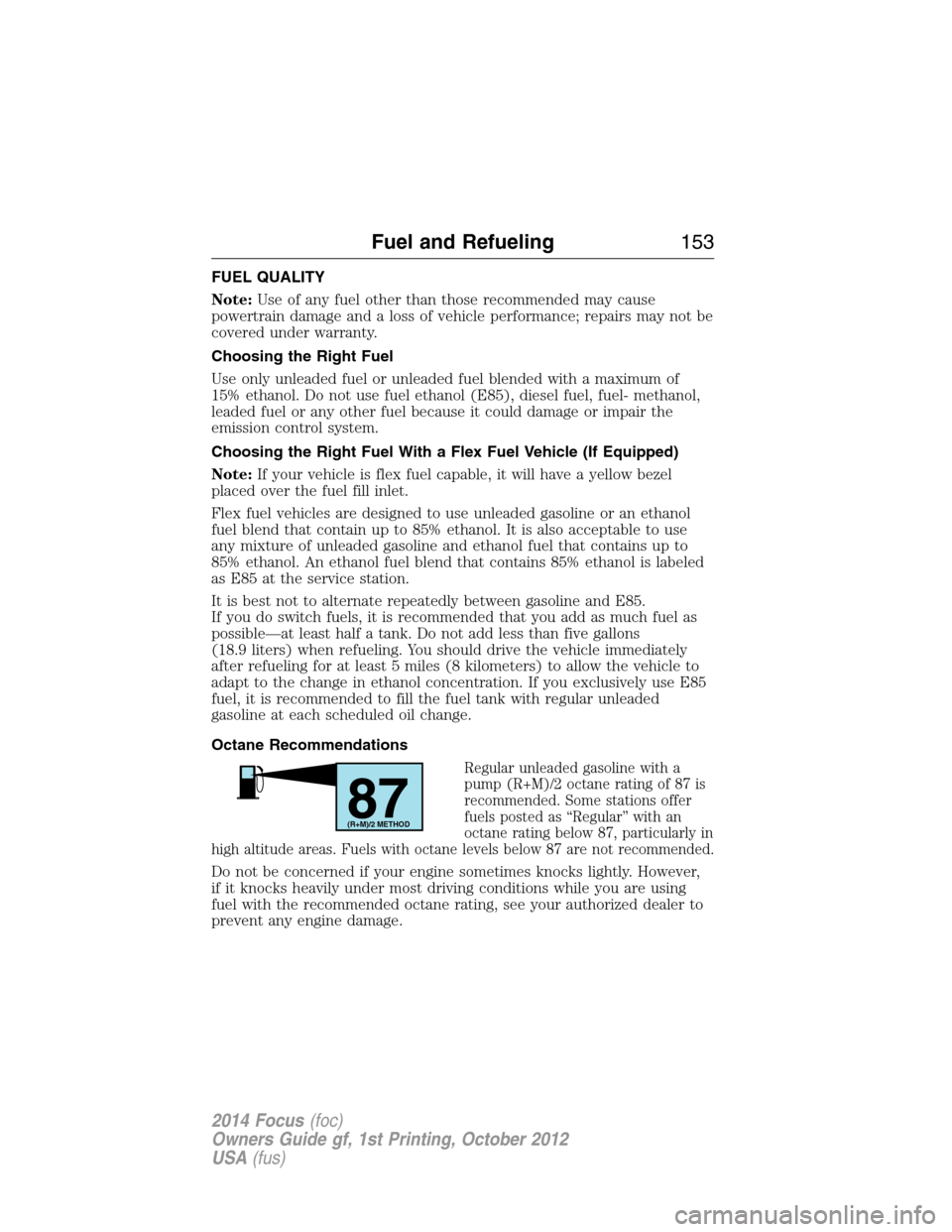
Regular unleaded gasoline with a
pump (R+M)/2 octane rating of 87 is
recommended. Some stations offer
fuels posted as “Regular” with an
octane rating below 87, particularly in
high altitude areas. Fuels with octane levels below 87 are not recommended.
Do not be concerned if your engine sometimes knocks lightly. However,
if it knocks heavily under most driving conditions while you are using
fuel with the recommended octane rating, see your authorized dealer to
prevent any engine damage.
87(R+M)/2 METHOD
Fuel and Refueling153
2014 Focus(foc)
Owners Guide gf, 1st Printing, October 2012
USA(fus)
Page 202 of 492
The front wheels (drive wheels) must be on a tow dolly when towing
your vehicle from the rear using wheel lift equipment. This prevents
damage to the transmission.
We recommend placing the rear wheels on a tow dolly when towing your
vehicle from the front using wheel lift equipment. This prevents damage
to the rear fascia.
TOWING THE VEHICLE ON FOUR WHEELS
Emergency Towing
If your vehicle becomes inoperable (without access to wheel dollies,
car-hauling trailer, or flatbed transport vehicle), it can be flat-towed
(all wheels on the ground, regardless of the powertrain and transmission
configuration) under the following conditions:
•Your vehicle is facing forward for towing in a forward direction.
•Place the transmission in positionN.SeeAutomatic transmissionin
theTransmissionchapter if you cannot move the transmission
intoN.
•Maximum speed is 35 mph (56 km/h).
•Maximum distance is 50 miles (80 kilometers).
Recreational Towing
Note:Put your climate control system in recirculated air mode to
prevent exhaust fumes from entering your vehicle. Refer to theClimate
Controlschapter for more information.
Note:You must tow your vehicle in the forward direction to avoid
damage to the internal transmission components. In addition, we
recommend you follow the instructions provided by the aftermarket
manufacturer of the towing equipment, if provided.
Follow these guidelines if you have a need for recreational towing, such
as towing your vehicle behind a motorhome. We designed these
guidelines to prevent damage to your transmission.
Towing201
2014 Focus(foc)
Owners Guide gf, 1st Printing, October 2012
USA(fus)
Page 295 of 492
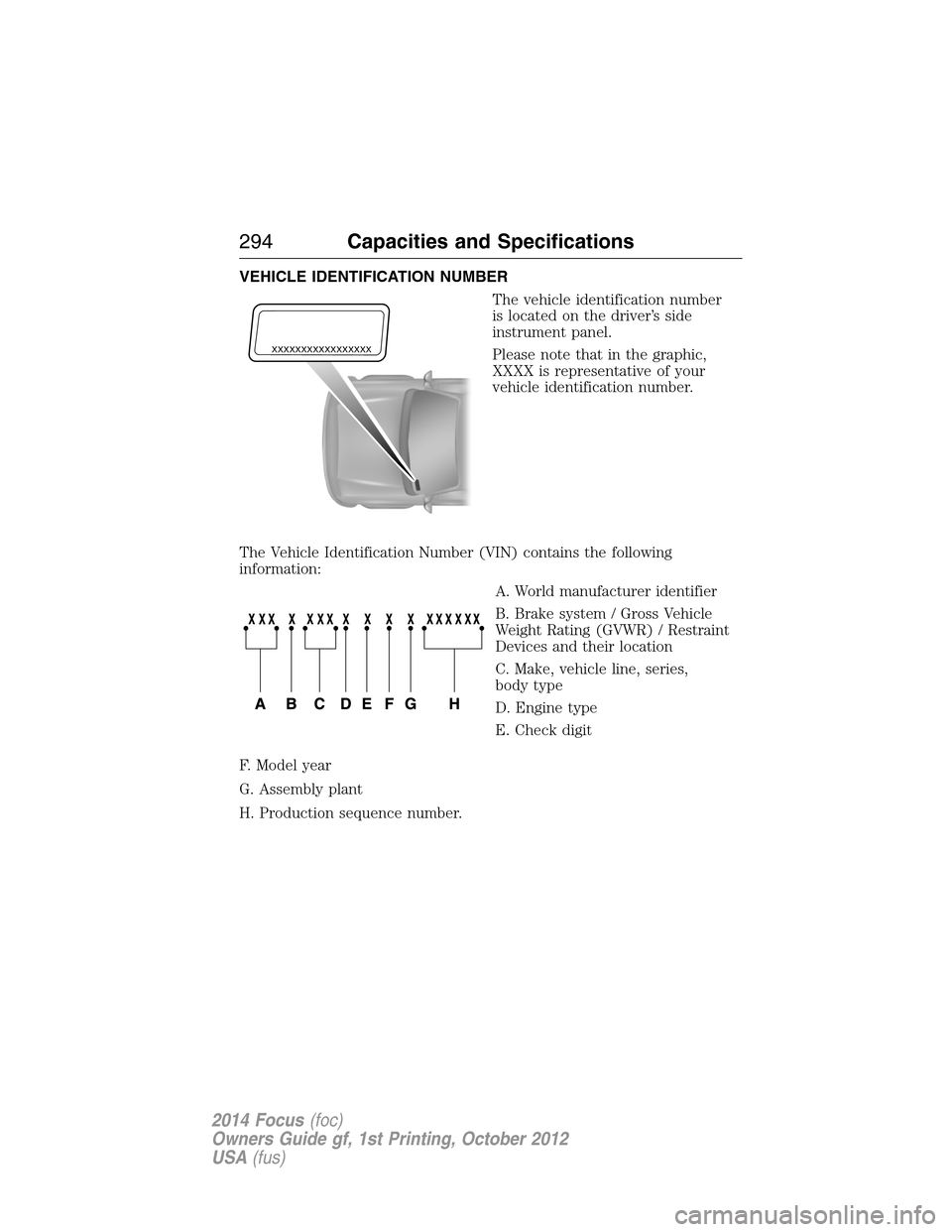
VEHICLE IDENTIFICATION NUMBER
The vehicle identification number
is located on the driver’s side
instrument panel.
Please note that in the graphic,
XXXX is representative of your
vehicle identification number.
The Vehicle Identification Number (VIN) contains the following
information:
A. World manufacturer identifier
B. Brake system / Gross Vehicle
Weight Rating (GVWR) / Restraint
Devices and their location
C. Make, vehicle line, series,
body type
D. Engine type
E. Check digit
F. Model year
G. Assembly plant
H. Production sequence number.
XXXXXXXXXXXXXXXXX
294Capacities and Specifications
2014 Focus(foc)
Owners Guide gf, 1st Printing, October 2012
USA(fus)