parking brake FORD FOCUS 2014 3.G User Guide
[x] Cancel search | Manufacturer: FORD, Model Year: 2014, Model line: FOCUS, Model: FORD FOCUS 2014 3.GPages: 492, PDF Size: 7.2 MB
Page 150 of 492

1.If your vehicle has an ignition key,move the transmission
selector lever to positionN(automatic transmission) or neutral
(manual transmission) and use the brakes to bring your vehicle to a
safe stop. When your vehicle has stopped, move the transmission
selector lever to positionP(automatic transmission) or1(manual
transmission) and turn the key to position0.
2.If your vehicle has a keyless start system,move the transmission
selector lever to positionNand use the brakes to bring your vehicle
to a safe stop. When your vehicle has stopped, move the transmission
selector lever to positionP.Switch the ignition off by pressing and
holding the button for one second, or pressing it three times within
two seconds.
3. Apply the parking brake.
Guarding Against Exhaust Fumes
WARNING:If you smell exhaust fumes inside your vehicle,
have this checked immediately. Do not drive your vehicle if you
smell exhaust fumes. Carbon monoxide is present in exhaust fumes.
Take precautions to avoid its dangerous effects.
Important Ventilating Information
If you stop your vehicle and leave the engine idling for long periods,
we recommend that you do one of the following:
•Open the windows at least 1 inch (2.5 centimeters).
•Set your climate control to outside air.
ENGINE BLOCK HEATER (IF EQUIPPED)
WARNING:Failure to follow engine block heater instructions
could result in property damage or physical injury.
WARNING:Do not use your heater with ungrounded electrical
systems or two-pronged (cheater) adapters. There is a risk of
electrical shock.
Note:The heater is most effective when outdoor temperatures are
below 0°F (-18°C).
Starting and Stopping the Engine149
2014 Focus(foc)
Owners Guide gf, 1st Printing, October 2012
USA(fus)
Page 163 of 492
AUTOMATIC TRANSMISSION
WARNING:Always set the parking brake fully and make sure
the gearshift is latched in P (Park). Turn the ignition to the off
position and remove the key whenever you leave your vehicle.
WARNING:Do not apply the brake pedal and accelerator pedal
simultaneously. Applying both pedals simultaneously for more
than three seconds will limit engine rpm, which may result in difficulty
maintaining speed in traffic and could lead to serious injury.
PowerShift Six-Speed Automatic Transmission
Your vehicle has been designed to improve fuel economy by reducing
fuel usage while compared to a traditional automatic transmission. When
you take your foot off the accelerator pedal and the vehicle begins to
slow down you may perceive a light to medium braking sensation as the
transmissions makes adjustments.
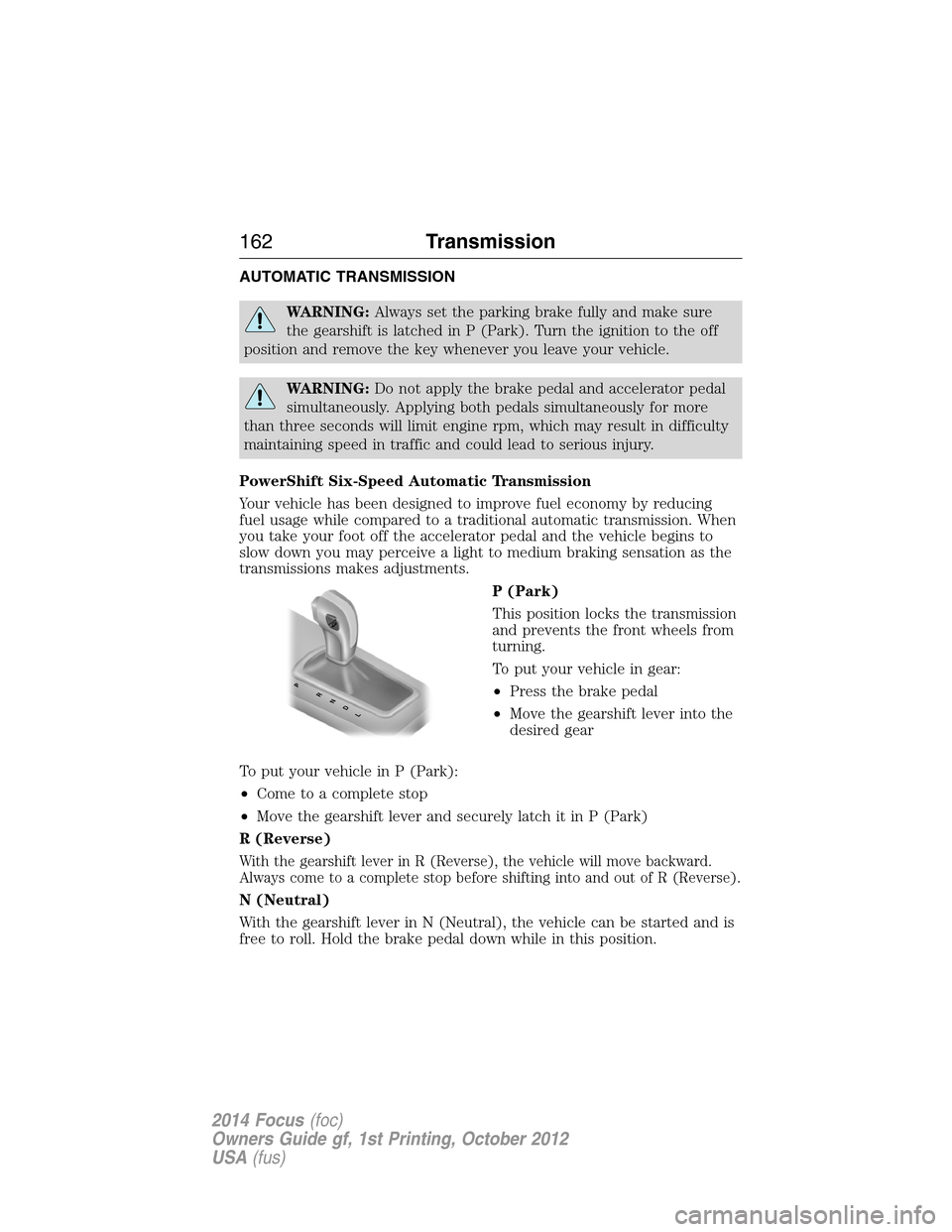
P (Park)
This position locks the transmission
and prevents the front wheels from
turning.
To put your vehicle in gear:
•Press the brake pedal
•Move the gearshift lever into the
desired gear
To put your vehicle in P (Park):
•Come to a complete stop
•Move the gearshift lever and securely latch it in P (Park)
R (Reverse)
With the gearshift lever in R (Reverse), the vehicle will move backward.
Always come to a complete stop before shifting into and out of R (Reverse).
N (Neutral)
With the gearshift lever in N (Neutral), the vehicle can be started and is
free to roll. Hold the brake pedal down while in this position.
PRNDL
162Transmission
2014 Focus(foc)
Owners Guide gf, 1st Printing, October 2012
USA(fus)
Page 166 of 492
Upshift to the recommended shift speeds according to the following chart.
Upshifts when accelerating (recommended for best fuel
economy)
Shift from:
1 - 2 15 mph (24 km/h)
2 - 3 25 mph (40 km/h)
3 - 4 40 mph (64 km/h)
4 - 5 45 mph (72 km/h)
5 - 6 50 mph (80 km/h)
The instrument cluster will show the current selected gear you are in.
SelectShift will automatically make some downshifts for you if it has
determined that you have not downshifted in time. Although SelectShift
will make some downshifts for you, it will still allow you to downshift at
any time as long as SelectShift determines that the engine will not be
damaged from over-revving.
Note:If manual control is no longer desired, return the gear shift lever
from S (Sport) to D (Drive).
Note:Engine damage may occur if excessive engine revving is held
without shifting.
Brake-Shift Interlock
WARNING:Do not drive your vehicle until you verify that the
brake lamps are working.
WARNING:When doing this procedure, you will be taking the
vehicle out of park which means the vehicle can roll freely. To
avoid unwanted vehicle movement, always fully set the parking brake
prior to doing this procedure. Use wheel chocks if appropriate.
WARNING:If the parking brake is fully released, but the brake
warning lamp remains illuminated, the brakes may not be
working properly. See your authorized dealer.
Transmission165
2014 Focus(foc)
Owners Guide gf, 1st Printing, October 2012
USA(fus)
Page 167 of 492
This vehicle is equipped with a brake-shift interlock feature that prevents
the gearshift lever from being moved from P (Park) when the ignition is
in the on position unless the brake pedal is pressed.
If you cannot move the gearshift lever out of P (Park) with ignition in
the on position and the brake pedal pressed, it is possible that a fuse has
blown or the vehicle’s brake lamps are not operating properly. Refer to
Fuses and relaysin theRoadside Emergencieschapter.
If the fuse is not blown and the brake lamps are working properly,
the following procedure will allow you to move the gearshift lever from
P (Park):
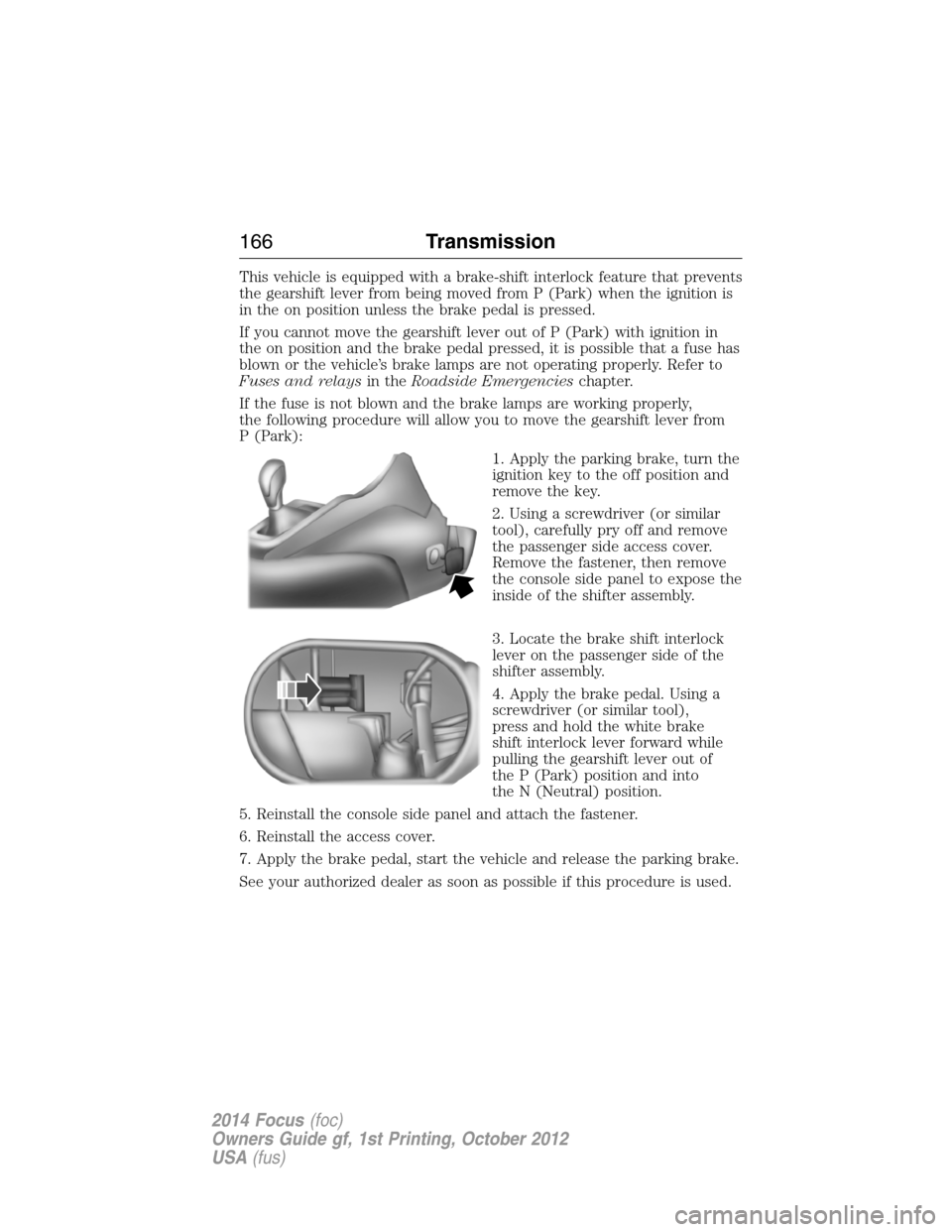
1. Apply the parking brake, turn the
ignition key to the off position and
remove the key.
2. Using a screwdriver (or similar
tool), carefully pry off and remove
the passenger side access cover.
Remove the fastener, then remove
the console side panel to expose the
inside of the shifter assembly.
3. Locate the brake shift interlock
lever on the passenger side of the
shifter assembly.
4. Apply the brake pedal. Using a
screwdriver (or similar tool),
press and hold the white brake
shift interlock lever forward while
pulling the gearshift lever out of
the P (Park) position and into
the N (Neutral) position.
5. Reinstall the console side panel and attach the fastener.
6. Reinstall the access cover.
7. Apply the brake pedal, start the vehicle and release the parking brake.
See your authorized dealer as soon as possible if this procedure is used.
166Transmission
2014 Focus(foc)
Owners Guide gf, 1st Printing, October 2012
USA(fus)
Page 168 of 492

If Your Vehicle Gets Stuck in Mud or Snow
Note:Do not rock the vehicle if the engine is not at normal operating
temperature or damage to the transmission may occur.
Note:Do not rock the vehicle for more than a minute or damage to the
transmission and tires may occur, or the engine may overheat.
If your vehicle gets stuck in mud or snow, it may be rocked out by
shifting between forward and reverse gears, stopping between shifts in a
steady pattern. Press lightly on the accelerator in each gear.
MANUAL TRANSMISSION (IF EQUIPPED)
Using the Clutch
Manual transmission vehicles have a starter interlock that prevents
starting the engine unless the clutch pedal is fully pressed.
To start the vehicle:
1. Make sure the parking brake is fully set.
2. Press the clutch pedal to the floor, then put the
gearshift lever in the neutral position.
3. Start the engine.
4. Press the brake pedal and move the gearshift
lever to the desired gear; position 1 or position R.
5. Release the parking brake, then slowly release
the clutch pedal while slowly pressing on the
accelerator.
During each shift, the clutch pedal must be fully pressed to the floor.
Make sure the floor mat is properly positioned so it does not interfere
with the full extension of the clutch pedal.
Note:Failure to fully press the clutch pedal to the floor may cause
increased shift efforts, prematurely wear transmission components or
damage the transmission.
Note:Do not drive with your foot resting on the clutch pedal or use the
clutch pedal to hold your vehicle at a standstill while waiting on a hill.
These actions will reduce the life of the clutch and could nullify a clutch
warranty claim.
135
24R
Transmission167
2014 Focus(foc)
Owners Guide gf, 1st Printing, October 2012
USA(fus)
Page 170 of 492

Parking Your Vehicle
WARNING:Do not park your vehicle in Neutral, it may move
unexpectedly and injure someone. Use 1 (First) gear and set the
parking brake fully.
To park your vehicle:
1. Apply the brake and shift into the neutral position.
2. Fully apply the parking brake, hold the clutch pedal down, then shift
into position 1.
3. Turn the ignition off.
HILL START ASSIST (IF EQUIPPED)
WARNING:The hill start assist feature does not replace the
parking brake. When you leave the vehicle, always apply the
parking brake and shift the transmission into P (Park) for automatic
transmission or 1st gear for manual transmissions.
WARNING:You must remain in the vehicle once you have
activated the hill start assist feature.
WARNING:During all times, you are responsible for controlling
the vehicle, supervising the hill start assist system and
intervening, if required.
WARNING:If the engine is revved excessively, or if a
malfunction is detected when the hill start assist feature is active,
the hill start assist feature will be deactivated.
This feature makes it easier to pull away when the vehicle is on a slope
without the need to use the parking brake. When this feature is active,
the vehicle will remain stationary on the slope for two to three seconds
after you release the brake pedal. This allows you time to move your
foot from the brake to the accelerator pedal. The brakes are released
automatically once the engine has developed sufficient drive to prevent
Transmission169
2014 Focus(foc)
Owners Guide gf, 1st Printing, October 2012
USA(fus)
Page 171 of 492
the vehicle from rolling down the slope. This is an advantage when
pulling away on a slope, (for example from a car park ramp, traffic lights
or when reversing uphill into a parking space).
This feature is activated automatically on any slope that can result in
significant vehicle rollback.
Using Hill Start Assist
Note:If the engine is revved excessively, hill start assist will be
deactivated.
1. Press the brake pedal to bring the vehicle to a complete standstill.
Keep the brake pedal pressed.
2. If the sensors detect that the vehicle is on a slope, the hill start assist
feature will be activated automatically.
3. When you remove your foot from the brake pedal, the vehicle will
remain on the slope without rolling away for approximately two or three
seconds. This hold time will automatically be extended if you are in the
process of driving off.
4. Drive off in the normal manner. The brakes will be released
automatically.
Note:Using the brakes and the hill start assist is the recommended
method of holding a position on a hill. It is not recommended to use the
accelerator pedal and engine torque to hold a hill position for an
extended period of time. Doing so will over heat the clutch in vehicles
equipped with a manual transmissions.
170Transmission
2014 Focus(foc)
Owners Guide gf, 1st Printing, October 2012
USA(fus)
Page 172 of 492
GENERAL INFORMATION
Note:Occasional brake noise is normal. If a metal-to-metal, continuous
grinding or continuous squeal sound is present, the brake linings may be
worn out. Have them inspected by an authorized dealer. If your vehicle
has continuous vibration or shudder in the steering wheel while braking,
have your vehicle inspected by an authorized dealer.
Note:Brake dust may accumulate on the wheels, even under normal
driving conditions. Some dust is inevitable as the brakes wear and does
not contribute to brake noise. See theVehicle Carechapter for wheel
cleaning instructions.
See theInstrument Clusterchapter for information on the
brake system warning light.
Wet brakes result in reduced braking efficiency. Gently press the brake
pedal a few times when driving from a car wash or standing water to dry
the brakes.
Brake Over Accelerator
In the event the accelerator pedal becomes stuck or entrapped, apply
steady and firm pressure to the brake pedal to slow your vehicle and
reduce engine power. If you experience this condition, apply the brakes
and bring your vehicle to a safe stop. Turn the engine off, shift to
positionPand apply the parking brake, then inspect the accelerator
pedal for any interferences. If none are found and the condition persists,
have your vehicle towed to the nearest authorized dealer.
Brake Assist
Brake assist detects when you brake heavily by measuring the rate at
which you press the brake pedal. It provides maximum braking efficiency
as long as you press the pedal. Brake assist can reduce stopping
distances in critical situations.
Brakes171
2014 Focus(foc)
Owners Guide gf, 1st Printing, October 2012
USA(fus)
Page 173 of 492
Anti-Lock Brake System
This system helps you maintain steering control during emergency stops
by keeping the brakes from locking.
This lamp momentarily illuminates when you turn the ignition
on. If the light does not illuminate during start-up, remains on
or flashes, the anti-lock brake system may be disabled and may
need to be serviced.
If the anti-lock brake system is disabled, normal braking is still
effective. If the brake warning lamp illuminates with the parking
brake released, have your brake system serviced immediately.
HINTS ON DRIVING WITH ANTI-LOCK BRAKES
When the system is operating, the brake pedal will pulse and may travel
further. Maintain pressure on the brake pedal. You may also hear a noise
from the system. This is normal.
The anti-lock braking system will not eliminate the dangers inherent when:
•you drive too closely to the vehicle in front of you.
•your vehicle is hydroplaning.
•you take corners too fast.
•the road surface is poor.
PARKING BRAKE
WARNING:If the parking brake is fully released, but the brake
warning lamp remains illuminated, the brakes may not be
working properly. See your authorized dealer as soon as possible.
WARNING:Always set the parking brake fully and make sure
that the transmission selector lever is securely latched in position
P(automatic transmission) or position1(manual transmission).
To set the parking brake, pull the parking brake handle up as far as possible.
To release the parking brake:
1.
Press and hold the button located at the end of the parking brake handle.
2. Pull the handle up slightly, then push the handle down.
172Brakes
2014 Focus(foc)
Owners Guide gf, 1st Printing, October 2012
USA(fus)
Page 177 of 492
SENSING SYSTEM (IF EQUIPPED)
WARNING:To help avoid personal injury, please read and
understand the limitations of the system as contained in this
section. Sensing is only an aid for some (generally large and fixed)
objects when moving in reverse on a flat surface at parking speeds.
Traffic control systems, inclement weather, air brakes, and external
motors and fans may also affect the function of the sensing system;
this may include reduced performance or a false activation.
WARNING:To help avoid personal injury, always use caution
when in R (Reverse) and when using the sensing system.
WARNING:This system is not designed to prevent contact with
small or moving objects. The system is designed to provide a
warning to assist the driver in detecting large stationary objects to
avoid damaging the vehicle. The system may not detect smaller objects,
particularly those close to the ground.
WARNING:Certain add-on devices such as large trailer hitches,
bike or surfboard racks and any device that may block the normal
detection zone of the system, may create false beeps.
Note:
Keep the sensors (located on the bumper/fascia) free from snow, ice
and large accumulations of dirt. If the sensors are covered, the system’s
accuracy can be affected. Do not clean the sensors with sharp objects.
Note:If your vehicle sustains damage to the bumper/fascia, leaving it
misaligned or bent, the sensing zone may be altered causing inaccurate
measurement of obstacles or false alarms.
Note:If your vehicle is equipped with MyKey®, it is possible to prevent
turning the sensing system off. Refer to theMyKey®chapter.
The sensing system warns the driver of obstacles within a certain range
of the bumper area. The system turns on automatically whenever the
ignition is switched on.
When receiving a detection warning, the radio volume is reduced to a
predetermined level. After the warning goes away, the radio volume
returns to the previous level.
176Parking Aids
2014 Focus(foc)
Owners Guide gf, 1st Printing, October 2012
USA(fus)