clock FORD FUSION HYBRID 2011 User Guide
[x] Cancel search | Manufacturer: FORD, Model Year: 2011, Model line: FUSION HYBRID, Model: FORD FUSION HYBRID 2011Pages: 345, PDF Size: 2.3 MB
Page 290 of 345
7. Drive the vehicle to complete the relearning process.
•The vehicle may need to be driven 10 miles (16 km) or more to
relearn the idle and fuel trim strategy.
•If you do not allow the engine to relearn its idle trim, the idle
quality of your vehicle may be adversely affected until the idle
trim is eventually relearned.
If the battery has been disconnected or a new battery has been installed,
the clock and the preset radio stations must be reset once the battery is
reconnected.
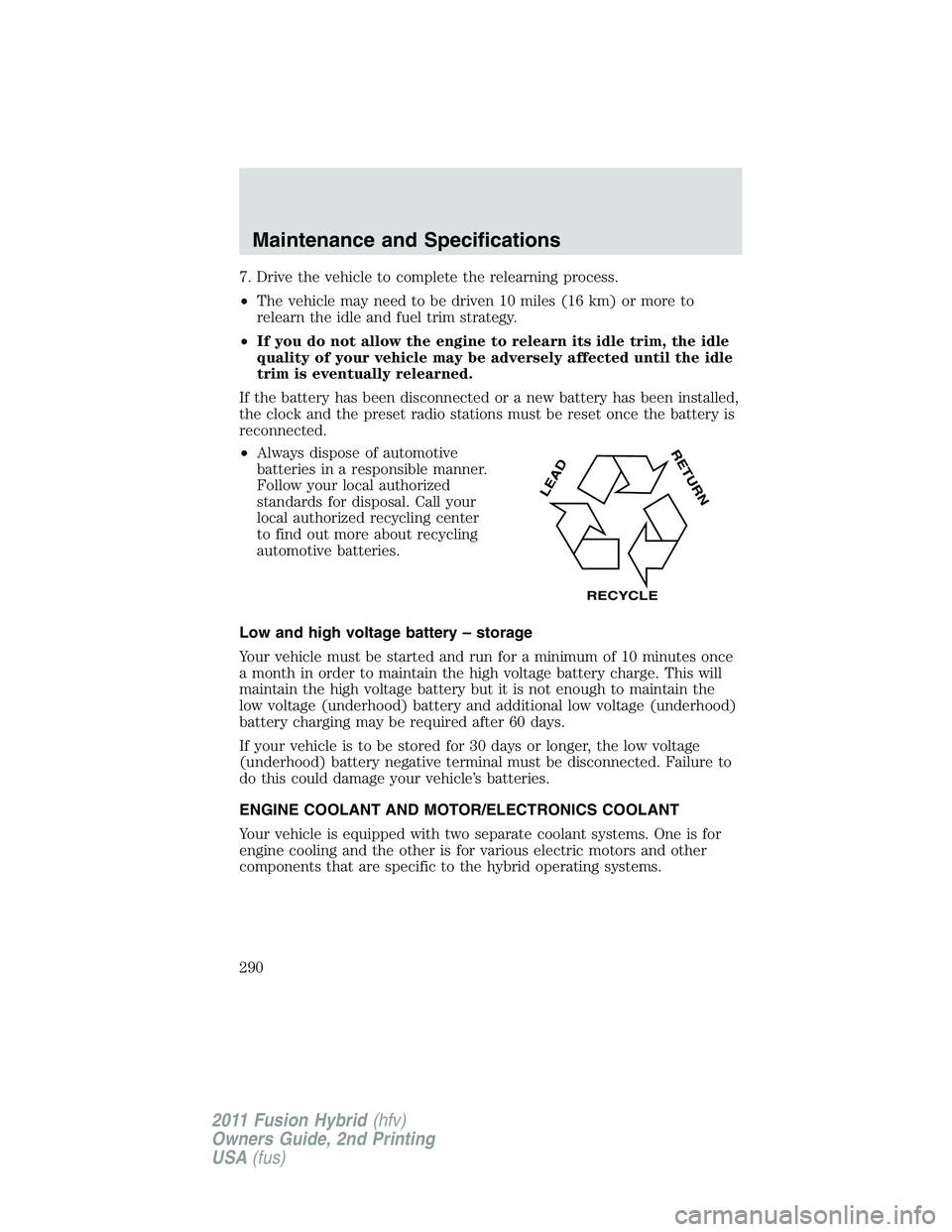
•Always dispose of automotive
batteries in a responsible manner.
Follow your local authorized
standards for disposal. Call your
local authorized recycling center
to find out more about recycling
automotive batteries.
Low and high voltage battery – storage
Your vehicle must be started and run for a minimum of 10 minutes once
a month in order to maintain the high voltage battery charge. This will
maintain the high voltage battery but it is not enough to maintain the
low voltage (underhood) battery and additional low voltage (underhood)
battery charging may be required after 60 days.
If your vehicle is to be stored for 30 days or longer, the low voltage
(underhood) battery negative terminal must be disconnected. Failure to
do this could damage your vehicle’s batteries.
ENGINE COOLANT AND MOTOR/ELECTRONICS COOLANT
Your vehicle is equipped with two separate coolant systems. One is for
engine cooling and the other is for various electric motors and other
components that are specific to the hybrid operating systems.
L
E
A
D
RETURN
RECYCLE
Maintenance and Specifications
290
2011 Fusion Hybrid(hfv)
Owners Guide, 2nd Printing
USA(fus)
Page 293 of 345
•A large amount of water without engine coolant may be added, in case
of emergency, to reach a vehicle service location. In this instance, the
cooling system must be drained and refilled with a 50/50 mixture of
engine coolant and distilled water as soon as possible. Water alone
(without engine coolant) can cause engine damage from corrosion,
overheating or freezing.
•Do not use alcohol, methanol, brine or any engine coolants
mixed with alcohol or methanol antifreeze (coolant).Alcohol
and other liquids can cause engine damage from overheating or
freezing.
•Do not add extra inhibitors or additives to the coolant.These
can be harmful and compromise the corrosion protection of the engine
coolant.
For vehicles with overflow coolant systems with a non-pressurized cap
on the coolant recovery system, add coolant to the coolant recovery
reservoir when the engine is cool. Add the proper mixture of coolant and
distilled water to the FULL COLD level. For all other vehicles which have
a coolant degas system with a pressurized cap, or if it is necessary to
remove the coolant pressure relief cap on the radiator of a vehicle with
an overflow system, follow these steps to add engine coolant.
WARNING:To reduce the risk of personal injury, make sure the
engine is cool before unscrewing the coolant pressure relief cap.
The cooling system is under pressure; steam and hot liquid can come
out forcefully when the cap is loosened slightly.
Add the proper mixture of coolant and water to the cooling system by
following these steps:
1. Before you begin, turn the engine off and let it cool.
2. When the engine is cool, wrap a thick cloth around the coolant
pressure relief cap on the coolant reservoir (a translucent plastic bottle).
Slowly turn cap counterclockwise (left) until pressure begins to release.
3. Step back while the pressure releases.
4. When you are sure that all the pressure has been released, use the
cloth to turn it counterclockwise and remove the cap.
5. Fill the coolant reservoir slowly with the proper coolant mixture, to
within the COLD FILL RANGE or the FULL COLD level on the reservoir.
If you removed the radiator cap in an overflow system, fill the radiator
until the coolant is visible and radiator is almost full.
Maintenance and Specifications
293
2011 Fusion Hybrid(hfv)
Owners Guide, 2nd Printing
USA(fus)
Page 341 of 345
Cell phone use ............................15
Changing a tire .........................254
Child safety seats ......................176
attaching with tether straps ..183
in front seat ............................177
in rear seat ..............................177
LATCH .....................................180
recommendations ...................174
Child safety seats - booster
seats ...........................................185
Cleaning your vehicle
engine compartment ..............275
instrument panel ....................277
interior .....................................278
plastic parts ............................276
washing ....................................274
waxing .....................................274
wheels ......................................275
wiper blades ............................276
Climate control (see Air
conditioning or Heating) ......68, 71
Clock ............................................51
Compass, electronic ....................90
calibration .................................91
set zone adjustment .................90
Console ........................................92
overhead ....................................89
Controls
power seat ...............................136
steering column ......................100
Coolant
checking and adding ......290–291
refill capacities ................294, 311
specifications ..........................311
Cross Traffic Alert ....................237
Cruise control
(see Speed control) ....................98
Cupholder(s) .............................141Customer Assistance ................244
Ford Extended Service
Plan ..................................318, 321
Getting assistance outside
the U.S. and Canada ..............270
Getting roadside assistance ...244
Getting the service you
need .........................................266
Ordering additional owner’s
literature .................................272
Utilizing the
Mediation/Arbitration
Program ...................................270
D
Daytime running lamps
(see Lamps) ................................79
Defrost
windshield .................................71
Dipstick
automatic transmission
fluid ..........................................307
engine oil .................................286
Driving under special
conditions ..................................232
through water .........................243
E
Electronic message center .........36
Emergencies, roadside
jump-starting ..........................261
running out of fuel .........260, 300
Emission control system ..........304
Engine ........................................313
cleaning ...................................275
idle speed control ...................288
lubrication specifications .......311
refill capacities ........................311
Index
341
2011 Fusion Hybrid(hfv)
Owners Guide, 2nd Printing
USA(fus)