Parking FORD KUGA 2010 1.G User Guide
[x] Cancel search | Manufacturer: FORD, Model Year: 2010, Model line: KUGA, Model: FORD KUGA 2010 1.GPages: 226, PDF Size: 8.07 MB
Page 117 of 226
PRINCIPLE OF OPERATION
WARNING
The parking aid does not relieve you
of your responsibility to drive with
due care and attention.
CAUTIONS
Vehicles fitted with a trailer tow
module not approved by us may not
correctly detect obstacles.
The sensors may not detect objects
in heavy rain or other conditions that
cause disruptive reflections.
The sensors may not detect objects
with surfaces that absorb ultrasonic
waves.
The parking aid does not detect
obstacles moving away from the
vehicle. They will only be detected
shortly after they start to move towards
the vehicle again. Take particular care when reversing
with a tow ball arm or rear fitted
accessories e.g. a bicycle carrier, as
the rear parking aid will only indicate the
distance from the bumper to the obstacle. If you use a high pressure spray to
wash your vehicle, only spray the
sensors briefly from a distance not
less than 20 centimetres (8 inches). Note:On vehicles fitted with a tow ball
arm, the parking aid is deactivated automatically when any trailer lamps (orlighting boards) are connected to the13-pin socket via a trailer tow module wehave approved.
Note:Keep the sensors free from dirt,
ice and snow. Do not clean with sharp objects.
Note:The parking aid may emit false
tones if it detects a signal using the same frequency as the sensors or if the vehicleis fully laden.
Note:The outer sensors may detect the
side walls of a garage. If the distance between the outer sensor and the sidewall remains constant for three seconds,the tone will switch off. As you continue,the inner sensors will detect rearwardobjects.
USING THE PARKING AID
Switching the parking aid on
and off
Note:
The parking aid switches off
automatically when you start the engine or when you exceed 16 km/h (10 mph).
Note:The front and rear sensors are
always activated or deactivated together.
The parking aid is per default off. To
switch the parking aid on, press the switch
in the instrument panel or select reverse
gear.
The light in the switch illuminates when
the parking aid is activated.
To turn it off, press the switch again.
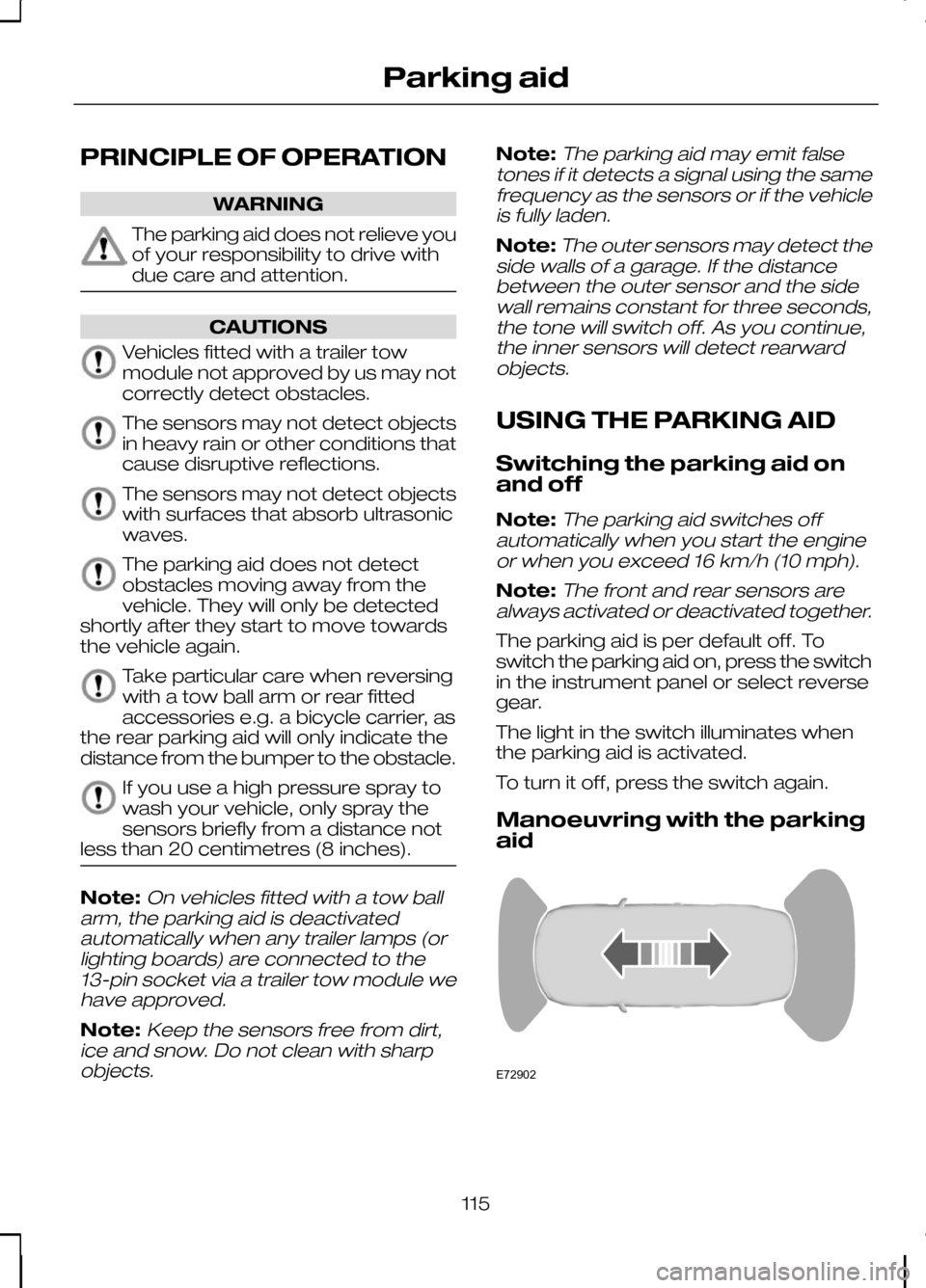
Manoeuvring with the parking
aid 115
Parking aidE72902
Page 118 of 226
Note:If a high pitch warning tone sounds
for three seconds and the light in the switch is flashing, it indicates amalfunction. The system will be disabled.Have the system checked by properlytrained technicians.
You will hear an intermittent tone at a
distance of up to approximately 150
centimetres (59 inches) between the
obstacle and rear bumper, 80 centimetres
(31 inches) between the obstacle and
front bumper and 50 centimetres (20
inches) to the side. Decreasing the
distance accelerates the intermittent tone.
A continuous tone will start at a distance
of less than 30 centimetres (12 inches).
You will hear an alternating tone from the
front and rear if obstacles are closer than
30 centimetres (12 inches) to the front
and rear bumpers.
116
Parking aid
Page 121 of 226
Amber - 2 metres (79 inches)
D
Amber - centre line of the
projected vehicle path
E
Note:When reversing with a trailer, the
lines on the screen show the vehicle direction and not the trailer.
Deactivating the rear view
camera
Note:
Disengage reverse gear. The
display will stay on for a short period before switching off.
The system will automatically switch off
once the vehicle speed has reached
approximately 15 km/h (9 mph).
Vehicles with parking aid
The display will additionally show a
coloured distance bar. This guide
indicates the distance from the rear
bumper to the detected obstacle.
These are colour coded as follows:
• Green - 0.8 to 1.5 metres (31 to 59
inches).
• Amber - 0.3 to 0.8 metre (12 to 31
inches).
• Red - 0.3 metre (12 inches) or less.
119
Rear view camera
Page 135 of 226
FUEL CUT-OFF SWITCH
Vehicles with a Duratec engine
The fuel supply may be cut off as a result
of an accident or sudden vibrations (e.g.
collision when parking).
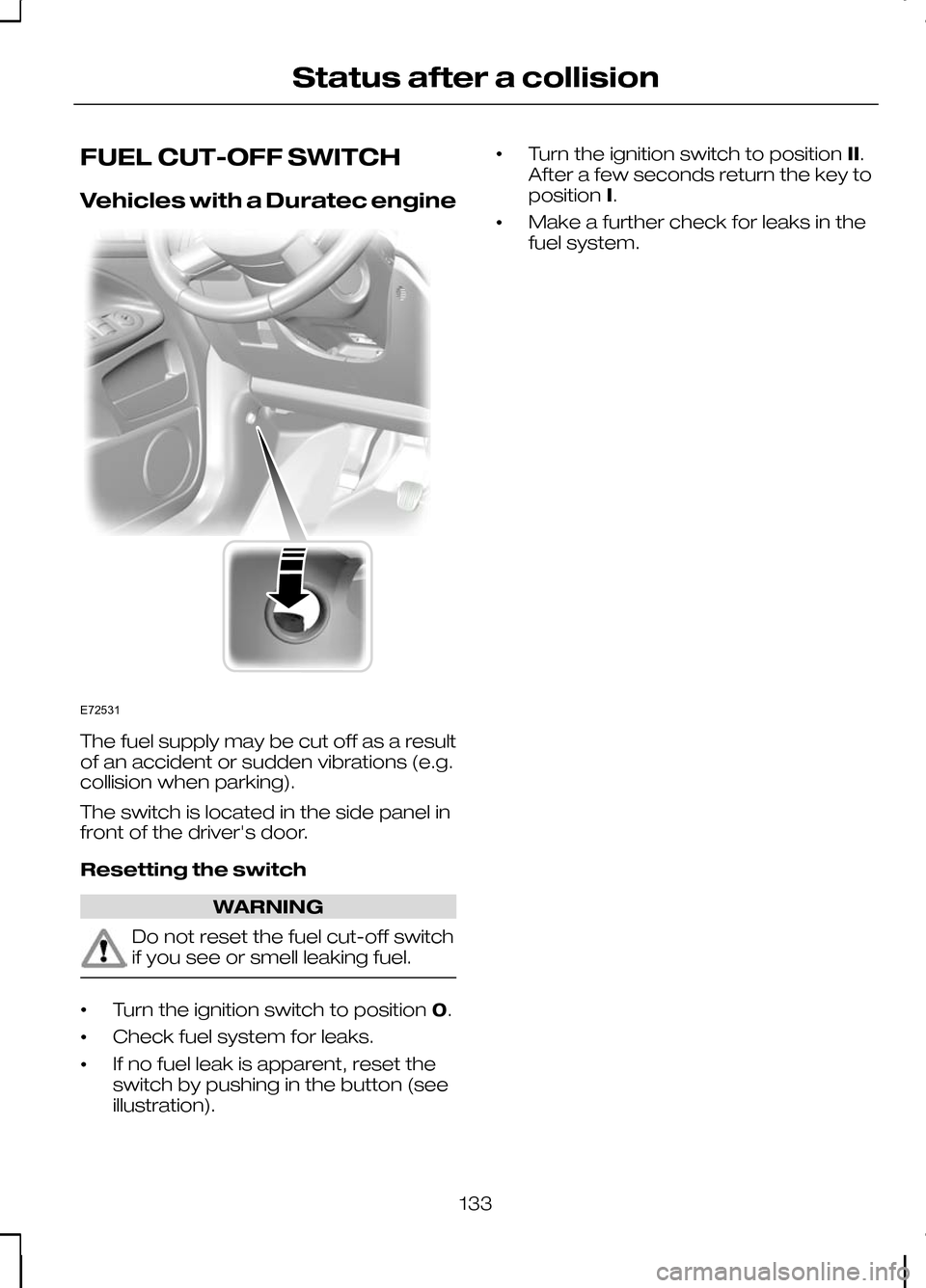
The switch is located in the side panel in
front of the driver's door.
Resetting the switch
WARNING
Do not reset the fuel cut-off switch
if you see or smell leaking fuel.
•
Turn the ignition switch to position
0.
• Check fuel system for leaks.
• If no fuel leak is apparent, reset the
switch by pushing in the button (see
illustration). •
Turn the ignition switch to position
II.
After a few seconds return the key to
position I.
• Make a further check for leaks in the
fuel system.
133
Status after a collisionE72531
Page 140 of 226
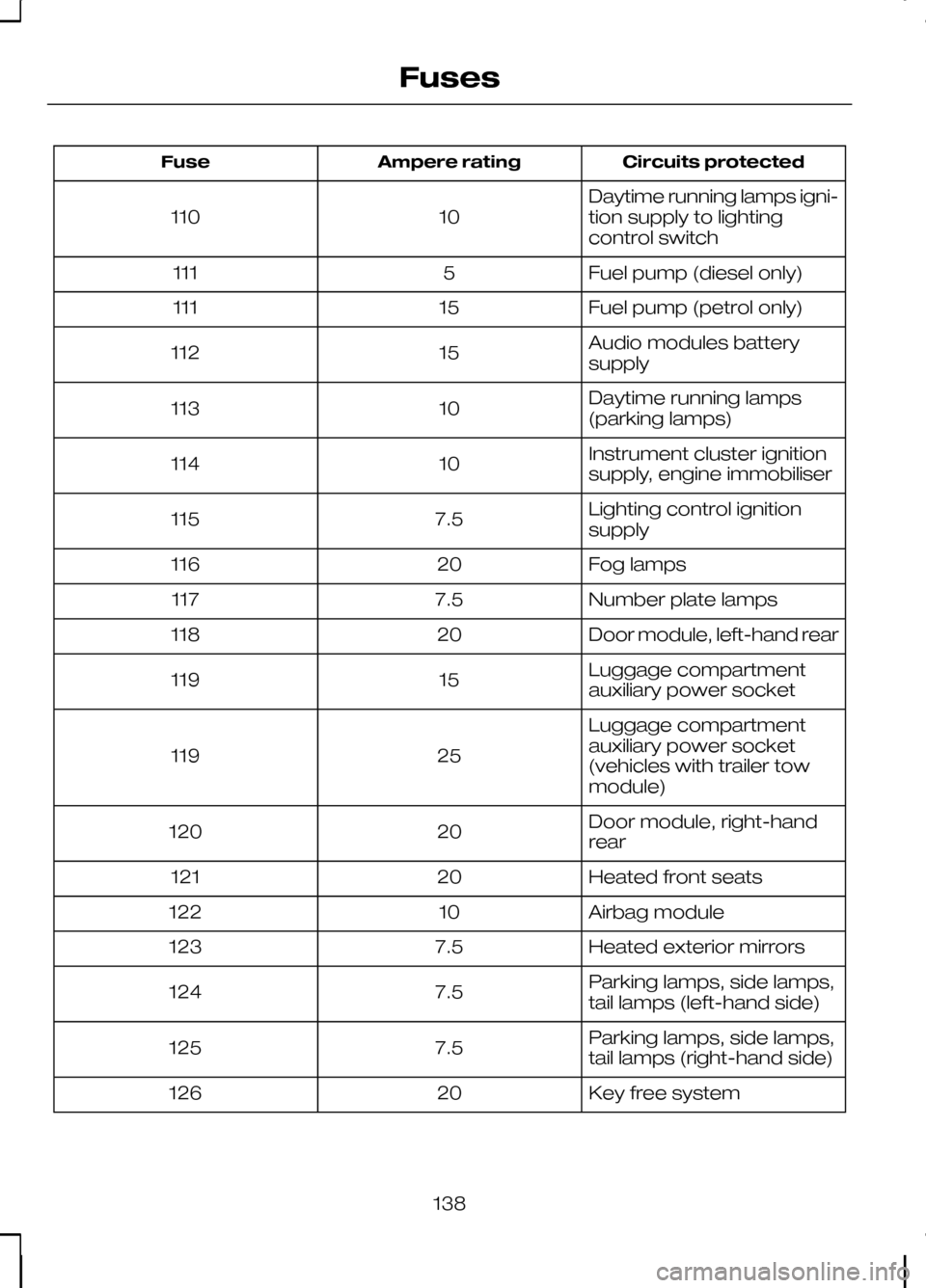
Circuits protected
Ampere rating
Fuse
Daytime running lamps igni-
tion supply to lighting
control switch
10
110
Fuel pump (diesel only)
5
111
Fuel pump (petrol only)
15
111
Audio modules battery
supply
15
112
Daytime running lamps
(parking lamps)
10
113
Instrument cluster ignition
supply, engine immobiliser
10
114
Lighting control ignition
supply
7.5
115
Fog lamps
20
116
Number plate lamps
7.5
117
Door module, left-hand rear
20
118
Luggage compartment
auxiliary power socket
15
119
Luggage compartment
auxiliary power socket
(vehicles with trailer tow
module)
25
119
Door module, right-hand
rear
20
120
Heated front seats
20
121
Airbag module
10
122
Heated exterior mirrors
7.5
123
Parking lamps, side lamps,
tail lamps (left-hand side)
7.5
124
Parking lamps, side lamps,
tail lamps (right-hand side)
7.5
125
Key free system
20
126
138
Fuses
Page 144 of 226
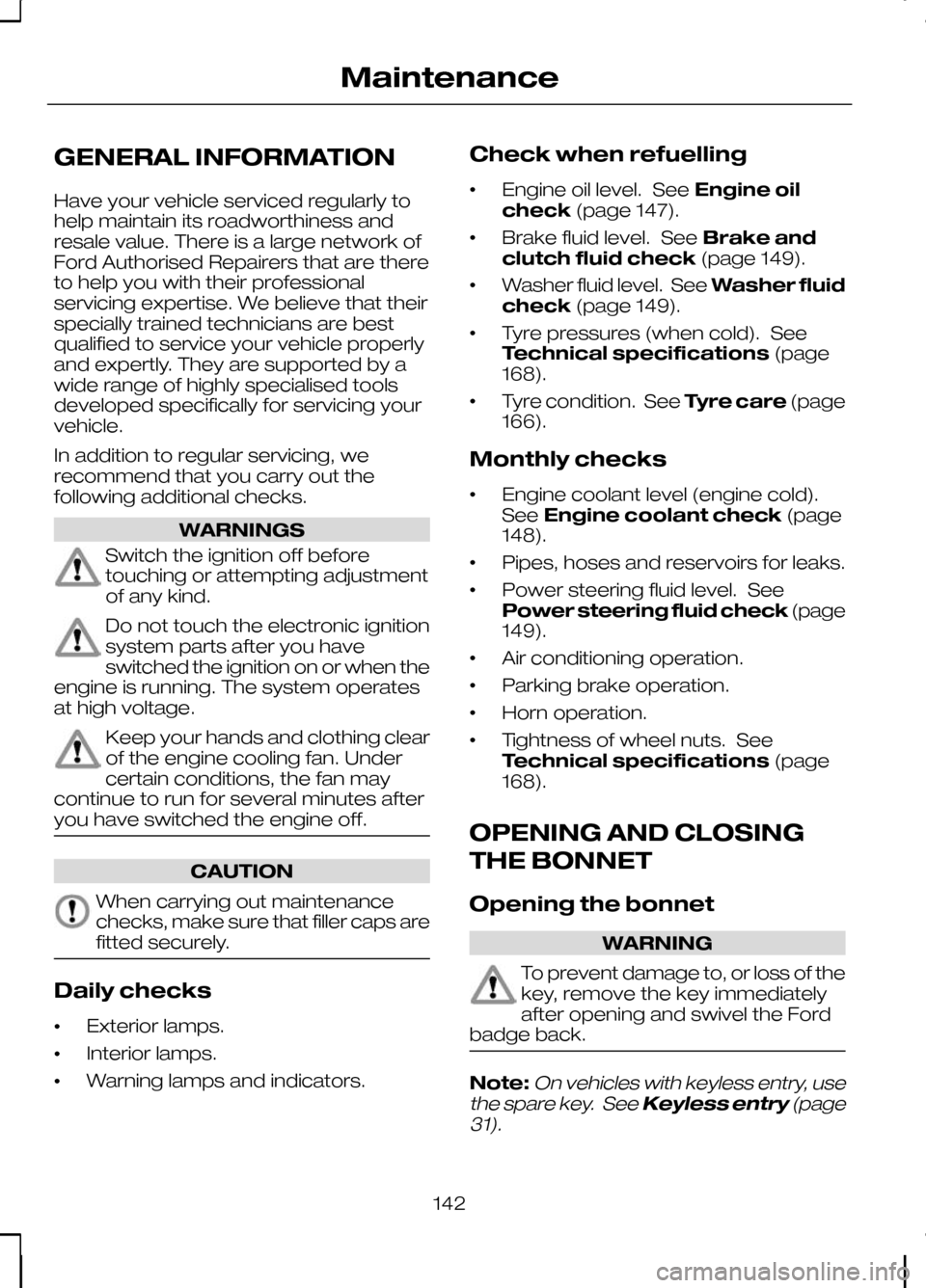
GENERAL INFORMATION
Have your vehicle serviced regularly to
help maintain its roadworthiness and
resale value. There is a large network of
Ford Authorised Repairers that are there
to help you with their professional
servicing expertise. We believe that their
specially trained technicians are best
qualified to service your vehicle properly
and expertly. They are supported by a
wide range of highly specialised tools
developed specifically for servicing your
vehicle.
In addition to regular servicing, we
recommend that you carry out the
following additional checks.
WARNINGS
Switch the ignition off before
touching or attempting adjustment
of any kind.
Do not touch the electronic ignition
system parts after you have
switched the ignition on or when the
engine is running. The system operates
at high voltage. Keep your hands and clothing clear
of the engine cooling fan. Under
certain conditions, the fan may
continue to run for several minutes after
you have switched the engine off. CAUTION
When carrying out maintenance
checks, make sure that filler caps are
fitted securely.
Daily checks
•
Exterior lamps.
• Interior lamps.
• Warning lamps and indicators. Check when refuelling
•
Engine oil level. See
Engine oil
check (page 147).
• Brake fluid level. See
Brake and
clutch fluid check (page 149).
• Washer fluid level. See
Washer fluid
check (page 149).
• Tyre pressures (when cold). See
Technical specifications
(page
168).
• Tyre condition. See
Tyre care(page
166).
Monthly checks
• Engine coolant level (engine cold).
See
Engine coolant check (page
148).
• Pipes, hoses and reservoirs for leaks.
• Power steering fluid level. See
Power steering fluid check
(page
149).
• Air conditioning operation.
• Parking brake operation.
• Horn operation.
• Tightness of wheel nuts. See
Technical specifications
(page
168).
OPENING AND CLOSING
THE BONNET
Opening the bonnet WARNING
To prevent damage to, or loss of the
key, remove the key immediately
after opening and swivel the Ford
badge back. Note:On vehicles with keyless entry, use
the spare key. See Keyless entry(page
31).
142
Maintenance
Page 158 of 226
GENERAL INFORMATION
CAUTIONS
Use only approved wheel and tyre
sizes. Using other sizes could
damage the vehicle and will make
the National Type Approval invalid. If you change the diameter of the
tyres from that fitted at the factory,
the speedometer may not display
the correct speed. Take the vehicle to
your dealer to have the engine
management system reprogrammed. A decal with tyre pressure data is located
in the driver’s door opening at the B-pillar.
Check and set the tyre pressure at the
ambient temperature in which you are
intending to drive the vehicle and when
the tyres are cold.
CHANGING A ROAD WHEEL
Locking wheel nuts
You can obtain a replacement locking
wheel nut key and replacement locking
wheel nuts from your dealer using the
reference number certificate.
Vehicles with a temporary
spare wheel
WARNINGS
If the spare wheel differs from the
other fitted wheels, these rules must
be followed:
Do not exceed 80 km/h (50 mph).
Drive the shortest possible
distances.
Do not fit more than one spare
wheel on your vehicle at any one
time. WARNINGS
Do not use snow chains on this type
of wheel.
Do not drive through an automatic
car wash.
Do not carry out any tyre repairs on
a temporary spare wheel.
CAUTION
The ground clearance of your vehicle
will be reduced. Take care when
parking next to a kerb.
Note:Your vehicle may exhibit some
unusual driving characteristics.
Vehicle jack WARNINGS
The vehicle jack supplied with your
vehicle should only be used when
changing a wheel in emergency
situations. Before using the vehicle jack, check
that it is not damaged or deformed
and that the thread is lubricated and
free from foreign matter. Never place anything between the
jack and the ground, or the jack and
the vehicle.
Note:
Vehicles with a tyre repair kit or run
flat tyres are not equipped with a vehicle jack or a wheel brace.
It is recommended to use a workshop
type hydraulic jack for changing between
summer and winter tyres.
Note:
Use a jack with a minimum lifting
capacity of 1.5 tonnes and a lifting plate with a minimum diameter of 80 millimetres(3.1 inches).
156
Wheels and tyres
Page 161 of 226
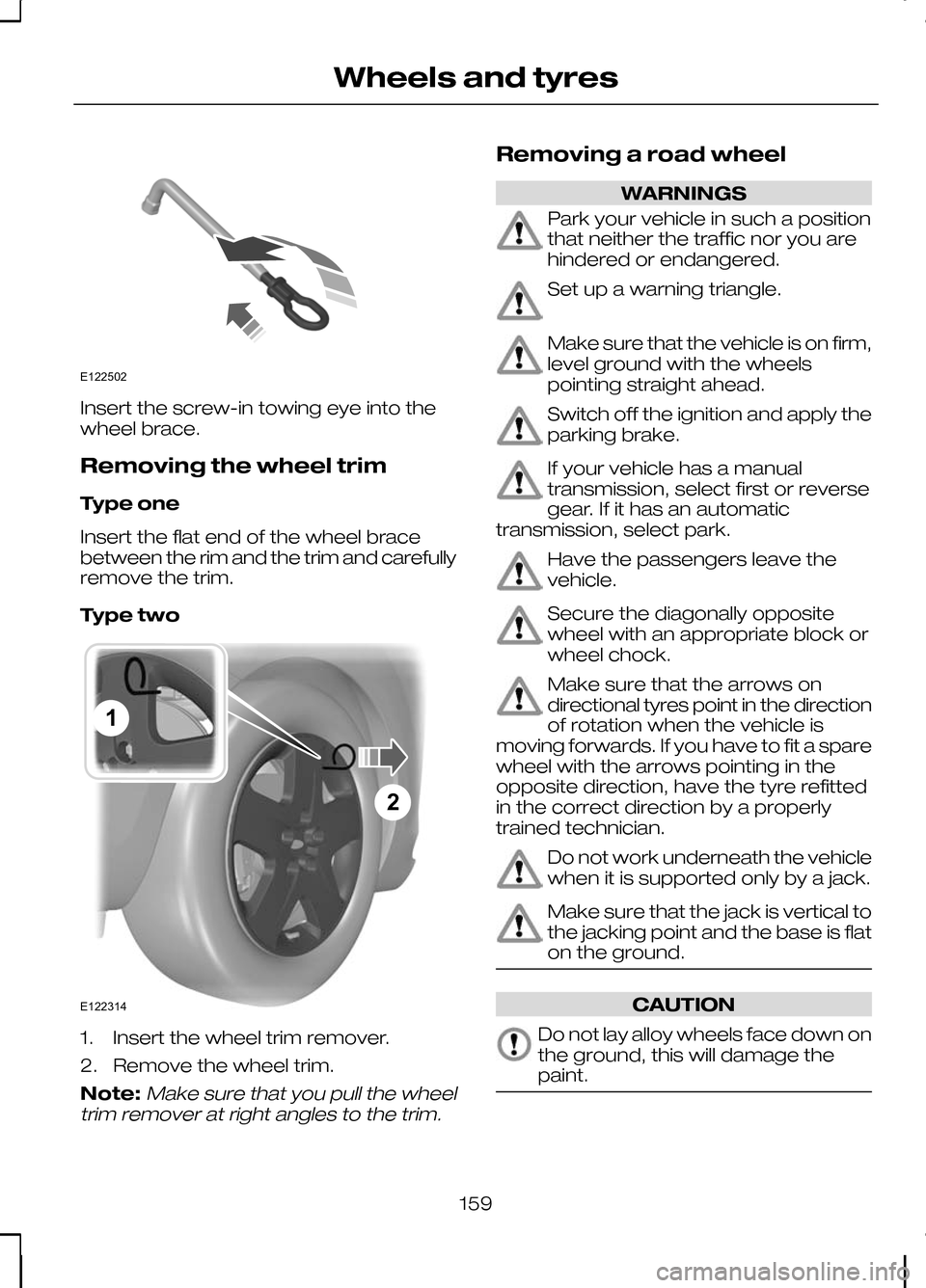
Insert the screw-in towing eye into the
wheel brace.
Removing the wheel trim
Type one
Insert the flat end of the wheel brace
between the rim and the trim and carefully
remove the trim.
Type two
1. Insert the wheel trim remover.
2. Remove the wheel trim.
Note:Make sure that you pull the wheel
trim remover at right angles to the trim.
Removing a road wheel WARNINGS
Park your vehicle in such a position
that neither the traffic nor you are
hindered or endangered.
Set up a warning triangle.
Make sure that the vehicle is on firm,
level ground with the wheels
pointing straight ahead.
Switch off the ignition and apply the
parking brake.
If your vehicle has a manual
transmission, select first or reverse
gear. If it has an automatic
transmission, select park. Have the passengers leave the
vehicle.
Secure the diagonally opposite
wheel with an appropriate block or
wheel chock.
Make sure that the arrows on
directional tyres point in the direction
of rotation when the vehicle is
moving forwards. If you have to fit a spare
wheel with the arrows pointing in the
opposite direction, have the tyre refitted
in the correct direction by a properly
trained technician. Do not work underneath the vehicle
when it is supported only by a jack.
Make sure that the jack is vertical to
the jacking point and the base is flat
on the ground.
CAUTION
Do not lay alloy wheels face down on
the ground, this will damage the
paint.
159
Wheels and tyresE122502 E12231421
Page 164 of 226
•
Park your vehicle at the roadside so
that you do not obstruct the flow of
traffic and so that you are able to use
the kit without being in danger.
• Apply the parking brake, even if you
have parked on a level road, to make
sure that the vehicle will not move.
• Do not attempt to remove foreign
objects like nails or screws penetrating
the tyre.
• Leave the engine running while the kit
is in use, but not if the vehicle is in an
enclosed or poorly ventilated area (for
example, inside a building). In these
circumstances, switch the
compressor on with the engine turned
off.
• Replace the sealant bottle with a new
one before the expiry date (see top
of bottle) is reached.
• Inform all other users of the vehicle
that the tyre has been temporarily
sealed with the tyre repair kit and
make them aware of the special
driving conditions to be observed.
Inflating the tyre WARNINGS
Check the sidewall of the tyre prior
to inflation. If there are any cracks,
bumps or similar damage, do not
attempt to inflate the tyre. Do not stand directly beside the tyre
while the compressor is pumping.
Watch the sidewall of the tyre. If any
cracks, bumps or similar damage
appear, turn off the compressor and
let the air out by means of the pressure
relief valve B. Do not continue driving with
this tyre. WARNINGS
The sealant contains natural rubber
latex. Avoid contact with skin and
clothing. If this happens, rinse the
affected areas immediately with plenty of
water and contact your doctor. If the tyre inflation pressure does not
reach 1.8 bar (26 psi) within seven
minutes, the tyre may have suffered
excessive damage, making a temporary
repair impossible. In this case, do not
continue driving with this tyre. CAUTION
Screwing the bottle onto the bottle
holder will pierce the seal of the
bottle. Do not unscrew the bottle
from the holder as the sealant will escape. 162
Wheels and tyres
Page 168 of 226
WARNINGS
Do not fit a mixture of run flat and
standard tyres. In isolated cases, a
standard tyre can be temporarily
mounted on a vehicle otherwise equipped
with run flat tyres. It must be pointed out
to the driver that the standard tyre has no
runflat properties. Do not fit run flat tyres on vehicles
that were not originally fitted with
them. Please contact your dealer
for more details regarding compatibility. Run flat tyres may be sold and mounted
only by specially trained and certified tyre
dealers.
TYRE CARE
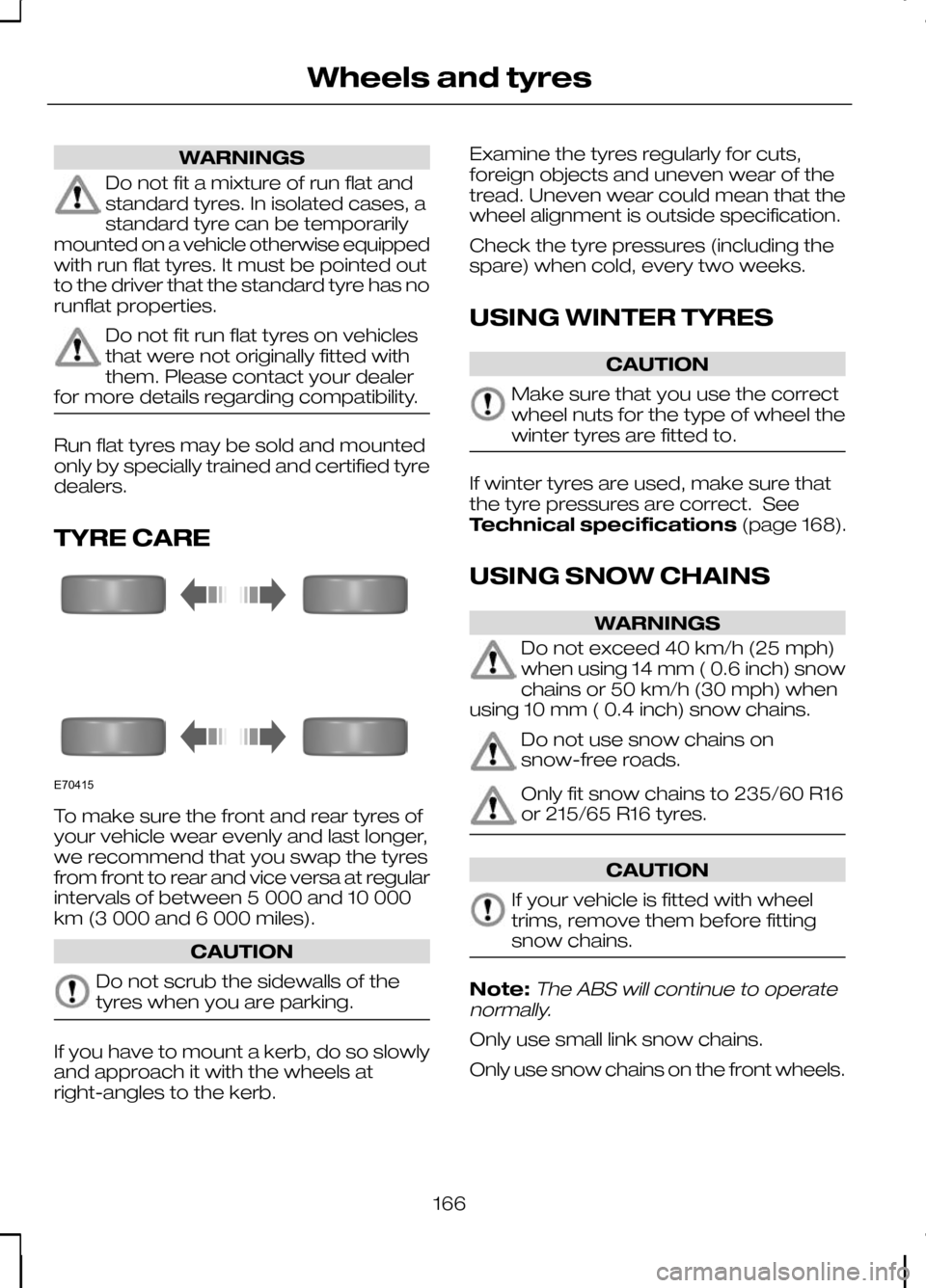
To make sure the front and rear tyres of
your vehicle wear evenly and last longer,
we recommend that you swap the tyres
from front to rear and vice versa at regular
intervals of between 5 000 and 10 000
km (3 000 and 6 000 miles).
CAUTION
Do not scrub the sidewalls of the
tyres when you are parking.
If you have to mount a kerb, do so slowly
and approach it with the wheels at
right-angles to the kerb. Examine the tyres regularly for cuts,
foreign objects and uneven wear of the
tread. Uneven wear could mean that the
wheel alignment is outside specification.
Check the tyre pressures (including the
spare) when cold, every two weeks.
USING WINTER TYRES
CAUTION
Make sure that you use the correct
wheel nuts for the type of wheel the
winter tyres are fitted to.
If winter tyres are used, make sure that
the tyre pressures are correct. See
Technical specifications
(page 168).
USING SNOW CHAINS WARNINGS
Do not exceed 40 km/h (25 mph)
when using 14 mm ( 0.6 inch) snow
chains or 50 km/h (30 mph) when
using 10 mm ( 0.4 inch) snow chains. Do not use snow chains on
snow-free roads.
Only fit snow chains to 235/60 R16
or 215/65 R16 tyres.
CAUTION
If your vehicle is fitted with wheel
trims, remove them before fitting
snow chains.
Note:The ABS will continue to operate
normally.
Only use small link snow chains.
Only use snow chains on the front wheels.
166
Wheels and tyresE70415