warning FORD KUGA 2010 1.G User Guide
[x] Cancel search | Manufacturer: FORD, Model Year: 2010, Model line: KUGA, Model: FORD KUGA 2010 1.GPages: 226, PDF Size: 8.07 MB
Page 19 of 226
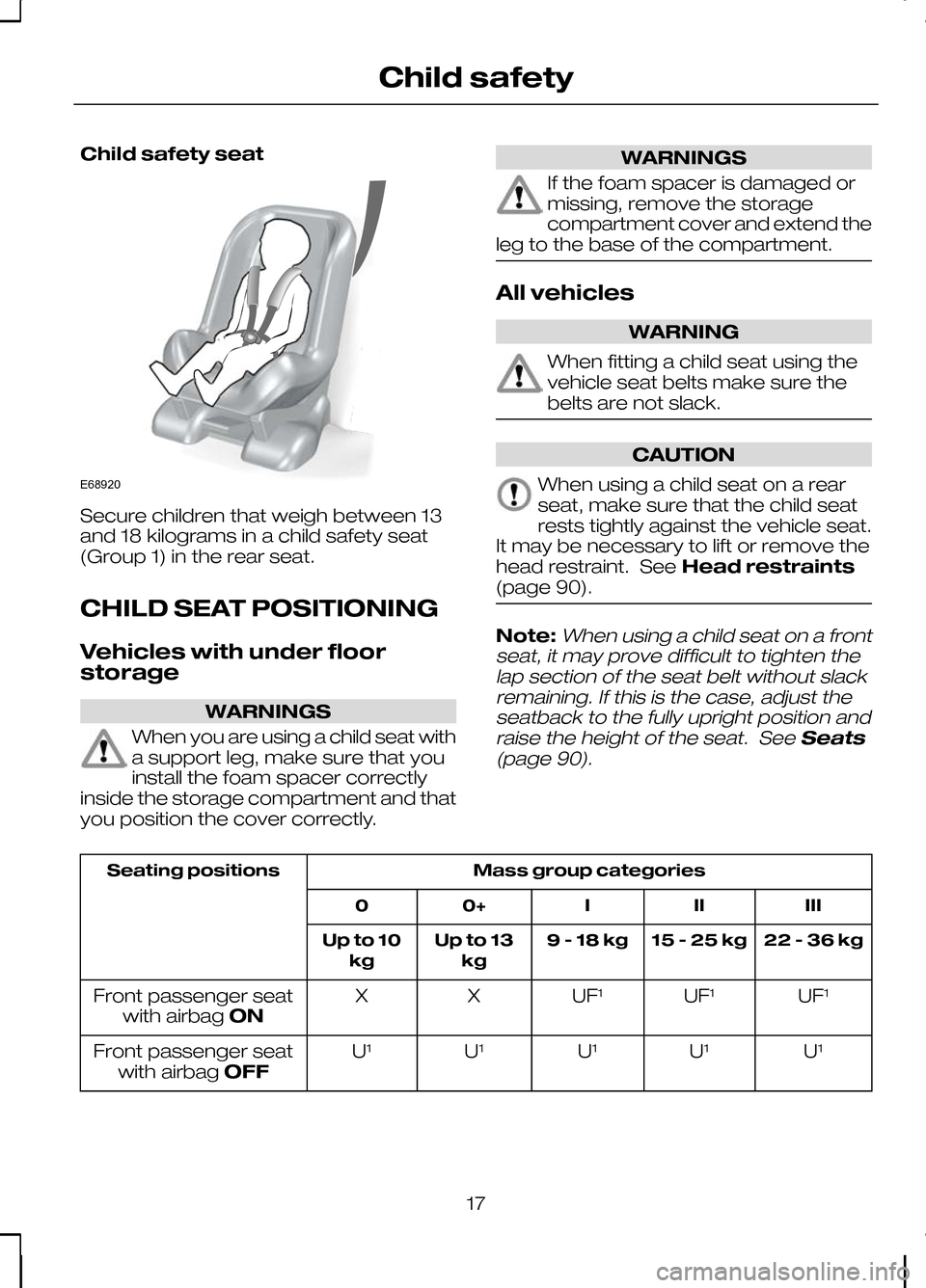
Child safety seat
Secure children that weigh between 13
and 18 kilograms in a child safety seat
(Group 1) in the rear seat.
CHILD SEAT POSITIONING
Vehicles with under floor
storage
WARNINGS
When you are using a child seat with
a support leg, make sure that you
install the foam spacer correctly
inside the storage compartment and that
you position the cover correctly. WARNINGS
If the foam spacer is damaged or
missing, remove the storage
compartment cover and extend the
leg to the base of the compartment. All vehicles
WARNING
When fitting a child seat using the
vehicle seat belts make sure the
belts are not slack.
CAUTION
When using a child seat on a rear
seat, make sure that the child seat
rests tightly against the vehicle seat.
It may be necessary to lift or remove the
head restraint. See Head restraints
(page 90). Note:When using a child seat on a front
seat, it may prove difficult to tighten the lap section of the seat belt without slackremaining. If this is the case, adjust theseatback to the fully upright position and
raise the height of the seat. See Seats
(page 90). Mass group categories
Seating positions
III
II
I
0+
0
22 - 36 kg
15 - 25 kg
9 - 18 kg
Up to 13
kg
Up to 10
kg
UF¹
UF¹
UF¹
X
X
Front passenger seat
with airbag ON
U¹
U¹
U¹
U¹
U¹
Front passenger seat
with airbag OFF
17
Child safetyE68920
Page 21 of 226
BOOSTER CUSHIONS
WARNINGS
Do not install a booster seat or a
booster cushion with only the lap
strap of the seat belt.
Do not install a booster seat or a
booster cushion with a seat belt that
is slack or twisted.
Do not put the seat belt under your
child’s arm or behind its back.
Do not use pillows, books or towels
to boost your child’s height.
Make sure that your children sit in
an upright position.
Secure children that weigh more
than 15 kilograms but are less than
150 centimetres tall in a booster
seat or a booster cushion. CAUTION
When using a child seat on a rear
seat, make sure that the child seat
rests tightly against the vehicle seat.
It may be necessary to lift or remove the
head restraint. See Head restraints
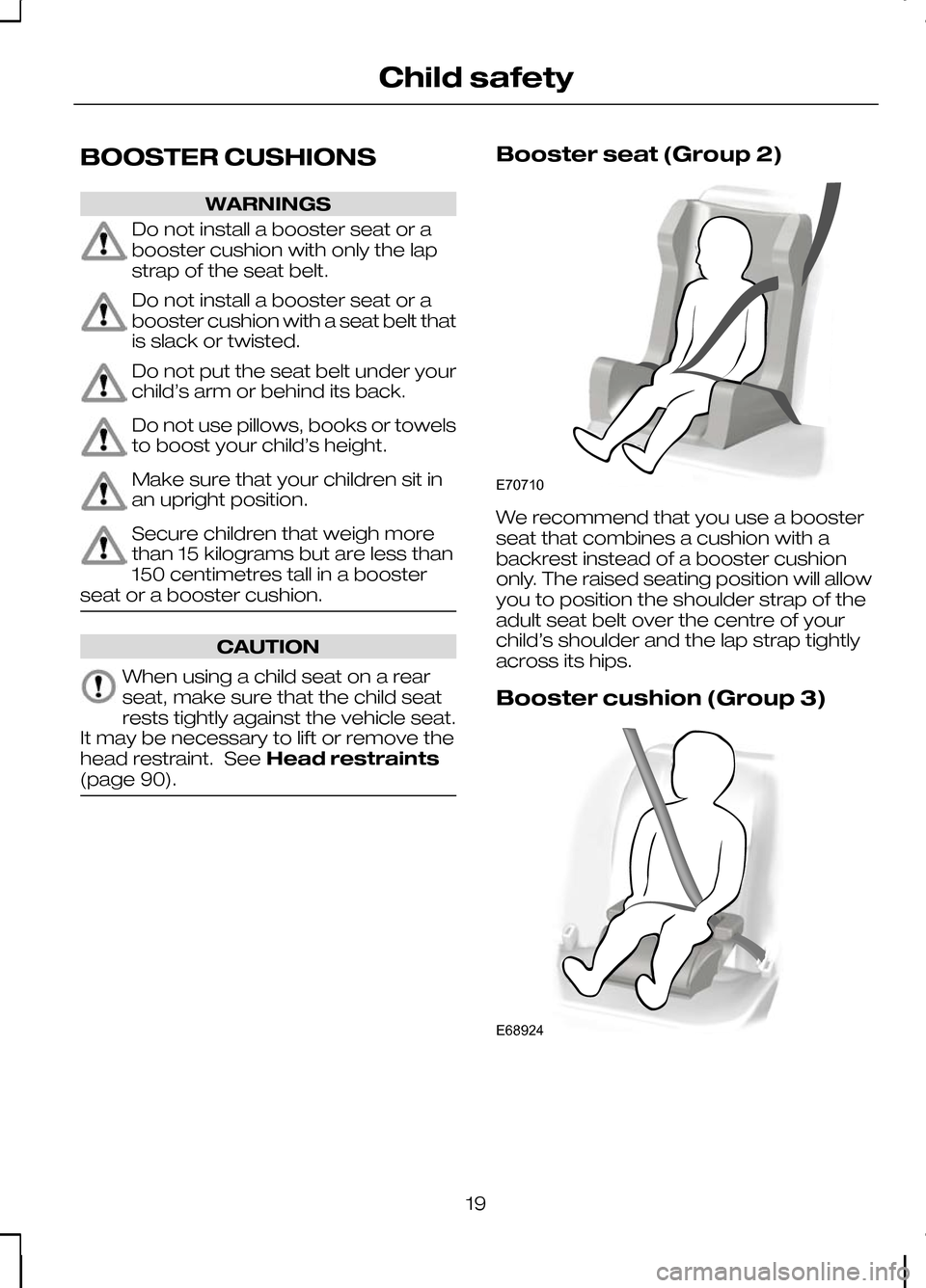
(page 90). Booster seat (Group 2)
We recommend that you use a booster
seat that combines a cushion with a
backrest instead of a booster cushion
only. The raised seating position will allow
you to position the shoulder strap of the
adult seat belt over the centre of your
child’s shoulder and the lap strap tightly
across its hips.
Booster cushion (Group 3)
19
Child safetyE70710 E68924
Page 22 of 226
ISOFIX ANCHOR POINTS
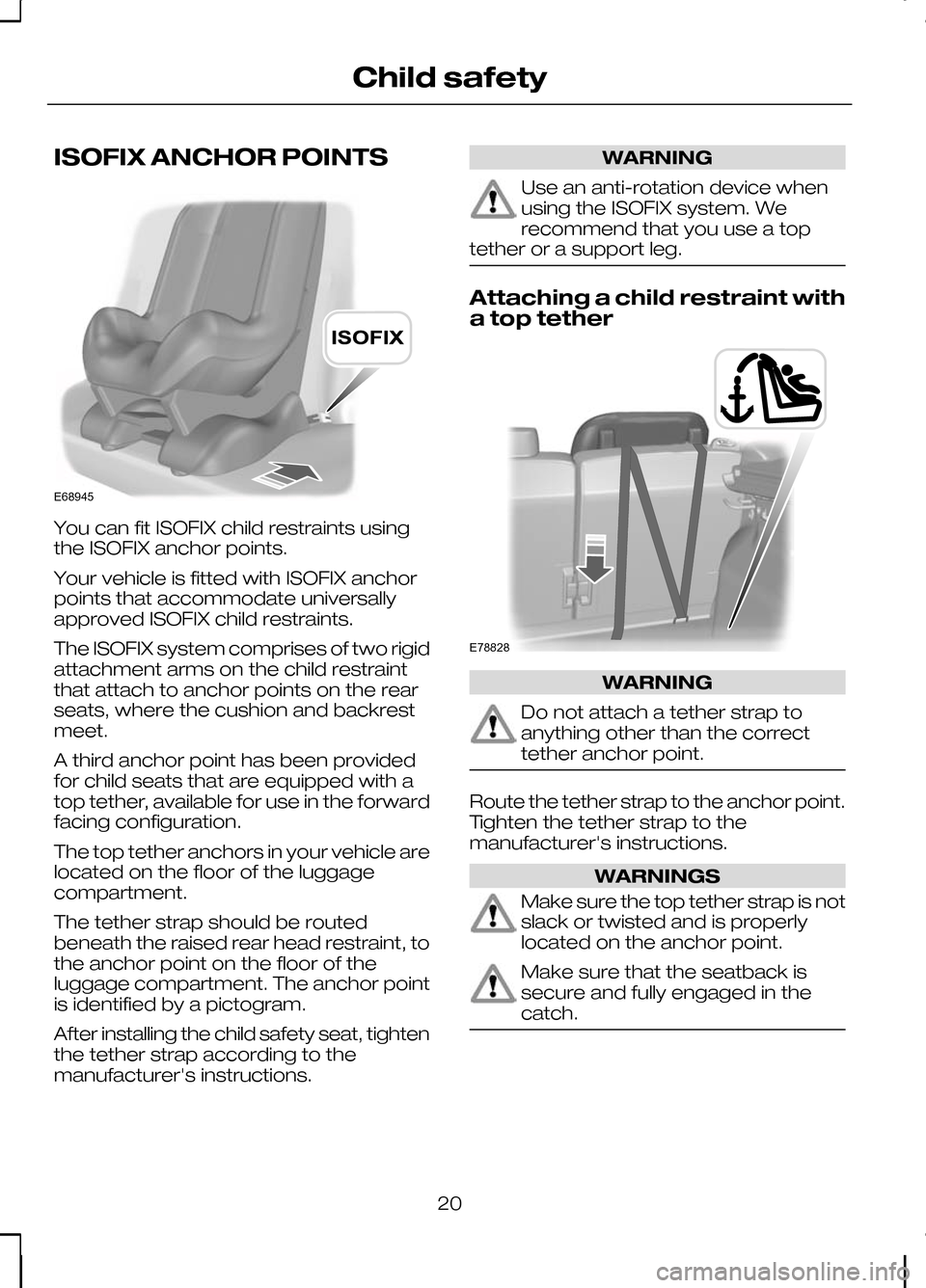
You can fit ISOFIX child restraints using
the ISOFIX anchor points.
Your vehicle is fitted with ISOFIX anchor
points that accommodate universally
approved ISOFIX child restraints.
The ISOFIX system comprises of two rigid
attachment arms on the child restraint
that attach to anchor points on the rear
seats, where the cushion and backrest
meet.
A third anchor point has been provided
for child seats that are equipped with a
top tether, available for use in the forward
facing configuration.
The top tether anchors in your vehicle are
located on the floor of the luggage
compartment.
The tether strap should be routed
beneath the raised rear head restraint, to
the anchor point on the floor of the
luggage compartment. The anchor point
is identified by a pictogram.
After installing the child safety seat, tighten
the tether strap according to the
manufacturer's instructions. WARNING
Use an anti-rotation device when
using the ISOFIX system. We
recommend that you use a top
tether or a support leg. Attaching a child restraint with
a top tether
WARNING
Do not attach a tether strap to
anything other than the correct
tether anchor point.
Route the tether strap to the anchor point.
Tighten the tether strap to the
manufacturer's instructions.
WARNINGS
Make sure the top tether strap is not
slack or twisted and is properly
located on the anchor point.
Make sure that the seatback is
secure and fully engaged in the
catch.
20
Child safetyE68945 E78828
Page 23 of 226
CHILD SAFETY LOCKS
WARNING
You cannot open the doors from
inside if you have put the child safety
locks on.
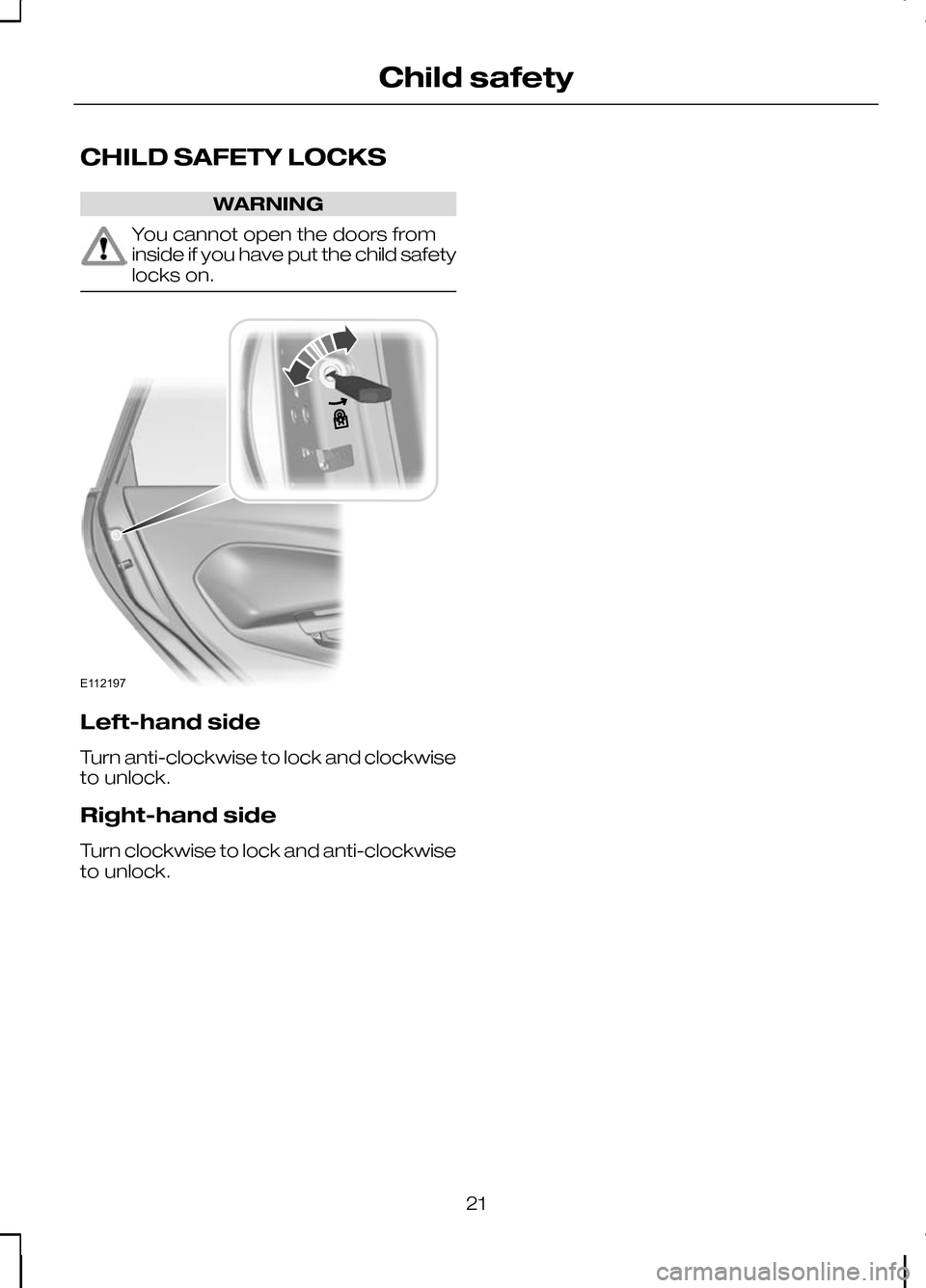
Left-hand side
Turn anti-clockwise to lock and clockwise
to unlock.
Right-hand side
Turn clockwise to lock and anti-clockwise
to unlock.
21
Child safetyE112197
Page 24 of 226
PRINCIPLE OF OPERATION
Airbags
WARNINGS
Do not modify the front of your
vehicle in any way. This could
adversely affect deployment of the
airbags. Original text according to ECE
R94.01: Extreme Hazard! Do not use
a rearward facing child restraint on
a seat protected by an airbag in front of
it! Wear a seat belt and keep sufficient
distance between yourself and the
steering wheel. Only when you use
the seat belt properly, can it hold you in a
position that allows the airbag to achieve
its optimum effect. See Sitting in the
correct position (page 90).Have repairs to the steering wheel,
steering column, seats, airbags and
seat belts carried out by a properly
trained technician. Keep the areas in front of the
airbags free from obstruction. Do
not affix anything to or over the
airbag covers. Do not poke sharp objects into
areas where airbags are fitted. This
could damage and adversely affect
deployment of the airbags. Use seat covers designed for seats
with side airbags. Have these fitted
by a properly trained technician.
Note:You will hear a loud bang and see
a cloud of harmless powdery residue if an airbag deploys. This is normal.
Note:Only wipe airbag covers with a
damp cloth.
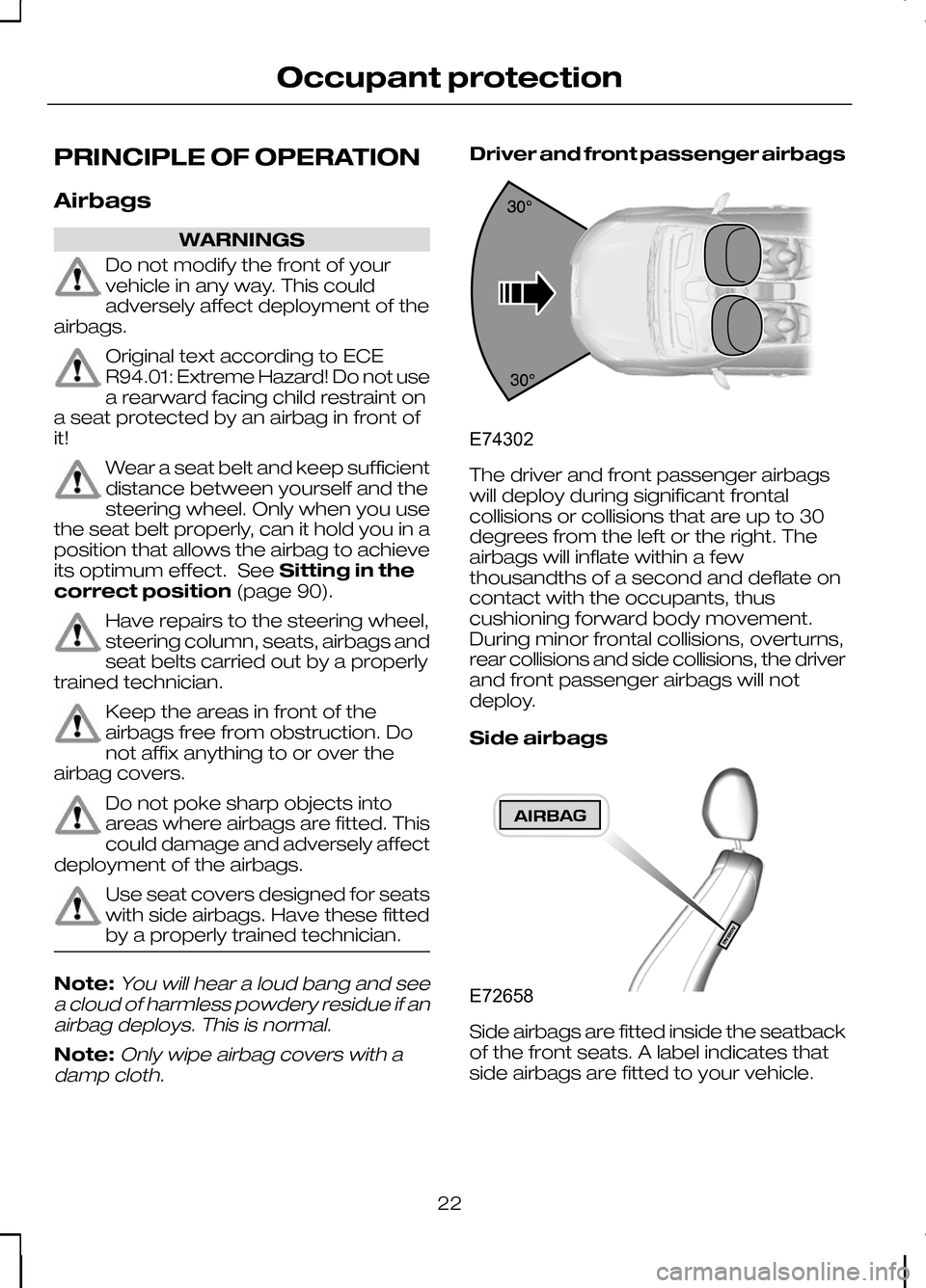
Driver and front passenger airbags The driver and front passenger airbags
will deploy during significant frontal
collisions or collisions that are up to 30
degrees from the left or the right. The
airbags will inflate within a few
thousandths of a second and deflate on
contact with the occupants, thus
cushioning forward body movement.
During minor frontal collisions, overturns,
rear collisions and side collisions, the driver
and front passenger airbags will not
deploy.
Side airbags
Side airbags are fitted inside the seatback
of the front seats. A label indicates that
side airbags are fitted to your vehicle.
22
Occupant protectionE74302 E72658
Page 25 of 226
The side airbags will deploy during
significant lateral collisions. Only the airbag
on the side affected by the collision will
deploy. The airbags will inflate within a few
thousandths of a second and deflate on
contact with the occupants, thus
providing protection for the chest and
shoulder areas. During minor lateral
collisions, overturns, front collisions and
rear collisions, the side airbags will not
deploy.
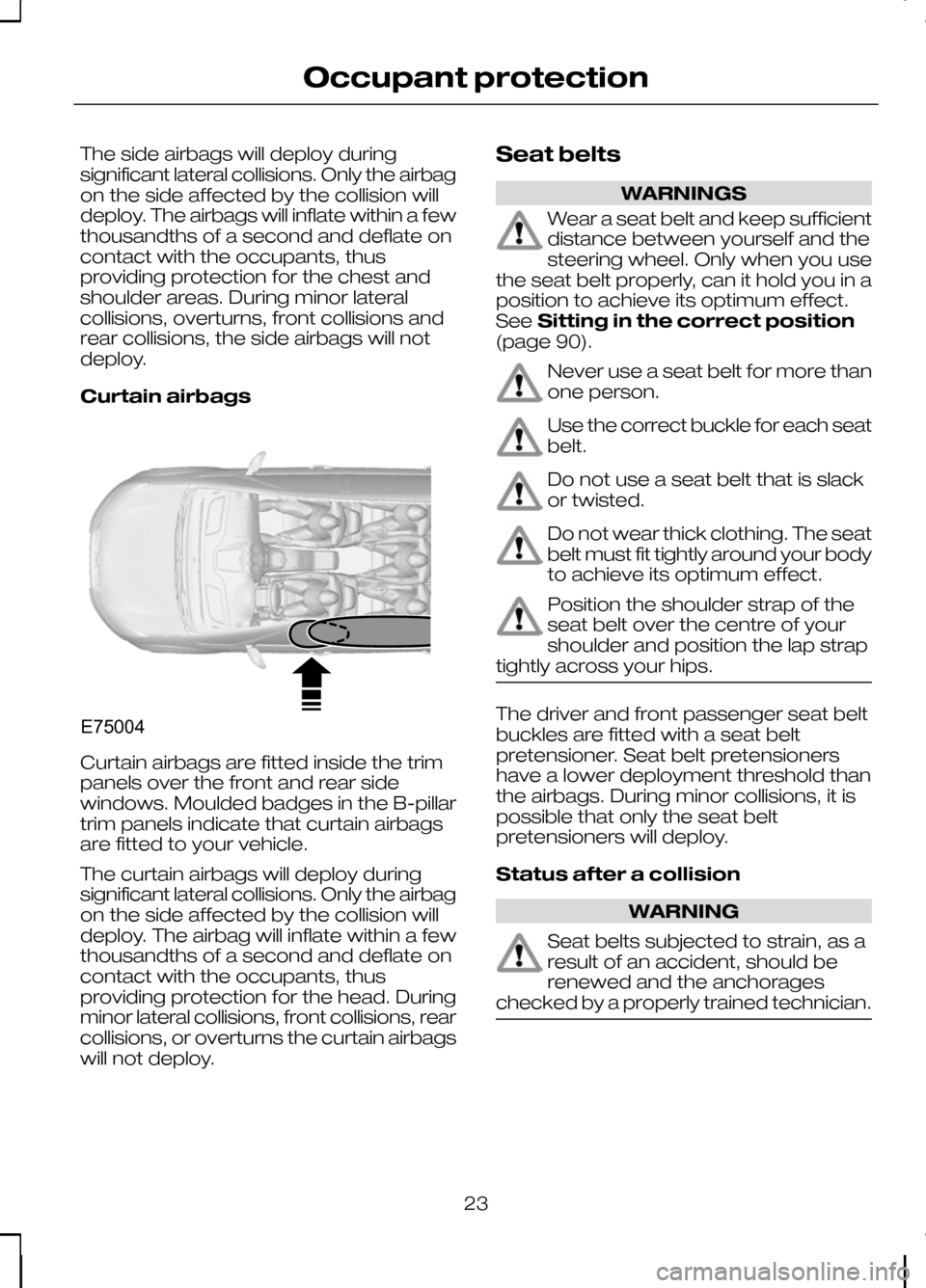
Curtain airbags
Curtain airbags are fitted inside the trim
panels over the front and rear side
windows. Moulded badges in the B-pillar
trim panels indicate that curtain airbags
are fitted to your vehicle.
The curtain airbags will deploy during
significant lateral collisions. Only the airbag
on the side affected by the collision will
deploy. The airbag will inflate within a few
thousandths of a second and deflate on
contact with the occupants, thus
providing protection for the head. During
minor lateral collisions, front collisions, rear
collisions, or overturns the curtain airbags
will not deploy. Seat belts WARNINGS
Wear a seat belt and keep sufficient
distance between yourself and the
steering wheel. Only when you use
the seat belt properly, can it hold you in a
position to achieve its optimum effect.
See Sitting in the correct position
(page 90). Never use a seat belt for more than
one person.
Use the correct buckle for each seat
belt.
Do not use a seat belt that is slack
or twisted.
Do not wear thick clothing. The seat
belt must fit tightly around your body
to achieve its optimum effect.
Position the shoulder strap of the
seat belt over the centre of your
shoulder and position the lap strap
tightly across your hips. The driver and front passenger seat belt
buckles are fitted with a seat belt
pretensioner. Seat belt pretensioners
have a lower deployment threshold than
the airbags. During minor collisions, it is
possible that only the seat belt
pretensioners will deploy.
Status after a collision
WARNING
Seat belts subjected to strain, as a
result of an accident, should be
renewed and the anchorages
checked by a properly trained technician. 23
Occupant protectionE75004
Page 26 of 226
FASTENING THE SEAT
BELTS
WARNING
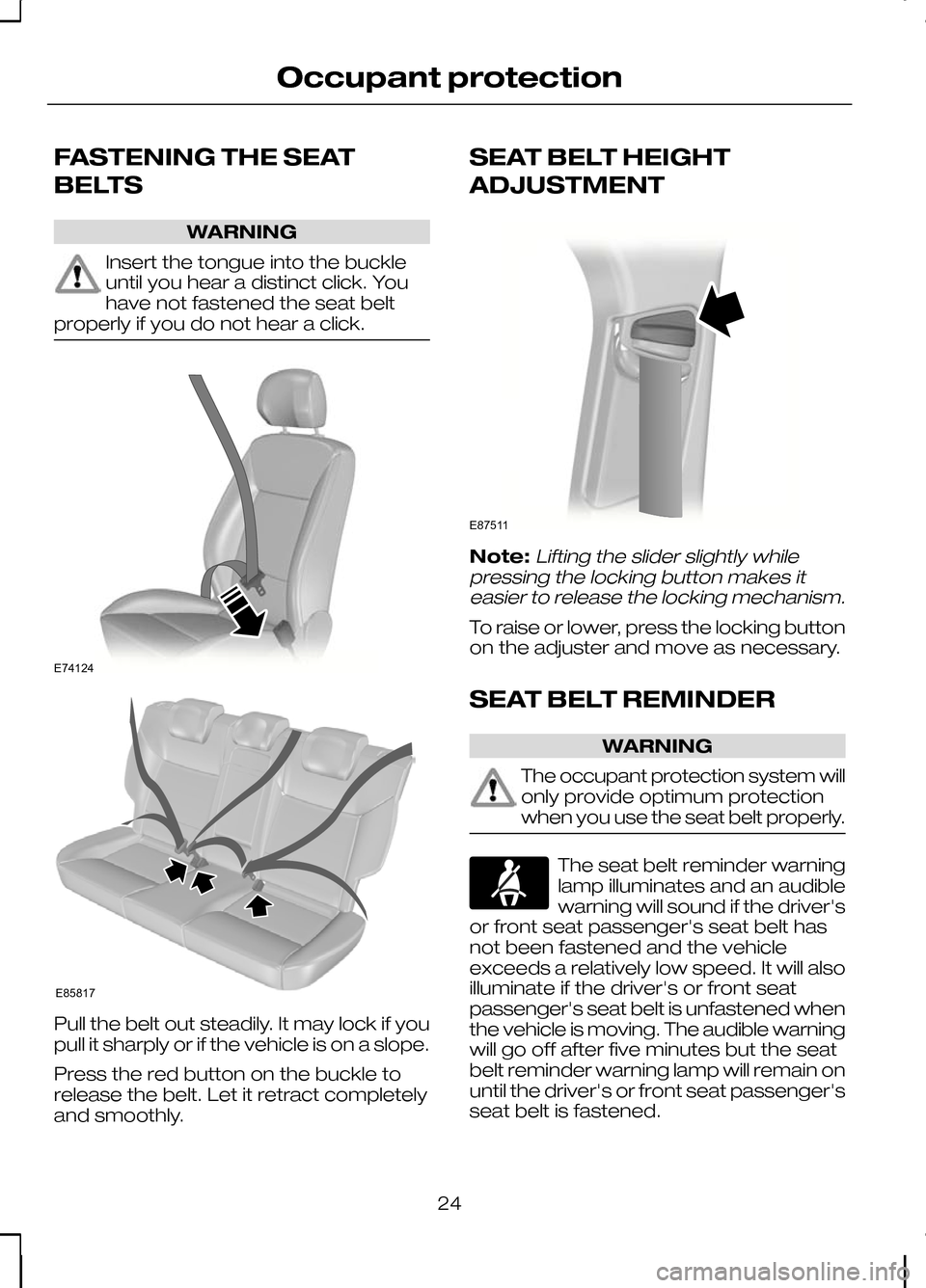
Insert the tongue into the buckle
until you hear a distinct click. You
have not fastened the seat belt
properly if you do not hear a click. Pull the belt out steadily. It may lock if you
pull it sharply or if the vehicle is on a slope.
Press the red button on the buckle to
release the belt. Let it retract completely
and smoothly. SEAT BELT HEIGHT
ADJUSTMENT
Note:Lifting the slider slightly while
pressing the locking button makes it easier to release the locking mechanism.
To raise or lower, press the locking button
on the adjuster and move as necessary.
SEAT BELT REMINDER WARNING
The occupant protection system will
only provide optimum protection
when you use the seat belt properly.
The seat belt reminder warning
lamp illuminates and an audible
warning will sound if the driver's
or front seat passenger's seat belt has
not been fastened and the vehicle
exceeds a relatively low speed. It will also
illuminate if the driver's or front seat
passenger's seat belt is unfastened when
the vehicle is moving. The audible warning
will go off after five minutes but the seat
belt reminder warning lamp will remain on
until the driver's or front seat passenger's
seat belt is fastened.
24
Occupant protectionE74124 E85817 E87511
Page 27 of 226
Deactivating the seat belt
reminder
See your dealer.
USING SEAT BELTS DURING
PREGNANCY
WARNING
Position the seat belt correctly for
your safety and that of your unborn
child. Do not use only the lap strap
or the shoulder strap. Position the lap strap comfortably across
your hips and low beneath your pregnant
abdomen. Position the shoulder strap
between your breasts, above and to the
side of your pregnant abdomen.
DISABLING THE
PASSENGER AIRBAG
WARNING
Make sure that the passenger
airbag is disabled when using a
rearward facing child restraint on the
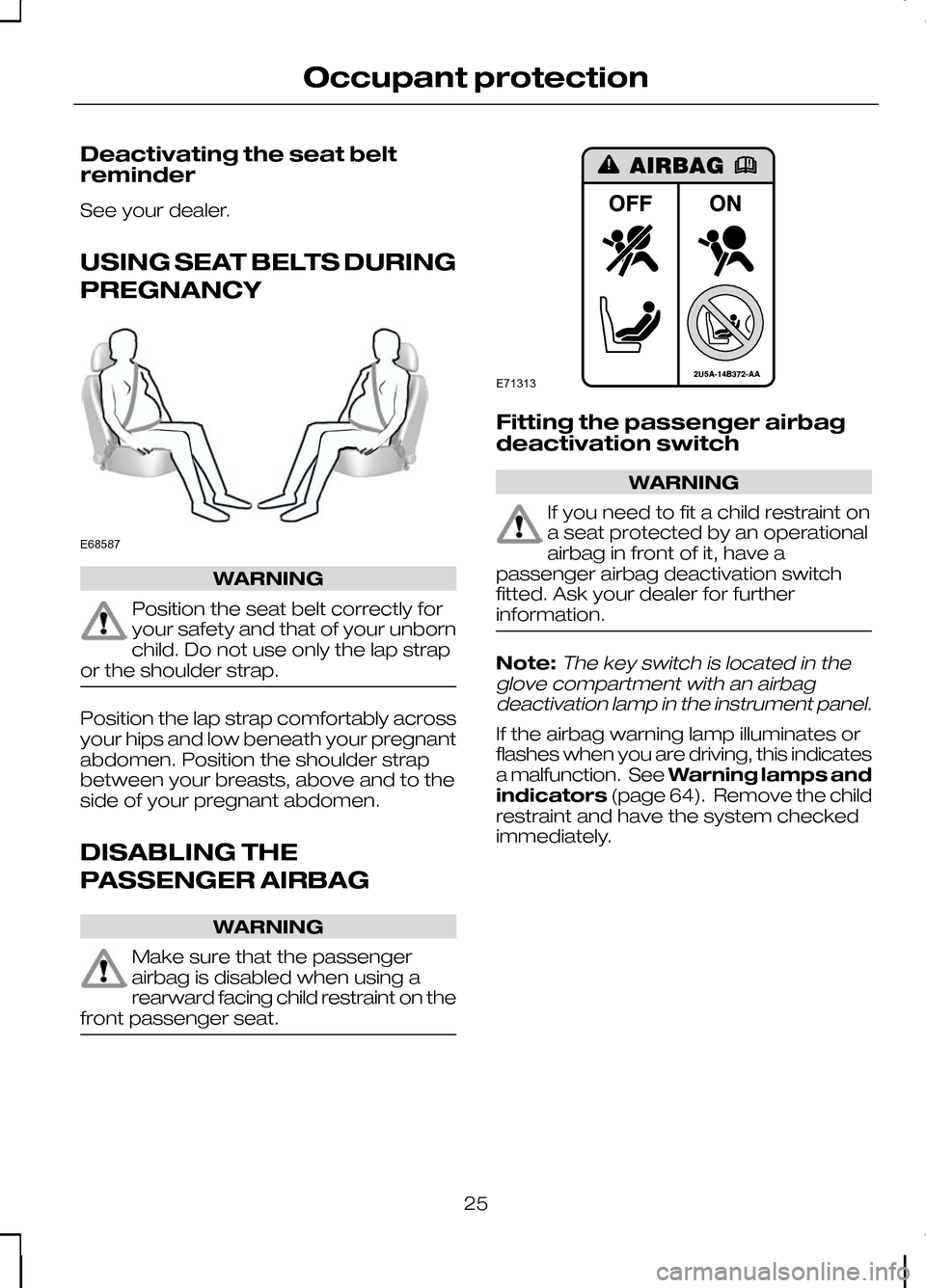
front passenger seat. Fitting the passenger airbag
deactivation switch
WARNING
If you need to fit a child restraint on
a seat protected by an operational
airbag in front of it, have a
passenger airbag deactivation switch
fitted. Ask your dealer for further
information. Note:The key switch is located in the
glove compartment with an airbag deactivation lamp in the instrument panel.
If the airbag warning lamp illuminates or
flashes when you are driving, this indicates
a malfunction. See Warning lamps and
indicators (page 64). Remove the child
restraint and have the system checked
immediately.
25
Occupant protectionE68587 E71313
Page 28 of 226
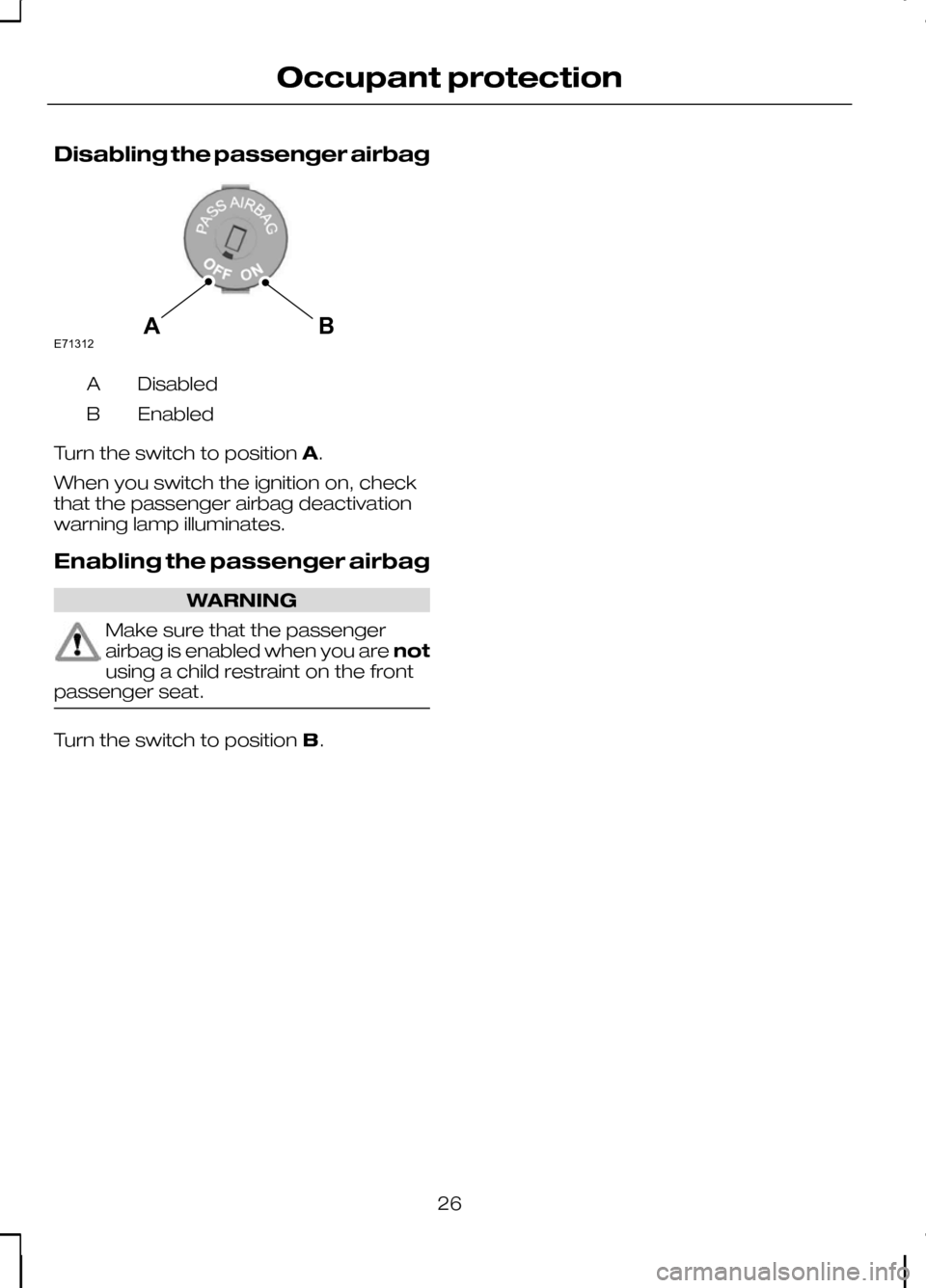
Disabling the passenger airbag
Disabled
A
Enabled
B
Turn the switch to position A.
When you switch the ignition on, check
that the passenger airbag deactivation
warning lamp illuminates.
Enabling the passenger airbag WARNING
Make sure that the passenger
airbag is enabled when you are
not
using a child restraint on the front
passenger seat. Turn the switch to position
B.
26
Occupant protectionABE71312
Page 31 of 226
LOCKING AND UNLOCKING
Central locking
You can only centrally lock the doors if
they are all closed.
Note:The driver’s door can be unlocked
with the key. This needs to be used if the remote control is not functioning.
Double locking WARNING
Do not activate double locking when
persons or animals are inside the
vehicle. You will not be able to
unlock the doors from the inside if you
have double locked them. Double locking is a theft protection feature
that prevents someone from opening the
doors from the inside. You can only
double lock the doors if they are all closed.
Locking and unlocking
confirmation
When you unlock the doors, the direction
indicators will flash once.
When you lock the doors, the direction
indicators will flash twice. Note:
The direction indicators will flash
twice as soon as you activate central locking. They will not flash again when youpress the lock button on the remotecontrol or turn the key for the secondtime, i.e. when you activate doublelocking.
Locking and unlocking the
doors with the key
Turn the top of the key towards the front
of the vehicle to lock the door. Turn the
top of the key towards the rear of the
vehicle to unlock the door.
Double locking the doors with
the key
Turn the key to the lock position twice
within three seconds to double lock the
doors.
Locking and unlocking the
doors and the luggage
compartment lid with the
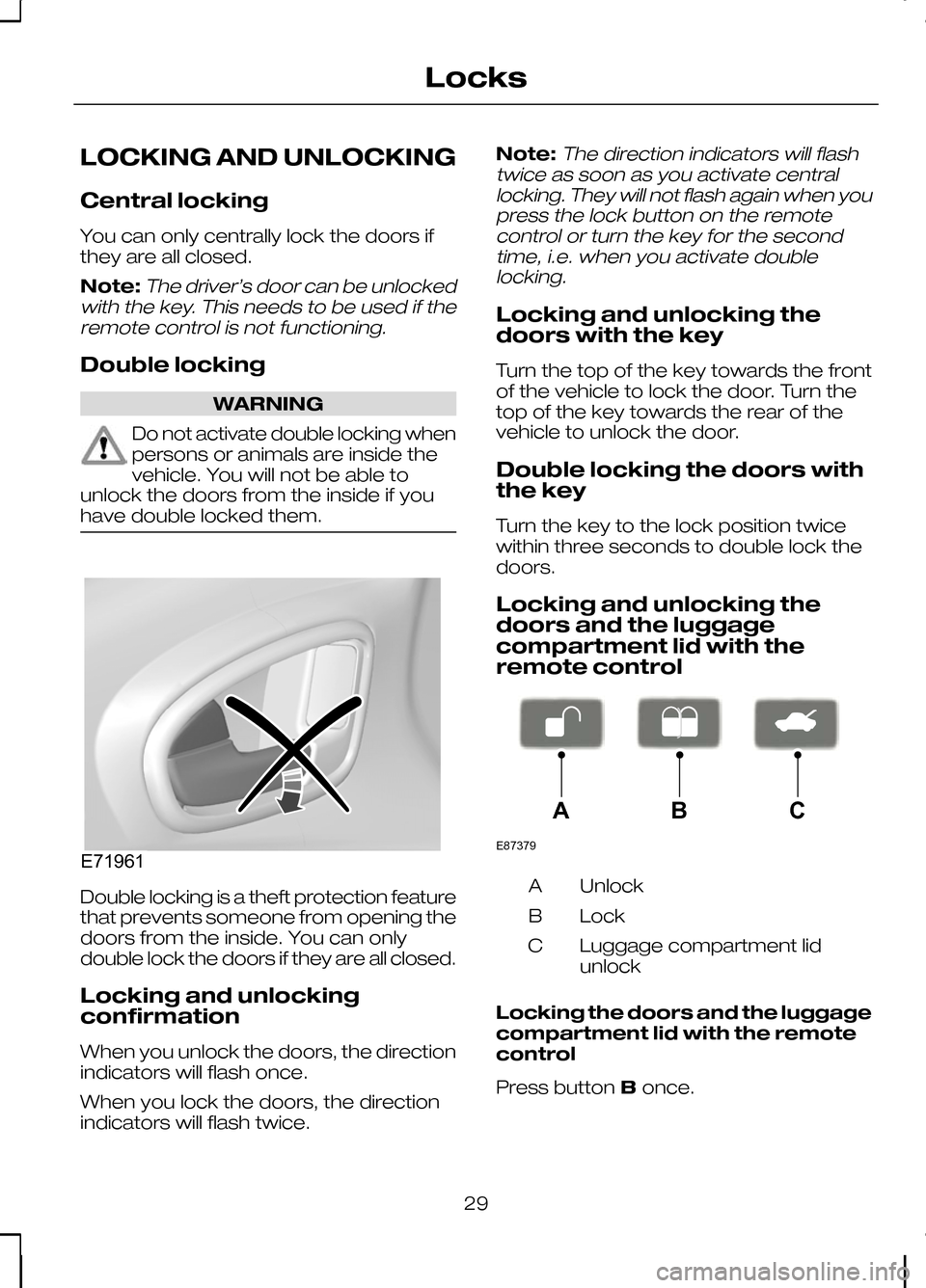
remote control Unlock
A
Lock
B
Luggage compartment lid
unlock
C
Locking the doors and the luggage
compartment lid with the remote
control
Press button Bonce.
29
LocksE71961 E87379ABC