ignition FORD KUGA 2010 1.G Owner's Manual
[x] Cancel search | Manufacturer: FORD, Model Year: 2010, Model line: KUGA, Model: FORD KUGA 2010 1.GPages: 226, PDF Size: 8.07 MB
Page 103 of 226
GENERAL INFORMATION
General points on starting
If the battery has been disconnected the
vehicle may exhibit some unusual driving
characteristics for approx. 8 kilometres
(5 miles) after reconnecting the battery.
This is because the engine management
system must realign itself with the engine.
Any unusual driving characteristics during
this period may be disregarded.
Starting the engine by towing
or pushing
WARNING
To prevent damage you must not
push or tow start your vehicle. Use
booster cables and a booster
battery. See Using booster cables
(page 154). KEYLESS STARTING
WARNINGS
The keyless starting system may not
function if the key is close to metal
objects or electronic devices such
as mobile phones. Always check that the steering
wheel lock is deactivated before
attempting to move your vehicle.
Note:A valid passive key must be
located inside the vehicle to switch the ignition on and start the engine.
Note:To start your engine you must also
fully depress the brake or clutch pedal, depending on the transmission fitted. Ignition on
Press the start button once. All electrical
circuits are operational, warning lamps
and indicators illuminate.
Starting with automatic
transmission
Note:
Releasing the brake pedal during
engine start will stop the engine cranking and return to ignition on.
1. Make sure the transmission is in Por
N.
2. Fully depress the brake pedal.
3. Briefly press the start button.
Starting with manual
transmission
Note:
Releasing the clutch pedal during
engine start will stop the engine cranking and return to ignition on.
1. Fully depress the clutch pedal.
2. Briefly press the start button.
Starting a diesel engine
Note:
Engine cranking will not
commence until the engine glow plug cycle has been completed. This may takeseveral seconds in extremely coldconditions.
Note:Continue to press the clutch or
brake pedal until engine cranking begins.
101
Starting the engineE85766
Page 104 of 226
Failure to start
The passive starting system will not
function if:
•
The passive key frequencies are
jammed.
• The passive key battery is flat.
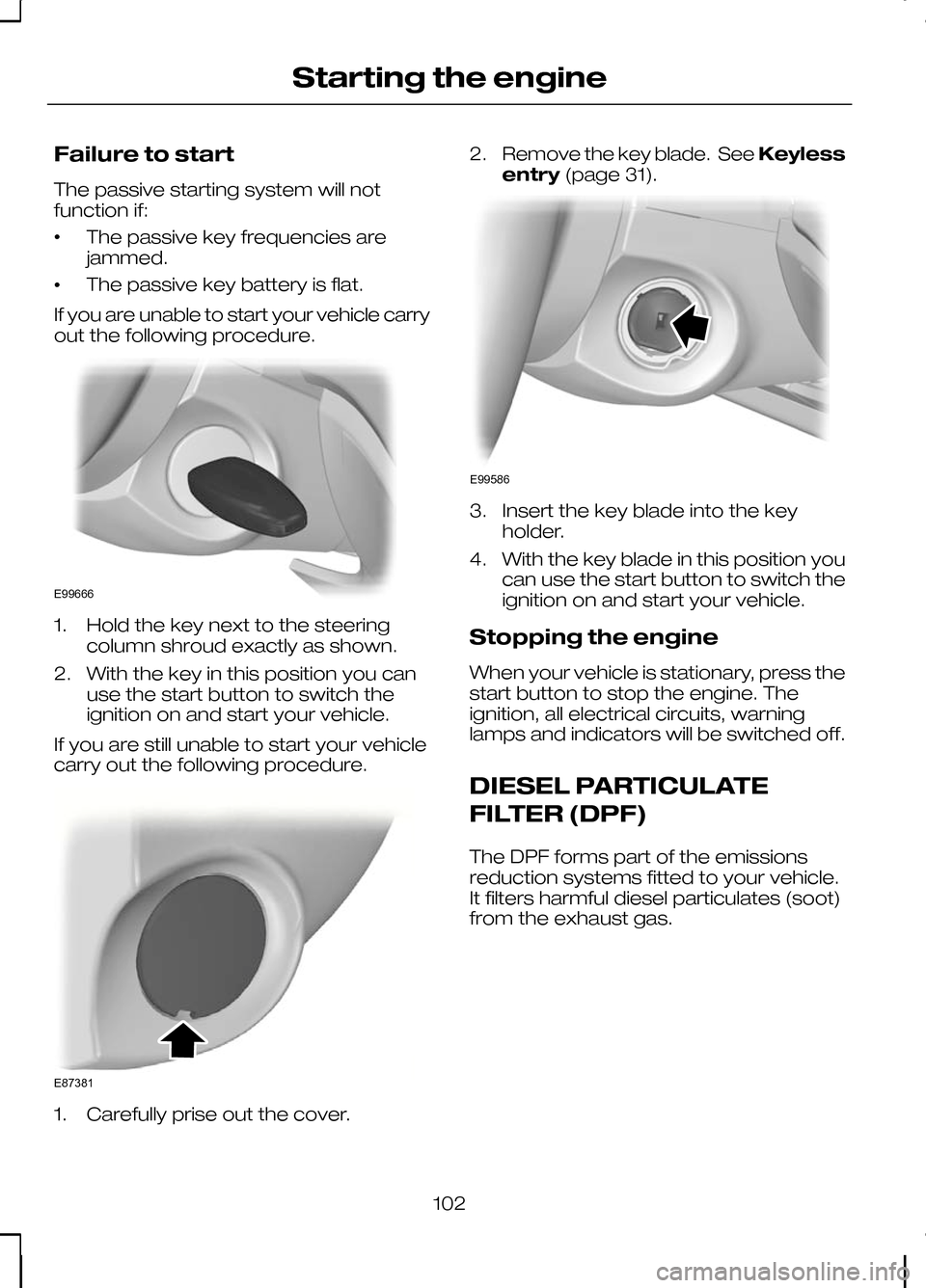
If you are unable to start your vehicle carry
out the following procedure. 1. Hold the key next to the steering
column shroud exactly as shown.
2. With the key in this position you can use the start button to switch the
ignition on and start your vehicle.
If you are still unable to start your vehicle
carry out the following procedure. 1. Carefully prise out the cover. 2.
Remove the key blade. See Keyless
entry (page 31). 3. Insert the key blade into the key
holder.
4. With the key blade in this position you can use the start button to switch the
ignition on and start your vehicle.
Stopping the engine
When your vehicle is stationary, press the
start button to stop the engine. The
ignition, all electrical circuits, warning
lamps and indicators will be switched off.
DIESEL PARTICULATE
FILTER (DPF)
The DPF forms part of the emissions
reduction systems fitted to your vehicle.
It filters harmful diesel particulates (soot)
from the exhaust gas.
102
Starting the engineE99666 E87381 E99586
Page 105 of 226
Regeneration
WARNING
Do not park or idle your vehicle over
dry leaves, dry grass or other
combustible materials. The DPF
regeneration process creates very high
exhaust gas temperatures and the
exhaust will radiate a considerable
amount of heat during and after DPF
regeneration, and after you have switched
the engine off. This is a potential fire
hazard. CAUTION
Avoid running out of fuel.
Note:After you have switched your
engine off the fans may continue to run for a short period of time.
Unlike a normal filter which requires
periodic replacement, the DPF has been
designed to regenerate, or clean itself to
maintain operating efficiency. The
regeneration process takes place
automatically. However, some driving
conditions mean that you may need to
support the regeneration process.
If you drive only short distances or your
journeys contain frequent stopping and
starting, where there is increased
acceleration and deceleration, occasional
trips with the following conditions could
assist the regeneration process:
• Drive your vehicle at a constant speed,
preferably on a main road or
motorway, for up to 20 minutes.
• Avoid prolonged idling and always
observe speed limits and road
conditions. •
Do not switch off the ignition.
• Use a lower gear than normal to
maintain a higher engine speed during
this journey, where appropriate.
SWITCHING OFF THE
ENGINE
Vehicles with a turbocharger CAUTION
Do not switch the engine off when it
is running at high speed. If you do,
the turbocharger will continue
running after the engine oil pressure has
dropped to zero. This will lead to
premature turbocharger bearing wear. Release the accelerator pedal. Wait until
the engine has reached idle speed and
then switch it off.
103
Starting the engine
Page 108 of 226
CAUTIONS
Do not push-start or tow-start your
vehicle. Use booster cables. See
Using booster cables
(page 154).Do not switch the ignition off when
driving.
REFUELLING
CAUTION
Do not attempt to start the engine if
you have filled the fuel tank with the
incorrect fuel. This could damage the
engine. Have the system checked by a
properly trained technician immediately. FUEL CONSUMPTION
The CO2 and fuel consumption figures
are derived from laboratory tests
according to EEC Directive 80/1268/EEC
and subsequent amendments and are
carried out by all vehicle manufacturers.
They are intended as a comparison
between makes and models of vehicles.
They are not intended to represent the
real world fuel consumption you may get
from your vehicle. Real world fuel
consumption is governed by many factors
including; driving style, high speed driving,
stop/start driving, air conditioning usage,
the accessories fitted and towing etc.
Your Ford dealer can give you advice on
improving your fuel consumption.
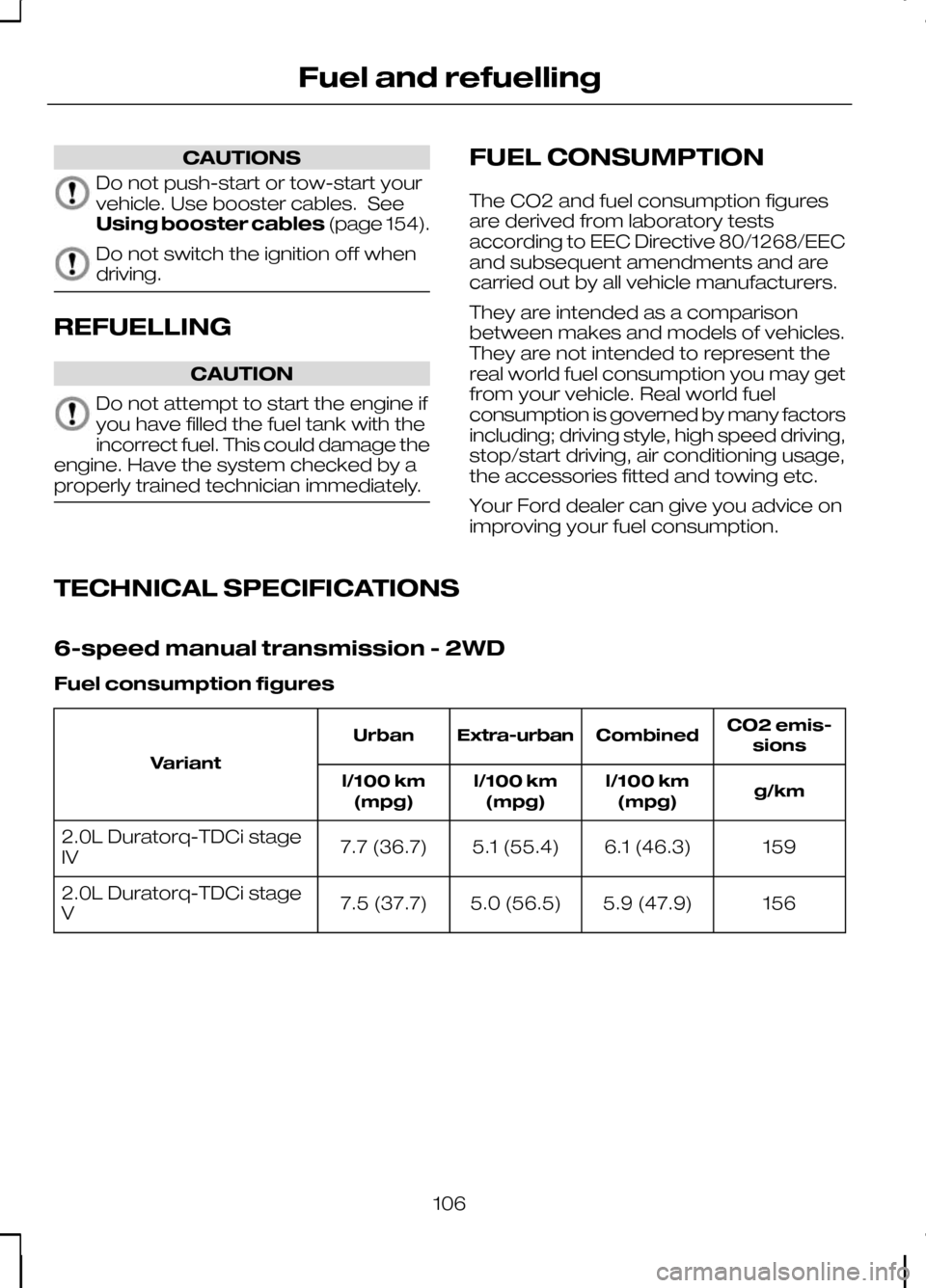
TECHNICAL SPECIFICATIONS
6-speed manual transmission - 2WD
Fuel consumption figures CO2 emis-
sions
Combined
Extra-urban
Urban
Variant g/km
l/100 km
(mpg)
l/100 km
(mpg)
l/100 km
(mpg)
159
6.1 (46.3)
5.1 (55.4)
7.7 (36.7)
2.0L Duratorq-TDCi stage
IV
156
5.9 (47.9)
5.0 (56.5)
7.5 (37.7)
2.0L Duratorq-TDCi stage
V
106
Fuel and refuelling
Page 115 of 226
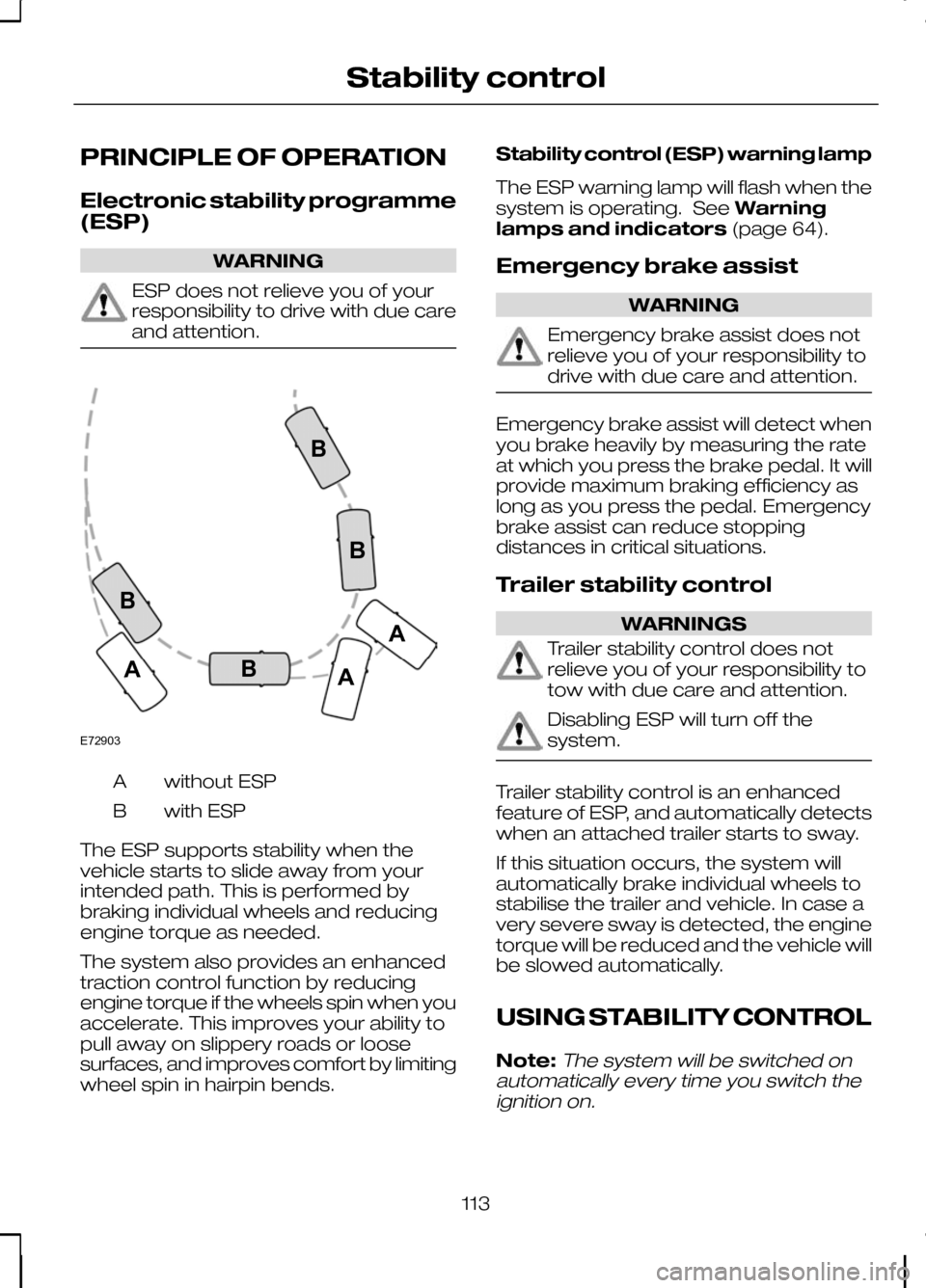
PRINCIPLE OF OPERATION
Electronic stability programme
(ESP)
WARNING
ESP does not relieve you of your
responsibility to drive with due care
and attention.
without ESP
A
with ESP
B
The ESP supports stability when the
vehicle starts to slide away from your
intended path. This is performed by
braking individual wheels and reducing
engine torque as needed.
The system also provides an enhanced
traction control function by reducing
engine torque if the wheels spin when you
accelerate. This improves your ability to
pull away on slippery roads or loose
surfaces, and improves comfort by limiting
wheel spin in hairpin bends. Stability control (ESP) warning lamp
The ESP warning lamp will flash when the
system is operating. See
Warning
lamps and indicators (page 64).
Emergency brake assist WARNING
Emergency brake assist does not
relieve you of your responsibility to
drive with due care and attention.
Emergency brake assist will detect when
you brake heavily by measuring the rate
at which you press the brake pedal. It will
provide maximum braking efficiency as
long as you press the pedal. Emergency
brake assist can reduce stopping
distances in critical situations.
Trailer stability control
WARNINGS
Trailer stability control does not
relieve you of your responsibility to
tow with due care and attention.
Disabling ESP will turn off the
system.
Trailer stability control is an enhanced
feature of ESP, and automatically detects
when an attached trailer starts to sway.
If this situation occurs, the system will
automatically brake individual wheels to
stabilise the trailer and vehicle. In case a
very severe sway is detected, the engine
torque will be reduced and the vehicle will
be slowed automatically.
USING STABILITY CONTROL
Note:The system will be switched on
automatically every time you switch the ignition on.
113
Stability controlE72903AAABBBB
Page 119 of 226
PRINCIPLE OF OPERATION
The camera is a visual aid for use when
reversing.
WARNING
The camera does not relieve you of
your responsibility to drive with due
care and attention.
CAUTIONS
If you use a high pressure spray to
wash your vehicle, only spray the
camera briefly from a distance not
less than 20 centimetres (8 inches). Do not apply pressure to the camera.
The position and the angle of the
camera automatically changes.
Note:Keep the camera free from dirt,
ice and snow. Do not clean with sharp objects, degreaser, wax or organicproducts. Use only a soft cloth.
During operation, guide lines appear in
the display which represent your vehicle's
path and approximate distance from
rearward objects.
USING THE REAR VIEW
CAMERA WARNINGS
The operation of the camera may
vary depending on the ambient
temperature, vehicle and road
conditions. The distances shown in the display
may differ from the actual distance.
Do not place objects in front of the
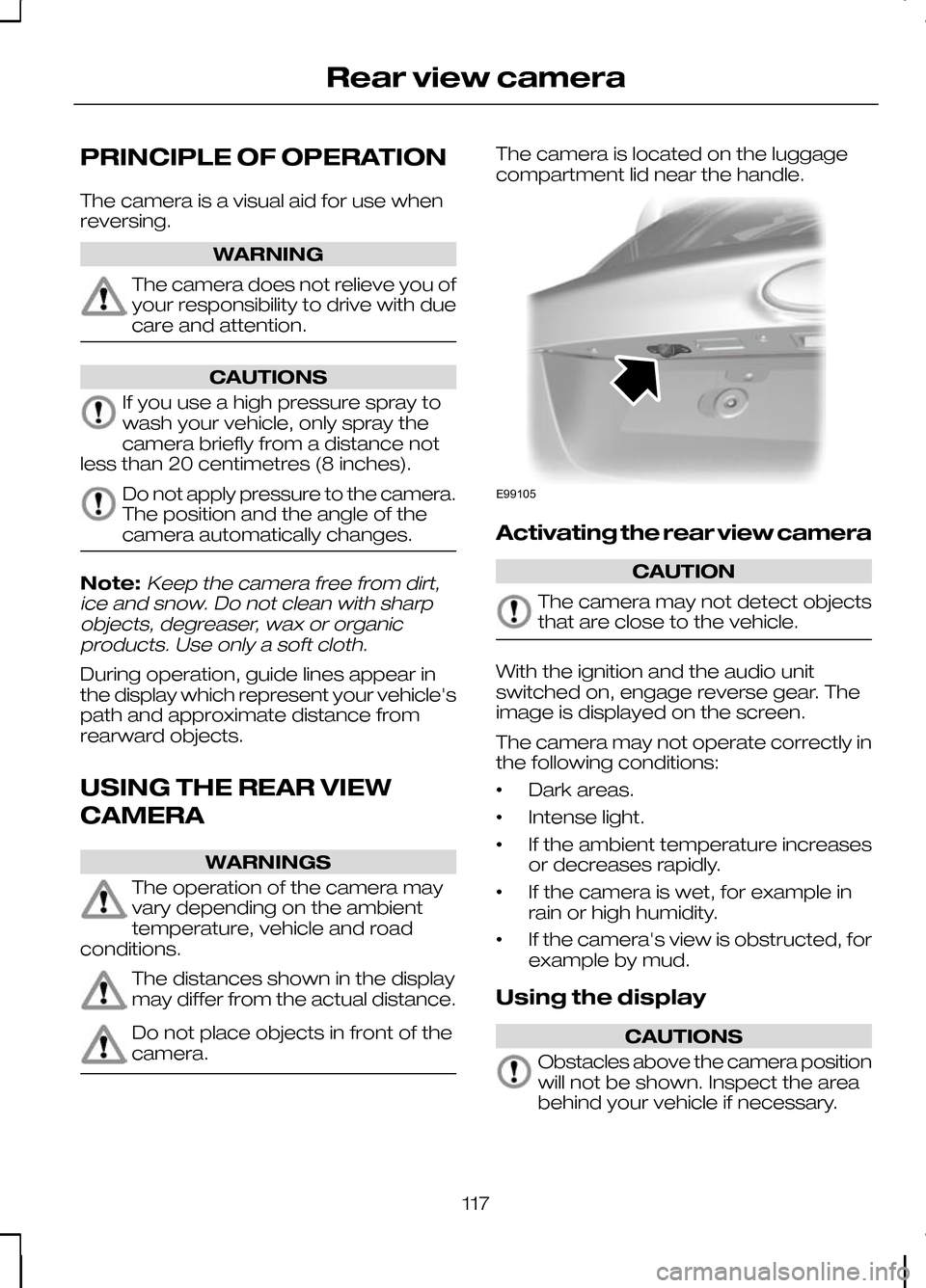
camera. The camera is located on the luggage
compartment lid near the handle.
Activating the rear view camera
CAUTION
The camera may not detect objects
that are close to the vehicle.
With the ignition and the audio unit
switched on, engage reverse gear. The
image is displayed on the screen.
The camera may not operate correctly in
the following conditions:
•
Dark areas.
• Intense light.
• If the ambient temperature increases
or decreases rapidly.
• If the camera is wet, for example in
rain or high humidity.
• If the camera's view is obstructed, for
example by mud.
Using the display CAUTIONS
Obstacles above the camera position
will not be shown. Inspect the area
behind your vehicle if necessary.
117
Rear view cameraE99105
Page 135 of 226
FUEL CUT-OFF SWITCH
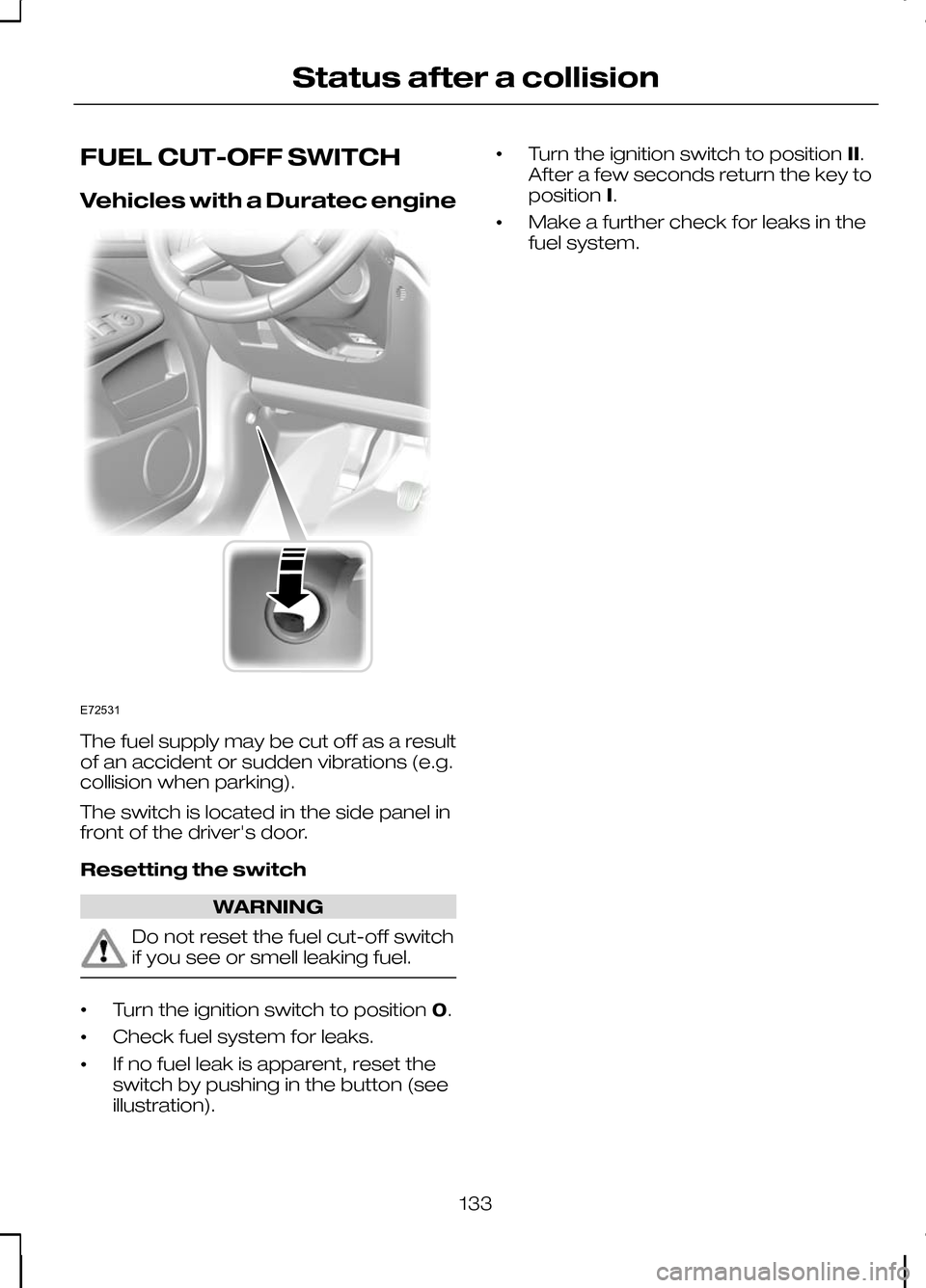
Vehicles with a Duratec engine
The fuel supply may be cut off as a result
of an accident or sudden vibrations (e.g.
collision when parking).
The switch is located in the side panel in
front of the driver's door.
Resetting the switch
WARNING
Do not reset the fuel cut-off switch
if you see or smell leaking fuel.
•
Turn the ignition switch to position
0.
• Check fuel system for leaks.
• If no fuel leak is apparent, reset the
switch by pushing in the button (see
illustration). •
Turn the ignition switch to position
II.
After a few seconds return the key to
position I.
• Make a further check for leaks in the
fuel system.
133
Status after a collisionE72531
Page 136 of 226
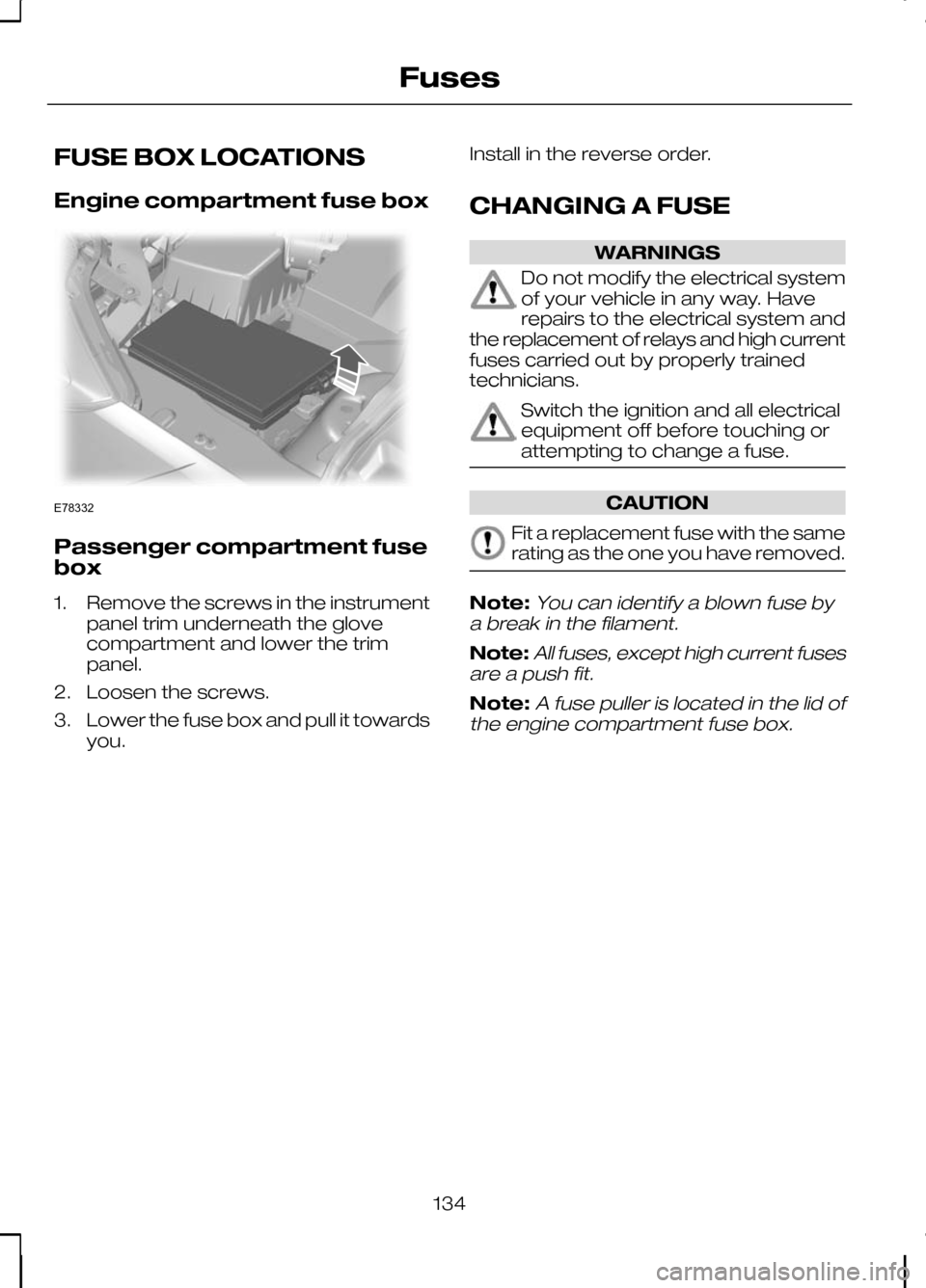
FUSE BOX LOCATIONS
Engine compartment fuse box
Passenger compartment fuse
box
1. Remove the screws in the instrument
panel trim underneath the glove
compartment and lower the trim
panel.
2. Loosen the screws.
3. Lower the fuse box and pull it towards you. Install in the reverse order.
CHANGING A FUSE WARNINGS
Do not modify the electrical system
of your vehicle in any way. Have
repairs to the electrical system and
the replacement of relays and high current
fuses carried out by properly trained
technicians. Switch the ignition and all electrical
equipment off before touching or
attempting to change a fuse.
CAUTION
Fit a replacement fuse with the same
rating as the one you have removed.
Note:You can identify a blown fuse by
a break in the filament.
Note:All fuses, except high current fuses
are a push fit.
Note:A fuse puller is located in the lid of
the engine compartment fuse box.
134
FusesE78332
Page 137 of 226
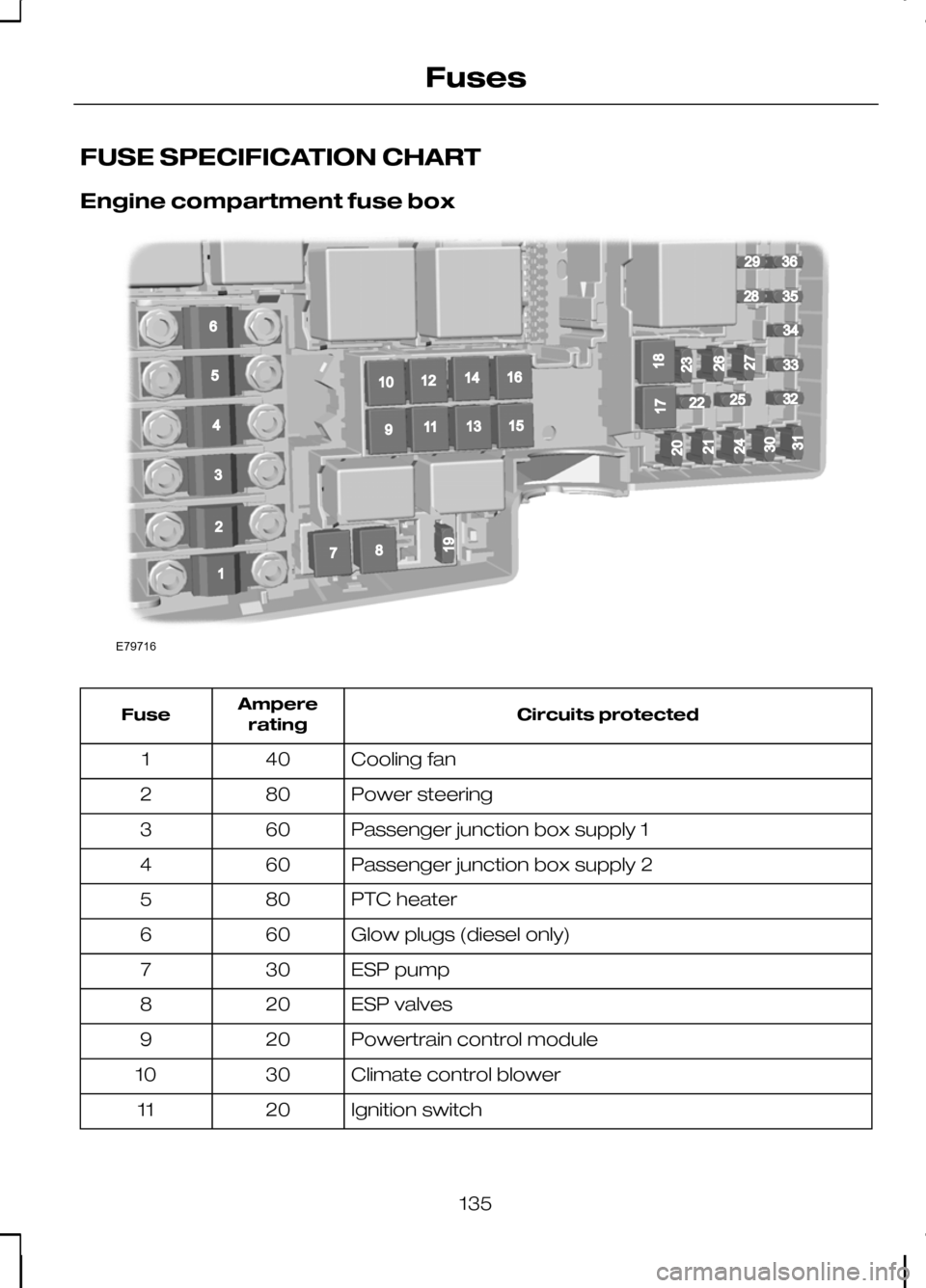
FUSE SPECIFICATION CHART
Engine compartment fuse box
Circuits protected
Ampere
rating
Fuse
Cooling fan
40
1
Power steering
80
2
Passenger junction box supply 1
60
3
Passenger junction box supply 2
60
4
PTC heater
80
5
Glow plugs (diesel only)
60
6
ESP pump
30
7
ESP valves
20
8
Powertrain control module
20
9
Climate control blower
30
10
Ignition switch
20
11
135
FusesE79716196781091211141316152936283435332225325432120171824213031232627
Page 138 of 226
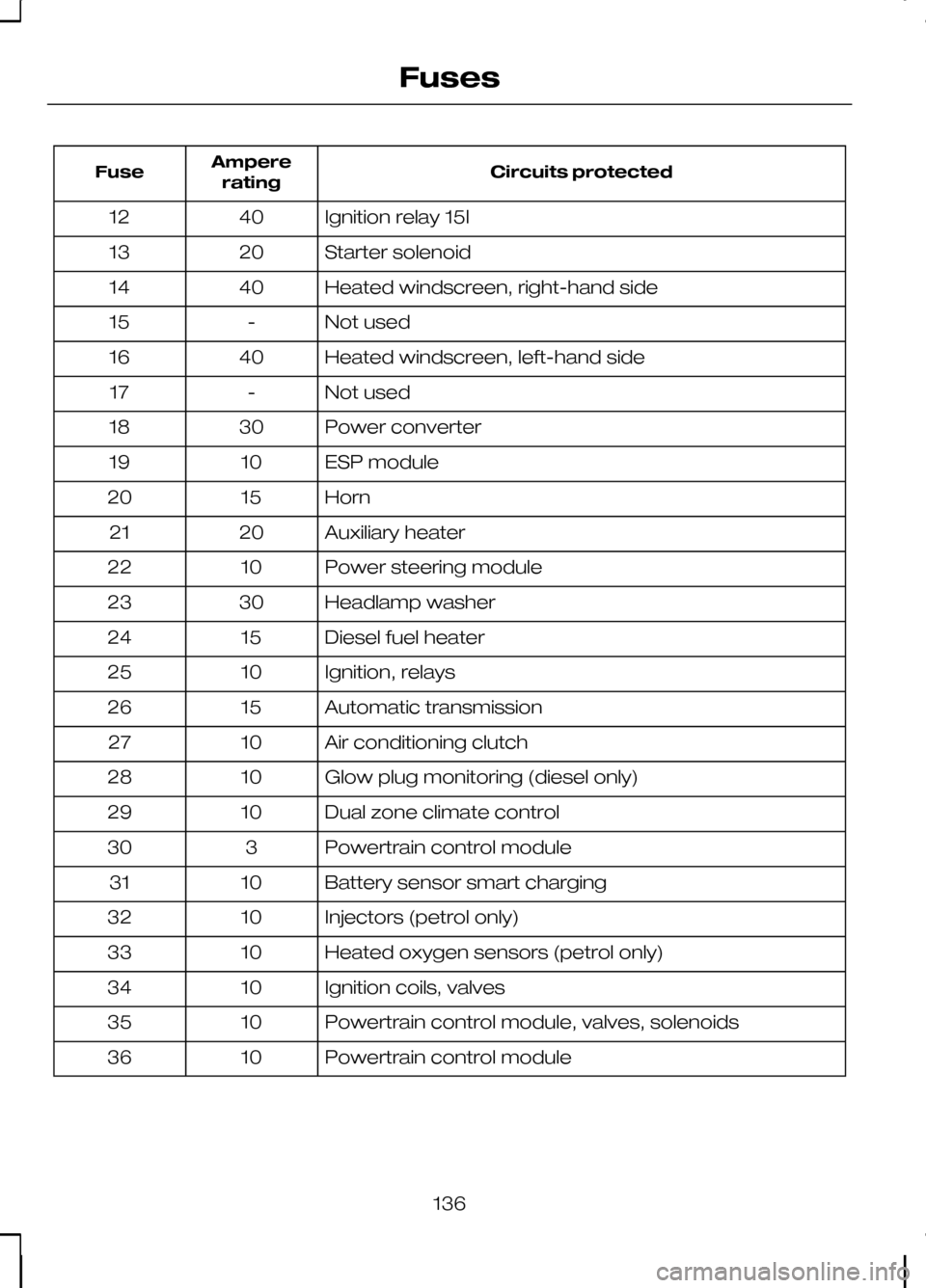
Circuits protected
Ampere
rating
Fuse
Ignition relay 15l
40
12
Starter solenoid
20
13
Heated windscreen, right-hand side
40
14
Not used
-
15
Heated windscreen, left-hand side
40
16
Not used
-
17
Power converter
30
18
ESP module
10
19
Horn
15
20
Auxiliary heater
20
21
Power steering module
10
22
Headlamp washer
30
23
Diesel fuel heater
15
24
Ignition, relays
10
25
Automatic transmission
15
26
Air conditioning clutch
10
27
Glow plug monitoring (diesel only)
10
28
Dual zone climate control
10
29
Powertrain control module
3
30
Battery sensor smart charging
10
31
Injectors (petrol only)
10
32
Heated oxygen sensors (petrol only)
10
33
Ignition coils, valves
10
34
Powertrain control module, valves, solenoids
10
35
Powertrain control module
10
36
136
Fuses