tow FORD KUGA 2010 1.G Owner's Manual
[x] Cancel search | Manufacturer: FORD, Model Year: 2010, Model line: KUGA, Model: FORD KUGA 2010 1.GPages: 226, PDF Size: 8.07 MB
Page 130 of 226
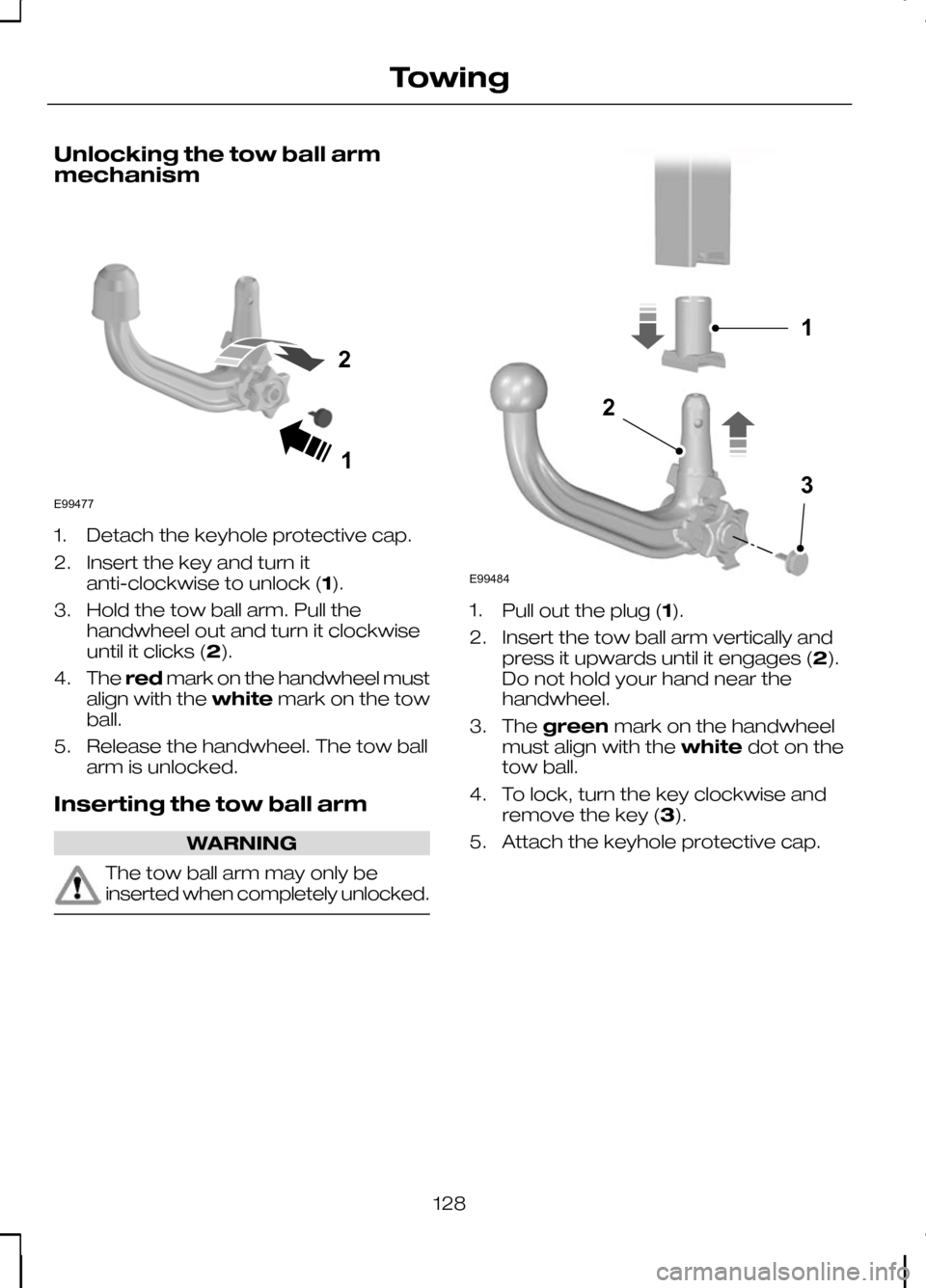
Unlocking the tow ball arm
mechanism
1. Detach the keyhole protective cap.
2. Insert the key and turn it
anti-clockwise to unlock (1).
3. Hold the tow ball arm. Pull the handwheel out and turn it clockwise
until it clicks (2).
4. The red mark on the handwheel must
align with the whitemark on the tow
ball.
5. Release the handwheel. The tow ball arm is unlocked.
Inserting the tow ball arm WARNING
The tow ball arm may only be
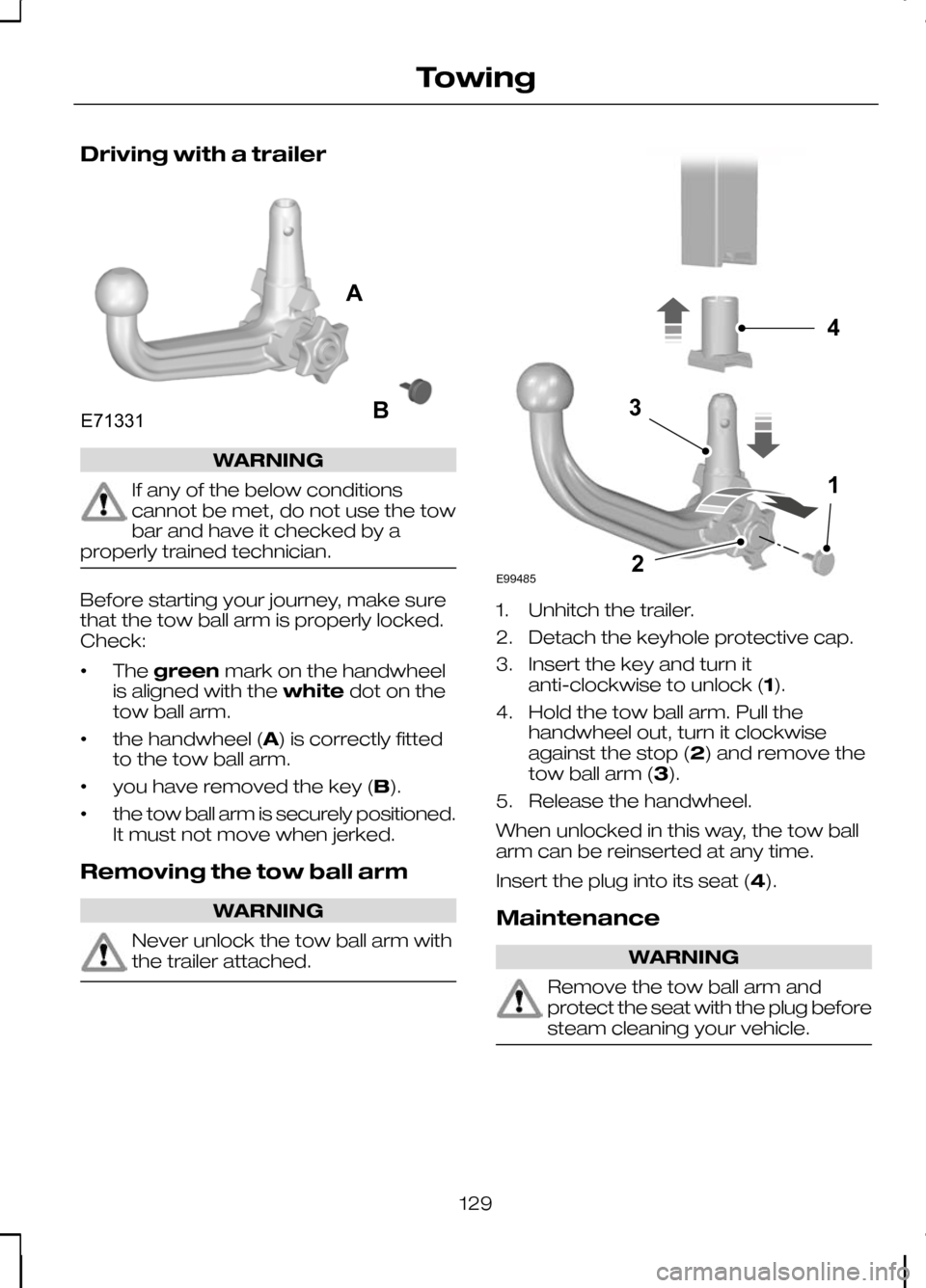
inserted when completely unlocked. 1.
Pull out the plug (1).
2. Insert the tow ball arm vertically and press it upwards until it engages (2).
Do not hold your hand near the
handwheel.
3. The green mark on the handwheel
must align with the whitedot on the
tow ball.
4. To lock, turn the key clockwise and remove the key (3).
5. Attach the keyhole protective cap.
128
TowingE9947712 E99484132
Page 131 of 226
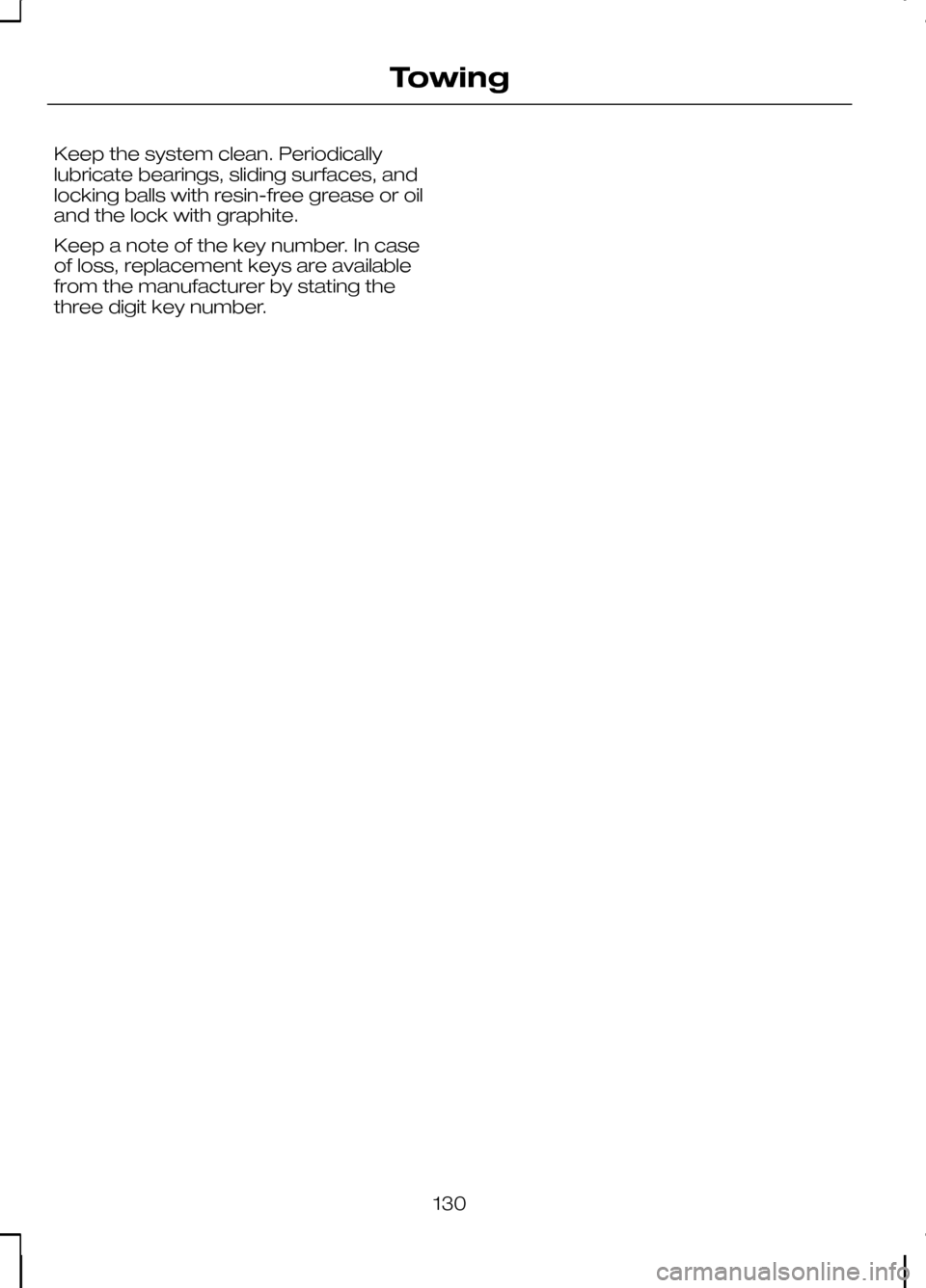
Driving with a trailer
WARNING
If any of the below conditions
cannot be met, do not use the tow
bar and have it checked by a
properly trained technician. Before starting your journey, make sure
that the tow ball arm is properly locked.
Check:
•
The
green mark on the handwheel
is aligned with the whitedot on the
tow ball arm.
• the handwheel (A) is correctly fitted
to the tow ball arm.
• you have removed the key (B).
• the tow ball arm is securely positioned.
It must not move when jerked.
Removing the tow ball arm WARNING
Never unlock the tow ball arm with
the trailer attached. 1. Unhitch the trailer.
2. Detach the keyhole protective cap.
3. Insert the key and turn it
anti-clockwise to unlock (1).
4. Hold the tow ball arm. Pull the handwheel out, turn it clockwise
against the stop (2) and remove the
tow ball arm (3).
5. Release the handwheel.
When unlocked in this way, the tow ball
arm can be reinserted at any time.
Insert the plug into its seat (4).
Maintenance WARNING
Remove the tow ball arm and
protect the seat with the plug before
steam cleaning your vehicle.
129
TowingE71331AB E994854132
Page 132 of 226
Keep the system clean. Periodically
lubricate bearings, sliding surfaces, and
locking balls with resin-free grease or oil
and the lock with graphite.
Keep a note of the key number. In case
of loss, replacement keys are available
from the manufacturer by stating the
three digit key number.
130
Towing
Page 133 of 226
RUNNING-IN
Tyres
WARNING
New tyres need to be run-in for
approximately 500 kilometres (300
miles). During this time, you may
experience different driving
characteristics. Brakes and clutch
WARNING
Avoid heavy use of the brakes and
clutch if possible for the first 150
kilometres (100 miles) in town and
for the first 1 500 kilometres (1 000 miles)
on motorways. Engine
CAUTION
Avoid driving too fast during the first
1 500 kilometres (1 000 miles). Vary
your speed frequently and change
up through the gears early. Do not labour
the engine. COLD WEATHER
PRECAUTIONS
The functional operation of some
components and systems can be
affected at temperatures below -30°C
(-22°F). DRIVING THROUGH WATER
Driving through water CAUTIONS
Drive through water in an emergency
only, and not as part of normal
driving.
Engine damage can occur if water
enters the air filter.
In an emergency, the vehicle can be
driven through water to a maximum depth
of 200 mm and at a maximum speed of
10 km/h (6 mph). Extra caution should be
exercised when driving through flowing
water.
When driving in water, maintain a low
speed and do not stop the vehicle. After
driving through water, and as soon as it
is safe to do so:
•
Depress the brake pedal lightly and
check that full brake function is
achieved.
• Check that the horn works.
• Check that the vehicle's lights are fully
operational.
• Check the power assistance
of the steering system.
131
Driving hints
Page 136 of 226
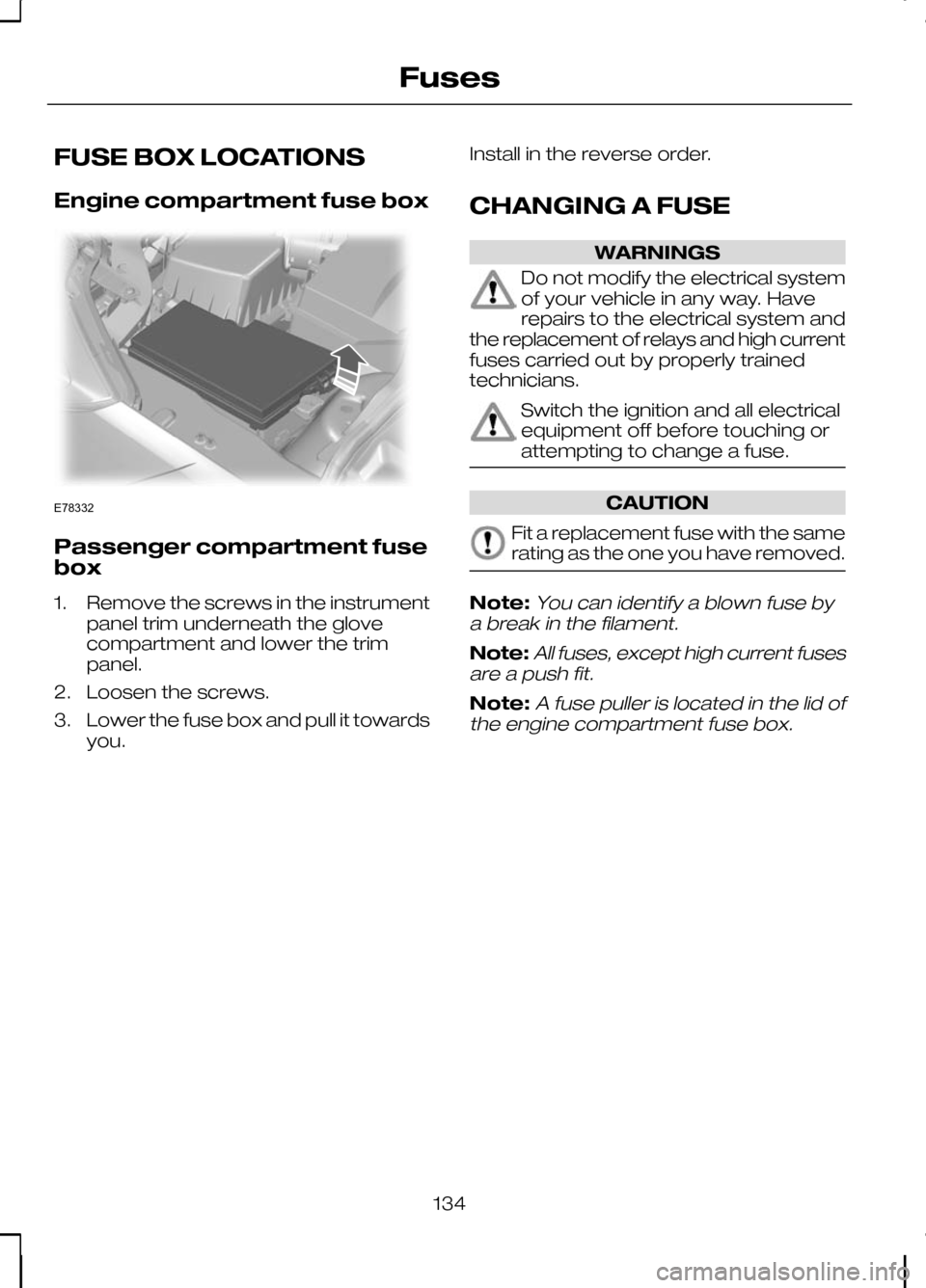
FUSE BOX LOCATIONS
Engine compartment fuse box
Passenger compartment fuse
box
1. Remove the screws in the instrument
panel trim underneath the glove
compartment and lower the trim
panel.
2. Loosen the screws.
3. Lower the fuse box and pull it towards you. Install in the reverse order.
CHANGING A FUSE WARNINGS
Do not modify the electrical system
of your vehicle in any way. Have
repairs to the electrical system and
the replacement of relays and high current
fuses carried out by properly trained
technicians. Switch the ignition and all electrical
equipment off before touching or
attempting to change a fuse.
CAUTION
Fit a replacement fuse with the same
rating as the one you have removed.
Note:You can identify a blown fuse by
a break in the filament.
Note:All fuses, except high current fuses
are a push fit.
Note:A fuse puller is located in the lid of
the engine compartment fuse box.
134
FusesE78332
Page 140 of 226
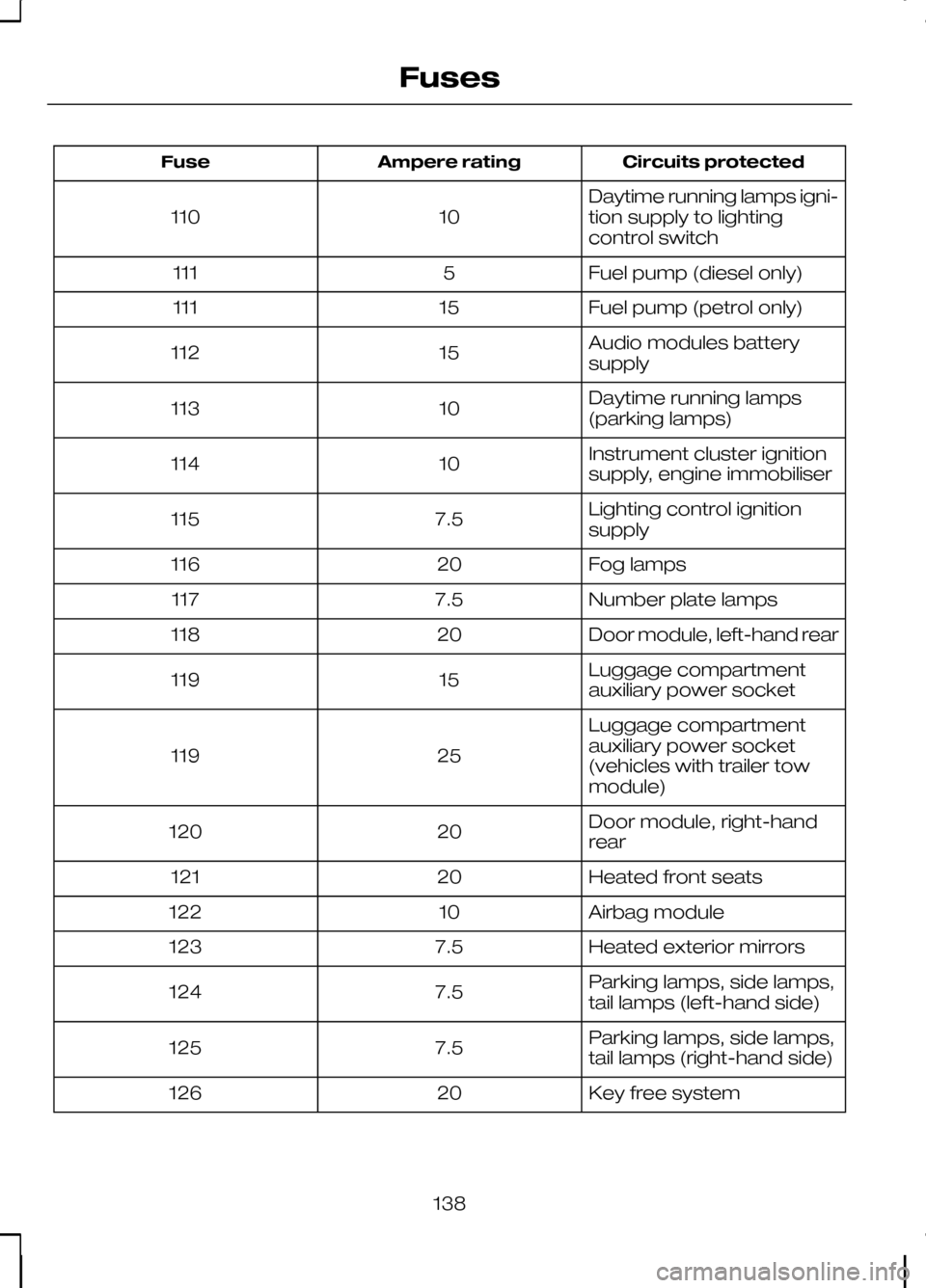
Circuits protected
Ampere rating
Fuse
Daytime running lamps igni-
tion supply to lighting
control switch
10
110
Fuel pump (diesel only)
5
111
Fuel pump (petrol only)
15
111
Audio modules battery
supply
15
112
Daytime running lamps
(parking lamps)
10
113
Instrument cluster ignition
supply, engine immobiliser
10
114
Lighting control ignition
supply
7.5
115
Fog lamps
20
116
Number plate lamps
7.5
117
Door module, left-hand rear
20
118
Luggage compartment
auxiliary power socket
15
119
Luggage compartment
auxiliary power socket
(vehicles with trailer tow
module)
25
119
Door module, right-hand
rear
20
120
Heated front seats
20
121
Airbag module
10
122
Heated exterior mirrors
7.5
123
Parking lamps, side lamps,
tail lamps (left-hand side)
7.5
124
Parking lamps, side lamps,
tail lamps (right-hand side)
7.5
125
Key free system
20
126
138
Fuses
Page 142 of 226
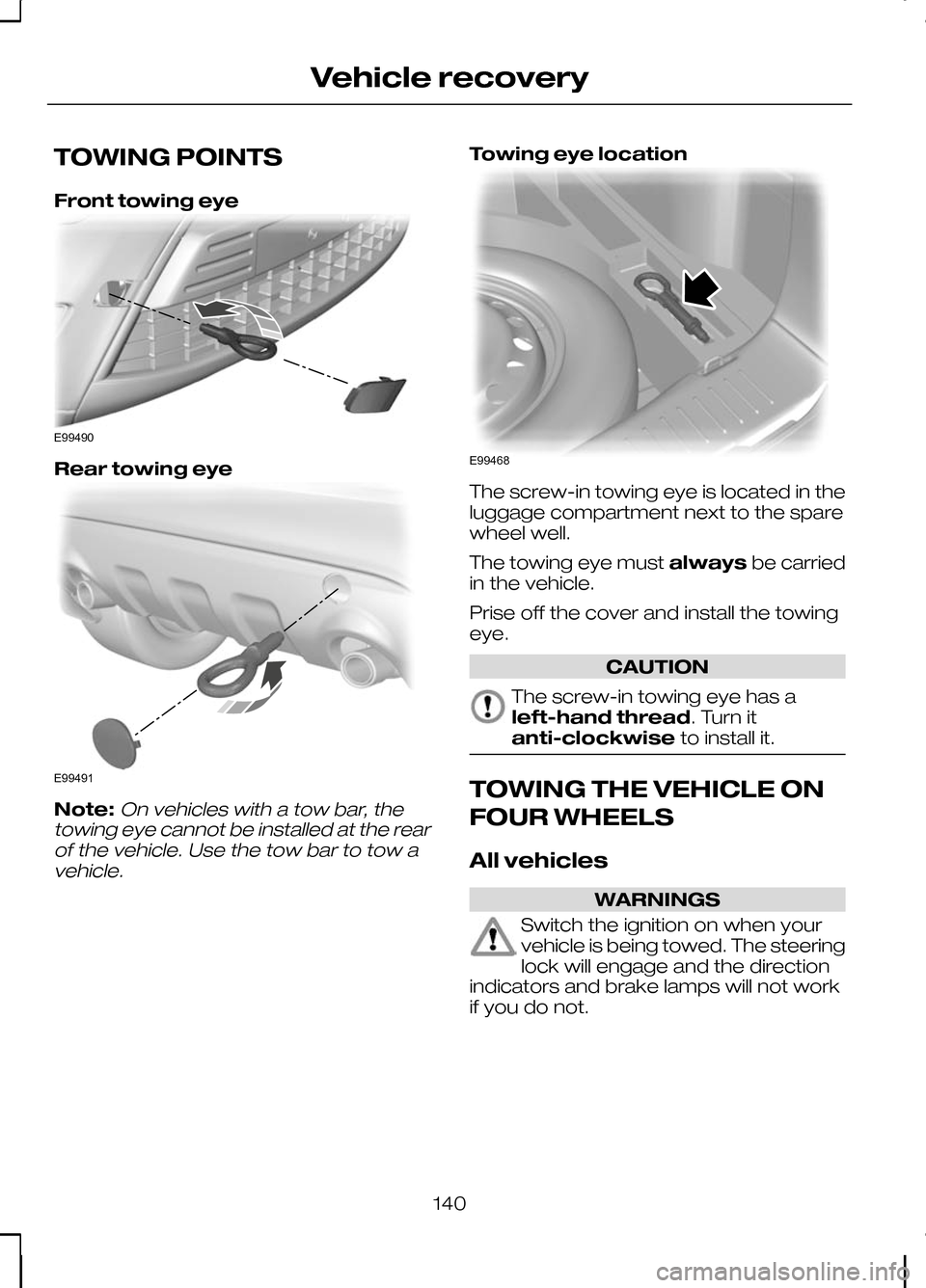
TOWING POINTS
Front towing eye
Rear towing eye
Note:On vehicles with a tow bar, the
towing eye cannot be installed at the rear of the vehicle. Use the tow bar to tow avehicle.
Towing eye location The screw-in towing eye is located in the
luggage compartment next to the spare
wheel well.
The towing eye must
alwaysbe carried
in the vehicle.
Prise off the cover and install the towing
eye. CAUTION
The screw-in towing eye has a
left-hand thread. Turn it
anti-clockwise
to install it. TOWING THE VEHICLE ON
FOUR WHEELS
All vehicles
WARNINGS
Switch the ignition on when your
vehicle is being towed. The steering
lock will engage and the direction
indicators and brake lamps will not work
if you do not.
140
Vehicle recoveryE99490 E99491 E99468
Page 143 of 226
WARNINGS
The brake servo and the power
steering pump do not operate
unless the engine is running. Press
the brake pedal harder and allow for
increased stopping distances and heavier
steering. CAUTIONS
Too much tension in the tow rope
could cause damage to your vehicle
or the vehicle that is towing.
Do not use a rigid tow bar on the
front towing eye.
Select neutral when your vehicle is
being towed.
For vehicles with AWD, in the event
of a breakdown or mechanical failure
of the transmission your vehicle must
be recovered with either ALLwheels on
the ground or transported with ALL
wheels off the ground. Drive off slowly and smoothly without
jerking the vehicle that is towing.
Vehicles with automatic
transmission
CAUTIONS
If a speed of 20 km/h (12 mph) and
a distance of 20 kilometres (12 miles)
is to be exceeded the drive wheels
must be lifted clear of the ground. It is recommended not to tow with
the drive wheels on the ground.
However, if it is required to move the
vehicle from a dangerous location, do not
tow your vehicle faster than 20 km/h (12
mph) or further than 20 kilometres (12
miles). Do not tow your vehicle backwards. CAUTIONS
In the event of a mechanical failure
of the transmission the drive wheels
must be lifted clear of the ground.
Do not tow your vehicle if the
ambient temperature is below 0ºC
(32ºF).
141
Vehicle recovery
Page 159 of 226
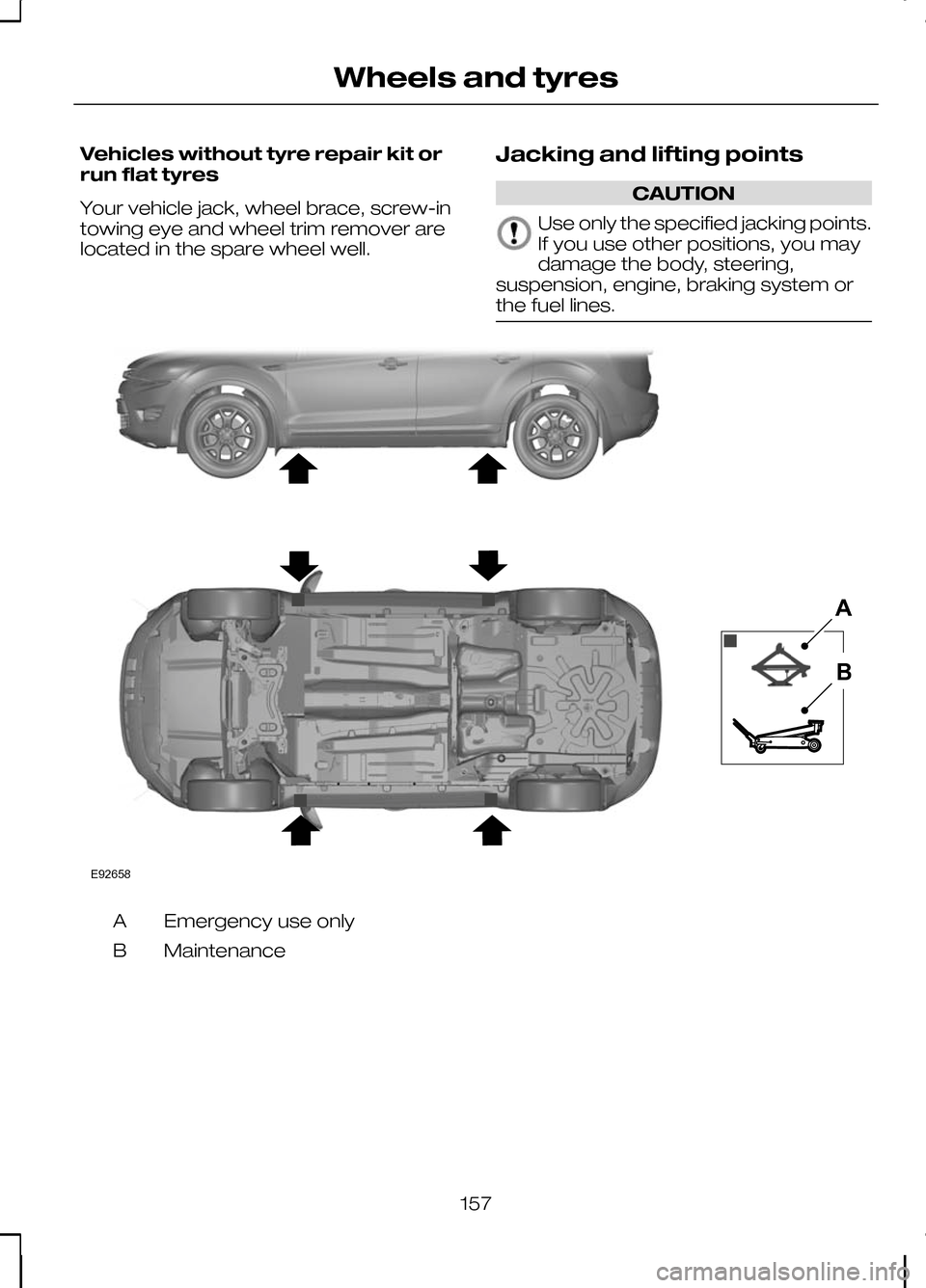
Vehicles without tyre repair kit or
run flat tyres
Your vehicle jack, wheel brace, screw-in
towing eye and wheel trim remover are
located in the spare wheel well.
Jacking and lifting points CAUTION
Use only the specified jacking points.
If you use other positions, you may
damage the body, steering,
suspension, engine, braking system or
the fuel lines. Emergency use only
A
Maintenance
B
157
Wheels and tyresE92658AB
Page 160 of 226
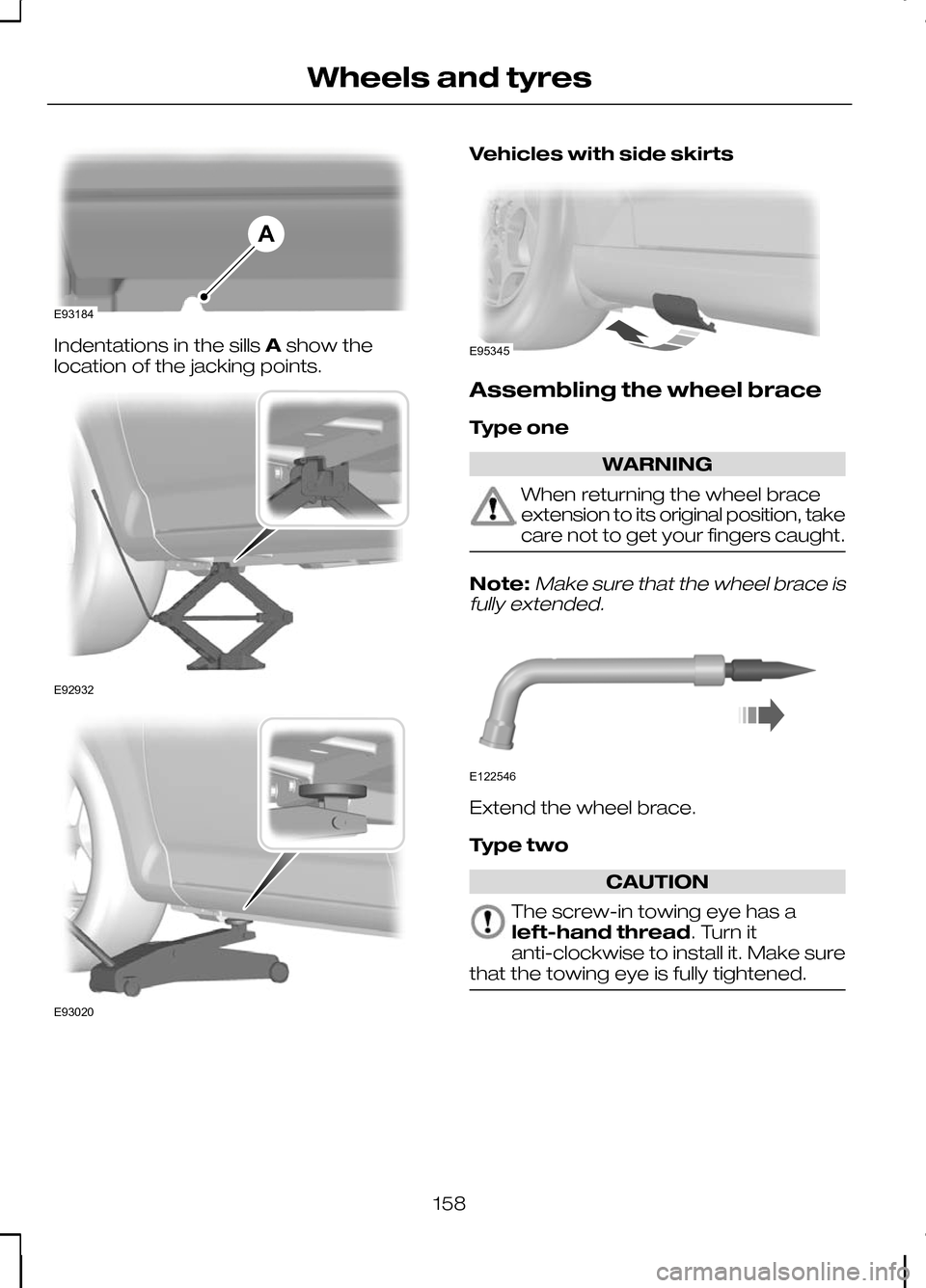
Indentations in the sills
Ashow the
location of the jacking points. Vehicles with side skirts
Assembling the wheel brace
Type one
WARNING
When returning the wheel brace
extension to its original position, take
care not to get your fingers caught.
Note:Make sure that the wheel brace is
fully extended. Extend the wheel brace.
Type two
CAUTION
The screw-in towing eye has a
left-hand thread. Turn it
anti-clockwise to install it. Make sure
that the towing eye is fully tightened. 158
Wheels and tyresE93184A E92932 E93020 E95345 E122546