ABS FORD MONDEO 1993 Service Owner's Manual
[x] Cancel search | Manufacturer: FORD, Model Year: 1993, Model line: MONDEO, Model: FORD MONDEO 1993Pages: 279, PDF Size: 12.71 MB
Page 131 of 279
and remove the clevis pin securing the servo
unit pushrod to the pedal cross-link arm.
7On left-hand drive models, unscrew the nut
securing the pedal trunnion to the servo unit
pushrod inside the passenger compartment.
The nut is located near the top of the pedal,
and is accessible through an access hole. For
improved access, remove the lower facia
panel first.
8Withdraw the servo unit from the bulkhead,
and remove it from the engine compartment.
On left-hand drive models, take care not to
damage the bulkhead rubber grommet as the
pushrod passes through it.
9Note that the servo unit cannot be
dismantled for repair or overhaul and, if faulty,
must be renewed.
Refitting
10Refitting is a reversal of the removal
procedure. Refer to Section 11 for details of
refitting the master cylinder.
Removal
1Depress the brake pedal four or five times,
to dissipate any remaining vacuum from the
servo unit.
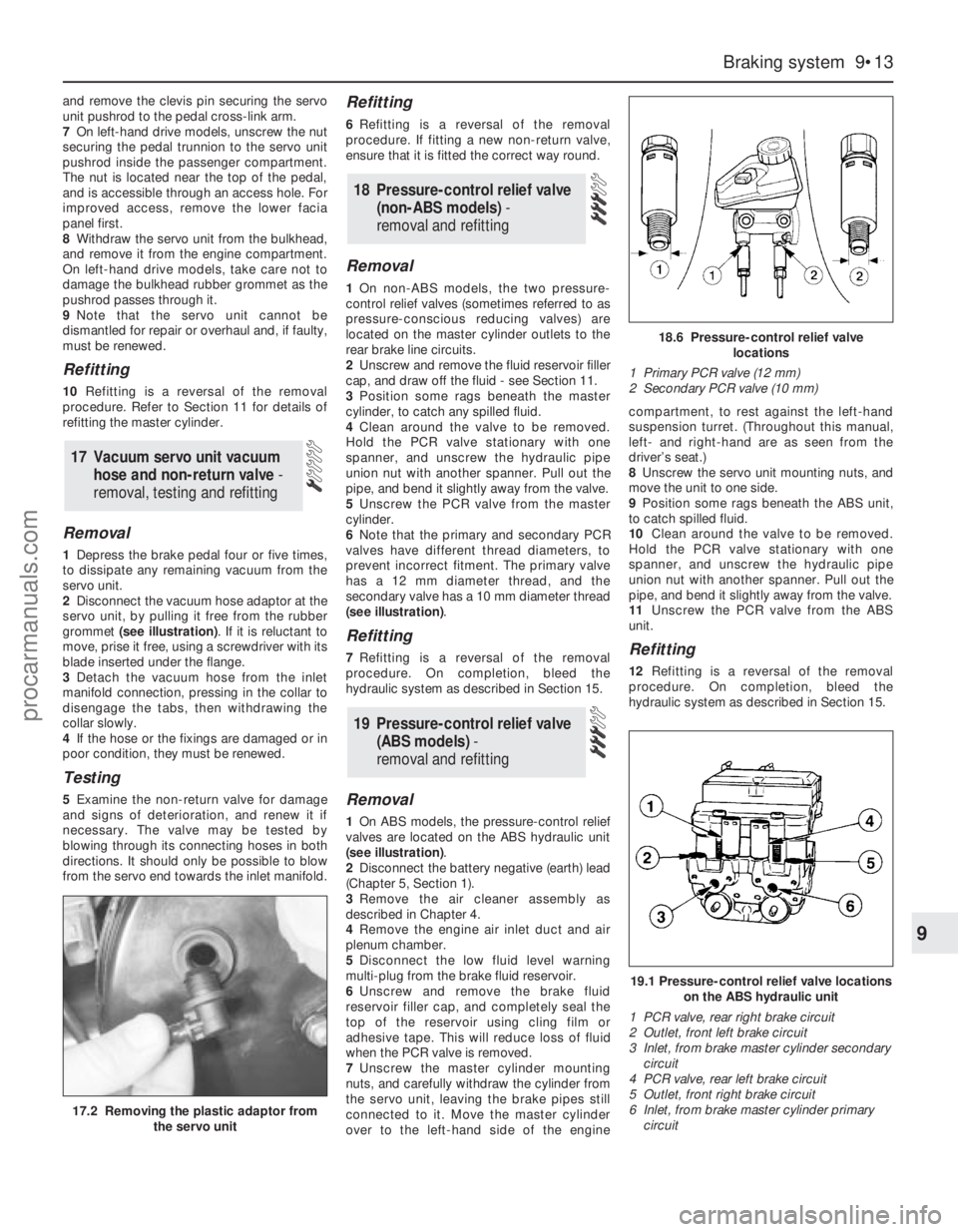
2Disconnect the vacuum hose adaptor at the
servo unit, by pulling it free from the rubber
grommet (see illustration). If it is reluctant to
move, prise it free, using a screwdriver with its
blade inserted under the flange.
3Detach the vacuum hose from the inlet
manifold connection, pressing in the collar to
disengage the tabs, then withdrawing the
collar slowly.
4If the hose or the fixings are damaged or in
poor condition, they must be renewed.
Testing
5Examine the non-return valve for damage
and signs of deterioration, and renew it if
necessary. The valve may be tested by
blowing through its connecting hoses in both
directions. It should only be possible to blow
from the servo end towards the inlet manifold.
Refitting
6Refitting is a reversal of the removal
procedure. If fitting a new non-return valve,
ensure that it is fitted the correct way round.
Removal
1On non-ABS models, the two pressure-
control relief valves (sometimes referred to as
pressure-conscious reducing valves) are
located on the master cylinder outlets to the
rear brake line circuits.
2Unscrew and remove the fluid reservoir filler
cap, and draw off the fluid - see Section 11.
3Position some rags beneath the master
cylinder, to catch any spilled fluid.
4Clean around the valve to be removed.
Hold the PCR valve stationary with one
spanner, and unscrew the hydraulic pipe
union nut with another spanner. Pull out the
pipe, and bend it slightly away from the valve.
5Unscrew the PCR valve from the master
cylinder.
6Note that the primary and secondary PCR
valves have different thread diameters, to
prevent incorrect fitment. The primary valve
has a 12 mm diameter thread, and the
secondary valve has a 10 mm diameter thread
(see illustration).
Refitting
7Refitting is a reversal of the removal
procedure. On completion, bleed the
hydraulic system as described in Section 15.
Removal
1On ABS models, the pressure-control relief
valves are located on the ABS hydraulic unit
(see illustration).
2Disconnect the battery negative (earth) lead
(Chapter 5, Section 1).
3Remove the air cleaner assembly as
described in Chapter 4.
4Remove the engine air inlet duct and air
plenum chamber.
5Disconnect the low fluid level warning
multi-plug from the brake fluid reservoir.
6Unscrew and remove the brake fluid
reservoir filler cap, and completely seal the
top of the reservoir using cling film or
adhesive tape. This will reduce loss of fluid
when the PCR valve is removed.
7Unscrew the master cylinder mounting
nuts, and carefully withdraw the cylinder from
the servo unit, leaving the brake pipes still
connected to it. Move the master cylinder
over to the left-hand side of the enginecompartment, to rest against the left-hand
suspension turret. (Throughout this manual,
left- and right-hand are as seen from the
driver’s seat.)
8Unscrew the servo unit mounting nuts, and
move the unit to one side.
9Position some rags beneath the ABS unit,
to catch spilled fluid.
10Clean around the valve to be removed.
Hold the PCR valve stationary with one
spanner, and unscrew the hydraulic pipe
union nut with another spanner. Pull out the
pipe, and bend it slightly away from the valve.
11Unscrew the PCR valve from the ABS
unit.
Refitting
12Refitting is a reversal of the removal
procedure. On completion, bleed the
hydraulic system as described in Section 15.
19 Pressure-control relief valve
(ABS models) -
removal and refitting
18 Pressure-control relief valve
(non-ABS models) -
removal and refitting
17 Vacuum servo unit vacuum
hose and non-return valve -
removal, testing and refitting
Braking system 9•13
9
17.2 Removing the plastic adaptor from
the servo unit
18.6 Pressure-control relief valve
locations
1 Primary PCR valve (12 mm)
2 Secondary PCR valve (10 mm)
19.1 Pressure-control relief valve locations
on the ABS hydraulic unit
1 PCR valve, rear right brake circuit
2 Outlet, front left brake circuit
3 Inlet, from brake master cylinder secondary
circuit
4 PCR valve, rear left brake circuit
5 Outlet, front right brake circuit
6 Inlet, from brake master cylinder primary
circuit
procarmanuals.com
Page 132 of 279
Note:If any part of the ABS hydraulic unit is
defective, it must be renewed as an assembly.
Apart from the relay box (Section 22),
individual spare parts are not available.
Removal
1Remove both pressure-control relief valves
as described in Section 19.
2Identify the location of the remaining brake
hydraulic pipes on the ABS hydraulic unit,
then unscrew the union nuts and pull out the
pipes. Carefully bend the pipes away from the
hydraulic unit, to allow the unit to be removed.
3Disconnect the multi-plugs from the
hydraulic unit. To disconnect the main 22-pin
multi-plug, push the locktab, then swivel the
multi-plug outwards and unhook it.
Right-hand drive models
4Have an assistant hold the brake pedal
depressed, then extract the spring clip and
remove the clevis pin securing the servo unit
pushrod to the pedal cross-link arm.
5Remove the vacuum servo unit from the
engine compartment.
Left-hand drive models
6Unscrew the nut securing the pedal
trunnion to the servo unit pushrod inside the
passenger compartment. The nut is located
near the top of the pedal, and is accessible
through an access hole. For improved access,
remove the lower facia panel first.
7Remove the vacuum servo unit, together
with the pushrod, from the engine
compartment. Take care not to damage the
rubber grommet in the bulkhead.
All models
8Unscrew the pump mounting nut.
9Raise the left-hand side of the ABS
hydraulic unit, then swivel the unit out of the
right-hand mounting. Take care not to lose the
bracket studs and insulator ring.
Refitting
10Locate the insulator ring on the pump
end, and fit the stud cap to the insulator ring.
11Lower the ABS hydraulic unit into
position, right-hand end first.
12Fit the right-hand bracket studs onto the
insulators.
13Lower the left-hand end of the ABS
hydraulic unit onto the bracket, then fit and
tighten the pump mounting nut.
Left-hand drive models
14Locate the vacuum servo unit and
pushrod on the bulkhead bracket, taking care
not to damage the rubber grommet.
15Insert the pushrod in the pedal trunnion,
and tighten the nut.
16Refit the lower facia panel if it was
removed.
Right-hand drive models
17Locate the vacuum servo unit and
pushrod on the bulkhead bracket.
18Refit the clevis pin and spring clip
securing the servo unit pushrod to the pedal
cross-link arm.
All models
19Reconnect the multi-plugs to the
hydraulic unit.
20Reconnect the brake pipes to the
hydraulic unit, and tighten the union nuts.
21Refit both pressure-control relief valves,
with reference to Section 20.
Testing
1Checking of the sensors is done before
removal, connecting a voltmeter to the
disconnected sensor multi-plug. Using an
analogue (moving coil) meter is not practical,
since the meter does not respond quickly
enough. A digital meter having an AC facility
may be used to check that the sensor is
operating correctly. To do this, raise the
relevant wheel then disconnect the wiring to
the ABS sensor and connect the meter to it.
Spin the wheel and check that the output
voltage is between 1.5 and 2.0 volts,
depending on how fast the wheel is spun.
Alternatively, an oscilloscope may be used to
check the output of the sensor - an alternating
current will be traced on the screen, of
magnitude depending on the speed of the
rotating wheel.
2If the sensor output is low or zero, renew
the sensor.
Removal
Front wheel sensor
3Apply the handbrake, jack up the front of
the vehicle and support it on axle stands.
Remove the relevant wheel.
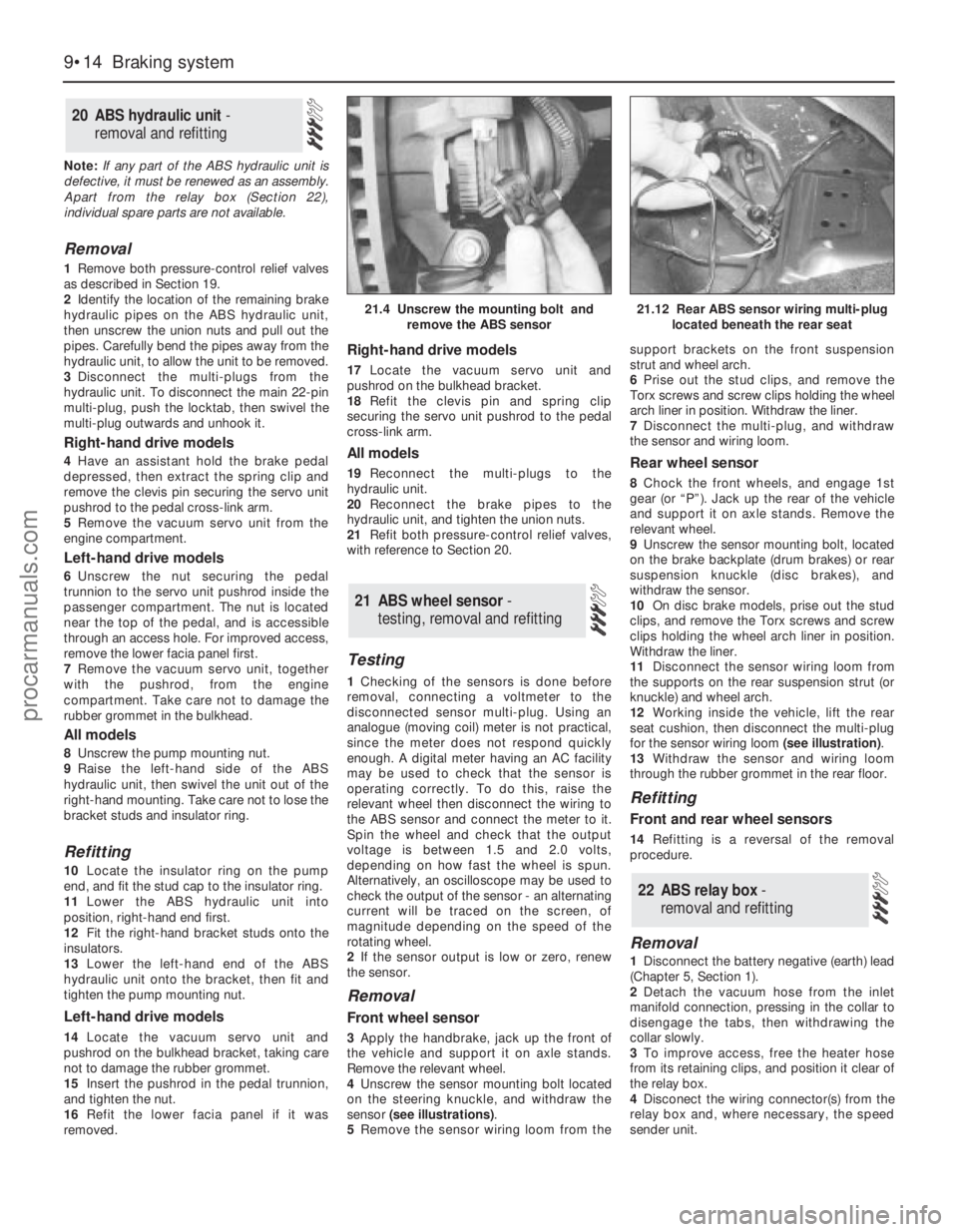
4Unscrew the sensor mounting bolt located
on the steering knuckle, and withdraw the
sensor (see illustrations).
5Remove the sensor wiring loom from thesupport brackets on the front suspension
strut and wheel arch.
6Prise out the stud clips, and remove the
Torx screws and screw clips holding the wheel
arch liner in position. Withdraw the liner.
7Disconnect the multi-plug, and withdraw
the sensor and wiring loom.
Rear wheel sensor
8Chock the front wheels, and engage 1st
gear (or “P”). Jack up the rear of the vehicle
and support it on axle stands. Remove the
relevant wheel.
9Unscrew the sensor mounting bolt, located
on the brake backplate (drum brakes) or rear
suspension knuckle (disc brakes), and
withdraw the sensor.
10On disc brake models, prise out the stud
clips, and remove the Torx screws and screw
clips holding the wheel arch liner in position.
Withdraw the liner.
11Disconnect the sensor wiring loom from
the supports on the rear suspension strut (or
knuckle) and wheel arch.
12Working inside the vehicle, lift the rear
seat cushion, then disconnect the multi-plug
for the sensor wiring loom (see illustration).
13Withdraw the sensor and wiring loom
through the rubber grommet in the rear floor.
Refitting
Front and rear wheel sensors
14Refitting is a reversal of the removal
procedure.
Removal
1Disconnect the battery negative (earth) lead
(Chapter 5, Section 1).
2Detach the vacuum hose from the inlet
manifold connection, pressing in the collar to
disengage the tabs, then withdrawing the
collar slowly.
3To improve access, free the heater hose
from its retaining clips, and position it clear of
the relay box.
4Disconect the wiring connector(s) from the
relay box and, where necessary, the speed
sender unit.
22 ABS relay box -
removal and refitting
21 ABS wheel sensor -
testing, removal and refitting
20 ABS hydraulic unit -
removal and refitting
9•14 Braking system
21.4 Unscrew the mounting bolt and
remove the ABS sensor21.12 Rear ABS sensor wiring multi-plug
located beneath the rear seat
procarmanuals.com
Page 133 of 279
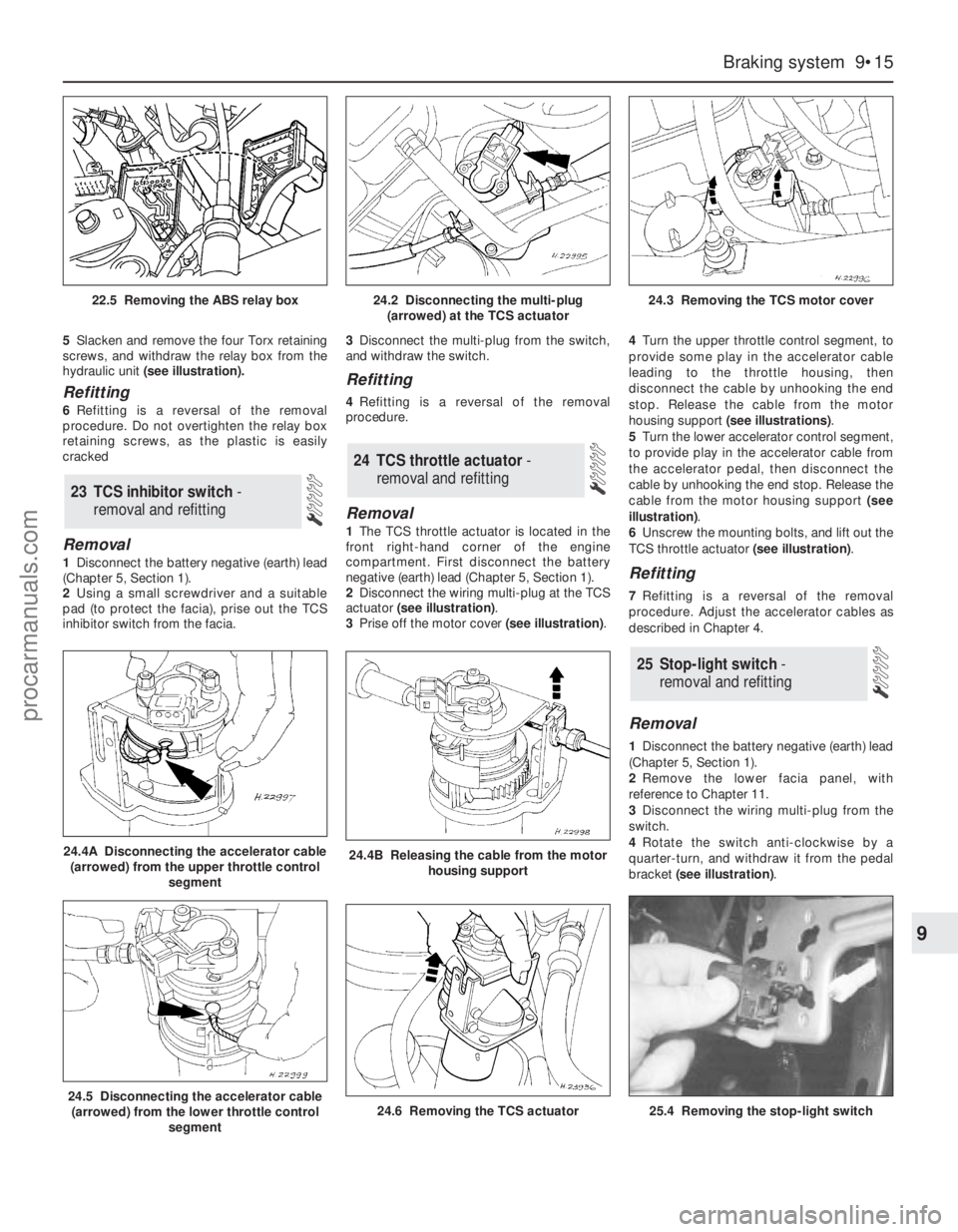
5Slacken and remove the four Torx retaining
screws, and withdraw the relay box from the
hydraulic unit (see illustration).
Refitting
6Refitting is a reversal of the removal
procedure. Do not overtighten the relay box
retaining screws, as the plastic is easily
cracked
Removal
1Disconnect the battery negative (earth) lead
(Chapter 5, Section 1).
2Using a small screwdriver and a suitable
pad (to protect the facia), prise out the TCS
inhibitor switch from the facia.3Disconnect the multi-plug from the switch,
and withdraw the switch.
Refitting
4Refitting is a reversal of the removal
procedure.
Removal
1The TCS throttle actuator is located in the
front right-hand corner of the engine
compartment. First disconnect the battery
negative (earth) lead (Chapter 5, Section 1).
2Disconnect the wiring multi-plug at the TCS
actuator (see illustration).
3Prise off the motor cover (see illustration).4Turn the upper throttle control segment, to
provide some play in the accelerator cable
leading to the throttle housing, then
disconnect the cable by unhooking the end
stop. Release the cable from the motor
housing support (see illustrations).
5Turn the lower accelerator control segment,
to provide play in the accelerator cable from
the accelerator pedal, then disconnect the
cable by unhooking the end stop. Release the
cable from the motor housing support (see
illustration).
6Unscrew the mounting bolts, and lift out the
TCS throttle actuator (see illustration).
Refitting
7Refitting is a reversal of the removal
procedure. Adjust the accelerator cables as
described in Chapter 4.
Removal
1Disconnect the battery negative (earth) lead
(Chapter 5, Section 1).
2Remove the lower facia panel, with
reference to Chapter 11.
3Disconnect the wiring multi-plug from the
switch.
4Rotate the switch anti-clockwise by a
quarter-turn, and withdraw it from the pedal
bracket (see illustration).
25 Stop-light switch -
removal and refitting
24 TCS throttle actuator -
removal and refitting
23 TCS inhibitor switch -
removal and refitting
Braking system 9•15
9
24.4B Releasing the cable from the motor
housing support24.4A Disconnecting the accelerator cable
(arrowed) from the upper throttle control
segment
24.5 Disconnecting the accelerator cable
(arrowed) from the lower throttle control
segment24.6 Removing the TCS actuator
22.5 Removing the ABS relay box24.2 Disconnecting the multi-plug
(arrowed) at the TCS actuator24.3 Removing the TCS motor cover
25.4 Removing the stop-light switch
procarmanuals.com
Page 139 of 279
coolant or EGR pipes, etc. In almost all cases,
damage of this sort is caused in the first
instance by incorrect routing on reassembly
after previous work has been carried out (see
the note at the beginning of this sub-Section).
6Obviously wires can break or short together
inside the insulation so that no visible
evidence betrays the fault, but this usually
only occurs where the wiring loom has been
incorrectly routed so that it is stretched taut or
kinked sharply; either of these conditions
should be obvious on even a casual
inspection. If this is thought to have happened
and the fault proves elusive, the suspect
section of wiring should be checked very
carefully during the more detailed checks
which follow.
7Depending on the extent of the problem,
damaged wiring may be repaired by rejoining
the break or splicing-in a new length of wire,
using solder to ensure a good connection,
and remaking the insulation with adhesive
insulating tape or heat-shrink tubing, as
desired. If the damage is extensive, given the
implications for the vehicle’s future reliability,
the best long-term answer may well be to
renew that entire section of the loom, however
expensive this may appear.
8When the actual damage has been
repaired, ensure that the wiring loom is
rerouted correctly, so that it is clear of other
components, is not stretched or kinked, and is
secured out of harm’s way using the plastic
clips, guides and ties provided.
9Check all electrical connectors, ensuring
that they are clean, securely fastened, and
that each is locked by its plastic tabs or wire
clip, as appropriate. If any connector shows
external signs of corrosion (accumulations of
white or green deposits, or streaks of “rust”),
or if any is thought to be dirty, it must be
unplugged and cleaned using electrical
contact cleaner. If the connector pins are
severely corroded, the connector must be
renewed; note that this may mean the renewalof that entire section of the loom - see your
local Ford dealer for details.
10If the cleaner completely removes the
corrosion to leave the connector in a
satisfactory condition, it would be wise to
pack the connector with a suitable material
which will exclude dirt and moisture, and
prevent the corrosion from occurring again; a
Ford dealer may be able to recommend a
suitable product. Note:The system’s
connectors use gold-plated pins, which must
notbe mixed with the older tin-plated types
(readily identifiable from the different colour) if
a component is renewed, nor must the lithium
grease previously used to protect tin-plated
pins be used on gold-plated connectors.
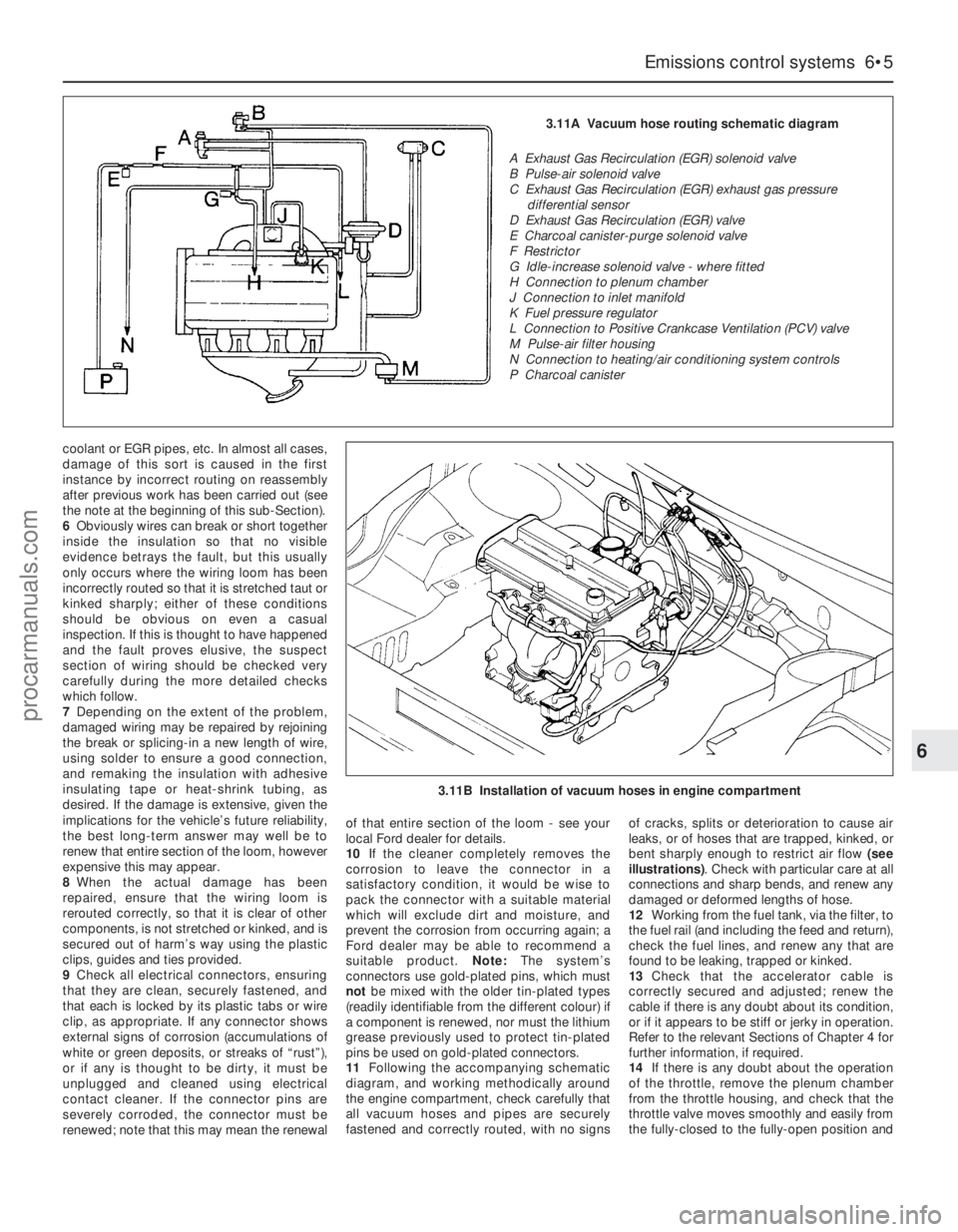
11Following the accompanying schematic
diagram, and working methodically around
the engine compartment, check carefully that
all vacuum hoses and pipes are securely
fastened and correctly routed, with no signsof cracks, splits or deterioration to cause air
leaks, or of hoses that are trapped, kinked, or
bent sharply enough to restrict air flow (see
illustrations). Check with particular care at all
connections and sharp bends, and renew any
damaged or deformed lengths of hose.
12Working from the fuel tank, via the filter, to
the fuel rail (and including the feed and return),
check the fuel lines, and renew any that are
found to be leaking, trapped or kinked.
13Check that the accelerator cable is
correctly secured and adjusted; renew the
cable if there is any doubt about its condition,
or if it appears to be stiff or jerky in operation.
Refer to the relevant Sections of Chapter 4 for
further information, if required.
14If there is any doubt about the operation
of the throttle, remove the plenum chamber
from the throttle housing, and check that the
throttle valve moves smoothly and easily from
the fully-closed to the fully-open position and
Emissions control systems 6•5
6
3.11A Vacuum hose routing schematic diagram
A Exhaust Gas Recirculation (EGR) solenoid valve
B Pulse-air solenoid valve
C Exhaust Gas Recirculation (EGR) exhaust gas pressure
differential sensor
D Exhaust Gas Recirculation (EGR) valve
E Charcoal canister-purge solenoid valve
F Restrictor
G Idle-increase solenoid valve - where fitted
H Connection to plenum chamber
J Connection to inlet manifold
K Fuel pressure regulator
L Connection to Positive Crankcase Ventilation (PCV) valve
M Pulse-air filter housing
N Connection to heating/air conditioning system controls
P Charcoal canister
3.11B Installation of vacuum hoses in engine compartment
procarmanuals.com
Page 155 of 279
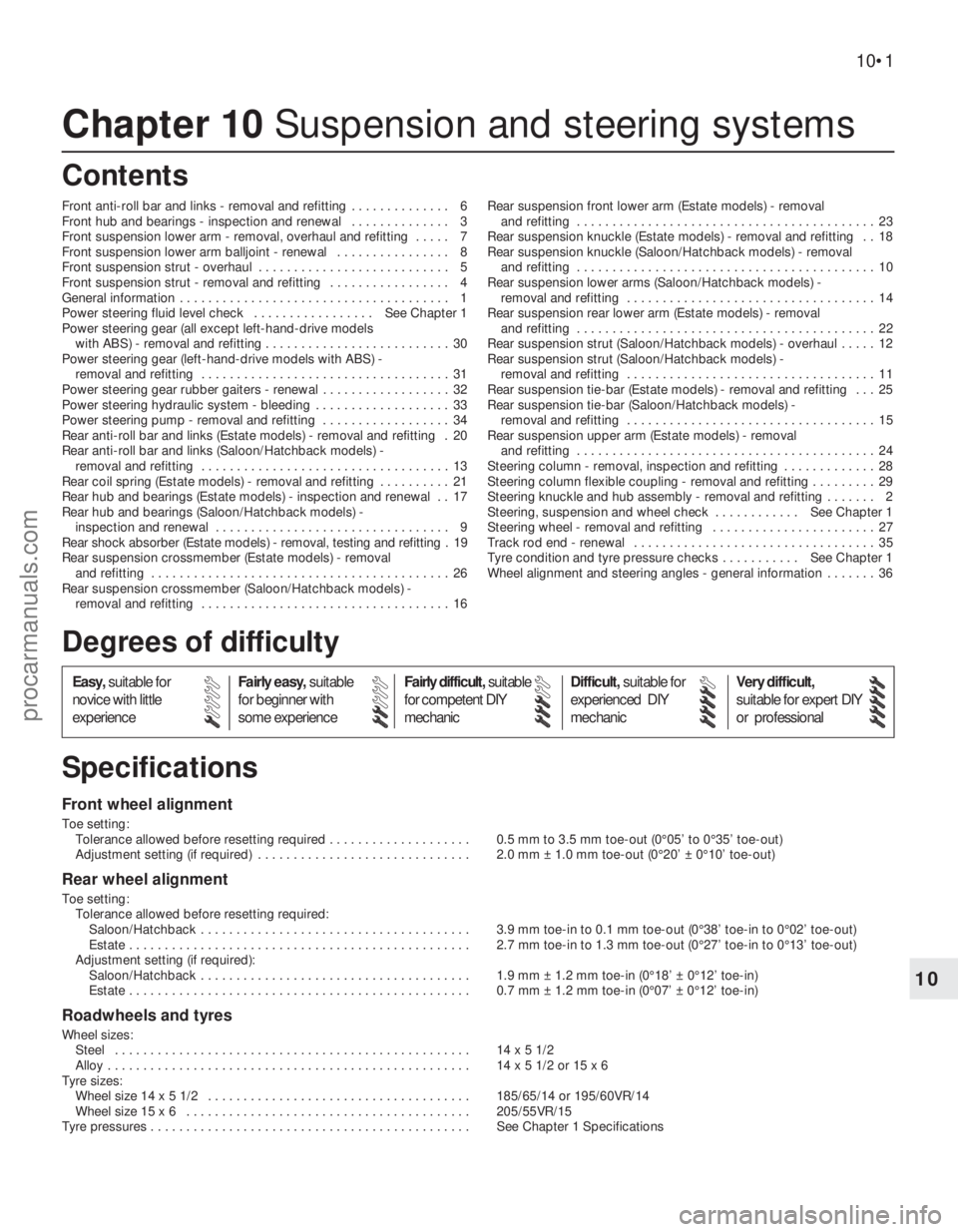
Chapter 10 Suspension and steering systems
Front anti-roll bar and links - removal and refitting . . . . . . . . . . . . . . 6
Front hub and bearings - inspection and renewal . . . . . . . . . . . . . . 3
Front suspension lower arm - removal, overhaul and refitting . . . . . 7
Front suspension lower arm balljoint - renewal . . . . . . . . . . . . . . . . 8
Front suspension strut - overhaul . . . . . . . . . . . . . . . . . . . . . . . . . . . 5
Front suspension strut - removal and refitting . . . . . . . . . . . . . . . . . 4
General information . . . . . . . . . . . . . . . . . . . . . . . . . . . . . . . . . . . . . . 1
Power steering fluid level check . . . . . . . . . . . . . . . . . See Chapter 1
Power steering gear (all except left-hand-drive models
with ABS) - removal and refitting . . . . . . . . . . . . . . . . . . . . . . . . . . 30
Power steering gear (left-hand-drive models with ABS) -
removal and refitting . . . . . . . . . . . . . . . . . . . . . . . . . . . . . . . . . . . 31
Power steering gear rubber gaiters - renewal . . . . . . . . . . . . . . . . . . 32
Power steering hydraulic system - bleeding . . . . . . . . . . . . . . . . . . . 33
Power steering pump - removal and refitting . . . . . . . . . . . . . . . . . . 34
Rear anti-roll bar and links (Estate models) - removal and refitting . 20
Rear anti-roll bar and links (Saloon/Hatchback models) -
removal and refitting . . . . . . . . . . . . . . . . . . . . . . . . . . . . . . . . . . . 13
Rear coil spring (Estate models) - removal and refitting . . . . . . . . . . 21
Rear hub and bearings (Estate models) - inspection and renewal . . 17
Rear hub and bearings (Saloon/Hatchback models) -
inspection and renewal . . . . . . . . . . . . . . . . . . . . . . . . . . . . . . . . . 9
Rear shock absorber (Estate models) - removal, testing and refitting . 19
Rear suspension crossmember (Estate models) - removal
and refitting . . . . . . . . . . . . . . . . . . . . . . . . . . . . . . . . . . . . . . . . . . 26
Rear suspension crossmember (Saloon/Hatchback models) -
removal and refitting . . . . . . . . . . . . . . . . . . . . . . . . . . . . . . . . . . . 16Rear suspension front lower arm (Estate models) - removal
and refitting . . . . . . . . . . . . . . . . . . . . . . . . . . . . . . . . . . . . . . . . . . 23
Rear suspension knuckle (Estate models) - removal and refitting . . 18
Rear suspension knuckle (Saloon/Hatchback models) - removal
and refitting . . . . . . . . . . . . . . . . . . . . . . . . . . . . . . . . . . . . . . . . . . 10
Rear suspension lower arms (Saloon/Hatchback models) -
removal and refitting . . . . . . . . . . . . . . . . . . . . . . . . . . . . . . . . . . . 14
Rear suspension rear lower arm (Estate models) - removal
and refitting . . . . . . . . . . . . . . . . . . . . . . . . . . . . . . . . . . . . . . . . . . 22
Rear suspension strut (Saloon/Hatchback models) - overhaul . . . . . 12
Rear suspension strut (Saloon/Hatchback models) -
removal and refitting . . . . . . . . . . . . . . . . . . . . . . . . . . . . . . . . . . . 11
Rear suspension tie-bar (Estate models) - removal and refitting . . . 25
Rear suspension tie-bar (Saloon/Hatchback models) -
removal and refitting . . . . . . . . . . . . . . . . . . . . . . . . . . . . . . . . . . . 15
Rear suspension upper arm (Estate models) - removal
and refitting . . . . . . . . . . . . . . . . . . . . . . . . . . . . . . . . . . . . . . . . . . 24
Steering column - removal, inspection and refitting . . . . . . . . . . . . . 28
Steering column flexible coupling - removal and refitting . . . . . . . . . 29
Steering knuckle and hub assembly - removal and refitting . . . . . . . 2
Steering, suspension and wheel check . . . . . . . . . . . . See Chapter 1
Steering wheel - removal and refitting . . . . . . . . . . . . . . . . . . . . . . . 27
Track rod end - renewal . . . . . . . . . . . . . . . . . . . . . . . . . . . . . . . . . . 35
Tyre condition and tyre pressure checks . . . . . . . . . . . See Chapter 1
Wheel alignment and steering angles - general information . . . . . . . 36
Front wheel alignment
Toe setting:
Tolerance allowed before resetting required . . . . . . . . . . . . . . . . . . . . 0.5 mm to 3.5 mm toe-out (0°05’ to 0°35’ toe-out)
Adjustment setting (if required) . . . . . . . . . . . . . . . . . . . . . . . . . . . . . . 2.0 mm ± 1.0 mm toe-out (0°20’ ± 0°10’ toe-out)
Rear wheel alignment
Toe setting:
Tolerance allowed before resetting required:
Saloon/Hatchback . . . . . . . . . . . . . . . . . . . . . . . . . . . . . . . . . . . . . . 3.9 mm toe-in to 0.1 mm toe-out (0°38’ toe-in to 0°02’ toe-out)
Estate . . . . . . . . . . . . . . . . . . . . . . . . . . . . . . . . . . . . . . . . . . . . . . . . 2.7 mm toe-in to 1.3 mm toe-out (0°27’ toe-in to 0°13’ toe-out)
Adjustment setting (if required):
Saloon/Hatchback . . . . . . . . . . . . . . . . . . . . . . . . . . . . . . . . . . . . . . 1.9 mm ± 1.2 mm toe-in (0°18’ ± 0°12’ toe-in)
Estate . . . . . . . . . . . . . . . . . . . . . . . . . . . . . . . . . . . . . . . . . . . . . . . . 0.7 mm ± 1.2 mm toe-in (0°07’ ± 0°12’ toe-in)
Roadwheels and tyres
Wheel sizes:
Steel . . . . . . . . . . . . . . . . . . . . . . . . . . . . . . . . . . . . . . . . . . . . . . . . . . 14 x 5 1/2
Alloy . . . . . . . . . . . . . . . . . . . . . . . . . . . . . . . . . . . . . . . . . . . . . . . . . . . 14 x 5 1/2 or 15 x 6
Tyre sizes:
Wheel size 14 x 5 1/2 . . . . . . . . . . . . . . . . . . . . . . . . . . . . . . . . . . . . . 185/65/14 or 195/60VR/14
Wheel size 15 x 6 . . . . . . . . . . . . . . . . . . . . . . . . . . . . . . . . . . . . . . . . 205/55VR/15
Tyre pressures . . . . . . . . . . . . . . . . . . . . . . . . . . . . . . . . . . . . . . . . . . . . . See Chapter 1 Specifications
10•1
Easy,suitable for
novice with little
experienceFairly easy,suitable
for beginner with
some experienceFairly difficult,suitable
for competent DIY
mechanicDifficult,suitable for
experienced DIY
mechanicVery difficult,
suitable for expert DIY
or professional
Degrees of difficulty
Specifications Contents
10
procarmanuals.com
Page 156 of 279
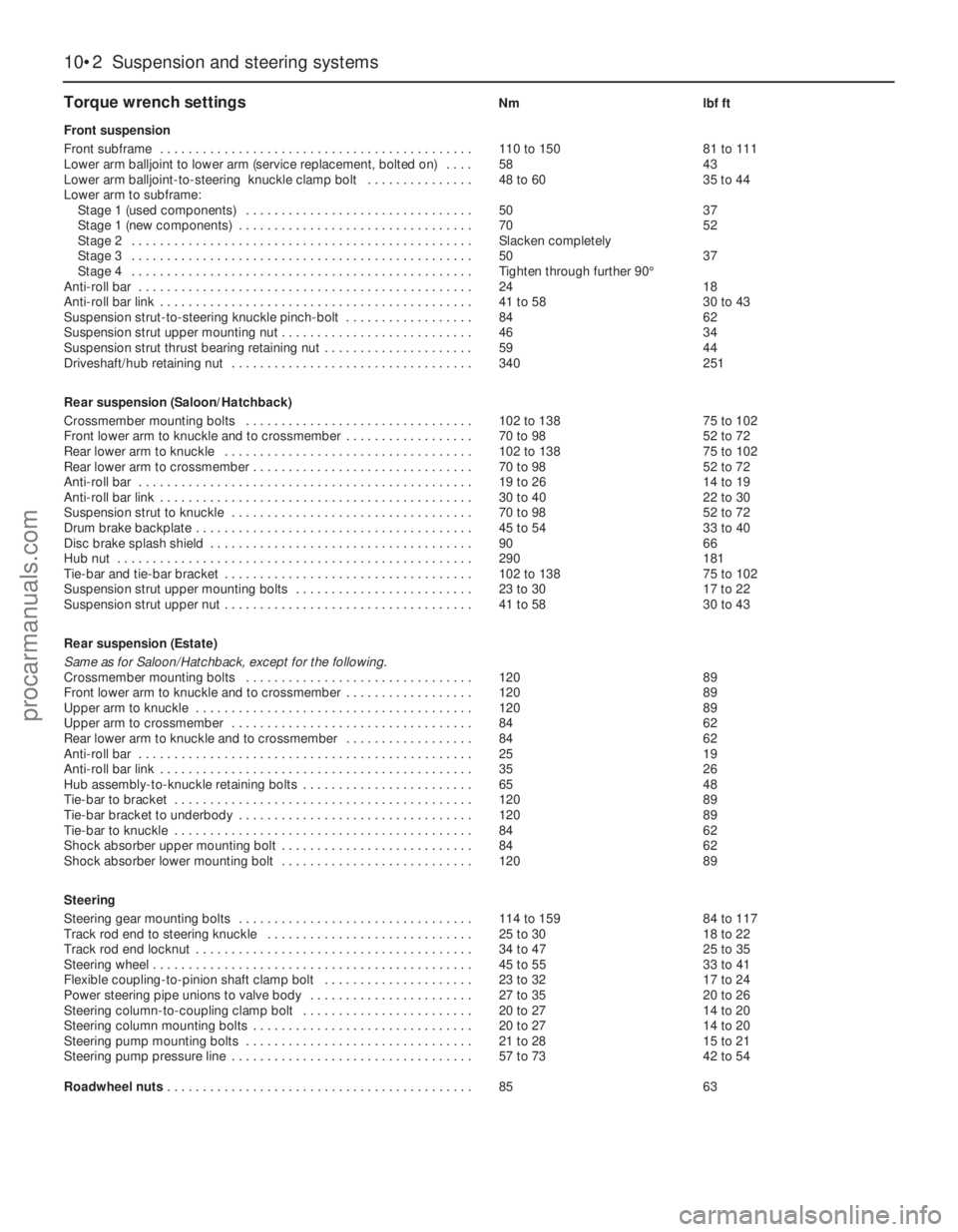
Torque wrench settingsNm lbf ft
Front suspension
Front subframe . . . . . . . . . . . . . . . . . . . . . . . . . . . . . . . . . . . . . . . . . . . . 110 to 150 81 to 111
Lower arm balljoint to lower arm (service replacement, bolted on) . . . . 58 43
Lower arm balljoint-to-steering knuckle clamp bolt . . . . . . . . . . . . . . . 48 to 60 35 to 44
Lower arm to subframe:
Stage 1 (used components) . . . . . . . . . . . . . . . . . . . . . . . . . . . . . . . . 50 37
Stage 1 (new components) . . . . . . . . . . . . . . . . . . . . . . . . . . . . . . . . . 70 52
Stage 2 . . . . . . . . . . . . . . . . . . . . . . . . . . . . . . . . . . . . . . . . . . . . . . . . Slacken completely
Stage 3 . . . . . . . . . . . . . . . . . . . . . . . . . . . . . . . . . . . . . . . . . . . . . . . . 50 37
Stage 4 . . . . . . . . . . . . . . . . . . . . . . . . . . . . . . . . . . . . . . . . . . . . . . . . Tighten through further 90°
Anti-roll bar . . . . . . . . . . . . . . . . . . . . . . . . . . . . . . . . . . . . . . . . . . . . . . . 24 18
Anti-roll bar link . . . . . . . . . . . . . . . . . . . . . . . . . . . . . . . . . . . . . . . . . . . . 41 to 58 30 to 43
Suspension strut-to-steering knuckle pinch-bolt . . . . . . . . . . . . . . . . . . 84 62
Suspension strut upper mounting nut . . . . . . . . . . . . . . . . . . . . . . . . . . . 46 34
Suspension strut thrust bearing retaining nut . . . . . . . . . . . . . . . . . . . . . 59 44
Driveshaft/hub retaining nut . . . . . . . . . . . . . . . . . . . . . . . . . . . . . . . . . . 340 251
Rear suspension (Saloon/Hatchback)
Crossmember mounting bolts . . . . . . . . . . . . . . . . . . . . . . . . . . . . . . . . 102 to 138 75 to 102
Front lower arm to knuckle and to crossmember . . . . . . . . . . . . . . . . . . 70 to 98 52 to 72
Rear lower arm to knuckle . . . . . . . . . . . . . . . . . . . . . . . . . . . . . . . . . . . 102 to 138 75 to 102
Rear lower arm to crossmember . . . . . . . . . . . . . . . . . . . . . . . . . . . . . . . 70 to 98 52 to 72
Anti-roll bar . . . . . . . . . . . . . . . . . . . . . . . . . . . . . . . . . . . . . . . . . . . . . . . 19 to 26 14 to 19
Anti-roll bar link . . . . . . . . . . . . . . . . . . . . . . . . . . . . . . . . . . . . . . . . . . . . 30 to 40 22 to 30
Suspension strut to knuckle . . . . . . . . . . . . . . . . . . . . . . . . . . . . . . . . . . 70 to 98 52 to 72
Drum brake backplate . . . . . . . . . . . . . . . . . . . . . . . . . . . . . . . . . . . . . . . 45 to 54 33 to 40
Disc brake splash shield . . . . . . . . . . . . . . . . . . . . . . . . . . . . . . . . . . . . . 90 66
Hub nut . . . . . . . . . . . . . . . . . . . . . . . . . . . . . . . . . . . . . . . . . . . . . . . . . . 290 181
Tie-bar and tie-bar bracket . . . . . . . . . . . . . . . . . . . . . . . . . . . . . . . . . . . 102 to 138 75 to 102
Suspension strut upper mounting bolts . . . . . . . . . . . . . . . . . . . . . . . . . 23 to 30 17 to 22
Suspension strut upper nut . . . . . . . . . . . . . . . . . . . . . . . . . . . . . . . . . . . 41 to 58 30 to 43
Rear suspension (Estate)
Same as for Saloon/Hatchback, except for the following.
Crossmember mounting bolts . . . . . . . . . . . . . . . . . . . . . . . . . . . . . . . . 120 89
Front lower arm to knuckle and to crossmember . . . . . . . . . . . . . . . . . . 120 89
Upper arm to knuckle . . . . . . . . . . . . . . . . . . . . . . . . . . . . . . . . . . . . . . . 120 89
Upper arm to crossmember . . . . . . . . . . . . . . . . . . . . . . . . . . . . . . . . . . 84 62
Rear lower arm to knuckle and to crossmember . . . . . . . . . . . . . . . . . . 84 62
Anti-roll bar . . . . . . . . . . . . . . . . . . . . . . . . . . . . . . . . . . . . . . . . . . . . . . . 25 19
Anti-roll bar link . . . . . . . . . . . . . . . . . . . . . . . . . . . . . . . . . . . . . . . . . . . . 35 26
Hub assembly-to-knuckle retaining bolts . . . . . . . . . . . . . . . . . . . . . . . . 65 48
Tie-bar to bracket . . . . . . . . . . . . . . . . . . . . . . . . . . . . . . . . . . . . . . . . . . 120 89
Tie-bar bracket to underbody . . . . . . . . . . . . . . . . . . . . . . . . . . . . . . . . . 120 89
Tie-bar to knuckle . . . . . . . . . . . . . . . . . . . . . . . . . . . . . . . . . . . . . . . . . . 84 62
Shock absorber upper mounting bolt . . . . . . . . . . . . . . . . . . . . . . . . . . . 84 62
Shock absorber lower mounting bolt . . . . . . . . . . . . . . . . . . . . . . . . . . . 120 89
Steering
Steering gear mounting bolts . . . . . . . . . . . . . . . . . . . . . . . . . . . . . . . . . 114 to 159 84 to 117
Track rod end to steering knuckle . . . . . . . . . . . . . . . . . . . . . . . . . . . . . 25 to 30 18 to 22
Track rod end locknut . . . . . . . . . . . . . . . . . . . . . . . . . . . . . . . . . . . . . . . 34 to 47 25 to 35
Steering wheel . . . . . . . . . . . . . . . . . . . . . . . . . . . . . . . . . . . . . . . . . . . . . 45 to 55 33 to 41
Flexible coupling-to-pinion shaft clamp bolt . . . . . . . . . . . . . . . . . . . . . 23 to 32 17 to 24
Power steering pipe unions to valve body . . . . . . . . . . . . . . . . . . . . . . . 27 to 35 20 to 26
Steering column-to-coupling clamp bolt . . . . . . . . . . . . . . . . . . . . . . . . 20 to 27 14 to 20
Steering column mounting bolts . . . . . . . . . . . . . . . . . . . . . . . . . . . . . . . 20 to 27 14 to 20
Steering pump mounting bolts . . . . . . . . . . . . . . . . . . . . . . . . . . . . . . . . 21 to 28 15 to 21
Steering pump pressure line . . . . . . . . . . . . . . . . . . . . . . . . . . . . . . . . . . 57 to 73 42 to 54
Roadwheel nuts . . . . . . . . . . . . . . . . . . . . . . . . . . . . . . . . . . . . . . . . . . . 85 63
10•2 Suspension and steering systems
procarmanuals.com
Page 157 of 279
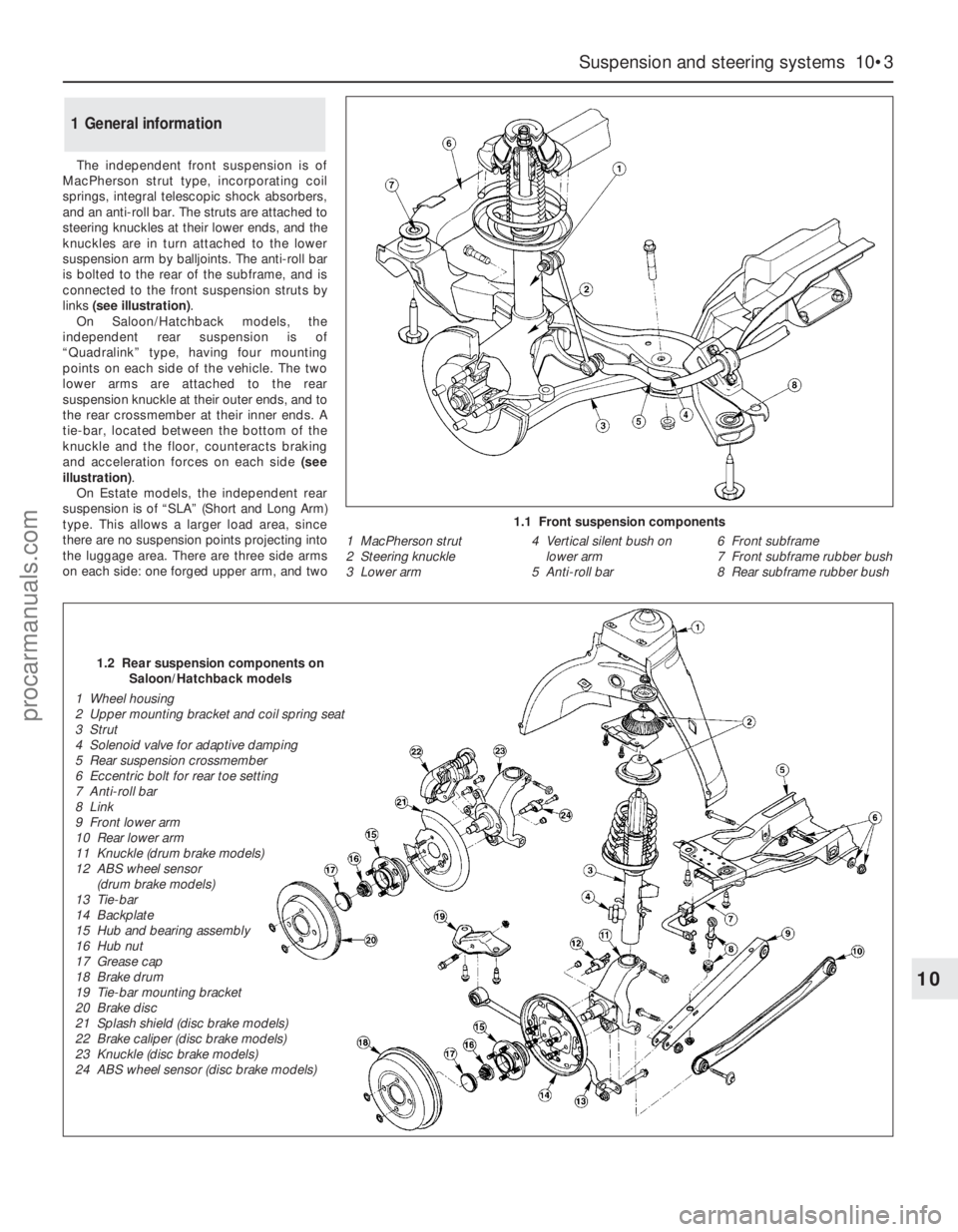
The independent front suspension is of
MacPherson strut type, incorporating coil
springs, integral telescopic shock absorbers,
and an anti-roll bar. The struts are attached to
steering knuckles at their lower ends, and the
knuckles are in turn attached to the lower
suspension arm by balljoints. The anti-roll bar
is bolted to the rear of the subframe, and is
connected to the front suspension struts by
links (see illustration).
On Saloon/Hatchback models, the
independent rear suspension is of
“Quadralink” type, having four mounting
points on each side of the vehicle. The two
lower arms are attached to the rear
suspension knuckle at their outer ends, and to
the rear crossmember at their inner ends. A
tie-bar, located between the bottom of the
knuckle and the floor, counteracts braking
and acceleration forces on each side (see
illustration).
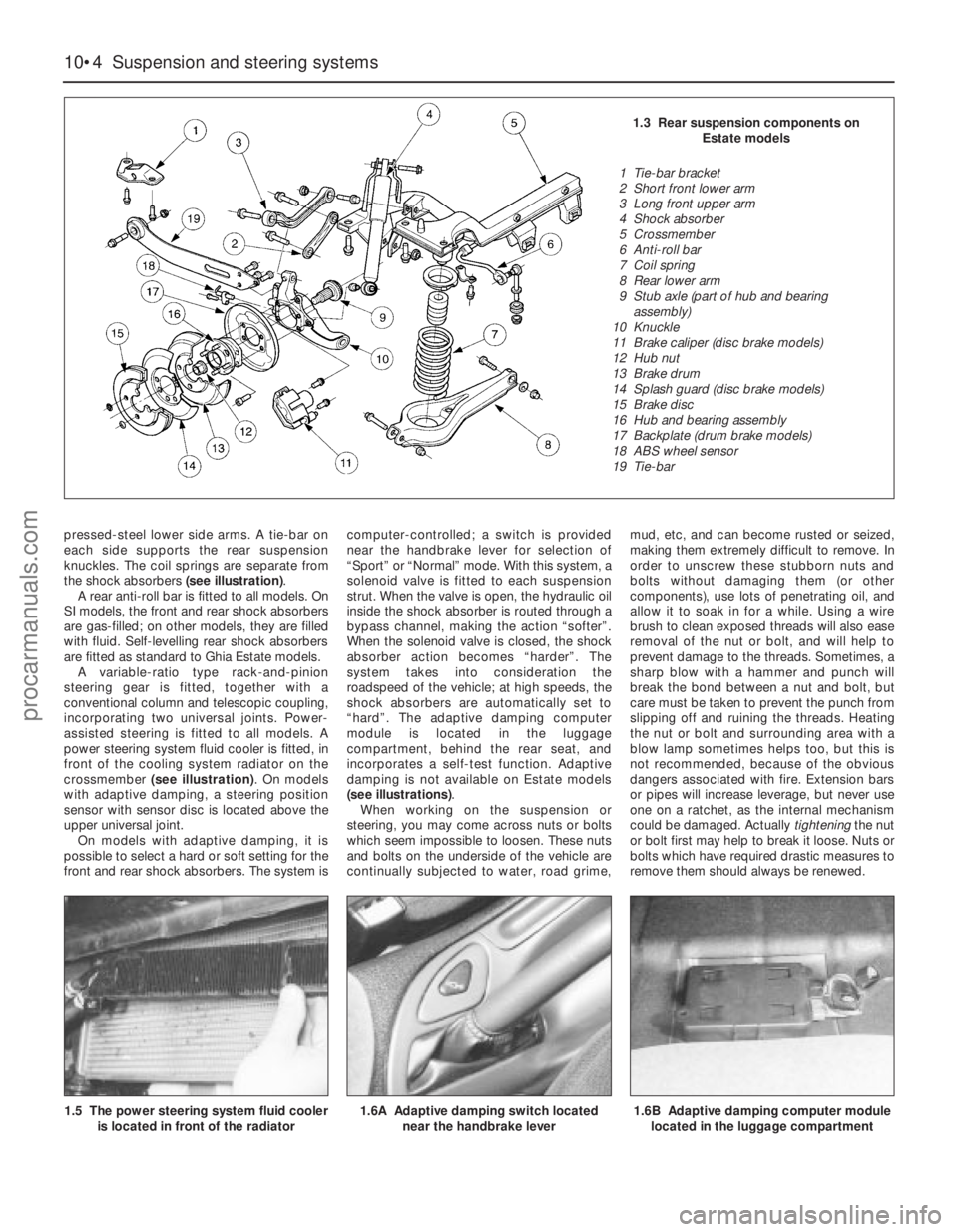
On Estate models, the independent rear
suspension is of “SLA” (Short and Long Arm)
type. This allows a larger load area, since
there are no suspension points projecting into
the luggage area. There are three side arms
on each side: one forged upper arm, and two
1 General information
Suspension and steering systems 10•3
10
1.1 Front suspension components
1 MacPherson strut
2 Steering knuckle
3 Lower arm4 Vertical silent bush on
lower arm
5 Anti-roll bar6 Front subframe
7 Front subframe rubber bush
8 Rear subframe rubber bush
1.2 Rear suspension components on
Saloon/Hatchback models
1 Wheel housing
2 Upper mounting bracket and coil spring seat
3 Strut
4 Solenoid valve for adaptive damping
5 Rear suspension crossmember
6 Eccentric bolt for rear toe setting
7 Anti-roll bar
8 Link
9 Front lower arm
10 Rear lower arm
11 Knuckle (drum brake models)
12 ABS wheel sensor
(drum brake models)
13 Tie-bar
14 Backplate
15 Hub and bearing assembly
16 Hub nut
17 Grease cap
18 Brake drum
19 Tie-bar mounting bracket
20 Brake disc
21 Splash shield (disc brake models)
22 Brake caliper (disc brake models)
23 Knuckle (disc brake models)
24 ABS wheel sensor (disc brake models)
procarmanuals.com
Page 158 of 279
10•4 Suspension and steering systems
pressed-steel lower side arms. A tie-bar on
each side supports the rear suspension
knuckles. The coil springs are separate from
the shock absorbers (see illustration).
A rear anti-roll bar is fitted to all models. On
SI models, the front and rear shock absorbers
are gas-filled; on other models, they are filled
with fluid. Self-levelling rear shock absorbers
are fitted as standard to Ghia Estate models.
A variable-ratio type rack-and-pinion
steering gear is fitted, together with a
conventional column and telescopic coupling,
incorporating two universal joints. Power-
assisted steering is fitted to all models. A
power steering system fluid cooler is fitted, in
front of the cooling system radiator on the
crossmember (see illustration). On models
with adaptive damping, a steering position
sensor with sensor disc is located above the
upper universal joint.
On models with adaptive damping, it is
possible to select a hard or soft setting for the
front and rear shock absorbers. The system iscomputer-controlled; a switch is provided
near the handbrake lever for selection of
“Sport” or “Normal” mode. With this system, a
solenoid valve is fitted to each suspension
strut. When the valve is open, the hydraulic oil
inside the shock absorber is routed through a
bypass channel, making the action “softer”.
When the solenoid valve is closed, the shock
absorber action becomes “harder”. The
system takes into consideration the
roadspeed of the vehicle; at high speeds, the
shock absorbers are automatically set to
“hard”. The adaptive damping computer
module is located in the luggage
compartment, behind the rear seat, and
incorporates a self-test function. Adaptive
damping is not available on Estate models
(see illustrations).
When working on the suspension or
steering, you may come across nuts or bolts
which seem impossible to loosen. These nuts
and bolts on the underside of the vehicle are
continually subjected to water, road grime,mud, etc, and can become rusted or seized,
making them extremely difficult to remove. In
order to unscrew these stubborn nuts and
bolts without damaging them (or other
components), use lots of penetrating oil, and
allow it to soak in for a while. Using a wire
brush to clean exposed threads will also ease
removal of the nut or bolt, and will help to
prevent damage to the threads. Sometimes, a
sharp blow with a hammer and punch will
break the bond between a nut and bolt, but
care must be taken to prevent the punch from
slipping off and ruining the threads. Heating
the nut or bolt and surrounding area with a
blow lamp sometimes helps too, but this is
not recommended, because of the obvious
dangers associated with fire. Extension bars
or pipes will increase leverage, but never use
one on a ratchet, as the internal mechanism
could be damaged. Actually tighteningthe nut
or bolt first may help to break it loose. Nuts or
bolts which have required drastic measures to
remove them should always be renewed.
1.5 The power steering system fluid cooler
is located in front of the radiator
1.6A Adaptive damping switch located
near the handbrake lever1.6B Adaptive damping computer module
located in the luggage compartment
1.3 Rear suspension components on
Estate models
1 Tie-bar bracket
2 Short front lower arm
3 Long front upper arm
4 Shock absorber
5 Crossmember
6 Anti-roll bar
7 Coil spring
8 Rear lower arm
9 Stub axle (part of hub and bearing
assembly)
10 Knuckle
11 Brake caliper (disc brake models)
12 Hub nut
13 Brake drum
14 Splash guard (disc brake models)
15 Brake disc
16 Hub and bearing assembly
17 Backplate (drum brake models)
18 ABS wheel sensor
19 Tie-bar
procarmanuals.com
Page 159 of 279
Since most of the procedures dealt with in
this Chapter involve jacking up the vehicle
and working underneath it, a good pair of axle
stands will be needed. A hydraulic trolley jack
is the preferred type of jack to lift the vehicle,
and it can also be used to support certain
components during removal and refitting
operations.
Warning: Never, under any
circumstances, rely on a jack to
support the vehicle while working
beneath it. When jacking up the vehicle, do
not lift or support it beneath the front or
rear subframes.
Removal
1Apply the handbrake. Remove the wheel
cover from the relevant front wheel, and
loosen (but do not remove) the driveshaft/hub
nut. This nut is very tight.
2Loosen the front wheel nuts, jack up the
front of the vehicle and support it on axle
stands. Remove the front wheel.
3Extract the split pin from the track rod end
balljoint nut. Unscrew the nut, and detach the
rod from the arm on the steering knuckle
using a conventional balljoint removal tool.
Take care not to damage the balljoint seal.
4Remove the ABS sensor (when fitted) as
described in Chapter 9.
5Remove the brake caliper and brake disc as
described in Chapter 9, but do not disconnect
the flexible hose from the caliper. Suspend
the caliper from a suitable point under the
wheel arch, taking care not to strain the hose.
6Unscrew and remove the driveshaft/hub
nut. Note that the nut is of special laminated
design, and should only be re-used a
maximum of 5 times. (It is a good idea to file a
small notch on the nut every time it is
removed.) Obtain a new nut if necessary.
7Note which way round the lower arm
balljoint clamp bolt is fitted, then unscrew and
remove it from the knuckle assembly. Lever
the balljoint down from the knuckle; if it is
tight, prise the clamp open using a large flat-
bladed tool. Take care not to damage the
balljoint seal during the separation procedure.
8Unscrew and remove the pinch-bolt
securing the steering knuckle assembly to the
front suspension strut, noting which way
round it is fitted. Prise open the clamp using a
wedge-shaped tool, and release the knuckle
from the strut. If necessary, tap the knuckle
downwards with a soft-headed mallet to
separate the two components. Support the
knuckle on an axle stand.
9Pull the steering knuckle and hub assembly
from the driveshaft splines. If it is tight,
connect a universal puller to the hub flange,
and withdraw it from the driveshaft. When the
driveshaft is free, support it on an axle stand,
or suspend it from a suitable point under thewheel arch, making sure that the inner
constant velocity joint is not turned through
more than 18°. (Damage may occur if the joint
is turned through too great an angle.)
Refitting
10Lift the steering knuckle and hub
assembly onto the driveshaft splines, and
support the assembly on an axle stand.
11Locate the assembly on the front
suspension strut. Insert the pinch-bolt with its
head facing forwards. Fit the nut and tighten it
to the specified torque.
12Refit the lower arm balljoint to the knuckle
assembly, and insert the clamp bolt with its
head facing forwards. Refit the nut and tighten
it to the specified torque.
13Refit the driveshaft/hub nut, and tighten it
moderately at this stage. Final tightening of
the nut is made with the vehicle lowered to the
ground.
14Refit the brake caliper and brake disc as
described in Chapter 9.
15Where fitted, refit the ABS sensor as
described in Chapter 9.
16Reconnect the track rod end balljoint to
the steering arm, and tighten the nut to the
specified torque. Check that the split pin
holes are aligned; if necessary, turn the nut to
the nearest alignment, making sure that the
torque wrench setting is still within the
specified range. Insert a new split pin, and
bend it back to secure.
17Refit the front wheel, and lower the
vehicle to the ground. Tighten the wheel nuts
to the specified torque.
18Tighten the driveshaft/hub nut to the
specified torque, and refit the wheel cover.
Inspection
1The front hub bearings are non-adjustable,
and are supplied already greased.
2To check the bearings for excessive wear,
apply the handbrake, jack up the front of the
vehicle and support it on axle stands.
3Grip the front wheel at top and bottom, and
attempt to rock it. If excessive movement is
noted, it may be that the hub bearings are
worn. Do not confuse wear in the driveshaft
outer joint or front suspension lower arm
balljoint with wear in the bearings. Hub
bearing wear will show up as roughness or
vibration when the wheel is spun; it will also
be noticeable as a rumbling or growling noise
when driving.
Renewal
4Remove the steering knuckle and hub
assembly as described in Section 2.
5The hub must now be removed from the
bearing inner races. It is preferable to use a
press to do this, but it is possible to drive outthe hub using a length of metal tube of
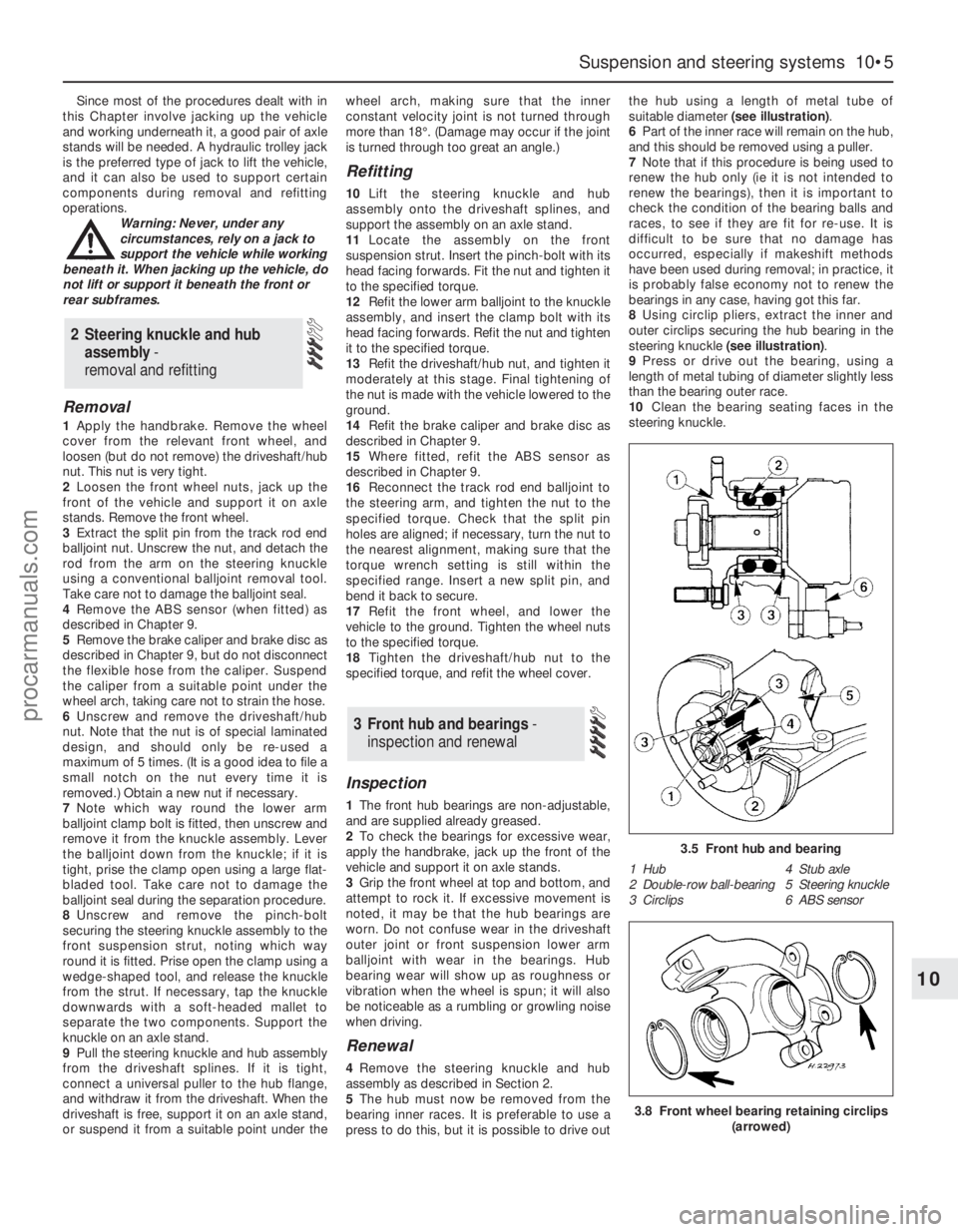
suitable diameter (see illustration).
6Part of the inner race will remain on the hub,
and this should be removed using a puller.
7Note that if this procedure is being used to
renew the hub only (ie it is not intended to
renew the bearings), then it is important to
check the condition of the bearing balls and
races, to see if they are fit for re-use. It is
difficult to be sure that no damage has
occurred, especially if makeshift methods
have been used during removal; in practice, it
is probably false economy not to renew the
bearings in any case, having got this far.
8Using circlip pliers, extract the inner and
outer circlips securing the hub bearing in the
steering knuckle (see illustration).
9Press or drive out the bearing, using a
length of metal tubing of diameter slightly less
than the bearing outer race.
10Clean the bearing seating faces in the
steering knuckle.
3 Front hub and bearings -
inspection and renewal
2 Steering knuckle and hub
assembly -
removal and refitting
Suspension and steering systems 10•5
10
3.5 Front hub and bearing
1 Hub 4 Stub axle
2 Double-row ball-bearing 5 Steering knuckle
3 Circlips 6 ABS sensor
3.8 Front wheel bearing retaining circlips
(arrowed)
procarmanuals.com
Page 160 of 279
11Locate one of the circlips in the outer
groove of the knuckle.
12Press or drive the new bearing into the
knuckle until it contacts the circlip, using a
length of metal tube of diameter slightly less
than the outer race. Do not apply any
pressure to the inner race.
13Locate the remaining circlip in the inner
groove of the knuckle.
14Support the inner race on a length of
metal tube, then press or drive the hub fully
into the bearing.
15Refit the steering knuckle and hub
assembly as described in Section 2.
Removal
1Apply the handbrake, then jack up the front
of the vehicle and support it on axle stands.
Remove the appropriate front wheel.
2Unbolt the brake hose support bracket from
the front of the suspension strut (see
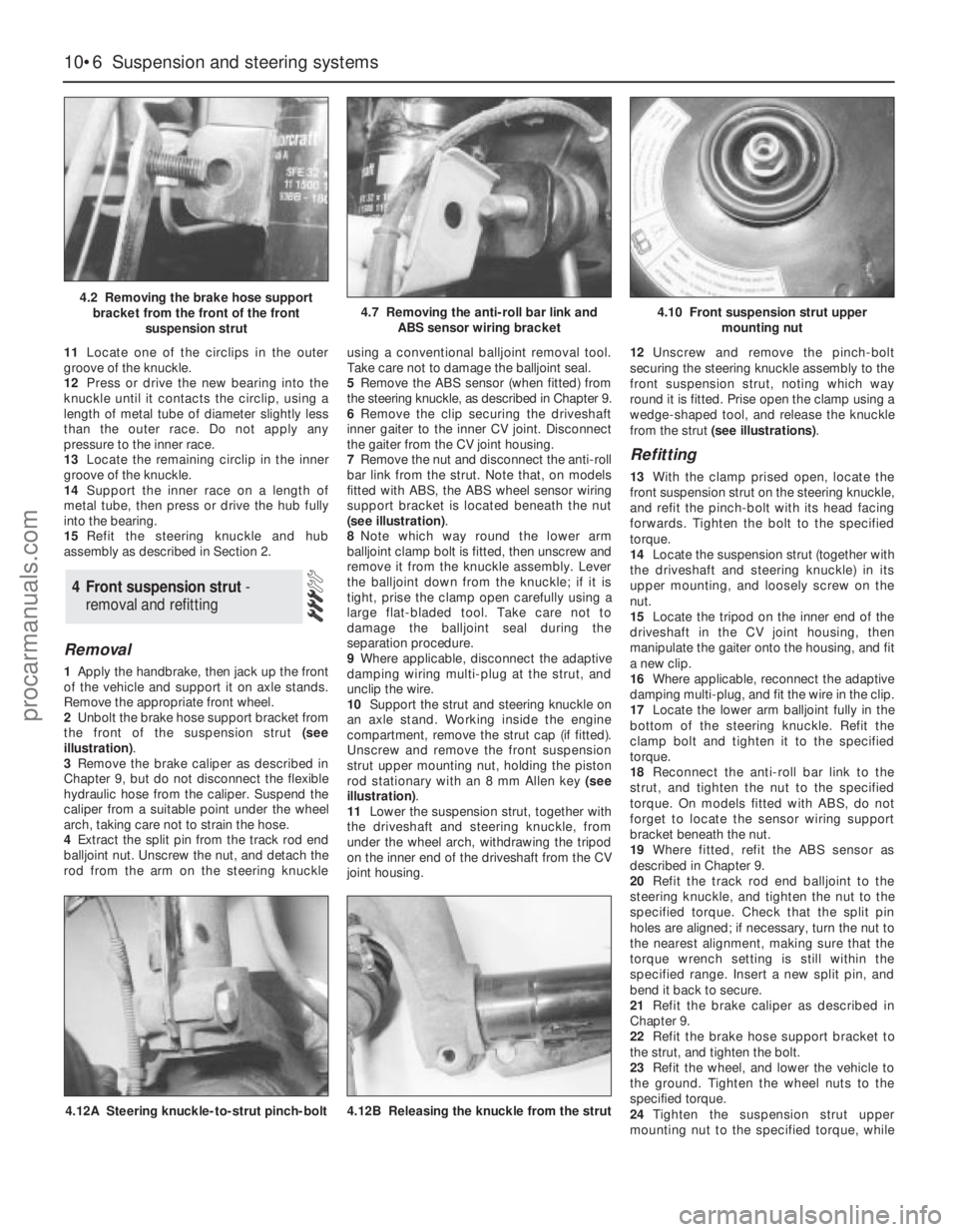
illustration).
3Remove the brake caliper as described in
Chapter 9, but do not disconnect the flexible
hydraulic hose from the caliper. Suspend the
caliper from a suitable point under the wheel
arch, taking care not to strain the hose.
4Extract the split pin from the track rod end
balljoint nut. Unscrew the nut, and detach the
rod from the arm on the steering knuckleusing a conventional balljoint removal tool.
Take care not to damage the balljoint seal.
5Remove the ABS sensor (when fitted) from
the steering knuckle, as described in Chapter 9.
6Remove the clip securing the driveshaft
inner gaiter to the inner CV joint. Disconnect
the gaiter from the CV joint housing.
7Remove the nut and disconnect the anti-roll
bar link from the strut. Note that, on models
fitted with ABS, the ABS wheel sensor wiring
support bracket is located beneath the nut
(see illustration).
8Note which way round the lower arm
balljoint clamp bolt is fitted, then unscrew and
remove it from the knuckle assembly. Lever
the balljoint down from the knuckle; if it is
tight, prise the clamp open carefully using a
large flat-bladed tool. Take care not to
damage the balljoint seal during the
separation procedure.
9Where applicable, disconnect the adaptive
damping wiring multi-plug at the strut, and
unclip the wire.
10Support the strut and steering knuckle on
an axle stand. Working inside the engine
compartment, remove the strut cap (if fitted).
Unscrew and remove the front suspension
strut upper mounting nut, holding the piston
rod stationary with an 8 mm Allen key (see
illustration).
11Lower the suspension strut, together with
the driveshaft and steering knuckle, from
under the wheel arch, withdrawing the tripod
on the inner end of the driveshaft from the CV
joint housing.12Unscrew and remove the pinch-bolt
securing the steering knuckle assembly to the
front suspension strut, noting which way
round it is fitted. Prise open the clamp using a
wedge-shaped tool, and release the knuckle
from the strut (see illustrations).
Refitting
13With the clamp prised open, locate the
front suspension strut on the steering knuckle,
and refit the pinch-bolt with its head facing
forwards. Tighten the bolt to the specified
torque.
14Locate the suspension strut (together with
the driveshaft and steering knuckle) in its
upper mounting, and loosely screw on the
nut.
15Locate the tripod on the inner end of the
driveshaft in the CV joint housing, then
manipulate the gaiter onto the housing, and fit
a new clip.
16Where applicable, reconnect the adaptive
damping multi-plug, and fit the wire in the clip.
17Locate the lower arm balljoint fully in the
bottom of the steering knuckle. Refit the
clamp bolt and tighten it to the specified
torque.
18Reconnect the anti-roll bar link to the
strut, and tighten the nut to the specified
torque. On models fitted with ABS, do not
forget to locate the sensor wiring support
bracket beneath the nut.
19Where fitted, refit the ABS sensor as
described in Chapter 9.
20Refit the track rod end balljoint to the
steering knuckle, and tighten the nut to the
specified torque. Check that the split pin
holes are aligned; if necessary, turn the nut to
the nearest alignment, making sure that the
torque wrench setting is still within the
specified range. Insert a new split pin, and
bend it back to secure.
21Refit the brake caliper as described in
Chapter 9.
22Refit the brake hose support bracket to
the strut, and tighten the bolt.
23Refit the wheel, and lower the vehicle to
the ground. Tighten the wheel nuts to the
specified torque.
24Tighten the suspension strut upper
mounting nut to the specified torque, while
4 Front suspension strut -
removal and refitting
10•6 Suspension and steering systems
4.2 Removing the brake hose support
bracket from the front of the front
suspension strut4.7 Removing the anti-roll bar link and
ABS sensor wiring bracket4.10 Front suspension strut upper
mounting nut
4.12A Steering knuckle-to-strut pinch-bolt4.12B Releasing the knuckle from the strut
procarmanuals.com