ECU FORD MONDEO 2006 2.G User Guide
[x] Cancel search | Manufacturer: FORD, Model Year: 2006, Model line: MONDEO, Model: FORD MONDEO 2006 2.GPages: 198, PDF Size: 4.69 MB
Page 92 of 198
Downloaded from www.Manualslib.com manuals search engine SITTING IN THE
CORRECT POSITION
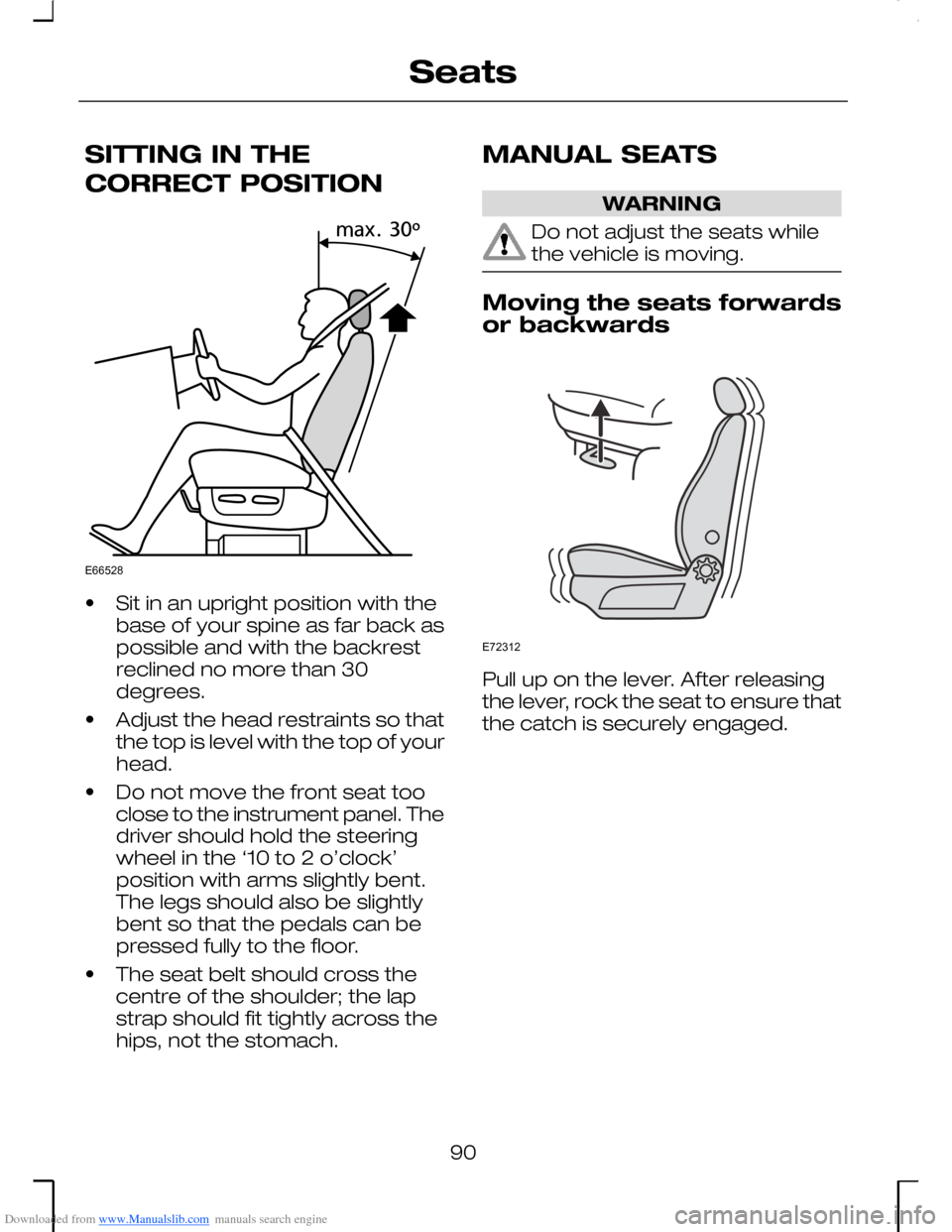
•Sit in an upright position with thebase of your spine as far back aspossible and with the backrestreclined no more than 30degrees.
•Adjust the head restraints so thatthe top is level with the top of yourhead.
•Do not move the front seat tooclose to the instrument panel. Thedriver should hold the steeringwheel in the ‘10 to 2 o’clock’position with arms slightly bent.The legs should also be slightlybent so that the pedals can bepressed fully to the floor.
•The seat belt should cross thecentre of the shoulder; the lapstrap should fit tightly across thehips, not the stomach.
MANUAL SEATS
WARNING
Do not adjust the seats whilethe vehicle is moving.
Moving the seats forwardsor backwards
Pull up on the lever. After releasingthe lever, rock the seat to ensure thatthe catch is securely engaged.
90
SeatsE66528 E72312
Page 101 of 198
Downloaded from www.Manualslib.com manuals search engine AUXILIARY POWER
SOCKETS
Estate
The auxiliary power socket is locatedin the right-hand side trim panel ofthe luggage compartment.
The auxiliary power socket can alsobe used to power 12 volt applianceshaving a current rating of maximum10 amperes. However, if the engineis not running, this will cause thebattery to discharge.
When connecting appliances, useonly specified connectors from theFord Accessory range or connectorsfor use with SAE standard sockets.
CUP HOLDERS
WARNING
Do not place hot drinks in thecup holders whilst driving −there is a risk of scalding.
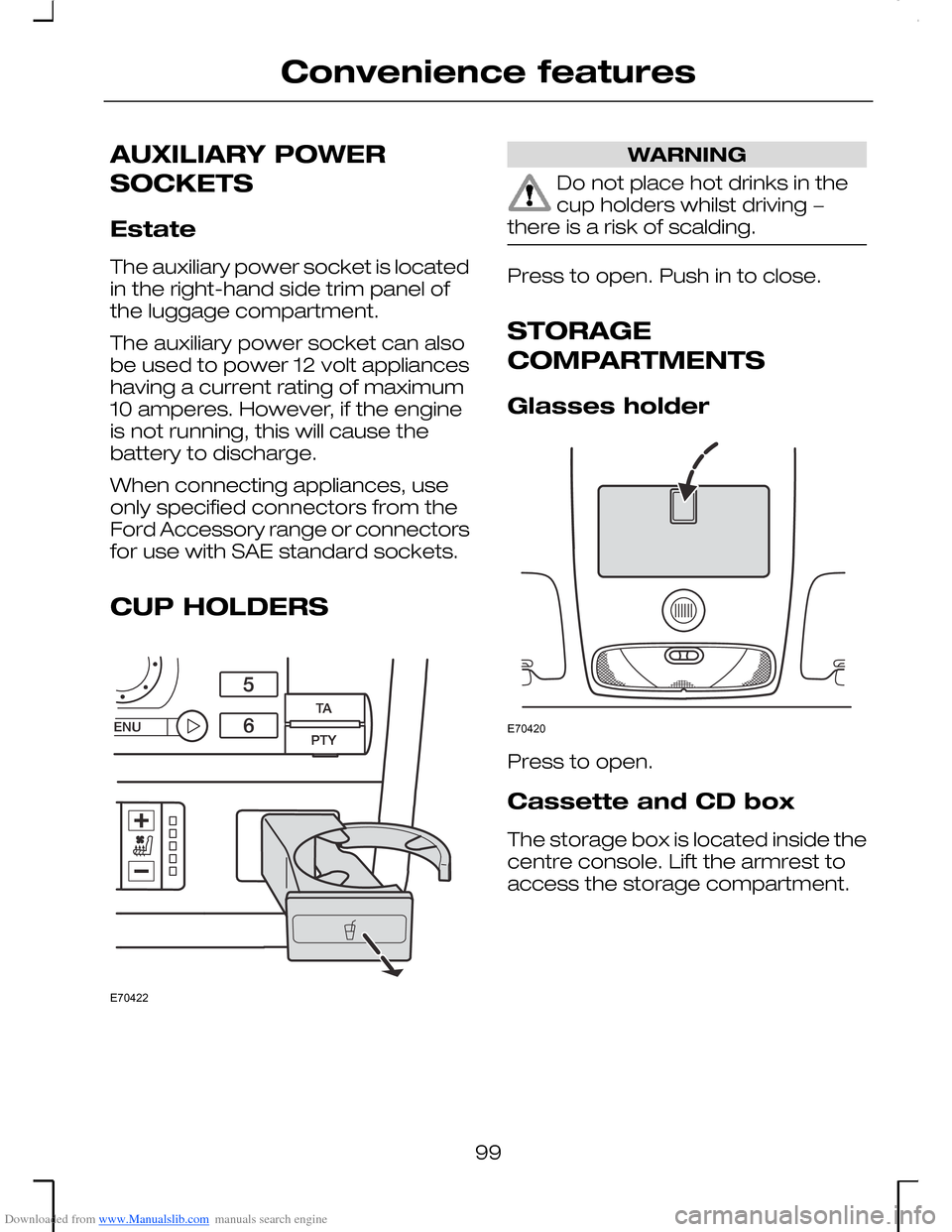
Press to open. Push in to close.
STORAGE
COMPARTMENTS
Glasses holder
Press to open.
Cassette and CD box
The storage box is located inside thecentre console. Lift the armrest toaccess the storage compartment.
99
Convenience featuresE70422 E70420
Page 113 of 198
Downloaded from www.Manualslib.com manuals search engine P = Park
WARNINGS
This position should be selectedonly when the vehicle isstationary.
Always apply the parking brakeand make sure that the selectorlever is securely latched in P. Turn offthe ignition whenever you leave thevehicle.
If position P is not selected, awarning chime will sound whenthe driver’s door is opened.
In this position, the transmission islocked.
The engine should be started withthe selector lever in position P. Ifnecessary, it can also be started inposition N.
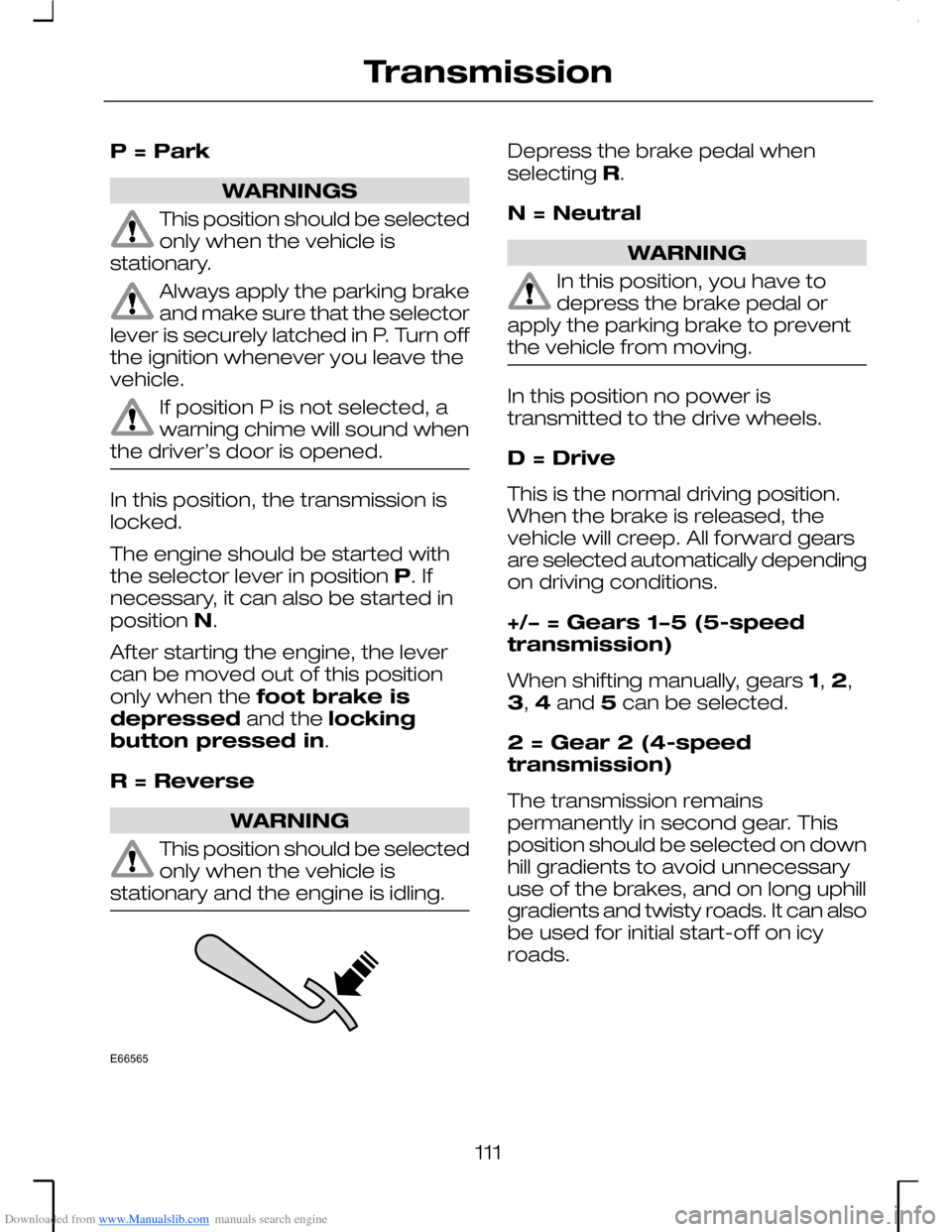
After starting the engine, the levercan be moved out of this positiononly when the foot brake isdepressed and the lockingbutton pressed in.
R = Reverse
WARNING
This position should be selectedonly when the vehicle isstationary and the engine is idling.
Depress the brake pedal whenselecting R.
N = Neutral
WARNING
In this position, you have todepress the brake pedal orapply the parking brake to preventthe vehicle from moving.
In this position no power istransmitted to the drive wheels.
D = Drive
This is the normal driving position.When the brake is released, thevehicle will creep. All forward gearsare selected automatically dependingon driving conditions.
+/− = Gears 1−5 (5-speedtransmission)
When shifting manually, gears 1, 2,3, 4 and 5 can be selected.
2 = Gear 2 (4-speedtransmission)
The transmission remainspermanently in second gear. Thisposition should be selected on downhill gradients to avoid unnecessaryuse of the brakes, and on long uphillgradients and twisty roads. It can alsobe used for initial start-off on icyroads.
111
TransmissionE66565
Page 115 of 198
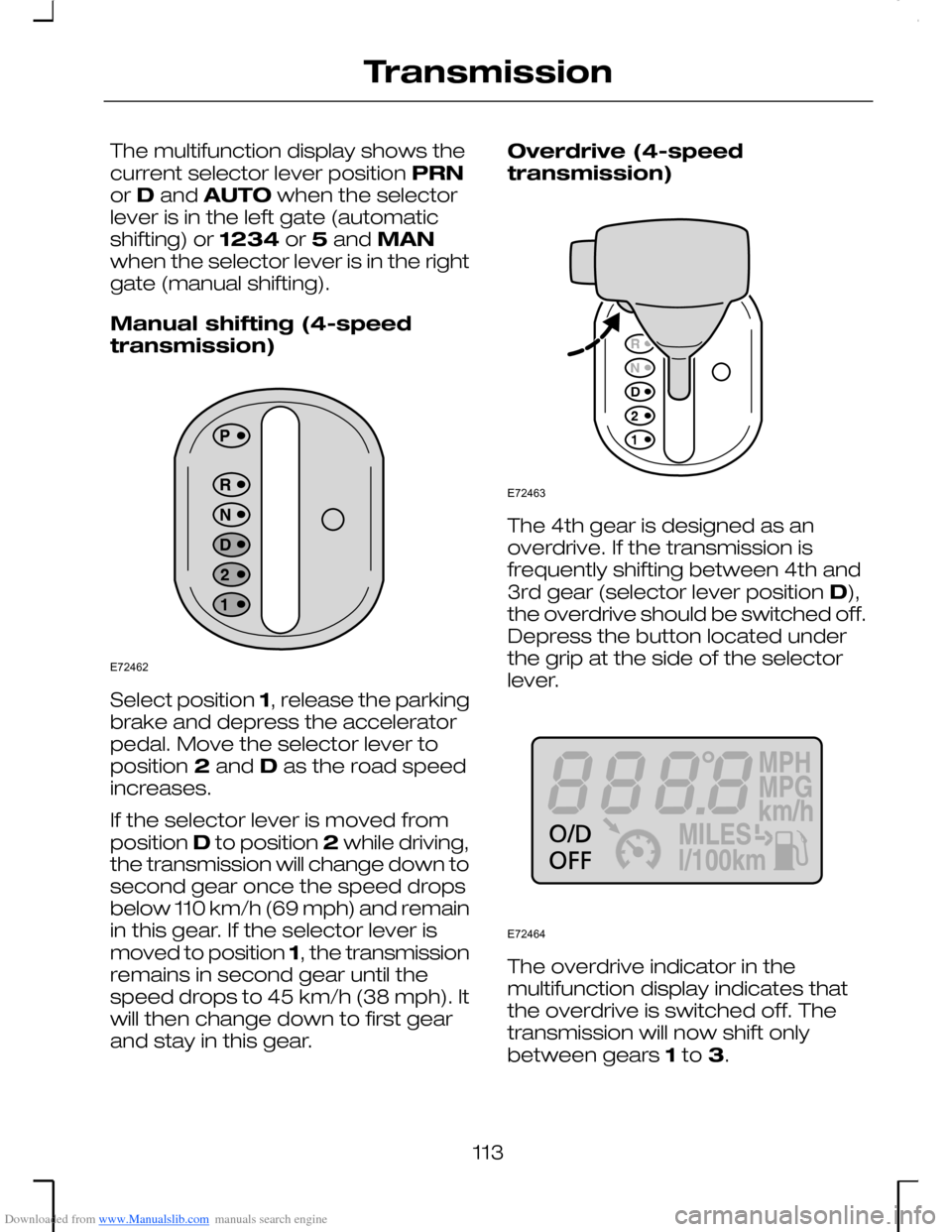
Downloaded from www.Manualslib.com manuals search engine The multifunction display shows thecurrent selector lever position PRNor D and AUTO when the selectorlever is in the left gate (automaticshifting) or 1234 or 5 and MANwhen the selector lever is in the rightgate (manual shifting).
Manual shifting (4-speedtransmission)
Select position 1, release the parkingbrake and depress the acceleratorpedal. Move the selector lever toposition 2 and D as the road speedincreases.
If the selector lever is moved fromposition D to position 2 while driving,the transmission will change down tosecond gear once the speed dropsbelow 110 km/h (69 mph) and remainin this gear. If the selector lever ismoved to position 1, the transmissionremains in second gear until thespeed drops to 45 km/h (38 mph). Itwill then change down to first gearand stay in this gear.
Overdrive (4-speedtransmission)
The 4th gear is designed as anoverdrive. If the transmission isfrequently shifting between 4th and3rd gear (selector lever position D),the overdrive should be switched off.Depress the button located underthe grip at the side of the selectorlever.
The overdrive indicator in themultifunction display indicates thatthe overdrive is switched off. Thetransmission will now shift onlybetween gears 1 to 3.
113
TransmissionE72462 E72463 E72464
Page 128 of 198
Downloaded from www.Manualslib.com manuals search engine GENERAL INFORMATION
WARNINGS
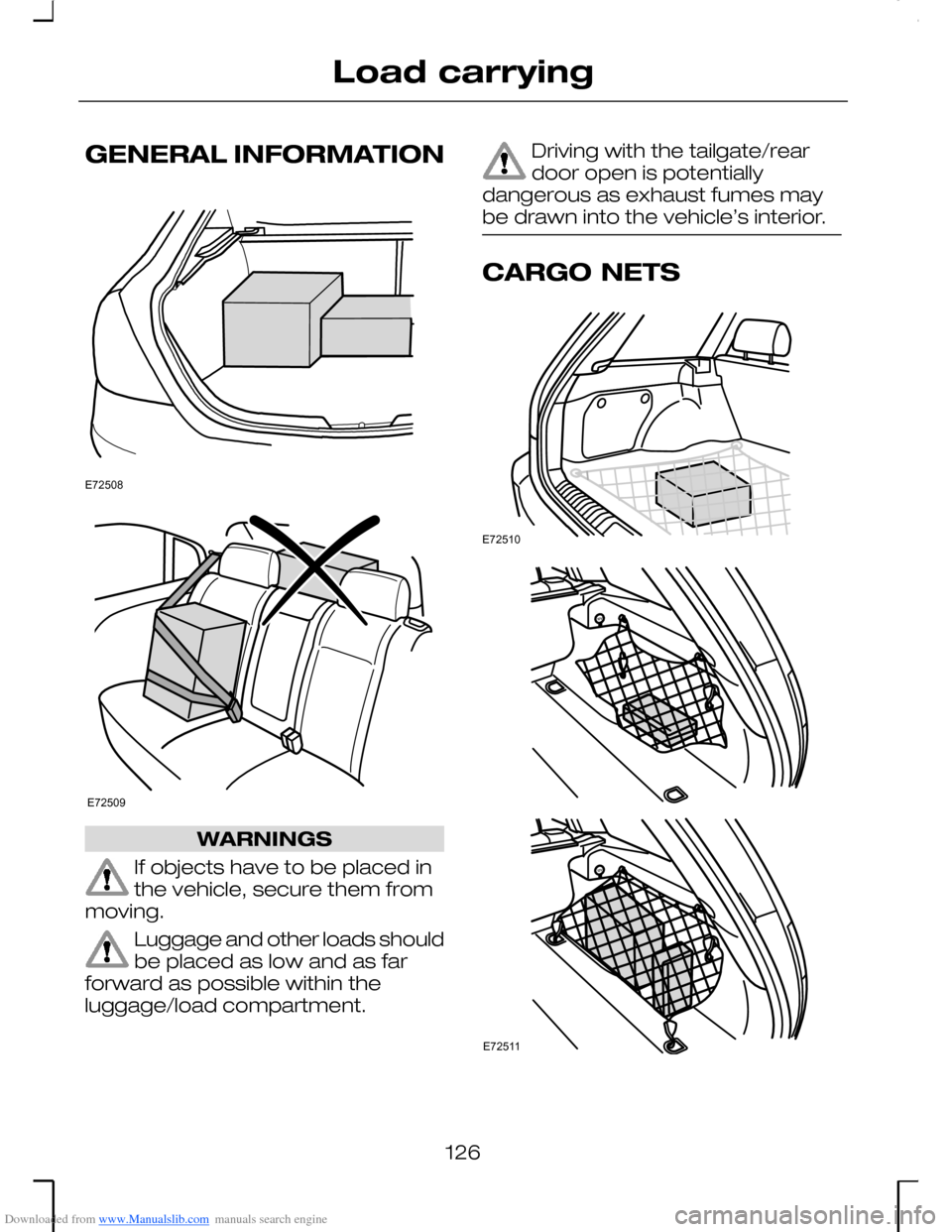
If objects have to be placed inthe vehicle, secure them frommoving.
Luggage and other loads shouldbe placed as low and as farforward as possible within theluggage/load compartment.
Driving with the tailgate/reardoor open is potentiallydangerous as exhaust fumes maybe drawn into the vehicle’s interior.
CARGO NETS
126
Load carryingE72508 E72509 E72510 E72511
Page 129 of 198
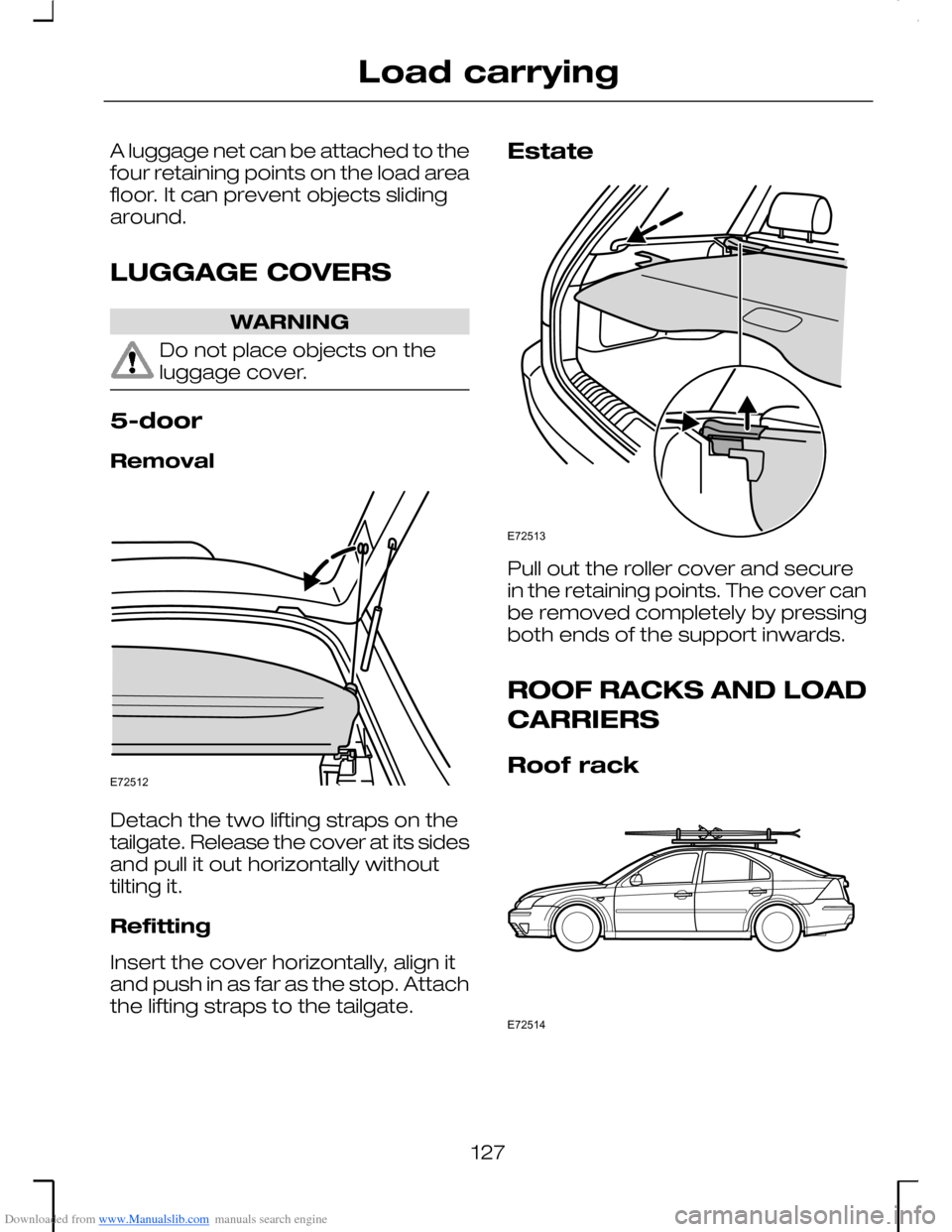
Downloaded from www.Manualslib.com manuals search engine A luggage net can be attached to thefour retaining points on the load areafloor. It can prevent objects slidingaround.
LUGGAGE COVERS
WARNING
Do not place objects on theluggage cover.
5-door
Removal
Detach the two lifting straps on thetailgate. Release the cover at its sidesand pull it out horizontally withouttilting it.
Refitting
Insert the cover horizontally, align itand push in as far as the stop. Attachthe lifting straps to the tailgate.
Estate
Pull out the roller cover and securein the retaining points. The cover canbe removed completely by pressingboth ends of the support inwards.
ROOF RACKS AND LOAD
CARRIERS
Roof rack
127
Load carryingE72512 E72513 E72514
Page 131 of 198
Downloaded from www.Manualslib.com manuals search engine TOWING A TRAILER
Note: Mondeo ST vehicles are notapproved for trailer towing.
The maximum vehicle and trailerpayloads represent technicallybinding values for gradients up to 12% and at an altitude of 1 000 metresabove sea level. In high altituderegions, thinner atmosphere canreduce engine performance so thefollowing restrictions will apply:
Above 1 000 metres, the stipulatedmaximum permitted gross trainweight must be reduced by 10 % forevery 1 000 metres in altitude.
Steep gradients
WARNING
The overrun brake on a trailer isnot controlled by the anti-lockbraking system.
Change down in plenty of timebefore downhill gradients.
For vehicles with an automatictransmission, if downhill modeprovides insufficient braking thenselect manual mode and second orfirst gear as necessary.
ESSENTIAL TOWING
CHECKS
WARNING
If any of the following conditionscannot be met, do not use thetow bar and have it inspected by anexpert.
Before starting your journey, ensurethe tow ball is properly locked.Check:
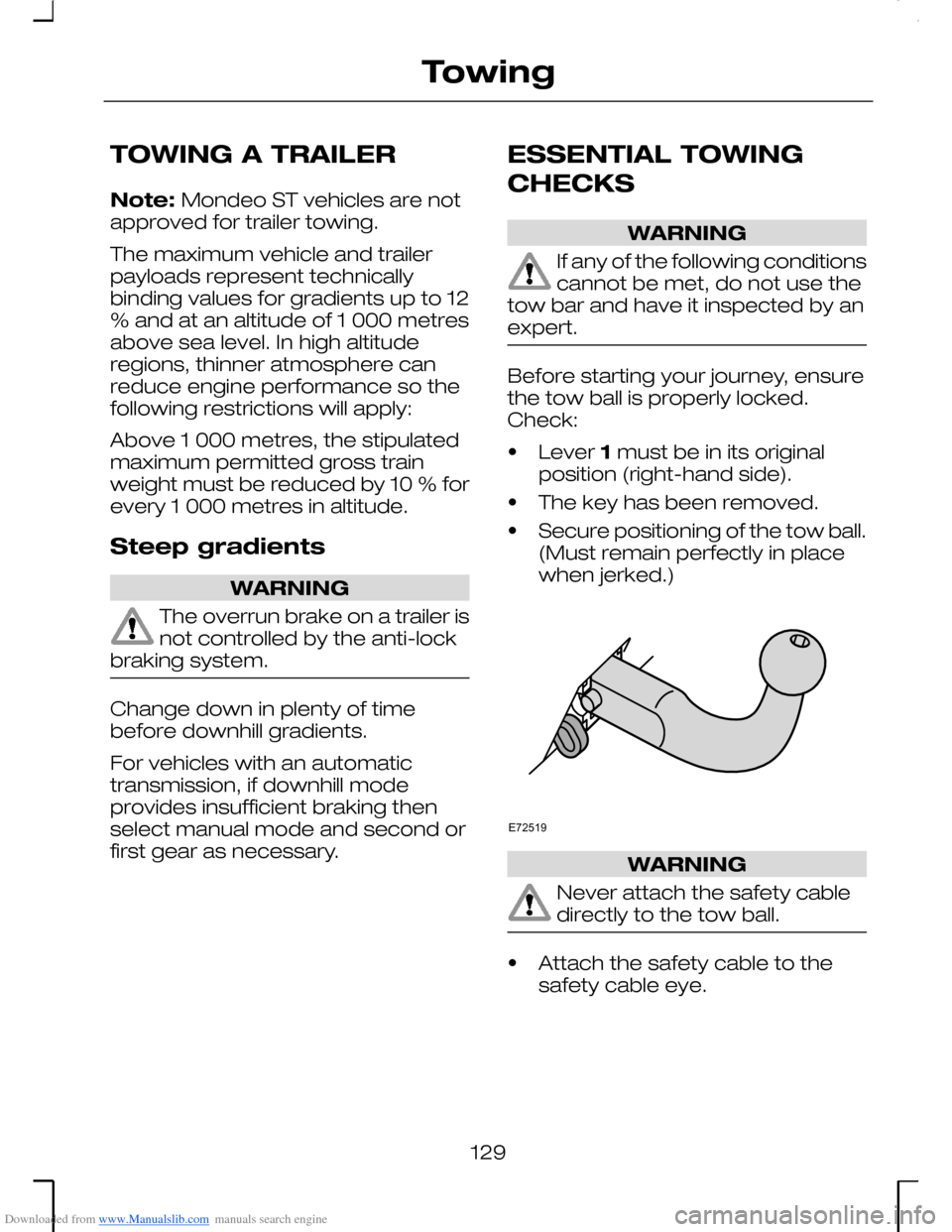
•Lever 1 must be in its originalposition (right-hand side).
•The key has been removed.
•Secure positioning of the tow ball.(Must remain perfectly in placewhen jerked.)
WARNING
Never attach the safety cabledirectly to the tow ball.
•Attach the safety cable to thesafety cable eye.
129
TowingE72519
Page 132 of 198
Downloaded from www.Manualslib.com manuals search engine DETACHABLE TOW BALL
WARNINGS
Remove and reinstall the towball regularly to keep the lockingmechanism working smoothly.
Do not use any tools formounting/dismounting the towball. Do not modify the trailercoupling. Do not disassemble/repairthe tow ball.
To avoid risk of injury, neverunlock the tow ball with thetrailer attached.
To avoid risk of injury, neverleave the detached tow ballunsecured inside the vehicle.
Note: When the tow ball is not inuse, always remove it and secure itwith the strap to the eye on theright-hand side in the rear of theluggage compartment.
Removing the tow ball
•Unhitch the trailer.
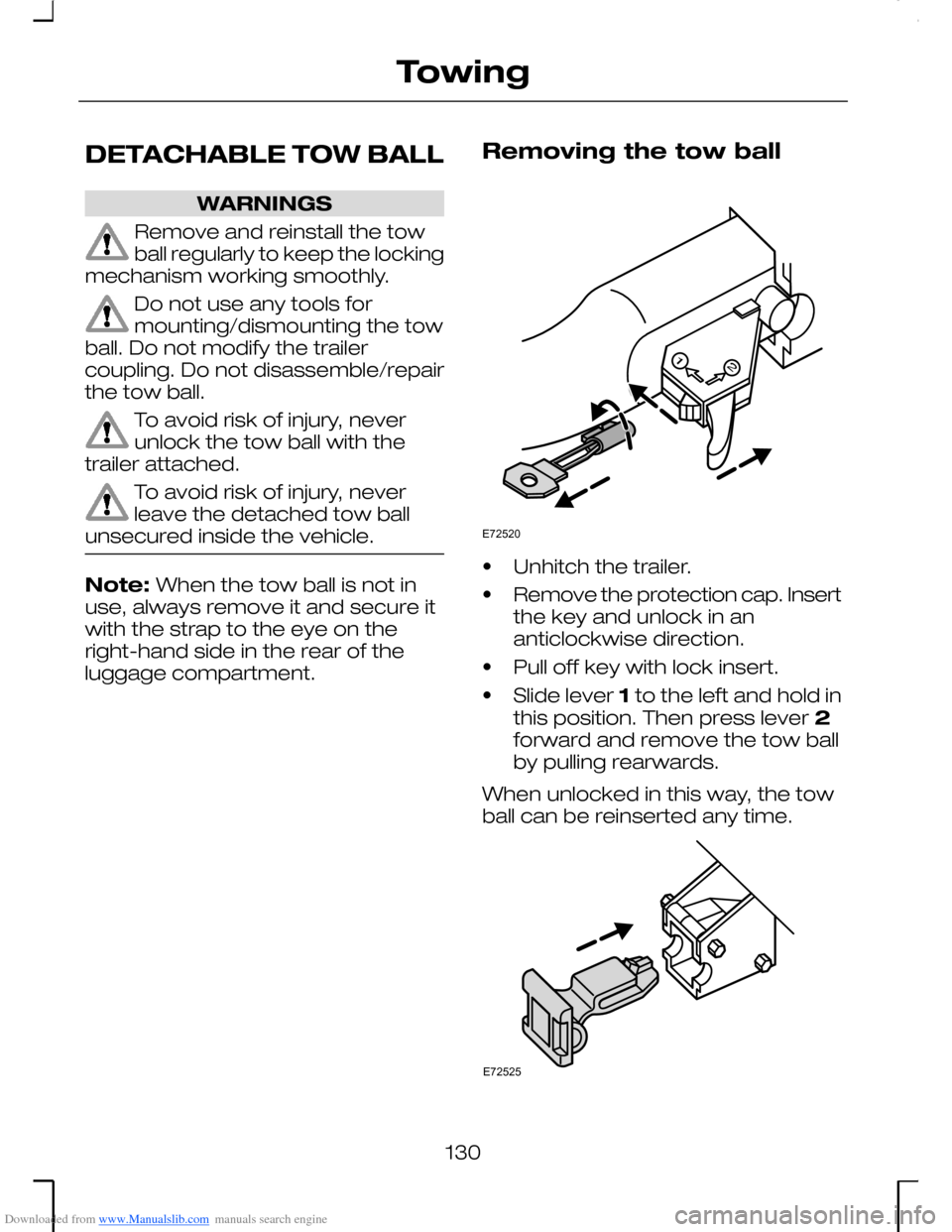
•Remove the protection cap. Insertthe key and unlock in ananticlockwise direction.
•Pull off key with lock insert.
•Slide lever 1 to the left and hold inthis position. Then press lever 2forward and remove the tow ballby pulling rearwards.
When unlocked in this way, the towball can be reinserted any time.
130
TowingE72520 E72525
Page 136 of 198
Downloaded from www.Manualslib.com manuals search engine FIRST AID KIT
4-door and 5-door
Vehicles with a temporaryspare wheel
Storage for a first aid kit is located oneither side of the luggagecompartment.
Vehicles with a full-size sparewheel
A fastening tape to secure a first aidkit is provided on the left side of theluggage compartment.
Estate
Storage for a first aid kit is located onthe left-hand side of the luggagecompartment.
WARNING TRIANGLE
4-door and 5-door
Vehicles with a temporaryspare wheel
Storage for a warning triangle islocated on either side of the luggagecompartment.
Vehicles with a full-size sparewheel
Storage for a warning triangle islocated on the right side of theluggage compartment in a foam trayunder the carpet.
Estate
Storage for a warning triangle islocated on the left-hand side of theluggage compartment.
134
Emergency equipment
Page 155 of 198
Downloaded from www.Manualslib.com manuals search engine POWER STEERING FLUID
CHECK
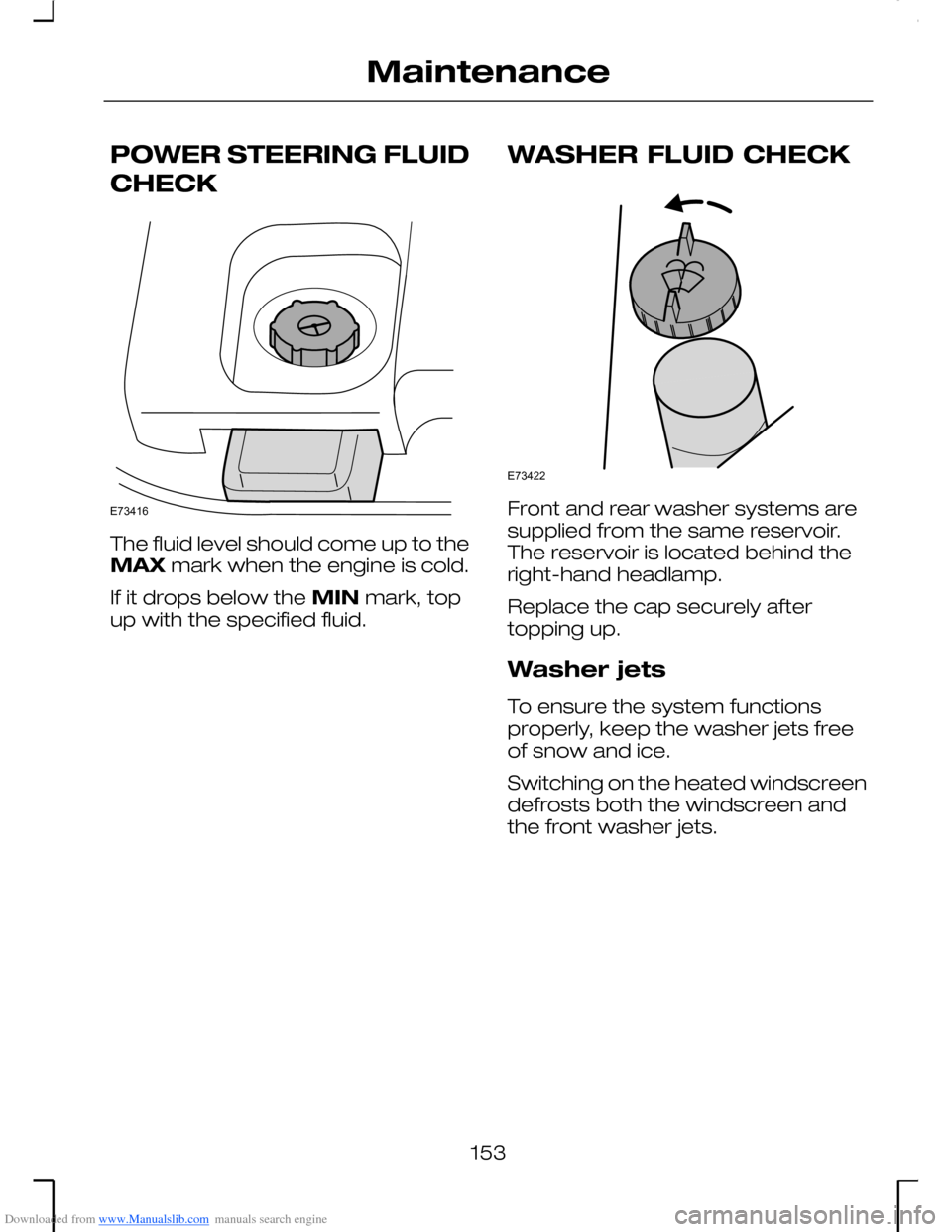
The fluid level should come up to theMAX mark when the engine is cold.
If it drops below the MIN mark, topup with the specified fluid.
WASHER FLUID CHECK
Front and rear washer systems aresupplied from the same reservoir.The reservoir is located behind theright-hand headlamp.
Replace the cap securely aftertopping up.
Washer jets
To ensure the system functionsproperly, keep the washer jets freeof snow and ice.
Switching on the heated windscreendefrosts both the windscreen andthe front washer jets.
153
MaintenanceE73416 E73422