steering FORD MONDEO 2006 2.G User Guide
[x] Cancel search | Manufacturer: FORD, Model Year: 2006, Model line: MONDEO, Model: FORD MONDEO 2006 2.GPages: 198, PDF Size: 4.69 MB
Page 55 of 198
Downloaded from www.Manualslib.com manuals search engine LIGHTING CONTROL
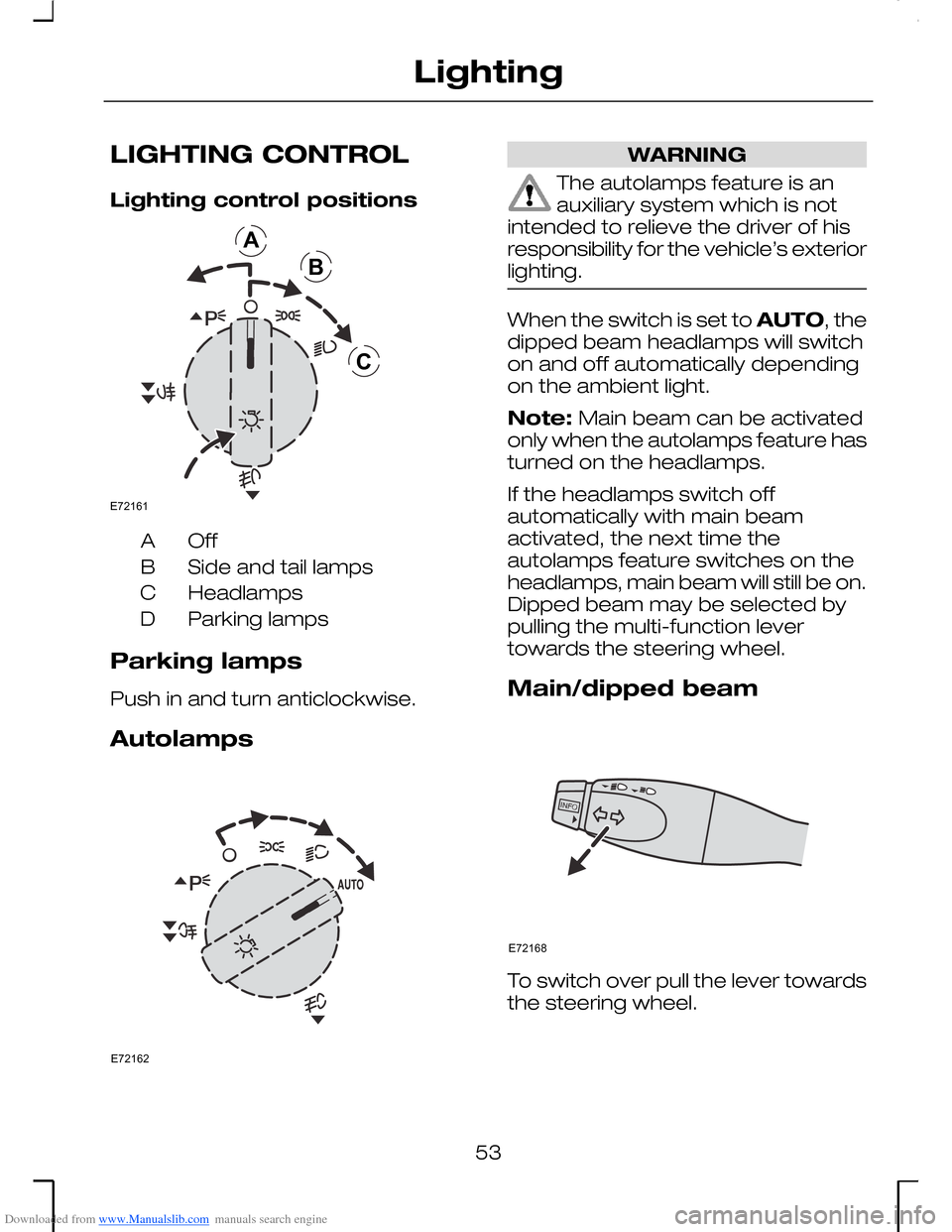
Lighting control positions
OffA
Side and tail lampsB
HeadlampsC
Parking lampsD
Parking lamps
Push in and turn anticlockwise.
Autolamps
WARNING
The autolamps feature is anauxiliary system which is notintended to relieve the driver of hisresponsibility for the vehicle’s exteriorlighting.
When the switch is set to AUTO, thedipped beam headlamps will switchon and off automatically dependingon the ambient light.
Note: Main beam can be activatedonly when the autolamps feature hasturned on the headlamps.
If the headlamps switch offautomatically with main beamactivated, the next time theautolamps feature switches on theheadlamps, main beam will still be on.Dipped beam may be selected bypulling the multi-function levertowards the steering wheel.
Main/dipped beam
To switch over pull the lever towardsthe steering wheel.
53
LightingABCE72161 E72162 E72168
Page 56 of 198
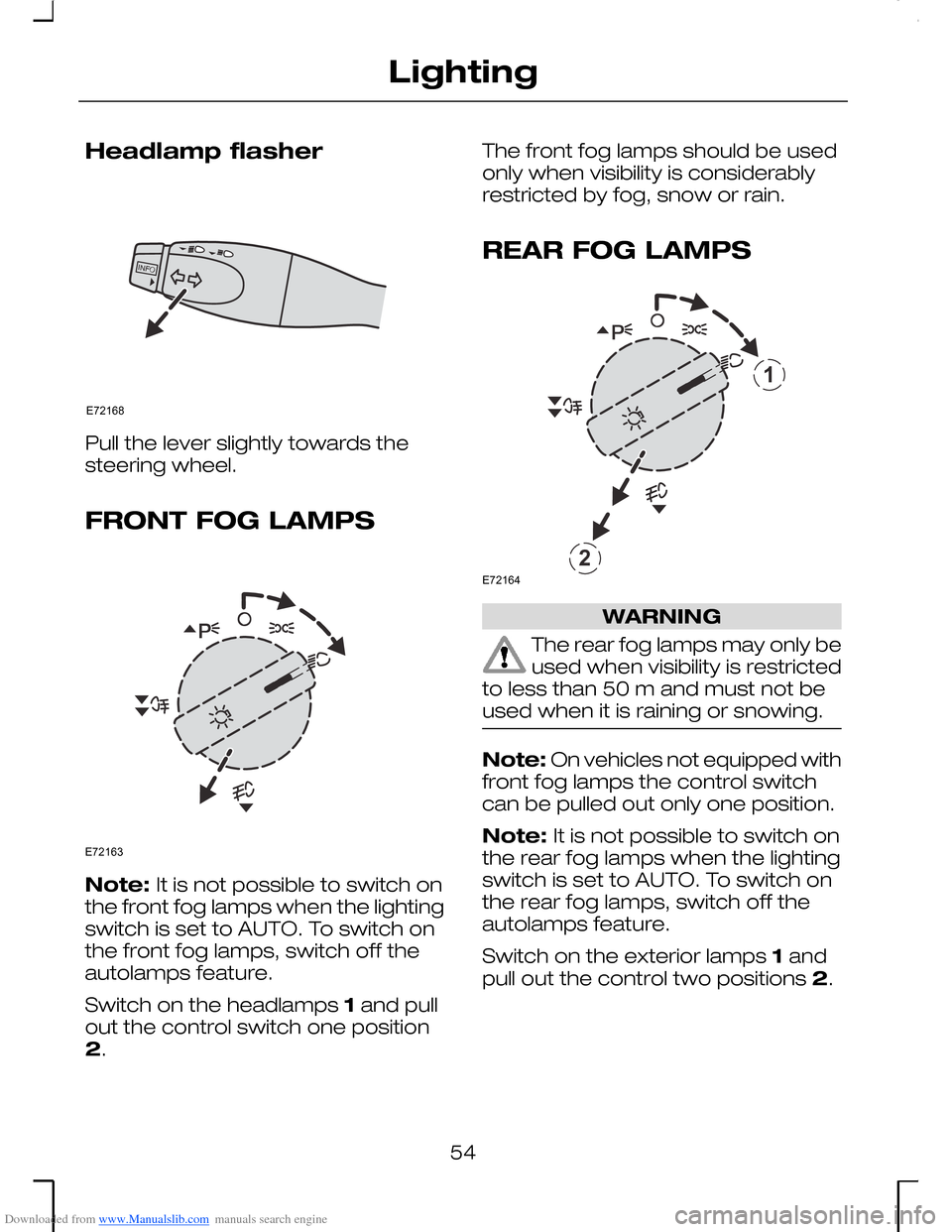
Downloaded from www.Manualslib.com manuals search engine Headlamp flasher
Pull the lever slightly towards thesteering wheel.
FRONT FOG LAMPS
Note: It is not possible to switch onthe front fog lamps when the lightingswitch is set to AUTO. To switch onthe front fog lamps, switch off theautolamps feature.
Switch on the headlamps 1 and pullout the control switch one position2.
The front fog lamps should be usedonly when visibility is considerablyrestricted by fog, snow or rain.
REAR FOG LAMPS
WARNING
The rear fog lamps may only beused when visibility is restrictedto less than 50 m and must not beused when it is raining or snowing.
Note: On vehicles not equipped withfront fog lamps the control switchcan be pulled out only one position.
Note: It is not possible to switch onthe rear fog lamps when the lightingswitch is set to AUTO. To switch onthe rear fog lamps, switch off theautolamps feature.
Switch on the exterior lamps 1 andpull out the control two positions 2.
54
LightingE72168 E72163 12E72164
Page 92 of 198
Downloaded from www.Manualslib.com manuals search engine SITTING IN THE
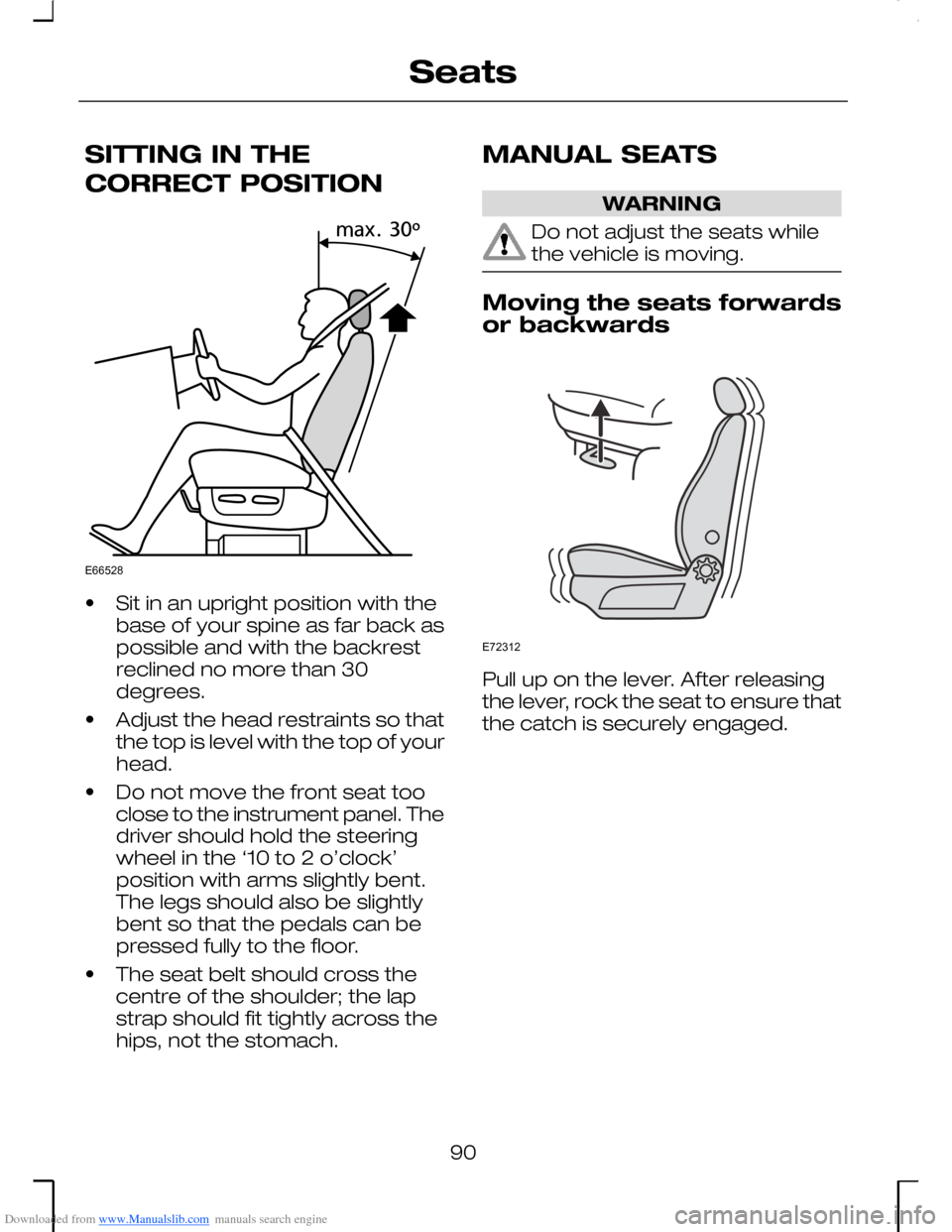
CORRECT POSITION
•Sit in an upright position with thebase of your spine as far back aspossible and with the backrestreclined no more than 30degrees.
•Adjust the head restraints so thatthe top is level with the top of yourhead.
•Do not move the front seat tooclose to the instrument panel. Thedriver should hold the steeringwheel in the ‘10 to 2 o’clock’position with arms slightly bent.The legs should also be slightlybent so that the pedals can bepressed fully to the floor.
•The seat belt should cross thecentre of the shoulder; the lapstrap should fit tightly across thehips, not the stomach.
MANUAL SEATS
WARNING
Do not adjust the seats whilethe vehicle is moving.
Moving the seats forwardsor backwards
Pull up on the lever. After releasingthe lever, rock the seat to ensure thatthe catch is securely engaged.
90
SeatsE66528 E72312
Page 102 of 198
Downloaded from www.Manualslib.com manuals search engine GENERAL INFORMATION
General points on starting
If the battery has been disconnectedthe vehicle may exhibit some unusualdriving characteristics for approx. 8kilometres (5 miles) afterreconnecting the battery.
This is because the enginemanagement system must realignitself with the engine. Any unusualdriving characteristics during thisperiod may be disregarded.
Starting the engine bytowing or pushing
WARNING
To prevent damage you mustnot push or tow start yourvehicle. Use booster cables and abooster battery. See Using boostercables (page 158).
IGNITION SWITCH
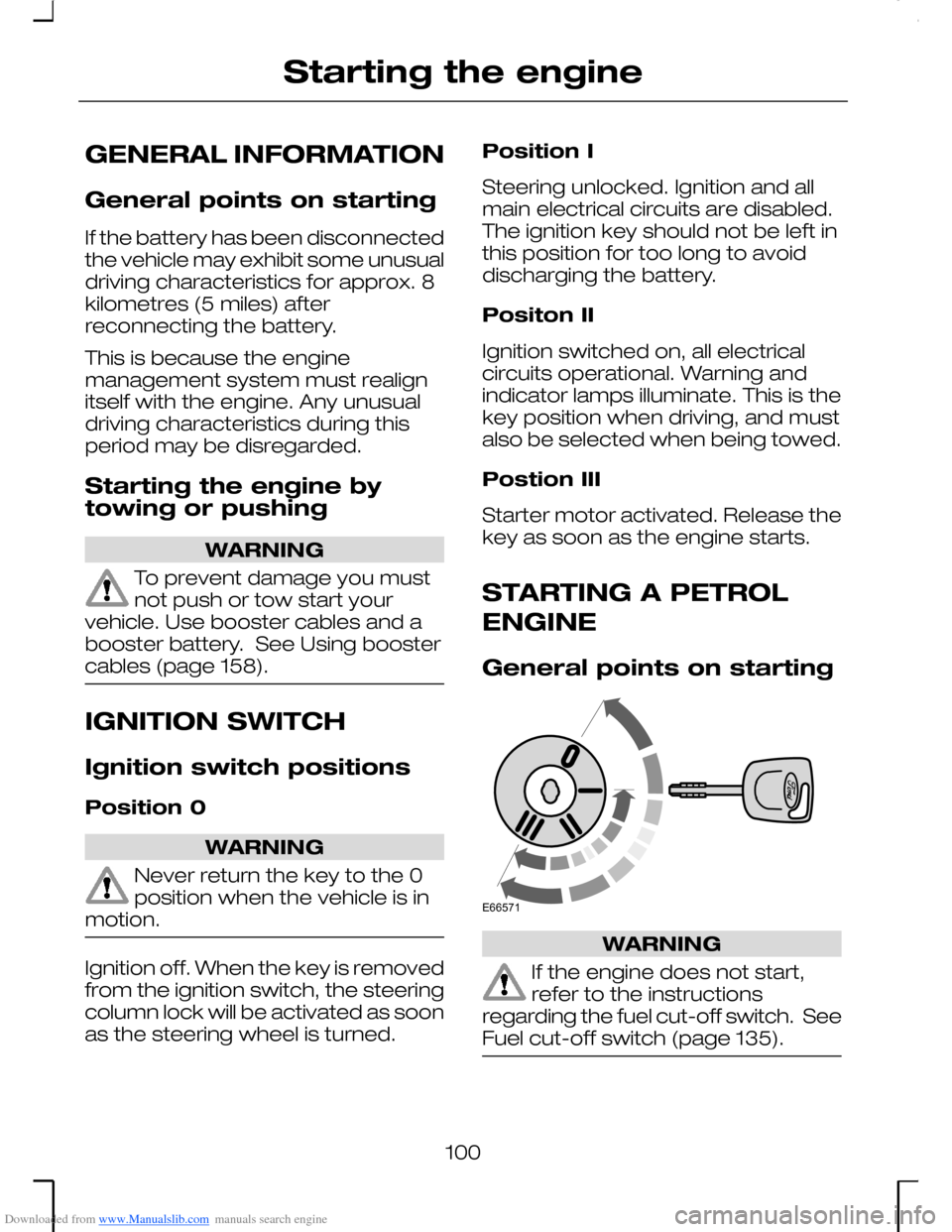
Ignition switch positions
Position 0
WARNING
Never return the key to the 0position when the vehicle is inmotion.
Ignition off. When the key is removedfrom the ignition switch, the steeringcolumn lock will be activated as soonas the steering wheel is turned.
Position I
Steering unlocked. Ignition and allmain electrical circuits are disabled.The ignition key should not be left inthis position for too long to avoiddischarging the battery.
Positon II
Ignition switched on, all electricalcircuits operational. Warning andindicator lamps illuminate. This is thekey position when driving, and mustalso be selected when being towed.
Postion III
Starter motor activated. Release thekey as soon as the engine starts.
STARTING A PETROL
ENGINE
General points on starting
WARNING
If the engine does not start,refer to the instructionsregarding the fuel cut-off switch. SeeFuel cut-off switch (page 135).
100
Starting the engineE66571
Page 114 of 198
Downloaded from www.Manualslib.com manuals search engine 1 = Gear 1 (4-speedtransmission)
The transmission remains in the firstgear. For extreme downhill gradients.
Manual shifting (5-speedtransmission)
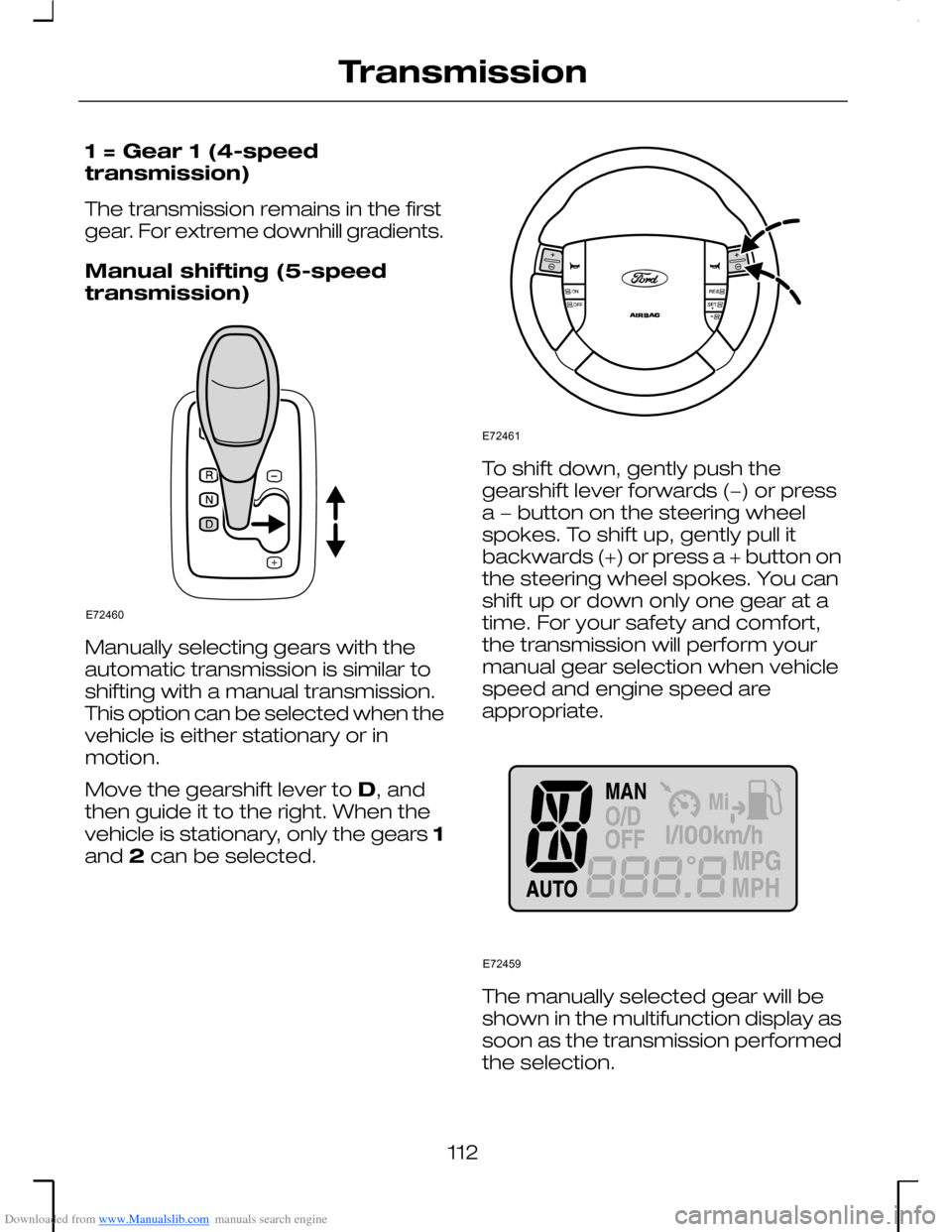
Manually selecting gears with theautomatic transmission is similar toshifting with a manual transmission.This option can be selected when thevehicle is either stationary or inmotion.
Move the gearshift lever to D, andthen guide it to the right. When thevehicle is stationary, only the gears 1and 2 can be selected.
To shift down, gently push thegearshift lever forwards (−) or pressa − button on the steering wheelspokes. To shift up, gently pull itbackwards (+) or press a + button onthe steering wheel spokes. You canshift up or down only one gear at atime. For your safety and comfort,the transmission will perform yourmanual gear selection when vehiclespeed and engine speed areappropriate.
The manually selected gear will beshown in the multifunction display assoon as the transmission performedthe selection.
112
TransmissionE72460 E72461 E72459
Page 121 of 198
Downloaded from www.Manualslib.com manuals search engine The ABS operates only when thewheels are about to lock. Itsoperation is indicated by a pulsing ofthe brake pedal and full steeringcontrol is retained. Do not releasethe pedal whilst braking.
PARKING BRAKE
All vehicles
WARNING
Vehicles with an automatictransmission should always beleft with the selector lever in positionP.
•Press the foot brake pedal firmly.
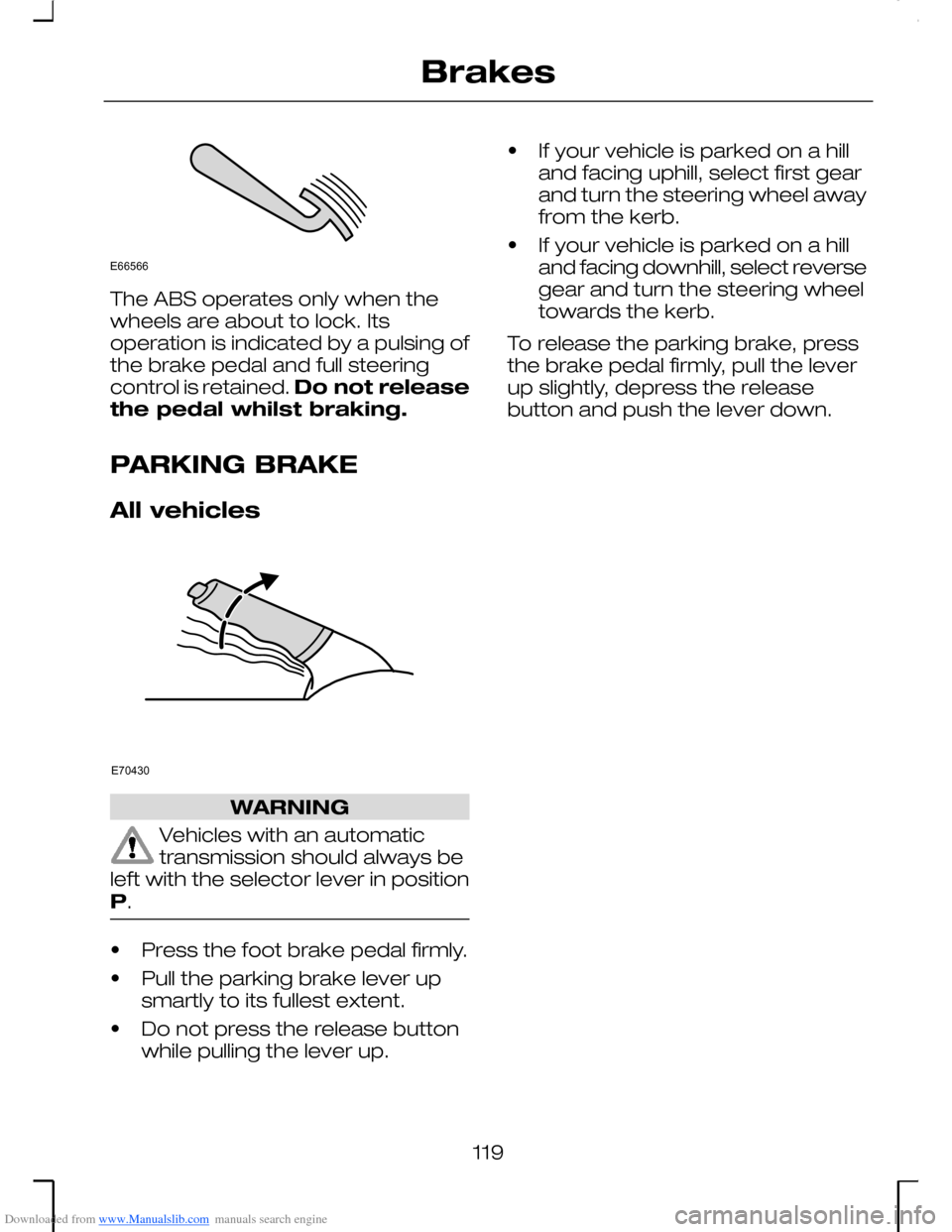
•Pull the parking brake lever upsmartly to its fullest extent.
•Do not press the release buttonwhile pulling the lever up.
•If your vehicle is parked on a hilland facing uphill, select first gearand turn the steering wheel awayfrom the kerb.
•If your vehicle is parked on a hilland facing downhill, select reversegear and turn the steering wheeltowards the kerb.
To release the parking brake, pressthe brake pedal firmly, pull the leverup slightly, depress the releasebutton and push the lever down.
119
BrakesE66566 E70430
Page 145 of 198
Downloaded from www.Manualslib.com manuals search engine TOWING THE VEHICLE
ON FOUR WHEELS
All vehicles
WARNING
The ignition key must be set toposition II when the vehicle isbeing towed so that the steering,direction indicator lamps and brakelamps are fully operational. Since thebrake servo and the power steeringdo not operate with the engineswitched off, you will need to exertgreater force to the brake pedal andsteering wheel. Make allowances forthe increased braking distance andheavier steering.
Note: Observe the safetyregulations that are valid for towinga vehicle depending on country.
When towing always drive off slowlyand smoothly without jerking thetowing vehicle. Excessive tow ropetension could result in damage toeither vehicle.
Vehicles with an automatictransmission
WARNINGS
Never tow a vehicle with anautomatic transmission fasterthan 50 km/h (30 mph) or furtherthan 50 kilometres (30 miles). SeeTransporting the vehicle (page 142).
Never tow a vehicle backwardswith the drive wheels turning. Ifthis instruction is not adhered to, itcould cause damage to theautomatic transmission.
When a vehicle with an automatictransmission is towed, the selectorlever must be in position N (neutral).
143
Vehicle recovery
Page 146 of 198
Downloaded from www.Manualslib.com manuals search engine GENERAL INFORMATION
WARNINGS
The electronic ignition systemworks with high voltage. Nevertouch these components with theengine running or the ignitionswitched on.
The ignition must be switchedoff before working in the enginecompartment. Under some operatingconditions, the cooling system fanmay continue to run for severalminutes after the engine has beenswitched off. This is quite normal.Take care not to get any fingers orclothing such as ties or scarvescaught in the fan.
•Check and top up fluid levelsregularly.
•Check tyre pressure.
•Check brakes and lamps areoperating correctly.
•Check warning and indicatorlamps.
Every day check
•Operation of all exterior andinterior lamps and make sure thatall lenses are clean.
When filling up check
•Engine oil level
•Brake fluid level
•Washer fluid level
•Tyre pressures and condition (onlywhen cold)
Once a month check
•Coolant level (engine cold)
•Assemblies, pipes, hoses andreservoirs for leaks
•Power steering fluid level
•Operation of the air conditioning
•Operation of the parking brake
•Operation of the horn
144
Maintenance
Page 147 of 198
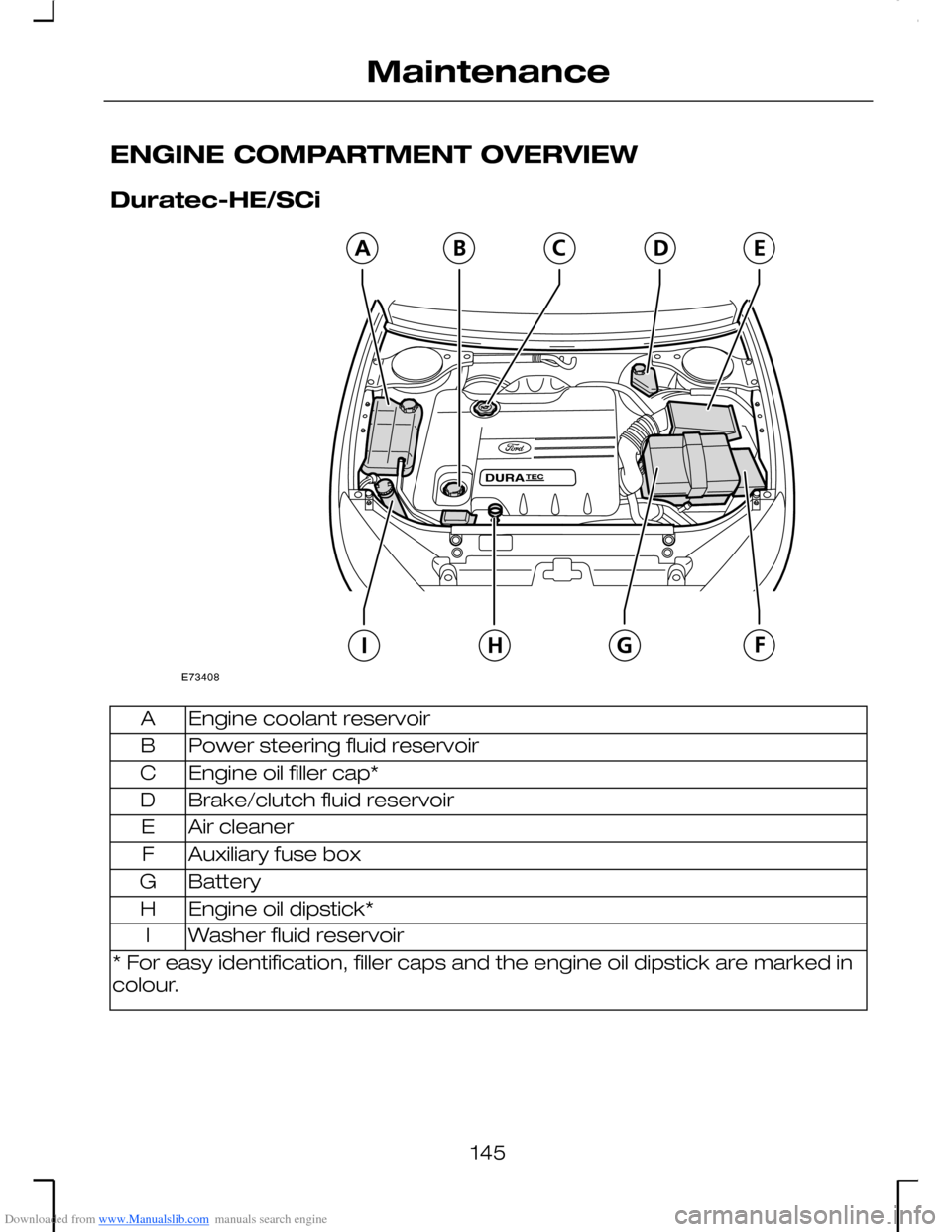
Downloaded from www.Manualslib.com manuals search engine ENGINE COMPARTMENT OVERVIEW
Duratec-HE/SCi
Engine coolant reservoirA
Power steering fluid reservoirB
Engine oil filler cap*C
Brake/clutch fluid reservoirD
Air cleanerE
Auxiliary fuse boxF
BatteryG
Engine oil dipstick*H
Washer fluid reservoirI
* For easy identification, filler caps and the engine oil dipstick are marked incolour.
145
MaintenanceE73408
Page 148 of 198
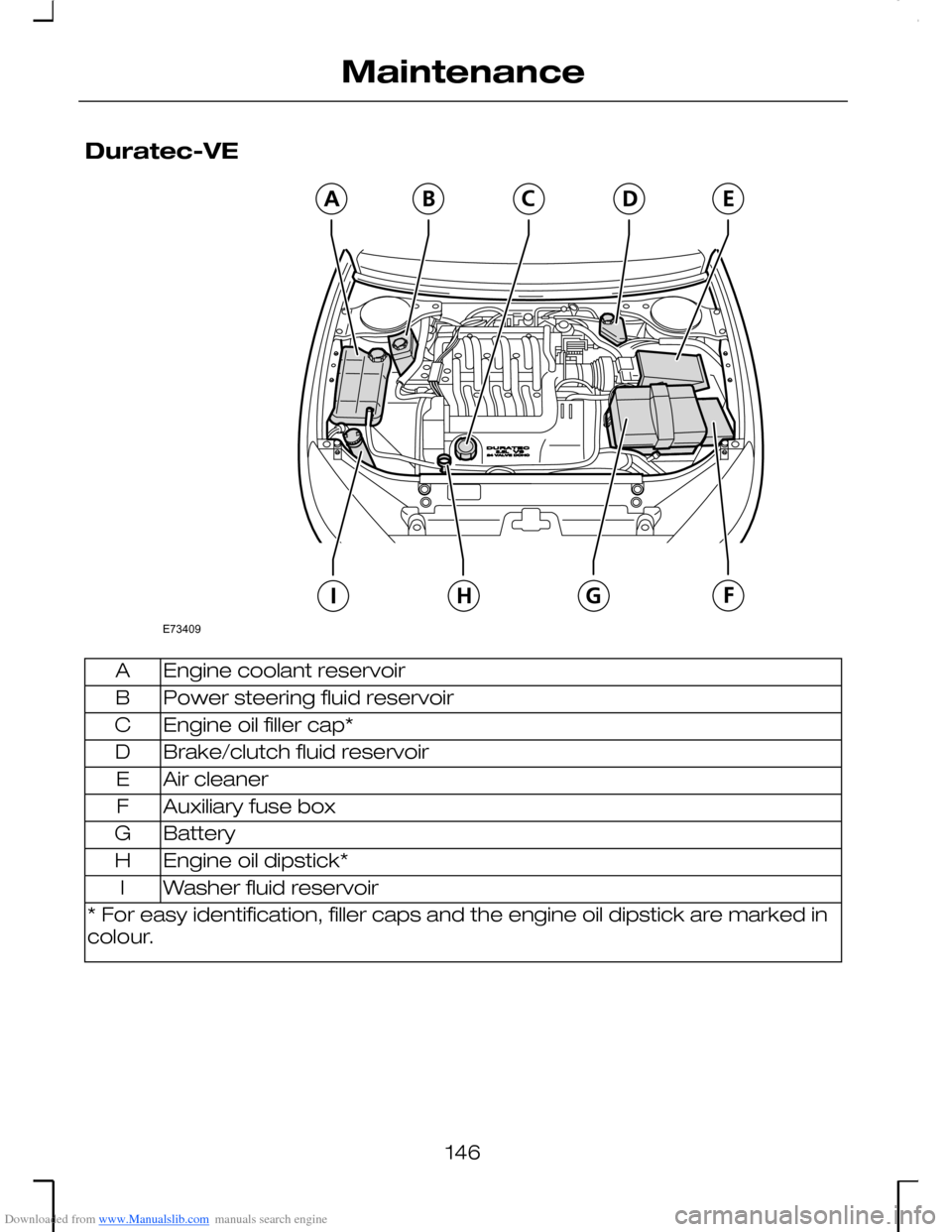
Downloaded from www.Manualslib.com manuals search engine Duratec-VE
Engine coolant reservoirA
Power steering fluid reservoirB
Engine oil filler cap*C
Brake/clutch fluid reservoirD
Air cleanerE
Auxiliary fuse boxF
BatteryG
Engine oil dipstick*H
Washer fluid reservoirI
* For easy identification, filler caps and the engine oil dipstick are marked incolour.
146
MaintenanceE73409