key FORD MONDEO 2006 2.G Owner's Manual
[x] Cancel search | Manufacturer: FORD, Model Year: 2006, Model line: MONDEO, Model: FORD MONDEO 2006 2.GPages: 198, PDF Size: 4.69 MB
Page 103 of 198
Downloaded from www.Manualslib.com manuals search engine Do not operate the starter for longerthan 30 seconds at a time. Releasethe ignition key as soon as the enginehas started. If the engine has notstarted, return the ignition key toposition 0 and repeat the startingprocedure.
Cold/hot engine
WARNING
At temperatures below –20 ºC,turn the ignition key to positionII for at least one second. Thisensures that maximum fuel pressureis established.
Depress the clutch pedal fully andstart the engine without touching theaccelerator.
If the engine does not start within 15seconds, wait for a short period andrepeat the procedure.
If the engine does not start afterthree attempts wait 10 seconds andfollow the Flooded engineprocedure.
Flooded engine
Depress the clutch pedal fully.
Slowly depress the accelerator fully,hold it in this position and start theengine.
If the engine does not start repeatthe Cold/hot engine procedure.
STARTING A DIESEL
ENGINE
General points on starting
WARNING
If the engine does not start,refer to the instructionsregarding the fuel cut-off switch. SeeFuel cut-off switch (page 135).
Do not operate the starter for longerthan 30 seconds. Release the ignitionkey as soon as the engine hasstarted. If the engine has not started,return the ignition key to position 0and repeat the starting procedure.
Cold/hot engine
Depress the clutch pedal withouttouching the accelerator.
Note: The glow plug indicator lampalso functions as an engine warninglight. See Warning lamps andindicators (page 73).
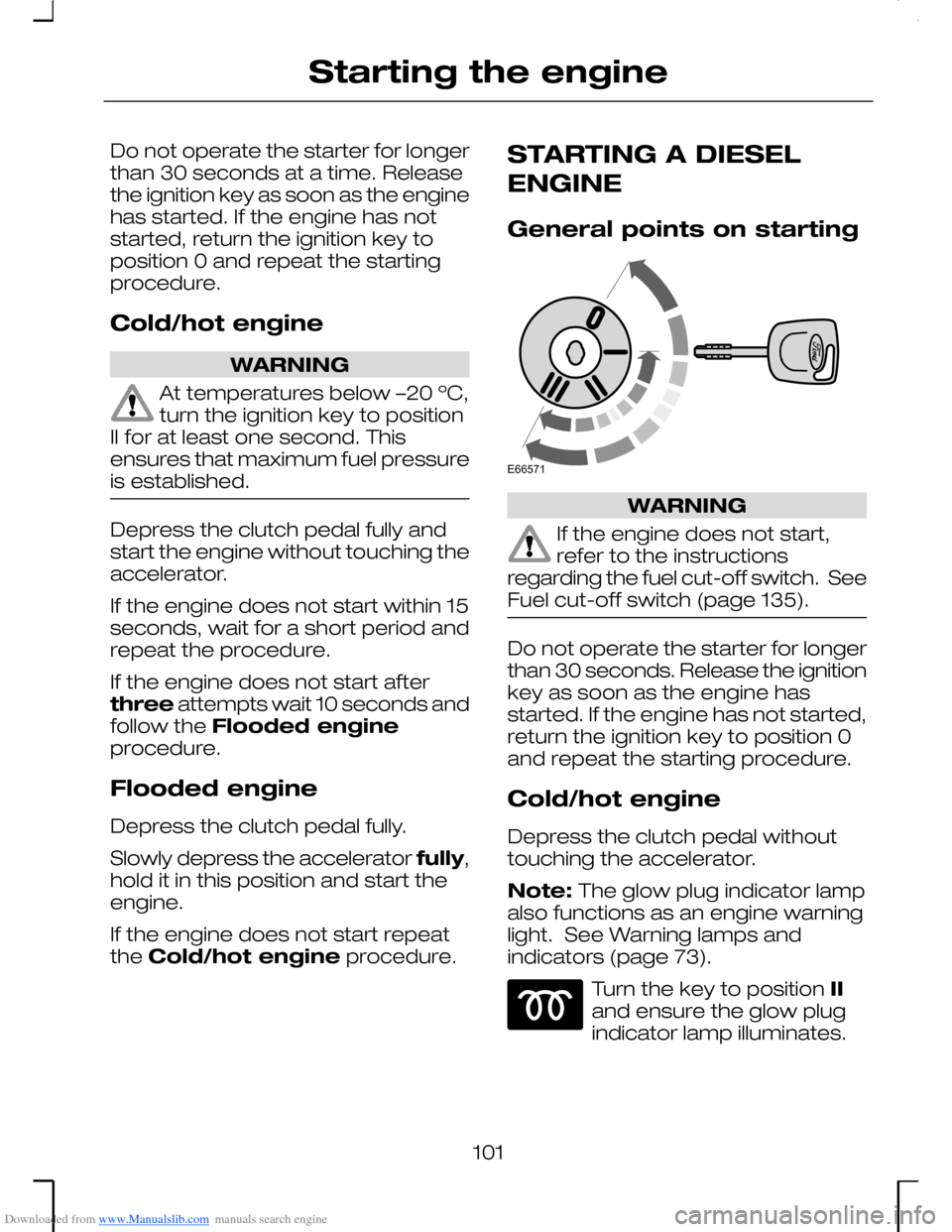
Turn the key to position IIand ensure the glow plugindicator lamp illuminates.
101
Starting the engineE66571
Page 130 of 198
Downloaded from www.Manualslib.com manuals search engine WARNING
Driving with a roof load can havea negative influence on thedriveability of the vehicle.
Roof rails (Estate)
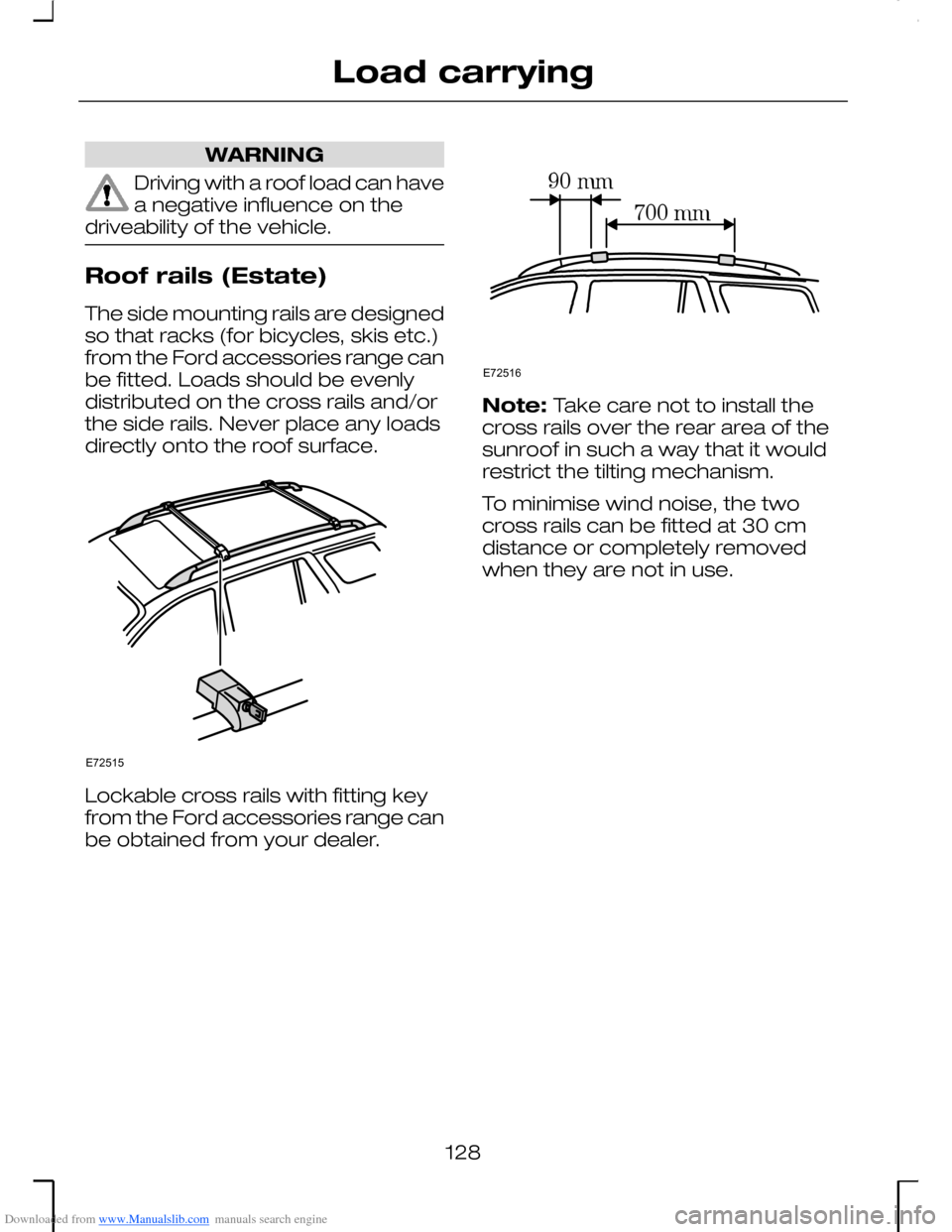
The side mounting rails are designedso that racks (for bicycles, skis etc.)from the Ford accessories range canbe fitted. Loads should be evenlydistributed on the cross rails and/orthe side rails. Never place any loadsdirectly onto the roof surface.
Lockable cross rails with fitting keyfrom the Ford accessories range canbe obtained from your dealer.
Note: Take care not to install thecross rails over the rear area of thesunroof in such a way that it wouldrestrict the tilting mechanism.
To minimise wind noise, the twocross rails can be fitted at 30 cmdistance or completely removedwhen they are not in use.
128
Load carryingE72515 E72516
Page 131 of 198
Downloaded from www.Manualslib.com manuals search engine TOWING A TRAILER
Note: Mondeo ST vehicles are notapproved for trailer towing.
The maximum vehicle and trailerpayloads represent technicallybinding values for gradients up to 12% and at an altitude of 1 000 metresabove sea level. In high altituderegions, thinner atmosphere canreduce engine performance so thefollowing restrictions will apply:
Above 1 000 metres, the stipulatedmaximum permitted gross trainweight must be reduced by 10 % forevery 1 000 metres in altitude.
Steep gradients
WARNING
The overrun brake on a trailer isnot controlled by the anti-lockbraking system.
Change down in plenty of timebefore downhill gradients.
For vehicles with an automatictransmission, if downhill modeprovides insufficient braking thenselect manual mode and second orfirst gear as necessary.
ESSENTIAL TOWING
CHECKS
WARNING
If any of the following conditionscannot be met, do not use thetow bar and have it inspected by anexpert.
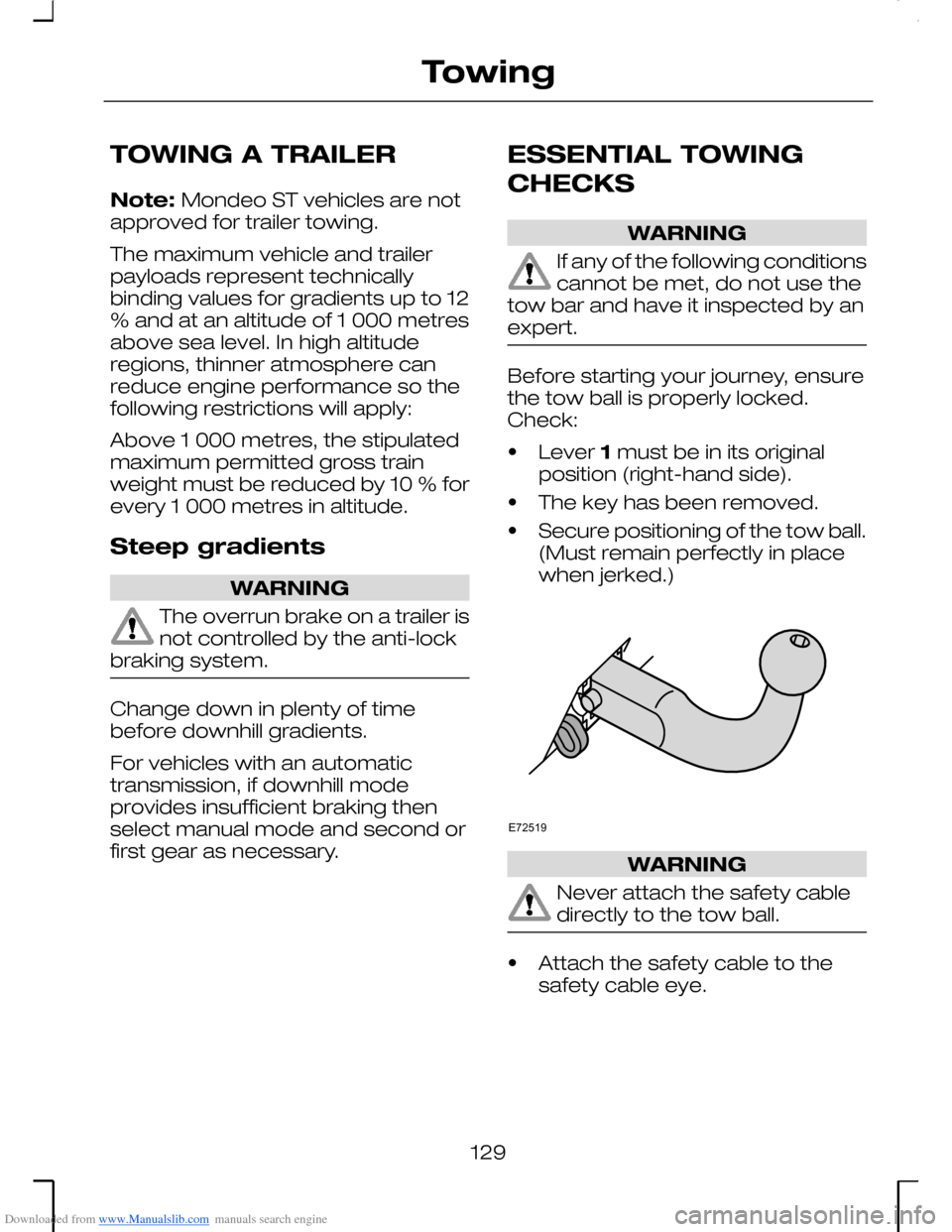
Before starting your journey, ensurethe tow ball is properly locked.Check:
•Lever 1 must be in its originalposition (right-hand side).
•The key has been removed.
•Secure positioning of the tow ball.(Must remain perfectly in placewhen jerked.)
WARNING
Never attach the safety cabledirectly to the tow ball.
•Attach the safety cable to thesafety cable eye.
129
TowingE72519
Page 132 of 198
Downloaded from www.Manualslib.com manuals search engine DETACHABLE TOW BALL
WARNINGS
Remove and reinstall the towball regularly to keep the lockingmechanism working smoothly.
Do not use any tools formounting/dismounting the towball. Do not modify the trailercoupling. Do not disassemble/repairthe tow ball.
To avoid risk of injury, neverunlock the tow ball with thetrailer attached.
To avoid risk of injury, neverleave the detached tow ballunsecured inside the vehicle.
Note: When the tow ball is not inuse, always remove it and secure itwith the strap to the eye on theright-hand side in the rear of theluggage compartment.
Removing the tow ball
•Unhitch the trailer.
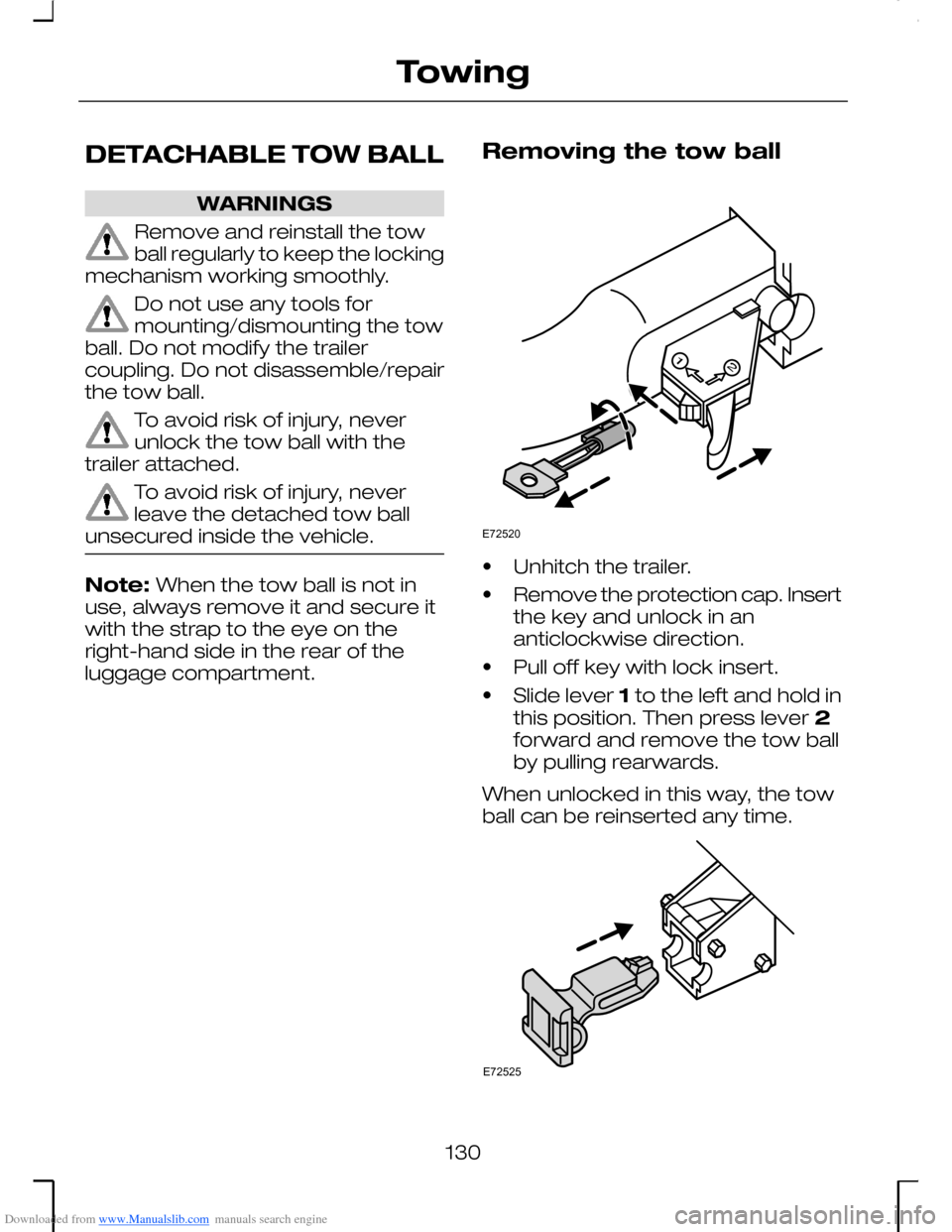
•Remove the protection cap. Insertthe key and unlock in ananticlockwise direction.
•Pull off key with lock insert.
•Slide lever 1 to the left and hold inthis position. Then press lever 2forward and remove the tow ballby pulling rearwards.
When unlocked in this way, the towball can be reinserted any time.
130
TowingE72520 E72525
Page 134 of 198
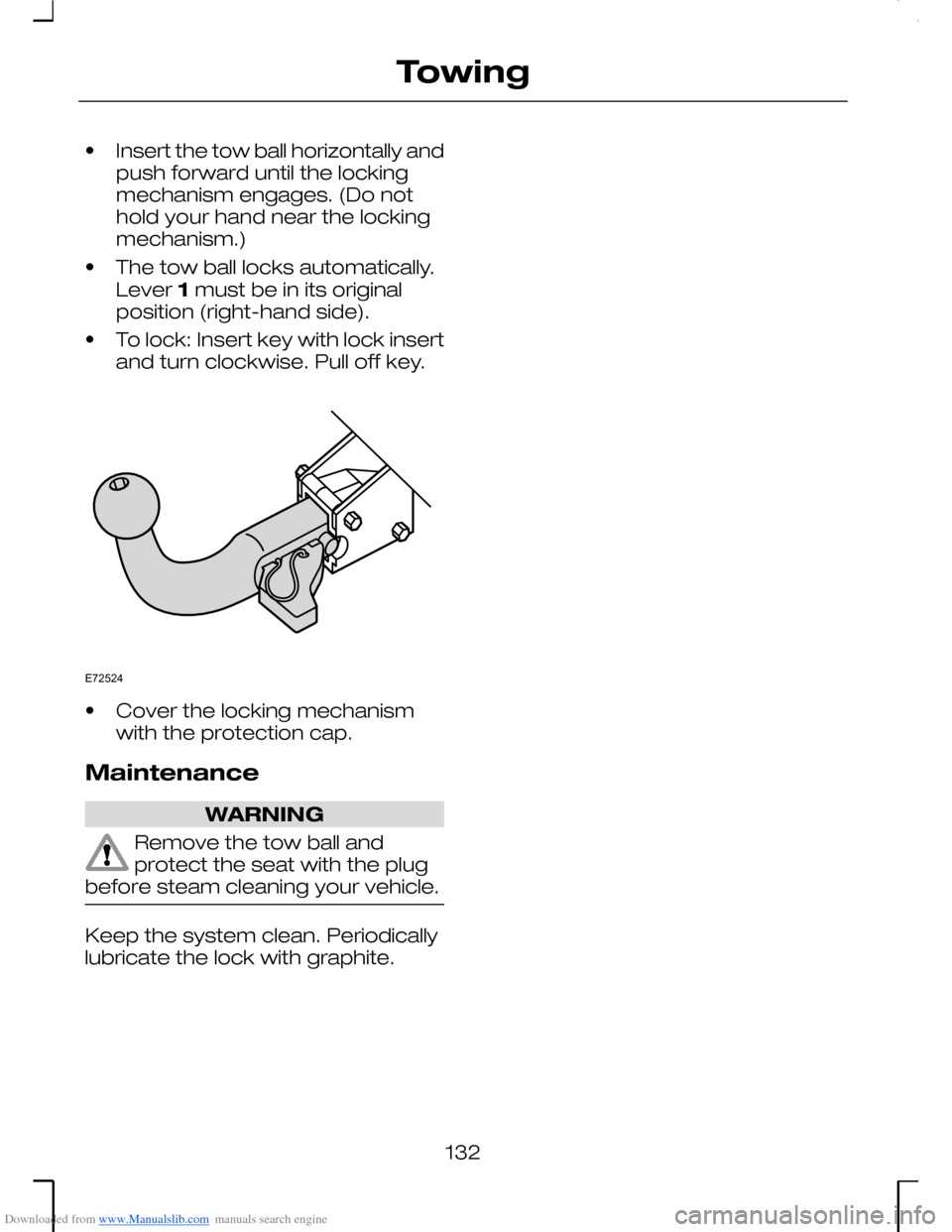
Downloaded from www.Manualslib.com manuals search engine •Insert the tow ball horizontally andpush forward until the lockingmechanism engages. (Do nothold your hand near the lockingmechanism.)
•The tow ball locks automatically.Lever 1 must be in its originalposition (right-hand side).
•To lock: Insert key with lock insertand turn clockwise. Pull off key.
•Cover the locking mechanismwith the protection cap.
Maintenance
WARNING
Remove the tow ball andprotect the seat with the plugbefore steam cleaning your vehicle.
Keep the system clean. Periodicallylubricate the lock with graphite.
132
TowingE72524
Page 137 of 198
Downloaded from www.Manualslib.com manuals search engine FUEL CUT-OFF SWITCH
Vehicles with a Duratecengine
The fuel supply may be cut off as aresult of an accident or suddenvibrations (e.g. collision whenparking).
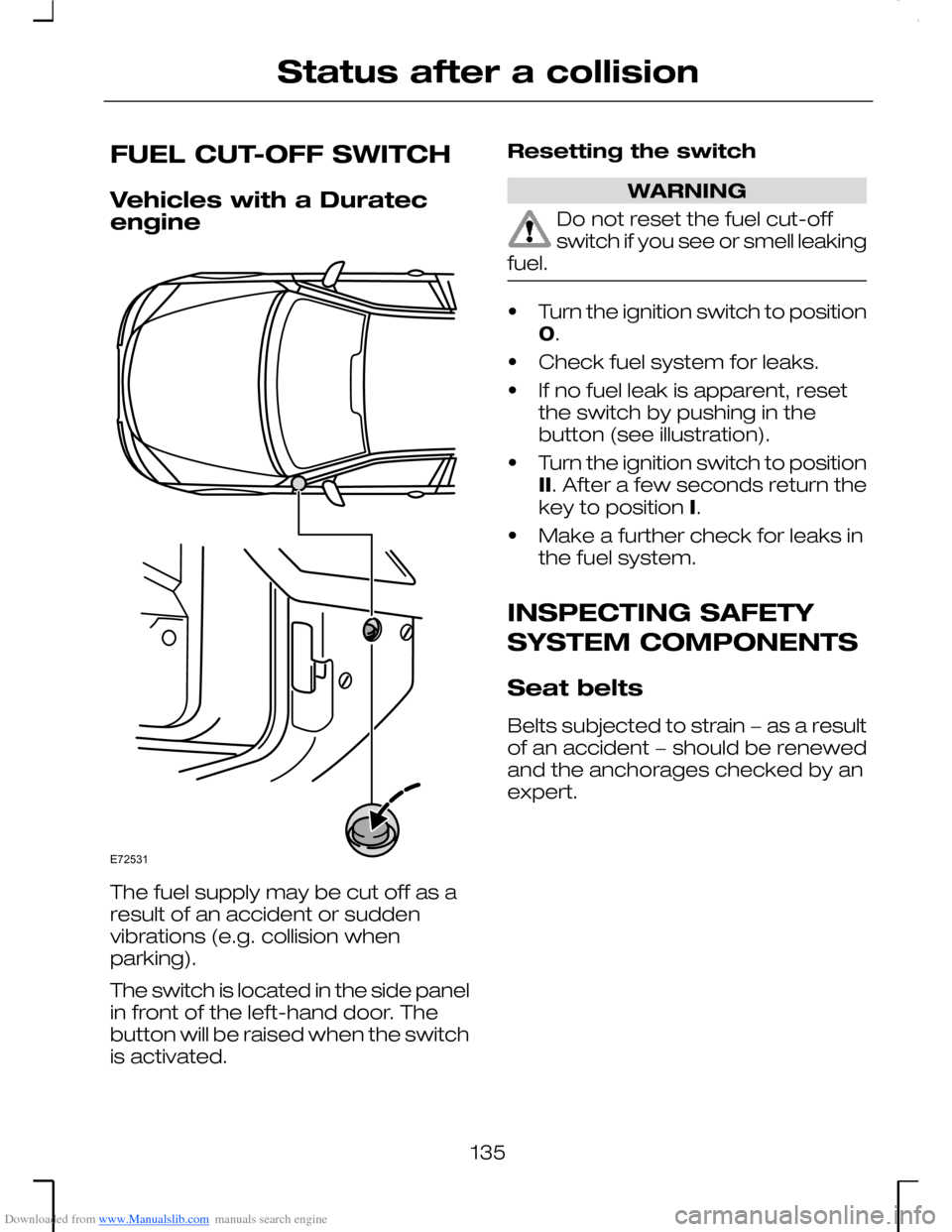
The switch is located in the side panelin front of the left-hand door. Thebutton will be raised when the switchis activated.
Resetting the switch
WARNING
Do not reset the fuel cut-offswitch if you see or smell leakingfuel.
•Turn the ignition switch to position0.
•Check fuel system for leaks.
•If no fuel leak is apparent, resetthe switch by pushing in thebutton (see illustration).
•Turn the ignition switch to positionII. After a few seconds return thekey to position I.
•Make a further check for leaks inthe fuel system.
INSPECTING SAFETY
SYSTEM COMPONENTS
Seat belts
Belts subjected to strain − as a resultof an accident − should be renewedand the anchorages checked by anexpert.
135
Status after a collisionE72531
Page 145 of 198
Downloaded from www.Manualslib.com manuals search engine TOWING THE VEHICLE
ON FOUR WHEELS
All vehicles
WARNING
The ignition key must be set toposition II when the vehicle isbeing towed so that the steering,direction indicator lamps and brakelamps are fully operational. Since thebrake servo and the power steeringdo not operate with the engineswitched off, you will need to exertgreater force to the brake pedal andsteering wheel. Make allowances forthe increased braking distance andheavier steering.
Note: Observe the safetyregulations that are valid for towinga vehicle depending on country.
When towing always drive off slowlyand smoothly without jerking thetowing vehicle. Excessive tow ropetension could result in damage toeither vehicle.
Vehicles with an automatictransmission
WARNINGS
Never tow a vehicle with anautomatic transmission fasterthan 50 km/h (30 mph) or furtherthan 50 kilometres (30 miles). SeeTransporting the vehicle (page 142).
Never tow a vehicle backwardswith the drive wheels turning. Ifthis instruction is not adhered to, itcould cause damage to theautomatic transmission.
When a vehicle with an automatictransmission is towed, the selectorlever must be in position N (neutral).
143
Vehicle recovery
Page 151 of 198
Downloaded from www.Manualslib.com manuals search engine OPENING AND CLOSING
THE BONNET
Opening the bonnet
WARNING
Remove the key immediatelyafter opening the bonnet.
The bonnet must be opened fromthe outside.
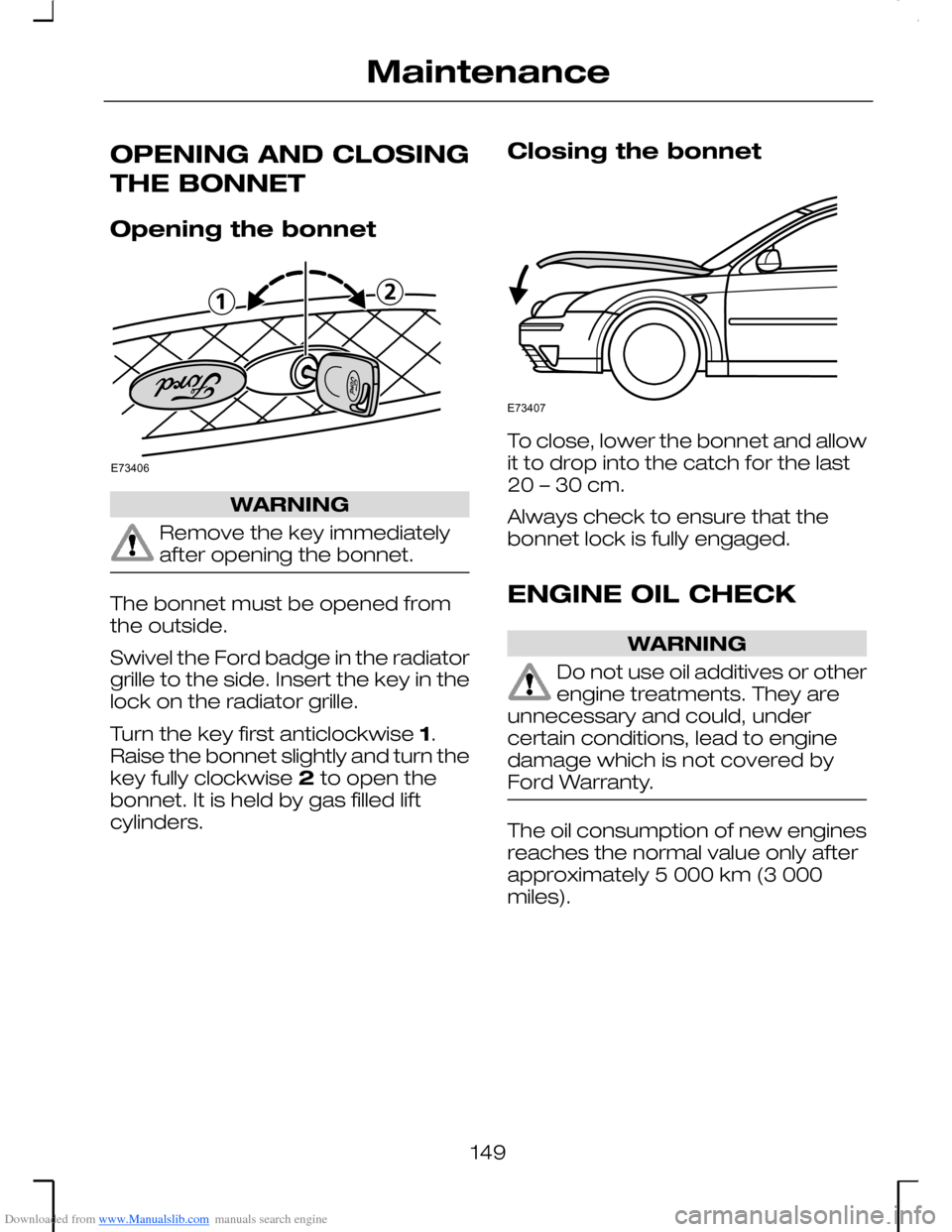
Swivel the Ford badge in the radiatorgrille to the side. Insert the key in thelock on the radiator grille.
Turn the key first anticlockwise 1.Raise the bonnet slightly and turn thekey fully clockwise 2 to open thebonnet. It is held by gas filled liftcylinders.
Closing the bonnet
To close, lower the bonnet and allowit to drop into the catch for the last20 – 30 cm.
Always check to ensure that thebonnet lock is fully engaged.
ENGINE OIL CHECK
WARNING
Do not use oil additives or otherengine treatments. They areunnecessary and could, undercertain conditions, lead to enginedamage which is not covered byFord Warranty.
The oil consumption of new enginesreaches the normal value only afterapproximately 5 000 km (3 000miles).
149
MaintenanceE73406 E73407
Page 166 of 198
Downloaded from www.Manualslib.com manuals search engine The vehicle jack must only beused to carry out wheelchanges. Do not work underneaththe vehicle when it is supported onlyby the jack.
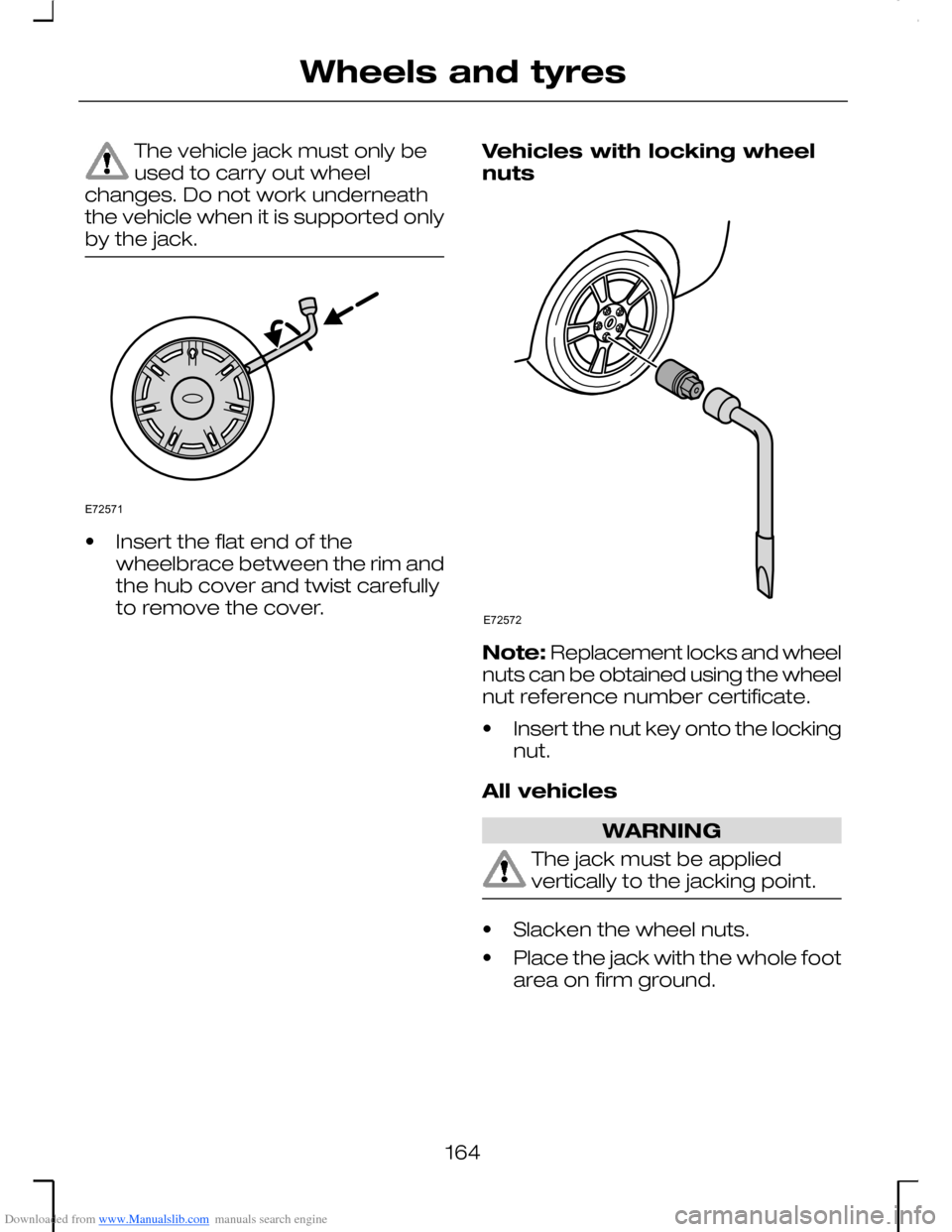
•Insert the flat end of thewheelbrace between the rim andthe hub cover and twist carefullyto remove the cover.
Vehicles with locking wheelnuts
Note: Replacement locks and wheelnuts can be obtained using the wheelnut reference number certificate.
•Insert the nut key onto the lockingnut.
All vehicles
WARNING
The jack must be appliedvertically to the jacking point.
•Slacken the wheel nuts.
•Place the jack with the whole footarea on firm ground.
164
Wheels and tyresE72571 E72572
Page 167 of 198
Downloaded from www.Manualslib.com manuals search engine •Jack up the vehicle until the wheelis clear of the ground.
•Unscrew and remove the wheelnuts and take off the wheel.
Fitting a wheel
Vehicles with alloy wheels
WARNING
Alloy wheels must never besecured using wheel nuts forsteel wheels.
Note: The wheel nuts of alloy wheelscan also be used for the steel sparewheel for a short time (maximum twoweeks).
All vehicles
•Push the wheel onto the wheelstuds. Screw on the wheel nutsand secure in a clockwisedirection ensuring that thetapered end of the wheel nuts isfacing the wheel.
•Lower the vehicle and remove thejack.
Vehicles with locking wheelnuts
•Insert the nut key onto the lockingnut.
All vehicles
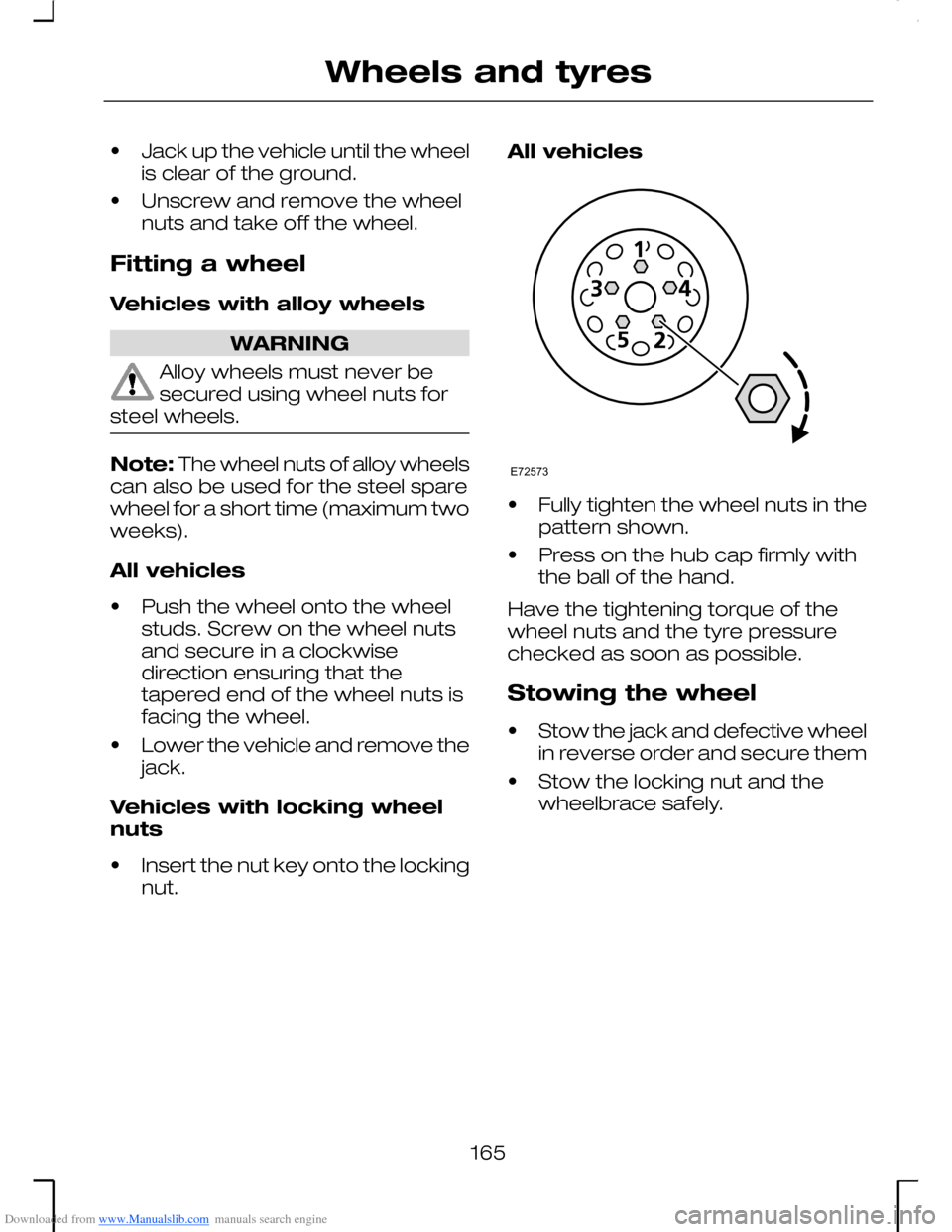
•Fully tighten the wheel nuts in thepattern shown.
•Press on the hub cap firmly withthe ball of the hand.
Have the tightening torque of thewheel nuts and the tyre pressurechecked as soon as possible.
Stowing the wheel
•Stow the jack and defective wheelin reverse order and secure them
•Stow the locking nut and thewheelbrace safely.
165
Wheels and tyresE72573