flat tire FORD MUSTANG 1969 Volume One Chassis
[x] Cancel search | Manufacturer: FORD, Model Year: 1969, Model line: MUSTANG, Model: FORD MUSTANG 1969Pages: 413, PDF Size: 75.81 MB
Page 177 of 413
03-12-06
Wheels And Tires
03-12-06
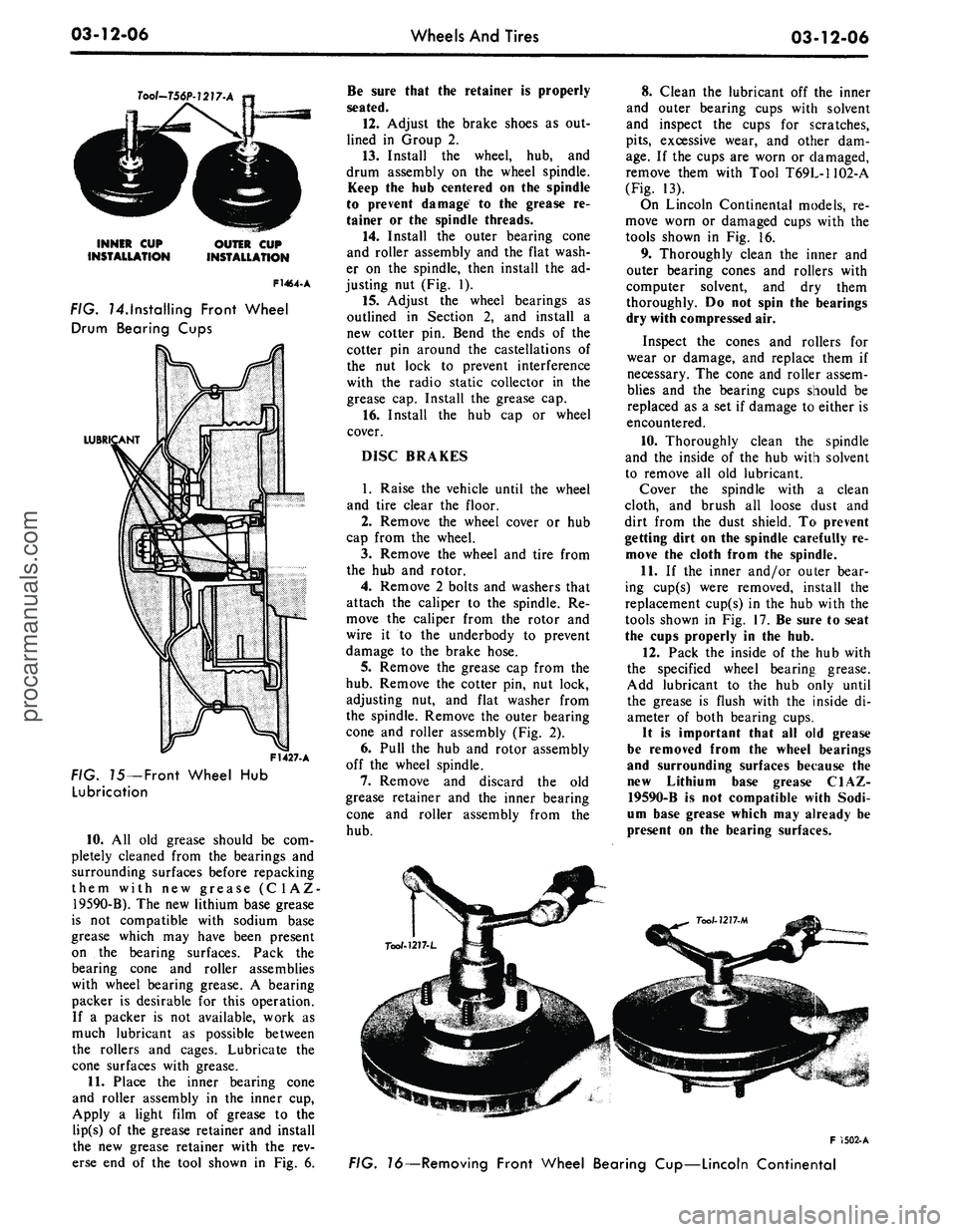
Tool-T56P-1217-A
INNER CUP
INSTALLATION
OUTER CUP
INSTALLATION
F1464-A
FIG. ^.Installing Front Wheel
Drum Bearing Cups
LUBR
F1427. A
FIG. 75—Front Wheel Hub
Lubrication
10.
All old grease should be com-
pletely cleaned from the bearings and
surrounding surfaces before repacking
them with new grease (C1AZ-
19590-B). The new lithium base grease
is not compatible with sodium base
grease which may have been present
on the bearing surfaces. Pack the
bearing cone and roller assemblies
with wheel bearing grease. A bearing
packer is desirable for this operation.
If a packer is not available, work as
much lubricant as possible between
the rollers and cages. Lubricate the
cone surfaces with grease.
11.
Place the inner bearing cone
and roller assembly in the inner cup,
Apply a light film of grease to the
lip(s) of the grease retainer and install
the new grease retainer with the rev-
erse end of the tool shown in Fig. 6.
Be sure that the retainer is properly
seated.
12.
Adjust the brake shoes as out-
lined in Group 2.
13.
Install the wheel, hub, and
drum assembly on the wheel spindle.
Keep the hub centered on the spindle
to prevent damage to the grease re-
tainer or the spindle threads.
14.
Install the outer bearing cone
and roller assembly and the flat wash-
er on the spindle, then install the ad-
justing nut (Fig. 1).
15.
Adjust the wheel bearings as
outlined in Section 2, and install a
new cotter pin. Bend the ends of the
cotter pin around the castellations of
the nut lock to prevent interference
with the radio static collector in the
grease cap. Install the grease cap.
16.
Install the hub cap or wheel
cover.
DISC BRAKES
1.
Raise the vehicle until the wheel
and tire clear the floor.
2.
Remove the wheel cover or hub
cap from the wheel.
3.
Remove the wheel and tire from
the hub and rotor.
4.
Remove 2 bolts and washers that
attach the caliper to the spindle. Re-
move the caliper from the rotor and
wire it to the underbody to prevent
damage to the brake hose.
5.
Remove the grease cap from the
hub.
Remove the cotter pin, nut lock,
adjusting nut, and flat washer from
the spindle. Remove the outer bearing
cone and roller assembly (Fig. 2).
6. Pull the hub and rotor assembly
off the wheel spindle.
7.
Remove and discard the old
grease retainer and the inner bearing
cone and roller assembly from the
hub.
8. Clean the lubricant off the inner
and outer bearing cups with solvent
and inspect the cups for scratches,
pits,
excessive wear, and other dam-
age.
If the cups are worn or damaged,
remove them with Tool T69L-1102-A
(Fig. 13).
On Lincoln Continental models, re-
move worn or damaged cups with the
tools shown in Fig. 16.
9. Thoroughly clean the inner and
outer bearing cones and rollers with
computer solvent, and dry them
thoroughly. Do not spin the bearings
dry with compressed air.
Inspect the cones and rollers for
wear or damage, and replace them if
necessary. The cone and roller assem-
blies and the bearing cups should be
replaced as a set if damage to either is
encountered.
10.
Thoroughly clean the spindle
and the inside of the hub with solvent
to remove all old lubricant.
Cover the spindle with a clean
cloth, and brush all loose dust and
dirt from the dust shield. To prevent
getting dirt on the spindle carefully re-
move the cloth from the spindle.
11.
If the inner and/or outer bear-
ing cup(s) were removed, install the
replacement cup(s) in the hub with the
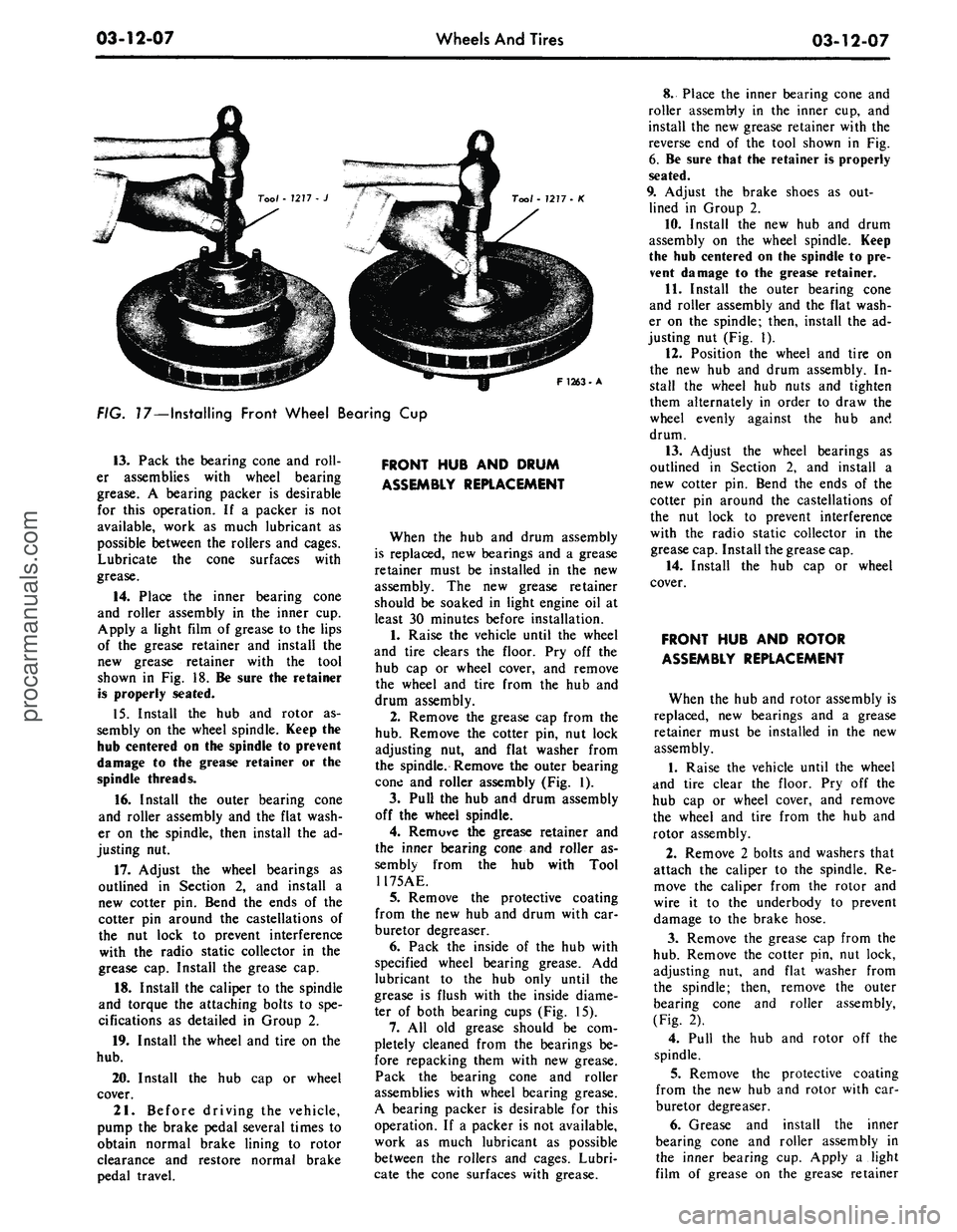
tools shown in Fig. 17. Be sure to seat
the cups properly in the hub.
12.
Pack the inside of the hub with
the specified wheel bearing grease.
Add lubricant to the hub only until
the grease is flush with the inside di-
ameter of both bearing cups.
It is important that all old grease
be removed from the wheel bearings
and surrounding surfaces because the
new Lithium base grease C1AZ-
19590-B is not compatible with Sodi-
um base grease which may already be
present on the bearing surfaces.
F 1502-A
FIG. 16—Removing Front Wheel Bearing Cup—Lincoln Continentalprocarmanuals.com
Page 178 of 413
03-12-07
Wheels And Tires
03-12-07
Tool - 7277- K
F 1263-A
FIG. 17—Installing Front Wheel Bearing Cup
13.
Pack the bearing cone and roll-
er assemblies with wheel bearing
grease. A bearing packer is desirable
for this operation. If a packer is not
available, work as much lubricant as
possible between the rollers and cages.
Lubricate the cone surfaces with
grease.
14.
Place the inner bearing cone
and roller assembly in the inner cup.
Apply a light film of grease to the lips
of the grease retainer and install the
new grease retainer with the tool
shown in Fig. 18. Be sure the retainer
is properly seated.
15.
Install the hub and rotor as-
sembly on the wheel spindle. Keep the
hub centered on the spindle to prevent
damage to the grease retainer or the
spindle threads.
16.
Install the outer bearing cone
and roller assembly and the flat wash-
er on the spindle, then install the ad-
justing nut.
17.
Adjust the wheel bearings as
outlined in Section 2, and install a
new cotter pin. Bend the ends of the
cotter pin around the castellations of
the nut lock to prevent interference
with the radio static collector in the
grease cap. Install the grease cap.
18.
Install the caliper to the spindle
and torque the attaching bolts to spe-
cifications as detailed in Group 2.
19.
Install the wheel and tire on the
hub.
20.
Install the hub cap or wheel
cover.
21.
Before driving the vehicle,
pump the brake pedal several times to
obtain normal brake lining to rotor
clearance and restore normal brake
pedal travel.
FRONT HUB AND DRUM
ASSEMBLY REPLACEMENT
When the hub and drum assembly
is replaced, new bearings and a grease
retainer must be installed in the new
assembly. The new grease retainer
should be soaked in light engine oil at
least 30 minutes before installation.
1.
Raise the vehicle until the wheel
and tire clears the floor. Pry off the
hub cap or wheel cover, and remove
the wheel and tire from the hub and
drum assembly.
2.
Remove the grease cap from the
hub.
Remove the cotter pin, nut lock
adjusting nut, and flat washer from
the spindle. Remove the outer bearing
cone and roller assembly (Fig. 1).
3.
Pull the hub and drum assembly
off the wheel spindle.
4.
Remuve the grease retainer and
the inner bearing cone and roller as-
sembly from the hub with Tool
1175AE.
5.
Remove the protective coating
from the new hub and drum with car-
buretor degreaser.
6. Pack the inside of the hub with
specified wheel bearing grease. Add
lubricant to the hub only until the
grease is flush with the inside diame-
ter of both bearing cups (Fig. 15).
7.
All old grease should be com-
pletely cleaned from the bearings be-
fore repacking them with new grease.
Pack the bearing cone and roller
assemblies with wheel bearing grease.
A bearing packer is desirable for this
operation. If a packer is not available,
work as much lubricant as possible
between the rollers and cages. Lubri-
cate the cone surfaces with grease.
8. Place the inner bearing cone and
roller assembly in the inner cup, and
install the new grease retainer with the
reverse end of the tool shown in Fig.
6. Be sure that the retainer is properly
seated.
9. Adjust the brake shoes as out-
lined in Group 2.
10.
Install the new hub and drum
assembly on the wheel spindle. Keep
the hub centered on the spindle to pre-
vent damage to the grease retainer.
11.
Install the outer bearing cone
and roller assembly and the flat wash-
er on the spindle; then, install the ad-
justing nut (Fig. 1).
12.
Position the wheel and tire on
the new hub and drum assembly. In-
stall the wheel hub nuts and tighten
them alternately in order to draw the
wheel evenly against the hub and
drum.
13.
Adjust the wheel bearings as
outlined in Section 2, and install a
new cotter pin. Bend the ends of the
cotter pin around the castellations of
the nut lock to prevent interference
with the radio static collector in the
grease cap. Install the grease cap.
14.
Install the hub cap or wheel
cover.
FRONT HUB AND ROTOR
ASSEMBLY REPLACEMENT
When the hub and rotor assembly is
replaced, new bearings and a grease
retainer must be installed in the new
assembly.
1.
Raise the vehicle until the wheel
and tire clear the floor. Pry off the
hub cap or wheel cover, and remove
the wheel and tire from the hub and
rotor assembly.
2.
Remove 2 bolts and washers that
attach the caliper to the spindle. Re-
move the caliper from the rotor and
wire it to the underbody to prevent
damage to the brake hose.
3.
Remove the grease cap from the
hub.
Remove the cotter pin, nut lock,
adjusting nut, and flat washer from
the spindle; then, remove the outer
bearing cone and roller assembly,
(Fig. 2).
4.
Pull the hub and rotor off the
spindle.
5.
Remove the protective coating
from the new hub and rotor with car-
buretor degreaser.
6. Grease and install the inner
bearing cone and roller assembly in
the inner bearing cup. Apply a light
film of grease on the grease retainerprocarmanuals.com
Page 179 of 413
03-12-08
Wheels And Tires
03-12-08
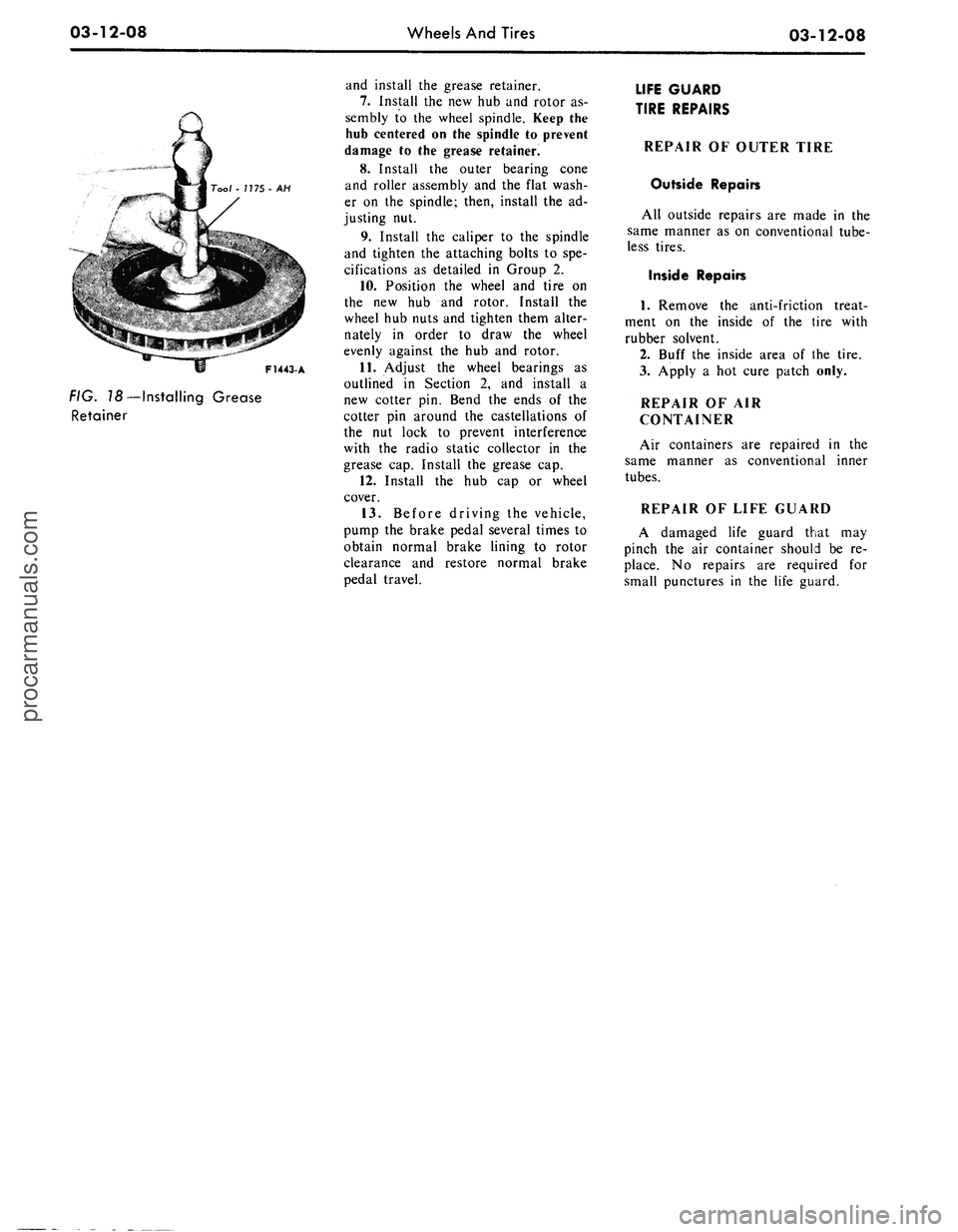
Tool -
7
775 - AH
F1443-A
FIG.
18
— Installing Grease
Retainer
and install the grease retainer.
7.
Install the new hub and rotor as-
sembly to the wheel spindle. Keep the
hub centered on the spindle to prevent
damage to the grease retainer.
8. Install the outer bearing cone
and roller assembly and the flat wash-
er on the spindle; then, install the ad-
justing nut.
9. Install the caliper to the spindle
and tighten the attaching bolts to spe-
cifications as detailed in Group 2.
10.
Position the wheel and tire on
the new hub and rotor. Install the
wheel hub nuts and tighten them alter-
nately in order to draw the wheel
evenly against the hub and rotor.
11.
Adjust the wheel bearings as
outlined in Section 2, and install a
new cotter pin. Bend the ends of the
cotter pin around the castellations of
the nut lock to prevent interference
with the radio static collector in the
grease cap. Install the grease cap.
12.
Install the hub cap or wheel
cover.
13.
Before driving the vehicle,
pump the brake pedal several times to
obtain normal brake lining to rotor
clearance and restore normal brake
pedal travel.
LIFE GUARD
TIRE REPAIRS
REPAIR OF OUTER TIRE
Outside Repairs
All outside repairs are made in the
same manner as on conventional tube-
less tires.
Inside Repairs
1.
Remove the anti-friction treat-
ment on the inside of the tire with
rubber solvent.
2.
Buff the inside area of the tire.
3.
Apply a hot cure patch only.
REPAIR OF AIR
CONTAINER
Air containers are repaired in the
same manner as conventional inner
tubes.
REPAIR OF LIFE GUARD
A damaged life guard that may
pinch the air container should be re-
place. No repairs are required for
small punctures in the life guard.procarmanuals.com
Page 224 of 413
04-03-04
Rear Axles — Integral Carrier Type
04-03-04
1.
Remove the wheel cover, wheel
and tire from the brake drum.
2.
Remove the Tinnerman nuts that
secure the brake drum to the axle
housing flange, and then remove the
drum from the flange.
3.
Working through the hole pro-
vided in each axle shaft flange, re-
move the nuts that secure the wheel
bearing retainer plate. Then pull the
axle shaft assembly out of the axle
housing (Fig. 2). The brake backing
plate must, not be dislodged. Install
one nut to hold the plate in place after
the axle shaft is removed.
4.
If the rear wheel bearing is to be
replaced, loosen the inner retainer
ring by nicking it deeply with a cold
chisel in several places (Fig. 3). It will
then slide off easily.
5.
Remove the bearing from the
axle shaft with the tool shown in Fig.
4 or 5. If the push-puller operation
shown in Fig. 5 is used, be sure that
the puller arms contact the flat sur-
face of the axle shaft flange rather
than the bolt heads. Also with this
method, be careful not to damage or
burr the oil seal journal as the bearing
breaks loose.
6. Whenever a rear axle shaft is re-
placed the oil seal must be replaced.
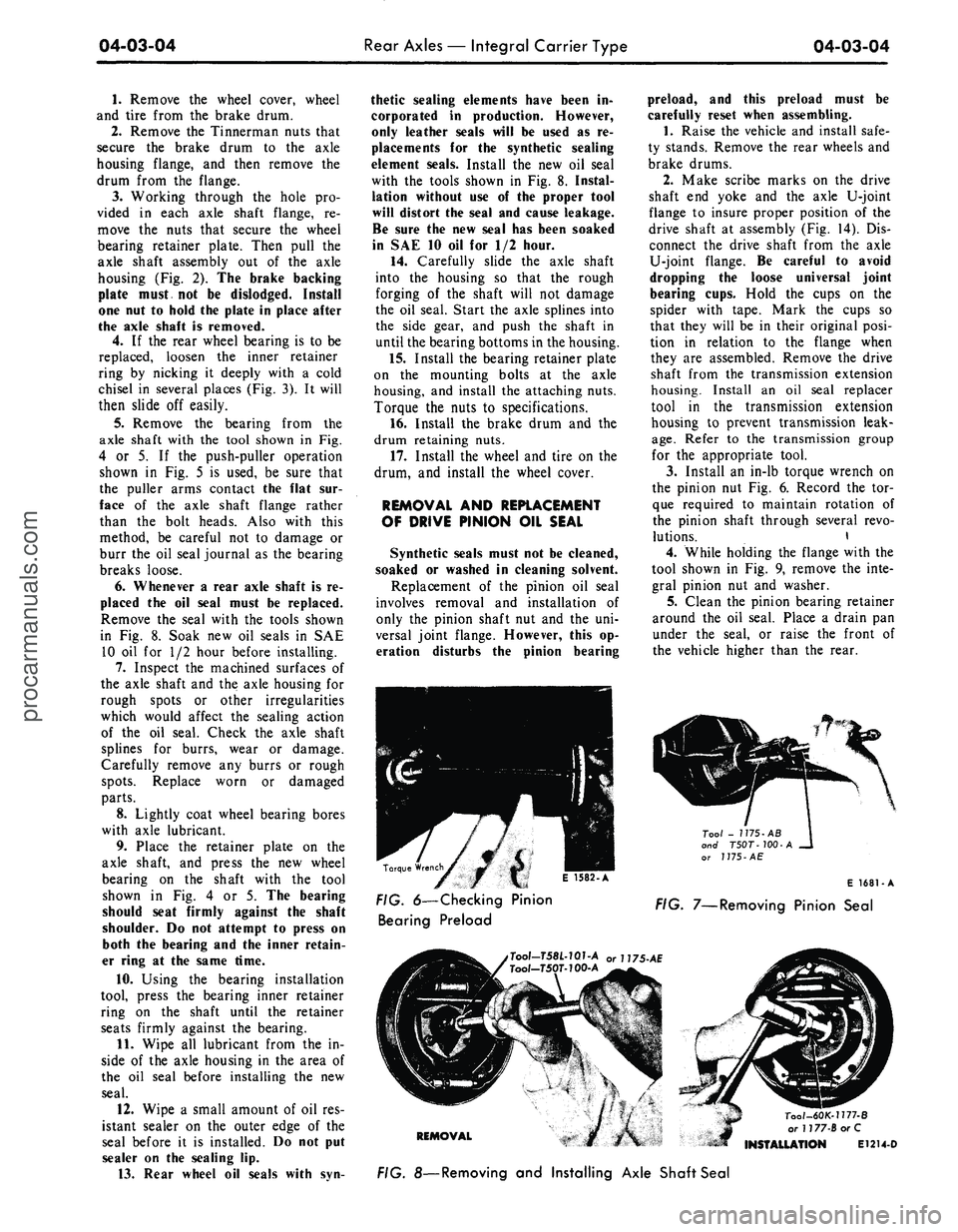
Remove the seal with the tools shown
in Fig. 8. Soak new oil seals in SAE
10 oil for 1/2 hour before installing.
7.
Inspect the machined surfaces of
the axle shaft and the axle housing for
rough spots or other irregularities
which would affect the sealing action
of the oil seal. Check the axle shaft
splines for burrs, wear or damage.
Carefully remove any burrs or rough
spots.
Replace worn or damaged
parts.
8. Lightly coat wheel bearing bores
with axle lubricant.
9. Place the retainer plate on the
axle shaft, and press the new wheel
bearing on the shaft with the tool
shown in Fig. 4 or 5. The bearing
should seat firmly against the shaft
shoulder. Do not attempt to press on
both the bearing and the inner retain-
er ring at the same time.
10.
Using the bearing installation
tool, press the bearing inner retainer
ring on the shaft until the retainer
seats firmly against the bearing.
11.
Wipe all lubricant from the in-
side of the axle housing in the area of
the oil seal before installing the new
seal.
12.
Wipe a small amount of oil res-
istant sealer on the outer edge of the
seal before it is installed. Do not put
sealer on the sealing lip.
13.
Rear wheel oil seals with syn-
thetic sealing elements have been in-
corporated in production. However,
only leather seals will be used as re-
placements for the synthetic sealing
element seals. Install the new oil seal
with the tools shown in Fig. 8. Instal-
lation without use of the proper tool
will distort the seal and cause leakage.
Be sure the new seal has been soaked
in SAE 10 oil for 1/2 hour.
14.
Carefully slide the axle shaft
into the housing so that the rough
forging of the shaft will not damage
the oil seal. Start the axle splines into
the side gear, and push the shaft in
until the bearing bottoms in the housing.
15.
Install the bearing retainer plate
on the mounting bolts at the axle
housing, and install the attaching nuts.
Torque the nuts to specifications.
16.
Install the brake drum and the
drum retaining nuts.
17.
Install the wheel and tire on the
drum, and install the wheel cover.
REMOVAL AND REPLACEMENT
OF DRIVE PINION OIL SEAL
Synthetic seals must not be cleaned,
soaked or washed in cleaning solvent.
Replacement of the pinion oil seal
involves removal and installation of
only the pinion shaft nut and the uni-
versal joint flange. However, this op-
eration disturbs the pinion bearing
preload, and this preload must be
carefully reset when assembling.
1.
Raise the vehicle and install safe-
ty stands. Remove the rear wheels and
brake drums.
2.
Make scribe marks on the drive
shaft end yoke and the axle U-joint
flange to insure proper position of the
drive shaft at assembly (Fig. 14). Dis-
connect the drive shaft from the axle
U-joint flange. Be careful to avoid
dropping the loose universal joint
bearing cups. Hold the cups on the
spider with tape. Mark the cups so
that they will be in their original posi-
tion in relation to the flange when
they are assembled. Remove the drive
shaft from the transmission extension
housing. Install an oil seal replacer
tool in the transmission extension
housing to prevent transmission leak-
age.
Refer to the transmission group
for the appropriate tool.
3.
Install an in-lb torque wrench on
the pinion nut Fig. 6. Record the tor-
que required to maintain rotation of
the pinion shaft through several revo-
lutions. \
4.
While holding the flange with the
tool shown in Fig. 9, remove the inte-
gral pinion nut and washer.
5.
Clean the pinion bearing retainer
around the oil seal. Place a drain pan
under the seal, or raise the front of
the vehicle higher than the rear.
KJ
E
I582-A
Tool - 1175-AB
and T50T-100-A
^___ or
J
775-
AE
Torque Wrench
^ mm i e
icot
A
E 1681-A
FIG. 6—Checking Pinion FiG 7_Removing
pjnjon
Sea,
Bearing Preload
,Tool-T58L-101-A or U75-AE
Tool-T50T-100-A
REMOVAL
Tool-60K-1177-B
or 1177-BorC
INSTALLATION E1214-D
FIG. 8—Removing and Installing Axle Shaft Sealprocarmanuals.com
Page 295 of 413
07-01-04
General Transmission Service
07-01-04
taching bolts to the proper torque. If
necessary, replace the gasket.
Check the fluid filler tube connec-
tion at the transmission case or pan.
If leakage is found here, install a new
O-ring or tighten the fitting to the
specified torque.
Check the fluid lines and fittings
between the transmission and the
cooler in the radiator tank for loose-
ness,
wear, or damage. If leakage can-
not be stopped by tightening a fitting,
replace the damaged parts.
Check the engine coolant in the ra-
diator. If transmission fluid is present
in the coolant, the cooler in the radia-
tor is probably leaking.
The cooler can be further checked
for leaks by disconnecting the lines
from the cooler fittings and applying
50-75 psi air pressure to the fittings.
Remove the radiator cap to relieve the
pressure build at the exterior of the oil
cooler tank. If the cooler is leaking
and will not hold this pressure the
cooler must be replaced. Cooler re-
placement is described in the Cooling
System Section of Group 11.
If leakage is found at either the
downshift control lever shaft or the
manual lever shaft, replace either or
both seals.
Inspect the pipe plug on the left
side of the transmission case at the
front. If the plug shows leakage, tor-
que the plug to specifications. If tight-
ening does not stop the leaks, replace
the plug. On a C6 transmission, a TV
pressure plug is also provided on the
right rear side of the case.
When converter drain plugs leak,
remove drain plugs with a six-point
wrench. Coat the threads with FoMo-
Co Perfect Seal Sealing Compound or
its equivalent, and install the plugs.
Torque the drain plugs to specifica-
tion. Fluid leakage from the converter
housing may be caused by engine oil
leaking past the rear main bearing or
from oil gallery plugs, or power steer-
ing oil leakage from steering system.
Be sure to determine the exact cause
of the leak before repair procedures
are started.
Oil-soluble aniline or fluorescent dyes
premixed at the rate of 1/2 teaspoon
of dye powder to 1/2 pint of transmis-
sion fluid have proved helpful in locat-
ing the source of the fluid leakage.
Such dyes may be used to determine
whether an engine oil or transmission
fluid leak is present or if the fluid in
the oil cooler leaks into the engine
coolant system. A black light, how-
ever, must be used with the fluorescent
dye solution.
DISHED OR
FLAT WASHER
" O.D.,
a" STEEL PLATE
5/8"X \W,
DRILL TO SUIT
HEX. HEAD SCREW
3/8"-24 X Vl
HEX. NUT W—
24
WELD
TOGETHER
WING
NUT
>/2"_13
THREAD
CHAIN,
10"
LONG
RUBBER PLUG
1
Vi" DIA. X 2"
LONG Vl"
HOLE THRU
APPROXIMATELY
40 DUROMETER
FLAT WASHER
Vs" O.D.
PLUG
VALVE
STANDARD BOLT
W-13
X 4Vl"
LONG SQUARE
THREAD
END
REMOVE HEAD
AND WELD
TO
WASHER
STANDARD 1/8" FITTING-87971-S FOR
RETAPPED DRAIN PLUG THREADS-USE
1/4" OVERSIZE FITTING-87973-S
D 1067-B
WELD TOGETHER
SECURELY—MUST
NOT LEAK
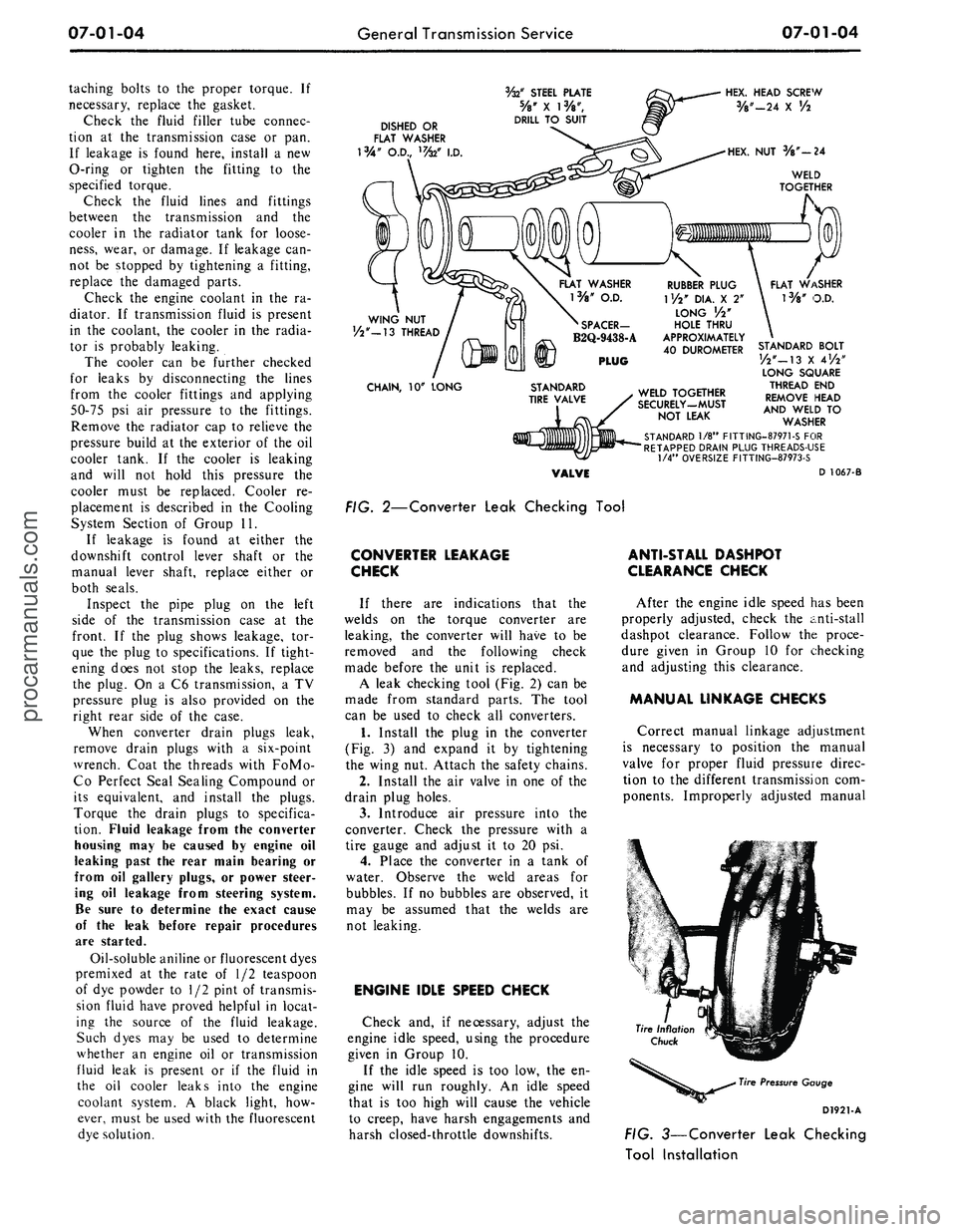
FIG. 2—Converter Leak Checking Tool
CONVERTER LEAKAGE
CHECK
If there are indications that the
welds on the torque converter are
leaking, the converter will have to be
removed and the following check
made before the unit is replaced.
A leak checking tool (Fig. 2) can be
made from standard parts. The tool
can be used to check all converters.
1.
Install the plug in the converter
(Fig. 3) and expand it by tightening
the wing nut. Attach the safety chains.
2.
Install the air valve in one of the
drain plug holes.
3.
Introduce air pressure into the
converter. Check the pressure with a
tire gauge and adjust it to 20 psi.
4.
Place the converter in a tank of
water. Observe the weld areas for
bubbles. If no bubbles are observed, it
may be assumed that the welds are
not leaking.
ENGINE IDLE SPEED CHECK
Check and, if necessary, adjust the
engine idle speed, using the procedure
given in Group 10.
If the idle speed is too low, the en-
gine will run roughly. An idle speed
that is too high will cause the vehicle
to creep, have harsh engagements and
harsh closed-throttle downshifts.
ANTI-STALL DASHPOT
CLEARANCE CHECK
After the engine idle speed has been
properly adjusted, check the anti-stall
dashpot clearance. Follow the proce-
dure given in Group 10 for checking
and adjusting this clearance.
MANUAL LINKAGE CHECKS
Correct manual linkage adjustment
is necessary to position the manual
valve for proper fluid pressure direc-
tion to the different transmission com-
ponents. Improperly adjusted manual
Tire Pressure Gauge
D1921-A
FIG. 3—Converter Leak Checking
Tool Installationprocarmanuals.com