power steering fluid FORD MUSTANG 1969 Volume One Chassis
[x] Cancel search | Manufacturer: FORD, Model Year: 1969, Model line: MUSTANG, Model: FORD MUSTANG 1969Pages: 413, PDF Size: 75.81 MB
Page 165 of 413
03-10-04
Ford-Thompson Power Steering Pump
03-10-04
OUTLET FITTING
GASKET
Wood Block
0-RING SEAL
G1345-
-500-
A
G1603- A
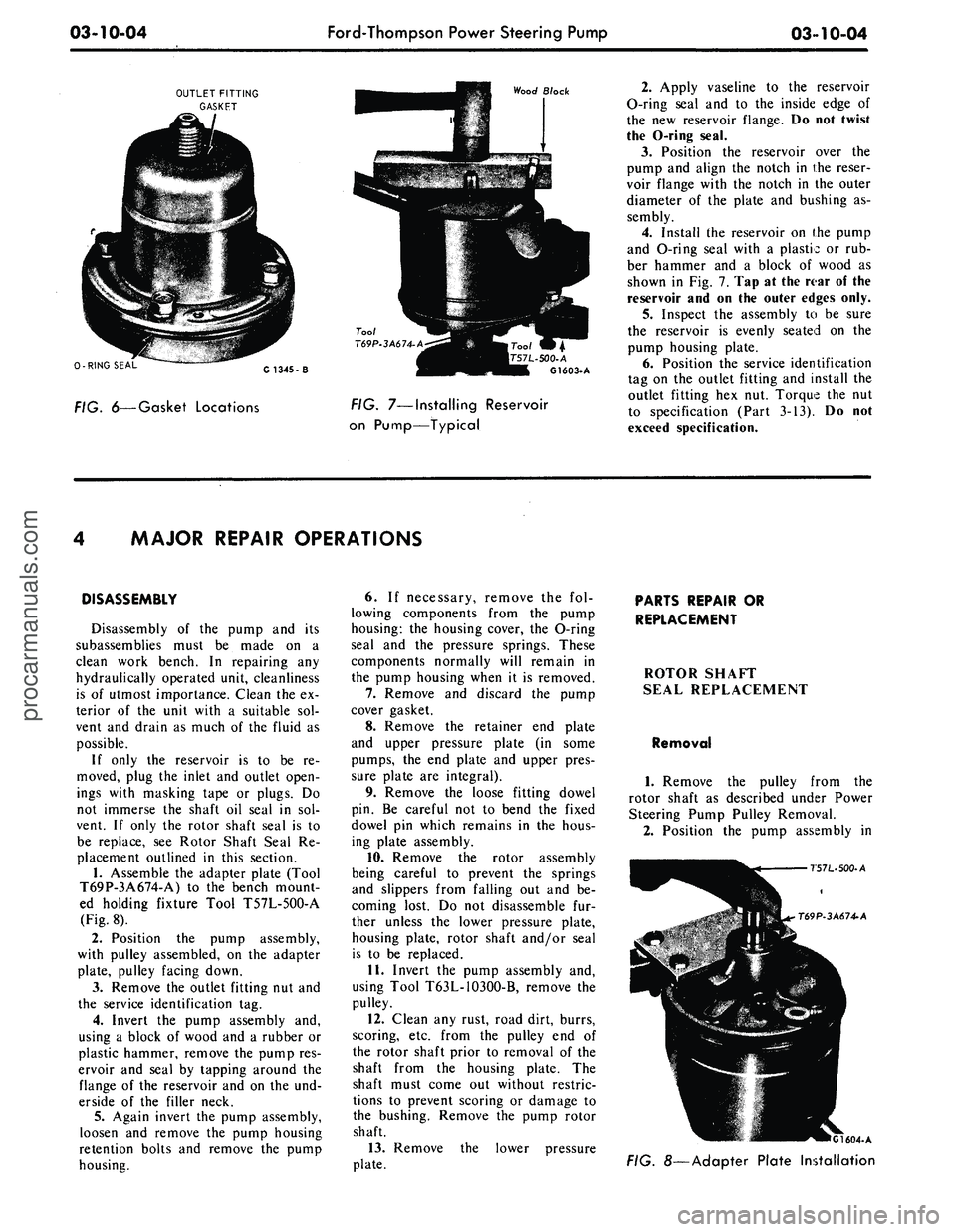
FIG. 6—Gasket Locations
FIG.
7—Installing
Reservoir
on Pump—Typical
2.
Apply vaseline to the reservoir
O-ring seal and to the inside edge of
the new reservoir flange. Do not twist
the O-ring seal.
3.
Position the reservoir over the
pump and align the notch in the reser-
voir flange with the notch in the outer
diameter of the plate and bushing as-
sembly.
4.
Install the reservoir on the pump
and O-ring seal with a plastic or rub-
ber hammer and a block of wood as
shown in Fig. 7. Tap at the rear of the
reservoir and on the outer edges only.
5.
Inspect the assembly to be sure
the reservoir is evenly seated on the
pump housing plate.
6. Position the service identification
tag on the outlet fitting and install the
outlet fitting hex nut. Torque the nut
to specification (Part 3-13). Do not
exceed specification.
MAJOR REPAIR OPERATIONS
DISASSEMBLY
Disassembly of the pump and its
subassemblies must be made on a
clean work bench. In repairing any
hydraulically operated unit, cleanliness
is of utmost importance. Clean the ex-
terior of the unit with a suitable sol-
vent and drain as much of the fluid as
possible.
If only the reservoir is to be re-
moved, plug the inlet and outlet open-
ings with masking tape or plugs. Do
not immerse the shaft oil seal in sol-
vent. If only the rotor shaft seal is to
be replace, see Rotor Shaft Seal Re-
placement outlined in this section.
1.
Assemble the adapter plate (Tool
T69P-3A674-A) to the bench mount-
ed holding fixture Tool T57L-5OO-A
(Fig. 8).
2.
Position the pump assembly,
with pulley assembled, on the adapter
plate, pulley facing down.
3.
Remove the outlet fitting nut and
the service identification tag.
4.
Invert the pump assembly and,
using a block of wood and a rubber or
plastic hammer, remove the pump res-
ervoir and seal by tapping around the
flange of the reservoir and on the und-
erside of the filler neck.
5.
Again invert the pump assembly,
loosen and remove the pump housing
retention bolts and remove the pump
housing.
6. If necessary, remove the fol-
lowing components from the pump
housing: the housing cover, the O-ring
seal and the pressure springs. These
components normally will remain in
the pump housing when it is removed.
7.
Remove and discard the pump
cover gasket.
8. Remove the retainer end plate
and upper pressure plate (in some
pumps, the end plate and upper pres-
sure plate are integral).
9. Remove the loose fitting dowel
pin. Be careful not to bend the fixed
dowel pin which remains in the hous-
ing plate assembly.
10.
Remove the rotor assembly
being careful to prevent the springs
and slippers from falling out and be-
coming lost. Do not disassemble fur-
ther unless the lower pressure plate,
housing plate, rotor shaft and/or seal
is to be replaced.
11.
Invert the pump assembly and,
using Tool T63L-1O3OO-B, remove the
pulley.
12.
Clean any rust, road dirt, burrs,
scoring, etc. from the pulley end of
the rotor shaft prior to removal of the
shaft from the housing plate. The
shaft must come out without restric-
tions to prevent scoring or damage to
the bushing. Remove the pump rotor
shaft.
13.
Remove the lower pressure
plate.
PARTS REPAIR OR
REPLACEMENT
ROTOR SHAFT
SEAL REPLACEMENT
Removal
1.
Remove the pulley from the
rotor shaft as described under Power
Steering Pump Pulley Removal.
2.
Position the pump assembly in
T57L-500-A
T69P-3A674-A
•
G1604-A
FIG. 8—Adapter Plate Installationprocarmanuals.com
Page 169 of 413
03-11-01
Eaton Power Steering Pump
03-11-01
PART 3-11 Eaton Power Steering Pump
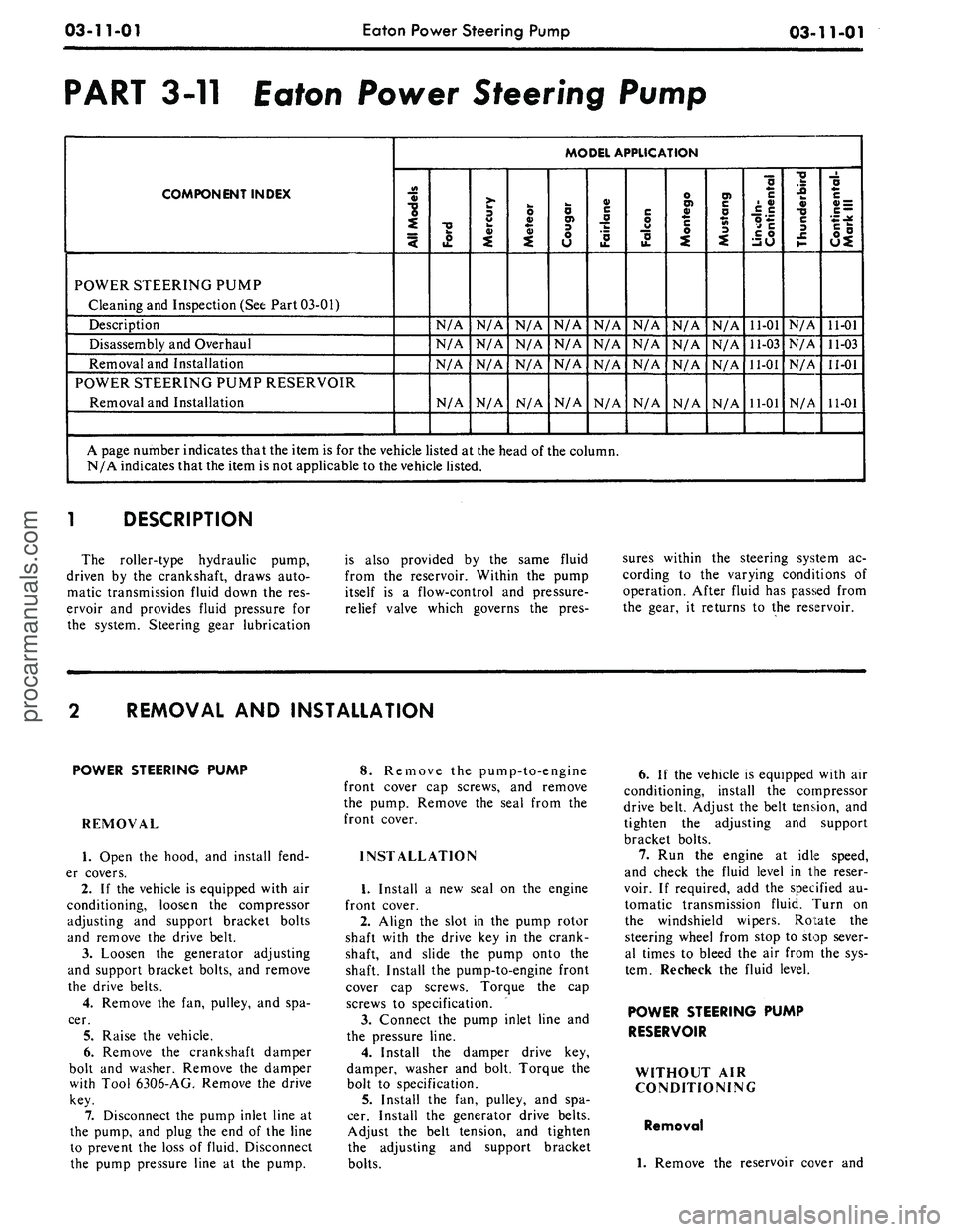
COMPONENT INDEX
MODEL APPLICATION
3
§>
"o
4
POWER STEERING PUMP
Cleaning and Inspection (See Part 03-01)
Description
N/A
N/A
N/A
N/A
N/A
N/A
N/A
N/A
11-01
N/A
11-01
Disassembly and Overhaul
N/A
N/A
N/A
N/A
N/A
N/A
N/A
N/A
11-03
N/A
11-03
Removal and Installation
N/A
N/A
N/A
N/A
N/A
N/A
N/A
N/A
11-01
N/A
11-01
POWER STEERING PUMP RESERVOIR
Removal and Installation
N/A
N/A
N/A
N/A
N/A
N/A
N/A
N/A
11-01
N/A
11-01
A page number indicates that the item is for the vehicle listed at the head of the column.
N/A indicates that the item is not applicable to the vehicle listed.
l
DESCRIPTION
The roller-type hydraulic pump,
driven by the crankshaft, draws auto-
matic transmission fluid down the res-
ervoir and provides fluid pressure for
the system. Steering gear lubrication
is also provided by the same fluid
from the reservoir. Within the pump
itself is a flow-control and pressure-
relief valve which governs the pres-
sures within the steering system ac-
cording to the varying conditions of
operation. After fluid has passed from
the gear, it returns to the reservoir.
REMOVAL AND INSTALLATION
POWER STEERING PUMP
REMOVAL
1.
Open the hood, and install fend-
er covers.
2.
If the vehicle is equipped with air
conditioning, loosen the compressor
adjusting and support bracket bolts
and remove the drive belt.
3.
Loosen the generator adjusting
and support bracket bolts, and remove
the drive belts.
4.
Remove the fan, pulley, and spa-
cer.
5.
Raise the vehicle.
6. Remove the crankshaft damper
bolt and washer. Remove the damper
with Tool 6306-AG. Remove the drive
key.
7.
Disconnect the pump inlet line at
the pump, and plug the end of the line
to prevent the loss of fluid. Disconnect
the pump pressure line at the pump.
8. Remove the pump-to-engine
front cover cap screws, and remove
the pump. Remove the seal from the
front cover.
INSTALLATION
1.
Install a new seal on the engine
front cover.
2.
Align the slot in the pump rotor
shaft with the drive key in the crank-
shaft, and slide the pump onto the
shaft. Install the pump-to-engine front
cover cap screws. Torque the cap
screws to specification.
3.
Connect the pump inlet line and
the pressure line.
4.
Install the damper drive key,
damper, washer and bolt. Torque the
bolt to specification.
5.
Install the fan, pulley, and spa-
cer. Install the generator drive belts.
Adjust the belt tension, and tighten
the adjusting and support bracket
bolts.
6. If the vehicle is equipped with air
conditioning, install the compressor
drive belt. Adjust the belt tension, and
tighten the adjusting and support
bracket bolts.
7.
Run the engine at idle speed,
and check the fluid level in the reser-
voir. If required, add the specified au-
tomatic transmission fluid. Turn on
the windshield wipers. Rotate the
steering wheel from stop to stop sever-
al times to bleed the air from the sys-
tem. Recheck the fluid level.
POWER STEERING PUMP
RESERVOIR
WITHOUT AIR
CONDITIONING
Removal
1.
Remove the reservoir cover andprocarmanuals.com
Page 170 of 413
03-11-02
Eaton Power Steering Pump
03-11-02
gasket. Withdraw the fluid with a suc-
tion gun.
2.
Remove the reservoir bracket-
to-cylinder block upper cap screw and
the lower cap screw and spacer.
3.
Disconnect the reservoir infet line
and the outlet line at the reservoir,
and remove the reservoir.
Installation
1.
Connect the reservoir-to-pump
line (outlet line) at the reservoir, but
do not tighten the clamp.
2.
Attach the reservoir and bracket
to the cylinder block with the upper
cap screw and the lower cap screw
and spacer. Tighten the cap screws.
3.
Tighten the outlet line clamp at
the reservoir. Connect the reservoir
inlet line to the reservoir.
4.
Fill the reservoir with the speci-
fied automatic transmission fluid. Run
the engine, and bleed the system by
cycling the steering gear with the
windshield wipers turned on. Check
for leaks, and recheck the fluid level.
WITH AIR CONDITIONING
Removal
1. Raise the front of the vehicle.
Remove the reservoir-to-pump line
(outlet line) clamp at the reservoir,
but do not disconnect the line at this
time.
2.
Disconnect the reservoir inlet line
at the reservoir.
3.
Remove the reservoir bracket to
the cylinder block upper cap screw.
Support the reservoir and remove the
lower cap screw and spacer.
4.
With a drain pan under the res-
ervoir, disconnect the outlet line hose
from the reservoir tube and allow the
fluid to drain.
5.
Remove the reservoir cover re-
taining nut and the cover. Position the
cover and the reservoir out of the way
and allow them to rest in the engine
compartment.
6. Lower the front of the vehicle.
Remove the fan shroud.
7.
Remove the reservoir and the
cover by manipulating them through
the opening between the radiator and
the compressor drive belt.
Installation
1.
Position the reservoir in the en-
gine compartment. Loosely attach the
reservoir and bracket to the cylinder
block with the upper cap screw.
2.
Install the fan shroud, then raise
the front of the vehicle.
3.
Connect the reservoir-to-pump
line (outlet line) at the reservoir.
4.
Install the reservoir bracket-
to-cylinder block lower cap screw and
spacer. Tighten both the upper and
the lower cap screws.
5.
Connect the reservoir inlet line at
the reservoir. Install the clamps on
both lines. Lower the car, and install
the reservoir cover and attaching nut.
6. Fill the reservoir with the speci-
fied automatic transmission fluid. Run
the engine, and bleed the system by
cycling the steering gear with the
windshield wipers turned on. Check
for leaks, and recheck the fluid level.
3 MAJOR REPAIR OPERATIONS
INSULATOR (2)
WASHER (2)
MOUNTING BOLT (2)
COVER
BOLT (7)
DOWEL
PIN (2)
ROTOR
ROTOR
SHAFT
COVER
SEAL
PLUG
O RING
VALVE
ASSEMBLY
VALVE
SPRING
INSULATOR
HOUSING
CAM RING
PRESSURE
PLATE
,
PUMP
i
HOUSING
SEAL
ROLL
PIN
INSULATOR
RETAINER
RING
TUBE SEAT
O RING
SCREW
(2)
G12O8-B
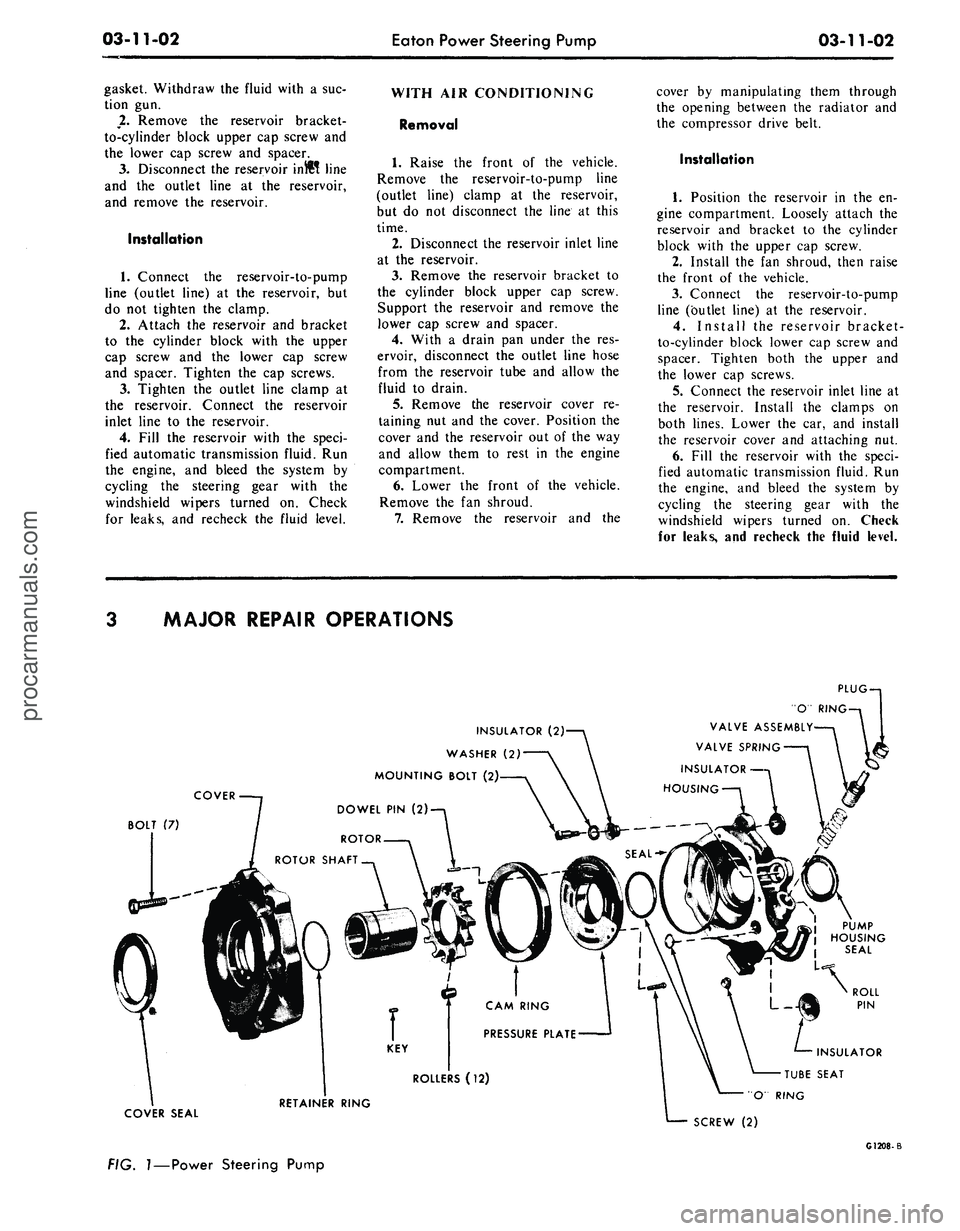
FIG.
1
— Power Steering Pumpprocarmanuals.com
Page 171 of 413
03-11-03
Eaton Power Steering Pump
03-11-03
POWER STEERING PUMP
DISASSEMBLY
A clean working area should be
used when overhauling the power
steering pump. Foreign matter picked
up on working parts may cause dam-
age or failure of the unit. Clean con-
tainers should be used for parts.
1.
Drain the fluid from the pump.
Remove the pump cover-to-housing
cap screws (Fig. 1). Place the pump
on the bench, cover side down. Lift
the housing from the cover.
2.
Remove the large and the small
O-rings from the pump cover. Remove
the O-ring from the pressure plate
hub.
3.
Remove the pressure plate-
to-cover screws, and remove the plate.
Lift the cam ring off the dowel pins.
4.
Remove the rollers. Lift the
rotor off the shaft, and remove the
drive key from the shaft. Remove the
dowel pins from the cover.
5.
Remove the rotor shaft from the
cover. Do not remove the snap ring
from the shaft unless it, or the shaft,
is damaged.
6. Pry the rotor shaft seals out of
the cover and the housing.
7. Do not disturb the control valve
unless diagnosis indicated a control
valve problem or foreign matter in the
valve. To remove the valve, drive the
roll pin out of the housing. Remove
the plug and O-ring, control valve,
and the spring. If the plug or valve is
stuck, tap the end of the housing on a
piece of wood or tap it with a soft-
faced hammer. Remove the O-ring
from the plug.
ASSEMBLY
Apply automatic transmission fluid
to all parts as they are assembled. Al-
ways use new seals and O-rings.
1.
Install the control valve spring in
the housing. Install the valve with the
small sensing hole in the end of the
valve toward the spring. Install a new
O-ring on the plug. The plug O-ring is
1/8 inch smaller in diameter than the
bypass O-ring. Make sure the proper
O-ring is used. Install the plug and a
new roll pin (Fig. 1).
2.
The rotor shaft oil seals are in-
stalled in the cover and the housing
with Tool 3583-J, which consists of a
driver and an adapter. The procedure
is as follows:
a. Support the cover on wood
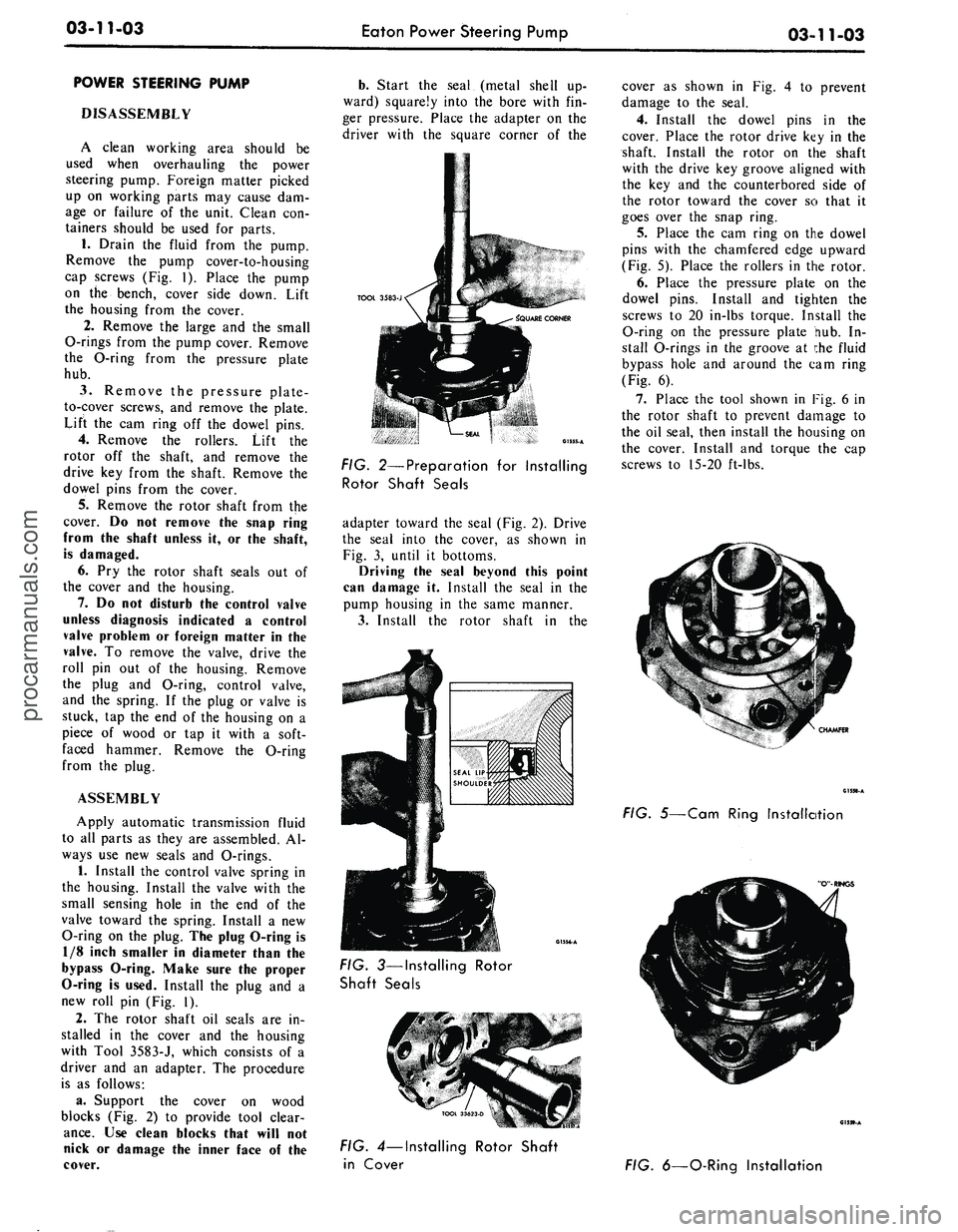
blocks (Fig. 2) to provide tool clear-
ance.
Use clean blocks that will not
nick or damage the inner face of the
cover.
b.
Start the seal (metal shell up-
ward) square!y into the bore with fin-
ger pressure. Place the adapter on the
driver with the square corner of the
FIG. 2—Preparation for Installing
Rotor Shaft Seals
adapter toward the seal (Fig. 2). Drive
the seal into the cover, as shown in
Fig. 3, until it bottoms.
Driving the seal beyond this point
can damage it. Install the seal in the
pump housing in the same manner.
3.
Install the rotor shaft in the
FIG. 3—Installing Rotor
Shaft Seals
cover as shown in Fig. 4 to prevent
damage to the seal.
4.
Install the dowel pins in the
cover. Place the rotor drive key in the
shaft. Install the rotor on the shaft
with the drive key groove aligned with
the key and the counterbored side of
the rotor toward the cover so that it
goes over the snap ring.
5.
Place the cam ring on the dowel
pins with the chamfered edge upward
(Fig. 5). Place the rollers in the rotor.
6. Place the pressure plate on the
dowel pins. Install and tighten the
screws to 20 in-lbs torque. Install the
O-ring on the pressure plate hub. In-
stall O-rings in the groove at the fluid
bypass hole and around the cam ring
(Fig. 6).
7.
Place the tool shown in Fig. 6 in
the rotor shaft to prevent damage to
the oil seal, then install the housing on
the cover. Install and torque the cap
screws to 15-20 ft-lbs.
FIG. 5—Cam Ring Installation
FIG. 4—Installing Rotor Shaft
in Cover
FIG. 6—O-Ring Installationprocarmanuals.com
Page 181 of 413
03-13-02
Specifications
03-13-02
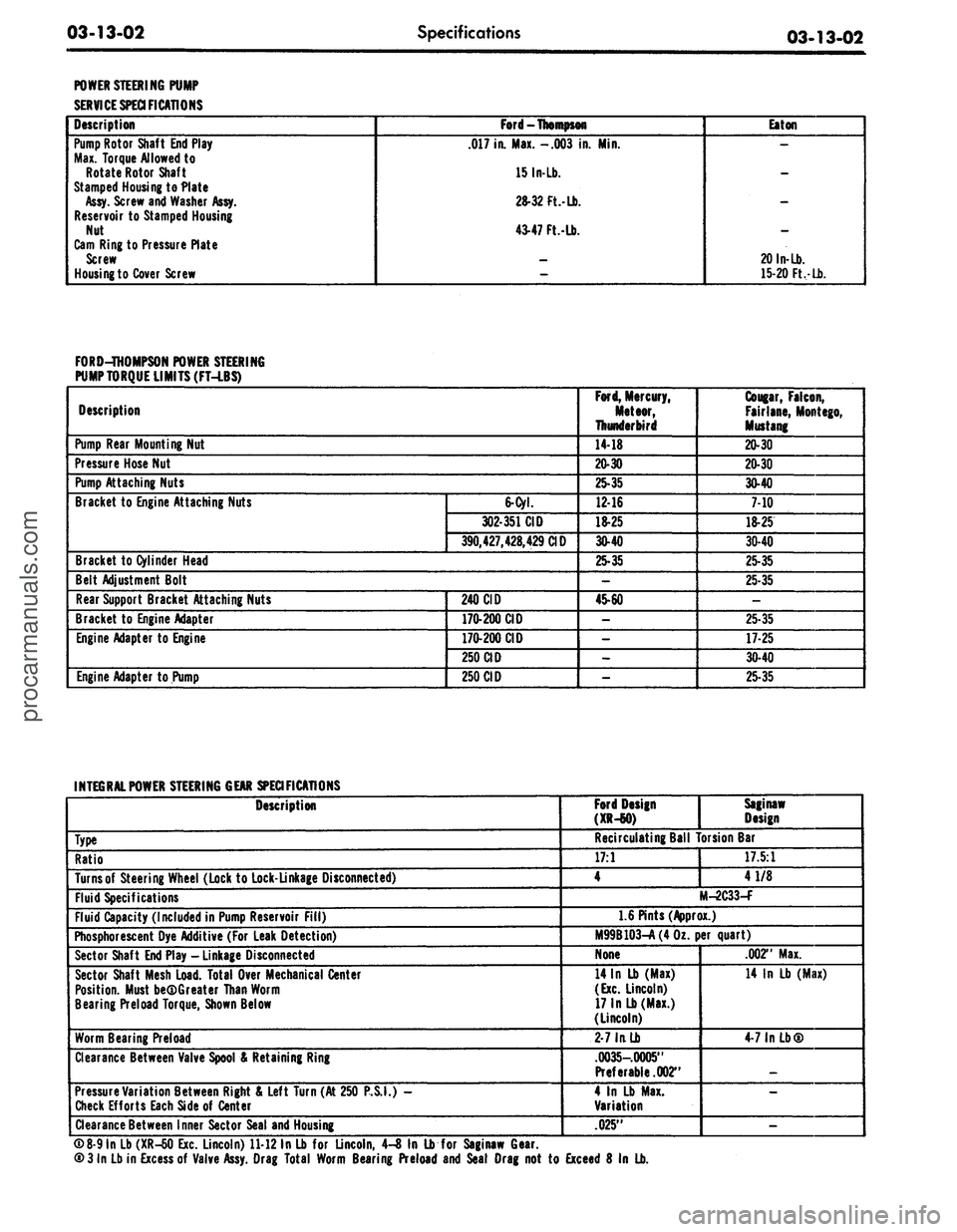
POWER STEERING PUMP
SERVICE
SPECIFICATIONS
Description
Pump Rotor Shaft End Play
Max. Torque Allowed
to
Rotate Rotor Shaft
Stamped Housing to Plate
Assy. Screw and Washer Assy.
Reservoir
to
Stamped Housing
Nut
Cam Ring to Pressure Plate
Screw
Housing to Cover Screw
Ford-Thompson
.017 in. Max.-.003 in. Min.
15 In-Lb.
28-32 Ft.-Lb.
43-47 Ft.-Lb.
_
-
Eaton
—
_
-
—
20 In-Lb.
15-20 Ft,-Lb.
FORD-THOMPSON POWER STEERING
PUMP
TORQUE
LIMITS (FT-LBS)
Description
Pump Rear Mounting Nut
Pressure Hose Nut
Pump Attaching Nuts
Bracket
to
Engine Attaching Nuts
6-Cyl.
302-351 CID
390,427,428,429 CID
Bracket
to
Cylinder Head
Belt Adjustment Bolt
Rear Support Bracket Attaching Nuts
Bracket
to
Engine Adapter
Engine Adapter
to
Engine
Engine Adapter
to
Pump
240 CID
170-200 CID
170-200 CID
250 CID
250 CID
Ford,
Mercury,
Meteor,
Thunderbird
14-18
20-30
25-35
1216
18-25
30-40
25-35
-
45-60
-
-
-
-
Cougar, Falcon,
Fairlane, Montego,
Mustang
20-30
20-30
30-40
7-10
18-25
30-40
25-35
25-35
-
25-35
17-25
30-40
25-35
INTEGRAL
POWER
STEERING GEAR SPECIFICATIONS
Description
Type
Ratio
Turns of Steering Wheel (Lock
to
Lock-Linkage Disconnected)
Fluid Specifications
Fluid Capacity (Included in Pump Reservoir Fill)
Phosphorescent Dye Additive (For Leak Detection)
Sector Shaft End Play -Linkage Disconnected
Sector Shaft Mesh Load. Total Over Mechanical Center
Position.
Must beCDGreater Than Worm
Bearing Preload Torque, Shown Below
Worm Bearing Preload
Clearance Between Valve Spool
&
Retaining Ring
Pressure Variation Between Right
&
Left Turn (At 250
P.S.I.)
-
Check Efforts Each Side
of
Center
Clearance Between Inner Sector Seal and Housing
Ford Design
(XR-«0)
Saginaw
Design
Recirculating Ball Torsion Bar
17:1
4
17.5:1
41/8
M-2C33-F
1.6 Pints (Approx.)
M99B103-A(4 0z. per quart)
None
14 In Lb (Max)
(Exc. Lincoln)
17
In
Lb (Max.)
(Lincoln)
2-7 la
U)
.0035-.0005"
Preferable .002"
4
In
Lb Max.
Variation
.025"
.002"
Max.
14
In
Lb (Max)
4-7 In Lb®
_
—
-
©8-9 In Lb (XR-50 Exc. Lincoln) 11-12 In Lb
for
Uncoln,
4-8 In
Lb
for
Saginaw Gear.
® 3 In Lb in Excess of Valve Assy. Drag Total Worm Bearing Preload and Seal Drag
not to
Exceed
8 In
Lb.procarmanuals.com
Page 295 of 413
07-01-04
General Transmission Service
07-01-04
taching bolts to the proper torque. If
necessary, replace the gasket.
Check the fluid filler tube connec-
tion at the transmission case or pan.
If leakage is found here, install a new
O-ring or tighten the fitting to the
specified torque.
Check the fluid lines and fittings
between the transmission and the
cooler in the radiator tank for loose-
ness,
wear, or damage. If leakage can-
not be stopped by tightening a fitting,
replace the damaged parts.
Check the engine coolant in the ra-
diator. If transmission fluid is present
in the coolant, the cooler in the radia-
tor is probably leaking.
The cooler can be further checked
for leaks by disconnecting the lines
from the cooler fittings and applying
50-75 psi air pressure to the fittings.
Remove the radiator cap to relieve the
pressure build at the exterior of the oil
cooler tank. If the cooler is leaking
and will not hold this pressure the
cooler must be replaced. Cooler re-
placement is described in the Cooling
System Section of Group 11.
If leakage is found at either the
downshift control lever shaft or the
manual lever shaft, replace either or
both seals.
Inspect the pipe plug on the left
side of the transmission case at the
front. If the plug shows leakage, tor-
que the plug to specifications. If tight-
ening does not stop the leaks, replace
the plug. On a C6 transmission, a TV
pressure plug is also provided on the
right rear side of the case.
When converter drain plugs leak,
remove drain plugs with a six-point
wrench. Coat the threads with FoMo-
Co Perfect Seal Sealing Compound or
its equivalent, and install the plugs.
Torque the drain plugs to specifica-
tion. Fluid leakage from the converter
housing may be caused by engine oil
leaking past the rear main bearing or
from oil gallery plugs, or power steer-
ing oil leakage from steering system.
Be sure to determine the exact cause
of the leak before repair procedures
are started.
Oil-soluble aniline or fluorescent dyes
premixed at the rate of 1/2 teaspoon
of dye powder to 1/2 pint of transmis-
sion fluid have proved helpful in locat-
ing the source of the fluid leakage.
Such dyes may be used to determine
whether an engine oil or transmission
fluid leak is present or if the fluid in
the oil cooler leaks into the engine
coolant system. A black light, how-
ever, must be used with the fluorescent
dye solution.
DISHED OR
FLAT WASHER
" O.D.,
a" STEEL PLATE
5/8"X \W,
DRILL TO SUIT
HEX. HEAD SCREW
3/8"-24 X Vl
HEX. NUT W—
24
WELD
TOGETHER
WING
NUT
>/2"_13
THREAD
CHAIN,
10"
LONG
RUBBER PLUG
1
Vi" DIA. X 2"
LONG Vl"
HOLE THRU
APPROXIMATELY
40 DUROMETER
FLAT WASHER
Vs" O.D.
PLUG
VALVE
STANDARD BOLT
W-13
X 4Vl"
LONG SQUARE
THREAD
END
REMOVE HEAD
AND WELD
TO
WASHER
STANDARD 1/8" FITTING-87971-S FOR
RETAPPED DRAIN PLUG THREADS-USE
1/4" OVERSIZE FITTING-87973-S
D 1067-B
WELD TOGETHER
SECURELY—MUST
NOT LEAK
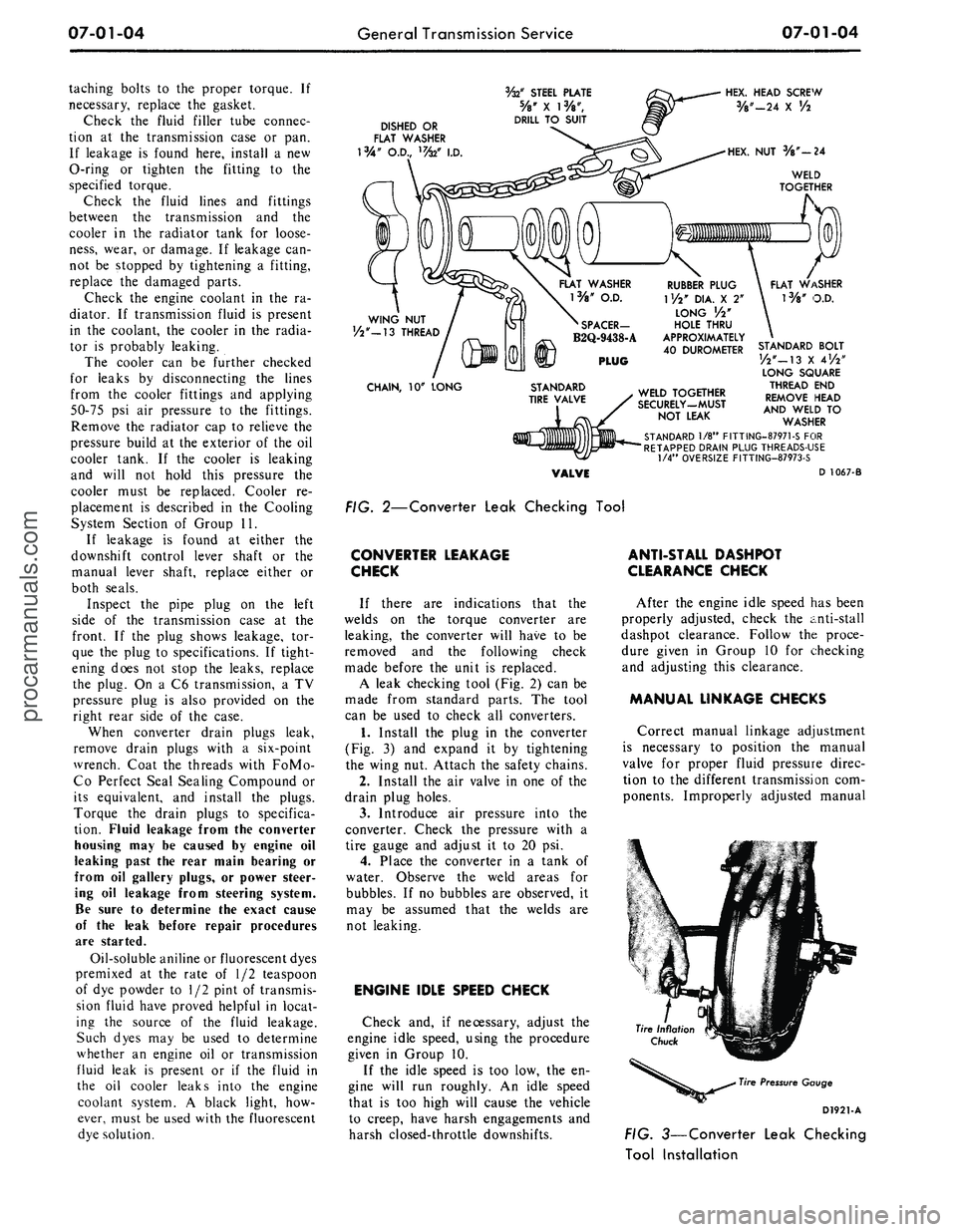
FIG. 2—Converter Leak Checking Tool
CONVERTER LEAKAGE
CHECK
If there are indications that the
welds on the torque converter are
leaking, the converter will have to be
removed and the following check
made before the unit is replaced.
A leak checking tool (Fig. 2) can be
made from standard parts. The tool
can be used to check all converters.
1.
Install the plug in the converter
(Fig. 3) and expand it by tightening
the wing nut. Attach the safety chains.
2.
Install the air valve in one of the
drain plug holes.
3.
Introduce air pressure into the
converter. Check the pressure with a
tire gauge and adjust it to 20 psi.
4.
Place the converter in a tank of
water. Observe the weld areas for
bubbles. If no bubbles are observed, it
may be assumed that the welds are
not leaking.
ENGINE IDLE SPEED CHECK
Check and, if necessary, adjust the
engine idle speed, using the procedure
given in Group 10.
If the idle speed is too low, the en-
gine will run roughly. An idle speed
that is too high will cause the vehicle
to creep, have harsh engagements and
harsh closed-throttle downshifts.
ANTI-STALL DASHPOT
CLEARANCE CHECK
After the engine idle speed has been
properly adjusted, check the anti-stall
dashpot clearance. Follow the proce-
dure given in Group 10 for checking
and adjusting this clearance.
MANUAL LINKAGE CHECKS
Correct manual linkage adjustment
is necessary to position the manual
valve for proper fluid pressure direc-
tion to the different transmission com-
ponents. Improperly adjusted manual
Tire Pressure Gauge
D1921-A
FIG. 3—Converter Leak Checking
Tool Installationprocarmanuals.com