wheel alignment FORD MUSTANG 1969 Volume One Chassis
[x] Cancel search | Manufacturer: FORD, Model Year: 1969, Model line: MUSTANG, Model: FORD MUSTANG 1969Pages: 413, PDF Size: 75.81 MB
Page 257 of 413
05-02-03
General Clutch Service
05-02-03
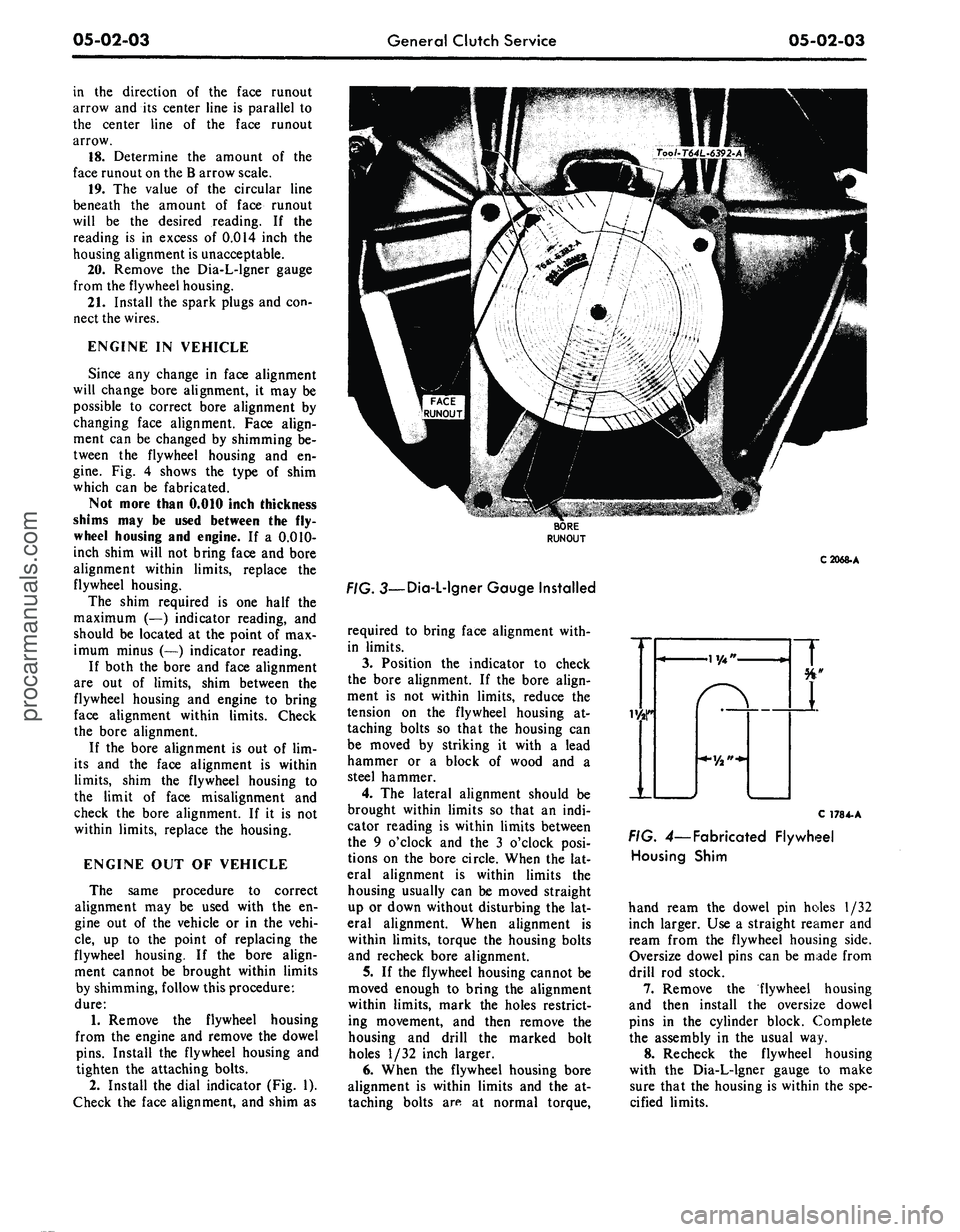
in the direction of the face runout
arrow and its center line is parallel to
the center line of the face runout
arrow.
18.
Determine the amount of the
face runout on the B arrow scale.
19.
The value of the circular line
beneath the amount of face runout
will be the desired reading. If the
reading is in excess of 0.014 inch the
housing alignment is unacceptable.
20.
Remove the Dia-L-lgner gauge
from the flywheel housing.
21.
Install the spark plugs and con-
nect the wires.
ENGINE IN VEHICLE
Since any change in face alignment
will change bore alignment, it may be
possible to correct bore alignment by
changing face alignment. Face align-
ment can be changed by shimming be-
tween the flywheel housing and en-
gine.
Fig. 4 shows the type of shim
which can be fabricated.
Not more than 0.010 inch thickness
shims may be used between the fly-
wheel housing and engine. If a 0.010-
inch shim will not bring face and bore
alignment within limits, replace the
flywheel housing.
The shim required is one half the
maximum (—) indicator reading, and
should be located at the point of max-
imum minus (—) indicator reading.
If both the bore and face alignment
are out of limits, shim between the
flywheel housing and engine to bring
face alignment within limits. Check
the bore alignment.
If the bore alignment is out of lim-
its and the face alignment is within
limits,
shim the flywheel housing to
the limit of face misalignment and
check the bore alignment. If it is not
within limits, replace the housing.
ENGINE OUT OF VEHICLE
The same procedure to correct
alignment may be used with the en-
gine out of the vehicle or in the vehi-
cle,
up to the point of replacing the
flywheel housing. If the bore align-
ment cannot be brought within limits
by shimming, follow this procedure:
dure:
1.
Remove the flywheel housing
from the engine and remove the dowel
pins.
Install the flywheel housing and
tighten the attaching bolts.
2.
Install the dial indicator (Fig. 1).
Check the face alignment, and shim as
C2068-A
. 3—Dia-L-lgner Gauge Installed
required to bring face alignment with-
in limits.
3.
Position the indicator to check
the bore alignment. If the bore align-
ment is not within limits, reduce the
tension on the flywheel housing at-
taching bolts so that the housing can
be moved by striking it with a lead
hammer or a block of wood and a
steel hammer.
4.
The lateral alignment should be
brought within limits so that an indi-
cator reading is within limits between
the 9 o'clock and the 3 o'clock posi-
tions on the bore circle. When the lat-
eral alignment is within limits the
housing usually can be moved straight
up or down without disturbing the lat-
eral alignment. When alignment is
within limits, torque the housing bolts
and recheck bore alignment.
5.
If the flywheel housing cannot be
moved enough to bring the alignment
within limits, mark the holes restrict-
ing movement, and then remove the
housing and drill the marked bolt
holes 1/32 inch larger.
6. When the flywheel housing bore
alignment is within limits and the at-
taching bolts are at normal torque,
C 178 4-A
FIG. 4— Fabricated Flywheel
Housing Shim
hand ream the dowel pin holes 1/32
inch larger. Use a straight reamer and
ream from the flywheel housing side.
Oversize dowel pins can be made from
drill rod stock.
7.
Remove the flywheel housing
and then install the oversize dowel
pins in the cylinder block. Complete
the assembly in the usual way.
8. Recheck the flywheel housing
with the Dia-L-lgner gauge to make
sure that the housing is within the spe-
cified limits.procarmanuals.com
Page 258 of 413
05-02-04
General Clutch Service
05-02-04
CLEANING AND INSPECTION
RELEASE BEARING
Wipe all oil and dirt off the release
bearing. The bearing is prelubricated
and should not be cleaned with sol-
vent.
Inspect the bearing retainer for
loose spring clips and rivets.
Inspect the release bearing assembly
for burrs which may cause the assem-
bly to drag on the transmission bear-
ing retainer. Any such burrs should be
cleaned up with fine crocus cloth. If
burrs are found, inspect the transmis-
sion input shaft bearing retainer for
evidence of scoring. Any scoring
should be polished out with crocus
cloth. Coat the bearing retainer with a
thin film of lithium-base grease
(C3VY-19586-A). Prior to release
bearing installation, apply a light film
of lithium base grease (C3VY-
19586-A) on both sides of the release
lever fork where it contacts the release
bearing hub and retaining springs.
Apply a light film of lithium base
grease (C3VY-19586-A) plate to the
release bearing surface that contacts
the pressure plate fingers. Carefully
fill the grease groove inside the bear-
ing hub with lithium base grease (no
polyethylene). Clean all excess grease
from the bore of the bearing hub. Ex-
cess grease will be forced onto the
spline by the transmission input shaft
bearing retainer and will contaminate
the clutch disc. Also, care must be
exercised when applying lubricants to
the release bearing, release bearing
hub and the release lever fork to avoid
excessive grease from contaminating
the clutch disc.
Hold the bearing inner race and ro-
tate the outer race while applying
pressure to it. If the bearing rotation
is rough or noisy, replace the bearing.
Most release bearing failures are
caused by improper clutch pedal ad-
justments. If the clutch linkage does
not have enough free travel, the re-
lease bearing will constantly touch the
release fingers and will spin whenever
the engine is running.
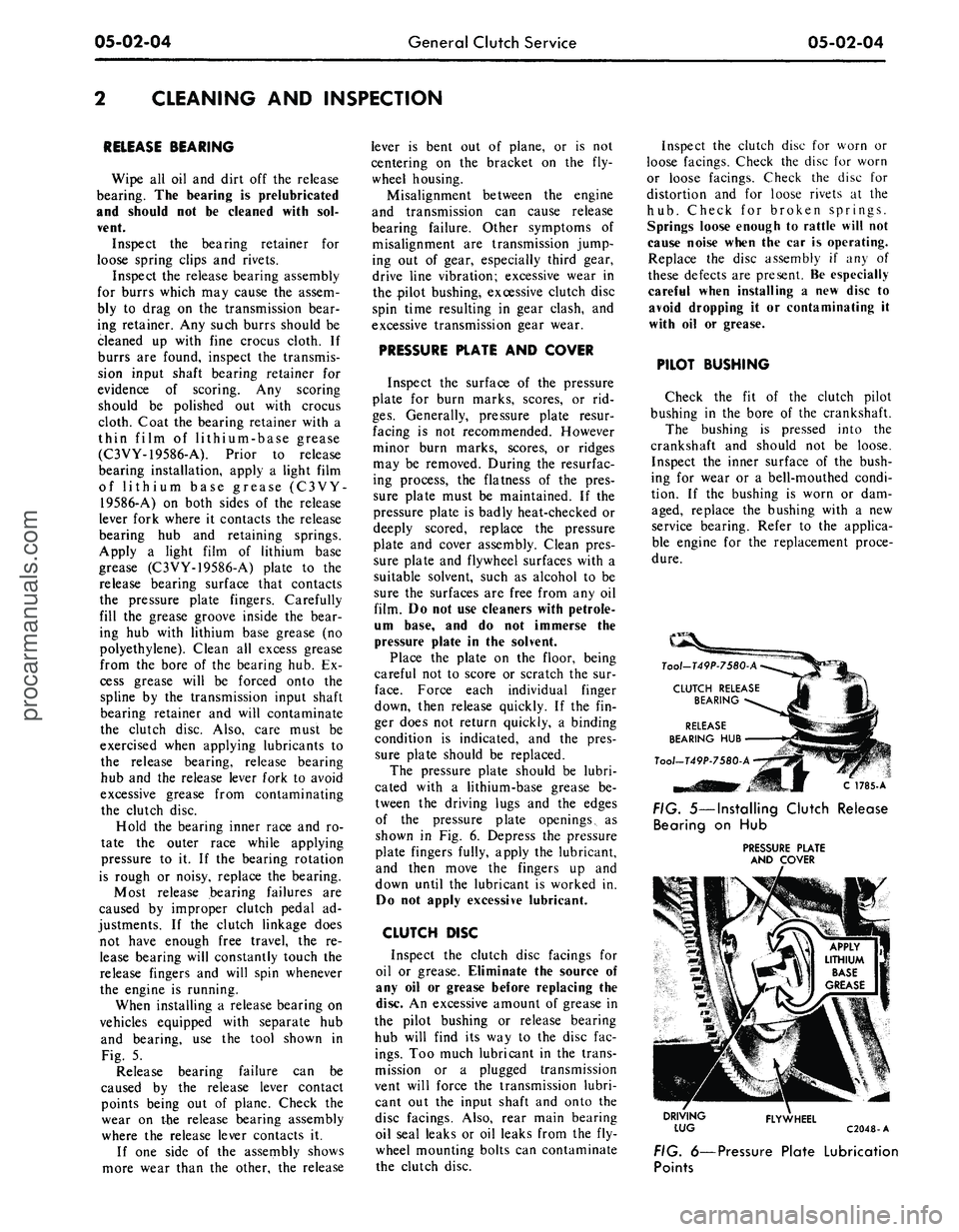
When installing a release bearing on
vehicles equipped with separate hub
and bearing, use the tool shown in
Fig. 5.
Release bearing failure can be
caused by the release lever contact
points being out of plane. Check the
wear on the release bearing assembly
where the release lever contacts it.
If one side of the assembly shows
more wear than the other, the release
lever is bent out of plane, or is not
centering on the bracket on the fly-
wheel housing.
Misalignment between the engine
and transmission can cause release
bearing failure. Other symptoms of
misalignment are transmission jump-
ing out of gear, especially third gear,
drive line vibration; excessive wear in
the pilot bushing, excessive clutch disc
spin time resulting in gear clash, and
excessive transmission gear wear.
PRESSURE PLATE AND COVER
Inspect the surface of the pressure
plate for burn marks, scores, or rid-
ges.
Generally, pressure plate resur-
facing is not recommended. However
minor burn marks, scores, or ridges
may be removed. During the resurfac-
ing process, the flatness of the pres-
sure plate must be maintained. If the
pressure plate is badly heat-checked or
deeply scored, replace the pressure
plate and cover assembly. Clean pres-
sure plate and flywheel surfaces with a
suitable solvent, such as alcohol to be
sure the surfaces are free from any oil
film. Do not use cleaners with petrole-
um base, and do not immerse the
pressure plate in the solvent.
Place the plate on the floor, being
careful not to score or scratch the sur-
face.
Force each individual finger
down, then release quickly. If the fin-
ger does not return quickly, a binding
condition is indicated, and the pres-
sure plate should be replaced.
The pressure plate should be lubri-
cated with a lithium-base grease be-
tween the driving lugs and the edges
of the pressure plate openings, as
shown in Fig. 6. Depress the pressure
plate fingers fully, apply the lubricant,
and then move the fingers up and
down until the lubricant is worked in.
Do not apply excessive lubricant.
CLUTCH DISC
Inspect the clutch disc facings for
oil or grease. Eliminate the source of
any oil or grease before replacing the
disc. An excessive amount of grease in
the pilot bushing or release bearing
hub will find its way to the disc fac-
ings.
Too much lubricant in the trans-
mission or a plugged transmission
vent will force the transmission lubri-
cant out the input shaft and onto the
disc facings. Also, rear main bearing
oil seal leaks or oil leaks from the fly-
wheel mounting bolts can contaminate
the clutch disc.
Inspect the clutch disc for worn or
loose facings. Check the disc for worn
or loose facings. Check the disc for
distortion and for loose rivets at the
hub.
Check for broken springs.
Springs loose enough to rattle will not
cause noise when the car is operating.
Replace the disc assembly if any of
these defects are present. Be especially
careful when installing a new disc to
avoid dropping it or contaminating it
with oil or grease.
PILOT BUSHING
Check the fit of the clutch pilot
bushing in the bore of the crankshaft.
The bushing is pressed into the
crankshaft and should not be loose.
Inspect the inner surface of the bush-
ing for wear or a bell-mouthed condi-
tion. If the bushing is worn or dam-
aged, replace the bushing with a new
service bearing. Refer to the applica-
ble engine for the replacement proce-
dure.
C 1785-A
FIG. 5—Installing Clutch Release
Bearing on Hub
PRESSURE PLATE
AND COVER
DRIVING
LUG
FLYWHEEL
C2048-A
FIG. 6—Pressure Plate Lubrication
Pointsprocarmanuals.com
Page 268 of 413
06-01-02
General Transmission Service
06-01-02
REAR SEAL REPLACEMENT
1.
Remove the drive shaft.
2.
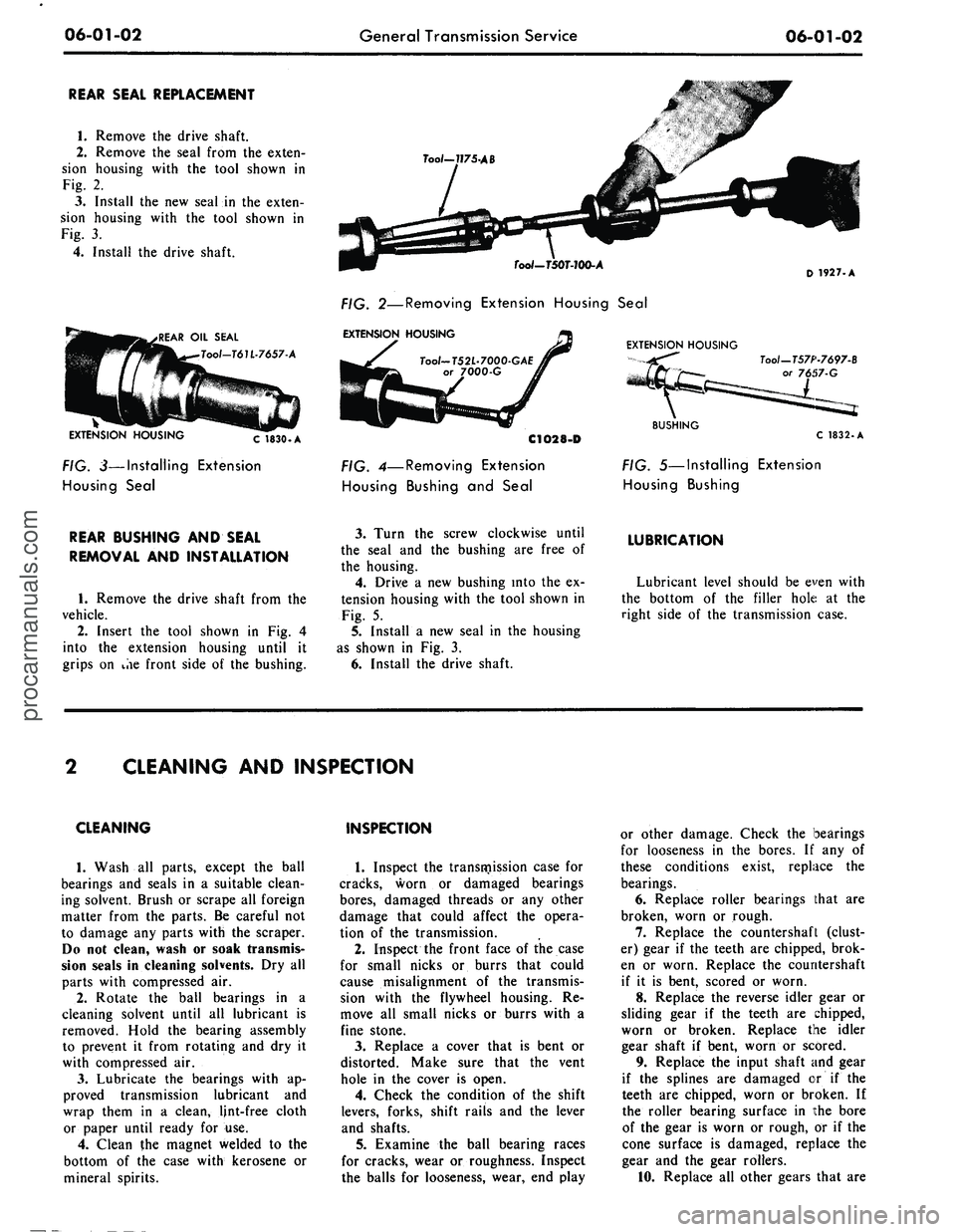
Remove the seal from the exten-
sion housing with the tool shown in
Fig. 2.
3.
Install the new seal in the exten-
sion housing with the tool shown in
Fig. 3.
4.
Install the drive shaft.
.REAR OIL SEAL
Tool-T61L-7657-A
EXTENSION HOUSING
C 1830.A
FIG. 3—Installing Extension
Housing Seal
Too/-7J75-AB
Tool-TSOT-lOO-A
FIG. 2—Removing Extension Housing Seal
EXTENSION HOUSING
Tool-T52L-7000-GAE
or 7000-G
C1O28-D
FIG. 4—Removing Extension
Housing Bushing and Seal
EXTENSION HOUSING
D
1927. A
Tool—T57P-7697-B
57-G
BUSHING
C 1832.A
FIG. 5—Installing Extension
Housing Bushing
REAR BUSHING AND SEAL
REMOVAL AND INSTALLATION
1.
Remove the drive shaft from the
vehicle.
2.
Insert the tool shown in Fig. 4
into the extension housing until it
grips on ihe front side of the bushing.
3.
Turn the screw clockwise until
the seal and the bushing are free of
the housing.
4.
Drive a new bushing into the ex-
tension housing with the tool shown in
Fig. 5.
5.
Install a new seal in the housing
as shown in Fig. 3.
6. Install the drive shaft.
LUBRICATION
Lubricant level should be even with
the bottom of the filler hole at the
right side of the transmission case.
CLEANING AND INSPECTION
CLEANING
1.
Wash all parts, except the ball
bearings and seals in a suitable clean-
ing solvent. Brush or scrape all foreign
matter from the parts. Be careful not
to damage any parts with the scraper.
Do not clean, wash or soak transmis-
sion seals in cleaning solvents. Dry all
parts with compressed air.
2.
Rotate the ball bearings in a
cleaning solvent until all lubricant is
removed. Hold the bearing assembly
to prevent it from rotating and dry it
with compressed air.
3.
Lubricate the bearings with ap-
proved transmission lubricant and
wrap them in a clean, lint-free cloth
or paper until ready for use.
4.
Clean the magnet welded to the
bottom of the case with kerosene or
mineral spirits.
INSPECTION
1.
Inspect the transmission case for
cracks, worn or damaged bearings
bores,
damaged threads or any other
damage that could affect the opera-
tion of the transmission.
2.
Inspect the front face of the case
for small nicks or burrs that could
cause misalignment of the transmis-
sion with the flywheel housing. Re-
move all small nicks or burrs with a
fine stone.
3.
Replace a cover that is bent or
distorted. Make sure that the vent
hole in the cover is open.
4.
Check the condition of the shift
levers, forks, shift rails and the lever
and shafts.
5.
Examine the ball bearing races
for cracks, wear or roughness. Inspect
the balls for looseness, wear, end play
or other damage. Check the bearings
for looseness in the bores. If any of
these conditions exist, replace the
bearings.
6. Replace roller bearings that are
broken, worn or rough.
7.
Replace the countershaft (clust-
er) gear if the teeth are chipped, brok-
en or worn. Replace the countershaft
if it is bent, scored or worn.
8. Replace the reverse idler gear or
sliding gear if the teeth are chipped,
worn or broken. Replace the idler
gear shaft if bent, worn or scored.
9. Replace the input shaft and gear
if the splines are damaged or if the
teeth are chipped, worn or broken. If
the roller bearing surface in the bore
of the gear is worn or rough, or if the
cone surface is damaged, replace the
gear and the gear rollers.
10.
Replace all other gears that areprocarmanuals.com
Page 282 of 413
06-03-03
Ford Design Four-Speed Transmission
06-03-03
cable from the equalizer lever and sep-
arate the lever from the crossmember.
5.
Remove the hairpin retainer se-
curing the cable to the transmission
rear support crossmember, and then
pull the cable assembly forward and
out of the crossmember.
6. Remove the retaining clip, flat
washer, and spring washer that se-
cures the shift rods to the shift levers.
7.
Remove the bolts that attach the
shift linkage control bracket to the ex-
tension housing and position the as-
sembly out of the way.
8. Support the engine with a trans-
mission jack and remove the extension
housing-to-engine rear support attach-
ing bolts.
9. Raise the rear of the engine high
enough to remove the weight from the
crossmember. Remove the bolts re-
taining the crossmember to the frame
side supports and remove the
crossmember.
10.
Support the transmission on a
jack and remove the bolts that attach
the transmission to the flywheel hous-
ing.
11.
Move the transmission and jack
rearward until the transmission input
shaft clears the flywheel housing. If
necessary, lower the engine enough to
obtain clearance for transmission re-
moval.
Do not depress the clutch pedal
while the transmission is removed.
INSTALLATION
1.
Make sure that the mounting
surface of the transmission and the
flywheel housing are free of dirt,
paint, and burrs. Install two guide
pins in the flywheel housing lower
mounting bolt holes. Move the trans-
mission forward on the guide pins
until the input shaft splines enter the
clutch hub splines and the case is posi-
tioned against the flywheel housing.
2.
Install the two upper transmis-
sion to flywheel housing, mounting
bolts snug, and then remove the two
guide pins. Install the two lower
mounting bolts. Torque all mounting
bolts to specifications.
3.
Raise the rear of the engine and
install the crossmember. Install and
torque the crossmember attaching
bolts to specifications, then lower the
engine.
4.
With the transmission extension
housing resting on the engine rear
support, install the transmission ex-
tension housing attaching bolts. Tor-
que the bolts to specifications.
5.
Position the shift linkage control
bracket to the extension housing and
install the attaching bolts.
6. Secure each shift rod to its re-
spective lever with the spring washer,
flat washer, and retaining pin.
7.
Guide the parking brake cable
assembly through the hole in the
transmission rear support crossmemb-
er. Secure the cable assembly to the
crossmember with the hair pin retain-
er.
8. Insert the parking brake front
cable in the equalizer and install the
equalizer in the bracket on the
crossmember. Secure the parking
brake rear cable to the equalizer.
9. Connect the speedometer cable
to the extension housing.
10.
Remove the extension housing
installation tool and slide the forward
end of the drive shaft over the trans-
mission output shaft. Connect the
drive shaft to the rear U-joint flange.
11.
Place both forward gear shift
levers and the reverse shift lever in the
neutral position and insert a 1/4 inch
diameter alignment tool in the shift
linkage alignment hole (Fig. 17). It
may be necessary to loosen the adjust-
ment nuts to install the alignment
tool. Adjust the linkage as necessary
and tighten the adjustment nuts to
specifications. Remove the alignment
tool.
12.
Fill the transmission to the
proper level with the specified lubri-
cant.
13.
Lower the car. Check tne shift
and crossover motion for full shift en-
gagement and smooth crossover oper-
ation.
MAJOR REPAIR OPERATIONS
DISASSEMBLY
1.
Mount the transmission in a
holding fixture and drain the lubri-
cant.
2.
Remove the cover attaching
screws from the case. Lift the cover
and gasket from the case.
3.
Remove the long spring that re-
tains the detent plug in the case (Fig.
4).
Remove the detent plug with a
small magnet.
4.
Remove the extension housing
attaching screws and lock washers.
Remove the housing and the gasket.
5.
Remove the input shaft bearing
retainer attaching screws. Slide the re-
tainer off the input shaft.
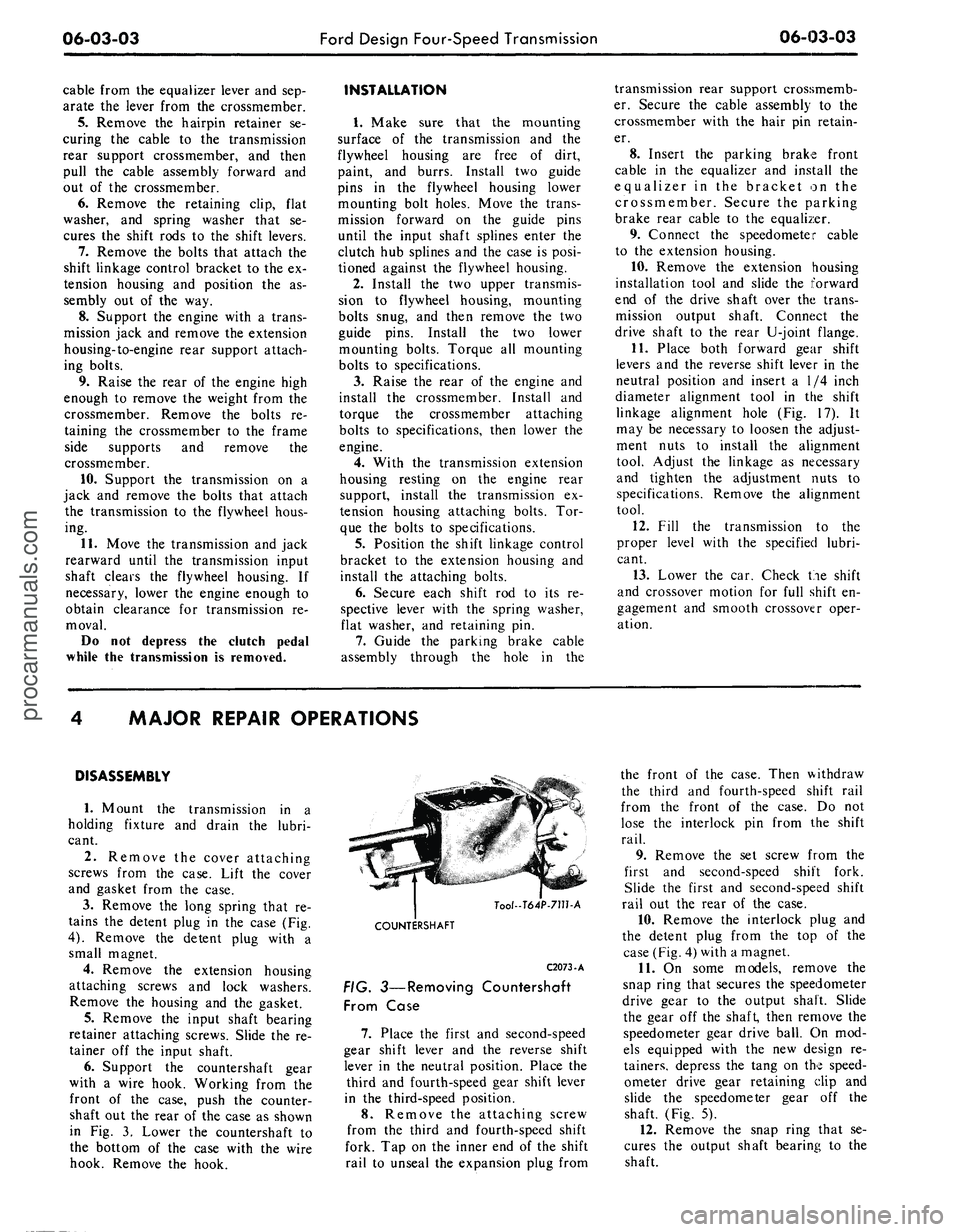
6. Support the countershaft gear
with a wire hook. Working from the
front of the case, push the counter-
shaft out the rear of the case as shown
in Fig. 3. Lower the countershaft to
the bottom of the case with the wire
hook. Remove the hook.
Tool-T64P-711hA
COUNTERSHAFT
C2073-A
FIG. 3—Removing Countershaft
From Case
7.
Place the first and second-speed
gear shift lever and the reverse shift
lever in the neutral position. Place the
third and fourth-speed gear shift lever
in the third-speed position.
8. Remove the attaching screw
from the third and fourth-speed shift
fork. Tap on the inner end of the shift
rail to unseal the expansion plug from
the front of the case. Then withdraw
the third and fourth-speed shift rail
from the front of the case. Do not
lose the interlock pin from the shift
rail.
9. Remove the set screw from the
first and second-speed shift fork.
Slide the first and second-speed shift
rail out the rear of the case.
10.
Remove the interlock plug and
the detent plug from the top of the
case (Fig. 4) with a magnet.
11.
On some models, remove the
snap ring that secures the speedometer
drive gear to the output shaft. Slide
the gear off the shaft, then remove the
speedometer gear drive ball. On mod-
els equipped with the new design re-
tainers, depress the tang on the speed-
ometer drive gear retaining clip and
slide the speedometer gear off the
shaft. (Fig. 5).
12.
Remove the snap ring that se-
cures the output shaft bearing to the
shaft.procarmanuals.com
Page 383 of 413
07-04-14
C-6 Automatic Transmission
07-04-14
taching bolt to turn the converter to
gain access to the nuts.
5.
Remove the rear mount to
crossmember attaching bolt.
6. Remove the two crossmember-
to-frame attaching bolts.
7.
Remove the two engine rear
support-to-extension housing attaching
bolts.
8. Disconnect the downshift rod
from the transmission downshift lever.
9. Disconnect the manual linkage
rod from the lever at the transmission.
On a column shift, use tool T67P-
7341-A to remove the rod.
10.
Remove the two bolts securing
the bellcrank bracket to the converter
housing.
11.
Raise the transmission with a
transmission jack to provide clearance
to remove the crossmember.
12.
Remove the rear mount from
the crossmember and remove the
crossmember from the side supports.
13.
Lower the transmission to gain
access to the oil cooler lines.
14.
Disconnect each oil line from
the fittings on the transmission.
15.
Disconnect the vacuum line
from the diaphragm located at the
right rear of the transmission. Remove
the metal line from the retaining clip
on the transmission.
16.
Disconnect the speedometer
cable from the extension housing.
17.
Remove the bolt that secures
the transmission fluid filler tube to the
cylinder block. Lift the filler tube and
the dipstick from the transmission.
18.
Secure the transmission to the
jack with the chain.
19.
Remove the converter housing-
to-cylinder block attaching bolts.
20.
Carefully move the transmission
away from the engine and, at the
same time, lower it to clear the und-
erside of the vehicle.
21.
Remove the converter and
mount the transmission in a holding
fixture.
INSTALLATION—FORD
MERCURY AND METEOR
1.
Torque the two converter drain
plugs to specification.
2.
Install the converter on the sta-
tor support.
3.
Secure the transmission to the
jack with the chain.
4.
Rotate the flywheel to place two
converter mounting stud holes that are
adjacent to the drain plug holes in a
vertical position.
5.
Rotate the converter so that the
studs and drain plugs are in alignment
with those in the flywheel.
6. Move the transmission toward
the cylinder block until they are in
contact. Install and torque the attach-
ing bolts to specification making sure
that the vacuum tube retaining clips
are properly positioned.
7.
Remove the transmission jack
chain from around the transmission.
8. Install a new Oring on the lower
end of the transmission filler tube. In-
sert the tube in the transmission case
and secure the tube to the engine with
the attaching bolt.
9. Connect the speedometer cable
to the extension housing.
10.
Connect the oil cooler lines to
the right side of transmission case.
11.
Connect the vacuum line to the
vacuum diaphragm making sure that
the metal tube is secured in the retain-
ing clip.
12.
Position the cross member on
the side supports. Position the rear
mount on the crossmember and install
the attaching bolt and nut.
13.
Secure the engine rear support
to the extension housing and torque
the bolts to specification.
14.
Lower the transmission and re-
move the jack.
15.
Secure the crossmember to the
side supports with the attaching bolts
and torque them to specification.
16.
Position the bellcrank bracket
to the converter housing and install
the two attaching bolts.
17.
Connect the downshift rod to
the transmission downshift lever.
18.
Connect the selector rod to the
manual lever at the transmission. On
a column shift, use tool T67P-7341-A
and install a new grommet in the
manual lever. Then, secure the manual
selector rod to the lever.
19.
Secure the converter-to-flywheel
attaching nuts and torque them to
specification. Use a wrench on the
crankshaft pulley attaching nut to ro-
tate the flywheel. Do not use a wrench
on the converter attaching nuts to ro-
tate it.
20.
Install the converter housing
dust shield and secure it with the at-
taching bolts.
21.
Secure the starter motor in
place with the attaching bolts. Con-
nect the cable to the terminal on the
starter.
22.
Install the driveshaft.
23.
Adjust the shift linkage as de-
tailed in Section 2.
24.
Lower the vehicle.
25.
Fill the transmission to the cor-
rect level with the specified lubricant.
Start the engine and shift the trans-
mission to all ranges, then recheck the
fluid level.
REMOVAL—FAIRLANE,
MONTEGO, MUSTANG
AND COUGAR
1.
On Mustang and Cougar, dis-
connect the neutral switch wires from
the harness connector and the retain-
ing clip on the dash.
2.
Remove the bolt that secures the
filler tube to the rear of the right
cylinder head.
3.
Raise the vehicle on a hoist or
jack stands.
4.
Remove the converter drain plug
access cover from the lower end of the
converter housing.
5.
Place a drain pan under nhe con-
verter housing and remove the two
converter drain plugs. Install the plugs
after the fluid has drained.
6. Place the drain pan under the
transmission fluid pan. Starting at the
rear of the pan and working toward
the front, loosen the attaching bolts
and allow the fluid to drain. Finally
remove all of the pan attaching bolts
except two at the front, to allow the
fluid to further drain. After the fluid
has drained, install two bolts on the
rear side of the pan to temporarily
hold it in place.
7.
Disconnect the drive shaft from
the rear axle flange and remove it
from the transmission. Install tool
T61L-7657-A in the rear of the exten-
sion housing to prevent the fluid from
leaking.
8. Disconnect the downshift rod
from the transmission downshift lever.
9. Disconnect the shift rod from the
manual lever. On a column shift, use
tool T67P-7341-A to remove the rod.
10.
Disconnect the speedometer
cable from the extension housing.
11.
Disconnect the rubber hose
from the vacuum diaphragm at the
rear of the transmission. Remove the
vacuum tube from the retaining clip at
the transmission.
12.
Disconnect the starter cable
from the terminal on the starter. Re-
move the starter attaching bolts and
remove it from the housing.
13.
Lift the fluid filler tube from
the transmission case.
14.
Remove the four converter-
to-flywheel attaching nuts.
15.
On a Mustang or Cougar, dis-
connect the complete exhaust system
and allow it to hang on the rear axle.
16.
Remove the two nuts that at-
tach the engine rear support to the
crossmember.
17.
Raise the transmission with a
jack just enough to remove the weight
from the crossmember.
18.
Remove the cotter pins from
the crossmember-to-frame side sup-procarmanuals.com
Page 384 of 413
07-04-15
C-6
Automatic Transmission
07-04-15
port attaching nuts and remove the
nuts.
Lift the crossmember from the
frame side supports.
19.
Remove the bolts that attach
the engine rear support to the exten-
sion housing and remove the support.
20.
Lower the transmission, then
disconnect the fluid cooler lines from
the transmission case.
21.
Secure the transmission to the
jack with a chain.
22.
Remove the six bolts that at-
tach the converter housing to the cyl-
inder block.
23.
Move the jack rearward until
the transmission clears the engine,
then tip it forward to provide clear-
ance. Lower the transmission and re-
move it from under the vehicle.
24.
Remove the converter from the
transmission. Mount the transmission
in a holding fixture if repairs are nec-
essary.
INSTALLATION—FAIRLANE,
MONTEGO,
MUSTANG
AND COUGAR
1. Mount the transmission in a
transmission jack and secure it with a
safety chain.
2.
Install the converter on the front
pump.
3.
Rotate the flywheel so that the
drain plug holes are in a vertical posi-
tion. Rotate the converter so that the
drain plugs are in the same relative
position as the drain plug holes in the
flywheel.
4.
Roll the transmission into posi-
tion under the vehicle and raise it to
alignment with the engine. Move it
forward until the converter housing
contacts the cylinder block. Install
and torque the converter-to-cylinder
block attaching bolts.
5.
Remove the jack safety chain
from the transmission.
6. Connect the two fluid cooler
lines to the fittings in the transmission
case.
7.
Secure the engine rear support to
the extension housing with the attach-
ing bolts. Torque the bolts to specifi-
cation.
8. Position the crossmember on the
frame side supports and install and
tighten the attaching nuts to specifica-
tion. Install cotter Dins to retain the
nuts.
9. Remove the transmission jack
from under the vehicle. Install and
torque the engine rear support-
to-crossmember attaching nuts.
10.
Install the exhaust system on
Mustang and Cougar.
11.
Install the converter-to-flywheel
attaching nuts and torque them to
specifications. Tighten the drain plugs
to specification.
12.
Secure the converter drain plug
access cover to the lower end of the
converter housing with the attaching
bolts.
13.
Install a new O-ring on the
lower end of the fluid filler tube. Dip
the O-ring in clean automatic trans-
mission fluid and insert the filler tube
in the transmission case.
14.
Secure the starter to the con-
verter housing. Connect the cable to
the terminal on the starter.
15.
Connect the speedometer cable
to the extension housing.
16.
Connect the shift rod to the
manual lever at the transmission. On
a column shift, use tool T67P-7341-A
and install a new grommet in the
manual lever. Then, secure the manual
selector rod to the lever.
17.
Connect the downshift rod to
the lever on the transmission. Adjust
the rod.
18.
Remove the tool from the ex-
tension housing and install the drive
shaft.
19.
Lower the vehicle.
20.
Working from the engine com-
partment, secure the fluid filler tube
to the rear of the right cylinder head
with the attaching bolt.
21.
On Mustang and Cougar, con-
nect the neutral switch wires to the
harness. Secure the wires to the dash
with the retaining clip.
22.
Fill the transmission with the
specified lubricant as detailed in Part
7-1.
REMOVAL—THUNDERBIRD
1. Working from the engine com-
partment, remove the fluid filler tube
bracket attaching screw that secures it
to the rear of the right cylinder head.
Lift the tube and dipstick from the
transmission.
2.
Remove the starting motor upper
attaching bolt using a long extension.
3.
Remove the two converter hous-
ing upper attaching bolts.
4.
Raise the vehicle on a hoist or
stands.
5.
Remove the dust shield from the
front lower end of the converter hous-
ing.
6. Crank the engine until one of the
converter drain plugs is accessible.
Then, remove the plug.
7.
Crank the engine until the other
plug is at the bottom. Place a drain
pan to catch the fluid, then remove
the pan and allow the fluid to drain.
8. Remove the drive shaft.
9. Remove the frame side rail sup-
port brace attaching bolts and remove
the brace.
10.
After the fluid has been drained
from the converter, install the plug.
11.
Place the drain pan under the
transmission pan and loosen the at-
taching bolts and allow the fluid to
drain. Finally remove all of the pan
attaching bolts except two, to allow
the oil to further drain. After the fluid
has drained, install two bolts on the
opposite side of the pan to temporari-
ly hold it in place.
12.
Remove the converter-
to-flywheel attaching nuts.
13.
Disconnect the downshift link-
age from the transmission downshift
lever.
14.
Using tool T67P-7341-A, re-
move the selector rod from the manu-
al lever.
15.
Remove the two screws that at-
tach the shift rod bellcrank bracket to
the converter housing and remove the
bracket.
16.
Disconnect the vacuum dia-
phragm hose from the upper end of
the vacuum tube.
17.
Disconnect the speedometer
cable from the extension housing and
place it to one side.
18.
Remove the starting motor two
lower attaching bolts and place the
motor to one side.
19.
Disconnect the two oil cooler
lines from the right side of the trans-
mission.
20.
Disconnect the muffler inlet
pipes at the exhaust manifolds and
allow the pipes to hang.
21.
Remove the vibration absorber
from the extension housing.
22.
Remove the two engine rear
support-to-extension housing attaching
bolts.
23.
Place a transmission jack under
the transmission and raise it just
enough to remove the weight from the
support.
24.
Remove the two support attach-
ing bolts and remove the support.
25.
Lower the jack just enough to
remove the weight.
26.
Remove the four remaining
converter housing-to-cylinder block at-
taching bolts and the accelerator link-
age stop from the left side of the
housing.
27.
Carefully lower the transmis-
sion and remove it from under the ve-
hicle.
28.
Remove the converter and
mount the transmission in a holding
fixture.procarmanuals.com
Page 385 of 413
07-04-16
C-6 Automatic Transmission
07-04-16
INSTALLATION—
THUNDERBIRD
1.
Torque the two converter drain
plugs to specification.
2.
Install the converter on the sta-
tor support.
3.
Secure the transmission on a
transmission jack.
4.
Rotate the converter so that the
studs and drain plugs are in alignment
with their holes in the flywheel.
5.
Move the transmission toward
the cylinder block until they contact
each other. Install and torque the at-
taching bolts to specification. Before
tightening the center bolt on the left
side,
make sure that the accelerator
linkage stop bracket is properly posi-
tioned so that the left upper bolt may
be installed later.
6. Connect the fluid cooler lines to
their fittings on the right side of the
transmission.
7.
Raise the transmission and in-
stall the engine rear support and tor-
que the bolts to specification. Make
sure that the hand brake equalizer is
positioned properly.
8. Lower the transmission and re-
move the jack.
9. Install the engine rear support-
to-extension housing attaching bolts.
10.
Install the drive shaft.
11.
Connect the speedometer cable
to the extension housing.
12.
Position the starting motor on
the converter housing and secure it
with the two lower bolts.
13.
Install the torque converter-
to-flywheel attaching nuts and torque
them to specification.
14.
Install the converter housing
dust shield.
15.
Secure the frame side rail sup-
port brace with the attaching bolts
and lock washers. Torque the bolts to
specification.
16.
Connect the downshift rod to
the transmission downshift lever.
17.
Connect the vacuum diaphragm
hose to the upper end of the vacuum
tube.
18.
Using Tool T67P-7341-A, in-
stall a new grommet in the manual
lever. Then, secure the manual selec-
tor rod to the lever.
19.
Position the vibration absorber
to the transmission extension housing
and secure it with the three attaching
bolts.
20.
Connect the muffler inlet pipes
to the exhaust manifolds.
21.
Lower the vehicle and install
the two converter housing upper bolts
and torque them to specification.
22.
Install the starting motor upper
bolt.
23.
Place a new O-ring on the end
of the fluid filler tube and insert it in
the transmission case. Secure the tube
to the rear of the right cylinder head
with the attaching screw and lock
washer.
24.
Fill the transmission to the
proper level with the specified fluids.
25.
Adjust the manual and throttle
linkage as required.
REMOVAL-
CONTINENTAL MARK III
1.
Working from the engine com-
partment, lift the fluid filler tube dio-
stick from the transmission.
2.
Raise the vehicle on a hoist or
stands.
3.
Remove the dust shield from the
front lower end of the converter hous-
ing.
4.
Crank the engine until one of the
converter drain plugs is accessible.
Then, remove the plug.
5.
Crank the engine until the other
plug is at the bottom. Place a drain
pan to catch the fluid, then remove
the pan and allow the fluid to drain.
6. Remove the driveshaft.
7.
Remove the frame side rail sup-
port brace attaching bolts and remove
the brace.
8. After the fluid has been drained
from the converter, install the plug.
9. Place the drain pan under the
transmission pan and loosen the at-
taching bolts and allow the fluid to
drain. Finally remove all of the pan
attaching bolts except two, to allow
the oil to further drain. After the fluid
has drained, install two bolts on the
opposite side of the pan to temporari-
ly hold it in place.
10.
Remove the. converter-
to-flywheel attaching nuts.
11.
Disconnect the downshift link-
age from the transmission downshift
lever.
12.
Using tool T67P-7341-A, re-
move the selector rod from the manu-
al lever.
13.
Remove the two screws that at-
tach the shift rod bellcrank bracket to
the converter housing and remove the
bracket.
14.
Disconnect the vacuum dia-
phragm hose at the transmission.
15.
Disconnect the speedometer
cable from the extension housing and
place it to one side.
16.
Remove the two idler arm
bracket retaining bolts at the frame
side rail and allow the linkage to
hang.
17.
Disconnect the starter cable
from the terminal on the starter. Re-
move the starter attaching bolts and
remove it from the housing.
18.
Remove the clip securing the oil
cooler lines to the support bracket.
19.
Disconnect the two oil cooler
lines from the right side of the trans-
mission.
20.
Disconnect the muffler inlet
pipes at the exhaust manifolds and
allow the pipes to hang.
21.
Remove the vibration absorber
from the extension housing.
22.
Remove the engine rear support
to extension housing attaching bolts.
23.
Place a transmission jack under
the transmission and raise it just
enough to remove the weight from the
support.
24.
Remove the two support attach-
ing bolts and remove the support.
25.
Lower the jack and secure the
transmission to the jack with a safety
chain.
26.
Remove the bolt that secures
the filler tube to the rear of the right
cylinder head and lift the tube from
the transmission case.
27.
Remove the six converter
housing-to-cylinder block attaching
bolts.
28.
Carefully lower the transmis-
sion and remove it from under the ve-
hicle.
29.
Remove the converter and
mount the transmission in a holding
fixture.
INSTALLATION—
CONTINENTAL MARK III
1.
Torque the two converter drain
plugs to specification.
2.
Install the converter on the sta-
tor support.
3.
Secure the transmission on a
transmission jack.
4.
Rotate the converter so that the
studs and drain plugs are in alignment
with their holes in the flywheel.
5.
Move the transmission toward
the cylinder block until they contact
each other. Install and torque the at-
taching bolts to specification
6. Remove the jack safety chain
from the transmission.
7.
Connect the fluid cooler lines to
their fittings on the right side of the
transmission.
8. Install a new O-ring on the lower
end of the fluid filler tube. Dip the
O-ring in clean automatic transmis-
sion fluid and insert the tube in the
transmission case. Install the attach-
ing bolt.procarmanuals.com
Page 386 of 413
07-04-17
C-6 Automatic Transmission
07-04-17
9. Raise the transmission and in-
stall the engine rear support and tor-
que the bolts to specification.
10.
Lower the transmission and re-
move the jack.
11.
Install the engine rear support-
to-extension housing attaching bolts.
12.
Install the drive shaft.
13.
Connect the speedometer cable
to the extension housing.
14.
Connect the muffler inlet pipes
to the exhaust manifolds.
15.
Position the starting motor on
the converter housing and secure it
with the attaching bolts. Connect the
cable to the terminal on the starter.
16.
Position the idler arm bracket
to the frame side rail and install the
attaching bolts.
17.
Install the torque converter-
to-flywheel attaching nuts and torque
them to specification.
18.
Install the converter housing
dust shield.
19.
Secure the frame side rail sup-
port brace with the attaching bolts
and lock washers. Torque the bolts to
specification.
20.
Connect the downshift rod to
the transmission downshift lever.
21.
Using Tool T67P-7341-A, in-
stall a new grommet in the manual
lever. Then, secure the manual selec-
tor rod to the lever.
22.
Connect the vacuum hose to the
vacuum diaphragm.
23.
Install the oil cooler line retain-
ing clip at the transmission support.
24.
Position the vibration absorber
to the transmission extension housing
and secure it with the three attaching
bolts.
25.
Lower the vehicle.
26.
Fill the transmission to the
proper level with the specified fluids.
27.
Adjust the manual and throttle
linkage as required.
REMOVAL-
LINCOLN CONTINENTAL
1.
Raise the hood and remove the
transmission dipstick.
2.
Raise the vehicle on a hoist. Re-
move the bolt that secures the trans-
mission filler tube to the cylinder
head.
3.
Remove the bolts that attach the
reinforcement plate at the rear of the
transmission oil pan and remove the
plate.
4.
Remove the three bolts that at-
tach the manual and downshift control
rod splash shield to the side rail and
remove the shield.
5.
Place a drain pan under the
transmission. Loosen all transmission
pan attaching bolts and allow the fluid
to drain. Remove the bolts from the
rear and both sides of the pan to
allow further drainage; then, finally
remove the pan. After all fluid has
been drained, install the pan using
four attaching bolts.
6. Remove the two bolts that attach
the cover to the lower end of the con-
verter housing.
7.
Remove the two front support
bracket bolts at the converter housing.
8. Remove the two drain plugs
from the converter and allow it to
drain.
9. Remove the four nuts that attach
the converter to the flywheel.
10.
Lift the fluid filler tube from
the transmission case.
11.
Remove the two idler arm
bracket bolts from the frame side rail
and allow the idler arm to hang free.
12.
Disconnect the starter cable
from the starter. Remove the starter
attaching bolts and remove the starter.
13.
Disconnect the oil cooler lines
from the transmission.
14.
Disconnect the vacuum hose
from the diaphragm.
15.
Loosen the parking brake ad-
justing nut at the equalizer and re-
move the retracting spring. Disconnect
the rear brake cables and remove the
equalizer from the bracket.
16.
Disconnect the speedometer
cable from the extension housing.
17.
Disconnect the drive shaft from
the transmission flange and position
the shaft out of the way.
18.
Disconnect the downshift rod
from the transmission downshift lever.
19.
Using tool T67P-7341-A, re-
move the manual selector rod from
the manual lever.
20.
Remove the lower bellcrank at-
taching bolts and remove the bell-
crank.
21.
Pry the upper bellcrank out of
the converter housing and allow it to
hang free.
22.
Remove the cooler lines from
the clip at the cylinder head.
23.
Remove the converter housing-
to-cylinder block lower attaching
bolts.
24.
Remove the two nuts that at-
tach the engine rear mounts to the
crossmember.
25.
Place a transmission jack under
the transmission and raise it just high
enough to remove the weight from the
crossmember.
26.
Remove the engine rear
support-to-extension housing attaching
bolts and remove the supports.
27.
Remove the crossmember-
to-frame attaching nuts and remove
the crossmember.
28.
Secure the transmission to the
jack with the safety chain. Lower the
transmission and remove the upper
converter housing-to-cylinder block at-
taching bolts.
29.
Move the transmission away
from the cylinder block.
30.
Carefully lower the transmis-
sion and remove it from under the ve-
hicle.
31.
Remove the converter and mount
the transmission in a holding fixture.
INSTALLATION-
LINCOLN CONTINENTAL
1.
Torque the two converter drain
plugs to specification.
2.
Install the converter on the sta-
tor support.
3.
Secure the transmission on a
transmission jack.
4.
Rotate the converter so that the
studs and drain plugs are in alignment
with those in the flywheel.
5.
Move the transmission toward the
cylinder block until they contact each
other. Install and torque the attaching
bolts to specification.
6. Secure the converter to the fly-
wheel with the four attaching nuts.
Torque the nuts to specification.
7.
Secure the converter access cover
to the converter housing with the at-
taching bolts.
8. Secure the two front support
brackets to the converter housing with
the attaching bolts.
9. Raise the transmission high en-
ough to position the crossmember. In-
stall the bolts, but do not tighten at
this time.
10.
Secure the engine rear support
to the extension housing and torque
the bolts to specification. At this time,
install and torque the crossmember-
to-frame attaching nuts to specifica-
tion.
11.
Lower the transmission and in-
stall the engine rear support-
to-crossmember attaching nuts and
plates.
Torque the •"its to specifica-
tion. Remove the transmission jack.
12.
Install the upper bellcrank in
the left side of the converter housing.
13.
Position the lower bellcrank to
the transmission and floor pan and se-
cure it with the two attaching bolts.
14.
Connect the downshift rod to
transmission downshift lever.
15.
Using tool T67P-7341-A, install
a new grommet in the manual lever.
Then, secure the manual selector rod
to the lever.procarmanuals.com