engine oil FORD MUSTANG 2002 4.G User Guide
[x] Cancel search | Manufacturer: FORD, Model Year: 2002, Model line: MUSTANG, Model: FORD MUSTANG 2002 4.GPages: 264, PDF Size: 2.56 MB
Page 209 of 264
4. Install the indicator and ensure it is fully seated.
5. Fully install the engine oil filler cap by turning the
filler cap clockwise 1/4 of a turn until three clicks
are heard or until the cap is fully seated.
To avoid possible oil loss, DO NOT operate the
vehicle with the engine oil level indicator
and/or the engine oil filler cap removed.
Engine oil and filter recommendations
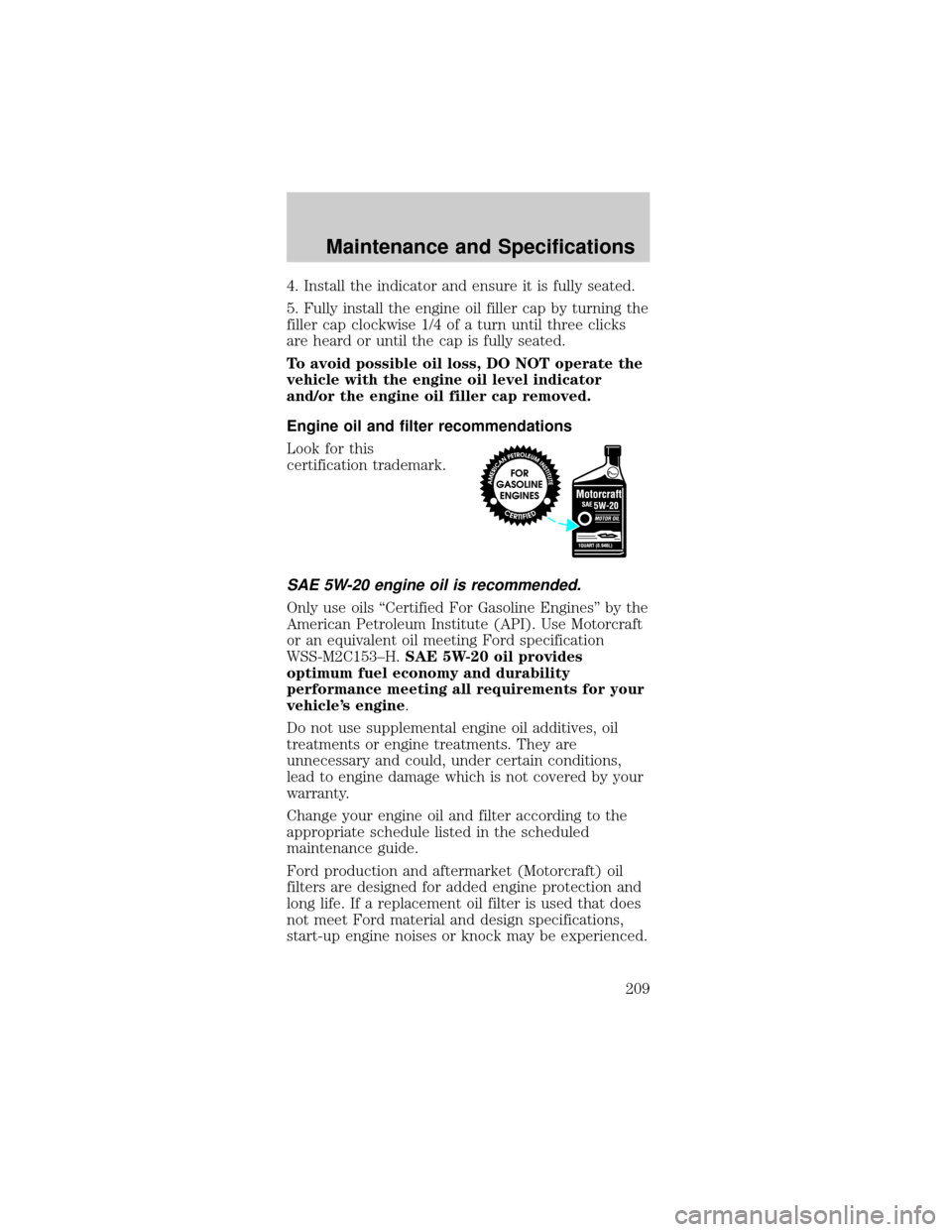
Look for this
certification trademark.
SAE 5W-20 engine oil is recommended.
Only use oils ªCertified For Gasoline Enginesº by the
American Petroleum Institute (API). Use Motorcraft
or an equivalent oil meeting Ford specification
WSS-M2C153±H.SAE 5W-20 oil provides
optimum fuel economy and durability
performance meeting all requirements for your
vehicle's engine.
Do not use supplemental engine oil additives, oil
treatments or engine treatments. They are
unnecessary and could, under certain conditions,
lead to engine damage which is not covered by your
warranty.
Change your engine oil and filter according to the
appropriate schedule listed in the scheduled
maintenance guide.
Ford production and aftermarket (Motorcraft) oil
filters are designed for added engine protection and
long life. If a replacement oil filter is used that does
not meet Ford material and design specifications,
start-up engine noises or knock may be experienced.
Maintenance and Specifications
209
Page 210 of 264
It is recommended you use the appropriate
Motorcraft oil filter (or another brand meeting Ford
specifications) for your engine application.
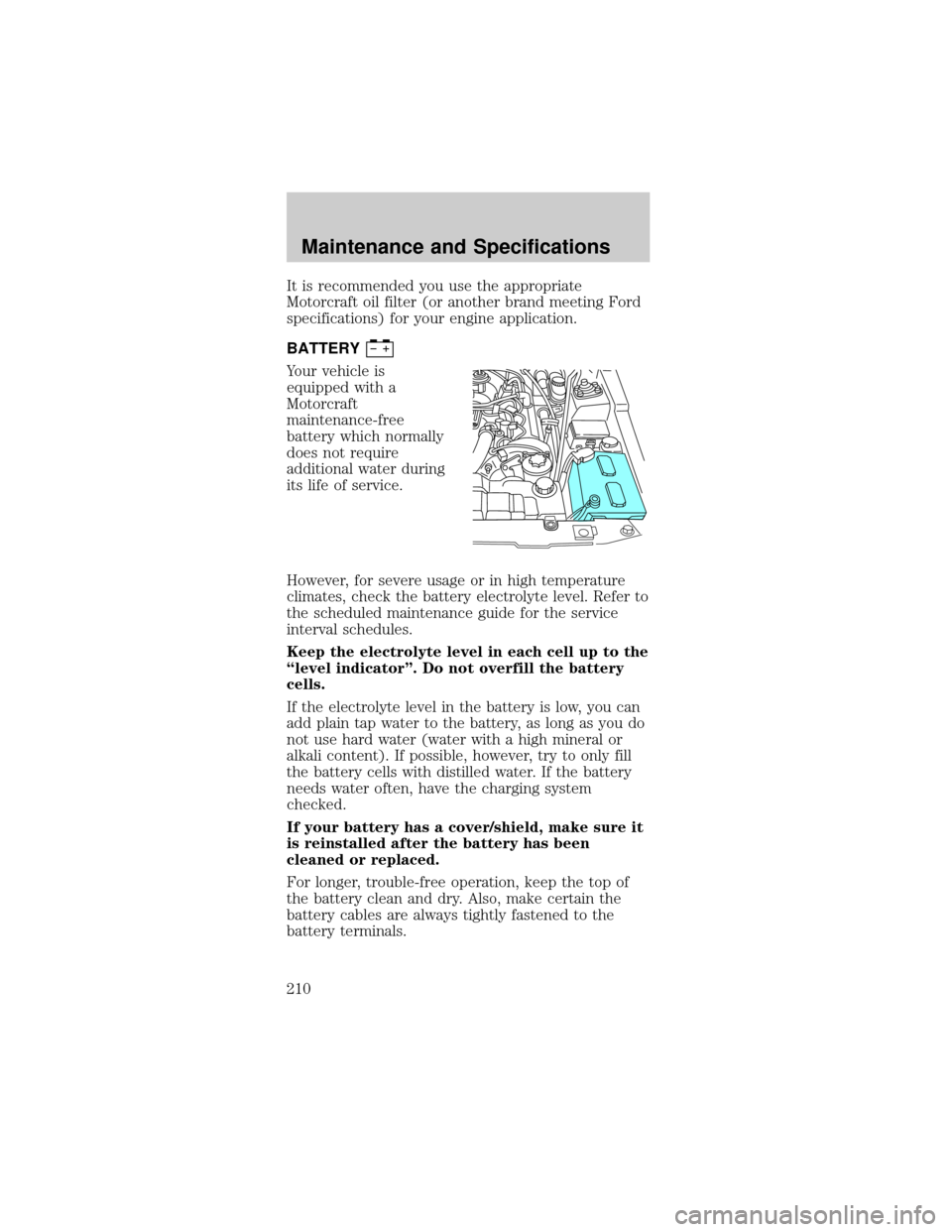
BATTERY
Your vehicle is
equipped with a
Motorcraft
maintenance-free
battery which normally
does not require
additional water during
its life of service.
However, for severe usage or in high temperature
climates, check the battery electrolyte level. Refer to
the scheduled maintenance guide for the service
interval schedules.
Keep the electrolyte level in each cell up to the
ªlevel indicatorº. Do not overfill the battery
cells.
If the electrolyte level in the battery is low, you can
add plain tap water to the battery, as long as you do
not use hard water (water with a high mineral or
alkali content). If possible, however, try to only fill
the battery cells with distilled water. If the battery
needs water often, have the charging system
checked.
If your battery has a cover/shield, make sure it
is reinstalled after the battery has been
cleaned or replaced.
For longer, trouble-free operation, keep the top of
the battery clean and dry. Also, make certain the
battery cables are always tightly fastened to the
battery terminals.
Maintenance and Specifications
210
Page 213 of 264
²Always dispose of
automotive batteries
in a responsible
manner. Follow your
local authorized
standards for
disposal. Call your
local authorized
recycling center to find out more about recycling
automotive batteries.
ENGINE COOLANT
Checking engine coolant
The concentration and level of engine coolant should
be checked at the mileage intervals in the scheduled
maintenance guide. The coolant concentration
should be maintained at 50/50 coolant and water,
which equates to a freeze point of -36É C (-34É F).
Coolant concentration testing is possible with a
hydrometer or antifreeze tester (such as the
Rotunda Battery and Antifreeze Tester, 014±R1060).
The level of coolant should be maintained at the
ªcold fullº of ªcold fill rangeº level in the coolant
reservoir. If the level falls below, add coolant per the
instructions in theAdding Engine Coolantsection.
Your vehicle was factory-filled with a 50/50 engine
coolant and water concentration. If the
concentration of coolant falls below 40% or above
60%, the engine parts could become damaged or not
work properly.A 50±50 mixture of coolant and
water provides the following:
²freeze protection down to -36É C (-34É F)
²boiling protection up to 129É C (265É F)
²protection against rust and other forms of
corrosion
²enables calibrated gages to function properly
LEAD
RETURN
RECYCLE
Maintenance and Specifications
213
Page 230 of 264
²Anticipate stopping; slowing down may eliminate
the need to stop.
²Sudden or hard accelerations may reduce fuel
economy.
²Slow down gradually.
²Driving at reasonable speeds (traveling at 88 km/h
[55 mph] uses 15% less fuel than traveling at
105 km/h [65 mph]).
²Revving the engine before turning it off may
reduce fuel economy.
²Using the air conditioner or defroster may reduce
fuel economy.
²You may want to turn off the speed control in
hilly terrain if unnecessary shifting between third
and fourth gear occurs. Unnecessary shifting of
this type could result in reduced fuel economy.
²Warming up a vehicle on cold mornings is not
required and may reduce fuel economy.
²Resting your foot on the brake pedal while driving
may reduce fuel economy.
²Combine errands and minimize stop-and-go
driving.
Maintenance
²Keep tires properly inflated and use only
recommended size.
²Operating a vehicle with the wheels out of
alignment will reduce fuel economy.
²Use recommended engine oil. Refer toLubricant
specificationsin this chapter.
²Perform all regularly scheduled maintenance
items. Follow the recommended maintenance
schedule and owner maintenance checks found in
your vehicle scheduled maintenance guide.
Maintenance and Specifications
230
Page 246 of 264
²Drive cautiously. If you hear the chains rub or
bang against your vehicle, stop and re-tighten the
chains. If this does not work, remove the chains
to prevent damage to your vehicle.
²If possible, avoid fully loading your vehicle.
²Remove the tire chains when they are no longer
needed. Do not use tire chains on dry roads.
²The suspension insulation and bumpers will help
prevent vehicle damage. Do not remove these
components from your vehicle when using snow
tires and chains.
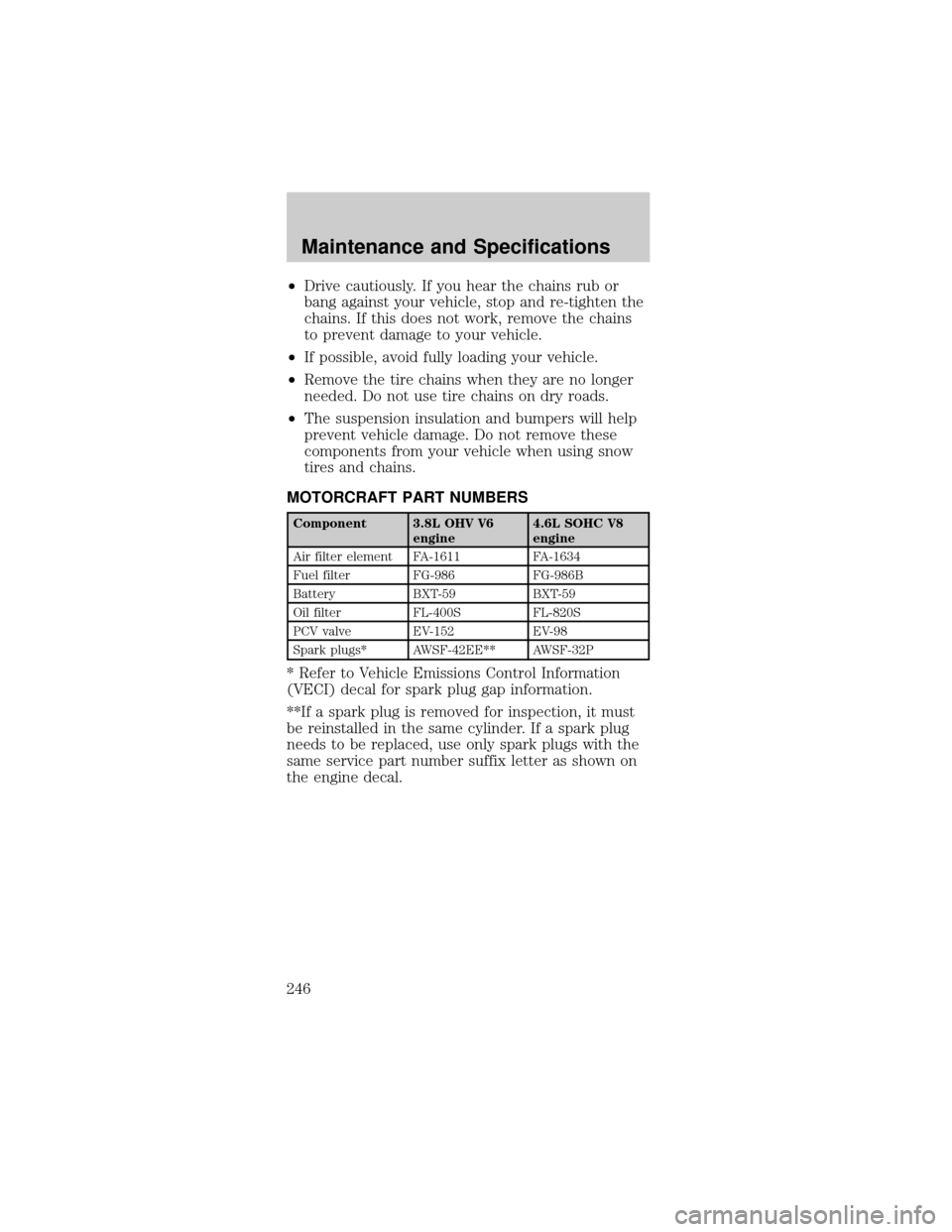
MOTORCRAFT PART NUMBERS
Component 3.8L OHV V6
engine4.6L SOHC V8
engine
Air filter element FA-1611 FA-1634
Fuel filter FG-986 FG-986B
Battery BXT-59 BXT-59
Oil filter FL-400S FL-820S
PCV valve EV-152 EV-98
Spark plugs* AWSF-42EE** AWSF-32P
* Refer to Vehicle Emissions Control Information
(VECI) decal for spark plug gap information.
**If a spark plug is removed for inspection, it must
be reinstalled in the same cylinder. If a spark plug
needs to be replaced, use only spark plugs with the
same service part number suffix letter as shown on
the engine decal.
Maintenance and Specifications
246
Page 247 of 264
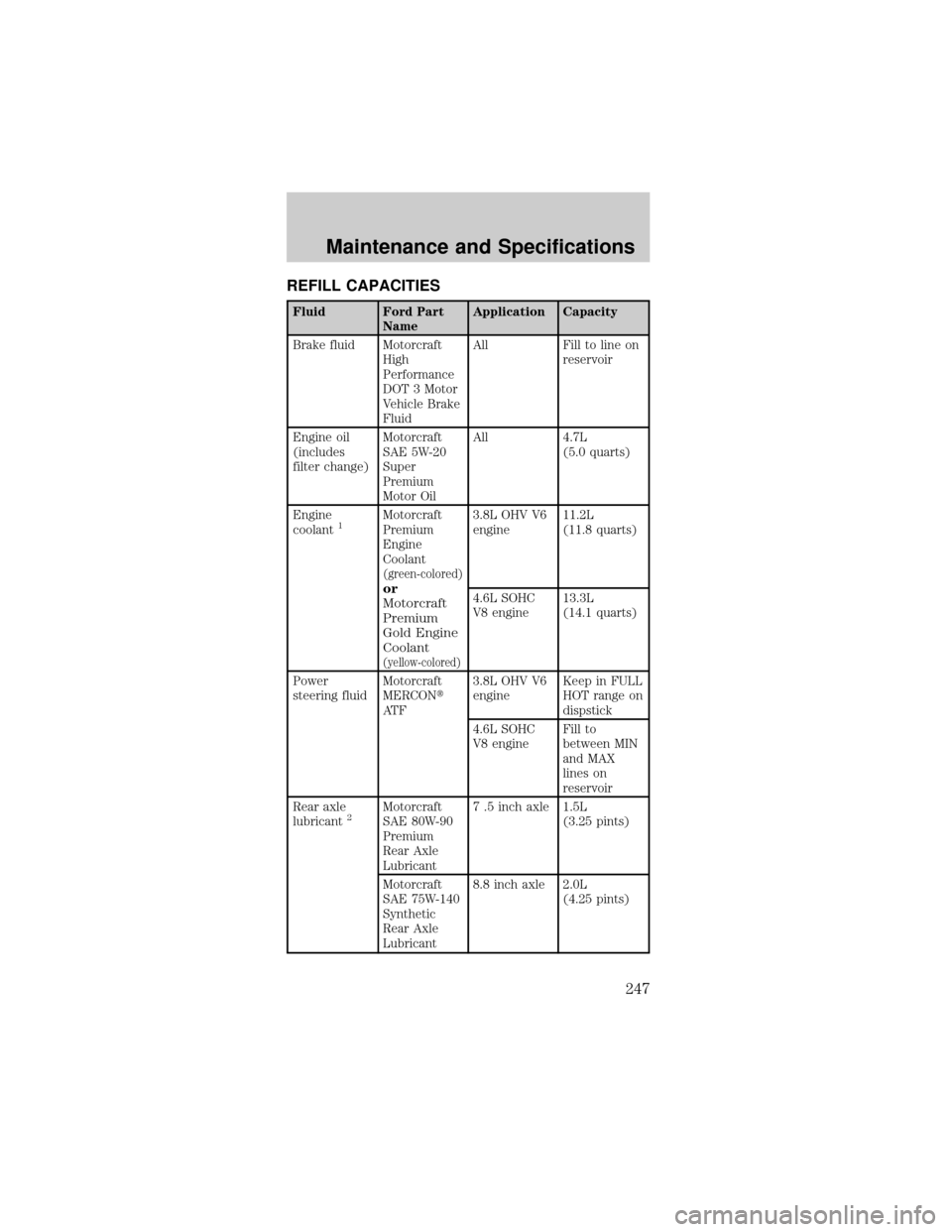
REFILL CAPACITIES
Fluid Ford Part
NameApplication Capacity
Brake fluid Motorcraft
High
Performance
DOT 3 Motor
Vehicle Brake
FluidAll Fill to line on
reservoir
Engine oil
(includes
filter change)Motorcraft
SAE 5W-20
Super
Premium
Motor OilAll 4.7L
(5.0 quarts)
Engine
coolant
1Motorcraft
Premium
Engine
Coolant
(green-colored)or
Motorcraft
Premium
Gold Engine
Coolant
(yellow-colored)
3.8L OHV V6
engine11.2L
(11.8 quarts)
4.6L SOHC
V8 engine13.3L
(14.1 quarts)
Power
steering fluidMotorcraft
MERCONt
AT F3.8L OHV V6
engineKeep in FULL
HOT range on
dispstick
4.6L SOHC
V8 engineFill to
between MIN
and MAX
lines on
reservoir
Rear axle
lubricant
2Motorcraft
SAE 80W-90
Premium
Rear Axle
Lubricant7 .5 inch axle 1.5L
(3.25 pints)
Motorcraft
SAE 75W-140
Synthetic
Rear Axle
Lubricant8.8 inch axle 2.0L
(4.25 pints)
Maintenance and Specifications
247
Page 250 of 264
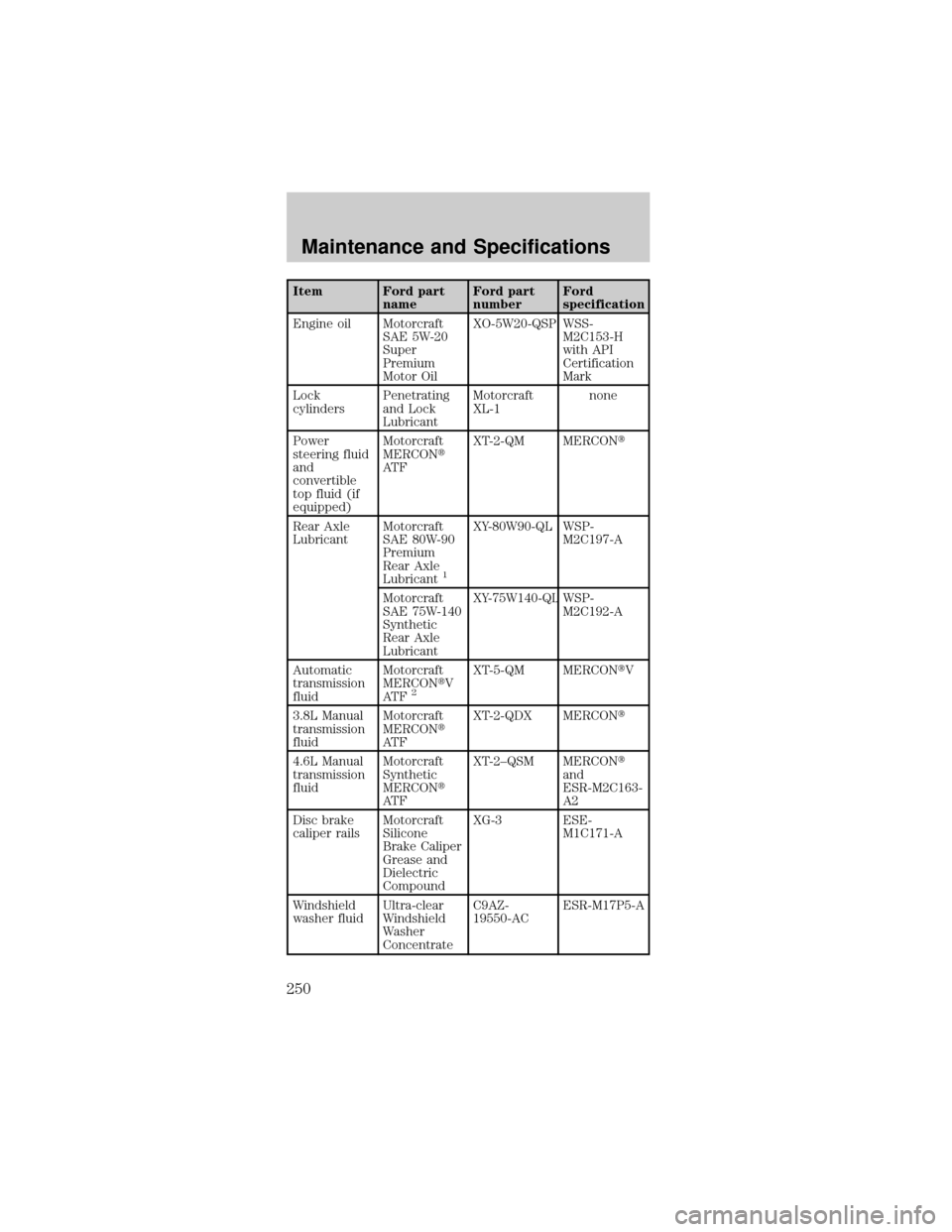
Item Ford part
nameFord part
numberFord
specification
Engine oil Motorcraft
SAE 5W-20
Super
Premium
Motor OilXO-5W20-QSP WSS-
M2C153-H
with API
Certification
Mark
Lock
cylindersPenetrating
and Lock
LubricantMotorcraft
XL-1none
Power
steering fluid
and
convertible
top fluid (if
equipped)Motorcraft
MERCONt
AT FXT-2-QM MERCONt
Rear Axle
LubricantMotorcraft
SAE 80W-90
Premium
Rear Axle
Lubricant
1
XY-80W90-QL WSP-
M2C197-A
Motorcraft
SAE 75W-140
Synthetic
Rear Axle
LubricantXY-75W140-QL WSP-
M2C192-A
Automatic
transmission
fluidMotorcraft
MERCONtV
AT F
2
XT-5-QM MERCONtV
3.8L Manual
transmission
fluidMotorcraft
MERCONt
AT FXT-2-QDX MERCONt
4.6L Manual
transmission
fluidMotorcraft
Synthetic
MERCONt
AT FXT-2±QSM MERCONt
and
ESR-M2C163-
A2
Disc brake
caliper railsMotorcraft
Silicone
Brake Caliper
Grease and
Dielectric
CompoundXG-3 ESE-
M1C171-A
Windshield
washer fluidUltra-clear
Windshield
Washer
ConcentrateC9AZ-
19550-ACESR-M17P5-A
Maintenance and Specifications
250
Page 251 of 264
1Add 118 ml (4 oz.) of Additive Friction Modifier
C8AZ-19B546-A or equivalent meeting Ford
specification EST-M2C118-A for complete refill of
Traction-Lok axles.
Ford design rear axles contain a synthetic lubricant
that does not require changing unless the axle has
been submerged in water.
2Ensure the correct automatic transmission fluid is
used. Transmission fluid requirements are indicated
on the dipstick or on the dipstick handle. MERCONt
and MERCONtV are not interchangeable. DO NOT
mix MERCONtand MERCONtV. Refer to your
scheduled maintenance guide to determine the
correct service interval.
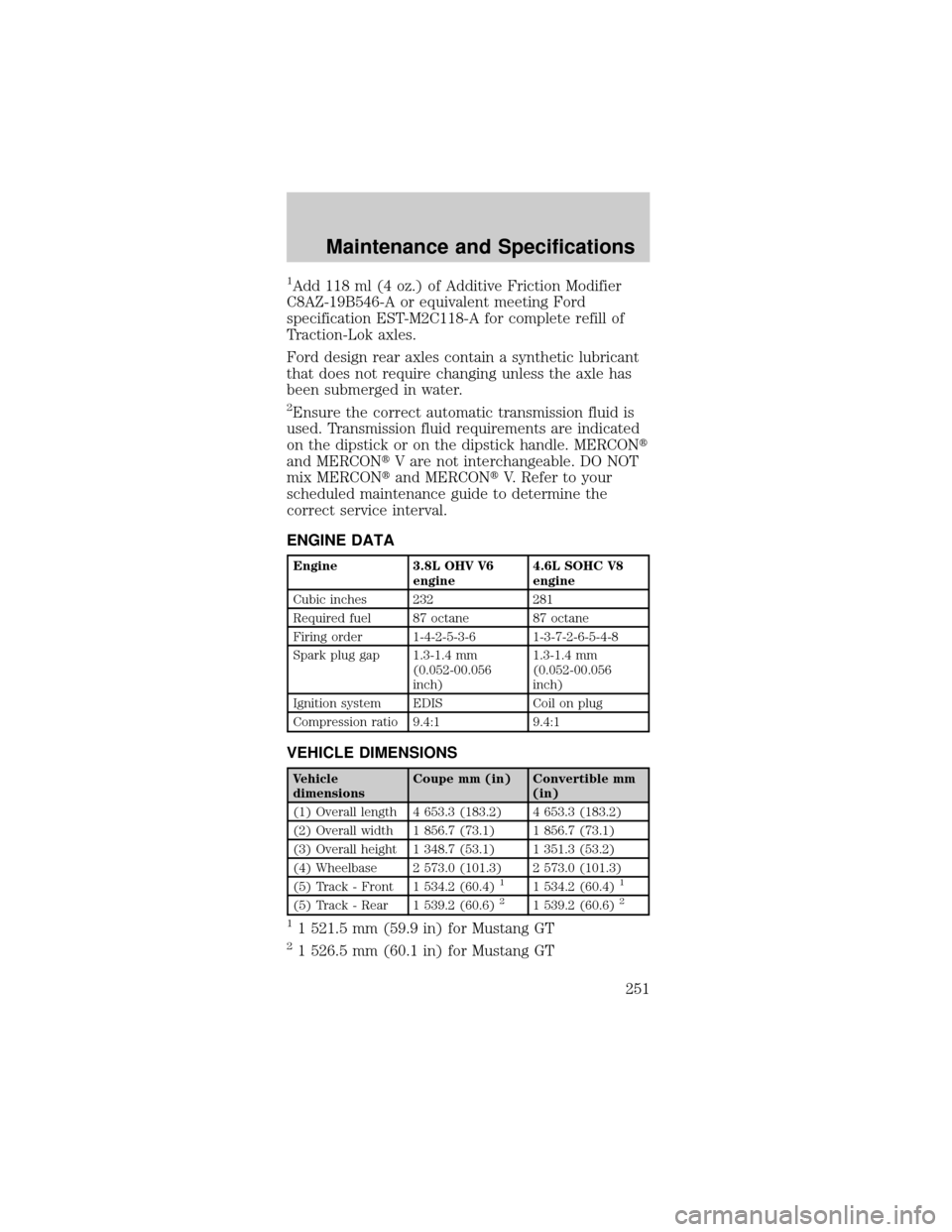
ENGINE DATA
Engine 3.8L OHV V6
engine4.6L SOHC V8
engine
Cubic inches 232 281
Required fuel 87 octane 87 octane
Firing order 1-4-2-5-3-6 1-3-7-2-6-5-4-8
Spark plug gap 1.3-1.4 mm
(0.052-00.056
inch)1.3-1.4 mm
(0.052-00.056
inch)
Ignition system EDIS Coil on plug
Compression ratio 9.4:1 9.4:1
VEHICLE DIMENSIONS
Vehicle
dimensionsCoupe mm (in) Convertible mm
(in)
(1) Overall length 4 653.3 (183.2) 4 653.3 (183.2)
(2) Overall width 1 856.7 (73.1) 1 856.7 (73.1)
(3) Overall height 1 348.7 (53.1) 1 351.3 (53.2)
(4) Wheelbase 2 573.0 (101.3) 2 573.0 (101.3)
(5) Track - Front 1 534.2 (60.4)
11 534.2 (60.4)1
(5) Track - Rear 1 539.2 (60.6)21 539.2 (60.6)2
11 521.5 mm (59.9 in) for Mustang GT
21 526.5 mm (60.1 in) for Mustang GT
Maintenance and Specifications
251
Page 260 of 264

The Dispute
Settlement Board . 183
Utilizing the
Mediation/Arbitration
Program ................. 187
D
Daytime running lamps
(see Lamps) .............. 71
Defrost
rear window ............ 70
Dipstick
automatic transmission
fluid ........................ 238
engine oil ............... 206
Doors
lubricant
specifications ........ 249
Driving under special
conditions
through water ....... 158
E
Emergencies, roadside
jump-starting ........ 174
Emission control
system ...................... 232
Engine ...................... 251
check engine/service
engine soon light .... 11
cleaning ................. 194
coolant ................... 213
idle speed control.. 210
lubrication
specifications. 249, 251
refill capacities ...... 247
service
points ............. 204±205starting after
a collision .............. 164
Engine block
heater ....................... 140
Engine oil ................ 206
checking and
adding .................... 206
dipstick .................. 206
filter,
specifications. 209, 246
recommendations... 209
refill capacities ...... 247
specifications. 249, 251
Exhaust fumes ........ 140
F
Floor mats ................. 90
Fluid capacities ....... 247
Foglamps ................... 71
Fuel .......................... 221
calculating fuel
economy ................ 227
cap ................... 13, 224
capacity ................. 247
choosing the
right fuel ................ 225
comparisons with EPA
fuel economy
estimates ............... 231
detergent in fuel ... 226
filling your vehicle
with
fuel
......... 221, 224, 227
filter,
specifications. 227, 246
fuel pump shut-off
switch .................... 164
gauge ....................... 18
improving fuel
economy ................ 227
Index
260
Page 261 of 264

low fuel warning
light .......................... 13
octane rating.. 225, 251
quality .................... 226
running out of fuel 226
safety information
relating to automotive
fuels ....................... 221
Fuses ................ 165±166
G
Gas cap
(see Fuel cap) ... 13, 224
Gas mileage (see
Fuel economy) ........ 227
Gauges ....................... 16
battery voltage
gauge ....................... 17
engine coolant
temperature gauge... 16
engine oil pressure
gauge ....................... 17
fuel gauge ................ 18
odometer ................. 18
speedometer ........... 18
tachometer .............. 19
trip odometer .......... 19
GAWR (Gross Axle
Weight Rating) ........ 158
definition ............... 158
driving with a
heavy load ............. 158
location .................. 158
GVWR (Gross Vehicle
Weight Rating) ........ 158
calculating ............. 158
definition ............... 158
driving with a
heavy load ............. 158
location .................. 158H
Hazard flashers ....... 163
Head restraints ....... 104
Headlamps ................. 71
aiming ...................... 73
bulb specifications .. 75
daytime running
lights ........................ 71
flash to pass ............ 72
high beam ......... 10, 72
replacing bulbs ....... 76
turning on and off .. 71
warning chime ........ 15
Heating
heating and air
conditioning
system ..................... 67
Hood ........................ 203
I
Ignition ............. 136, 251
removing the key .. 157
Infant seats
(see Safety seats) ... 128
Inspection/maintenance
(I/M) testing ............ 233
Instrument panel
cleaning ................. 197
cluster .............. 10, 198
lighting up panel
and interior ............. 72
J
Jack .......................... 170
positioning ............. 170
storage ................... 170
Jump-starting your
vehicle ...................... 174
Index
261