battery FORD MUSTANG 2002 4.G Owners Manual
[x] Cancel search | Manufacturer: FORD, Model Year: 2002, Model line: MUSTANG, Model: FORD MUSTANG 2002 4.GPages: 264, PDF Size: 2.56 MB
Page 3 of 264
Maintenance and Specifications 201
Hood 203
Engine compartment 204
Engine oil 206
Battery 210
Fuel information 221
Part numbers 246
Refill capacities 247
Lubricant specifications 249
Engine data 251
Vehicle dimensions 251
Accessories 254
Index 258
All rights reserved. Reproduction by any means, electronic
or mechanical including photocopying, recording or by any
information storage and retrieval system or translation in
whole or part is not permitted without written
authorization from Ford Motor Company. Ford may change
the contents without notice and without incurring
obligation.
Copyright 2001 Ford Motor Company
Table of Contents
3
Page 9 of 264
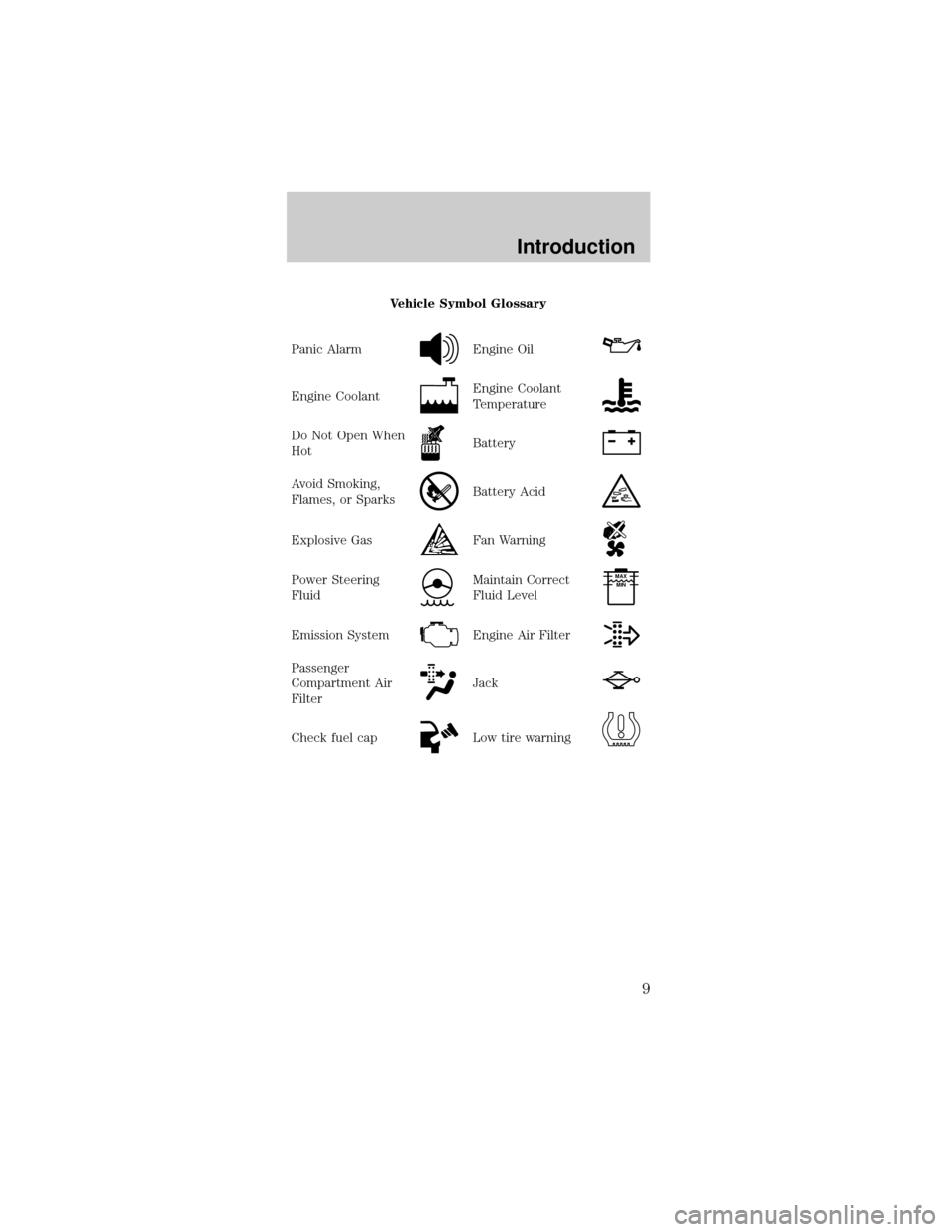
Vehicle Symbol Glossary
Panic Alarm
Engine Oil
Engine CoolantEngine Coolant
Temperature
Do Not Open When
HotBattery
Avoid Smoking,
Flames, or SparksBattery Acid
Explosive GasFan Warning
Power Steering
FluidMaintain Correct
Fluid LevelMAX
MIN
Emission SystemEngine Air Filter
Passenger
Compartment Air
FilterJack
Check fuel capLow tire warning
Introduction
9
Page 11 of 264
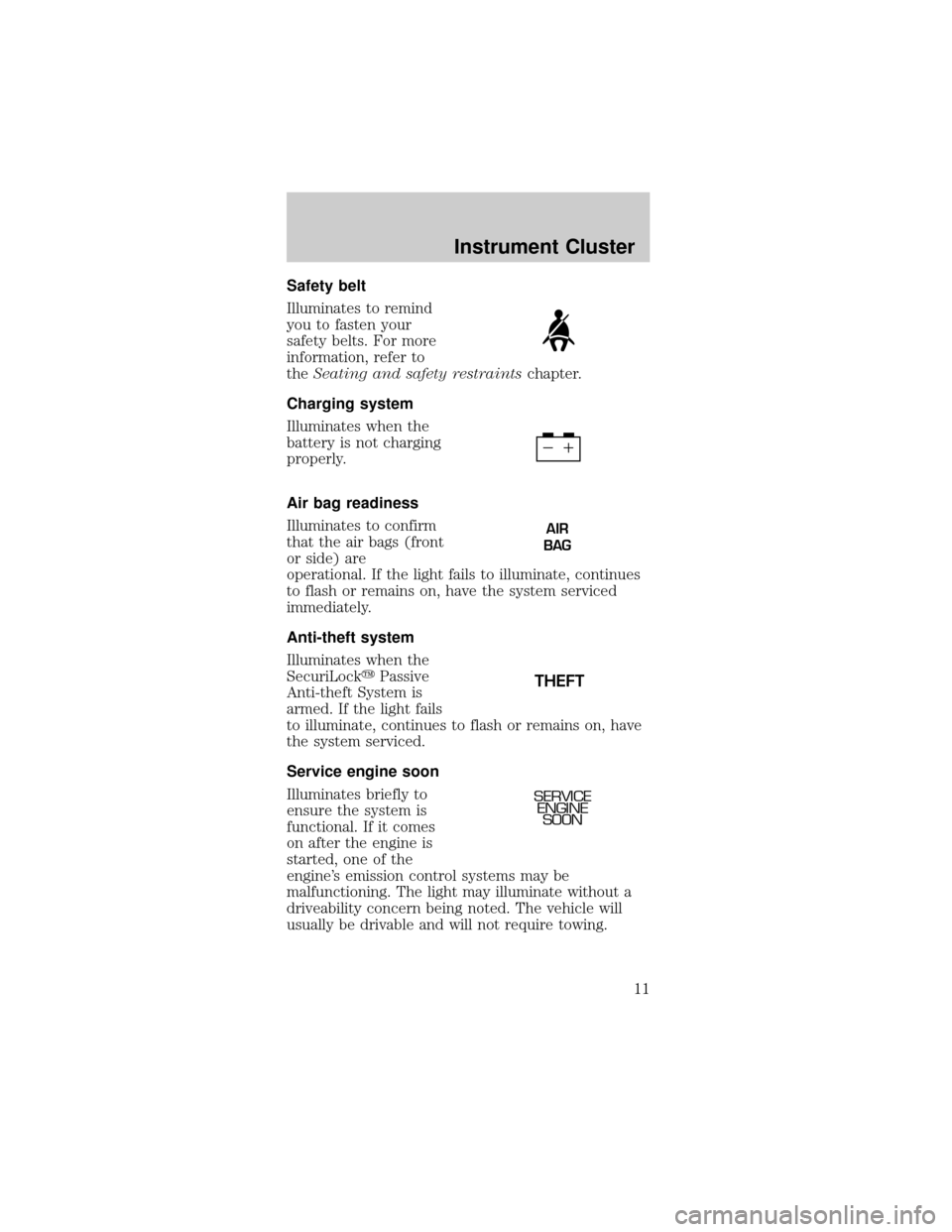
Safety belt
Illuminates to remind
you to fasten your
safety belts. For more
information, refer to
theSeating and safety restraintschapter.
Charging system
Illuminates when the
battery is not charging
properly.
Air bag readiness
Illuminates to confirm
that the air bags (front
or side) are
operational. If the light fails to illuminate, continues
to flash or remains on, have the system serviced
immediately.
Anti-theft system
Illuminates when the
SecuriLockyPassive
Anti-theft System is
armed. If the light fails
to illuminate, continues to flash or remains on, have
the system serviced.
Service engine soon
Illuminates briefly to
ensure the system is
functional. If it comes
on after the engine is
started, one of the
engine's emission control systems may be
malfunctioning. The light may illuminate without a
driveability concern being noted. The vehicle will
usually be drivable and will not require towing.
AIR
BAG
THEFT
SERVICE
ENGINE
SOON
Instrument Cluster
11
Page 17 of 264
Never remove the coolant reservoir cap
while the engine is running or hot. Steam
and scalding liquid from a hot cooling system can
burn you badly.
This gauge indicates the temperature of the engine
coolant, not the coolant level. If the coolant is not at
its proper level the gauge indication will not be
accurate.
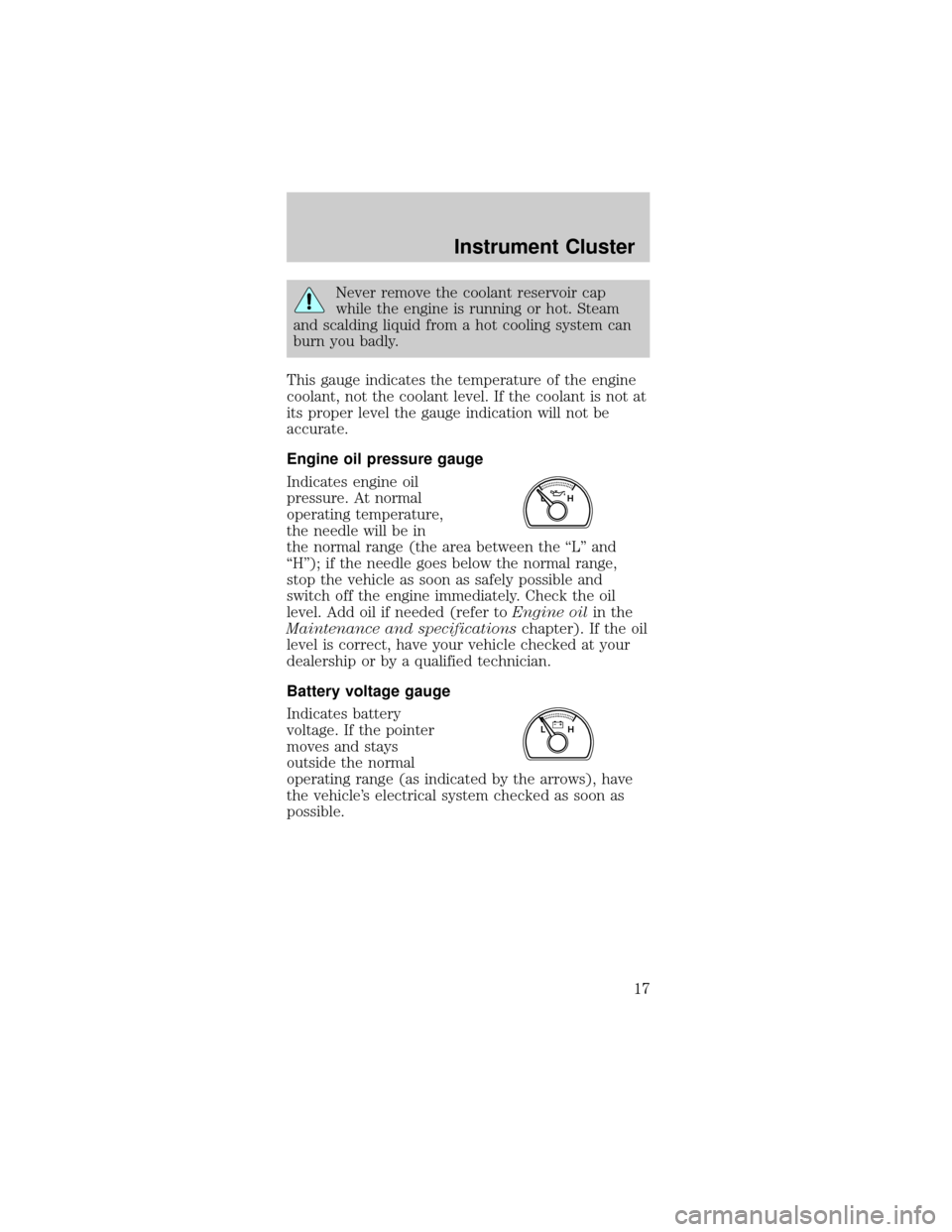
Engine oil pressure gauge
Indicates engine oil
pressure. At normal
operating temperature,
the needle will be in
the normal range (the area between the ªLº and
ªHº); if the needle goes below the normal range,
stop the vehicle as soon as safely possible and
switch off the engine immediately. Check the oil
level. Add oil if needed (refer toEngine oilin the
Maintenance and specificationschapter). If the oil
level is correct, have your vehicle checked at your
dealership or by a qualified technician.
Battery voltage gauge
Indicates battery
voltage. If the pointer
moves and stays
outside the normal
operating range (as indicated by the arrows), have
the vehicle's electrical system checked as soon as
possible.
LH
LH
Instrument Cluster
17
Page 99 of 264
Replacement of the battery willnotcause the
remote transmitter to become deprogrammed from
your vehicle. The remote transmitter should operate
normally after battery replacement.
Replacing lost transmitters
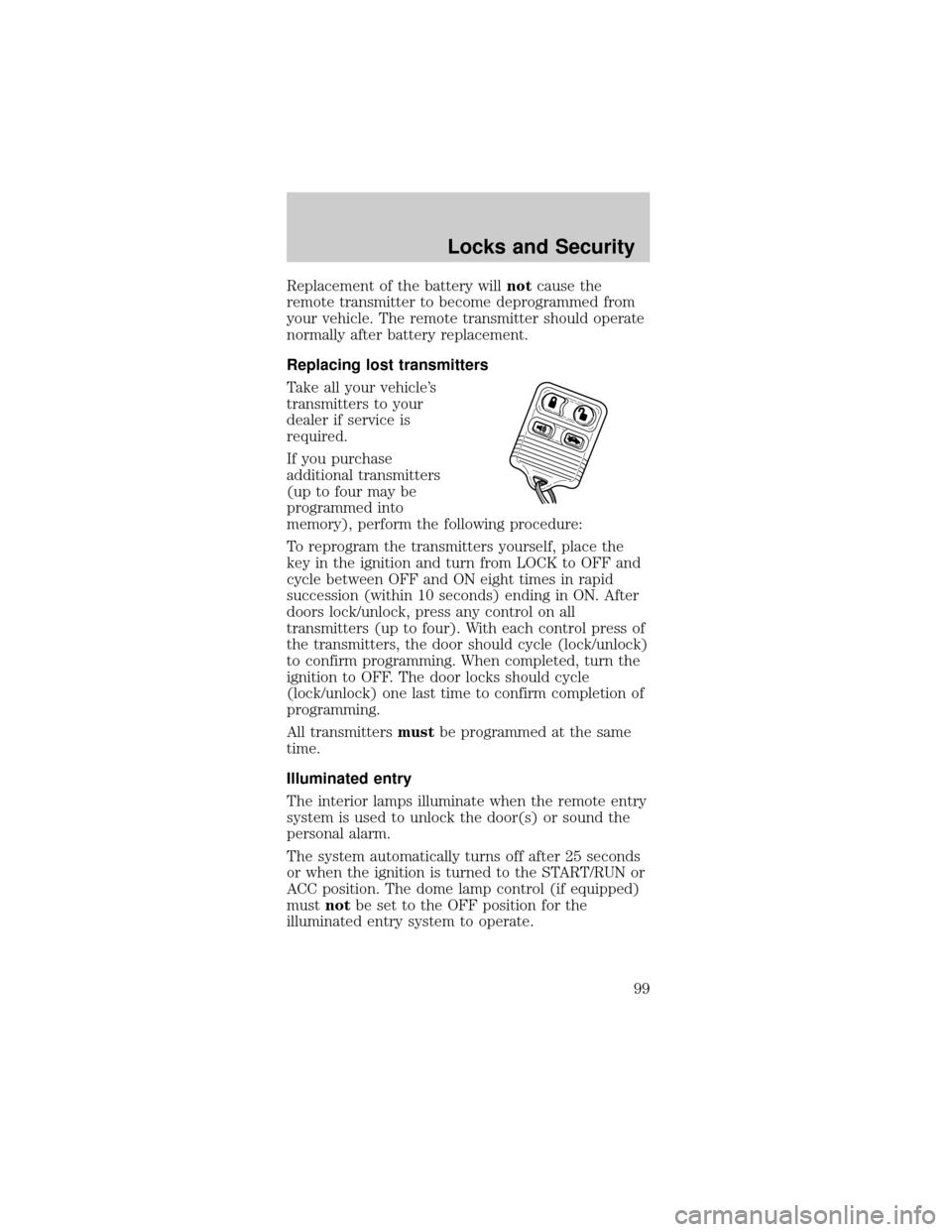
Take all your vehicle's
transmitters to your
dealer if service is
required.
If you purchase
additional transmitters
(up to four may be
programmed into
memory), perform the following procedure:
To reprogram the transmitters yourself, place the
key in the ignition and turn from LOCK to OFF and
cycle between OFF and ON eight times in rapid
succession (within 10 seconds) ending in ON. After
doors lock/unlock, press any control on all
transmitters (up to four). With each control press of
the transmitters, the door should cycle (lock/unlock)
to confirm programming. When completed, turn the
ignition to OFF. The door locks should cycle
(lock/unlock) one last time to confirm completion of
programming.
All transmittersmustbe programmed at the same
time.
Illuminated entry
The interior lamps illuminate when the remote entry
system is used to unlock the door(s) or sound the
personal alarm.
The system automatically turns off after 25 seconds
or when the ignition is turned to the START/RUN or
ACC position. The dome lamp control (if equipped)
mustnotbe set to the OFF position for the
illuminated entry system to operate.
Locks and Security
99
Page 100 of 264
The inside lights will not turn off if:
²they have been turned on with the dimmer
control or
²any door is open
The battery saver will shut off the interior lamps 30
minutes after the ignition has been turned to the
OFF position, 10 minutes after if the door is left
open, and 30 minutes after if the trunk is left open
or the dome lamp switch is left on.
SECURILOCKYPASSIVE ANTI-THEFT SYSTEM
SecuriLockypassive anti-theft system is an engine
immobilization system. This system prevents the
engine from being started unless acoded key
programmed to your vehicleis used.
The SecuriLockypassive anti-theft system is not
compatible with non-Ford aftermarket remote start
systems. Use of these systems may result in vehicle
starting problems and a loss of security protection.
Automatic arming
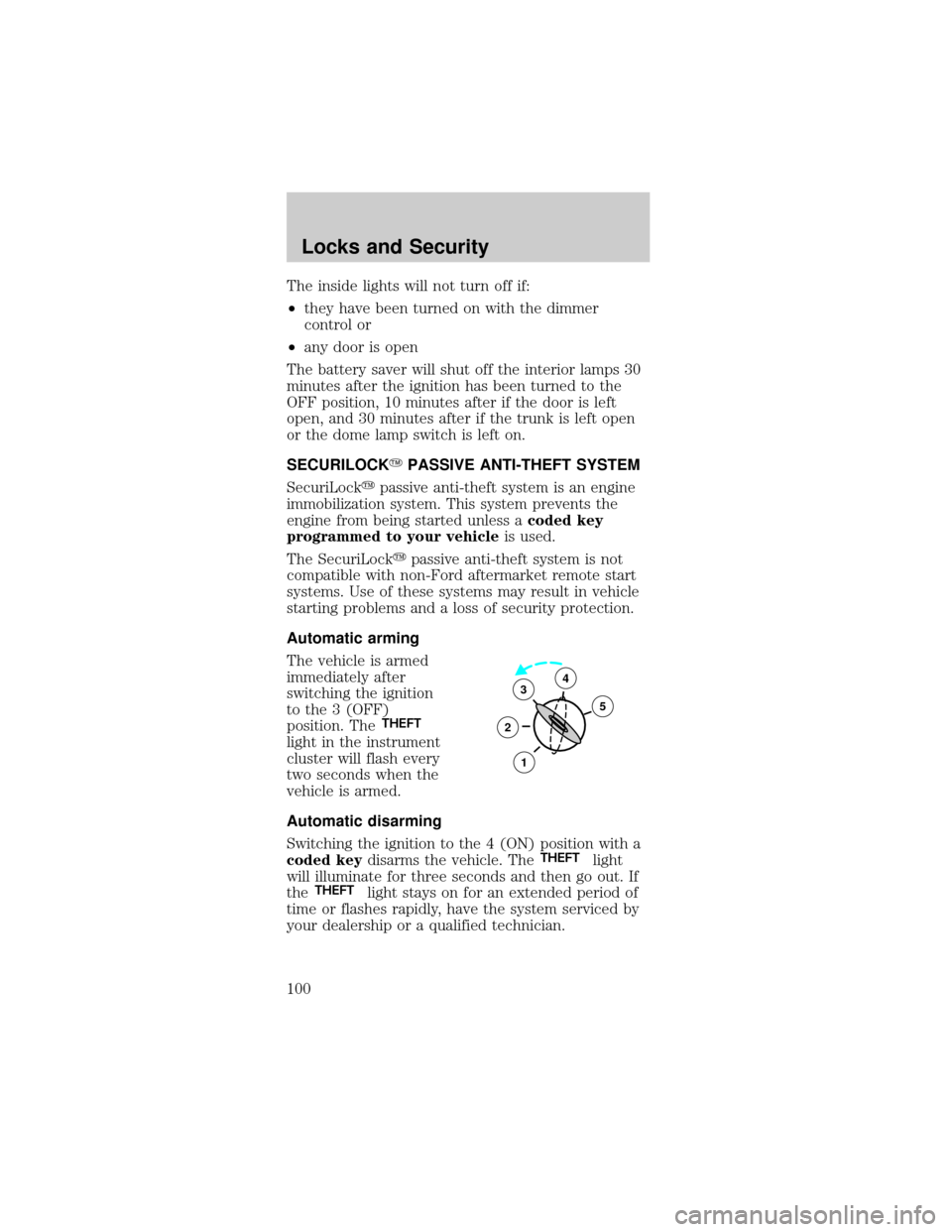
The vehicle is armed
immediately after
switching the ignition
to the 3 (OFF)
position. The
THEFT
light in the instrument
cluster will flash every
two seconds when the
vehicle is armed.
Automatic disarming
Switching the ignition to the 4 (ON) position with a
coded keydisarms the vehicle. The
THEFTlight
will illuminate for three seconds and then go out. If
the
THEFTlight stays on for an extended period of
time or flashes rapidly, have the system serviced by
your dealership or a qualified technician.
3
2
1
5
4
Locks and Security
100
Page 168 of 264
Fuse/Relay
LocationFuse Amp
RatingPassenger Compartment
Fuse Panel Description
35 15A Shift lock actuator, PCM,
Speed control servo, ABS
module
36 15A Airbag control module
37 5A Adjustable illumination
38 20A High beams
39 5A GEM
40 Ð Not used
41 15A Brake lamp
42 Ð Not used
43 20A CB Power windows
44 Ð Not used
Power distribution box
The power distribution box is located in the engine
compartment. The power distribution box contains
high-current fuses that protect your vehicle's main
electrical systems from overloads.
Always disconnect the battery before
servicing high current fuses.
Always replace the cover to the power
distribution box before reconnecting the
battery or refilling fluid reservoirs
If the battery has been disconnected and
reconnected, refer to theBatterysection of the
Maintenance and specificationschapter.
Roadside Emergencies
168
Page 174 of 264
Anti-theft lug nuts (if equipped)
If your vehicle is equipped with this feature, one of
the lug nuts on each wheel must be removed and
replaced with a special key. The key and registration
card are attached to the lug wrench and stored with
the spare tire. If you lose the key, send the
registration card to the manufacturer (not the
dealer) to get a replacement key. If the lug
wrench/lug nut key assembly is lost, see your
nearest Ford or Lincoln Mercury dealer who has
access to the master set of keys.Do not use an
impact wrench with the anti-theft key.
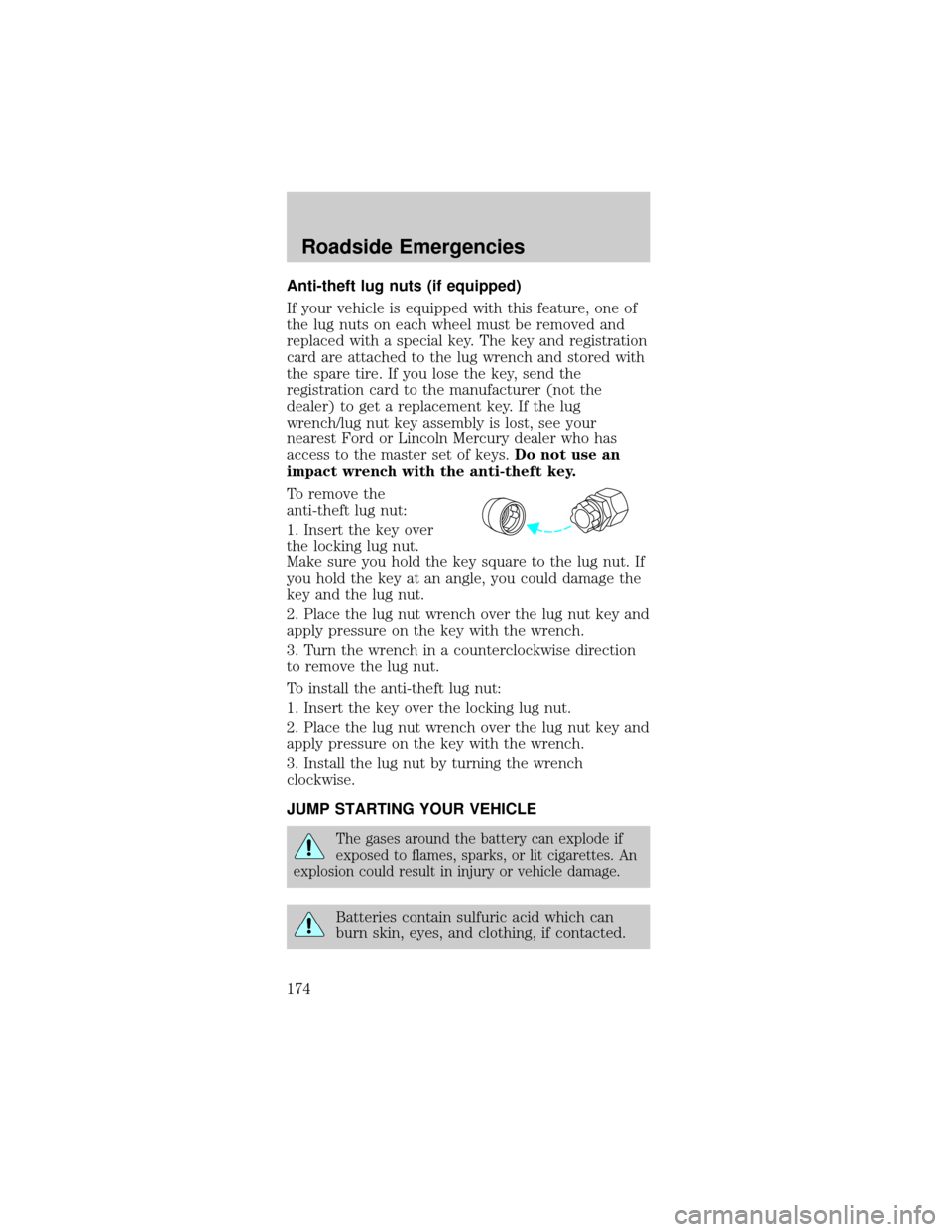
To remove the
anti-theft lug nut:
1. Insert the key over
the locking lug nut.
Make sure you hold the key square to the lug nut. If
you hold the key at an angle, you could damage the
key and the lug nut.
2. Place the lug nut wrench over the lug nut key and
apply pressure on the key with the wrench.
3. Turn the wrench in a counterclockwise direction
to remove the lug nut.
To install the anti-theft lug nut:
1. Insert the key over the locking lug nut.
2. Place the lug nut wrench over the lug nut key and
apply pressure on the key with the wrench.
3. Install the lug nut by turning the wrench
clockwise.
JUMP STARTING YOUR VEHICLE
The gases around the battery can explode if
exposed to flames, sparks, or lit cigarettes. An
explosion could result in injury or vehicle damage.
Batteries contain sulfuric acid which can
burn skin, eyes, and clothing, if contacted.
Roadside Emergencies
174
Page 175 of 264
Do not attempt to push-start your vehicle.
Automatic transmissions do not have
push-start capability; also, the catalytic
conveter may become damaged.
Preparing your vehicle
When the battery is disconnected or a new battery is
installed, the transmission must relearn its adaptive
strategy. As a result of this, the transmission may
shift firmly. This operation is considered normal and
will not effect function or durability of the
transmission. Over time, the adaptive learning
process will fully update transmission operation to
its optimum shift feel.
1.
Use only a 12±volt supply to start your vehicle.
2.Do not disconnect the battery of the disabled vehicle
as this could damage the vehicle's electrical system.
3.Park the booster vehicle close to the hood of the
disabled vehicle making sure the two vehiclesdo not
touch. Set the parking brake on both vehicles and stay
clear of the engine cooling fan and other moving parts.
4. Check all battery terminals and remove any
excessive corrosion before you attach the battery
cables. Ensure the vent caps are tight and level.
5. Turn the heater fan on in both vehicles to protect
any electrical surges. Turn all other accessories off.
Connecting the jumper cables
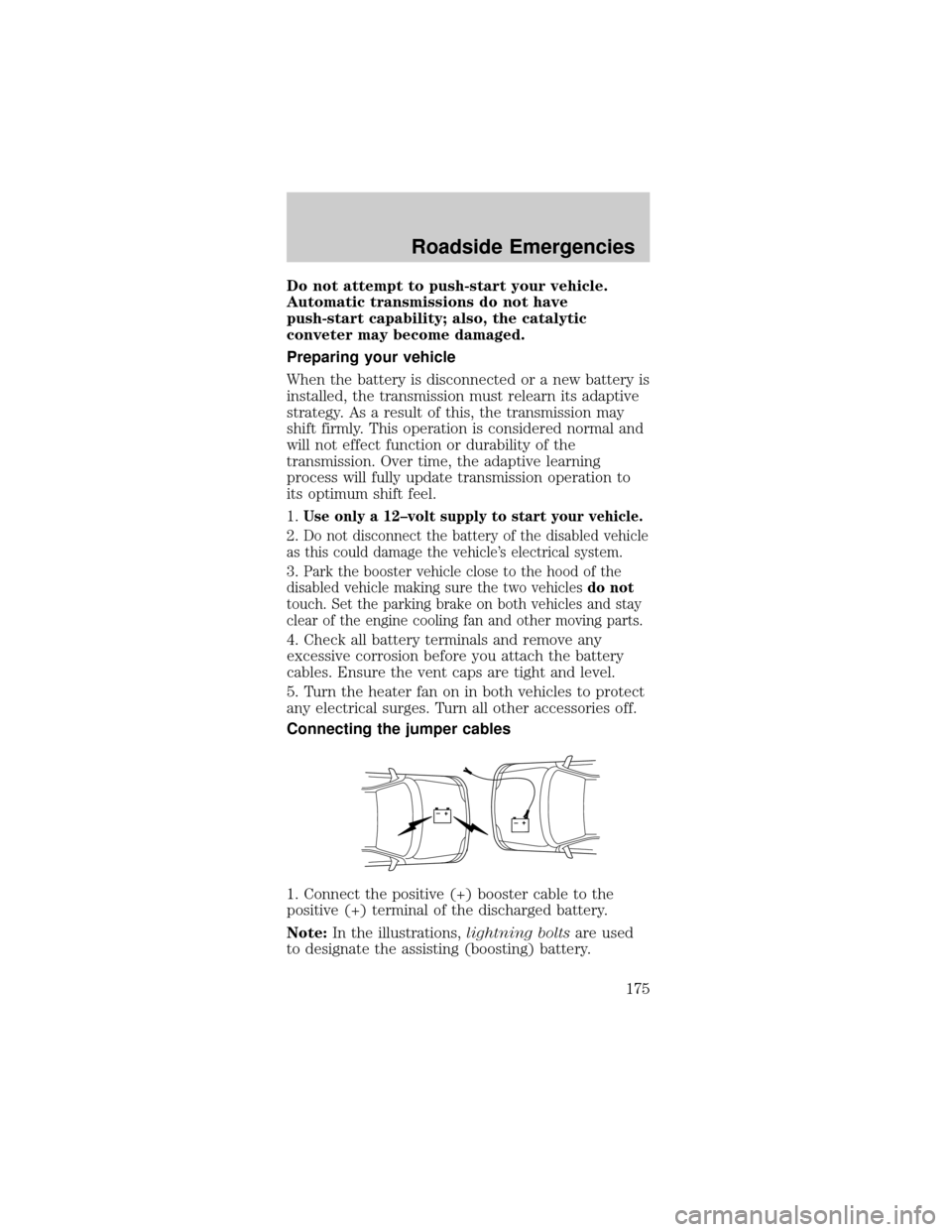
1. Connect the positive (+) booster cable to the
positive (+) terminal of the discharged battery.
Note:In the illustrations,lightning boltsare used
to designate the assisting (boosting) battery.
+–+–
Roadside Emergencies
175
Page 176 of 264
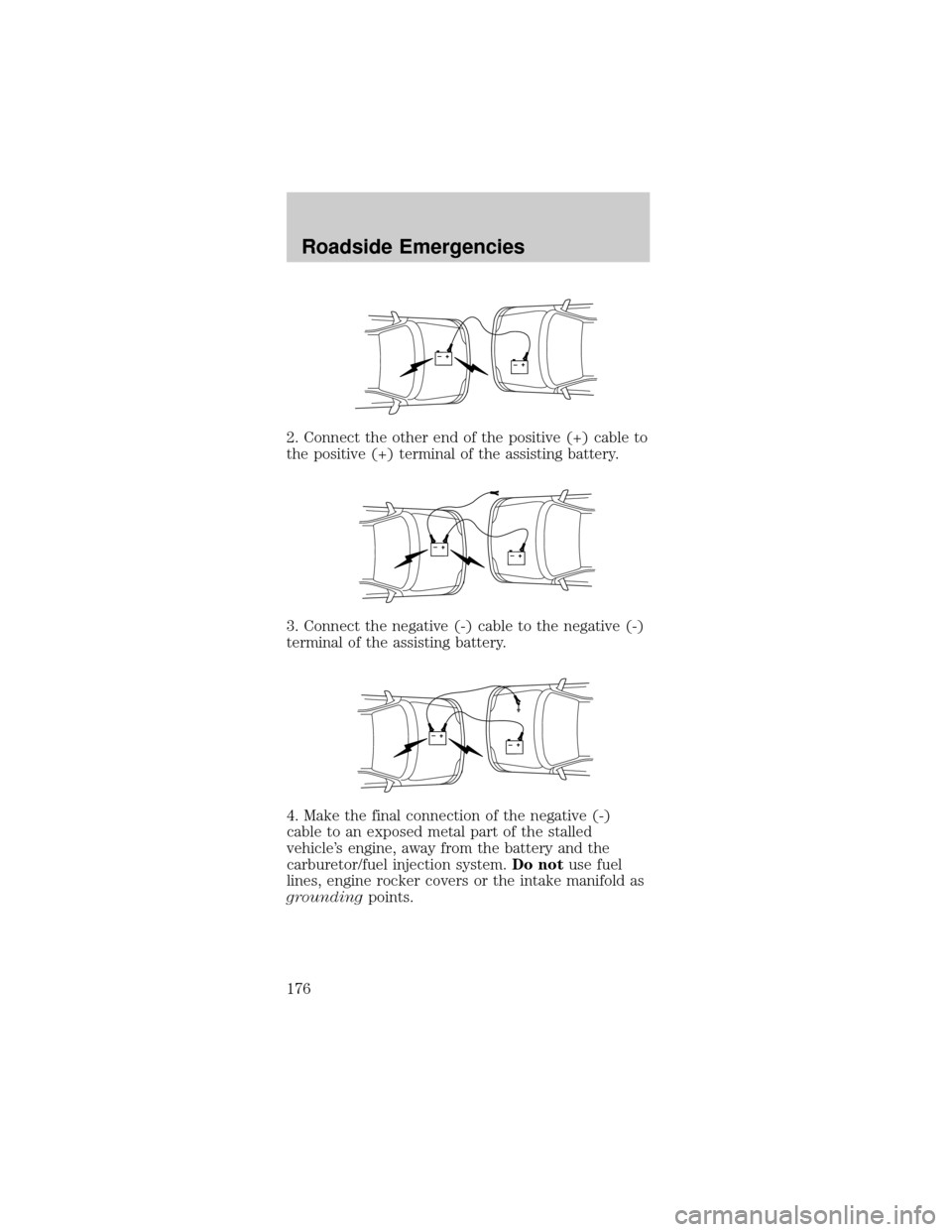
2. Connect the other end of the positive (+) cable to
the positive (+) terminal of the assisting battery.
3. Connect the negative (-) cable to the negative (-)
terminal of the assisting battery.
4. Make the final connection of the negative (-)
cable to an exposed metal part of the stalled
vehicle's engine, away from the battery and the
carburetor/fuel injection system.Do notuse fuel
lines, engine rocker covers or the intake manifold as
groundingpoints.
+–+–
+–+–
+–+–
Roadside Emergencies
176